The length of a rectangular field is 25 meters 7 decimeters 5 centimeters, and its breadth is 18 meters 4 decimeters 6 centimeters.
If a square path of uniform width 35 cm is constructed inside the rectangle along its boundary, find the area of the path.
- A28.64 m²
- B29.82 m²
- C30.46 m²
- D31.75 m²
- E32.50 m²
Show answerHide answer
Answer: C ✓ official key
Approach: Inner path area = outer rectangle − inner rectangle (each side reduced by 2w).
Solution:
L = 25 m 7 dm 5 cm = 25.75 m; B = 18 m 4 dm 6 cm = 18.46 m; w = 0.35 m.
Inner rectangle = (25.75 − 0.70) × (18.46 − 0.70) = 25.05 × 17.76 = 444.888 m².
Outer = 25.75 × 18.46 = 475.345 m².
Path area = 475.345 − 444.888 = 30.457 ≈ 30.46 m².
Cetking shortcut: Inner path area = 2w(L + B) − 4w² = 0.7 × 44.21 − 0.49 = 30.947 − 0.49 = 30.46 m².
Answer: C
A cylinder is surmounted by a cone at one end and a hemisphere at the other end. The common radius is 3.5 cm, the height of the cylinder is 6.5 cm, and the total height of the structure is 12.8 cm.
The volume V of the structure lies between:
- A370 cm³ to 380 cm³
- B380 cm³ to 390 cm³
- C390 cm³ to 400 cm³
- D420 cm³ to 440 cm³
- E480 cm³ to 520 cm³
Show answerHide answer
Answer: A ✓ official key
Approach: Composite solid: cone + cylinder + hemisphere with common radius.
Solution:
r = 3.5 cm; hemisphere height = r = 3.5 cm.
Cone height = 12.8 − 6.5 − 3.5 = 2.8 cm.
πr² = 22/7 × 12.25 = 38.5.
Cylinder = 38.5 × 6.5 = 250.25; Cone = 1/3 × 38.5 × 2.8 = 35.93.
Hemisphere = 2/3 × 38.5 × 3.5 = 89.83.
V = 250.25 + 35.93 + 89.83 ≈ 376.0 cm³ → between 370 and 380.
Cetking shortcut: V = πr²(h_cyl + h_cone/3 + 2r/3) = 38.5 × (6.5 + 0.933 + 2.333) = 38.5 × 9.77 ≈ 376.
Answer: A
A solid lead sphere of radius 8 cm is melted and recast into two types of smaller spherical balls:
- 40% of the molten lead is used to make balls of radius 1 cm.
- The remaining 60% is used to make balls of radius 2 cm.
During recasting, 10% of the total lead is wasted.
How many balls of radius 1 cm can be made?
- A184
- B192
- C204
- D216
- E256
Show answerHide answer
Answer: A ✓ official key
Approach: Volume conservation: number of balls = usable volume ÷ volume of one ball.
Solution:
Sphere volume ∝ r³: big sphere = 8³ = 512 units (unit = 4/3·π).
Lead for 1 cm balls = 40% of 512 = 204.8 units.
10% wastage applies → usable = 90% of 204.8 = 184.32 units.
Each 1 cm ball = 1³ = 1 unit → 184 balls (whole balls only).
Why the other options are wrong:
C (204) ignores the 10% wastage; B, D, E use wrong shares of the lead.
Cetking shortcut: Work in r³ units — 4/3 π cancels everywhere.
Answer: A
Three solid cubes of sides 3 cm, 4 cm, and 5 cm are melted to form a new solid cube. The side of the new cube is:
- A6 cm
- B8 cm
- C9 cm
- D12 cm
- E7 cm
Show answerHide answer
Answer: A ✓ official key
Approach: Melting conserves volume.
Solution:
Total volume = 3³ + 4³ + 5³ = 27 + 64 + 125 = 216 cm³.
New side = ∛216 = 6 cm.
Why the other options are wrong:
B, C, D, E – add sides (12) or cube-roots incorrectly.
Cetking shortcut: Remember 3³ + 4³ + 5³ = 6³.
Answer: A
The volume V of a pyramid varies jointly as its height h and the area of its base .A pyramid has a base area of 48 dm² and a height of 150 cm, giving a volume of 240 dm³.Find the area of the base (in cm²) of another pyramid whose volume is 420 dm³ and whose height is 180 cm.
- A4200 cm²
- B7000 cm²
- C7200 cm²
- D8400 cm²
- E5600 cm²
Show answerHide answer
Answer: B ✓ official key
Approach: Joint variation: V = kAh. Keep all units in dm.
Solution:
150 cm = 15 dm, 180 cm = 18 dm.
240 = k × 48 × 15 → k = 240/720 = 1/3.
420 = (1/3) × A × 18 → A = 420/6 = 70 dm².
70 dm² = 70 × 100 cm² = 7000 cm².
Cetking shortcut: A₂ = A₁ × (V₂/V₁) × (h₁/h₂) = 48 × 7/4 × 5/6 = 70 dm²; 1 dm² = 100 cm².
Answer: B
A tank measures 99 cm × 120 cm × 80 cm. It is to be filled using a cylindrical bucket of radius 12 cm and height 20 cm. If the bucket is filled up to 75% of its height each time, what is the minimum number of times the bucket must be used to completely fill the tank?
- A120
- B130
- C140
- D135
- E145
Show answerHide answer
Answer: C ✓ official key
Approach: Number of fills = tank volume / volume carried per fill (π = 22/7).
Solution:
Tank = 99 × 120 × 80 = 9,50,400 cm³.
Water per fill = π × 12² × (75% of 20 = 15) = (22/7) × 144 × 15 = 47520/7 cm³.
Fills = 950400 × 7 / 47520 = 140.
Cetking shortcut: 99 = 9 × 11 and 7 pairs with 22/7 — the numbers are built to cancel; 950400 ÷ 6788.57 = 140 exactly with π = 22/7.
Answer: C
The diameters of two cones are equal. If their slant heights be in the ratio 5:7, find the ratio of their curved surface areas.
- A25 : 7
- B25 : 49
- C5 : 49
- D5 : 7
- E7 : 12
Show answerHide answer
Answer: D ✓ official key
Approach: Curved surface area of a cone = πrl.
Solution:
Equal diameters → equal r.
CSA₁ : CSA₂ = πrl₁ : πrl₂ = l₁ : l₂ = 5 : 7.
Why the other options are wrong:
- B: squares the ratio (that would be for similar figures' areas).
- A, C, E: no basis.
Answer: D
DIRECTION for the question: Solve the following question and mark the best possible option.
A rectangular parking space is marked out by painting three of its sides. If the length of the unpainted side is 9 feet, and the sum of the lengths of the painted sides is 37 feet, then what is the area of the parking space in square feet?
- A46
- B81
- C126
- D252
- E37
Show answerHide answer
Answer: C ✓ official key
Approach: Identify which sides are painted.
Solution: Unpainted side = 9 ft, so the opposite side (9 ft) is painted along with the two other sides.
9 + 2b = 37 ⇒ b = 14 ft.
Area = 9 × 14 = 126 sq ft.
Why the other options are wrong:
D (252): (37 − 9) × 9, treating 28 as one side.
B (81): 9 × 9 square.
A, E: perimeter-type numbers, not area.
Answer: C
DIRECTION for the question: Solve the following question and mark the best possible option.
A rectangular field is to be fenced on three sides, leaving a side of 20 feet uncovered. If the area of the field is 680 sq. feet, how many feet of fencing will be required?
- A34
- B40
- C68
- D88
- E38
Show answerHide answer
Answer: D ✓ official key
Approach: Find the other side from the area.
Solution: Other side = 680 ÷ 20 = 34 ft.
Fence = 20 + 34 + 34 = 88 ft.
Why the other options are wrong:
C (68): only the two 34-ft sides.
A (34): one side only.
B, E: arithmetic slips.
Answer: D
DIRECTION for the question: Solve the following question and mark the best possible option.
A rectangular carpet has an area of 120 sq. meters and a perimeter of 46 meters. The length of its diagonal is?
- A15 meters
- B16 meters
- C17 meters
- D19 meters
- E20 meters
Show answerHide answer
Answer: C ✓ official key
Approach: Use (l + b)² − 2lb.
Solution: Perimeter 46 ⇒ l + b = 23. Area lb = 120.
d² = 23² − 2 × 120 = 529 − 240 = 289 ⇒ d = 17 m.
(Sides are 15 and 8: 15 × 8 = 120, 2(15 + 8) = 46.)
Why the other options are wrong:
A (15): that is the length.
B, D, E: not √289.
Cetking shortcut: 8-15-17 is a Pythagorean triplet — spot 15 × 8 = 120 instantly.
Answer: C
A wooden toy is in the form of a cone surmounted on a hemisphere. The diameter of the base of the cone is 6 cm and its height is 4 cm. Find the cost of painting the toy at the rate of ₹5 per 1000 cm².
- A₹0.52
- B₹0.83
- C₹0.43
- D₹0.29
- E₹0.37
Show answerHide answer
Answer: A ✓ official key
Approach: Painted surface = curved surface of cone + curved surface of hemisphere (shared base not painted).
Solution:
r = 6/2 = 3 cm, cone height h = 4 cm → slant l = √(3² + 4²) = 5 cm
Cone CSA = πrl = π × 3 × 5 = 15π
Hemisphere CSA = 2πr² = 2π × 9 = 18π
Total = 33π = 33 × 3.1416 ≈ 103.67 cm²
Cost = 103.67 × 5/1000 = ₹0.518 ≈ ₹0.52
Cetking shortcut: 33π ≈ 103.7 cm²; ₹5 per 1000 cm² = ₹0.005 per cm² → ≈ ₹0.52.
Answer: A
A triangular pennant has a base of 10 cm and a height of 8 cm. The same amount of cloth is used to make a rectangular banner whose length is 5 cm. Find the breadth of the rectangle.
- A10 cm
- B8 cm
- C12 cm
- D6 cm
- E14 cm
Show answerHide answer
Answer: B ✓ official key
Approach: Equal cloth → equal area: ½ × base × height = length × breadth.
Solution:
Triangle area = ½ × 10 × 8 = 40 cm²
Rectangle: 5 × b = 40 → b = 8 cm
Answer: B
A cylindrical tank has a diameter of 10 m and a height of 6 m. Find the volume of water it can hold.
- A481.73 m³
- B351.49 m³
- C471.24 m³
- D341.74 m³
- E321.63 m³
Show answerHide answer
Answer: C ✓ official key
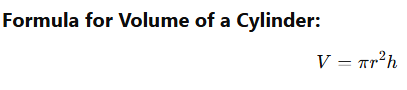
Approach: Volume of cylinder = πr²h.
Solution:
r = 10/2 = 5 m, h = 6 m
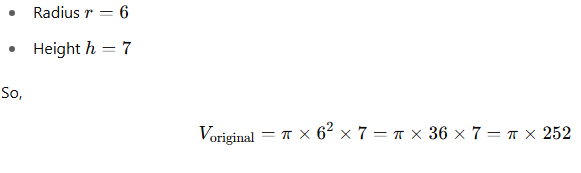
V = π × 25 × 6 = 150π = 150 × 3.1416 = 471.24 m³
Cetking shortcut: 150π: 150 × 3.14 = 471 → only 471.24 matches.
Answer: C
The outer rolling surface of eight similar small rollers having a radius of 9 cm and length as 12 cm are to be painted at a rate of Rs 15 /cm.what will be the total cost of painting ( in Rs) ?
- A80788.7
- B80488.7
- C81280.5
- D81388.8
- E82487.2
Show answerHide answer
Answer: D
Approach: Curved surface area of a cylinder = 2πrh; cost = area × rate (π = 3.14, which the options are built on).
Solution:
CSA of one roller = 2 × 3.14 × 9 × 12 = 678.24 cm².
CSA of 8 rollers = 678.24 × 8 = 5425.92 cm².
Cost = 5425.92 × 15 = ₹81388.8.
Why the other options are wrong:
With π = 22/7 the cost is ≈ ₹81463 — not offered, so the paper clearly uses π = 3.14.
A, B, C, E: do not match 216π × 8 × 15 for any standard π.
Cetking shortcut: Cost = 2πrh × 8 × 15 = 25920π; 25920 × 3.14 = 81388.8.
Answer: D
A courtyard is 30 meters long and 20 meters broad and is to be paved with bricks of dimensions 15cm by 10 cm what will be the number of bricks required?
- A25000
- B30000
- C40000
- D35000
- E42000
Show answerHide answer
Answer: C
Approach: Number of tiles = area of floor / area of one tile (same units).
Solution:
Courtyard area = 30 m × 20 m = 600 m².
Brick = 15 cm × 10 cm = 0.15 m × 0.10 m = 0.015 m².
Number of bricks = 600 / 0.015 = 40000.
Cetking shortcut: Work in cm: (3000 × 2000)/(15 × 10) = 200 × 200 = 40000.
Answer: C
If the length of a certain rectangle is decreased by 4 cm and the width is increased by 3 cm, a square with the same area as the original rectangle would result. Find the perimeter of the original rectangle.
- A45 cm
- B50 cm
- C55 cm
- D53 cm
- E48 cm
Show answerHide answer
Answer: B
Approach: Square side = L − 4 = W + 3; equate square area to rectangle area.
Solution:
L − 4 = W + 3 → L = W + 7
(W + 3)² = W(W + 7)
W² + 6W + 9 = W² + 7W → W = 9
L = 16
Perimeter = 2(16 + 9) = 50 cm
Cetking shortcut: Check options via L + W = perimeter/2: 25 → W = 9, L = 16; square side 12, 12² = 144 = 16 × 9. ✓
Answer: B
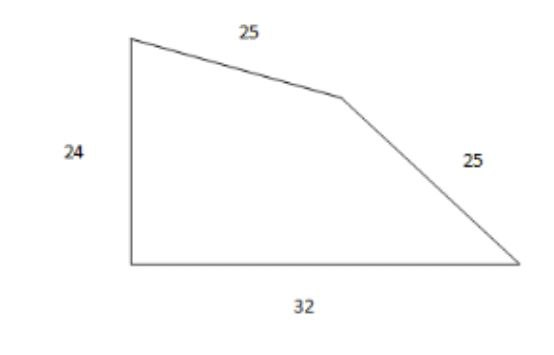
Two sides of a plot measure 32m and 24m and the angle between them a perfect right angle. The other two sides measure 25m each and the other three angles are not right angles. What is the area of the plot? (in m²)
- A534
- B634
- C684
- D456
- E658
Show answerHide answer
Answer: C
Approach: Split the plot along the diagonal into a right triangle and an isosceles triangle.
Solution:
Right triangle legs 24 and 32 → diagonal = 40 (8 × 3-4-5)
Area 1 = ½ × 24 × 32 = 384
Isosceles triangle 25, 25, base 40 → height = √(25² − 20²) = 15
Area 2 = ½ × 40 × 15 = 300
Total = 384 + 300 = 684 m²
Cetking shortcut: Both triangles are triplets: 24-32-40 and 15-20-25 → no square roots needed.
Answer: C
The length of a room is double its breadth. The cost of coloring the ceiling at Rs 25 per sq. meter is Rs 5000 and the cost of painting the four walls at Rs. 240 per sq metre is Rs. 64800. Find the height of the room:
- A4 m
- B4.5 m
- C5 m
- D3.5 m
- E3 m
Show answerHide answer
Answer: B
Approach: Ceiling = l × b; four walls = 2(l + b)h.
Solution:
Ceiling area = 5000/25 = 200 m² → 2x² = 200 → x = 10 → b = 10, l = 20
Wall area = 64800/240 = 270 m²
2(20 + 10)h = 270 → 60h = 270 → h = 4.5 m
Why the other options are wrong:
A (4 m) → walls 240 m² → ₹57,600.
C (5 m) → 300 m² → ₹72,000.
Answer: B
The trunk of a tree is a right cylinder 1.5m in radius and 10m high. What is the volume of the timber which remains when the trunk is trimmed just enough to reduce it to a rectangular parallelopiped on a square base?
- A40 m³
- B45 m³
- C35 m³
- D25 m³
- E50 m³
Show answerHide answer
Answer: B
Approach: The largest square cross-section inside a circle has its diagonal equal to the diameter.
Solution:
Diameter = 2 × 1.5 = 3 m = diagonal of the square base
Side² = (diagonal²)/2 = 9/2 = 4.5 m²
Volume = 4.5 × 10 = 45 m³
Cetking shortcut: Square area = d²/2 directly — no need to find the side.
Answer: B
A garden is 24 m long and 14 m wide. There is a path 1 m wide outside the garden along its sides If the path is to be constructed with square marble tiles 20 cm*20 cm, find the number of tiles required to cover the path?
- A1500
- B2000
- C1800
- D2200
- E2400
Show answerHide answer
Answer: B
Approach: Path area = outer rectangle − garden; tiles = path area ÷ tile area.
Solution:
Outer = (24 + 2) × (14 + 2) = 26 × 16 = 416 m²
Garden = 24 × 14 = 336 m²
Path = 80 m²
Tile = 0.2 × 0.2 = 0.04 m²
Tiles = 80/0.04 = 2000
Why the other options are wrong:
Forgetting the four 1 m x 1 m corner squares gives 76 m² → 1900 tiles; double-counting them gives other wrong totals. Tile area is 0.04 m², i.e. 25 tiles per m².
Cetking shortcut: Outer path area = 2w(l + b) + 4w² = 2(38) + 4 = 80 m²; tiles = 80 × 25 = 2000.
Answer: B
A rectangular paper, when folded into two congruent parts has a perimeter of 34 cm for each part folded along one set of sides and the same is 38 cm when folded along the other set of sides. What is the area of the paper (in sq. cms)?
- A130
- B140
- C150
- D160
- E145
Show answerHide answer
Answer: B
Approach: Two linear equations from the folded halves.
Solution:
Let the sheet be l × b.
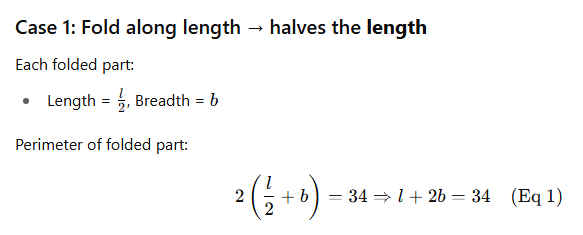
Fold across the length: half is (l/2) × b ⇒ perimeter = l + 2b = 34.
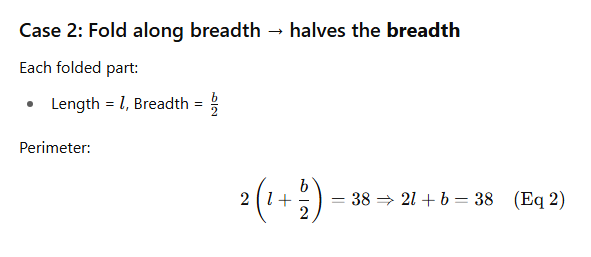
Fold across the breadth: half is l × (b/2) ⇒ perimeter = 2l + b = 38.
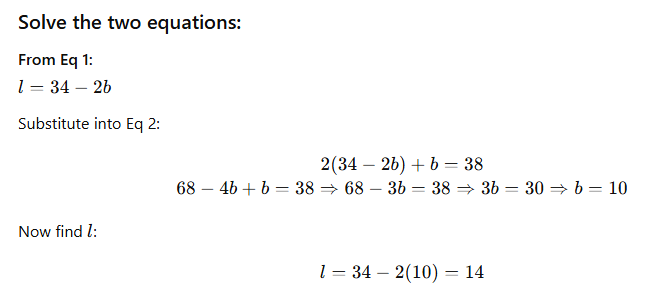
Adding: 3(l + b) = 72 ⇒ l + b = 24. Subtracting: l − b = 4 ⇒ l = 14, b = 10.
Area = 14 × 10 = 140 sq. cm.
Cetking shortcut: Add the two perimeters: 3(l + b) = 72 ⇒ l + b = 24, then subtract for l − b = 4.
Answer: B
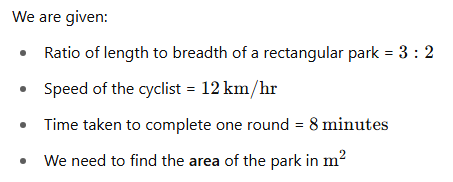
The ratio between the length and the breadth of a rectangular park is 3 : 2. If a man cycling along the boundary of the park at the speed of 12 km/hr completes one round in 8 minutes, then what is the area of the park (in sq. m)?
- A152600
- B154600
- C153600
- D152500
- E153500
Show answerHide answer
Answer: C
Approach: Distance = speed × time, then rectangle with ratio sides.
Solution:
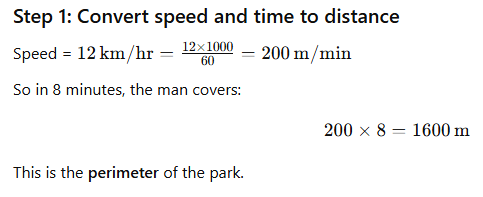
12 km/hr = 12000 m/60 min = 200 m/min.
Perimeter = 200 × 8 = 1600 m.
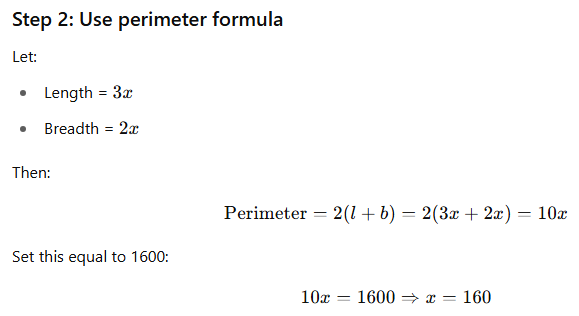
Sides 3x and 2x ⇒ 2(3x + 2x) = 10x = 1600 ⇒ x = 160.
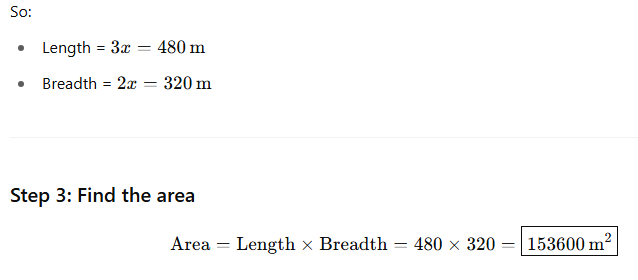
Length = 480 m, breadth = 320 m.
Area = 480 × 320 = 153600 sq. m.
Why the other options are wrong:
A, B, D, E: near-miss values; 480 × 320 is exactly 153600.
Cetking shortcut: Area = 6x² with x = 160 ⇒ 6 × 25600 = 153600.
Answer: C
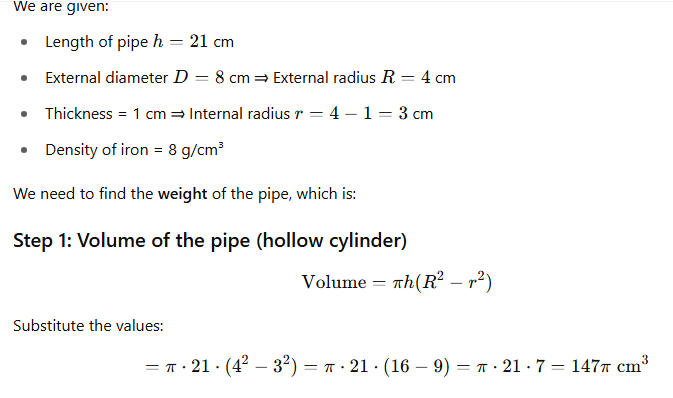
A hollow iron pipe is 21 cm long and its external diameter is 8 cm. If the thickness of the pipe is 1 cm and iron weighs 8 g/cm³, then the weight of the pipe is:
- A3.6kg
- B3.69kg
- C3.696kg
- D3.96kg
- E3.66kg
Show answerHide answer
Answer: C
Approach: Hollow cylinder volume × density.
Solution:
External radius R = 8/2 = 4 cm; internal radius r = 4 − 1 = 3 cm.
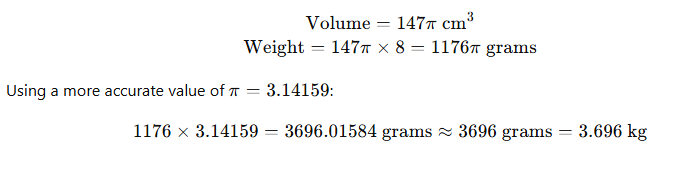
Volume = 22/7 × (16 − 9) × 21 = 22/7 × 7 × 21 = 462 cm³.
Weight = 462 × 8 = 3696 g = 3.696 kg.
Why the other options are wrong:
A, B, D, E: rounding variants; exact value is 3.696 kg.
Answer: C
In a garden, there are 10 rows and 12 columns of mango trees. The distance between the two trees is 2 meters and a distance of one metre is left from all sides of the boundary of the garden. What is the length of the garden?
- A20m
- B22m
- C24m
- D26m
- E28m
Show answerHide answer
Answer: C
Approach: Trees in a line: n trees have (n − 1) gaps. Add the margin at both ends.
Solution:
The length runs along the longer side, which has 12 trees (columns).
Gaps between 12 trees = 11, so 11 × 2 m = 22 m.
Add the 1 m margin at each end: 22 + 1 + 1 = 24 m.
(Width check: 10 trees → 9 × 2 + 2 = 20 m, which is option A, the trap.)
Why the other options are wrong:
A (20 m): this is the width, using the 10 rows.
B (22 m): leaves out the 1 m margins.
D (26 m), E (28 m): count 12 gaps or add extra margin.
Cetking shortcut: Length = (trees − 1) × gap + 2 × margin = 11 × 2 + 2 = 24.
Answer: C
The length of the rectangle is 18cm, and breadth is 10cm. When the length is increased to 25cm, what will be the breadth of the rectangle if the area remains the same?
- A7
- B7.1
- C7.2
- D7.3
- E7.7
Show answerHide answer
Answer: C
Approach: Area constant.
Solution: Area = 18 × 10 = 180 cm².
New breadth = 180 ÷ 25 = 7.2 cm.
Answer: C
Aadee’s land is square, Aahuu’s land is circular. Both have equal perimeters. What is the ratio of the areas (square : circle)?
- A4 : π
- B1 : 4
- Cπ : 4
- D4 : π²
- Eπ² : 4
Show answerHide answer
Answer: C
Approach: Equal perimeter → express both areas in P.
Solution:
Square: side = P/4 → area = P²/16.
Circle: 2πr = P → r = P/(2π) → area = πr² = P²/(4π).
Square : circle = (1/16) : (1/(4π)) = 4π : 16 = π : 4.
Cetking shortcut: For equal perimeters the circle always has the larger area, so the ratio must be less than 1 → π : 4 (≈ 0.785).
Answer: C
A vertical pillar has a trapezium base with sides 10 cm and 20 cm, height between them = 12 cm, and pillar height = 20 cm. What is the total surface area?
- A1340
- B1300
- C1550
- D1520
- E1480
Show answerHide answer
Answer: E
Approach: Prism TSA = 2 × base area + base perimeter × height.
Solution:
Base trapezium (taken as isosceles): parallel sides 10 and 20, height 12.
Base area = ½ × (10 + 20) × 12 = 180 cm².
Each slanted side: overhang = (20 − 10)/2 = 5 → side = √(12² + 5²) = 13.
Perimeter = 10 + 20 + 13 + 13 = 56.
Lateral area = 56 × 20 = 1120. TSA = 2 × 180 + 1120 = 1480 cm².
Cetking shortcut: 5-12-13 triple gives the slant sides instantly.
Answer: E
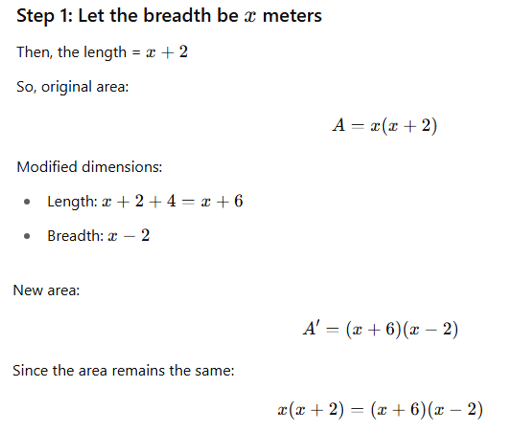
The length of a room exceeds its breadth by 2 meters. If the length be increased by 4 meters and the breadth decreased by 2 meters, the area remains the same. Find the surface area of its walls if the height is 3 meters ?
- A248m2
- B48m2
- C84m2
- D56m2
- E260m2
Show answerHide answer
Answer: C
Approach: Form an equation from 'area unchanged', then use 2(l + b)h.
Solution:
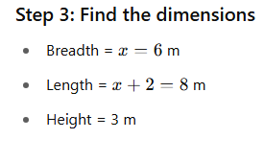
Let breadth = b, length = b + 2
(b + 2 + 4)(b − 2) = (b + 2)b
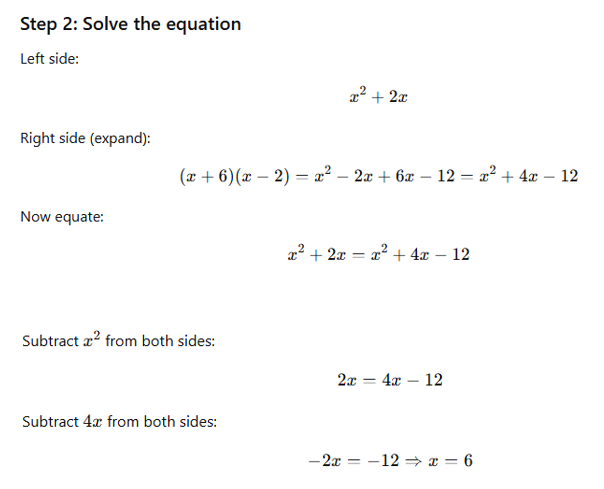
b² + 4b − 12 = b² + 2b → 2b = 12 → b = 6, l = 8
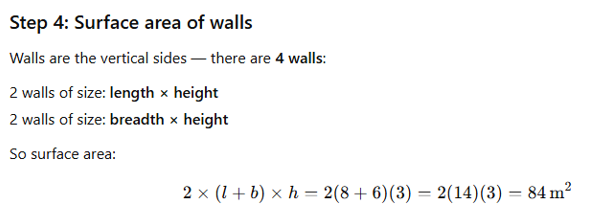
Walls = 2(8 + 6) × 3 = 84 m²
Cetking shortcut: (l + 4)(b − 2) = lb ⇒ 4b − 2l = 8; with l = b + 2 this gives b = 6 in one line.
Answer: C
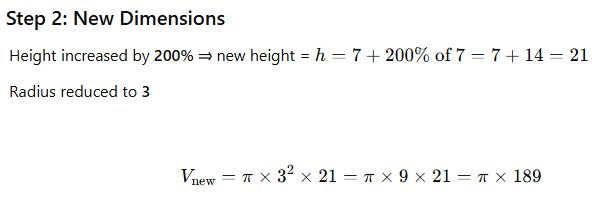
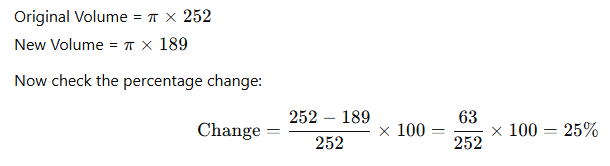
If the height of a right circular cone is increased by 200% and the radius of the base is reduced by 50%, then volume of the cone shall :
- Aincrease by 25%
- Bdecrease by 25%
- Cincrease by 100%
- Dincrease by 75%
- Edecrease by 20%
Show answerHide answer
Answer: B
Approach: Volume ∝ r²h; apply multiplying factors.
Solution:
Height +200% → h becomes 3h
Radius −50% → r becomes r/2, so r² becomes r²/4
New volume factor = 3 × 1/4 = 0.75
Volume decreases by 25%
Cetking shortcut: Factors only: (½)² × 3 = ¾ → 25% down.
Answer: B
A copper wire having length of 243 m and diameter 4 mm was melted to form a sphere. Find the diameter of the sphere thus formed ?
- A16cm
- B24cm
- C18cm
- D22cm
- E20cm
Show answerHide answer
Answer: C
Approach: Equate volumes in cm.
Solution:
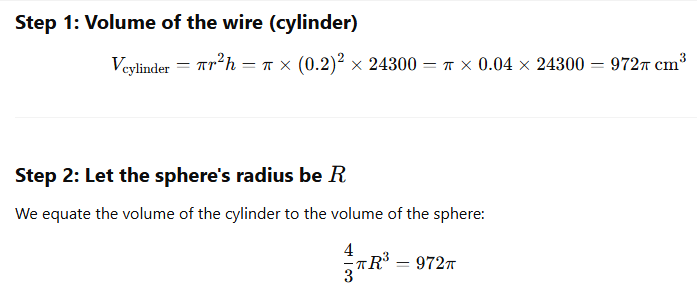
Wire: r = 2 mm = 0.2 cm, length = 243 m = 24300 cm
Volume = π × 0.2² × 24300 = 972π cm³
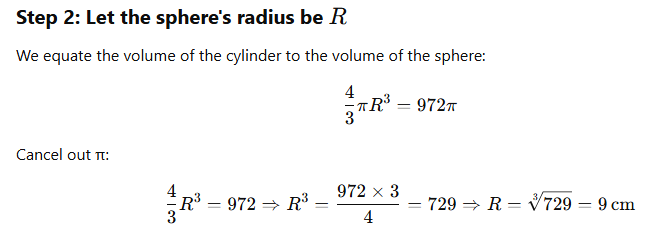
Sphere: (4/3)πR³ = 972π → R³ = 729 → R = 9 cm
Diameter = 18 cm
Cetking shortcut: R³ = (3/4) × 0.04 × 24300 = 729 — a perfect cube, confirming R = 9.
Answer: C
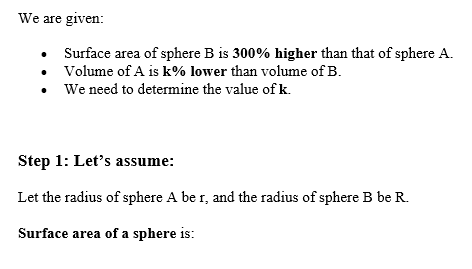
Let A and B be two solid spheres such that the surface area of B is 300% higher than the surface area of A. The volume of A is found to be k% lower than the volume of B. Determine the value of k :
- A85.5
- B92.5
- C87.5
- D88.5
- E90.5
Show answerHide answer
Answer: C
Approach: Area ratio → radius ratio → volume ratio.
Solution:
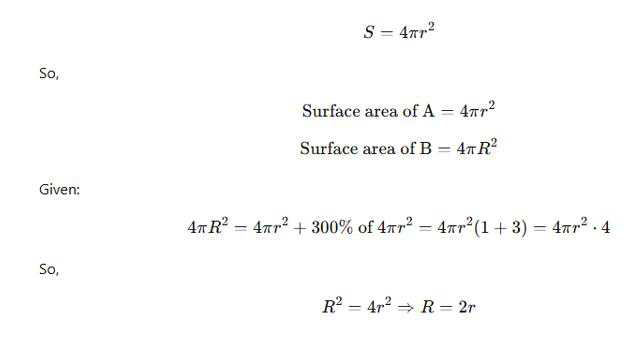
SA of B = SA of A + 300% = 4 × SA of A
r_B/r_A = √4 = 2
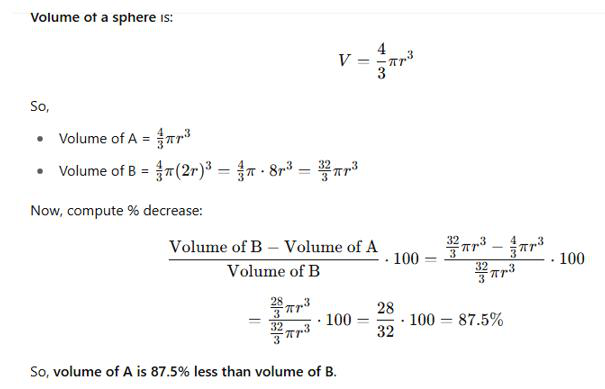
V_B/V_A = 2³ = 8
V_A is lower than V_B by (8 − 1)/8 = 7/8 = 87.5%
Cetking shortcut: 'k% lower than B' uses B as base: 1 − 1/8 = 87.5%.
Answer: C