Let’s Crack CET 2027

Your CET check-up · tap a ring to see yours

Partnership – MBA CET questions with solutions

19 questions · CET 2025–2026 · Easy 10 · Medium 9 · Hard 0. Newest paper first. Full papers

Q123EasyCET 2026 · Attempt 2 Slot 2 · Q123
A and B are partners in a business. A contributed one-fourth of the total capital for 15 months. B received two-thirds of the total profit. For how long was B's capital invested in the business ?
  1. 6 months
  2. 8 months
  3. 10 months
  4. 12 months
  5. 8.5 months
Show answerHide answer

Answer: C official key

Approach: Profit share ∝ capital × time.

Solution:
Capital: A = 1/4, B = 3/4 of total.
Profit: B gets 2/3 → A gets 1/3 → A : B = 1 : 2.
(1/4 × 15) : (3/4 × t) = 1 : 2
3t/4 = 2 × 15/4 = 30/4 → t = 10 months.

Cetking shortcut: Capital ratio 1 : 3, profit ratio 1 : 2 → time ratio = (1/1) : (2/3) = 15 : 10 → B = 10 months.

Answer: C
Q124MediumCET 2026 · Attempt 2 Slot 2 · Q124
Three students A, B and C hired a computer for a month. A runs 27 floppy discs for 19 days, B runs 21 for 17 days and C runs 24 for 23 days. If, at the end of the month, the rent amounts to Rs 23,700, how much rent should be paid by C ?
  1. Rs. 5,600
  2. Rs. 8,400
  3. Rs. 10,600
  4. Rs. 15,600
  5. Rs. 9,200
Show answerHide answer

Official CET key: E · Cetking's answer: C — see why below

Approach: Rent shared in proportion to usage = discs × days.

Solution:
A = 27 × 19 = 513; B = 21 × 17 = 357; C = 24 × 23 = 552.
Total = 513 + 357 + 552 = 1422.
C's share = 552/1422 × 23,700.
23,700/1422 = 50/3 → 552 × 50/3 = Rs. 9,200.

Cetking shortcut: Notice 1422 × 50 = 71,100 = 3 × 23,700 → each unit = Rs. 50/3; C = 552 × 50/3 = 9200.

Answer: E

Q108MediumCET 2026 · Attempt 2 Slot 1 · Q108

Amar, Akbar, and Anthony start a business, each investing Rs 30,000. After 4 months, Amar withdraws Rs 8,000, Akbar withdraws Rs 5,000, and Anthony invests Rs 10,000 more. At the end of the year, the total profit is Rs 1,05,000. What is Anthony's share of the profit?

  1. 29,432
  2. 31,818
  3. 43,750
  4. 31,500
  5. 43,500
Show answerHide answer

Answer: C official key

Approach: Partnership: profit ∝ capital × time.

Solution:
Amar: 30,000 × 4 + 22,000 × 8 = 2,96,000.
Akbar: 30,000 × 4 + 25,000 × 8 = 3,20,000.
Anthony: 30,000 × 4 + 40,000 × 8 = 4,40,000.
Ratio 296 : 320 : 440 = 37 : 40 : 55; total 132.
Anthony = 55/132 × 1,05,000 = 5/12 × 1,05,000 = 43,750.

Cetking shortcut: Work in thousands: first 4 months are equal (120 each), so compare only the extra: 176, 200, 320 → add 120 back → 296 : 320 : 440; 440/1056 = 5/12.

Answer: C

Q137MediumCET 2026 · Attempt 2 Slot 1 · Q137

Two partners invest ₹1,80,000 and ₹1,20,000 respectively in a business. They agree that 50% of the total profit will be divided equally between them, and the remaining profit will be treated as interest on capital.
If one partner receives ₹600 more than the other, what is the total profit earned?

  1. ₹6,000
  2. ₹7,000
  3. ₹7,500
  4. ₹8,000
  5. ₹9,000
Show answerHide answer

Answer: A official key

Approach: Split profit into an equal part and a capital-ratio part.

Solution:
Let total profit = P. Half (P/2) is shared equally — no difference.
Other half is shared in 1,80,000 : 1,20,000 = 3 : 2.
Difference = (3 − 2)/5 × P/2 = P/10.
P/10 = 600 → P = Rs 6,000.

Cetking shortcut: Only the capital-ratio half creates the difference: 1/5 of half = 1/10 of total.

Answer: A

Q118EasyCET 2026 · Slot 5 · Q118

A, B, and C entered into a partnership.
A received 3/5 of the total profit.
B and C shared the remaining profit equally.
If C initially received ₹400 less than A, what was the total profit?

  1. ₹800
  2. ₹1,000
  3. ₹1,200
  4. ₹1,600
  5. ₹1,800
Show answerHide answer

Answer: B official key

Approach: Express each partner's share as a fraction of total profit.

Solution:
A = 3/5 of total.
Remaining 2/5 split equally → B = C = 1/5 of total.
A − C = 3/5 − 1/5 = 2/5 of total = ₹400.
Total = 400 × 5/2 = ₹1,000.

Why the other options are wrong:

  • A (₹800): would make the gap ₹320.
  • C, D, E: make the gap ₹480, ₹640, ₹720.

Cetking shortcut: Shares A : B : C = 3 : 1 : 1; gap of 2 parts = 400 → 1 part = 200 → 5 parts = 1000.

Answer: B

Q121EasyCET 2026 · Slot 4 · Q121
A, B, and C enter into a partnership with a capital in which A's contribution is Rs. 10,000. If out of a total profit of Rs. 1000, A gets Rs. 500 and B gets Rs. 300, then C's capital is:
  1. Rs. 4000
  2. Rs. 5000
  3. Rs. 6000
  4. Rs. 9000
  5. Rs. 4500
Show answerHide answer

Answer: A official key

Approach: Same time period ⇒ profit ratio = capital ratio.

Solution:
C's profit = 1000 − 500 − 300 = Rs. 200.
Profit ratio A : B : C = 500 : 300 : 200 = 5 : 3 : 2.
A's 5 parts = Rs. 10,000 ⇒ 1 part = Rs. 2,000.
C's capital = 2 × 2,000 = Rs. 4,000.

Why the other options are wrong:
C (6000) – this is B's capital.
B (5000) – A's half, not C's.
D, E – no basis in the ratio.

Cetking shortcut: C's capital = 10,000 × 200/500 = Rs. 4,000.

Answer: A

Q122EasyCET 2026 · Slot 4 · Q122
A and B started a partnership business investing some amount in the ratio of 3 : 5. C joined them after six months with an amount equal to that of B. In what proportion should the profit at the end of one year be distributed among A, B and C?
  1. 3 : 5 : 2
  2. 3 : 5 : 5
  3. 6 : 10 : 5
  4. 3 : 7 : 8
  5. 6 : 10 : 3
Show answerHide answer

Answer: C official key

Approach: Profit ratio = capital × time.

Solution:
Capitals: A = 3k, B = 5k, C = 5k (equal to B).
Time: A and B 12 months, C 6 months.
A : B : C = 3 × 12 : 5 × 12 : 5 × 6 = 36 : 60 : 30 = 6 : 10 : 5.

Why the other options are wrong:
A (3:5:2), B (3:5:5) – ignore that C invested only for 6 months or scale wrongly.
D (3:7:8), E (6:10:3) – wrong time/amount for C.

Cetking shortcut: Halve C's capital for half the time: 3 : 5 : 2.5 = 6 : 10 : 5.

Answer: C

Q116EasyCET 2026 · Slot 2 · Q116

DIRECTION for the question: Solve the following question and mark the best possible option.

Manick received Rs. 6000 as his share out of the total profit of Rs. 9000 which he and Raunaq earned at the end of one year. If Manick invested Rs. 20000 for 6 months, whereas Raunaq invested his amount for the whole year, what was the amount invested by Raunaq?
  1. Rs. 4000
  2. Rs. 5000
  3. Rs. 6000
  4. Rs. 10,000
  5. Rs. 9000
Show answerHide answer

Answer: B official key

Approach: Profit ratio = capital × months.

Solution: Raunaq's profit = 9000 − 6000 = 3000 ⇒ ratio 2 : 1.
Manick: 20000 × 6 = 120000. Raunaq: x × 12.
120000 : 12x = 2 : 1 ⇒ 24x = 120000 ⇒ x = 5000.

Why the other options are wrong:
D (10,000): ignores the time factor.
A, C, E: arithmetic slips.

Answer: B

Q117EasyCET 2026 · Slot 2 · Q117

DIRECTION for the question: Solve the following question and mark the best possible option.

Arun, Kamal and Vinay invested ₹8000, ₹4000 and ₹8000 respectively in a business. Arun left after six months. If after eight months, there was a gain of ₹ 4005, then what will be the share of Kamal ?
  1. ₹890
  2. ₹1335
  3. ₹1602
  4. ₹1780
  5. ₹666
Show answerHide answer

Official CET key: A · Cetking's answer: B — see why below

Approach: Capital × time ratio.

Solution: Arun: 8000 × 6 = 48000; Kamal: 4000 × 8 = 32000; Vinay: 8000 × 8 = 64000.
Ratio = 48 : 32 : 64 = 3 : 2 : 4 (total 9 parts).
Kamal's share = 2/9 × 4005 = ₹890.

Why the other options are wrong:
B (₹1335): 4005/3 — treats shares as equal.
D (₹1780): Vinay's share (4/9).
C (₹1602): 2/5 of 4005.
E (₹666): not from any valid split.

Answer: A

Q122MediumCET 2026 · Slot 1 · Q122

A and B start a business together.

  • A invests ₹1,20,000 at the beginning.
  • After 4 months, B joins the business with ₹90,000.
  • After another 4 months, A adds ₹30,000 to his investment, while B withdraws ₹30,000 from his capital.

At the end of 1 year, in what ratio should A and B share the profit?

  1. 10:7
  2. 9:8
  3. 13:5
  4. 14:9
  5. 14:5
Show answerHide answer

Official CET key: C · Cetking's answer: A — see why below

Approach: Profit share ∝ capital × time; split each partner's investment into periods.

Solution:
A: ₹1,20,000 for 8 months = 9,60,000; then ₹1,50,000 for 4 months = 6,00,000 → total 15,60,000
B: joins at month 4 with ₹90,000 for 4 months = 3,60,000; then ₹60,000 for 4 months = 2,40,000 → total 6,00,000
A : B = 15,60,000 : 6,00,000 = 156 : 60 = 13 : 5

Why the other options are wrong:
A (10:7), B (9:8), D (14:9), E (14:5) come from wrong periods — e.g. giving B 12 months or ignoring the mid-year top-up/withdrawal.

Cetking shortcut: Work in ₹10,000 units and months: A = 12×8 + 15×4 = 156, B = 9×4 + 6×4 = 60 → 13 : 5.

Answer: C

Q123EasyCET 2026 · Slot 1 · Q123

A invests ₹6,000 in a business for 8 months, and B invests ₹9,000 for 12 months. If the total profit at the end of the year is ₹3,000, find A's share.

  1. ₹923.08
  2. ₹933.07
  3. ₹813.06
  4. ₹863.02
  5. ₹683.05
Show answerHide answer

Answer: A official key

Approach: Profit share ∝ capital × time.

Solution:
A = 6000 × 8 = 48,000; B = 9000 × 12 = 1,08,000
A : B = 48 : 108 = 4 : 9
A's share = 3000 × 4/13 = ₹923.08

Cetking shortcut: 13 parts of 3000 → one part ≈ 230.77; A = 4 parts = 923.08.

Answer: A

Q124EasyCET 2026 · Slot 1 · Q124

A, B, and C start a business with capitals in the ratio 3 : 4 : 5.

  • A invests for 12 months,
  • B invests for 9 months,
  • C invests for 6 months.

If the total profit at the end of the year is ₹36,000, find C's share.

  1. ₹10,582.24
  2. ₹11,682.21
  3. ₹12,772.34
  4. ₹14,792.37
  5. ₹10,588.24
Show answerHide answer

Answer: E official key

Approach: Profit share ∝ capital ratio × months.

Solution:
A = 3 × 12 = 36, B = 4 × 9 = 36, C = 5 × 6 = 30
Total = 102 parts
C's share = 36000 × 30/102 = 36000 × 5/17 = ₹10,588.24

Why the other options are wrong:
A (₹10,582.24) is a near-miss decoy: 180000/17 = 10588.235…, so the digits must end in 588.

Cetking shortcut: 36 : 36 : 30 = 6 : 6 : 5 → C = 5/17 of 36000.

Answer: E

Q118MediumCET 2025 · Slot 6 · Q118
Find the ratio of investment of Ajay to Vijay if Ajay invests after 6 months of Vijay's investment and Vijay invests after 3 months of commencement of business. It is known that their profit-sharing ratio after 1 year of commencement of business is 2:3.
  1. 2 : 1
  2. 1 : 3
  3. 3 : 1
  4. 1: 2
  5. 4 : 1
Show answerHide answer

Answer: A

Approach: Partnership: profit share ∝ capital × time.

Solution:
Vijay joins after 3 months ⇒ invests for 12 − 3 = 9 months.
Ajay joins 6 months after Vijay (month 9) ⇒ invests for 3 months.
A × 3 : V × 9 = 2 : 3 ⇒ 3A × 3 = 2 × 9V ⇒ 9A = 18V ⇒ A : V = 2 : 1.

Why the other options are wrong:
D 1:2: inverts the ratio.
B, C, E: wrong durations (e.g. 6 months for Ajay).

Cetking shortcut: Capital ratio = profit ratio ÷ time ratio = (2/3) ÷ (3/9) = 2 ⇒ 2 : 1.

Answer: A

Q120MediumCET 2025 · Slot 5 · Q120

Two friends P and Q started a business investing in the ratio of 5 :6. R joined them after six months investing an amount equal to that of Q's. At the end of the year, 20% profit was earned which was equal to Rs. 98,000. What was the amount invested by R ?

  1. Rs 1,05,000
  2. Rs 1,55,000
  3. Rs. 2,05,000
  4. Rs. 2,10,000
  5. Rs 1,95,000
Show answerHide answer

Answer: D

Approach: Profit share ∝ capital × time; a 20% annual return on R's money for half a year gives R's share.

Solution:
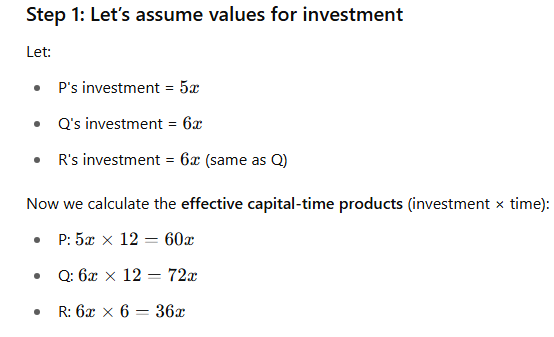
P : Q : R capitals = 5x : 6x : 6x; months = 12 : 12 : 6
Capital-time = 60x : 72x : 36x = 10 : 12 : 6
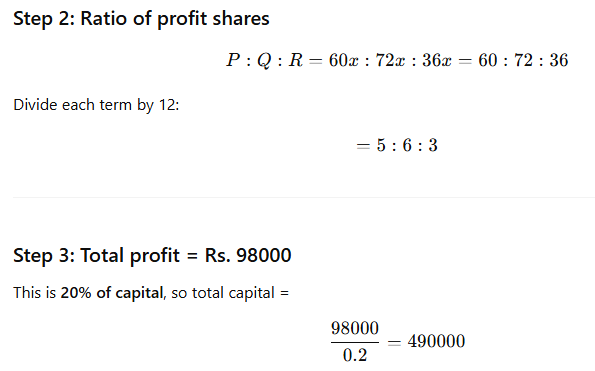
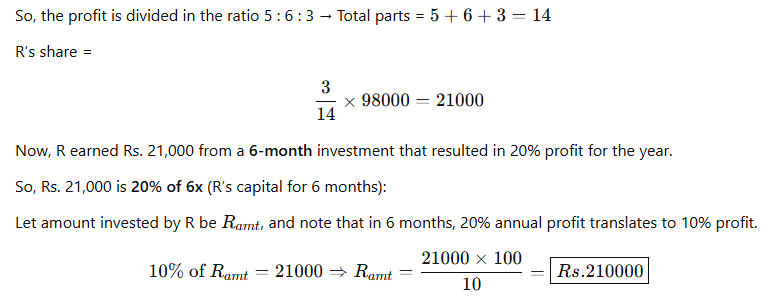
R's share of ₹98,000 = 6/28 × 98,000 = ₹21,000
R's money earned 20% per annum for only 6 months → 10% of capital
R's investment = 21,000/0.10 = ₹2,10,000
Check: P = 1,75,000 → 35,000; Q = 2,10,000 → 42,000; R → 21,000; total 98,000 ✓

Why the other options are wrong:
A (1,05,000): treats R's ₹21,000 as a full-year 20% return — that is only R's half-year-equivalent capital.
B, C, E: do not fit the 5:6:6 structure.

Cetking shortcut: Annualised capital = 98,000/0.2 = 4,90,000 = 5x + 6x + 3x = 14x → x = 35,000 → R = 6x = 2,10,000.

Answer: D

Q121EasyCET 2025 · Slot 5 · Q121

A and B rent a pasture for 10 months. A puts in 80 cows for 7 months and leaves. How many cows can B put in for the remaining 3 months, if he pays half as much rent again as A?

  1. 250
  2. 280
  3. 275
  4. 200
  5. 120
Show answerHide answer

Answer: B

Approach: Rent is shared in the ratio of cow-months; 'half as much again' means 1.5 times.

Solution:
A's cow-months = 80 × 7 = 560
B pays 1.5 × A's rent → B's cow-months = 1.5 × 560 = 840
B's cows for 3 months = 840/3 = 280

Why the other options are wrong:
A/C/D/E: misread 'half as much again' as 0.5× (gives 93.3) or use 10 months instead of 3.

Cetking shortcut: Cows = 80 × 7 × 1.5/3 = 280 in one line.

Answer: B

Q121MediumCET 2025 · Slot 4 · Q121

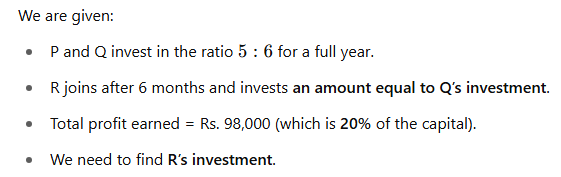
Two friends, P and Q started a business investing in the ratio 5 : 6. R joined them after six months, investing an amount equal to that of Q's. At the end of the year, 20% profit was earned which was equal to Rs. 98000. What was the amount invested by R?

  1. 190000
  2. 200000
  3. 210000
  4. 250000
  5. 180000
Show answerHide answer

Answer: C

Approach: Partnership — time-weighted capital.

Solution:
Let P, Q invest 5x and 6x for 12 months; R invests 6x for 6 months.
Capital employed over the year (in year-equivalents) = 5x + 6x + 6x × 6/12 = 14x.
Profit = 20% of capital employed = 0.2 × 14x = 2.8x = 98000.
x = 98000/2.8 = 35000.
R's investment = 6x = 6 × 35000 = Rs. 2,10,000.
Check: R's capital-months 210000 × 6 = 12.6 lakh out of 58.8 lakh total ⇒ R's profit share = 98000 × 3/14 = 21000 (10% of his amount for half a year at 20% p.a.). ✓

Why the other options are wrong:
A, B, D, E: do not give 6x with 2.8x = 98000.

Cetking shortcut: Year-equivalent capital = 14 units; 20% of 14 = 2.8 units = 98000 ⇒ 1 unit = 35000 ⇒ R = 6 units.

Answer: C

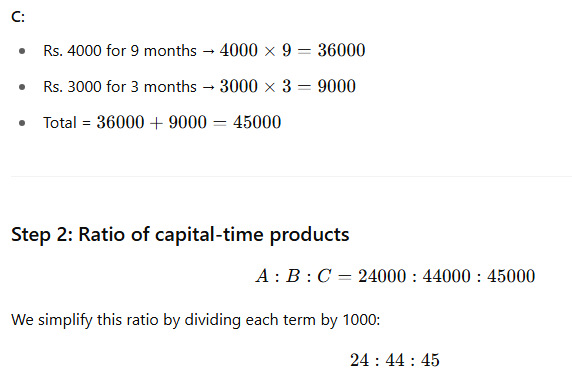
Solution figure for question 121Solution figure for question 121Solution figure for question 121Solution figure for question 121
Q124MediumCET 2025 · Slot 4 · Q124

A, B and C start a business by investing Rs.2000, Rs.3000 and Rs.4000 respectively. But B increases his investment to Rs.4000 after 4 months and C withdraws Rs.1000 at the end of 9 months. What is A's share out of a total profit of Rs. 8475 earned in a year?

  1. 1600
  2. 1800
  3. 1500
  4. 1400
  5. 1200
Show answerHide answer

Answer: B

Approach: Capital × months for each partner.

Solution:
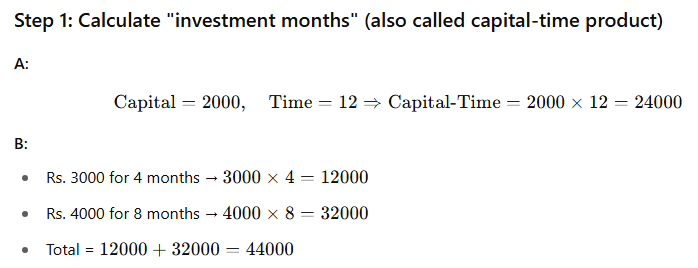
A: 2000 × 12 = 24000.
B: 3000 × 4 + 4000 × 8 = 12000 + 32000 = 44000.
C: 4000 × 9 + 3000 × 3 = 36000 + 9000 = 45000.
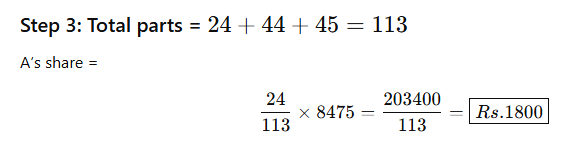
Ratio = 24 : 44 : 45, total 113.
A's share = 24/113 × 8475 = 24 × 75 = Rs. 1800.

Why the other options are wrong:
A, C, D, E: none equals 24/113 × 8475 = 1800 (ignoring the changes in B's and C's capital gives a different ratio).

Cetking shortcut: 8475 = 113 × 75 — once you see that, A's share = 24 × 75 = 1800.

Answer: B

Solution figure for question 124Solution figure for question 124Solution figure for question 124
Q110MediumCET 2025 · Slot 2 · Q110
Two friends P and Q started a business investing in the ratio of 5:6. R joined them after 6 months, investing an amount equal to Q's. At the end of the year, the profit earned, which was 20% of the investment, was ₹98000. Determine the amount invested by R.
  1. ₹105000
  2. ₹420000
  3. ₹200000
  4. ₹110000
  5. ₹210000
Show answerHide answer

Answer: E

Approach: Partnership — convert investments into time-weighted (yearly-equivalent) capital.

Solution:
Let P = 5k, Q = 6k; R puts 6k for 6 months.
Yearly-equivalent capital = 5k + 6k + 6k × 6/12 = 14k (profit ratio 5 : 6 : 3).
Profit = 20% of investment = 0.2 × 14k = 2.8k = 98,000 → k = 35,000.
R's investment = 6k = ₹2,10,000.

Cetking shortcut: R invested the same as Q, so R = 6/14 of the capital base; 98,000/0.2 = 4,90,000 → 4,90,000 × 6/14 = 2,10,000.

Answer: E

Q119EasyCET 2025 · Slot 1 · Q119

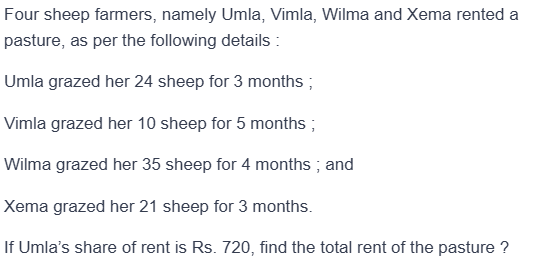
Four sheep farmers, namely Umla, Vimla, Wilma and Xema rented a pasture, as per the following details:
Umla grazed her 24 sheep for 3 months ;
Vimla grazed her 10 sheep for 5 months ;
Wilma grazed her 35 sheep for 4 months ; and
Xema grazed her 21 sheep for 3 months.

If Umla's share of rent is Rs. 720, find the total rent of the pasture ?
Figure for MBA CET 2025 Slot 1 question 119
  1. 2880rs
  2. 3200rs
  3. 3150rs
  4. 3250rs
  5. 3350rs
Show answerHide answer

Answer: D

Approach: Share ∝ sheep × months.

Solution:
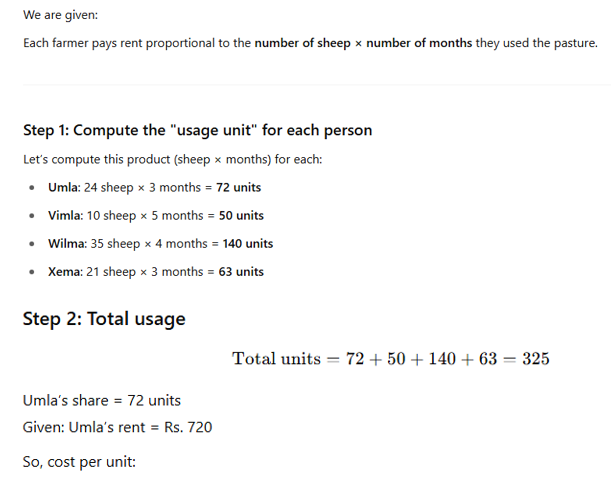
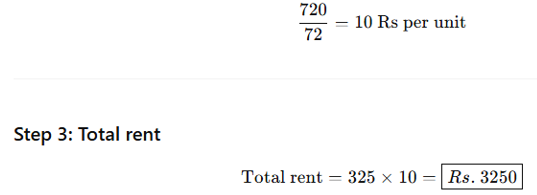
Umla 24 × 3 = 72, Vimla 10 × 5 = 50, Wilma 35 × 4 = 140, Xema 21 × 3 = 63
Total = 72 + 50 + 140 + 63 = 325 units
Umla's 72 units = ₹720 → 1 unit = ₹10
Total rent = 325 × 10 = ₹3250

Cetking shortcut: ₹720/72 = ₹10 per sheep-month, so the total must be 325 × 10.

Answer: D

Solution figure for question 119Solution figure for question 119

Practise these in the Arena

Take timed tests built around MBA CET topics and see where you stand.

Open the Arena