Let’s Crack CET 2027

Your CET check-up · tap a ring to see yours

Simplification – MBA CET questions with solutions

27 questions · CET 2025–2026 · Easy 25 · Medium 2 · Hard 0. Newest paper first. Full papers

Q105EasyCET 2026 · Attempt 2 Slot 2 · Q105
Calculate 1397 × 1397 and choose the correct option :
  1. 1981709
  2. 1951609
  3. 2031719
  4. 1951719
  5. 2011609
Show answerHide answer

Answer: B official key

Approach: Square near a round number: (a − b)² = a² − 2ab + b².

Solution:
1397² = (1400 − 3)²
= 1400² − 2 × 1400 × 3 + 3²
= 1,960,000 − 8,400 + 9
= 1,951,609.

Cetking shortcut: Last digit 7² → 9 and last two digits 97² → 09 kill C and D; size ≈ 1.95 million kills A and E.

Answer: B
Q106EasyCET 2026 · Attempt 2 Slot 2 · Q106

Solve the following mathematical expression and select the correct answer:

(53 × 2 × 106) − (47 × 2 × 94)
  1. 2200
  2. 2400
  3. 2000
  4. 1906
  5. 1904
Show answerHide answer

Answer: B official key

Approach: Rewrite as squares and use a² − b² = (a + b)(a − b).

Solution:
53 × 2 × 106 = 4 × 53² and 47 × 2 × 94 = 4 × 47².
Expression = 4(53² − 47²) = 4 × (53 + 47)(53 − 47)
= 4 × 100 × 6 = 2400.
(Direct check: 11236 − 8836 = 2400.)

Cetking shortcut: Spot 106 = 2 × 53 and 94 = 2 × 47 → 4(a² − b²) in one line.

Answer: B

Q114EasyCET 2026 · Attempt 2 Slot 2 · Q114
Find the value of 'x' in the given mathematical expression :
88% of 370 + 24 % of 210 - x = 118
  1. 256
  2. 258
  3. 260
  4. 266
  5. 265
Show answerHide answer

Answer: B official key

Approach: Evaluate the percentages, then isolate x.

Solution:
88% of 370 = 325.6.
24% of 210 = 50.4.
325.6 + 50.4 − x = 118 → 376 − x = 118 → x = 258.

Cetking shortcut: The decimals .6 and .4 add to a whole number — 376 − 118 = 258.

Answer: B

Q127EasyCET 2026 · Attempt 2 Slot 1 · Q127

Find the value of the following equation:

30% of 40% of (2/5) of 2500

  1. 500
  2. 400
  3. 360
  4. 120
  5. 109
Show answerHide answer

Answer: D official key

Approach: Fraction-of chain: multiply step by step.

Solution:
2/5 of 2500 = 1000.
40% of 1000 = 400.
30% of 400 = 120.

Cetking shortcut: 0.3 × 0.4 × 0.4 × 2500 = 0.048 × 2500 = 120.

Answer: D

Q130MediumCET 2026 · Attempt 2 Slot 1 · Q130

Arrange the following fractions in descending order:

(97/101), (48/50), (89/93), (76/79)

  1. (48/50) > (97/101) > (76/79) > (89/93)
  2. (97/101) > (48/50) > (89/93) > (76/79)
  3. (48/50) > (76/79) > (97/101) > (89/93)
  4. (76/79) > (97/101) > (48/50) > (89/93)
  5. (97/101) > (76/79) > (48/50) > (89/93)
Show answerHide answer

Answer: D official key

Approach: Compare fractions close to 1 by their gap from 1: smaller gap = larger fraction.

Solution:
1 − 97/101 = 4/101 ≈ 0.0396
1 − 48/50 = 2/50 = 0.04
1 − 89/93 = 4/93 ≈ 0.0430
1 − 76/79 = 3/79 ≈ 0.0380
Smallest gap → largest: 76/79 > 97/101 > 48/50 > 89/93.

Why the other options are wrong:
A, B, C, E put 48/50 or 97/101 ahead of 76/79, which has the smallest gap from 1.

Cetking shortcut: For a/b just below 1, compare (b − a)/b — the 'complement' method avoids long division.

Answer: D

Q139EasyCET 2026 · Attempt 2 Slot 1 · Q139

Find the value of the following equation:

1.43 + 6 (1/4) − 3 (1/5) + 0.88 − (2.5 × 0.32)

  1. 45.6
  2. 4.56
  3. 0.456
  4. 5.46
  5. 5.13
Show answerHide answer

Answer: B official key

Approach: Convert mixed fractions to decimals and simplify (BODMAS).

Solution:
6 1/4 = 6.25; 3 1/5 = 3.2; 2.5 × 0.32 = 0.8.
1.43 + 6.25 − 3.2 + 0.88 − 0.8
= 7.68 − 3.2 + 0.88 − 0.8 = 4.48 + 0.08 = 4.56.

Cetking shortcut: Group: (1.43 + 0.88) + (6.25 − 3.2 − 0.8) = 2.31 + 2.25 = 4.56.

Answer: B

Q140EasyCET 2026 · Attempt 2 Slot 1 · Q140

Find the value of

999 (1/7) + 999 (2/7) + 999 (3/7) + 999 (4/7) + 999 (5/7) + 999 (6/7)

  1. 5994
  2. 5995
  3. 5997
  4. 6000
  5. 6003
Show answerHide answer

Answer: C official key

Approach: Split each mixed number into whole and fraction parts.

Solution:
Whole parts: 999 × 6 = 5994.
Fractions: (1 + 2 + 3 + 4 + 5 + 6)/7 = 21/7 = 3.
Total = 5994 + 3 = 5997.

Cetking shortcut: Fraction pairs 1/7 + 6/7, 2/7 + 5/7, 3/7 + 4/7 each make 1 → 3.

Answer: C

Q107EasyCET 2026 · Slot 5 · Q107

What will come in place of question mark (?) in the given expression ?

(39.3 × 53.4) + (26.7 × 5.9) = ?

  1. 2246.15
  2. 2251.85
  3. 2256.15
  4. 2261.50
  5. 2270.25
Show answerHide answer

Answer: C official key

Approach: Direct multiplication of decimals, then addition.

Solution:
39.3 × 53.4 = 2098.62.
26.7 × 5.9 = 157.53.
Sum = 2098.62 + 157.53 = 2256.15.

Why the other options are wrong:

  • A, B, D, E: arithmetic slips — only 2256.15 matches the exact sum.

Cetking shortcut: 39.3 × 53.4 = 40 × 53.4 − 0.7 × 53.4 = 2136 − 37.38 = 2098.62; 26.7 × 5.9 = 26.7 × 6 − 2.67 = 157.53; total 2256.15.

Answer: C

Q108EasyCET 2026 · Slot 4 · Q108
Solve: 0.2 * 0.2 + 0.3 * 0.3 + 2 * 0.2 * 0.3
  1. 0.025
  2. 0.25
  3. 0.5
  4. 0.05
  5. 0.6
Show answerHide answer

Answer: B official key

Approach: Recognise the identity a² + b² + 2ab = (a + b)².

Solution:
a = 0.2, b = 0.3.
0.2 × 0.2 + 0.3 × 0.3 + 2 × 0.2 × 0.3 = (0.2 + 0.3)².
= (0.5)² = 0.25.
Check: 0.04 + 0.09 + 0.12 = 0.25.

Why the other options are wrong:
A (0.025) – decimal placed wrongly.
C (0.5) – forgets to square a + b.
D (0.05), E (0.6) – arithmetic slips.

Cetking shortcut: Spot a² + b² + 2ab at a glance → (a + b)²; no multiplication needed.

Answer: B

Q114EasyCET 2026 · Slot 4 · Q114
Which of the following fractions is the smallest?
  1. 7/6
  2. 7/9
  3. 4/5
  4. 5/7
  5. 9/11
Show answerHide answer

Answer: D official key

Approach: Compare fractions by decimals or by 'gap from 1'.

Solution:
7/6 = 1.17 (greater than 1).
7/9 = 0.778, 4/5 = 0.800, 5/7 = 0.714, 9/11 = 0.818.
Smallest = 5/7 = 0.714.

Why the other options are wrong:
A (7/6) – more than 1, the largest.
B (7/9 = 0.778), C (4/5 = 0.8), E (9/11 = 0.818) – all above 0.714.

Cetking shortcut: For fractions of the form (n − k)/n, compare the gap k/n: 5/7 is short by 2/7 ≈ 0.29, the biggest gap → smallest fraction.

Answer: D

Q109EasyCET 2026 · Slot 3 · Q109
Find the value of (1 − 1/3)(1 − 1/4)(1 − 1/5)...(1 − 1/100)
  1. 99/100
  2. 2/100
  3. 1
  4. 101/100
  5. 101/100
Show answerHide answer

Answer: B official key

Approach: Telescoping product: (1 − 1/n) = (n − 1)/n.

Solution:
Product = (2/3)(3/4)(4/5)…(99/100).
Every numerator cancels the previous denominator.
Only the first numerator (2) and last denominator (100) remain → 2/100 (= 1/50).

Why the other options are wrong:

  • A: 99/100 is just the last factor.
  • C: the product of fractions less than 1 cannot be 1.
  • D, E: 101/100 is greater than 1 — impossible for a product of proper fractions (D and E are identical in the paper).

Cetking shortcut: First numerator over last denominator.

Answer: B

Q101EasyCET 2026 · Slot 2 · Q101

DIRECTION for the question: Solve the following question and mark the best possible option.

587 × 999 = ?
  1. 586413
  2. 587523
  3. 614823
  4. 615173
  5. 615976
Show answerHide answer

Answer: A official key

Approach: Write 999 as 1000 − 1 and distribute.

Solution: 587 × 999 = 587 × (1000 − 1)
= 587000 − 587
= 586413

Cetking shortcut: Last three digits of N × 999 (N < 1000) are 1000 − N = 413; leading part is N − 1 = 586 → 586413. Only option A ends in 413.

Answer: A

Q104EasyCET 2026 · Slot 2 · Q104

DIRECTION for the question: Solve the following question and mark the best possible option.

400 ÷ 0.1 × 0.2 =?
  1. 0.8
  2. 8
  3. 80
  4. 8000
  5. 800
Show answerHide answer

Answer: E official key

Approach: BODMAS — division and multiplication left to right.

Solution: 400 ÷ 0.1 = 4000 (dividing by 0.1 = multiplying by 10).
4000 × 0.2 = 800.

Why the other options are wrong:
A/B/C: decimal-place slips.
D (8000): uses × 2 instead of × 0.2.

Answer: E

Q105EasyCET 2026 · Slot 2 · Q105

DIRECTION for the question: Solve the following question and mark the best possible option.

Given 168 × 32 = 5376, then 5.376 ÷ 16.8 is equal to?
  1. 0.032
  2. 0.32
  3. 3.2
  4. 320
  5. 32
Show answerHide answer

Answer: B official key

Approach: Use 5376 ÷ 168 = 32 and adjust decimals.

Solution: 168 × 32 = 5376 ⇒ 5376 ÷ 168 = 32.
5.376 = 5376 ÷ 1000 and 16.8 = 168 ÷ 10.
5.376 ÷ 16.8 = (5376 ÷ 168) × (10 ÷ 1000) = 32 ÷ 100 = 0.32.

Cetking shortcut: Estimate: 5.4 ÷ 17 ≈ 0.3 → only 0.32 fits.

Answer: B

Q43EasyCET 2026 · Slot 1 · Q43

Solve :

777.97 X 999.79

  1. 888604.73
  2. 788808.63
  3. 777806.63
  4. 776608.13
  5. 777706.53
Show answerHide answer

Answer: C official key

Approach: Write 999.79 as 1000 − 0.21 and multiply.

Solution:
777.97 × 1000 = 777970
777.97 × 0.21 = 163.3737
777970 − 163.3737 = 777806.6263 ≈ 777806.63

Cetking shortcut: The answer must be just under 777970 by about 160 → only 777806.63 lies in that range (777706.53 is 100 too low).

Answer: C

Q111EasyCET 2026 · Slot 1 · Q111

Simplify:
((3⁴ × 2³ − 5³)/7) + √256 − (2/5) × (25/4) + 0.75 × 8

  1. 90.53
  2. 91.25
  3. 98.75
  4. 94.21
  5. 98.50
Show answerHide answer

Answer: D official key

Approach: BODMAS — evaluate powers and roots, then division/multiplication, then addition/subtraction.

Solution:
3⁴ × 2³ = 81 × 8 = 648; 648 − 5³ = 648 − 125 = 523
523/7 = 74.714
√256 = 16
(2/5) × (25/4) = 50/20 = 2.5
0.75 × 8 = 6
Total = 74.714 + 16 − 2.5 + 6 = 94.214 ≈ 94.21

Cetking shortcut: Only 523/7 is non-terminating; the rest add to 16 − 2.5 + 6 = 19.5, so answer = 74.71 + 19.5 = 94.21.

Answer: D

Q126EasyCET 2025 · Slot 6 · Q126
What is the value of (26+(42(23-20) + 2-(2(5*80-100))+16-4))?
  1. -434
  2. 434
  3. -443
  4. -453
  5. 435
Show answerHide answer

Answer: A

Approach: BODMAS — innermost brackets first.

Solution:
23 − 20 = 3 ⇒ 42 × 3 = 126.
5 × 80 − 100 = 300 ⇒ 2 × 300 = 600.
Inside: 126 + 2 − 600 + 16 − 4 = −460.
26 + (−460) = −434.

Why the other options are wrong:
B 434: sign error.
C −443, D −453, E 435: arithmetic slips.

Cetking shortcut: Sign check: −600 dominates ⇒ answer must be negative, leaving only A, C, D.

Answer: A

Q130MediumCET 2025 · Slot 6 · Q130
Find the value of 0.081³+0.009³+0.002187*0.09
  1. 0.000729
  2. 0.00729
  3. 0.0000729
  4. 0.0729
  5. 0.729
Show answerHide answer

Answer: A

Approach: Identity (a + b)³ = a³ + b³ + 3ab(a + b) with a = 0.081, b = 0.009.

Solution:
3ab = 3 × 0.081 × 0.009 = 0.002187 and a + b = 0.09.
So 0.081³ + 0.009³ + 0.002187 × 0.09 = a³ + b³ + 3ab(a + b) = (a + b)³.
(0.09)³ = 0.000729.

Why the other options are wrong:
B, C, D, E: same digits 729 with the decimal misplaced — (0.09)³ has 6 decimal places.

Cetking shortcut: Spot 0.002187 = 3 × 0.081 × 0.009 and 0.09 = 0.081 + 0.009 ⇒ cube of 0.09.

Answer: A

Q140EasyCET 2025 · Slot 6 · Q140
Given that 1²+3²+5²+7²+9²=165, then what is the value of 3²+9²+15²+21²+27²?
  1. 1485
  2. 1385
  3. 990
  4. 495
  5. 995
Show answerHide answer

Answer: A

Approach: Scaling: every term is 3 times an odd number, so each square is 9 times.

Solution:
3² + 9² + 15² + 21² + 27² = 3²(1² + 3² + 5² + 7² + 9²)
= 9 × 165 = 1485.

Why the other options are wrong:
D 495: multiplies by 3 instead of 9.
C 990: multiplies by 6.
B, E: slips.

Cetking shortcut: Factor out 3² = 9 ⇒ 9 × 165 = 1485.

Answer: A

Q145EasyCET 2025 · Slot 6 · Q145
Find the product of 968427 and 3493
  1. 3382715511
  2. 3382715523
  3. 3382756879
  4. 3328778965
  5. 3357729673
Show answerHide answer

Answer: A

Approach: Last-digit check, then a rough size check.

Solution:
Units digit: 7 × 3 = 21 ⇒ product ends in 1 ⇒ only A (…511) qualifies.
Size check: 968427 × 3493 ≈ 9.68 × 10⁵ × 3.49 × 10³ ≈ 3.38 × 10⁹ ✓.
Exact: 968427 × 3493 = 3382715511.

Why the other options are wrong:
B …523, C …879, D …965, E …673: wrong units digit.

Cetking shortcut: Units digit 7 × 3 → 1 eliminates every option except A.

Answer: A

Q102EasyCET 2025 · Slot 3 · Q102
8796 × 223 + 8796 × 77 = ?
  1. 2736900
  2. 2638800
  3. 2658560
  4. 2716740
  5. 2637700
Show answerHide answer

Answer: B

Approach: Take the common factor 8796 out.

Solution: 8796 × 223 + 8796 × 77 = 8796 × (223 + 77) = 8796 × 300.
8796 × 3 = 26,388 → × 100 = 2,638,800.

Cetking shortcut: Last digits: 6 × 300 ends in 800; only B (2638800) ends in 800 with the right size — E ends 700.

Answer: B

Q108EasyCET 2025 · Slot 3 · Q108
786 ÷ 24 × ? = 6.55
  1. 0.4
  2. 4
  3. 0.2
  4. 5
  5. 6
Show answerHide answer

Answer: C

Approach: Left-to-right division then multiplication, then isolate ?.

Solution: 786 ÷ 24 = 32.75.
32.75 × ? = 6.55 → ? = 6.55 ÷ 32.75 = 0.2.
Check: 32.75 × 0.2 = 6.55 ✔

Cetking shortcut: 6.55 is one-fifth of 32.75 (32.75 ÷ 5 = 6.55) → ? = 1/5 = 0.2.

Answer: C

Q133EasyCET 2025 · Slot 3 · Q133
When 52416 is divided by 312, the quotient is 168. What will be the quotient when 52.416 is divided by 0.0168?
  1. 3.12
  2. 312
  3. 3120
  4. 31.2
  5. 168
Show answerHide answer

Answer: C

Approach: Use 52416 ÷ 168 = 312 (equivalent to the given fact) and adjust decimals.

Solution: Given 52416 ÷ 312 = 168 ⇔ 52416 ÷ 168 = 312.
52.416 ÷ 0.0168 = (52416 × 10⁻³) ÷ (168 × 10⁻⁴) = 312 × 10 = 3120.

Answer: C

Q71EasyCET 2025 · Slot 2 · Q71
If one third of one-fourth of a number is 15, then three-tenth of that number will be which of the following?
  1. 61
  2. 54
  3. 72
  4. 63
  5. 48
Show answerHide answer

Answer: B

Approach: Undo the fractions to find the number, then take the new fraction.

Solution:
(1/3) × (1/4) × x = 15 → x/12 = 15 → x = 180.
(3/10) × 180 = 54.

Cetking shortcut: 3/10 of x = (3/10) × 12 × 15 = 3.6 × 15 = 54.

Answer: B

Q106EasyCET 2025 · Slot 2 · Q106
8796×223+8796×77
  1. 2638800
  2. 2716740
  3. 2637700
  4. 2658560
  5. None
Show answerHide answer

Answer: A

Approach: Distributive law — take the common factor out.

Solution:
8796 × 223 + 8796 × 77 = 8796 × (223 + 77) = 8796 × 300 = 26,38,800.

Cetking shortcut: Answer must end in 00 (×300) and be ≈ 8800 × 300 = 26.4 lakh → only 2638800 fits.

Answer: A

Q130EasyCET 2025 · Slot 2 · Q130
Amreeshdar calculated 7/18 instead of 7/8 of a number. His answer was 770 less than the correct one. What was the number?
  1. 1520
  2. 1584
  3. 1556
  4. 1656
  5. 1728
Show answerHide answer

Answer: B

Approach: Difference of the two fractions × number = 770.

Solution:
7/8 − 7/18 = 7(18 − 8)/144 = 70/144 = 35/72.
(35/72)x = 770 → x = 770 × 72/35 = 22 × 72 = 1584.

Cetking shortcut: 770/35 = 22 → x = 22 × 72.

Answer: B

Q143EasyCET 2025 · Slot 1 · Q143

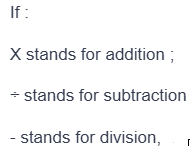
If :
X stands for addition ;
÷ stands for subtraction ;
- stands for division,
+ means multiplication
Then,

20 X 8 ÷ 8 - 4 + 2 shall be equal to
Figure for MBA CET 2025 Slot 1 question 143Figure for MBA CET 2025 Slot 1 question 143
  1. 22
  2. 15
  3. 24
  4. 25
  5. 30
Show answerHide answer

Answer: C

Approach: Decode symbols, then BODMAS.

Solution:
X → +, ÷ → −, − → ÷, + → ×
20 X 8 ÷ 8 − 4 + 2 becomes 20 + 8 − 8 ÷ 4 × 2
8 ÷ 4 × 2 = 2 × 2 = 4
20 + 8 − 4 = 24

Cetking shortcut: Write the decoded expression on paper before calculating — most errors come from decoding in your head.

Answer: C

Practise these in the Arena

Take timed tests built around MBA CET topics and see where you stand.

Open the Arena
