A thief starts running at a constant speed of 5 m/s. A policeman starts chasing the thief 2 seconds later at a speed of 10 m/s.
After how much time (from the moment the policeman starts running) will the policeman catch the thief?
- A1 second
- B2 seconds
- C3 seconds
- D4 seconds
- E5 second
Show answerHide answer
Answer: B ✓ official key
Approach: Chase problem: head start ÷ relative speed.
Solution:
In the first 2 s the thief covers 5 × 2 = 10 m.
Relative speed = 10 − 5 = 5 m/s.
Time to close 10 m = 10 / 5 = 2 s (from when the policeman starts).
Cetking shortcut: Policeman is twice as fast, so he catches up in the same time as the head-start time (2 s).
Answer: B
In a 1-kilometer race, A, B, and C are three participants.
A can give B, a start of 50 meters and C a start of 69 meters.
How many meters start can B, give C in the same race?
- A15 meters
- B18 meters
- C20 meters
- D21 meters
- E23 meters
Show answerHide answer
Answer: C ✓ official key
Approach: Race starts: convert to distances run in the same time.
Solution:
When A runs 1000 m, B runs 950 m and C runs 931 m.
So B : C speed = 950 : 931.
When B runs 1000 m, C runs 1000 × 931/950 = 980 m.
B can give C a start of 1000 − 980 = 20 m.
Why the other options are wrong:
B (19 m) is the naive 69 − 50 subtraction; A, D, E do not fit the ratio.
Cetking shortcut: 931/950 = 0.98 exactly (950 × 0.98 = 931) → 20 m.
Answer: C
A man travels three equal distances at speeds 30 km/h, 40 km/h, and 60 km/h, respectively.
What is the average speed of the man for the entire journey?
- A40 km/h
- B42 km/h
- C45 km/h
- D48 km/h
- E50 km/h
Show answerHide answer
Answer: A ✓ official key
Approach: Equal distances → average speed is the harmonic mean.
Solution:
Average speed = 3 / (1/30 + 1/40 + 1/60).
LCM 120: 1/30 + 1/40 + 1/60 = (4 + 3 + 2)/120 = 9/120.
Average speed = 3 × 120/9 = 40 km/h.
Why the other options are wrong:
- The arithmetic mean would be ≈ 43.3, which is not an option; B (42), C (45), D (48), E (50) are not the harmonic mean.
Cetking shortcut: Take distance = LCM 120 km each leg: times 4 + 3 + 2 = 9 h for 360 km → 40 km/h.
Answer: A
A and B are two stations 480 km apart. A train starts from A at 9:30 a.m. and travels towards B at 72 km/h. Another train starts from B at 10:15 a.m. and travels towards A at 48 km/h. At what time do the two trains meet?
- A1:30 p.m.
- B1:45 p.m.
- C1:48 p.m.
- D2:00 p.m.
- E2:15 p.m.
Show answerHide answer
Official CET key: C · Cetking's answer: B — see why below
Approach: Head start, then relative speed for trains moving towards each other.
Solution:
From 9:30 to 10:15 = 45 min = 3/4 h; train A covers 72 × 3/4 = 54 km alone.
Gap at 10:15 = 480 − 54 = 426 km.
Relative speed (towards each other) = 72 + 48 = 120 km/h.
Time = 426/120 = 3.55 h = 3 h 33 min.
Meeting time = 10:15 + 3:33 = 1:48 p.m.
Why the other options are wrong:
- A (1:30), B (1:45): ignore part of the time — 3.55 h is 3 h 33 min, not 3 h 30 min.
- D (2:00) would need 3.75 h after 10:15; E (2:15) comes from 480/120 = 4 h after 10:15, ignoring A's 54 km head start.
Cetking shortcut: 0.55 h × 60 = 33 min — convert decimals of an hour carefully; 3.5 h would be 3 h 30 min.
Answer: C
A rabbit takes 6 hops while a dog takes 5 hops in the same time. If 4 hops of the dog equal 5 hops of the rabbit, what is the ratio of their speeds (Rabbit : Dog)?
- A5 : 4
- B6 : 5
- C24 : 25
- D25 : 24
- E5 : 6
Show answerHide answer
Answer: C ✓ official key
Approach: Speed = (hops per unit time) × (length of one hop).
Solution:
4 dog hops = 5 rabbit hops → rabbit hop : dog hop = 4 : 5. Let rabbit hop = 4, dog hop = 5 units.
In the same time: rabbit 6 hops = 6 × 4 = 24 units; dog 5 hops = 5 × 5 = 25 units.
Speed ratio rabbit : dog = 24 : 25.
Why the other options are wrong:
- A (5 : 4), D (25 : 24): reverse the hop-length ratio.
- B (6 : 5): uses only hop counts.
- E (5 : 6): inverse of hop counts.
Cetking shortcut: Speed ratio = (hop-rate ratio) × (hop-length ratio) = (6/5) × (4/5) = 24/25.
Answer: C
In a 100 m race, A runs at a speed of 8 km per hour. A gives B a start of 4 m and still beats him by 15 seconds. What is the speed of B?
- A4.5 km/h
- B5.2 km/h
- C5.8 km/h
- D6.4 km/h
- E7 km/h
Show answerHide answer
Official CET key: C · Cetking's answer: B — see why below
Approach: Race with head start — B covers less distance but takes 15 s more.
Solution:
A's speed = 8 km/h = 8 × 5/18 = 20/9 m/s.
A's time for 100 m = 100 ÷ 20/9 = 45 s.
B starts 4 m ahead → runs 96 m, and finishes 15 s after A → 45 + 15 = 60 s.
B's speed = 96/60 = 1.6 m/s = 1.6 × 18/5 = 5.76 km/h ≈ 5.8 km/h.
Why the other options are wrong:
- A (4.5), B (5.2), D (6.4), E (7): none equals 96 m in 60 s (5.76 km/h); they come from using a wrong distance or time for B.
Cetking shortcut: Convert once: 96 m in 60 s = 96 × 60 m/h = 5.76 km/h.
Answer: C
In a 500 m race, the ratio of the speeds of two contestants A and B is 3 : 4. A has a start of 140 m. Then, A wins by:
- A10 m
- B20 m
- C30 m
- D40 m
- E60 m
Show answerHide answer
Answer: B ✓ official key
Approach: Races with a head start — compare the times to finish.
Solution:
A runs 500 − 140 = 360 m at speed 3 ⇒ time = 120 units.
In 120 units B runs 4 × 120 = 480 m.
When A finishes, B is 500 − 480 = 20 m short ⇒ A wins by 20 m.
Why the other options are wrong:
A (10), C (30), D (40), E (60) – wrong time base (e.g. using 500 m for A).
Cetking shortcut: Distance ratio = speed ratio: B covers 360 × 4/3 = 480 m while A covers 360 m.
Answer: B
Three runners A, B and C run a race, with runner A finishing 12 meters ahead of runner B and 18 meters ahead of runner C, while runner B finishes 8 meters ahead of runner C. Each runner travels the entire distance at a constant speed. What was the length of the race?
- A36 m
- B24 m
- C60 m
- D72 m
- E48 m
Show answerHide answer
Answer: E ✓ official key
Approach: Constant speeds ⇒ speed ratios chain: (A/B) × (B/C) = (A/C).
Solution:
Let the race length = L. When A finishes, B has run L − 12 and C has run L − 18.
When B finishes, C has run L − 8 ⇒ C/B = (L − 8)/L.
Also C/B = (L − 18)/(L − 12).
(L − 8)/L = (L − 18)/(L − 12) ⇒ L² − 20L + 96 = L² − 18L ⇒ 2L = 96 ⇒ L = 48 m.
Check: A : B : C = 48 : 36 : 30; B/C = 36/30 = 48/40 ✓.
Why the other options are wrong:
A (36), B (24), C (60), D (72) – fail the chained ratio check.
Cetking shortcut: B beats C by 6 m over the last L − 12 m and by 8 m over L m: 6/(L − 12) = 8/L ⇒ L = 48.
Answer: E
A person covers half of his journey at 30 km/h, one-third at 40 km/h, and the remaining part at 20 km/h.What is his average speed for the whole journey?
- A26 km/h
- B27 km/h
- C28 km/h
- D30 km/h
- E32 km/h
Show answerHide answer
Answer: D ✓ official key
Approach: Average speed = total distance / total time (not the mean of speeds).
Solution:
Take total distance = 6 units (LCM of 2 and 3): parts 3, 2, 1.
Time = 3/30 + 2/40 + 1/20 = 0.1 + 0.05 + 0.05 = 0.2.
Average speed = 6 / 0.2 = 30 km/h.
Cetking shortcut: Better: take distance = 120 km → 60/30 + 40/40 + 20/20 = 2 + 1 + 1 = 4 h → 120/4 = 30.
Answer: D
DIRECTION for the question: Solve the following question and mark the best possible option.
A motorist travels to a place 150 km away at an average speed of 50 km/hr and returns at 30 km/hr. His average speed for the whole journey in km/hr is?
- A35
- B37
- C37.5
- D40.5
- E40
Show answerHide answer
Answer: C ✓ official key
Approach: Harmonic mean for equal distances.
Solution: Average speed = 2 × 50 × 30 / (50 + 30) = 3000/80 = 37.5 km/hr.
Check: time = 150/50 + 150/30 = 3 + 5 = 8 h; 300/8 = 37.5.
Why the other options are wrong:
E (40): simple average — the classic trap.
A, B, D: calculation slips.
Answer: C
DIRECTION for the question: Solve the following question and mark the best possible option.
If a person walked at 14 km/hr. instead of 10 km/hr., he would have walked 20 km more. The actual distance traveled by him is?
- A50 km
- B56 km
- C70 km
- D80 km
- E30 km
Show answerHide answer
Answer: A ✓ official key
Approach: Time is the same in both cases.
Solution: Extra distance = (14 − 10) × t = 20 ⇒ t = 5 hours.
Actual distance = 10 × 5 = 50 km.
Why the other options are wrong:
C (70 km): distance at 14 km/hr.
B, D, E: arithmetic slips.
Answer: A
DIRECTION for the question: Solve the following question and mark the best possible option.
A train X starts from Meerut at 4 pm and reaches Ghaziabad at 5 pm. While another train Y starts from Ghaziabad at 4pm and reaches Meerut at 5:30pm. The two trains will cross each other at?
- A4.36 pm
- B4.42 pm
- C4.48 pm
- D4.50 pm
- E4.55 pm
Show answerHide answer
Answer: A ✓ official key
Approach: Relative speed with distance as 1 unit.
Solution: X takes 60 min, Y takes 90 min (4:00 to 5:30).
Let distance = 180 units. Speed X = 3 units/min, Y = 2 units/min.
Meeting time = 180 ÷ (3 + 2) = 36 min after 4 pm.
They cross at 4:36 pm.
Why the other options are wrong:
B–E: come from wrong times (e.g. averaging) — the formula gives exactly 36 min.
Cetking shortcut: T = (60 × 90)/(60 + 90) = 5400/150 = 36 min.
Answer: A
DIRECTION for the question: Solve the following question and mark the best possible option.
Two trains, one from Howrah to Patna and the other from Patna to Howrah, start simultaneously. After they meet, the trains reach their destinations after 9 hours and 16 hours respectively. The ratio of their speed is?
- A2:3
- B4:3
- C6:7
- D9:16
- E5:7
Show answerHide answer
Answer: B ✓ official key
Approach: Speed ratio = √(time of the other after meeting).
Solution: Howrah train: 9 h after meeting; Patna train: 16 h.
S1 : S2 = √16 : √9 = 4 : 3.
Why the other options are wrong:
D (9 : 16): takes the time ratio directly.
A (2 : 3): no valid working.
C, E: no valid working.
Answer: B
DIRECTION for the question: Solve the following question and mark the best possible option.
In a 100 m race, A covers the whole distance in 36 seconds and B in 45 seconds. In this race, A beats B by
- A20 m
- B25 m
- C22.5 m
- D9 m
- E10 m
Show answerHide answer
Answer: A ✓ official key
Approach: Distance B covers in A's time.
Solution: B's speed = 100/45 m/s.
In 36 s B runs 36 × 100/45 = 80 m.
A beats B by 100 − 80 = 20 m.
Why the other options are wrong:
D (9 m): takes 45 − 36 seconds as metres.
B (25 m): uses A's speed × 9 s.
C, E: arithmetic slips.
Answer: A
DIRECTION for the question: Solve the following question and mark the best possible option.
In a 200 m race, A beats B by 35 m or 7 seconds. A's time over the course is
- A40 sec
- B47 sec
- C33 sec
- D35 sec
- E20 sec
Show answerHide answer
Answer: C ✓ official key
Approach: Use the beat-margin to find B's speed.
Solution: B runs 35 m in 7 s ⇒ speed = 5 m/s.
B's time for 200 m = 200 ÷ 5 = 40 s.
A's time = 40 − 7 = 33 s.
Why the other options are wrong:
A (40 s): B's time.
B (47 s): adds 7 instead of subtracting.
D, E: no valid working.
Answer: C
There are 23 steps to reach a temple. On descending from the temple, Ram takes two steps in the same time Shyam ascends one step. If they start to work simultaneously, at which step will they meet each other from the bottom?
- A8 th
- B10 th
- C9 th
- D11 th
- E15 th
Show answerHide answer
Answer: A
Approach: Relative movement on steps — count step positions after each move.
Solution: Shyam starts at the bottom (step 0) and goes up 1 step per move; Ram starts at the top (step 23) and comes down 2 steps per move. The gap of 23 steps closes by 3 steps per move.
After 7 moves: Shyam is on step 7, Ram on step 23 − 14 = 9.
The only step between them now is step 8; in the next move both reach/cross it, so they meet at step 8 from the bottom.
Cetking shortcut: Gap ÷ combined steps = 23 ÷ 3 = 7.67 → they meet during the 8th move, i.e. on the 8th step.
Answer: A
Two trains P and Q start simultaneously in the opposite direction from two points A and B and arrive at their destinations 25 and 16 hours respectively after their meeting each other. At what speed does the second train Q travel if the first train travels at 100 km/h?
- A100
- B125
- C120
- D140
- E115
Show answerHide answer
Answer: B
Approach: Trains meeting rule: SP/SQ = √(tQ/tP), where t = time taken after meeting.
Solution:
Time of P after meeting tP = 25 h; time of Q after meeting tQ = 16 h.
SP/SQ = √(16/25) = 4/5
100/SQ = 4/5 ⇒ SQ = 100 × 5/4 = 125 km/h
Cetking shortcut: The train that takes LESS time after meeting is FASTER — so Q > 100; only 120, 125, 140, 115 qualify, and √(25/16) = 5/4 gives 125.
Answer: B
Amit cycled from his house to the garden at speed of 12 km/hr and cam back to his house at the speed of 6 km/hr. if the total time taken by Amit to complete the journey was 6 hours, then find the distance between Amit's House and garden?
- A32
- B28
- C24
- D36
- E40
Show answerHide answer
Answer: C
Approach: Distance = Speed × Time; same distance both ways.
Solution:
Let one-way distance = D km.
Time going = D/12, time returning = D/6.
D/12 + D/6 = 6 ⇒ (D + 2D)/12 = 6 ⇒ 3D = 72 ⇒ D = 24 km.
Cetking shortcut: Average speed for equal distances = 2×12×6/(12+6) = 8 km/h; total distance = 8 × 6 = 48 km, one way = 24 km.
Answer: C
the speeds of A,B and C are 15 m/s, 67 Kmph and 1020 m/ minute. if they start running in the same direction find the maximum difference between any two of them after 8 hours 30 minutes and 39 seconds.
- A111.399 km
- B112.289 km
- C109.243 km
- D108.221 km
- E110.606 km
Show answerHide answer
Answer: E
Approach: Gap between two runners in the same direction = (difference of speeds) × time; max gap is between fastest and slowest.
Solution:
Speeds in m/s: A = 15; B = 67 × 5/18 ≈ 18.61; C = 1020/60 = 17.
Fastest = B, slowest = A ⇒ speed difference = 18.61 − 15 = 3.61 m/s.
Time = 8 h 30 min 39 s = 30600 + 39 = 30639 s.
Maximum gap = 3.61 × 30639 ≈ 110606.8 m ≈ 110.606 km (rounding the speed to 3.61 m/s; the unrounded 3.6111 gives 110.64 km, still closest to E).
Why the other options are wrong:
Ignoring the 39 seconds gives ≈ 110.47 km — not offered.
A, B, C, D: other pairs/slips; B−C and C−A gaps are far smaller (≈ 49 km and ≈ 61 km).
Cetking shortcut: Only the fastest-minus-slowest pair matters: 3.61 m/s × 30639 s.
Answer: E
A road from A to B is 11.5 km long: first goes uphill, then crosses a plain, and then goes downhill. A person walking from A to B covered this road in 2 h 54 min, and the return journey took him 3 h 6 min. His speed uphill is 3 km/h, on the plain 4 km/h and downhill is 5 km/h. What is the length of the plain part of the journey?
- A4.5 km
- B5 km
- C5.5 km
- D6 km
- E4 km
Show answerHide answer
Answer: E
Approach: Uphill one way is downhill the other way; add the two journeys so hill parts combine.
Solution:
Let uphill (A→B) = x, plain = y, downhill (A→B) = z; x + y + z = 11.5
A→B: x/3 + y/4 + z/5 = 2.9 h (2 h 54 min)
B→A: x/5 + y/4 + z/3 = 3.1 h (3 h 6 min)
Add: (1/3 + 1/5)(x + z) + y/2 = 6 → (8/15)(11.5 − y) + y/2 = 6
× 30: 16(11.5 − y) + 15y = 180 → 184 − y = 180 → y = 4 km
(Also x = 3, z = 4.5: 1 + 1 + 0.9 = 2.9 ✓)
Cetking shortcut: Adding the two trips removes the direction issue — every hill km costs 8/15 h round trip, every plain km 1/2 h. If all 11.5 km were hill: 11.5 × 8/15 = 6.133 h; actual 6 h; each plain km saves 1/30 h → 0.133 × 30 = 4 km.
Answer: E
In a 100 m race, A beats B by 10m and C by 13m. In a race of 180 m , B will beat C by
- A5.4 m
- B5 m
- C6 m
- D4 m
- E4.4 m
Show answerHide answer
Answer: C
Approach: Distances covered in the same time are in the ratio of speeds.
Solution:
When A runs 100, B runs 90 and C runs 87
So B : C = 90 : 87 = 30 : 29
When B runs 180, C runs 180 × 29/30 = 174
B beats C by 180 − 174 = 6 m
Why the other options are wrong:
A (5.4 m): uses 3 m per 100 m instead of 3 m per 90 m.
B, D, E: arithmetic slips; only 6 m satisfies the 30 : 29 speed ratio.
Cetking shortcut: B beats C by 3 m in 90 m → 1 m per 30 m → 6 m in 180 m.
Answer: C
A ship 156 km from the shore springs a leak which admits 2 1/3 metric tons of water in 6 1/2 minutes. A quantity of 68 metric tons would suffice to sink it, but the pumps can throw out 15 metric tons in an hour. The average rate of sailing so that it just reaches the shore as it begins to sink should be
- A16 km/hr
- B18 km/hr
- C15 km/hr
- D14 km/hr
- E17 km/hr
Show answerHide answer
Answer: C
Approach: Net inflow = leak rate − pump rate; ship must reach shore before 68 t accumulates.
Solution:
Leak: (7/3) t in (13/2) min → 14/39 t/min → 840/39 = 280/13 t/h
Net inflow = 280/13 − 15 = 85/13 t/h
Time to sink = 68 ÷ 85/13 = 68 × 13/85 = 10.4 h
Speed = 156/10.4 = 15 km/h
Why the other options are wrong:
A/B/D/E: rounding the leak rate early or forgetting the pump gives wrong times (e.g. ignoring pump → 3.16 h).
Cetking shortcut: Keep fractions: 68 × 13/85 = 4 × 13/5 = 10.4 h exactly → 156/10.4 = 15.
Answer: C
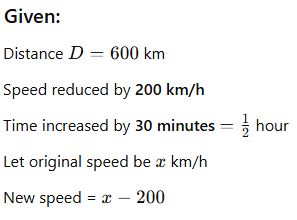
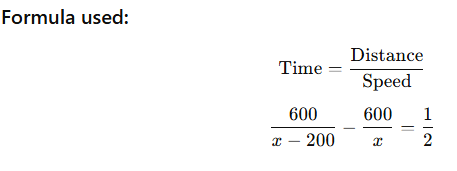
In a flight of 600 km, an aircraft was slowed down due to bad weather. Its average speed for the trip was reduced by 200 km/hr and the time of flight increased by 30 minutes. The duration of the flight is
- A1 hrs.
- B2 hrs.
- C3 hrs.
- D4 hrs.
- E2.5 hrs.
Show answerHide answer
Answer: A
Approach: Fixed distance — speed down, time up.
Solution:
Let the usual speed = s km/hr; scheduled time = 600/s.
600/(s − 200) − 600/s = 1/2.
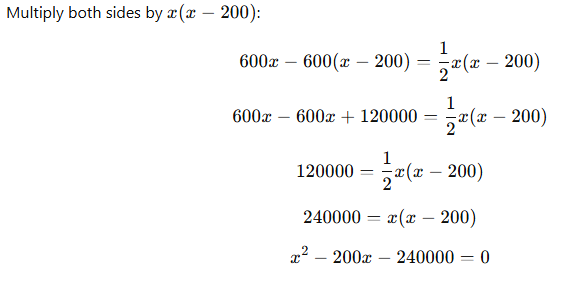
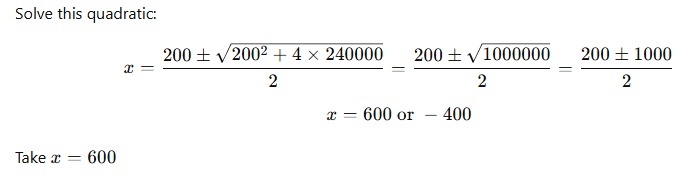
600 × 200 = ½ × s(s − 200) ⇒ s² − 200s − 240000 = 0 ⇒ (s − 600)(s + 400) = 0 ⇒ s = 600 km/hr.
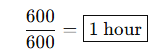
Scheduled duration of the flight = 600/600 = 1 hr (the slowed flight took 1 hr + 30 min = 1.5 hr).
The duration asked (scheduled flight time) = 1 hr.
Why the other options are wrong:
B (2 hrs): s = 300 ⇒ 600/100 − 2 = 4 hr extra, not 0.5.
C, D, E: likewise give extra time ≠ 30 min.
Cetking shortcut: Test options as the scheduled time t: 600/t − 600/(t + 0.5) must be 200 ⇒ t = 1: 600 − 400 = 200 ✓.
Answer: A
A and B take part in 100m race. A runs at 5 kmph. A gives B a start of 8 m and still beats him by 8 seconds. The speed of B is:
- A4.14kmph
- B4.5kmph
- C4.32kmph
- D4.9kmph
- E4.11kmph
Show answerHide answer
Answer: A
Approach: Races — head start and time margin.
Solution:
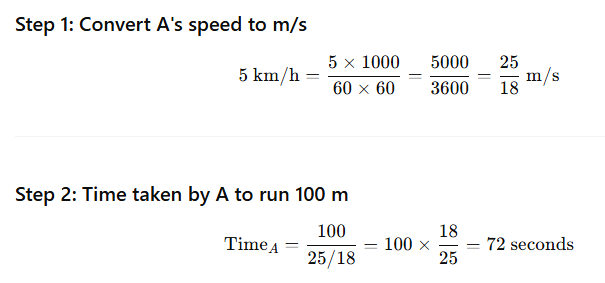
A's speed = 5 km/hr = 25/18 m/s ⇒ A's time for 100 m = 100 × 18/25 = 72 s.
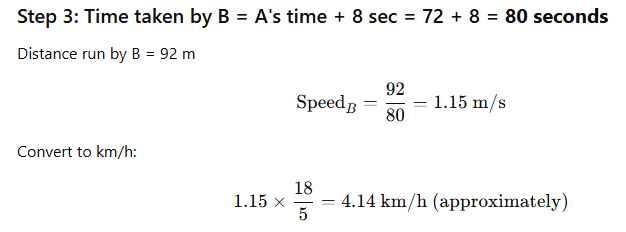
B starts 8 m ahead ⇒ runs 92 m, and finishes 8 s after A ⇒ B's time = 80 s.
B's speed = 92/80 = 1.15 m/s = 1.15 × 18/5 = 4.14 km/hr.
Why the other options are wrong:
B, C, D, E: use 100 m or 72/80 s wrongly.
Cetking shortcut: B's speed = 5 × (92/100) × (72/80) = 5 × 0.92 × 0.9 = 4.14 km/hr.
Answer: A
A motorist covers a distance of 39 km in 45 minutes by moving at a speed of x kmph for the first 15 minutes, then moving at a double the speed for the next 20 minutes and then again moving at his original speed for the rest of the journey. Then, x is equal to :
- A31.2
- B36
- C40
- D52
- E39
Show answerHide answer
Answer: B
Approach: Sum the distances of the three segments.
Solution: Segment times: 15 min = 1/4 h (speed x), 20 min = 1/3 h (speed 2x), 10 min = 1/6 h (speed x).
Distance = x/4 + 2x/3 + x/6 = (3x + 8x + 2x)/12 = 13x/12.
13x/12 = 39 → x = 36 km/h.
Cetking shortcut: Effective 'x-minutes' = 15 + 2×20 + 10 = 65 min at speed x → 39 km in 65 min → x = 39 × 60/65 = 36.
Answer: B
A motorist covers 39 km in 45 minutes by moving at x km/h for the first 15 min, then double that speed for the next 20 min, and finally again at original speed. Find x.
- A31.2
- B32
- C36
- D39.6
- E52
Show answerHide answer
Answer: C
Approach: Distance = speed × time for each part; times in hours.
Solution:
45 min = 15 min at x + 20 min at 2x + 10 min at x.
Distance = x(15/60) + 2x(20/60) + x(10/60) = x/4 + 2x/3 + x/6 = 13x/12.
13x/12 = 39 → x = 39 × 12/13 = 36 km/h.
Cetking shortcut: Time at x is equivalent to 15 + 40 + 10 = 65 min at speed x → x = 39 × 60/65 = 36.
Answer: C
A motorbike leaves point A at 1 pm and moves towards point B at a uniform speed. A car leaves point B at 2 pm and moves towards point A at a uniform speed, which is double that of the motorbike. They meet at 3:40 pm at a point which is 168 km away from A.
What is the distance (in km) between A and B?
- A400
- B395
- C365
- D375
- E378
Show answerHide answer
Answer: E
Approach: Use the motorbike's distance to A to find its speed, then add both distances.
Solution:
Motorbike: 1 pm → 3:40 pm = 8/3 h; car: 2 pm → 3:40 pm = 5/3 h.
Motorbike speed x: (8/3)x = 168 → x = 63 km/h; car = 126 km/h.
Car distance = 126 × 5/3 = 210 km.
AB = 168 + 210 = 378 km.
Cetking shortcut: Car covers 2 × (5/8) = 5/4 of the motorbike's distance: 168 × 5/4 = 210.
Answer: E
A thief, after committing the burglary, started fleeing at 12 noon, at a speed of 60 km/hr. He was then chased by a policeman X. X started the chase, 15 min after the thief had started, at a speed of 65 km/hr. If another policeman had started the same chase along with X, but at a speed of 60 km/hr, then how far behind was he when X caught the thief?
- A32.5 km
- B17.5 km
- C21 km
- D20 km
- E15 km
Show answerHide answer
Answer: E
Approach: Relative speed for the catch time; a chaser at the thief's own speed never closes the gap.
Solution:
Head start of thief in 15 min = 60 × 0.25 = 15 km.
X closes at 65 − 60 = 5 km/h → catch time = 15/5 = 3 h after 12:15.
In those 3 h, X runs 195 km; the second policeman (60 km/h, same start time as X) runs 180 km.
Gap at the moment of catching = 195 − 180 = 15 km.
Cetking shortcut: The second policeman matches the thief's speed, so he stays exactly as far behind as the thief's head start: 15 km.
Answer: E
Deep inside a jungle, a deer and a tiger are joyfully playing. The deer notices that it is 40 steps away from the tiger and starts running towards it. At the same time, the tiger starts running away. For every five steps the deer takes, the tiger takes six. However, the deer takes two steps to cover the distance that the tiger covers in three. In how many steps can the deer catch the tiger?
- A200
- B180
- C150
- D320
- E240
Show answerHide answer
Answer: A
Approach: Convert both animals to the same distance unit (deer steps) and per-time rates.
Solution:
2 deer steps = 3 tiger steps → 1 tiger step = 2/3 deer step.
In the time the deer takes 5 steps (5 deer-steps of distance), the tiger takes 6 steps = 6 × 2/3 = 4 deer-steps.
Gain = 1 deer-step per 5 deer steps.
Gap = 40 deer-steps → deer needs 40 × 5 = 200 steps.
Cetking shortcut: Distance ratio per unit time = 5 : 4 → deer gains 1 part in 5; 40 × 5 = 200.
Answer: A
In a 4000 m race around a circular track of circumference 1000 m, the fastest and the slowest runners meet for the first time after the start at the end of the 5th minute. If the fastest runner runs at twice the speed of the slowest, in how much time will the fastest runner finish the race?
- A15 minutes
- B20 minutes
- C10 minutes
- D13 minutes
- E5 minutes
Show answerHide answer
Answer: C
Approach: On a circular track, runners meet for the first time when the faster gains one full lap.
Solution:
Let slowest = x m/min, fastest = 2x m/min.
First meeting after 5 min: gain of one lap → (2x − x) × 5 = 1000 → x = 200 m/min.
Fastest = 400 m/min → 4000 m race takes 4000/400 = 10 minutes.
Cetking shortcut: In 5 min the fastest runs exactly 2 laps (the slow one 1), so 2000 m per 5 min → 4000 m in 10 min.
Answer: C
A motorbike leaves point A at 1 pm and moves towards point B at a uniform speed. A car leaves point B at 2 pm and moves towards point A at a uniform speed which is double that of the motorbike. They meet at 3:40 pm at a point which is 168 km away from A. What is the distance, in km, between A and B?
- A400
- B395
- C365
- D375
- E378
Show answerHide answer
Answer: E
Approach: Use the meeting-point distance from A to find the bike's speed, then add the car's distance.
Solution: Let bike speed = x km/h; car speed = 2x.
Bike time (1:00 → 3:40 pm) = 2 h 40 min = 8/3 h. Meeting point is 168 km from A, so (8/3)x = 168 → x = 63 km/h.
Car time (2:00 → 3:40 pm) = 1 h 40 min = 5/3 h. Car distance = 126 × 5/3 = 210 km.
AB = 168 + 210 = 378 km.
Why the other options are wrong:
A, B, C, D: none matches 168 + 210; D (375) is a near-miss trap.
Cetking shortcut: Distances ∝ speed × time = 1 × 8 : 2 × 5 = 8 : 10. Bike's 8 parts = 168 → 1 part = 21 → total 18 parts = 378.
Answer: E
The speeds of 3 cars in the ratio 5 : 4 : 6. The ratio between the time taken by them to travel same distance shall be :
- A15:12:11
- B12:10:13
- C10:20:30
- D5:4:6
- E12:15:10
Show answerHide answer
Answer: E
Approach: For a fixed distance, time is inversely proportional to speed.
Solution:
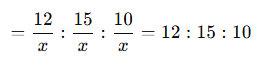
Time ratio = 1/5 : 1/4 : 1/6.
Multiply by LCM 60: 12 : 15 : 10.
So times are in the ratio 12 : 15 : 10.
Why the other options are wrong:
5 : 4 : 6: this is the speed ratio itself.
15 : 12 : 11, 12 : 10 : 13, 10 : 20 : 30: not the reciprocal ratio.
Cetking shortcut: Inverse of a : b : c = bc : ac : ab → 4×6 : 5×6 : 5×4 = 24 : 30 : 20 = 12 : 15 : 10.
Answer: E
A friend is spotted by Lala at a distance of 200 m. When Lala starts to approach him, the friend also starts moving in the same direction as Lala. If the speed of his friend is 15 kmph, and that of Lala is 20 kmph, then how far will the friend have to walk before Lala meets him ?
- A600m
- B0.6m
- C6km
- D900m
- E6m
Show answerHide answer
Answer: A
Approach: Same-direction chase: gap closes at relative speed (difference of speeds).
Solution:
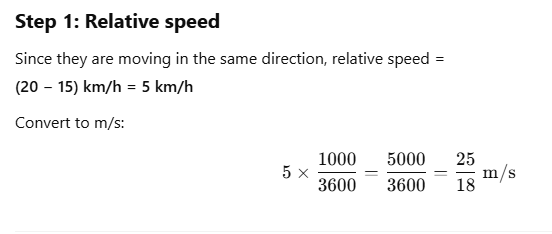
Relative speed = 20 − 15 = 5 km/h.
Gap 200 m = 0.2 km → time = 0.2 / 5 = 0.04 h.
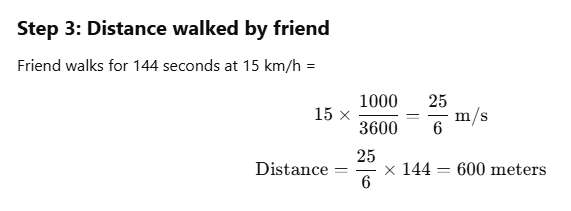
Distance walked by the friend = 15 × 0.04 = 0.6 km = 600 m.
Why the other options are wrong:
900 m: no working gives this (Lala walks 800 m, the friend 600 m).
6 km / 0.6 m / 6 m: unit slips.
Cetking shortcut: Distance ratio = speed ratio: friend : Lala = 15 : 20 = 3 : 4, and the difference (1 part) = 200 m → friend = 3 × 200 = 600 m.
Answer: A
A bus covers a distance of first 50 km in 40 minutes, next 50 km at a speed of 2 km per minute and the next 30 km at a speed of 1.0 km per minute. What is its average speed during the entire journey ?
- A81.2kmph
- B64.8kmph
- C80.8kmph
- D84.1kmph
- E82.1kmph
Show answerHide answer
Answer: E
Approach: Find time for each leg, then total distance / total time.
Solution:
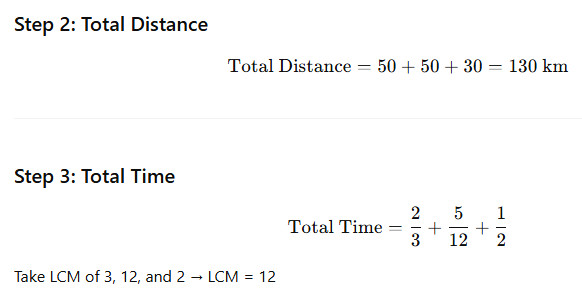
Leg 1: 50 km in 40 min
Leg 2: 50 km at 2 km/min = 25 min
Leg 3: 30 km at 1 km/min = 30 min
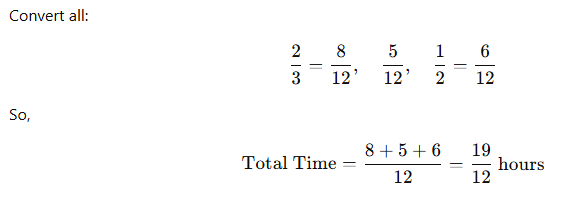
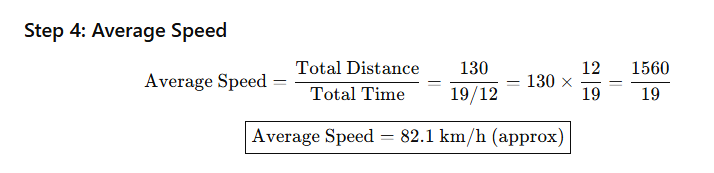
Total: 130 km in 95 min
Average speed = 130 × 60/95 = 7800/95 = 82.1 km/h
Cetking shortcut: 130/95 ≈ 1.368 km/min × 60 ≈ 82.1 — just above 82, which rules out 81.2 and 80.8.
Answer: E