Let’s Crack CET 2027

Your CET check-up · tap a ring to see yours

Vocabulary in Context – MBA CET questions with solutions

32 questions · CET 2025–2026 · Easy 23 · Medium 9 · Hard 0. Newest paper first. Full papers

Q165EasyCET 2026 · Attempt 2 Slot 2 · Q165

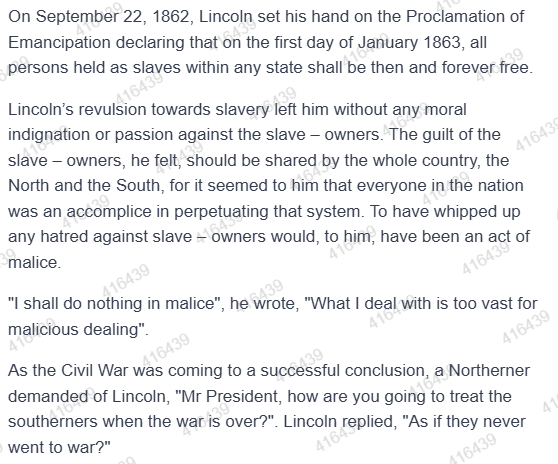
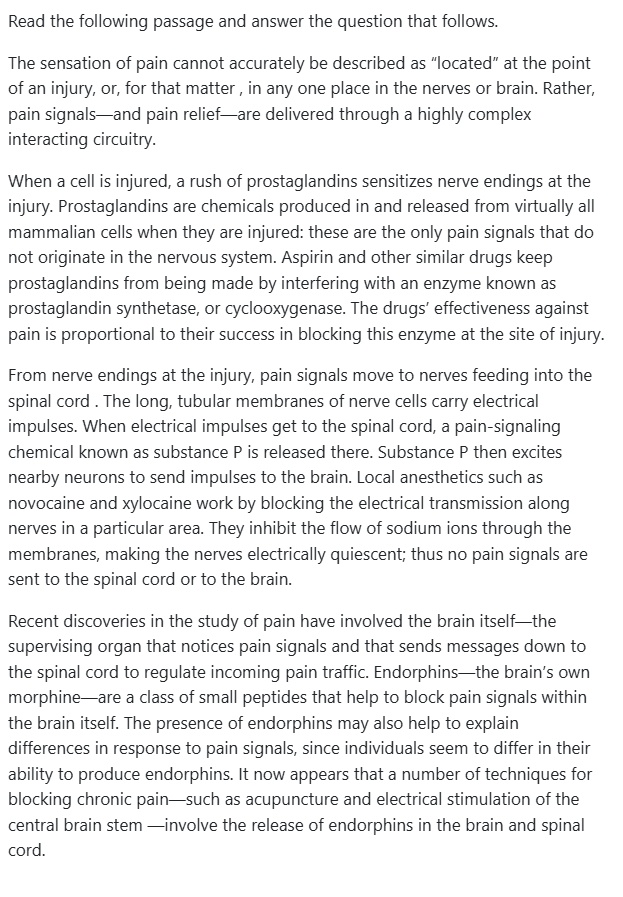
Passage shown as image

What does the word 'quiescent' implies?

Figure for MBA CET 2026 Attempt 2 Slot 2 question 165
  1. dormant
  2. vibrant
  3. busy
  4. dead
  5. energetic
Show answerHide answer

Answer: A official key

Approach: Vocabulary in context.

Solution: Para 3: anaesthetics inhibit sodium flow, 'making the nerves electrically quiescent; thus no pain signals are sent.' Quiescent = inactive, at rest, temporarily quiet — i.e. dormant.

Why the other options are wrong:
B, C, E: vibrant/busy/energetic are opposites.
D: 'dead' is too strong — the nerves recover when the anaesthetic wears off.

Answer: A

Q169MediumCET 2026 · Attempt 2 Slot 2 · Q169
Passage / data for this question

Passage shown as image

Choose the synonym for the word 'transcription' given in the passage.

Figure for MBA CET 2026 Attempt 2 Slot 2 question 169
  1. introduction
  2. evidence
  3. variation
  4. induction
  5. deduction
Show answerHide answer

Answer: B official key

Approach: Vocabulary in context — closest meaning of 'transcription' among the options.

Solution: In the passage, tTAV 'blocks the transcription of several other genes' — transcription is the copying of a gene's information into a record (RNA). In general use, a transcription (transcript) is a written copy or record of something, and a record is what serves as evidence. None of the other options carries the sense of a copied record, so evidence is the closest.

Why the other options are wrong:
A: Introduction — a beginning, not a copy.
C: Variation — a change, the opposite of a faithful copy.
D, E: Induction/deduction — modes of reasoning.

Answer: B

Q170EasyCET 2026 · Attempt 2 Slot 2 · Q170
Passage / data for this question

Passage shown as image

Which of these is an antonym to the word 'sustained' given in the passage?

Figure for MBA CET 2026 Attempt 2 Slot 2 question 170
  1. nourished
  2. sporadic
  3. back
  4. relieved
  5. prolonged
Show answerHide answer

Answer: B official key

Approach: Antonym in context.

Solution: 'Sustained release over the course of a year led to a reduction…' — sustained = continuous, kept up without break. The opposite is sporadic = occurring irregularly, now and then.

Why the other options are wrong:
A: nourished — a different sense of 'sustain' (to feed), and a near-synonym, not an antonym.
C: 'back' — unrelated.
D: relieved — unrelated to continuity.
E: prolonged — a synonym.

Cetking shortcut: Antonym questions: first eliminate synonyms (prolonged, nourished).

Answer: B

Q184EasyCET 2026 · Slot 4 · Q184

Passage shown as image

Choose the word which is most nearly the similar in meaning to the word ‘disseminating’ as used in the passage.

Figure for MBA CET 2026 Slot 4 question 184
  1. Agree
  2. Taunt
  3. Barb
  4. Sneer
  5. Spread
Show answerHide answer

Answer: E official key

Approach: Vocabulary in context: read the sentence around the word.

Solution: 'Disseminating news and information on paper presented significant challenges. When each copy had to be handwritten, mass distribution was impossible.' The context is about distribution, so disseminating = SPREADING widely.

Why the other options are wrong:
A Agree: unrelated.
B Taunt, C Barb, D Sneer: all mean mocking or insulting remarks; none fits distributing news.

Cetking shortcut: Three options are synonyms of one another (taunt/barb/sneer), so all three are out at once.

Answer: E

Q188EasyCET 2026 · Slot 4 · Q188
Passage / data for this question

Passage shown as image

Which of the following word is most similar in meaning to “accounting for” as given in the passage?

Figure for MBA CET 2026 Slot 4 question 188
  1. contradict
  2. contribute
  3. devious
  4. retrieve
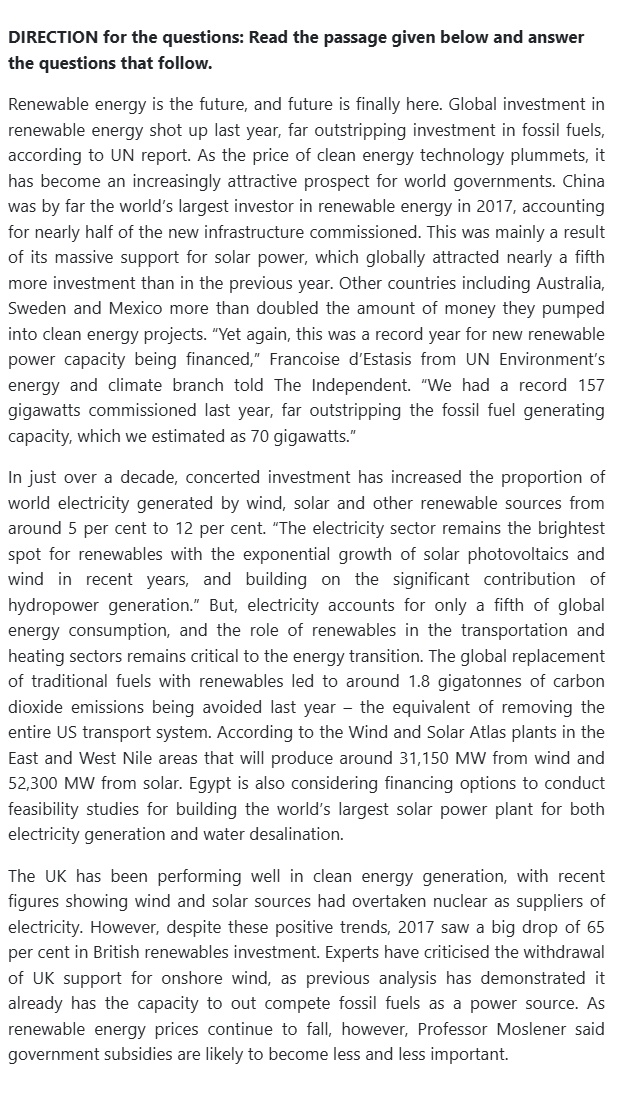
  5. categorical
Show answerHide answer

Answer: B official key

Approach: Vocabulary in context: read the sentence.

Solution: 'China was by far the world's largest investor ... accounting for nearly half of the new infrastructure commissioned.' Here 'accounting for' = forming or contributing that share. CONTRIBUTE fits.

Why the other options are wrong:
A Contradict: to deny; unrelated.
C Devious: dishonest; an adjective.
D Retrieve: to get back.
E Categorical: absolute; an adjective.

Answer: B

Q189EasyCET 2026 · Slot 4 · Q189
Passage / data for this question

Passage shown as image

Which of the following words is most similar in meaning to “plummets” as given in the passage?

Figure for MBA CET 2026 Slot 4 question 189
  1. Intensify
  2. Escalate
  3. Callous
  4. Slump
  5. Reminiscent
Show answerHide answer

Answer: D official key

Approach: Vocabulary in context.

Solution: 'As the price of clean energy technology plummets, it has become an increasingly attractive prospect.' Falling prices make it attractive, so plummets = falls sharply. SLUMP = a sudden fall.

Why the other options are wrong:
A Intensify / B Escalate: mean increase, the opposite.
C Callous: insensitive; unrelated.
E Reminiscent: suggestive of the past; unrelated.

Answer: D

Q192MediumCET 2026 · Slot 4 · Q192
Passage / data for this question

Passage shown as image

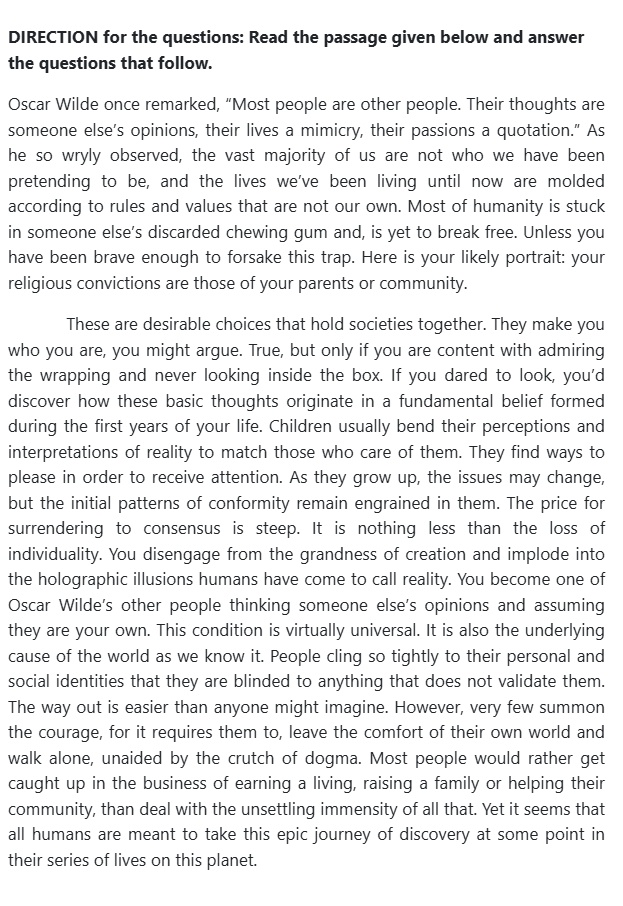
In the context of the passage, ‘wryly’ means:

Figure for MBA CET 2026 Slot 4 question 192
  1. Disapprovingly
  2. Unwillingly
  3. Repulsively
  4. Hesitatingly
  5. Willingly
Show answerHide answer

Answer: A official key

Approach: Vocabulary in context: what was Wilde's attitude in the quote?

Solution: 'As he so wryly observed, the vast majority of us are not who we have been pretending to be.' Wilde is mocking people's lack of originality with dry, ironic humour; the attitude underneath is critical. Of the options, DISAPPROVINGLY captures this critical, mocking sense.

Why the other options are wrong:
B Unwillingly / D Hesitatingly: Wilde's remark is confident, not reluctant.
C Repulsively: means in a disgusting way; far too strong and wrong sense.
E Willingly: describes readiness, not tone.

Answer: A

Q194MediumCET 2026 · Slot 4 · Q194
Passage / data for this question

Passage shown as image

What does the expression ‘lives a mimicry, passions a quotation’ mean?

Figure for MBA CET 2026 Slot 4 question 194
  1. Lives a parody, feelings a repetition
  2. Lives a duplication, feelings a recitation
  3. Lives an imitation, feelings a borrowing
  4. Lives a sham, feelings a deception
  5. Lives originality, feeling a meaning
Show answerHide answer

Answer: C official key

Approach: Translate both halves of the expression.

Solution: Mimicry = imitation of others. A quotation = words borrowed from someone else. So: lives are imitations, feelings are borrowed. Option C ('Lives an imitation, feelings a borrowing') matches both halves.

Why the other options are wrong:
A Parody implies mockery or humour; 'repetition' misses the idea of borrowing.
B Recitation is reciting aloud, narrower than borrowing.
D Sham and deception suggest deliberate fraud; the passage describes unconscious conformity.
E Says lives are original, the opposite.

Answer: C

Q199EasyCET 2026 · Slot 4 · Q199

Passage shown as image

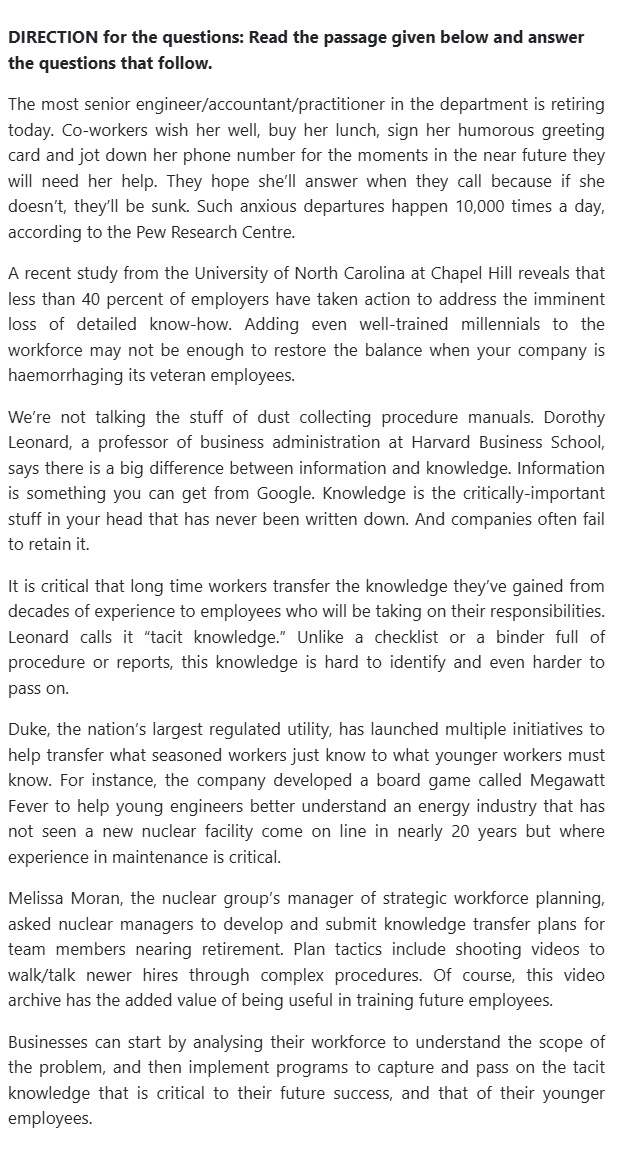
What does the phrase “haemorrhaging its veteran employees”, as used in paragraph 2, refer to?

Figure for MBA CET 2026 Slot 4 question 199
  1. Not providing them with proper healthcare post retirement.
  2. Pressuring them into coming back to work.
  3. Severing all ties with them after they retire.
  4. Laying off their oldest employees.
  5. Retiring of their most experienced employees.
Show answerHide answer

Answer: E official key

Approach: Vocabulary in context: haemorrhage = heavy loss of blood, used figuratively for a heavy loss.

Solution: The passage is about senior workers retiring and taking know-how with them ('Such anxious departures happen 10,000 times a day'). So a company 'haemorrhaging its veteran employees' is losing its most experienced employees to retirement: option E.

Why the other options are wrong:
A Healthcare after retirement: a literal 'medical' misreading.
B Pressuring them to return: not discussed.
C Severing ties: colleagues even keep her number to call her.
D Laying off: the employees retire; they are not fired.

Answer: E

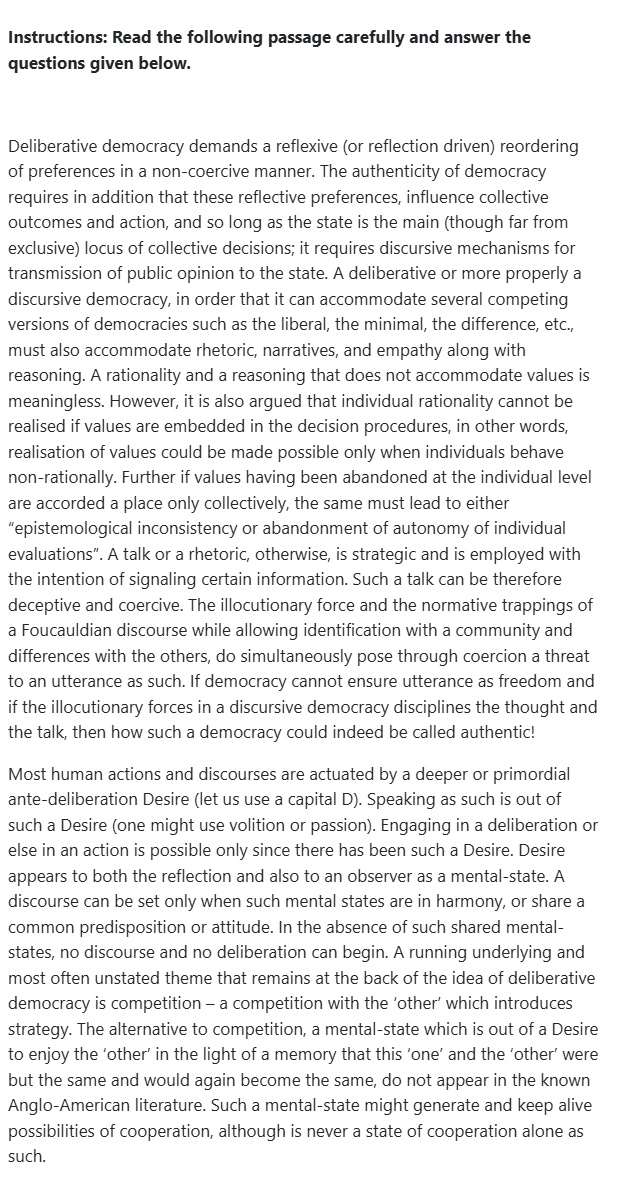
Q155EasyCET 2026 · Slot 3 · Q155

Passage shown as image

Which of the following word is closest to the word ‘primordial’ as used in the passage above ?

Figure for MBA CET 2026 Slot 3 question 155
  1. Elemental
  2. Anarchist
  3. Animalistic
  4. Nihilistic
  5. Discursive
Show answerHide answer

Answer: A official key

Approach: Vocabulary in context.

Solution: "A deeper or primordial ante-deliberation Desire" — the Desire is the original, most basic force behind action. Primordial = existing from the beginning, fundamental. Elemental = basic, fundamental, primary.

Why the other options are wrong:
B: Anarchist — against authority; unrelated.
C: Animalistic — beast-like; primordial is about origin, not animal nature.
D: Nihilistic — rejecting all values; unrelated.
E: Discursive — related to discourse/rambling; unrelated.

Cetking shortcut: 'Deeper or primordial' — the word 'deeper' already tells you it means basic/fundamental.

Answer: A

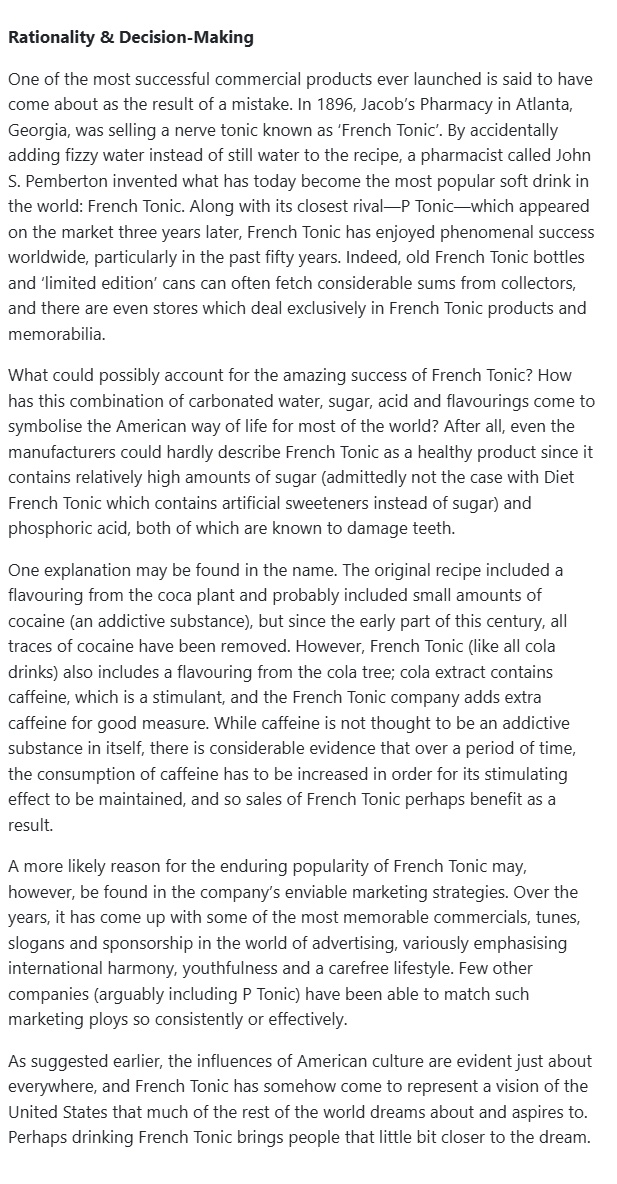
Q161EasyCET 2026 · Slot 3 · Q161
Passage / data for this question

Passage shown as image

According to the paragraph, ‘cans can often fetch considerable sums’ means the same as:

Figure for MBA CET 2026 Slot 3 question 161
  1. French Tonic is quite expensive in some parts of the world.
  2. collectors consider carefully how much they are paying for a can of French Tonic.
  3. Technological innovation is sufficient to achieve sustainability
  4. Some collectors will only drink French Tonic in exclusive stores.
  5. Certain French Tonic cans are worth a lot of money as collectable items.
Show answerHide answer

Official CET key: D · Cetking's answer: E — see why below

Approach: Phrase meaning in context.

Solution: Para 1: "old French Tonic bottles and 'limited edition' cans can often fetch considerable sums from collectors, and there are even stores which deal exclusively in French Tonic products and memorabilia." To 'fetch a sum' = to be sold for that amount. So the phrase means certain cans are worth a lot of money as collectable items — option E. The official MahaCET key marks D, linking the phrase to the very next clause about exclusive stores; the passage, however, speaks of stores selling products and memorabilia, not of collectors drinking there.

Why the other options are wrong:
A: About the price of the drink, not of collectable cans.
B: Collectors paying 'carefully' is not the sense of 'fetch'.
C: Technological innovation/sustainability — unrelated to the passage.
D (official key): The exclusive-stores detail is in the passage, but it is about stores dealing in products and memorabilia, not collectors drinking.

Cetking shortcut: 'Fetch' + money = sell for. Match the option that keeps both 'cans' and 'collectors'.

Answer: D (official MahaCET key; the text-based meaning of the phrase is E)

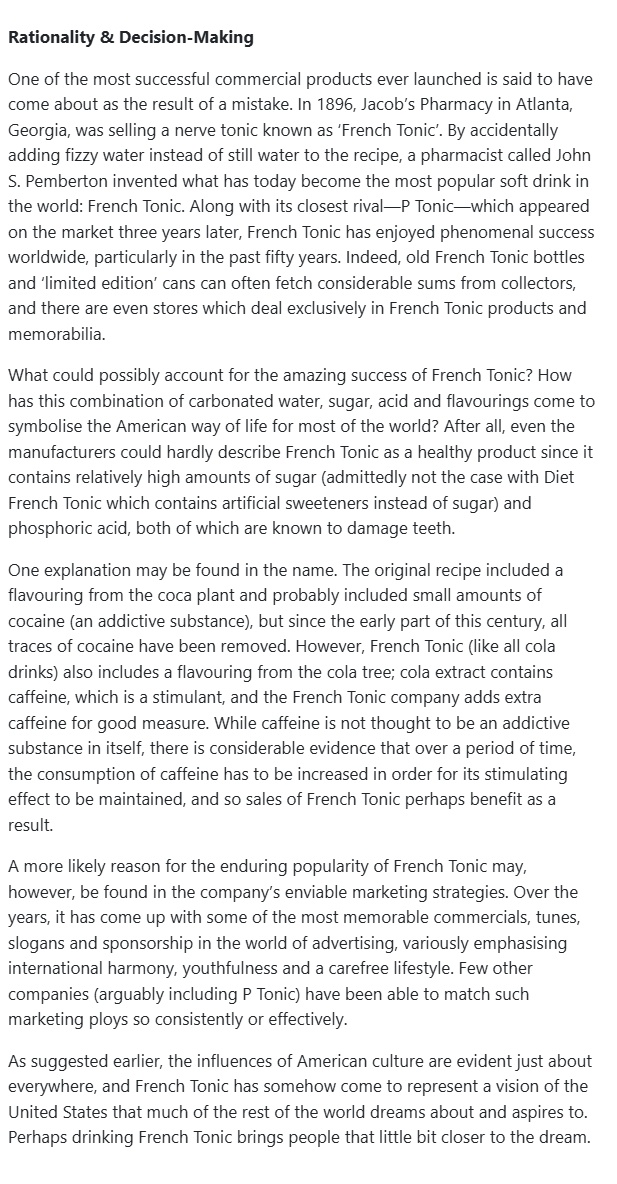
Q162EasyCET 2026 · Slot 3 · Q162
Passage / data for this question

Passage shown as image

According to the paragraph, the author uses ‘for good measure’ to emphasize the fact that:

Figure for MBA CET 2026 Slot 3 question 162
  1. There is a lot of caffeine in French Tonic.
  2. The amount of caffeine in French Tonic is carefully measured.
  3. The extra caffeine improves the taste of French Tonic.
  4. The extra caffeine balances the amount found naturally in the cola extract.
  5. The extra caffeine is healthy for the drinkers of French Tonic.
Show answerHide answer

Answer: A official key

Approach: Idiom in context.

Solution: Para 3: "cola extract contains caffeine… and the French Tonic company adds extra caffeine for good measure." The idiom means 'in addition, as an extra'. The author stresses that caffeine is already present and more is added — so the drink has a lot of caffeine (and the next lines link this to repeat sales).

Why the other options are wrong:
B: Literal reading of 'measure'; the idiom does not mean careful measurement.
C: Taste is never mentioned.
D: 'Balance' is opposite — extra caffeine adds to, not balances, the natural amount.
E: Health benefit not claimed; the passage says the drink is hardly healthy.

Answer: A

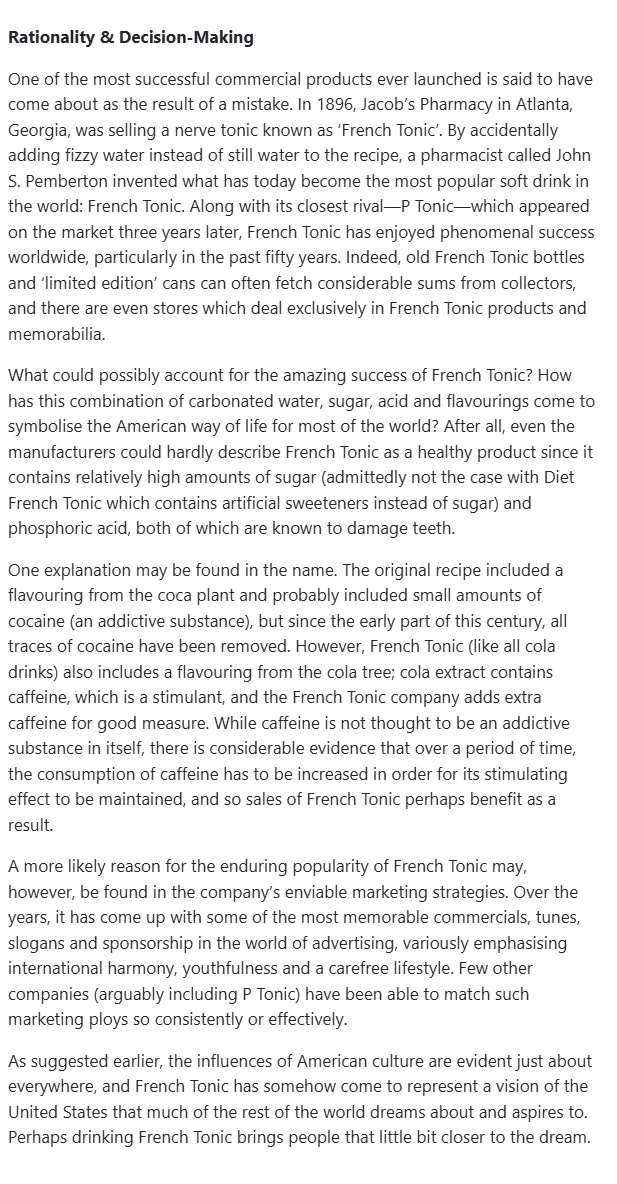
Q164EasyCET 2026 · Slot 3 · Q164
Passage / data for this question

Passage shown as image

Describing French Tonic’s marketing strategies as ‘enviable’ in the paragraph, the author means that:

Figure for MBA CET 2026 Slot 3 question 164
  1. The strategies are based on envy.
  2. French Tonic’s marketing staff is encouraged to be envious of each other’s ideas.
  3. People are persuaded to buy French Tonic because they are envious of others.
  4. Rivals are envious of the French Tonic Company’s successful methods of marketing.
  5. French Tonic’s marketing strategies are enviable.
Show answerHide answer

Answer: D official key

Approach: Word meaning, confirmed by the next sentences.

Solution: Para 4: "the company's enviable marketing strategies… Few other companies (arguably including P Tonic) have been able to match such marketing ploys." Enviable = arousing envy in others because it is so good. So rivals envy French Tonic's successful marketing.

Why the other options are wrong:
A: Strategies are not 'based on envy'.
B: Staff envying each other — not stated.
C: Customers buying out of envy — not stated.
E: Restates the word without explaining what the author means.

Cetking shortcut: An option that merely repeats the question's word (E) is almost never the 'meaning' answer.

Answer: D

Q151EasyCET 2026 · Slot 2 · Q151

Passage shown as image

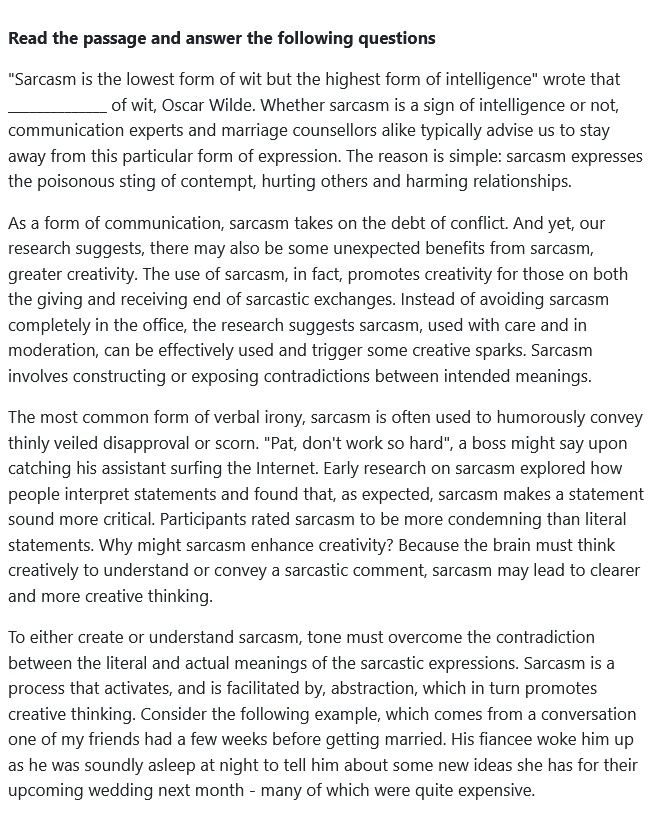
According to the passage, which of the following is most nearly the same in meaning as the word 'condemning' as used in the passage?

Figure for MBA CET 2026 Slot 2 question 151
  1. censuring
  2. hurting
  3. killing
  4. shouting
  5. scolding
Show answerHide answer

Answer: A official key

Approach: Vocabulary in context — read the sentence where the word appears.

Solution: Passage: 'Participants rated sarcasm to be more condemning than literal statements' — i.e. sarcasm sounds more critical / disapproving.
To condemn = to express strong disapproval of. 'Censuring' = expressing formal, severe disapproval — the same sense.

Why the other options are wrong:
B hurting — an effect, not disapproval.
C killing — 'condemn to death' sense, not used here.
D shouting — a manner of speaking, not a judgement.
E scolding — angry rebuke of a person (usually a child); weaker and more informal than condemning.

Cetking shortcut: The sentence links 'condemning' with 'more critical' — pick the option that means 'criticise strongly'.

Answer: A

Q159EasyCET 2026 · Slot 2 · Q159

Passage shown as image

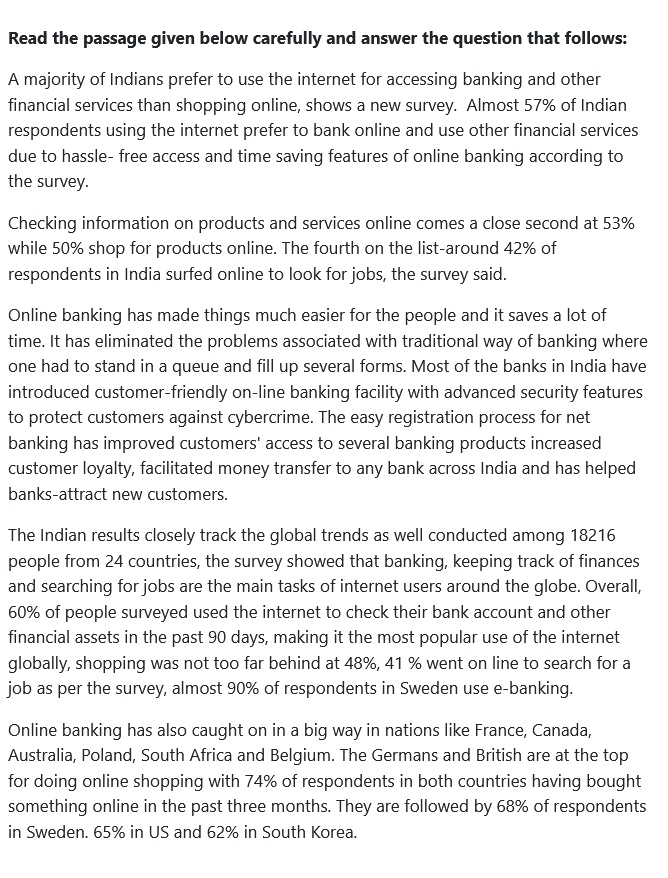
Which of the following is most nearly the same in meaning as the word, 'hassle-free' as used in the passage?

Figure for MBA CET 2026 Slot 2 question 159
  1. Unskilled
  2. Negotiable
  3. Subtle
  4. Notable
  5. Not annoying
Show answerHide answer

Answer: E official key

Approach: Vocabulary in context — 'hassle' = annoying trouble or bother.

Solution: Para 1: '... due to hassle-free access and time saving features of online banking'.
Hassle-free = without bother or annoyance → 'Not annoying'.

Why the other options are wrong:
A Unskilled — unrelated.
B Negotiable — open to discussion; unrelated.
C Subtle — delicate / not obvious.
D Notable — worth noticing.

Cetking shortcut: Break the compound: hassle (annoyance) + free (without) = without annoyance.

Answer: E

Q159EasyCET 2026 · Slot 1 · Q159

Read the passage carefully and answer the question that follows. Choose the correct alternative from the given options based only on the information in the passage.

In the digital age, cyber crime has emerged as one of the most complex and rapidly evolving threats to individuals, organizations, and governments. Cyber crime refers to illegal activities conducted using computers, digital networks, or the internet, ranging from identity theft and online fraud to hacking, ransomware attacks, and cyber terrorism. As societies increasingly rely on digital infrastructure for communication, finance, healthcare, and governance, the potential impact of cyber crime has expanded exponentially.

One of the most alarming features of cyber crime is its anonymity. Unlike traditional crimes, cyber offences often transcend geographical boundaries, making it difficult for law enforcement agencies to identify perpetrators and enforce jurisdiction. A cyber criminal operating from one country can target victims across multiple continents within seconds. This borderless nature not only complicates investigations but also necessitates international cooperation, which is often hindered by differing legal frameworks and enforcement priorities.

Another critical dimension of cyber crime is its psychological manipulation. Many cyber attacks rely less on technical sophistication and more on exploiting human vulnerabilities. Phishing emails, fraudulent messages, and social engineering tactics deceive users into revealing sensitive information such as passwords, banking details, or one-time verification codes. Despite advances in cybersecurity technology, human error remains one of the weakest links in digital security systems.

The economic consequences of cyber crime are equally severe. Businesses suffer financial losses due to data breaches, operational disruptions, and reputational damage. Small and medium enterprises, often lacking robust cybersecurity infrastructure, are particularly vulnerable. On a broader scale, cyber crime can destabilize national economies by targeting financial institutions, stock markets, and critical infrastructure such as power grids and transportation systems.

Governments and organizations have responded by strengthening cybersecurity laws, investing in advanced detection technologies, and promoting digital literacy among citizens. However, cyber criminals continuously adapt, employing artificial intelligence, encrypted communication, and decentralized networks to evade detection. This ongoing arms race underscores the need for a holistic approach that combines technological innovation, legal reform, international collaboration, and public awareness.

Ultimately, combating cyber crime is not solely the responsibility of authorities or technology experts. Individuals must remain vigilant, adopt safe online practices, and understand that convenience in the digital world often comes with hidden risks. Only through collective effort can the pervasive threat of cyber crime be effectively mitigated.

The phrase “ongoing arms race” in the passage most nearly implies that:
  1. Cyber criminals will eventually overpower governments
  2. Both defenders and offenders continuously evolve their strategies
  3. Cyber crime will soon become obsolete
  4. Military involvement is essential to prevent cyber crime
  5. Technological development favors criminals over institutions
Show answerHide answer

Answer: B official key

Approach: Vocabulary in context — meaning of a metaphor.

Solution: An arms race is a contest in which each side keeps building better weapons in response to the other. In para 5, governments invest in detection technology while "cyber criminals continuously adapt" with AI and encryption. So the phrase means both defenders and offenders keep evolving their strategies — option B.

Why the other options are wrong:
A: Predicts a winner; the phrase implies a continuing contest with no winner yet.
C: Contradicts "ongoing".
D: "Arms" is a metaphor; no military role is suggested.
E: The passage does not say technology favours criminals.

Cetking shortcut: Metaphor questions: take the literal meaning (two sides out-building each other) and map it onto the context.

Answer: B

Q156EasyCET 2025 · Slot 6 · Q156

Reading Comprehension passage — shown as image.

Which of the following is closest to the meaning of beset?
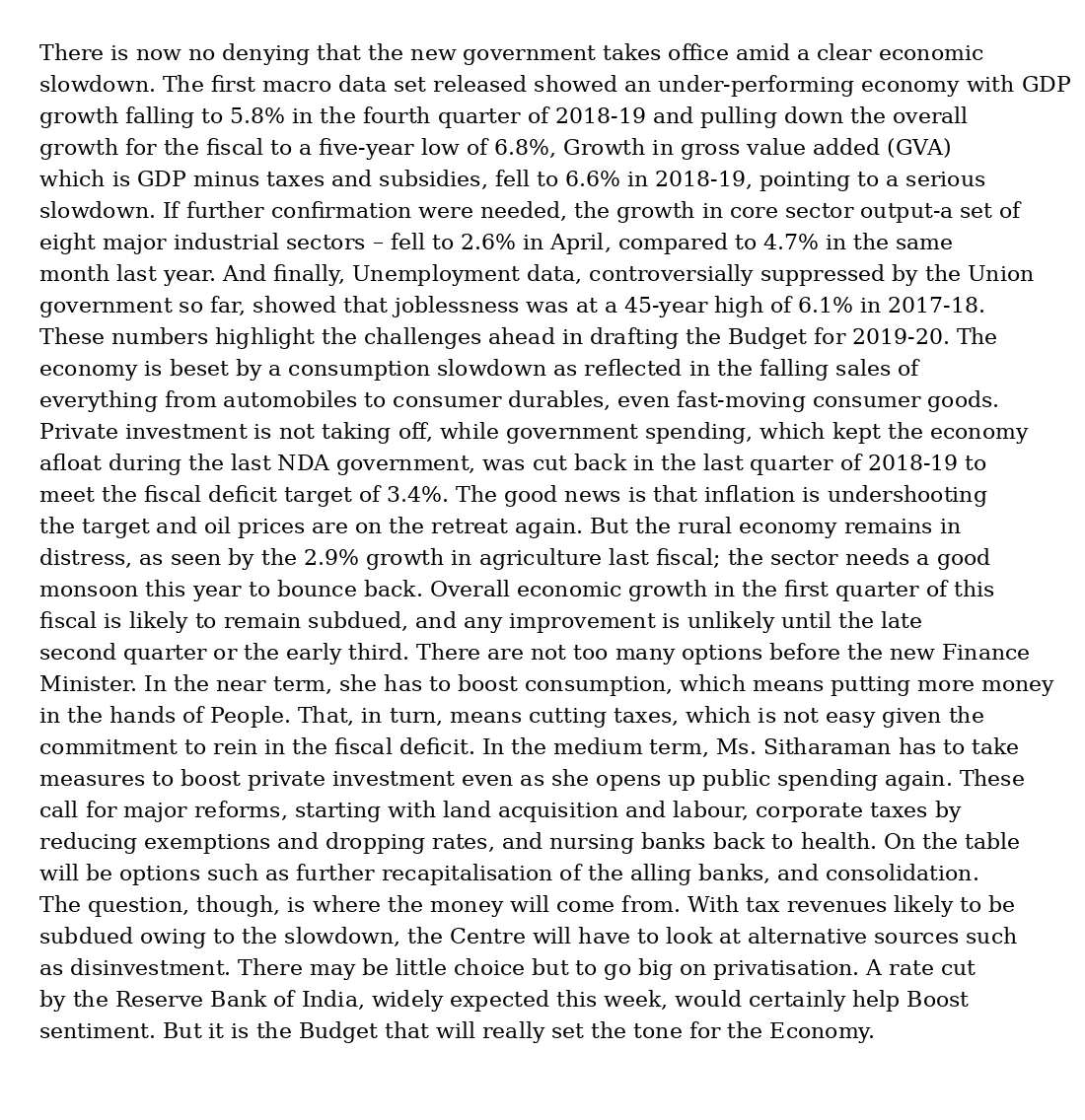
Figure for MBA CET 2025 Slot 6 question 156
  1. Besiege
  2. Terminate
  3. Filter
  4. Tiny
  5. Huge
Show answerHide answer

Answer: A

Approach: Vocabulary in context — read the sentence where the word appears.

Solution: The passage says 'The economy is beset by a consumption slowdown'. Beset = troubled/surrounded by problems from all sides. Besiege (surround, overwhelm) carries the same sense.

Why the other options are wrong:
B: terminate = end — unrelated.
C: filter — unrelated.
D, E: tiny / huge are size adjectives, not verbs of attack/trouble.

Cetking shortcut: Beset and besiege share the 'be-' prefix (all around) — the only verb with that sense.

Answer: A

Q168MediumCET 2025 · Slot 6 · Q168

Reading Comprehension passage — shown as image.

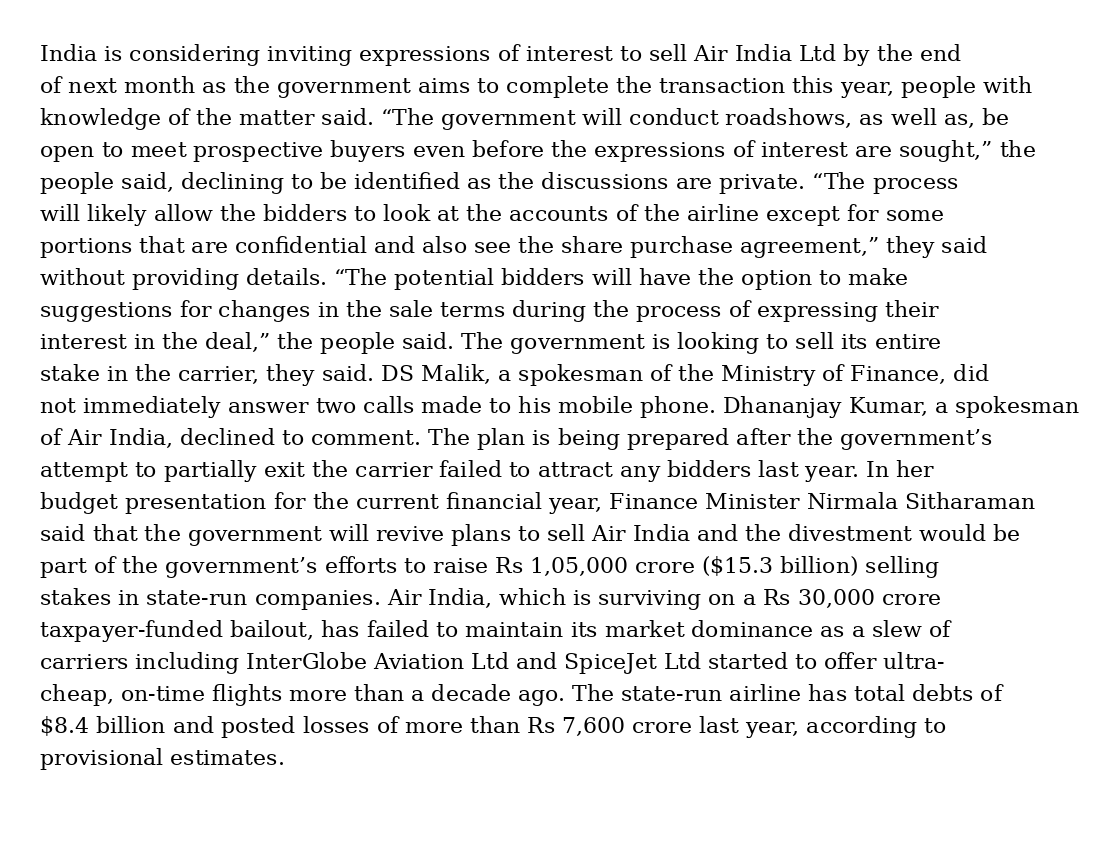
Which among the following is OPPOSITE in meaning to the word Dominance as used in the passage?
Figure for MBA CET 2025 Slot 6 question 168
  1. Inferiority
  2. Powerlessness
  3. Submission
  4. Ascendency
  5. None of the above
Show answerHide answer

Answer: A

Approach: Antonym in context — 'market dominance' means a superior, leading position.

Solution: 'Failed to maintain its market dominance' = superiority/leading position over rivals. The opposite of a superior position is inferiority (a lower, weaker position compared with others).

Why the other options are wrong:
B: powerlessness = no power at all — opposite of 'power', too extreme for market position.
C: submission = yielding to someone's control — opposite of dominating a person, not of market leadership.
D: ascendency is a synonym of dominance.
E: A fits.

Cetking shortcut: Ask what 'dominance' compares — Air India vs rivals — so the antonym must also be comparative: inferiority.

Answer: A

Q169EasyCET 2025 · Slot 6 · Q169

Reading Comprehension passage — shown as image.

Which of the following is antonym of “frigid” in context of passage?
Figure for MBA CET 2025 Slot 6 question 169
  1. Flexible
  2. Soft
  3. Lukewarm
  4. Rigid
  5. Hot
Show answerHide answer

Answer: E

Approach: Antonym in context — check how 'frigid' is used.

Solution: Passage: infant penguins were thrown 'into the frigid water' — frigid = extremely cold. The opposite is hot.

Why the other options are wrong:
A, B: flexible / soft oppose 'rigid', not 'frigid'.
C: lukewarm is mildly warm — between cold and hot, not the opposite.
D: rigid only sounds like frigid.

Cetking shortcut: Don't be fooled by the rhyme frigid–rigid; context (Antarctic water) fixes the meaning as cold.

Answer: E

Q174EasyCET 2025 · Slot 6 · Q174

Reading Comprehension passage — shown as image.

Which among the following is opposite in meaning to the word doused as used in the passage.
Figure for MBA CET 2025 Slot 6 question 174
  1. Saturated
  2. Deluged
  3. Wet
  4. Lighted
  5. All correct
Show answerHide answer

Answer: D

Approach: Antonym in context — check how 'doused' is used.

Solution: 'When the flames were doused' — doused = extinguished, put out (a fire). The opposite of putting out a fire is lighted (set alight) — the passage itself uses 'the fire that Juan had lighted'.

Why the other options are wrong:
A, B, C: saturated, deluged, wet relate to the other meaning of douse (to drench) — they are near-synonyms, not antonyms.
E: not valid — only D is opposite.

Cetking shortcut: Douse has two senses (drench / extinguish); the context 'flames were doused' decides it.

Answer: D

Q199EasyCET 2025 · Slot 6 · Q199

Reading Comprehension passage — shown as image.

Choose a similar word in meaning to the word "trounce"
Figure for MBA CET 2025 Slot 6 question 199
  1. Vacillation
  2. Temerity
  3. Lambaste
  4. Nefarious
  5. None of the above
Show answerHide answer

Answer: C

Approach: Vocabulary in context.

Solution: 'Abhay Deol took to Facebook to trounce his fellow actors who earn millions from endorsing fairness creams' — here trounce = attack/criticise severely. Lambaste = criticise harshly. Same meaning.

Why the other options are wrong:
A: vacillation = indecision.
B: temerity = boldness/audacity.
D: nefarious = wicked (an adjective).
E: C matches.

Cetking shortcut: Check part of speech: trounce is a verb — only 'lambaste' is a verb among the choices.

Answer: C

Q151EasyCET 2025 · Slot 5 · Q151

Today, every major anthology of nineteenth century poetry includes examples of the work which Christina Rossetti produced during her long literary career. Born in 1830, she began composing verse at the age of eleven and continued to write for the remaining fifty-three years of her life. Her brother, Dante Gabriel Rossetti, himself a poet and painter, soon recognized her genius and urged her to publish her poems. By the time of her death in 1894, Rossetti had written more than eleven hundred poems and had published over nine hundred of them. Although this work has earned her recognition as the greatest woman poet of the Victorian Age, there is still no authoritative edition of her poetry

The word "anthology” (line I) means:
  1. writer
  2. poem
  3. collection
  4. poet
  5. history
Show answerHide answer

Answer: C

Approach: Vocabulary in context — read the word in its sentence.

Solution: "Every major anthology of nineteenth century poetry includes examples of the work..." — an anthology includes works of many poets, so it is a collection of literary pieces.

Why the other options are wrong:
A writer / D poet: a person, cannot 'include examples of work'.
B poem: a single piece, not a container of many.
E history: a narrative of events, not a compilation of poems.

Cetking shortcut: If the word 'includes' many items, it must be a container noun — only 'collection' qualifies.

Answer: C

Q164EasyCET 2025 · Slot 5 · Q164

If translated into English, most of the ways economists talk among themselves would sound plausible enough to poets, journalists, business people, and other thoughtful though non-economical folk. Like serious talk anywhere— among boat designers and baseball fans, say — the talk is hard to follow when one has not made a habit of listening to it for a while. The culture of conversation makes the words arcane. But the people in the unfamiliar conversation are not Martians. Underneath it all (the economist’s favourite phrase), conversational habits are similar Economics uses mathematical models and statistical tests and market arguments, all of which look alien to the literary eye. But looked at closely, they are not so alien They may be seen as figures of speech-metaphors, analogies, and appeals to authority.

Figures of speech are not mere frills. They think for us. Someone who thinks of a market as an invisible hand' and the organization of work as a production function' and its coefficients as being significant, as an economist does, gives the language a lot of responsibility It seems a good idea to look hard at his language.

If economic conversation were found to depend a lot on its verbal forms, this would not mean that economics would be not a science, or just a matter of opinion, or some sort of confidence game. Good poets, though not scientists, are serious thinkers about symbols; good historians, though not scientists, are serious thinkers about data Good scientists also use language. What is more (though it remains to be shown) they use the cunning of language, without particularly meaning to. The language used is a social object, and using language in a social act. It requires cunning (or, if you prefer consideration) attention to the other and present when one speaks.

The paying of attention to one's audience is called 'rhetoric", a word that I later exercise hard. One uses rhetoric, of course, to warn of a fire in a theatre or to arouse the xenophobia of the electorate. This sort of yelling is the vulgar meaning of the word, like the president's heated rhetoric' in a press conference or the 'mere rhetoric to which our enemies stoop. Since the Greek flame was lit, though, the word has been used also in a broader and more amiable sense, to mean the study of all the ways of accomplishing things with language: inciting a mob to lynch the accused, to be sure, but also persuading readers of a novel that its characters breathe, or bringing scholars to accept the better argument and reject the worse. The question is whether the scholar- who usually fancies himself an announcer of 'results' or a starter of 'conclusions free of rhetoric speaks rhetorically. Does he try to persuade? It would seem so. Language, I just said, is not a solitary accomplishment. The scholar doesn't speak into the void, or to himself. He speaks to a community of voices. He desires to be heeded, praised, published, imitated, honoured, en-Nobeled. These are the desires. The devices of language are the means. Rhetoric is the proportioning of means to desires in speech.

Rhetoric is an economics of language, the study of how scarce means are allocated to the insatiable desires of people to be heard. It seems on the face of it a reasonable hypothesis that economists are like other people in being talkers, who desire listeners when they go to the library or the laboratory as much as when they go to the office or the polls. The purpose here is to see if this is true, and to see if it is useful: to study the rhetoric of economic scholarship. The subject is scholarship. It is not the economy, or the adequacy of economic theory as a description of the economy, or even mainly the economist's role in the economy.

The subject is the conversation economists have among themselves, for purposes of persuading each other that the interest elasticity of demand for investment is zero or that the money supply is controlled by the Federal Reserve.

Unfortunately, though, the conclusions are of more than academic interest. The conversations of classicists or of astronomers rarely affect the lives of other people. Those of economists do so on a large scale. A well known joke describes a May Day parade through Red Square with the usual mass of soldiers, guided missiles, rocket launchers. At last come rank upon rank of people in gray business suits. A bystander asks, "Who are those?" "Aha!" comes the reply, "Those are economists: you have no idea what damage they can do!" Their conversations do it.

As used in the passage, which of the following is the closest alternative to the word arcane?
  1. Mysterious
  2. Secret
  3. Covert
  4. Perfidious
  5. Clumsy
Show answerHide answer

Answer: A

Approach: Vocabulary in context.

Solution: Arcane = known or understood by very few; obscure. Talk that is 'hard to follow' for outsiders is mysterious to them.

Why the other options are wrong:
B Secret / C Covert: imply deliberate concealment, which economists do not attempt.
D Perfidious: treacherous.
E Clumsy: awkward — unrelated.

Answer: A

Q183MediumCET 2025 · Slot 4 · Q183

Reading Comprehension passage — shown as image.

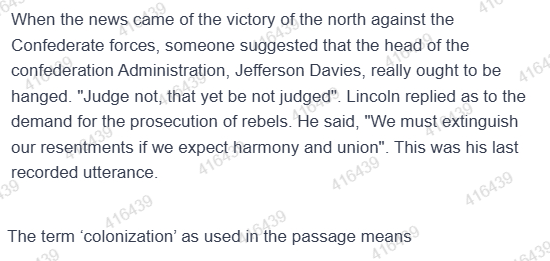
The term 'colonization' as used in the passage means
Figure for MBA CET 2025 Slot 4 question 183Figure for MBA CET 2025 Slot 4 question 183Figure for MBA CET 2025 Slot 4 question 183
  1. Option A
  2. Option B
  3. Option C
  4. Option D
  5. Option E
Show answerHide answer

Answer: E

Approach: Vocabulary in context.

Solution: The passage: "grants for the rehabilitation of blacks — 'colonization' as he called it." So colonization means settling the freed slaves in a separate place of their own — a colony of (freed) slaves, option E.

Why the other options are wrong:
A Handing over slaves to slave-owners: the opposite of emancipation.
B Efforts by blacks to free themselves: not what the word refers to.
C Separate dwellings for slave-owners / D Rehabilitation for slave-owners: the rehabilitation was for blacks, not owners (owners got compensation).

Cetking shortcut: The dash defines the term: "rehabilitation of blacks — colonization" → resettling the freed slaves.

Answer: E

Q198EasyCET 2025 · Slot 4 · Q198

Reading Comprehension passage — shown as image.

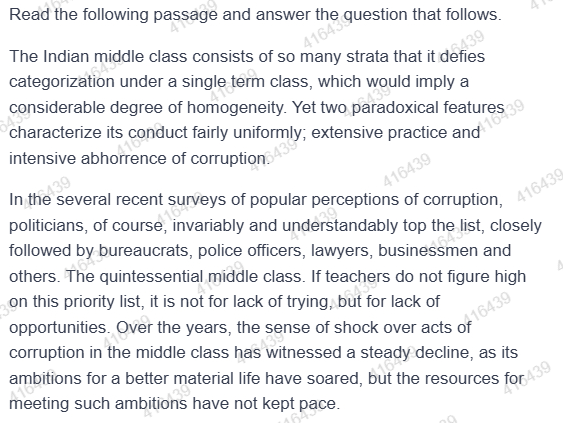
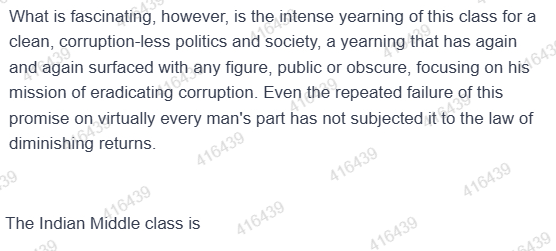
Meaning of the word 'stratified' as used in the passage: The Indian middle class is ______ (see figure).
Figure for MBA CET 2025 Slot 4 question 198Figure for MBA CET 2025 Slot 4 question 198
  1. Defiant
  2. Mysterious
  3. Homogeneous
  4. Stratified
  5. Unique
Show answerHide answer

Answer: D

Approach: Vocabulary in context / description of the middle class.

Solution: Para 1: "The Indian middle class consists of so many strata that it defies categorization under a single term class, which would imply a considerable degree of homogeneity." Many strata = stratified (divided into layers). Option D.

Why the other options are wrong:
A Defiant: "defies categorization" is about the term, not the class's attitude.
B Mysterious / E Unique: not stated.
C Homogeneous: the passage says the class is NOT homogeneous.

Cetking shortcut: "Strata" → stratified; "homogeneity" is denied, so C is the trap.

Answer: D

Q154EasyCET 2025 · Slot 3 · Q154

The last twenty years have witnessed an explosion of growth opportunities for women in industry, especially at the decision-making level. Today, more and more young women have a chance to walk the competitive edge and prove that their abilities are at par with, if not better than, those of their male colleagues.

However, as they are beginning to storm the traditional male bastions of management, they are finding out that the roads to success are paved with difficulties. They discover very early in their career that the battle for supremacy in corporate organizations calls into play not only the forces of power, control and dominance, but issues of gender, attitude and acceptance of women.

Which of the following best reflects the meaning of ‘male bastions’.
  1. Management style of male
  2. Management areas dominated by males
  3. Careers for male
  4. Management abilities of male
  5. Careers of women
Show answerHide answer

Answer: B

Approach: Vocabulary in context — meaning of 'male bastions'.

Solution: Bastion = fortress/stronghold. 'Storm the traditional male bastions of management' = enter the management areas that men have traditionally held and dominated.

Why the other options are wrong:
A. Management style of male — a style is not a place one 'storms'.
C. Careers for male — too broad; the passage is about management.
D. Management abilities of male — abilities are not strongholds.
E. Careers of women — opposite of 'male'.

Answer: B

Q167EasyCET 2025 · Slot 3 · Q167

Rationalism has been defined as the mental attitude which unreservedly accepts the supremacy of reason and aims at establishing a system of philosophy and ethics verifiable by experience and independent of all arbitrary assumptions or authority. This definition of Rationalism was framed at the inauguration of the Rationalist Press Association (RPA) in London in the year 1899.

Which of the following words is most nearly the same in meaning as the word ‘unreservedly’ as used in the paragraph?
  1. unilaterally
  2. collectively
  3. partially
  4. fully
  5. conditionally
Show answerHide answer

Answer: D

Approach: Vocabulary in context — meaning of 'unreservedly'.

Solution: 'Unreservedly accepts the supremacy of reason' = accepts it without any reservation or condition = fully.

Why the other options are wrong:
A. Unilaterally — done by one side only; a different idea.
B. Collectively — done as a group.
C. Partially — opposite.
E. Conditionally — opposite (with reservations).

Answer: D

Q192EasyCET 2025 · Slot 3 · Q192

Compact Discs (CDs) have revolutionized the music industry with their surprisingly realistic sound. The six-inch discs look like plastic sandwiches with aluminum at the centre. They have digitally recorded material that is read by laser beams, so the sound has none of the crackling of vinyl records. CDs are also virtually indestructible, and they are lighter and smaller than conventional records. Since their introduction, CDs have become more affordable and widely available. In fact, they are now sold in electronics and video stores that didn’t formerly carry records or cassettes.

There has been a phenomenal growth in the sale of CDs. Sales climbed dramatically during the second half of the 1980s. In the 1990s, sales have been greater. CDs have all but replaced records in stores and, in spite of their being less affordable than cassettes, continue to gain in popularity.

Which word ‘revolutionized’, as used in line 1 of passage, could best be replaced with?
  1. marked
  2. surprised
  3. taught
  4. changed
  5. raised
Show answerHide answer

Answer: D

Approach: Vocabulary in context — replace the word and check the sentence.

Solution: 'CDs have revolutionized the music industry' = CDs have changed it radically. Substituting 'changed' keeps the meaning.

Why the other options are wrong:
A. Marked — to note or label; no idea of change.
B. Surprised — an emotion; does not fit an industry.
C. Taught — unrelated.
E. Raised — to lift; not the meaning.

Answer: D

Q159MediumCET 2025 · Slot 2 · Q159

Words remain an enigma, their presence within the human sphere is a unique mystery. They form the intricate tapestry that convinces us of our existence, blurring lines between fact and fiction. An engagement with words is the most captivating, enchanting, and sometimes daunting encounter with the world. A word, a symbolic entity formed from the ethereal, exists neither as animate nor inanimate, yet pulsates with life. It can emanate warmth or coldness, absorb emotions, or stand as dry as a rock. Words can provoke smiles and elicit joy. They are like glow-worms, momentarily dispelling the surrounding darkness and act as life-saving rafts amid the tumultuous ocean waves. Words grant us the ability to explore the universe, and “to see a world in a grain of sand,” as William Blake noted. They impart a semantic existence to the lifeless, and bestow aesthetic form upon the formless. Scriptures say the word is the world. I say the world within the word is the abode of faith.

In the context of the passage, what is the significance of the “world within the word”?
  1. It describes the author’s mission to explore different cultures.
  2. It signifies a spiritual exposition.
  3. It refers to the power of language to create inspiration, energy and faith.
  4. It signifies the author’s love for the global community.
  5. It represents the mysteries hidden in language.
Show answerHide answer

Answer: B

Approach: Read the phrase with its own sentence: 'the world within the word is the abode of faith'.

Solution: The author contrasts scripture ('the word is the world') with his own view that the world inside words is 'the abode of faith'. Calling it a home of faith gives words a sacred, spiritual meaning – a spiritual exposition. So B.

Why the other options are wrong:
A: exploring cultures is not mentioned.
C: inspiration and energy are added – the line speaks of faith only.
D: love for the global community is not mentioned.
E: mystery is in the opening line, but the phrase itself is tied to faith, not mystery.

Cetking shortcut: Key word 'abode of faith' + 'Scriptures say' → spiritual.

Answer: B

Q191MediumCET 2025 · Slot 2 · Q191

Most of recorded human history is one big data gap. Starting with the story of Man the Hunter, the chroniclers of the past have left little space for women’s role in the evolution of humanity, whether cultural or biological. Instead, the lives of men have been taken to represent that of humans overall. When it comes to the lives of the other half of humanity, there is often nothing but silence.
And these silences are everywhere. Our entire culture is riddled with them. Films, news, literature, science, city planning, economics. The stories we tell ourselves about our past, present and future. They are all marked—disfigured—by a female-shaped absent presence. This is the gender data gap.

The gender data gap isn’t just about silence. These silences, these gaps, have consequences. They impact on women’s lives every day. The impact can be relatively minor. Shivering in offices set to a male temperature norm, for example, or struggling to reach a top shelf set at a male height norm. Irritating, certainly. Unjust, undoubtedly. But not life-threatening. Not like crashing in a car whose safety measures don’t account for women’s measurements. Not like having your heart attack go undiagnosed because your symptoms are deemed “atypical”. For these women, the consequences of living in a world built around male data can be deadly.

One of the most important things to say about the gender data gap is that it is not generally malicious, or even deliberate. Quite the opposite. It is simply the product of a way of thinking that has been around for millennia and is therefore a kind of not thinking. A double not thinking, even: men go without saying, and women don’t get said at all. Because when we say human, on the whole, we mean man.

This is not a new observation. Simone de Beauvoir made it most famously when in 1949 she wrote, ‘Humanity is male and man defines woman not in herself, but as relative to him; she is not regarded as an autonomous being. […] He is the Subject, he is the Absolute—she is the Other.’ What is new is the context in which women continue to be the ‘Other’. And that context is a world increasingly reliant on and in thrall to data. Big Data. Which in turn is panned for Big Truths by Big Algorithms, using Big Computers. But when your big data is corrupted by big silences, the truths you get are half-truths, at best. And often, for women, they aren’t true at all. As computer scientists themselves say: “Garbage in, garbage out.”

Based on the passage, which of the following statements best explains "absent presence"?
  1. The absence is female-shaped, making it present.
  2. The presence is felt due to the specificity of the absence.
  3. By its sheer absence, it is present.
  4. The absence makes the case for the need for presence.
  5. Because of the absence, one can recognise its presence.
Show answerHide answer

Answer: A

Approach: Read the phrase in its full form: 'a female-shaped absent presence'.

Solution: Women's lives are missing from culture and data (absence), but the gap they leave has a definite female shape – it is visible and has consequences everywhere (presence). The phrase is explained by the shape of the absence: because it is female-shaped, the absence is felt as a presence – A.

Why the other options are wrong:
B: 'specificity' is vague and drops the female shape the author stresses.
C: a generic definition of any absent presence; it ignores what makes this one present (its female shape).
D: making a case for presence is the author's purpose, not the meaning of the phrase.
E: 'recognise its presence' does not explain how the absence becomes present.

Cetking shortcut: Pick the option that keeps the passage's own qualifier ('female-shaped') – generic dictionary meanings are the traps.

Answer: A

Q153MediumCET 2025 · Slot 1 · Q153
Passage / data for this question

Reading Comprehension passage — shown as image.

Which word used in the passage is the synonym of LANCET
Figure for MBA CET 2025 Slot 1 question 153Figure for MBA CET 2025 Slot 1 question 153
  1. Twelve
  2. Window
  3. Inch
  4. Turbulent
  5. Smokejumper
Show answerHide answer

Answer: B

Approach: Vocabulary in context: match the given word's meaning to a word used in the passage.

Solution: A lancet (lancet window) is a tall, narrow window with a pointed arch. Of the passage words given, only 'window' (in 'near windows, exterior doors') shares this meaning.

Why the other options are wrong:
A Twelve, C Inch: measurements from the passage.
D Turbulent: describes hot air.
E Smokejumper: a firefighter.

Answer: B

Q156MediumCET 2025 · Slot 1 · Q156
Passage / data for this question

Reading Comprehension passage — shown as image.

Which word used in the passage is the antonym of NESCIENCE
Figure for MBA CET 2025 Slot 1 question 156Figure for MBA CET 2025 Slot 1 question 156
  1. Deterrence
  2. Turbulent
  3. Bouncing
  4. Smokejumper
  5. Detection
Show answerHide answer

Answer: E

Approach: Vocabulary in context: antonym of the given word, chosen from passage words.

Solution: Nescience = lack of knowledge, ignorance. Its opposite is knowing or finding out. 'Detection' (discovering the presence of something) is the only option tied to knowledge or discovery.

Why the other options are wrong:
A Deterrence: preventing something.
B Turbulent: agitated.
C Bouncing: rebounding.
D Smokejumper: a person.

Cetking shortcut: Ne + science (Latin nescire, 'not to know') = not knowing, so look for a word about finding out or knowing.

Answer: E

Practise these in the Arena

Take timed tests built around MBA CET topics and see where you stand.

Open the Arena