Let’s Crack CET 2027

Your CET check-up · tap a ring to see yours

Alphabet Series – MBA CET questions with solutions

47 questions · CET 2025–2026 · Easy 38 · Medium 9 · Hard 0. Newest paper first. Full papers

Q28EasyCET 2026 · Attempt 2 Slot 2 · Q28

Fill the blank place with the correct option given below.

FAG, GAF, HAI, IAH, _____.

  1. HAK
  2. HAL
  3. JAK
  4. JAI
  5. KAH
Show answerHide answer

Answer: C official key

Approach: Letter series — alternate terms move +2; each even term is the reverse of the term before it.

Solution:
Odd terms: FAG → HAI → ?: outer letters +2 each (F→H, G→I), A stays.
Even terms: GAF = FAG reversed, IAH = HAI reversed.
The 5th term is the next odd term: H+2 = J, A, I+2 = K → JAK.

Why the other options are wrong:
A, B: HAK / HAL keep H as first letter — no +2 move.
D: JAI moves only the first letter.
E: KAH does not follow either pattern.

Cetking shortcut: Pairs (FAG, GAF), (HAI, IAH): new word then its mirror — the 5th term starts a new pair: JAK.

Answer: C
Q33EasyCET 2026 · Attempt 2 Slot 2 · Q33

Complete the given series :

AYBZC, DWEXF, GUHVI, JSKTL, ?

  1. MQORN
  2. MQNRO
  3. NQMOR
  4. QMONR
  5. OQRPM
Show answerHide answer

Answer: B official key

Approach: Letter series — position-wise patterns in 5-letter groups.

Solution:
Position 1: A, D, G, J → +3 → M
Position 2: Y, W, U, S → −2 → Q
Position 3: B, E, H, K → +3 → N
Position 4: Z, X, V, T → −2 → R
Position 5: C, F, I, L → +3 → O
Next group: MQNRO.

Why the other options are wrong:
A: MQORN swaps the 3rd and 5th letters.
C, D, E: wrong first letter (must be M = J + 3).

Cetking shortcut: Positions 1, 3, 5 just run through the alphabet (ABC, DEF, GHI, JKL → MNO); slot Q and R into positions 2 and 4.

Answer: B

Q56EasyCET 2026 · Attempt 2 Slot 2 · Q56

Which of the following set of letters will complete the given letter series ?

WFB, TGD, QHG, ?

  1. NIJ
  2. NIK
  3. NJK
  4. NOK
  5. PJK
Show answerHide answer

Answer: B official key

Approach: Letter series: treat each letter position as its own series.

Solution:
1st letter: W (−3) T (−3) Q (−3) N.
2nd letter: F (+1) G (+1) H (+1) I.
3rd letter: B (+2) D (+3) G (+4) K.
Next group: NIK.

Why the other options are wrong:
A (NIJ): 3rd letter uses +3 again instead of +4.
C (NJK): 2nd letter jumps +2.
D (NOK): 2nd letter wrong.
E (PJK): 1st and 2nd letters wrong.

Cetking shortcut: Third letter has increasing gaps (+2, +3, +4): G + 4 = K. Last letter K rules out A; first letter N rules out E; second letter I (not J or O) leaves only B.

Answer: B

Q3EasyCET 2026 · Attempt 2 Slot 1 · Q3

DIRECTIONS for the question: In the following question, an alphabet series is given with term/s missing. Choose the correct alternative to replace the question mark in the given series.

SHG, RIF, QJE, PKD, ?

  1. NME
  2. NLB
  3. OLE
  4. OLC
  5. SRQ
Show answerHide answer

Answer: D official key

Approach: Track each letter position separately.

Solution:
1st letters: S, R, Q, P → O (−1 each step)
2nd letters: H, I, J, K → L (+1)
3rd letters: G, F, E, D → C (−1)
Next term = OLC

Why the other options are wrong:
A NME, B NLB: first letter should be O, not N.
C OLE: third letter should be C, not E.
E SRQ: repeats a different pattern entirely.

Cetking shortcut: First letter must be O (eliminates A, B, E); third must be C → D.

Answer: D

Q5EasyCET 2026 · Attempt 2 Slot 1 · Q5

DIRECTIONS for the question: In the following letter series, some of the letters are missing which are given in that order as one of the alternatives below it. Choose the correct alternative.

m n o n o p q o p q r s _____

  1. mnopq
  2. oqrst
  3. pqrst
  4. qrstu
  5. mnono
Show answerHide answer

Answer: C official key

Approach: Break the series into groups.

Solution:
m n o | n o p q | o p q r s | ...
Groups start at m, n, o → next group starts at p.
The next group therefore starts at p; among the options, the five-letter block that begins correctly is p q r s t.

Why the other options are wrong:
A mnopq, E mnono: restart from m — the start letter moves forward each group.
B oqrst: skips p and repeats o.
D qrstu: starts at q, one step too far.

Cetking shortcut: Each group starts one letter later than the previous one (m, n, o) — only C starts with p.

Answer: C

Q41EasyCET 2026 · Attempt 2 Slot 1 · Q41
Passage / data for this question

DIRECTION for the question: Read the following information carefully and answer the question given below.

If letters from A to M were written, leaving space for one letter between every two letters, and then the remaining letters were inserted, beginning with N and ending the series with Z after M, answer the following questions:

Which letter would be third to the right of the seventh letter from the left?

  1. C
  2. O
  3. R
  4. S
  5. A
Show answerHide answer

Answer: C official key

Approach: Write the new series: A–M in odd positions, N–Z in the gaps.

Solution:
Arrangement: A N B O C P D Q E R F S G T H U I V J W K X L Y M Z (positions 1–26).
7th from left = D.
Third to the right of D (position 7) = position 10 = R.

Why the other options are wrong:
A C: position 5.
B O: position 4 (counting left).
D S: position 12.
E A: position 1.

Cetking shortcut: Odd positions hold A–M: position 2k − 1 = k-th letter; even position 2k = (13 + k)-th letter. Position 10 → 13 + 5 = 18th = R.

Answer: C

Q42EasyCET 2026 · Attempt 2 Slot 1 · Q42
Passage / data for this question

DIRECTION for the question: Read the following information carefully and answer the question given below.

If letters from A to M were written, leaving space for one letter between every two letters, and then the remaining letters were inserted, beginning with N and ending the series with Z after M, answer the following questions:

Which letter would be exactly between D and K?

  1. S
  2. T
  3. V
  4. W
  5. B
Show answerHide answer

Answer: B official key

Approach: Write the new series: A–M in odd positions, N–Z in the gaps.

Solution:
Arrangement: A N B O C P D Q E R F S G T H U I V J W K X L Y M Z (positions 1–26).
D is at position 7, K at position 21.
Middle position = (7 + 21) ÷ 2 = 14 → letter at 14 = T.

Why the other options are wrong:
A S: position 12.
C V: position 18.
D W: position 20.
E B: position 3.

Cetking shortcut: Even position 14 → (13 + 7)th letter = T.

Answer: B

Q43EasyCET 2026 · Attempt 2 Slot 1 · Q43
Passage / data for this question

DIRECTION for the question: Study the letter-series given below and answer the questions that follow.

H D Y S M W N B Q P O C R T B L Z V E G U F

Which two neighbours in the given arrangement are farthest in the alphabetical order?

  1. B and Q
  2. D and Y
  3. U and F
  4. V and E
  5. Q and O
Show answerHide answer

Answer: B official key

Approach: Compare the given arrangement with alphabetical positions.

Solution:
Series positions: 1 H, 2 D, 3 Y, 4 S, 5 M, 6 W, 7 N, 8 B, 9 Q, 10 P, 11 O, 12 C, 13 R, 14 T, 15 B, 16 L, 17 Z, 18 V, 19 E, 20 G, 21 U, 22 F.
Option pairs and gaps: B–Q = 15, D–Y = 25 − 4 = 21, U–F = 15, V–E = 17, Q–O = 2.
Largest gap = D and Y (21).

Why the other options are wrong:
A B–Q: 15.
C U–F: 15.
D V–E: 17.
E Q–O: 2 (and they are not neighbours).

Cetking shortcut: Only check option pairs — D (4) vs Y (25) is the obvious extreme.

Answer: B

Q44EasyCET 2026 · Attempt 2 Slot 1 · Q44
Passage / data for this question

DIRECTION for the question: Study the letter-series given below and answer the questions that follow.

H D Y S M W N B Q P O C R T B L Z V E G U F

Which letter has the same neighbours as in the alphabetical order though they have changed places?

  1. M
  2. N
  3. O
  4. P
  5. D
Show answerHide answer

Answer: D official key

Approach: Compare the given arrangement with alphabetical positions.

Solution:
Series positions: 1 H, 2 D, 3 Y, 4 S, 5 M, 6 W, 7 N, 8 B, 9 Q, 10 P, 11 O, 12 C, 13 R, 14 T, 15 B, 16 L, 17 Z, 18 V, 19 E, 20 G, 21 U, 22 F.
P (position 10) has neighbours Q and O.
In the alphabet P lies between O and Q — same neighbours, sides swapped → P.

Why the other options are wrong:
A M: neighbours S, W.
B N: neighbours W, B.
C O: neighbours P, C.
E D: neighbours H, Y.

Cetking shortcut: Look for a run of three consecutive letters reversed — Q P O.

Answer: D

Q45MediumCET 2026 · Attempt 2 Slot 1 · Q45
Passage / data for this question

DIRECTION for the question: Study the letter-series given below and answer the questions that follow.

H D Y S M W N B Q P O C R T B L Z V E G U F

Which three letters have the same distance as they have in the alphabetical order though they have changed places?

  1. HMP
  2. NQZ
  3. QOE
  4. YLF
  5. HDY
Show answerHide answer

Answer: D official key

Approach: Compare the given arrangement with alphabetical positions.

Solution:
Series positions: 1 H, 2 D, 3 Y, 4 S, 5 M, 6 W, 7 N, 8 B, 9 Q, 10 P, 11 O, 12 C, 13 R, 14 T, 15 B, 16 L, 17 Z, 18 V, 19 E, 20 G, 21 U, 22 F.
Y, L, F are at positions 3, 16, 22 → gaps 13 and 6.
In the alphabet F = 6, L = 12, Y = 25 → gaps 6 and 13.
Same distances, order reversed → YLF.

Why the other options are wrong:
A HMP: series gaps 4, 5; alphabet gaps 5, 3.
B NQZ: series gaps 2, 8; alphabet 3, 9.
C QOE: series gaps 2, 8; alphabet 10, 2.
E HDY: series gaps 1, 1; alphabet 4, 17.

Cetking shortcut: Compute only the first gap for each option and match it to an alphabet gap — Y to L is 13 in both.

Answer: D

Q46EasyCET 2026 · Attempt 2 Slot 1 · Q46
Passage / data for this question

DIRECTION for the question: Study the following arrangement and mark the best possible option.

C B T A E X F I M K E U V N X O D

If all the vowels are dropped from the given arrangement, which of the following is 9th from the right end?

  1. T
  2. X
  3. B
  4. F
  5. C
Show answerHide answer

Answer: A official key

Approach: Mark vowels (A, E, I, O, U) and consonants, then count carefully.

Solution:
Drop A, E, I, E, U, O → C B T X F M K V N X D (11 letters).
9th from the right = (11 − 9 + 1) = 3rd from the left = T.

Why the other options are wrong:
B X: 4th from left (8th from right).
C B: 2nd from left (10th from right).
D F: 5th from left.
E C: 1st from left.

Cetking shortcut: Position from right = n − k + 1 from left: 11 − 9 + 1 = 3.

Answer: A

Q47EasyCET 2026 · Attempt 2 Slot 1 · Q47
Passage / data for this question

DIRECTION for the question: Study the following arrangement and mark the best possible option.

C B T A E X F I M K E U V N X O D

How many such consonants are there which are immediately followed by a consonant and immediately preceded by a vowel?

  1. Seven
  2. One
  3. Two
  4. Three
  5. Four
Show answerHide answer

Answer: D official key

Approach: Mark vowels (A, E, I, O, U) and consonants, then count carefully.

Solution:
Positions: 1 C, 2 B, 3 T, 4 A, 5 E, 6 X, 7 F, 8 I, 9 M, 10 K, 11 E, 12 U, 13 V, 14 N, 15 X, 16 O, 17 D.
Pattern needed: vowel, consonant, consonant.
E X F → X ✓; I M K → M ✓; U V N → V ✓.
Others fail (e.g. A E X: E is a vowel; O D: D has nothing after it). Count = 3.

Why the other options are wrong:
A Seven, E Four: count consonants without checking both neighbours.
B One, C Two: miss a match such as U V N.

Cetking shortcut: Start from each vowel that is followed by a consonant and check just the next letter.

Answer: D

Q36MediumCET 2026 · Slot 4 · Q36

How many such pairs of letters are there in the word “SEPARATION” which have as many letters between them in the word as in the English alphabetical series?

  1. 1
  2. 2
  3. 3
  4. 4
  5. 5
Show answerHide answer

Official CET key: E · Cetking's answer: C — see why below

Approach: Compare position difference in the word with position difference in the alphabet.

Solution:
S E P A R A T I O N = positions 1–10; letter values S19 E5 P16 A1 R18 A1 T20 I9 O15 N14.
E(2)–A(6): word gap 4, alphabet gap 5 − 1 = 4 ✓
P(3)–R(5): gap 2, 18 − 16 = 2 ✓
P(3)–T(7): gap 4, 20 − 16 = 4 ✓
R(5)–T(7): gap 2, 20 − 18 = 2 ✓
O(9)–N(10): gap 1, 15 − 14 = 1 ✓
Total = 5 pairs.

Cetking shortcut: For each letter, scan right only as far as the word allows and check both A→Z and Z→A directions.

Answer: E

Q37EasyCET 2026 · Slot 4 · Q37

If all the letters of “SATELLITE” are arranged in alphabetical order, how many letters keep their original positions?

  1. 2
  2. 1
  3. 3
  4. 4
  5. 0
Show answerHide answer

Official CET key: C · Cetking's answer: E — see why below

Approach: Sort and compare position-wise.

Solution:
Original: S A T E L L I T E
Sorted: A E E I L L S T T
Position 5: L = L ✓
Position 6: L = L ✓
Position 8: T = T ✓
All other positions differ → 3 letters unchanged.

Why the other options are wrong:
E 0 – overlooks positions 5, 6 and 8.
A 2 / B 1 / D 4 – miscounts.

Answer: C

Q66EasyCET 2026 · Slot 4 · Q66

In the following letter series, one letter is missing and is represented by ( ? ). Choose the correct letter from the given options that will complete the series.

C, H, P, ( ? ), O, F

  1. Y
  2. Z
  3. B
  4. A
  5. C
Show answerHide answer

Answer: D official key

Approach: Letter positions with increasing gaps (cyclic alphabet).

Solution: C(3) → H(8): +5; H(8) → P(16): +8; next gap +11: 16 + 11 = 27 → 27 − 26 = 1 = A.
Check: A(1) + 14 = 15 = O ✔; O(15) + 17 = 32 − 26 = 6 = F ✔.
Gaps +5, +8, +11, +14, +17.

Cetking shortcut: Write positions under letters; gaps increasing by 3 is a classic CET pattern. Wrap past Z by subtracting 26.

Answer: D

Q67EasyCET 2026 · Slot 4 · Q67

In the following letter series, one letter is missing and is represented by ( ? ). Choose the correct letter from the given options.

Z, T, M, ( ? ), V, L

  1. E
  2. F
  3. G
  4. H
  5. I
Show answerHide answer

Answer: A official key

Approach: Letter positions with decreasing steps (cyclic alphabet).

Solution: Z(26) → T(20): −6; T → M(13): −7; next −8: 13 − 8 = 5 = E.
Check: E(5) − 9 = −4 → −4 + 26 = 22 = V ✔; V(22) − 10 = 12 = L ✔.

Cetking shortcut: Backward gaps −6, −7, −8, −9, −10; add 26 when you go below A.

Answer: A

Q69EasyCET 2026 · Slot 4 · Q69

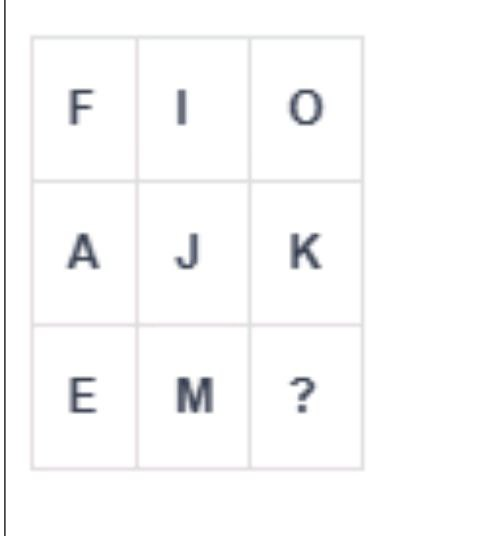
In the following question find the missing letter?

FIO
AJK
EM?
  1. P
  2. R
  3. Q
  4. V
  5. S
Show answerHide answer

Answer: B official key

Approach: Letter positions: third column = first + second in each row.

Solution: Row 1: F(6) + I(9) = 15 = O ✔.
Row 2: A(1) + J(10) = 11 = K ✔.
Row 3: E(5) + M(13) = 18 = R.

Cetking shortcut: Convert to numbers immediately; row-wise sums are the first test.

Answer: B

Q2EasyCET 2026 · Slot 3 · Q2

OLPA, QLRA, SLTA, _____, WLXA Fill the blank of the series

  1. OLPA
  2. ULVA
  3. KLMA
  4. LLMA
  5. ULAV
Show answerHide answer

Answer: B official key

Approach: Letter-position shift in each slot of a 4-letter group.

Solution:
1st letter: O, Q, S, ?, W → +2 each → U.
2nd letter: L constant.
3rd letter: P, R, T, ?, X → +2 each → V.
4th letter: A constant.
Missing term = U L V A.

Why the other options are wrong: OLPA repeats the first term; KLMA and LLMA move backwards; ULAV swaps the last two letters.

Answer: B

Q17EasyCET 2026 · Slot 3 · Q17

If the letters in the word 'CREATION' are rearranged as they appear in the English alphabet then the position of how many letters will remain unchanged after the rearrangement ?

  1. Two
  2. One
  3. Three
  4. Four
  5. Five
Show answerHide answer

Answer: B official key

Approach: Sort the letters alphabetically and compare position by position.

Solution:
Original: C R E A T I O N
Sorted:   A C E I N O R T
Position 3: E = E — the only match.
All other positions differ.

Answer: B

Q18MediumCET 2026 · Slot 3 · Q18

How many pairs of letters are there in the word ‘BEAUTIFYING’ which have as many letters between them as are in the ordinary English Alphabet series ?

  1. One
  2. Two
  3. Three
  4. Four
  5. Five
Show answerHide answer

Answer: D official key

Approach: For each pair, letters between them in the word must equal letters between them in the alphabet (count both forward and backward pairs).

Solution: B(1) E(2) A(3) U(4) T(5) I(6) F(7) Y(8) I(9) N(10) G(11)
E–I: 3 letters between in word (A,U,T), alphabet E→I has F,G,H = 3 ✓
U–T: adjacent in word, adjacent in alphabet (T,U) ✓
U–Y: 3 between in word (T,I,F), alphabet U→Y has V,W,X = 3 ✓
I–G (positions 9, 11): 1 between (N), alphabet G→I has H = 1 ✓
Total = 4 pairs.

Cetking shortcut: Check each letter only against the next 4–5 letters; far-apart pairs rarely match.

Answer: D

Q24EasyCET 2026 · Slot 3 · Q24

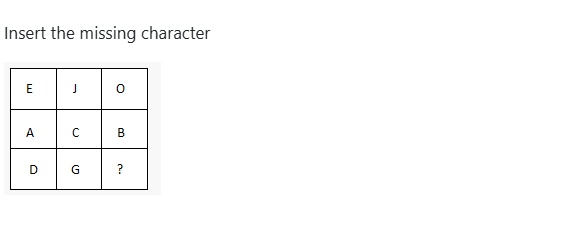
Insert the missing character

EJO
ACB
DG?
Figure for MBA CET 2026 Slot 3 question 24
  1. M
  2. N
  3. L
  4. T
  5. Q
Show answerHide answer

Answer: A official key

Approach: Column rule with alphabet positions: row 1 – row 2 = row 3.

Solution:
Column 1: E(5) – A(1) = 4 = D ✓
Column 2: J(10) – C(3) = 7 = G ✓
Column 3: O(15) – B(2) = 13 = M.

Why the other options are wrong: N(14), L(12), T(20), Q(17) do not give 15 – 2.

Answer: A

Q30EasyCET 2026 · Slot 3 · Q30

Which one set of letters when sequentially placed at the gaps in the given letter series shall complete it :

an__nn__ana__na__nan__a

  1. nnan
  2. aanan
  3. nanna
  4. naana
  5. aaana
Show answerHide answer

Answer: B official key

Approach: Fill the blanks so the series becomes a repeating block.

Solution:
Fill with a, a, n, a, n:
ananna | ananna | ananna
= ananna | ananna | ananna — the block 'ananna' repeats three times.

Why the other options are wrong: A has only 4 letters for 5 gaps; C, D, E break the repeating block.

Cetking shortcut: Total length 18 with 5 gaps → try a 6-letter repeating block.

Answer: B

Q33EasyCET 2026 · Slot 3 · Q33

Choose the option that shall come in place of ' ? ' :

AZ, GT, MN, ?, YB

  1. PW
  2. ST
  3. RX
  4. SH
  5. HS
Show answerHide answer

Answer: D official key

Approach: Track first and second letters separately.

Solution:
First letters: A(1), G(7), M(13), ?, Y(25) → +6 each → S(19).
Second letters: Z(26), T(20), N(14), ?, B(2) → –6 each → H(8).
Missing term = SH.

Why the other options are wrong: HS reverses the pair; PW, ST, RX fail one of the ±6 rules.

Cetking shortcut: Each pair is a letter and its opposite (A–Z, G–T, M–N) — S's opposite is H.

Answer: D

Q66EasyCET 2026 · Slot 3 · Q66
If the following series is written in reverse order and then all the vowels are deleted, which will be the 15th letter from the right in the new series?
A B C D E F G H I J K L M N O P Q R S T U V W X Y Z
  1. L
  2. S
  3. M
  4. T
  5. V
Show answerHide answer

Answer: B official key

Approach: Alphabet manipulation — reverse, delete vowels, then count position.

Solution:
Reversed: Z Y X W V U T S R Q P O N M L K J I H G F E D C B A.
Delete A, E, I, O, U ⇒ Z Y X W V T S R Q P N M L K J H G F D C B (21 letters).
15th from the right = (21 − 15 + 1) = 7th from the left.
Z(1) Y(2) X(3) W(4) V(5) T(6) S(7).

Why the other options are wrong:
L, M, T, V are at other positions (T is 6th, V 5th from left).

Cetking shortcut: n-th from right = (total − n + 1)-th from left; 21 − 15 + 1 = 7.

Answer: B

Q31MediumCET 2026 · Slot 2 · Q31

In the word “ANALYTICS”:

  • Letters at odd positions are changed to the letter two steps forward in the English alphabetical series,
  • Letters at even positions are changed to the letter one step backward in the English alphabetical series,
  • After this change, the letters at positions which are perfect squares are interchanged with the letters immediately following them.
After performing all the above operations, determine the alphabets that shall appear between the third and the seventh alphabets of the newly formed word, when compared to the alphabets that appear in an ordinary English dictionary.
  1. 8
  2. 5
  3. 7
  4. 9
  5. 4
Show answerHide answer

Answer: C official key

Approach: Apply the three operations in order, then count letters between two letters in the alphabet.

Solution:
ANALYTICS: 1 A, 2 N, 3 A, 4 L, 5 Y, 6 T, 7 I, 8 C, 9 S.
Odd positions +2: A→C, A→C, Y→A, I→K, S→U. Even positions −1: N→M, L→K, T→S, C→B.
Word: C M C K A S K B U.
Perfect-square positions 1, 4, 9 swap with the next letter: 1↔2 → M C; 4↔5 → A K; 9 has no 10th letter.
New word: M C C A K S K B U.
3rd letter = C, 7th letter = K. Letters between C and K in the alphabet: D, E, F, G, H, I, J = 7.

Cetking shortcut: Between two letters = difference of positions − 1: K(11) − C(3) − 1 = 7.

Answer: C

Q32EasyCET 2026 · Slot 2 · Q32
If all the alphabets of the word UNIDENTIFIED are arranged in an alphabetical order, then the position of how many alphabets shall remain unchanged in the newly formed word?
  1. 3
  2. 2
  3. 1
  4. 4
  5. 5
Show answerHide answer

Official CET key: C · Cetking's answer: A — see why below

Approach: Sort the letters alphabetically and compare position by position.

Solution:
UNIDENTIFIED: U N I D E N T I F I E D (12 letters).
Alphabetical: D D E E F I I I N N T U.
Compare: U/D, N/D, I/E, D/E, E/F, N/I, T/I, I/I, F/N, I/N, E/T, D/U.
Only the 8th letter (I) stays in place → 1.

Cetking shortcut: Write the sorted word directly under the original – a match jumps out.

Answer: C

Q33MediumCET 2026 · Slot 2 · Q33
If in the word SEPTUAGENARIAN first three and then next three letters are written in reverse order and the rest of the letters are written as they appear in English alphabet, the positions of how many letters get changed in the new arrangement?
  1. 10
  2. 8
  3. 9
  4. 11
  5. 12
Show answerHide answer

Official CET key: E · Cetking's answer: A — see why below

Approach: Rewrite the word per the rule and compare positions.

Solution:
SEPTUAGENARIAN: S E P T U A G E N A R I A N (14 letters).
First three reversed: SEP → P E S. Next three reversed: TUA → A U T.
Remaining G E N A R I A N in alphabetical order: A A E G I N N R.
New word: P E S A U T A A E G I N N R.
Compare with S E P T U A G E N A R I A N: only positions 2 (E) and 5 (U) are unchanged.
Letters whose positions change = 14 − 2 = 12.

Cetking shortcut: Reversing a group of 3 keeps its middle letter fixed – so check positions 2 and 5 first, then the sorted tail.

Answer: E

Q34EasyCET 2026 · Slot 2 · Q34
Each consonant of the word “EDUCATION” is changed to the next alphabet in the English alphabet and each vowel is changed to the previous alphabet.
If the new alphabets are arranged in alphabetical order, which alphabet will be the 4th from the left end?
  1. N
  2. U
  3. H
  4. E
  5. O
Show answerHide answer

Official CET key: C · Cetking's answer: D — see why below

Approach: Transform each letter, then sort.

Solution:
EDUCATION: E D U C A T I O N.
Consonants +1: D→E, C→D, T→U, N→O. Vowels −1: E→D, U→T, A→Z, I→H, O→N.
New letters: D E T D Z U H N O.
Alphabetical: D D E H N O T U Z.
4th from the left = H.

Why the other options are wrong:

  • D E is 3rd, not 4th (D, D, E, H…).
  • A N, B U, E O – later positions.

Answer: C

Q2MediumCET 2026 · Slot 1 · Q2
Find the number of pairs of alphabets in the English word PHYSICAL that have as many alphabets between them in the given word as they have in the actual English alphabet series ?
  1. One
  2. Four
  3. Zero
  4. Two
  5. Three
Show answerHide answer

Answer: D official key

Approach: For every pair of letters, compare the gap in the word with the gap in the alphabet.

Solution:
Word positions: P1 H2 Y3 S4 I5 C6 A7 L8.
Alphabet values: P16 H8 Y25 S19 I9 C3 A1 L12.
A pair qualifies when |word-position difference| = |alphabet-value difference|.
P–S: word gap 4−1 = 3, alphabet gap 19−16 = 3 ✓
I–L: word gap 8−5 = 3, alphabet gap 12−9 = 3 ✓
Every other pair fails (e.g. H–I: word gap 3, alphabet gap 1; C–A: 1 vs 2).
Total qualifying pairs = 2.

Cetking shortcut: Write the alphabet values under the word and scan each letter only against letters within a few places; large value jumps (Y=25, A=1) can be ignored quickly.

Answer: D

Q33MediumCET 2026 · Slot 1 · Q33
If the alphabets from T to Z are interchanged in opposite direction by the alphabets A to G of the English language alphabet series in such way tthat A takes the positions of T and so on, then which will be the third alphabet to the right of the18th letter from the left ?
  1. D
  2. E
  3. C
  4. F
  5. B
Show answerHide answer

Official CET key: E · Cetking's answer: B — see why below

Approach: Rewrite only the changed part of the alphabet, then count positions.

Solution:
A–G swap places with T–Z, with A taking T's place: positions 20–26 now read A B C D E F G (and T–Z move to positions 1–7).
18th letter from the left is still R (positions 8–19 are unchanged).
Third letter to the right of the 18th = position 21.
Position 21 now holds B.

Why the other options are wrong: C, D, E, F sit at positions 22–25 after the swap — they come from counting 4–7 places instead of 3, or from starting at the wrong letter.

Cetking shortcut: Positions 8–19 never change, so only map position 21 → A at 20, B at 21.

Answer: E

Q6EasyCET 2025 · Slot 6 · Q6

If all the letters of the word ‘ALLITERATION’ are arranged in the alphabetical order, then the position of how many letters will remain unchanged?

  1. None
  2. One
  3. Three
  4. Two
  5. More than three
Show answerHide answer

Answer: D

Approach: Write the word and its alphabetical arrangement position by position and count matches.

Solution:

Pos123456789101112
WordALLITERATION
SortedAAEIILLNORTT
Matches at position 1 (A) and position 4 (I) only.
So two letters remain unchanged.

Cetking shortcut: Sort by counting letters (A2, E1, I2, L2, N1, O1, R1, T2) and fill positions; compare only where the same letter could land.

Answer: D

Q46MediumCET 2025 · Slot 6 · Q46

How many pairs of letters (both forward and backward direction) are there in the word “STRENGTHEN” each of which have as many letters between them in the word as they have between them in the English alphabetic series?

  1. 1
  2. 2
  3. 3
  4. 4
  5. 5
Show answerHide answer

Answer: B

Approach: Write alphabet positions; a pair qualifies when |difference in values| = gap in positions in the word.

Solution:
S19 T20 R18 E5 N14 G7 T20 H8 E5 N14 (positions 1–10).
S–T (pos 1, 2): values differ by 1, positions by 1 → no letter between in either ✓
E–G (pos 4, 6): values differ by 2 (F between), positions differ by 2 (N between) ✓
Every other pair fails, e.g. R–T (2 vs 4), G–H (1 vs 2), H–E (3 vs 1), N–T (6 vs 2).
Total = 2 pairs.

Cetking shortcut: Check each letter only against letters within ~8 places and with close alphabet values; long gaps rarely match.

Answer: B

Q47EasyCET 2025 · Slot 6 · Q47

If all the vowels of the word “TREATMENT “ are replaced by succeeding letter according to the English alphabet and all the consonant are replaced with their previous letter according to the English alphabet and then all the letters are arranged in alphabetical order, then how many letter are there between the 3rd letter from the left and 4th letter from the right in the English alphabetic series.

  1. 6
  2. 12
  3. 9
  4. 10
  5. 11
Show answerHide answer

Answer: D

Approach: Apply the letter changes, sort, then count letters between in the alphabet.

Solution:
TREATMENT: vowels +1 (E→F, A→B, E→F), consonants −1 (T→S, R→Q, T→S, M→L, N→M, T→S).
New letters: S Q F B S L F M S.
Alphabetical: B F F L M Q S S S.
3rd from left = F; 4th from right = 6th from left = Q.
Letters between F and Q in the alphabet: G to P = 10.

Cetking shortcut: Between letters at positions a and b = |a − b| − 1 → F(6), Q(17): 17 − 6 − 1 = 10.

Answer: D

Q32EasyCET 2025 · Slot 5 · Q32

Complete the series:
WXCD, UVEF, STGH, QRIJ, ?

  1. OPKL
  2. OPQR
  3. LRMS
  4. AYBZ
  5. KLYZ
Show answerHide answer

Answer: A

Approach: Two letter pairs moving in opposite directions.

Solution: First pair: WX → UV → ST → QR (each letter −2) → next OP.
Second pair: CD → EF → GH → IJ (each letter +2) → next KL.
Next term = OPKL.

Why the other options are wrong:
B OPQR — second pair should be KL.
C, D, E — first pair is not OP.

Cetking shortcut: First pair alone (OP) cuts to A or B; second pair KL settles it.

Answer: A

Q69EasyCET 2025 · Slot 5 · Q69

Find the missing character from among the given alternatives.

Figure for MBA CET 2025 Slot 5 question 69
  1. Q
  2. R
  3. S
  4. B
  5. T
Show answerHide answer

Answer: B

Approach: Letter matrix: convert letters to alphabet positions.

Solution: Row 1: F(6) + I(9) = 15 = O ✓
Row 2: A(1) + J(10) = 11 = K ✓
Row 3: E(5) + M(13) = 18 = R.

Why the other options are wrong:
A Q = 17, C S = 19, D B = 2, E T = 20 – none equals 5 + 13.

Cetking shortcut: Memorise EJOTY (5, 10, 15, 20, 25) to convert letters instantly.

Answer: B

Q15EasyCET 2025 · Slot 4 · Q15

Complete the series by filling the blank with suitable alternative
CMM, EOO, GQQ, ______, KUU

  1. GRR
  2. GSS
  3. ISS
  4. ITT
  5. HSS
Show answerHide answer

Answer: C

Approach: Letter series — each letter moves by a fixed step.

Solution:
First letters: C, E, G, __, K → +2 each → I.
Second & third letters (same in each term): M, O, Q, __, U → +2 each → S.
Missing term = ISS.

Why the other options are wrong:
A (GRR), B (GSS): first letter G repeats instead of moving to I.
D (ITT): T is +3 from Q.
E (HSS): H is +1 from G.

Cetking shortcut: Check the first letter only: C→E→G→I→K. Only C and D start with I; the Q→S step then picks C.

Answer: C

Solution figure for question 15
Q3EasyCET 2025 · Slot 3 · Q3
DIRECTIONS for the question: In the following question, an alphabet series is given with term/s missing. Choose the correct alternative to replace the question mark in the given series.
A, CD, GHI, ?, UVWXY
  1. LMNO
  2. MNO
  3. MNOP
  4. NOPQ
  5. OPQZ
Show answerHide answer

Answer: C

Approach: Letter groups grow by one letter; starting positions jump by +2, +4, +6, +8.

Solution:
Group sizes: 1, 2, 3, ?, 5 → the missing group has 4 letters.
Starting letters: A(1), C(3), G(7), ?, U(21).
Jumps: +2, +4, so next +6 → 13 = M, then 13 + 8 = 21 = U ✓
Missing group = MNOP.
Equivalently, letters skipped between groups: B (1), EF (2), JKL (3), QRST (4).

Why the other options are wrong:
A LMNO: starts at L (12), breaks the +6 jump.
B MNO: only 3 letters.
D NOPQ: starts at N (14).
E OPQZ: not consecutive letters.

Cetking shortcut: Count skipped letters: 1, 2, 3, 4 — after GHI skip JKL, so the group starts at M.

Answer: C

Q51EasyCET 2025 · Slot 3 · Q51
Passage / data for this question

Following questions are based on the alphabet-series given below.
A B C D E F G H I J K L M N O P Q R S T U V W X Y Z

If the above alphabet is written in the reverse order, which will be the eighth letter to the right of O?
  1. F
  2. G
  3. V
  4. W
  5. A
Show answerHide answer

Answer: B

Approach: Reverse the alphabet, then count positions to the right of the given letter.

Solution:
Reversed order: Z Y X W V U T S R Q P O N M L K J I H G F E D C B A.
In this order, the letters to the right of O are N, M, L, K, J, I, H, G ...
Counting 8 places: N(1), M(2), L(3), K(4), J(5), I(6), H(7), G(8).

Why the other options are wrong:
A (F): this is the 9th letter to the right.
C (V), D (W): these are to the LEFT of O in the reversed order.
E (A): this is the last letter of the reversed series, not the 8th from O.

Cetking shortcut: In the reversed series, moving right from a letter means going backwards in the normal alphabet. O = 15, so 15 − 8 = 7, which is G.

Answer: B

Q52EasyCET 2025 · Slot 3 · Q52
Passage / data for this question

Following questions are based on the alphabet-series given below.
A B C D E F G H I J K L M N O P Q R S T U V W X Y Z

If the above alphabet is written in the reverse order, which will be the fifth letter to the left of the ninth letter from the right?
  1. P
  2. N
  3. D
  4. W
  5. M
Show answerHide answer

Answer: B

Approach: Reverse the alphabet, locate the reference letter from the right end, then count to its left.

Solution:
Reversed order: Z Y X W V U T S R Q P O N M L K J I H G F E D C B A.
Ninth letter from the right end (A is 1st): A, B, C, D, E, F, G, H, I.
Fifth letter to the left of I: J(1), K(2), L(3), M(4), N(5).

Why the other options are wrong:
A (P): this is the 7th letter to the left of I.
C (D): this is to the right of I, not the left.
D (W): far to the left; it is the 4th letter from the left end.
E (M): this is only the 4th letter to the left of I.

Cetking shortcut: In the reversed series, the k-th letter from the right is simply the k-th letter of the normal alphabet (9th = I). Left in the reversed series = forward in the normal alphabet: I + 5 = N.

Answer: B

Q53EasyCET 2025 · Slot 3 · Q53
In the following question, an alphabet series is given with term/s missing. Choose the correct alternative to replace the question mark in the given series.
ADVENTURE, DVENTURE, DVENTUR, ?, VENTU
  1. DVENT
  2. VENTURE
  3. VENTUR
  4. DVENTU
  5. ADVENT
Show answerHide answer

Answer: C

Approach: Letter-deletion series: remove the first and last letters alternately.

Solution:
ADVENTURE → DVENTURE: first letter A removed.
DVENTURE → DVENTUR: last letter E removed.
DVENTUR → ? : remove the first letter D, giving VENTUR.
Check: VENTUR → VENTU (last letter R removed), which matches the next term.

Why the other options are wrong:
A (DVENT): two letters are dropped from the end at once.
B (VENTURE): brings back the E that was already removed.
D (DVENTU): drops the last letter twice in a row and breaks the alternation.
E (ADVENT): brings back the A that was already removed.

Cetking shortcut: Each term is one letter shorter than the one before. The missing term must have 6 letters and lie inside both DVENTUR and VENTU, so it is VENTUR.

Answer: C

Q6EasyCET 2025 · Slot 2 · Q6

In the following letter series, some of the letters are missing which are given in that order as one of the alternatives below it. Choose the correct alternative:

m n o p n o p q o p q r _ _ _ _

  1. o q r s
  2. m o p q
  3. q r s t
  4. m n o p
  5. p q r s
Show answerHide answer

Answer: E

Approach: Split the series into blocks of four consecutive letters.

Solution:
Block 1: m n o p
Block 2: n o p q (starts one letter later)
Block 3: o p q r
Block 4 must start at p: p q r s.

Why the other options are wrong: q r s t is block 5, not block 4; m n o p repeats block 1; o q r s and m o p q break the consecutive-letter rule.

Cetking shortcut: The first letters of the blocks (m, n, o, …) give the start of the missing block directly.

Answer: E

Q20EasyCET 2025 · Slot 2 · Q20

Alphabet Series: A B C D E F G H I J K L M N O P Q R S T U V W X Y Z

If the series is written in reverse, which will be the eighth letter to the right of O?

  1. I
  2. G
  3. Q
  4. H
  5. S
Show answerHide answer

Answer: B

Approach: In the reversed alphabet, position from left = 27 − normal position.

Solution:
Reversed: Z Y X W V U T S R Q P O N M L K J I H G F E D C B A.
O (15th letter) is at 27 − 15 = 12th from the left.
Eighth to its right = 12 + 8 = 20th from left.
Letter = 27 − 20 = 7th letter = G.

Why the other options are wrong: I and H are the 18th/19th; Q and S are to the left of O in the reversed series.

Cetking shortcut: In the reversed series 'right' means going back in the alphabet: O − 8 = G.

Answer: B

Q21EasyCET 2025 · Slot 2 · Q21

Same reversed alphabet series.

Find the fifth letter to the left of the ninth letter from the right.

  1. M
  2. W
  3. O
  4. N
  5. L
Show answerHide answer

Answer: D

Approach: In the reversed alphabet Z … A, the k-th letter from the right is the k-th letter of the normal alphabet.

Solution:
Reversed: Z Y X … C B A. Counting from the right: A(1), B(2), … → 9th from right = I.
I is at 27 − 9 = 18th from the left.
Fifth to its left = 18 − 5 = 13th from left = 27 − 13 = 14th letter = N.

Why the other options are wrong: M is 4th to the left of I; O is 6th; L and W are wrong counts/directions.

Cetking shortcut: Left in the reversed series = forward in the normal alphabet: I + 5 = N.

Answer: D

Q22EasyCET 2025 · Slot 2 · Q22

If the last 10 letters of the English alphabet (Q to Z) are written in reverse order and the first 16 letters (A to P) are kept as they are, which letter will be sixth to the right of the thirteenth letter from the left?

  1. X
  2. W
  3. G
  4. V
  5. Y
Show answerHide answer

Answer: A

Approach: Write the new series and count positions.

Solution:
New series: A B C … O P | Z Y X W V U T S R Q.
Positions 1–16 unchanged; 13th from left = M.
Sixth to its right = 13 + 6 = 19th position.
Positions 17, 18, 19 = Z, Y, X.

Why the other options are wrong: S would be the 19th letter of the normal alphabet (not offered); W, V are the 20th/21st; Y is the 18th; G is to the left of M.

Answer: A

Q54EasyCET 2025 · Slot 2 · Q54
Find the 288th term in the series:
a, b, b, c, c, c, d, d, d, d, e, e, e, e, e, f, f, f, f, f, f, …
  1. u
  2. x
  3. v
  4. w
  5. y
Show answerHide answer

Answer: B

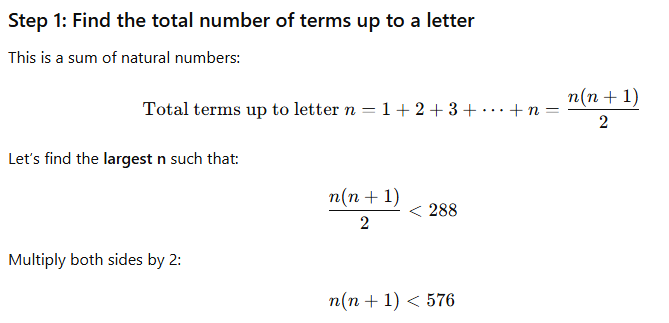
Approach: The n-th letter appears n times, so positions end at triangular numbers n(n + 1)/2.

Solution:
Last position of the n-th letter = n(n + 1)/2.
n = 23: 23 × 24/2 = 276 (W ends at 276).
n = 24: 24 × 25/2 = 300 (X occupies 277 to 300).
288 lies between 277 and 300 → 24th letter = X.

Cetking shortcut: Solve n²/2 ≈ 288 → n ≈ 24; check 276 < 288 ≤ 300.

Answer: B

Q17EasyCET 2025 · Slot 1 · Q17

Determine the alphabets that shall come in the blank space :
UNR ICF LEI OGL RIO ___

  1. WTR
  2. UKR
  3. ULS
  4. UJR
  5. UKS
Show answerHide answer

Answer: B

Approach: Column-wise alphabet series.

Solution:
1st letters: I, L, O, R → +3 each → next U (21).
2nd letters: C, E, G, I → +2 each → next K (11).
3rd letters: F, I, L, O → +3 each → next R (18).
Next group = U K R.
The opening group UNR does not follow this progression (the series runs from ICF onward).

Why the other options are wrong:
E UKS, C ULS — third letter should be R.
D UJR — second letter should be K (I + 2).
A WTR — first letter should be U.

Cetking shortcut: The answer repeats the 1st and 3rd letters of the first term (U _ R), so only the middle letter needs work.

Answer: B

Q73MediumCET 2025 · Slot 1 · Q73

Determine the 288th term of the series a,b,b,c,c,c,d,d,d,d,e,e,e,e,e,f,f,f,f,f,f,... :

Figure for MBA CET 2025 Slot 1 question 73
  1. X
  2. Z
  3. V
  4. W
  5. U
Show answerHide answer

Answer: A

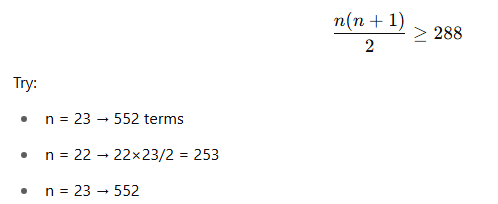
Approach: The n-th letter appears n times, so the last position of the n-th letter is n(n+1)/2.

Solution:
Find n with n(n+1)/2 ≥ 288.
n = 23: 23 × 24 / 2 = 276; n = 24: 24 × 25 / 2 = 300.
Positions 277–300 are the 24th letter = X (288 is the 12th 'x').

Why the other options are wrong:
W: 23rd letter, ends at position 276.
Z / V / U: 26th, 22nd, 21st letters.

Cetking shortcut: √(2 × 288) = √576 = 24 → the 24th letter, X (then confirm 276 < 288 ≤ 300).

Answer: A

Solution figure for question 73Solution figure for question 73

Practise these in the Arena

Take timed tests built around MBA CET topics and see where you stand.

Open the Arena