Let’s Crack CET 2027

Your CET check-up · tap a ring to see yours

Analogy – MBA CET questions with solutions

41 questions · CET 2025–2026 · Easy 38 · Medium 3 · Hard 0. Newest paper first. Full papers

Q3EasyCET 2026 · Attempt 2 Slot 2 · Q3
Choose the Option that shall correctly complete the analogy given below :
Fish : School :: Bird : ?
  1. Nest
  2. Flock
  3. Water
  4. Sky
  5. Feather
Show answerHide answer

Answer: B official key

Approach: Collective-noun analogy (animal : name of its group).

Solution:
A group of fish is called a 'school'.
Applying the same relation, a group of birds is called a 'flock'.
So Fish : School :: Bird : Flock.

Why the other options are wrong:
A: Nest is a bird's home, not its group.
C, D: Water and Sky are the habitats/mediums of fish and birds.
E: Feather is a body part.

Answer: B

Q29EasyCET 2026 · Attempt 2 Slot 2 · Q29

Select the option that correctly completes the given analogy. The relationship between the first pair must be applied in the same way to the second pair.

P21 : J28 :: G19 : ?

  1. T17
  2. C16
  3. A26
  4. O19
  5. K11
Show answerHide answer

Official CET key: C · Cetking's answer: B — see why below

Approach: Alphanumeric analogy — letter rank shift and number shift.

Solution:
P21 → J28: P (16) → J (10) is −6; 21 → 28 is +7.
Apply to G19: G (7) − 6 = 1 → A.
19 + 7 = 26.
So G19 : A26.

Why the other options are wrong:
A: T17 — T is +13 and 17 is −2.
B: C16 — C is −4 and 16 is −3.
D: O19 — number unchanged.
E: K11 — K is +4 and 11 is −8.

Cetking shortcut: Fix the number part first: only A26 has 19 + 7 = 26.

Answer: C

Q64EasyCET 2026 · Attempt 2 Slot 2 · Q64

Choose the word that best expresses the relationship similar to that of the given pair.

Giant : Dwarf :: Genius : ?

  1. Wicked
  2. Gentle
  3. Idiot
  4. Tiny
  5. Huge
Show answerHide answer

Answer: C official key

Approach: Word analogy: opposites.

Solution:
Giant (very big) is the opposite of Dwarf (very small).
Genius (very intelligent) is opposite to Idiot (very unintelligent).

Why the other options are wrong:
A (Wicked): opposite of good, not of genius.
B (Gentle): unrelated to intelligence.
D (Tiny), E (Huge): sizes, linked to the first pair, not to Genius.

Cetking shortcut: Name the relation in one word ('opposite') before reading options; ignore size words that just echo the first pair.

Answer: C

Q65EasyCET 2026 · Attempt 2 Slot 2 · Q65

Choose the word that best expresses the relationship similar to that of the given pair;

Mango : Fruit :: Potato : ?

  1. Root
  2. Fruit
  3. Stem
  4. Flower
  5. Bush
Show answerHide answer

Answer: C official key

Approach: Word analogy: plant part classification.

Solution:
A mango is the fruit of the mango plant.
A potato is a stem tuber — a modified underground stem (it has eyes/buds), not a root.
So Potato : Stem.

Why the other options are wrong:
A (Root): common trap; carrot/sweet potato are roots, potato is a stem.
B (Fruit): potato is not a fruit.
D (Flower), E (Bush): wrong plant parts.

Cetking shortcut: Potato, ginger, onion (bulb) = modified stems; carrot, radish, sweet potato = roots.

Answer: C

Q9EasyCET 2026 · Attempt 2 Slot 1 · Q9

Complete the following analogy:

5 : 30 :: 7 : ?

  1. 70
  2. 56
  3. 72
  4. 42
  5. 37
Show answerHide answer

Answer: B official key

Approach: n : n × (n + 1).

Solution:
5 × 6 = 30.
7 × 8 = 56.

Why the other options are wrong:
D 42: 7 × 6 copies the multiplier, not the rule.
A 70, C 72, E 37: fit no rule linking 5 and 30.

Cetking shortcut: 30 = 5² + 5, so the answer is 7² + 7 = 56.

Answer: B

Q7EasyCET 2026 · Slot 5 · Q7

If :

432 : 24, then 735 : ?

  1. 105
  2. 73
  3. 132
  4. 216
  5. 196
Show answerHide answer

Answer: A official key

Approach: Number analogy — product of the digits.

Solution:
432 → 4 × 3 × 2 = 24 ✓
735 → 7 × 3 × 5 = 105

Answer: A

Q8MediumCET 2026 · Slot 5 · Q8

If :

520 : 738

Then :

? : 350

  1. 222
  2. 248
  3. 230
  4. 232
  5. 220
Show answerHide answer

Official CET key: A · Cetking's answer: D — see why below

Approach: Each number is of the form n³ + n.

Solution:
520 = 8³ + 8 = 512 + 8
738 = 9³ + 9 = 729 + 9
350 = 7³ + 7 = 343 + 7
The first pair uses n = 8, 9; the second pair has 7 on the right, so the left number uses n = 6: 6³ + 6 = 216 + 6 = 222

Why the other options are wrong:
248, 232, 230, 220 are not of the form n³ + n (n = 6 gives 222, n = 5 gives 130).

Cetking shortcut: Spot the nearby cubes (512, 729, 343) — the remainders 8, 9, 7 equal the cube roots.

Answer: A

Q9EasyCET 2026 · Slot 5 · Q9

If :

6524 : 6465

Then;

9638 : ?

  1. 9832
  2. 9692
  3. 9825
  4. 9579
  5. 9673
Show answerHide answer

Official CET key: D · Cetking's answer: B — see why below

Approach: Number analogy — constant difference.

Solution:
6524 − 6465 = 59
Apply the same: 9638 − 59 = 9579

Why the other options are wrong:
A) 9832, C) 9825 — larger than 9638, but the rule decreases the number.
B) 9692 — larger than 9638.
E) 9673 — larger than 9638.

Cetking shortcut: The second number is smaller, so only D (the one option below 9638) can fit.

Answer: D

Q10EasyCET 2026 · Slot 5 · Q10

Identify the set of option that satisfies the condition given in the set provided :

[2846, 8462, 2864]

  1. [2046, 6468, 2684]
  2. [2476, 4764, 8084]
  3. [1317, 4768, 9024]
  4. [2846, 8260, 2862]
  5. [8246, 6824, 2468]
Show answerHide answer

Answer: E official key

Approach: Find the common property of the given set.

Solution:
2846, 8462, 2864 are all arrangements of the same four digits 2, 4, 6, 8 (each used once).
Option E: 8246, 6824, 2468 — each is again an arrangement of 2, 4, 6, 8 ✓

Why the other options are wrong:
A) 2046 has 0, 6468 repeats 6.
B) 2476 has 7, 8084 has 0.
C) odd digits 1, 3, 7, 9 appear.
D) 8260 has 0, 2862 repeats 2.

Answer: E

Q6EasyCET 2026 · Slot 4 · Q6
In question, a pair of words has a specific relationship. Select the option that best represents a similar relationship.
Prologue : Novel :: Preamble : ?
  1. Speech
  2. Law
  3. Poem
  4. Drama
  5. Action
Show answerHide answer

Answer: B official key

Approach: Part-to-whole analogy: the formal opening section of a text.

Solution:
A prologue is the introductory section of a novel/play.
A preamble is the introductory statement of a law, statute or constitution (e.g. the Preamble to the Constitution).

Why the other options are wrong:
A Speech – has an opening, not formally a preamble.
C Poem – an introduction to a poem is a proem/prelude.
D Drama – the introduction to a drama is itself a prologue.
E Action – not a text at all.

Answer: B

Q7EasyCET 2026 · Slot 4 · Q7
In question, a pair of words has a specific relationship. Select the option that best represents a similar relationship.
Obstinate : Yielding :: Optimistic : ?
  1. Cheerful
  2. Hopeful
  3. Pessimistic
  4. Confident
  5. Positive
Show answerHide answer

Answer: C official key

Approach: Antonym analogy.

Solution:
Obstinate (stubborn, unyielding) ↔ Yielding — opposites.
Optimistic (expecting the best) ↔ Pessimistic — opposites.

Why the other options are wrong:
A Cheerful, B Hopeful, D Confident, E Positive – all synonyms or near-synonyms of optimistic.

Answer: C

Q8EasyCET 2026 · Slot 4 · Q8
In question, a pair of words has a specific relationship. Select the option that best represents a similar relationship.
Cartography : Map :: Lexicography : ?
  1. Book
  2. Language
  3. Dictionary
  4. Grammar
  5. Alphabet
Show answerHide answer

Answer: C official key

Approach: Field of work : its product.

Solution:
Cartography → makes maps.
Lexicography → compiles dictionaries.

Why the other options are wrong:
A Book – too general.
B Language – subject of linguistics.
D Grammar – studied by grammarians.
E Alphabet – not the output of lexicography.

Answer: C

Q9MediumCET 2026 · Slot 4 · Q9
In question, a pair of words has a specific relationship. Select the option that best represents a similar relationship.
Panacea : Universal :: Antidote : ?
  1. Rare
  2. Specific
  3. Curative
  4. Medicinal
  5. Preventive
Show answerHide answer

Answer: B official key

Approach: Object : defining scope.

Solution:
Panacea = a remedy for all ills → its defining quality is universal.
Antidote = a remedy against a particular poison → its defining quality is specific.

Why the other options are wrong:
A Rare – not a defining feature.
C Curative / D Medicinal – true of both, so not the parallel quality.
E Preventive – an antidote counteracts after exposure; it does not prevent.

Answer: B

Q10EasyCET 2026 · Slot 4 · Q10
In question, a pair of words has a specific relationship. Select the option that best represents a similar relationship.
Opaque : Transparent :: Cryptic : ?
  1. Obvious
  2. Hidden
  3. Confusing
  4. Secret
  5. Vague
Show answerHide answer

Answer: A official key

Approach: Antonym analogy.

Solution:
Opaque (cannot be seen through) ↔ Transparent.
Cryptic (mysterious, hard to understand) ↔ Obvious.

Why the other options are wrong:
B Hidden, C Confusing, D Secret, E Vague – all synonyms of cryptic.

Answer: A

Q3EasyCET 2026 · Slot 3 · Q3

Choose the pair that best represents a similar relationship to the one expressed in the original pair of words.

SPY : CLANDESTINE

  1. Accountant : Meticulous
  2. Furrier : Rambunctious
  3. Lawyer : Ironic
  4. Shepherd : Garrulous
  5. Astronaut : Opulent
Show answerHide answer

Answer: A official key

Approach: Analogy — person : quality essential to that person's work.

Solution:
A spy must work in a clandestine (secret) way — secrecy is the defining trait of the job.
An accountant must be meticulous (careful, precise) — precision is the defining trait of that job.

Why the other options are wrong:
B: a furrier need not be rambunctious (noisy, unruly).
C: a lawyer is not defined by being ironic.
D: a shepherd need not be garrulous (talkative).
E: an astronaut is not defined by being opulent (rich).

Answer: A

Q28EasyCET 2026 · Slot 3 · Q28

The following questions consist of two words each that have a certain relationship to each other, followed by four lettered pairs of words. Select the lettered pair that has the same relationship as the original pair of words.

Hymn : Praise

  1. Prayer : Congregation
  2. Large : Mammoth
  3. Lullaby : Child
  4. Dirge : Grief
  5. Liturgy : Rite
Show answerHide answer

Answer: D official key

Approach: Analogy — a type of song : the feeling it expresses.

Solution:
A hymn is a song of praise.
A dirge is a song of grief (a lament for the dead).

Why the other options are wrong:
A: a congregation sings a prayer — performer, not emotion.
B: mammoth is a degree of large.
C: a lullaby is sung to a child — audience, not emotion.
E: a liturgy is a form of rite — type, not emotion.

Answer: D

Q49EasyCET 2026 · Slot 3 · Q49

In the question, find out the alternative which will replace the question mark.

Prologue : Epilogue : : Dawn : ?

  1. Afternoon
  2. Morning
  3. Evening
  4. Night
  5. Dusk
Show answerHide answer

Answer: E official key

Approach: Analogy — beginning : end.

Solution:
Prologue opens a book; epilogue closes it.
Dawn opens the day; dusk closes it.

Why the other options are wrong: Afternoon and morning are mid-day parts; evening is a period, not the exact closing point; night is the following phase — dusk is the true counterpart of dawn.

Answer: E

Q58EasyCET 2026 · Slot 3 · Q58
Choose the pair that best represents a similar relationship to the one expressed in the original pair of words.
DEPENDABLE : CAPRICIOUS
  1. fallible : cantankerous
  2. incorrigible : guilty
  3. capable : inept
  4. malleable : limpid
  5. erasable : obtuse
Show answerHide answer

Answer: C official key

Approach: Word analogy — DEPENDABLE and CAPRICIOUS are antonyms.

Solution:
Dependable = reliable, consistent. Capricious = unpredictable, changing on a whim. So the pair is opposites.
capable (able, competent) : inept (incompetent) — also opposites.

Why the other options are wrong:
fallible : cantankerous — unrelated (liable to err / bad-tempered). incorrigible : guilty — not opposites. malleable : limpid — unrelated (pliable / clear). erasable : obtuse — unrelated.

Answer: C

Q1EasyCET 2026 · Slot 2 · Q1

Select the option that is related to the third word in the same way as the second word is related to the first word:

Currency: Inflation : : Metal : ?

  1. Hunger
  2. Disease
  3. Rust
  4. Fuel
  5. Recycling
Show answerHide answer

Answer: C official key

Approach: Cause–effect analogy: the second word is the process that erodes / devalues the first.

Solution:
Inflation erodes the value of currency over time.
Rust (corrosion) erodes metal over time.
So Currency : Inflation :: Metal : Rust.

Why the other options are wrong:

  • A Hunger – affects living beings, not metal.
  • B Disease – affects organisms, not metal.
  • D Fuel – no deterioration relation with metal.
  • E Recycling – a reuse process, not deterioration.

Cetking shortcut: Ask 'what slowly eats away X?' – inflation eats currency, rust eats metal.

Answer: C

Q2EasyCET 2026 · Slot 2 · Q2

Choose the analogy that best matches the example provided:

Potter : Vase

A) Author : Idea
B) Carpenter : Chair
C) Painter : Brush
D) Chef : Recipe
E) Sculptor : Marble

  1. Author : Idea
  2. Carpenter : Chair
  3. Painter : Brush
  4. Chef : Recipe
  5. Sculptor : Marble
Show answerHide answer

Answer: B official key

Approach: Maker–product analogy.

Solution:
A potter makes a vase (finished product made by the craftsman).
A carpenter makes a chair – same maker → product relation.

Why the other options are wrong:

  • A Author : Idea – an author produces a book; an idea is not a crafted object.
  • C Painter : Brush – worker : tool, not product.
  • D Chef : Recipe – a chef makes a dish; a recipe is the instruction.
  • E Sculptor : Marble – worker : raw material, not product.

Cetking shortcut: Frame a sentence: 'A potter MAKES a vase' – only 'a carpenter MAKES a chair' fits the same sentence.

Answer: B

Q3EasyCET 2026 · Slot 2 · Q3

Select the option that completes the number analogy.

18 : 441 : : 21 : 576 : : 24: ?

  1. 564
  2. 478
  3. 729
  4. 446
  5. 676
Show answerHide answer

Answer: C official key

Approach: Number analogy: second term = (first term + 3)².

Solution:
18 → (18 + 3)² = 21² = 441 ✓
21 → (21 + 3)² = 24² = 576 ✓
24 → (24 + 3)² = 27² = 729

Cetking shortcut: 441 and 576 are perfect squares (21², 24²) – the chain 18, 21, 24 itself tells you the next square is 27².

Answer: C

Q4EasyCET 2026 · Slot 2 · Q4

Select the option in which the numbers follow the same relationship as in the given set.

40 : 49 : 22

  1. 31 : 41 : 21
  2. 35 : 47 : 28
  3. 45 : 56 : 22
  4. 27 : 37 : 12
  5. 42 : 51 : 24
Show answerHide answer

Answer: E official key

Approach: Number-triad relation: first + 9 = second; second − 27 = third (equivalently, all three numbers have the same digit sum root).

Solution:
Given: 40 + 9 = 49; 49 − 27 = 22 ✓ (digit roots 4, 4, 4).
E: 42 + 9 = 51; 51 − 27 = 24 ✓ (digit roots 6, 6, 6).

Why the other options are wrong:

  • A 31 : 41 : 21 – 31 + 9 = 40 ≠ 41.
  • B 35 : 47 : 28 – 35 + 9 = 44 ≠ 47.
  • C 45 : 56 : 22 – 45 + 9 = 54 ≠ 56.
  • D 27 : 37 : 12 – 27 + 9 = 36 ≠ 37.

Cetking shortcut: Check only 'first + 9 = second': it alone eliminates A–D in seconds.

Answer: E

Q5EasyCET 2026 · Slot 2 · Q5

Select the option that is related to the third word in the same way as the second word is related to the first word:

Democracy : Ballot :: Monarchy : ?

  1. Justice
  2. Charity
  3. Help
  4. Crown
  5. Borrow
Show answerHide answer

Answer: D official key

Approach: System : its defining instrument/symbol of power.

Solution:
In a democracy, power is conferred through the ballot.
In a monarchy, power is held through the crown.
So Democracy : Ballot :: Monarchy : Crown.

Why the other options are wrong:

  • A Justice, B Charity, C Help, E Borrow – none is the instrument or symbol of a system of rule.

Answer: D

Q35EasyCET 2025 · Slot 6 · Q35

Ally: foe:: Admit:

  1. Repudiate
  2. Plaint
  3. Humorous
  4. Indiscreet
  5. Tedious
Show answerHide answer

Answer: A

Approach: Identify the relation in the first pair: antonyms.

Solution:
Ally (friend) is the opposite of foe (enemy).
Admit (accept as true) — its opposite is repudiate (deny, reject).

Why the other options are wrong:
B Plaint = complaint.
C Humorous, D Indiscreet, E Tedious have no opposite relation to 'admit'.

Answer: A

Q49EasyCET 2025 · Slot 6 · Q49

Choose the word that best complete the comparison.

Particular: fussy :: ______ : subservient

  1. Meek
  2. Above
  3. Cranky
  4. Uptight
  5. Clever
Show answerHide answer

Answer: A

Approach: First pair are synonyms; find a synonym of 'subservient'.

Solution:
Particular = fussy (hard to please, exacting).
Subservient = overly obedient, submissive → meek.

Why the other options are wrong:
B Above, E Clever: unrelated.
C Cranky, D Uptight: closer to 'fussy', the opposite of submissive.

Answer: A

Q53EasyCET 2025 · Slot 6 · Q53
Find the word that names a necessary part of the underlined word
VIBRATION
  1. Motion
  2. Electricity
  3. Science
  4. Sound
  5. Electron
Show answerHide answer

Answer: A

Approach: Essential-part question — pick what the thing cannot exist without.

Solution: A vibration is a rapid back-and-forth movement. Without motion there is no vibration, so motion is a necessary part of it.

Why the other options are wrong: Electricity, science and electron are not needed for a vibration; sound is often caused by vibration but is not a required part of it.

Cetking shortcut: Ask: 'Can the word exist without this?' Only the 'no' answer is correct.

Answer: A

Q54EasyCET 2025 · Slot 6 · Q54
find out which of the answer choices completes the same relationship
Yard is to inch as quart is to
  1. Gallon
  2. Ounce
  3. Milk
  4. Liquid
  5. Solid
Show answerHide answer

Answer: B

Approach: Unit analogy — bigger unit : smaller unit of the same quantity.

Solution: A yard is a unit of length made of smaller units, inches (1 yard = 36 inches).
A quart is a unit of volume made of smaller units, fluid ounces (1 quart = 32 fl oz).
So quart : ounce.

Why the other options are wrong: Gallon is bigger than a quart (reverses the order); milk, liquid and solid are not units.

Answer: B

Q55EasyCET 2025 · Slot 6 · Q55
find the word that completes the bottom row of words
Rule command dictate
Doze sleep _________
  1. Snore
  2. Govern
  3. Awaken
  4. Hibernate
  5. Stringent
Show answerHide answer

Answer: D

Approach: Degree-progression analogy — each row increases in intensity.

Solution: Rule → command → dictate: increasing force of control.
Doze → sleep → ?: increasing depth/length of sleep. Hibernate (a long, deep sleep) is the next step.

Why the other options are wrong: Snore is a sound made while sleeping, not a deeper sleep; govern belongs to the first row; awaken is the opposite; stringent is unrelated.

Answer: D

Q1EasyCET 2025 · Slot 5 · Q1

The question contains a pair of words followed by four options. The relationship between the first pair of words is similar to the relationship between the third word and one of the options. Choose the correct option that best completes the analogy.

Eye : Myopia :: Teeth : ?

  1. Pyorrhoea
  2. Cataract
  3. Trachoma
  4. Eczema
  5. Psoriasis
Show answerHide answer

Answer: A

Approach: Organ : disease of that organ.

Solution: Myopia (short-sightedness) is a disorder of the eye.
So we need a disease of the teeth.
Pyorrhoea is an infection of the gums and tooth sockets that loosens teeth — a dental disease.

Why the other options are wrong:
B Cataract — eye disease (clouding of the lens).
C Trachoma — eye disease (bacterial infection).
D Eczema — skin disease.
E Psoriasis — skin disease.

Cetking shortcut: Group the options by organ: two eye, two skin, one teeth — the odd organ group of one is the answer.

Answer: A

Q2EasyCET 2025 · Slot 5 · Q2

The question contains a pair of words followed by four options. The relationship between the first pair of words is similar to the relationship between the third word and one of the options. Choose the correct option that best completes the analogy.

Wimbledon Trophy: Tennis :: Walker’s Cup: ?

  1. Hockey
  2. Golf
  3. Cricket
  4. Polo
  5. Wrestling
Show answerHide answer

Answer: B

Approach: Trophy : sport in which it is awarded.

Solution: The Wimbledon trophy is awarded in tennis.
The Walker Cup is the amateur golf team competition between the USA and Great Britain & Ireland.

Why the other options are wrong:
A Hockey — e.g. Beighton Cup, Rangaswami Cup.
C Cricket — e.g. Ashes, Ranji Trophy.
D Polo — e.g. Cowdray Park Gold Cup.
E Wrestling — no link with the Walker Cup.

Cetking shortcut: Walker Cup and Ryder Cup are both golf — remember the pair.

Answer: B

Q3EasyCET 2025 · Slot 5 · Q3

The question contains a pair of words followed by four options. The relationship between the first pair of words is similar to the relationship between the third word and one of the options. Choose the correct option that best completes the analogy.

Virology: Virus :: Entomology : ?

  1. Insects
  2. Bacteria
  3. Fungi
  4. Animals
  5. Fishes
Show answerHide answer

Answer: A

Approach: Branch of science : what it studies.

Solution: Virology is the study of viruses.
Entomology is the study of insects (Greek entomon = insect).

Why the other options are wrong:
B Bacteria — bacteriology.
C Fungi — mycology.
D Animals — zoology.
E Fishes — ichthyology.

Answer: A

Q4EasyCET 2025 · Slot 5 · Q4

The question contains a pair of words followed by four options. The relationship between the first pair of words is similar to the relationship between the third word and one of the options. Choose the correct option that best completes the analogy.

Scale: Length :: Odometer : ?

  1. Smell
  2. Temperature
  3. Speed
  4. Rain
  5. Current
Show answerHide answer

Answer: C

Approach: Instrument : quantity it measures.

Solution: A scale measures length.
An odometer is the dashboard instrument that records how far a vehicle has travelled, so it belongs to the vehicle-motion family. Of the quantities given, only speed is a vehicle-motion quantity (distance itself is not offered).

Why the other options are wrong:
A Smell — no instrument link with an odometer.
B Temperature — thermometer.
D Rain — rain gauge.
E Current — ammeter.

Cetking shortcut: Eliminate every option that has its own well-known instrument (thermometer, rain gauge, ammeter); only Speed is left in the vehicle family.

Answer: C

Q5EasyCET 2025 · Slot 5 · Q5

The question contains a pair of words followed by four options. The relationship between the first pair of words is similar to the relationship between the third word and one of the options. Choose the correct option that best completes the analogy.

Annihilation : Fire :: Cataclysm : ?

  1. Steam
  2. Earthquake
  3. Emergency
  4. Disaster
  5. Radiation
Show answerHide answer

Answer: B

Approach: Effect : cause (the second word is what brings about the first).

Solution: Annihilation (total destruction) can be brought about by fire.
A cataclysm (a sudden violent upheaval) is brought about by an earthquake — a natural force that causes it, just as fire causes annihilation.

Why the other options are wrong:
A Steam — not a cause of large-scale upheaval.
C Emergency — a situation, not a cause.
D Disaster — a synonym of cataclysm, not its cause.
E Radiation — not the typical cause of a cataclysm.

Cetking shortcut: When the option list has a synonym of the third word (Disaster), it is usually a trap — the pair is cause–effect, not synonyms.

Answer: B

Q58EasyCET 2025 · Slot 4 · Q58
In the following question find out the alternative which will replace the question mark.
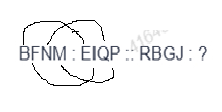
BFNM : EIQP :: RBGJ : ?
Figure for MBA CET 2025 Slot 4 question 58
  1. GHJK
  2. WXYZ
  3. UEJM
  4. ABCD
  5. PQRS
Show answerHide answer

Answer: C

Approach: Letter analogy: find the shift applied to each letter of the first pair.

Solution:
B→E, F→I, N→Q, M→P: every letter moves +3.
Apply +3 to RBGJ: R→U, B→E, G→J, J→M.
So RBGJ : UEJM.

Why the other options are wrong:
A, B, D, E: none of these is a +3 shift of R, B, G, J (e.g. they do not start with U).

Cetking shortcut: Check only the first letter: R+3 = U — only option C starts with U.

Answer: C

Solution figure for question 58
Q6MediumCET 2025 · Slot 3 · Q6
DIRECTIONS for the question: In the following question, there is a particular relationship given, similar relationship has to be identified from the alternatives provided.
CRED is related to PSQR in the same way as JMKL is related to…..?……..
  1. YXZW
  2. YVZX
  3. UVXZ
  4. WZWZ
  5. RQSP
Show answerHide answer

Answer: D

Approach: Letter analogy by positional shifts.

Solution:
CRED → PSQR: C(3)→P(16) = +13, R(18)→S(19) = +1, E(5)→Q(17) = +12, D(4)→R(18) = +14.
Apply to JMKL: J(10)+13 = W(23), K(11)+12 = W(23), L(12)+14 = Z(26).
So the answer has the form W _ W Z (the same rule would give N as the 2nd letter, M+1, which no option shows).
Only option D (WZWZ) has W in the 1st and 3rd places and Z in the 4th.

Why the other options are wrong:
A YXZW, B YVZX: start with Y, not W.
C UVXZ: starts with U.
E RQSP: starts with R.

Cetking shortcut: Check just the first letter: J + 13 = W. Only option D starts with W.

Answer: D

Q7EasyCET 2025 · Slot 3 · Q7
DIRECTIONS for the question: In the following question, there is a particular relationship given, similar relationship has to be identified from the alternatives provided.
EGIK is related to WUSQ in the same way as DFHJ is related to…..?……..
  1. BDFH
  2. ECGI
  3. XVTR
  4. SQOM
  5. QSUV
Show answerHide answer

Answer: C

Approach: Letter analogy: each pair of positions adds up to 28.

Solution:
EGIK → WUSQ: E(5)+W(23) = 28, G(7)+U(21) = 28, I(9)+S(19) = 28, K(11)+Q(17) = 28.
So each letter → (28 − position).
DFHJ: D(4) → 24 = X, F(6) → 22 = V, H(8) → 20 = T, J(10) → 18 = R.
Answer = XVTR.

Why the other options are wrong:
A BDFH, B ECGI: move backward by small steps, not the 28-sum rule.
D SQOM: sums are 23, not 28.
E QSUV: wrong direction and spacing.

Cetking shortcut: Both words are alternate-letter runs (gap 2), so the answer must be a reverse alternate run starting one step after W: X, V, T, R.

Answer: C

Q8EasyCET 2025 · Slot 3 · Q8
DIRECTIONS for the question: In the following question, there is a some relationship between the two terms to the left of : : and the same relationship holds between the two terms to its right. Also, in each question, one term either to the right of : : or to the left of it is missing. This term is given as one of the alternatives given below the question. Choose the correct answer.
acE : bdF : : fhJ : ?
  1. jbf
  2. ghK
  3. giK
  4. dfH
  5. fhL
Show answerHide answer

Answer: C

Approach: Letter analogy: every letter moves +1, case preserved.

Solution:
acE → bdF: a→b, c→d, E→F (each +1).
fhJ → f+1 = g, h+1 = i, J+1 = K → giK.

Why the other options are wrong:
A jbf: not a +1 shift.
B ghK: second letter should be i (h + 1), not h.
D dfH: shifts backward.
E fhL: first two letters unchanged.

Cetking shortcut: The given terms are alternate letters (a, c, E / f, h, J); after +1 they stay alternate — only giK keeps the g_i spacing.

Answer: C

Q9EasyCET 2025 · Slot 3 · Q9
DIRECTIONS for the question: In the following question, there is a certain relationship between the two given numbers on one side of : : and one number is given on another side of : : while another number is to be found from the given alternatives, having the same relation with this number as the numbers of the given pair bear. Choose the correct answer.
3 : 11 : : 7 : ?
  1. 22
  2. 29
  3. 18
  4. 51
  5. 13
Show answerHide answer

Answer: D

Approach: Number analogy: square the number and add 2.

Solution:
3 → 3² + 2 = 9 + 2 = 11 ✓
7 → 7² + 2 = 49 + 2 = 51

Why the other options are wrong:
A 22, B 29, C 18, E 13: none equals 7² + 2; linear rules (×3+2 = 23, ×4−1 = 27) do not match any option either.

Cetking shortcut: 11 is just above 9 = 3² — check n² + k first; 49 + 2 = 51 is in the options.

Answer: D

Q10EasyCET 2025 · Slot 3 · Q10
DIRECTIONS for the question: In the following question, there is a certain relationship between the two given numbers on one side of : : and one number is given on another side of : : while another number is to be found from the given alternatives, having the same relation with this number as the numbers of the given pair bear. Choose the correct answer.
121 : 12 : : 25 : ?
  1. 1
  2. 2
  3. 6
  4. 7
  5. 5
Show answerHide answer

Answer: C

Approach: Number analogy: square root plus 1.

Solution:
121 → √121 = 11 → 11 + 1 = 12 ✓
25 → √25 = 5 → 5 + 1 = 6

Why the other options are wrong:
A 1, B 2: no root-based rule gives these.
D 7: √25 + 2.
E 5: just the square root, missing the +1.

Answer: C

Q7EasyCET 2025 · Slot 2 · Q7

In the following question there is a certain relationship between two given numbers on one side of '::' and one number is given on another side of '::'. While another number is to be found from the given alternatives, having the same relation with this number as the numbers of the given pair have. 6 : 43 :: 4 : ?

  1. 44
  2. 45
  3. 29
  4. 88
  5. 21
Show answerHide answer

Answer: E

Approach: Find one rule that turns 6 into 43, then apply it to 4.

Solution:
6 → 6 × 7 + 1 = 43, i.e. n × (n + 1) + 1 (same as n² + n + 1).
4 → 4 × 5 + 1 = 21.

Why the other options are wrong: 44 and 45 are near-miss values; 29 = 4 × 7 + 1 reuses the multiplier 7 instead of n + 1; 88 has no link to 4 under this rule.

Cetking shortcut: 43 is one more than 42 = 6 × 7, a product of consecutive numbers; for 4 that is 4 × 5 = 20, plus 1.

Answer: E

Q23EasyCET 2025 · Slot 1 · Q23

6 : 222 :: 7 : ?

  1. 350
  2. 225
  3. 349
  4. 210
  5. 343
Show answerHide answer

Answer: A

Approach: Number analogy: n → n³ + n.

Solution:
6³ + 6 = 216 + 6 = 222 ✓.
7³ + 7 = 343 + 7 = 350.

Why the other options are wrong:
E 343 = 7³ only.
C 349 = 7³ + 6 (added the wrong n).
B 225, D 210 — no consistent rule.

Answer: A

Practise these in the Arena

Take timed tests built around MBA CET topics and see where you stand.

Open the Arena