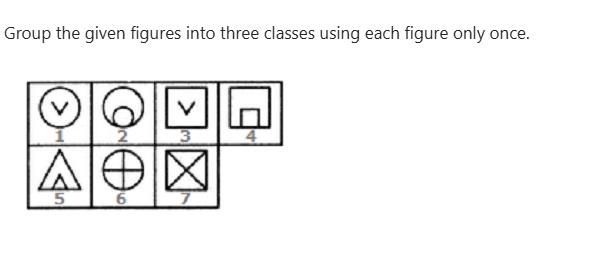
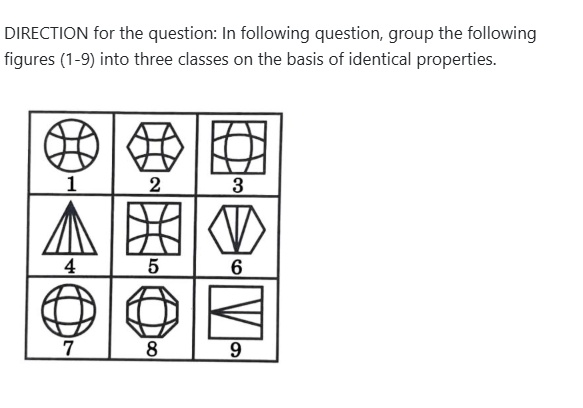
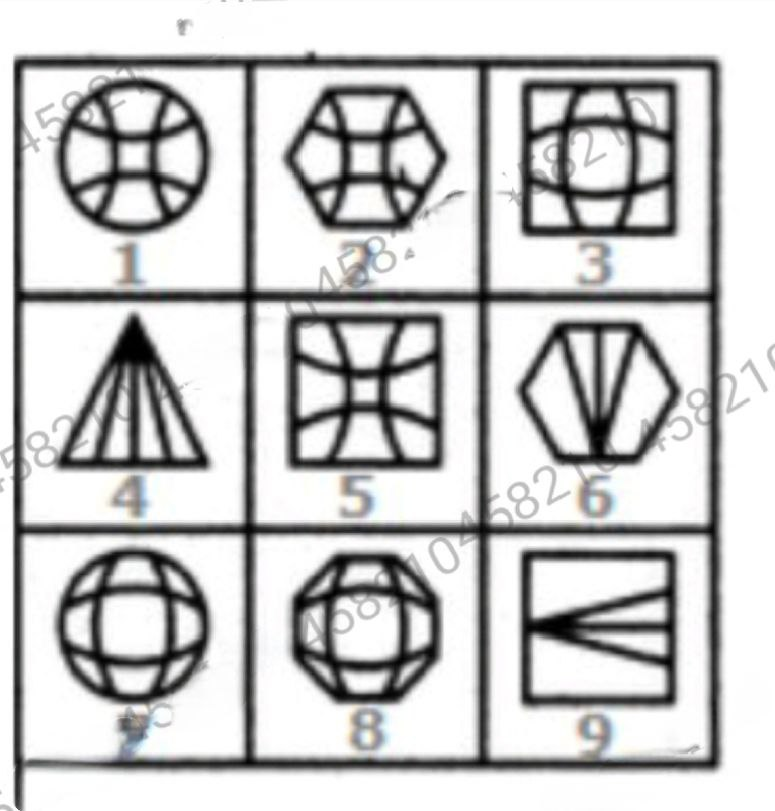
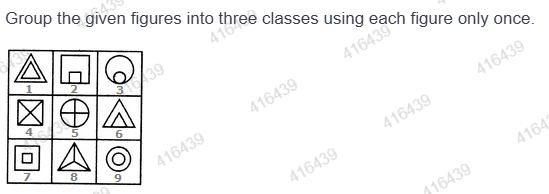
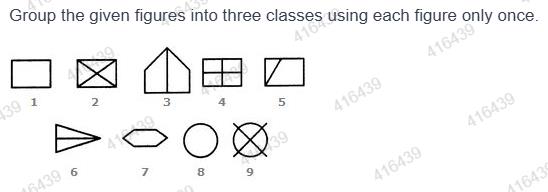
Group the given figures into three classes using each figure only once.
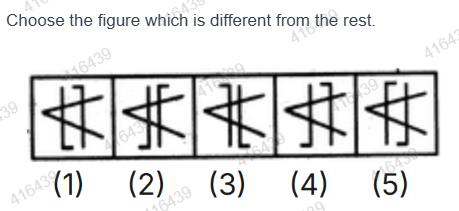
- A1,2,6 ; 3,4,7 ; 5
- B1,3 ; 2,6 ; 4,5,7
- C1,2,6,7 ; 3 ; 4,5
- D1,3 ; 2,4,5 ; 6,7
- E1,6 ; 4,3,5 ; 2,7
Show answerHide answer
Answer: D ✓ official key
Approach: Figure classification into three groups by what is inside the outer shape.
Solution:
Figures 1 and 3: an outer shape (circle, square) with a V-mark inside.
Figures 2, 4 and 5: an outer shape with a smaller copy of the same shape sitting on its base (circle in circle, square in square, triangle in triangle).
Figures 6 and 7: an outer shape divided by two crossing lines (+ in the circle, × in the square).
Groups: (1, 3), (2, 4, 5), (6, 7).
Why the other options are wrong:
A: puts 1 with 2 and 6, which have different inner elements.
B: splits 2 and 4/5 and puts 4, 5 with 7.
C: mixes V-mark, small-copy and cross figures.
E: splits the crossing-line pair 6, 7.
Cetking shortcut: Ignore the outer shape; classify only by the inner element (V, small copy, cross).
Answer: D
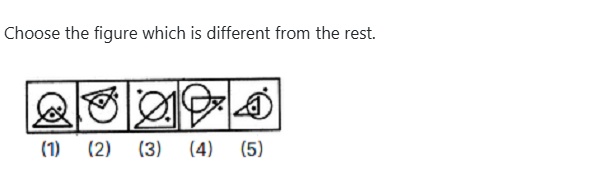
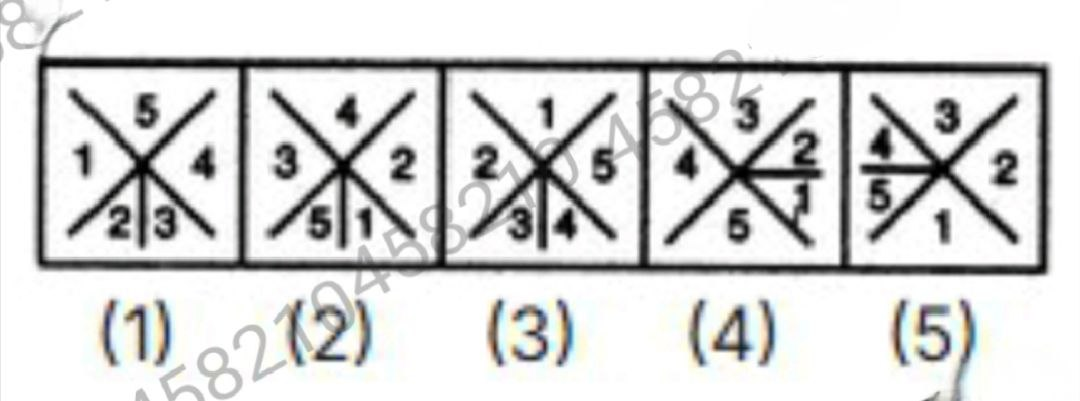
Choose the figure which is different from the rest.
- A1
- B2
- C3
- D4
- E5
Show answerHide answer
Answer: A ✓ official key
Approach: Dot-position classification: locate each dot relative to the circle and the triangle.
Solution:
Figure 2: one dot in circle∩triangle, one dot outside both.
Figure 3: one dot in the triangle only, one dot outside both.
Figure 4: one dot in the triangle only, one dot outside both.
Figure 5: one dot in circle∩triangle, one dot outside both.
So in figures 2–5 one dot always lies outside both shapes.
Figure 1: one dot in circle∩triangle and the other inside the circle only — no dot is outside ⇒ Figure 1 is different.
Why the other options are wrong:
Figures 2, 3, 4, 5 all have one dot outside both the circle and the triangle.
Cetking shortcut: Look only for the 'outside' dot — the figure without one is the answer.
Answer: A
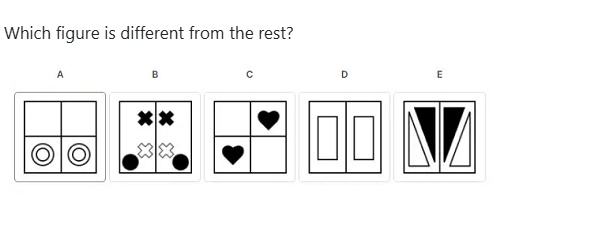
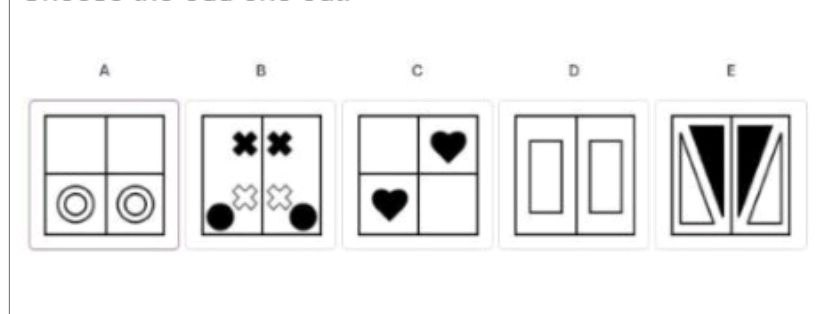
Which figure is different from the rest?
- AA
- BB
- CC
- DD
- EE
Show answerHide answer
Answer: C ✓ official key
Approach: Odd one out by symmetry: check the left and right halves of each figure.
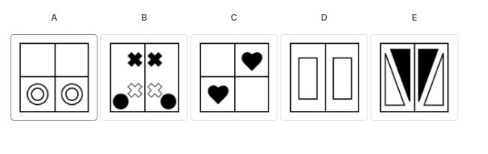
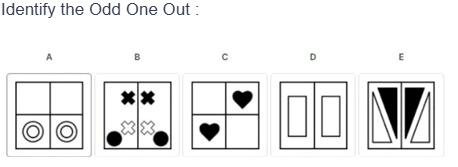
Solution:
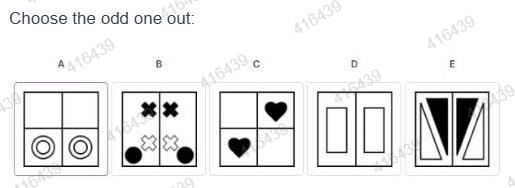
A: two identical double circles in the bottom cells ⇒ mirror symmetric.
B: crosses and dots placed the same on both sides ⇒ mirror symmetric.
D: identical rectangles in both halves ⇒ mirror symmetric.
E: black and white triangles mirrored on both halves ⇒ mirror symmetric.
C: hearts in the top-right and bottom-left cells (diagonal) ⇒ not mirror symmetric about the vertical line.
Why the other options are wrong:
A, B, D, E: each is a mirror image about the central vertical line.
Cetking shortcut: Fold every figure along its middle line in your head; the one that does not match is the odd one.
Answer: C
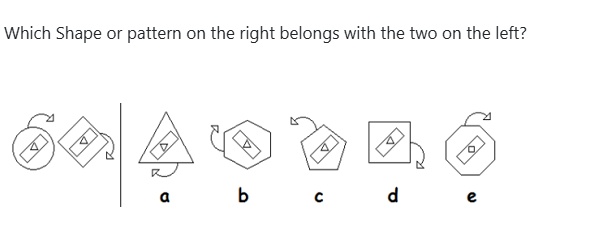
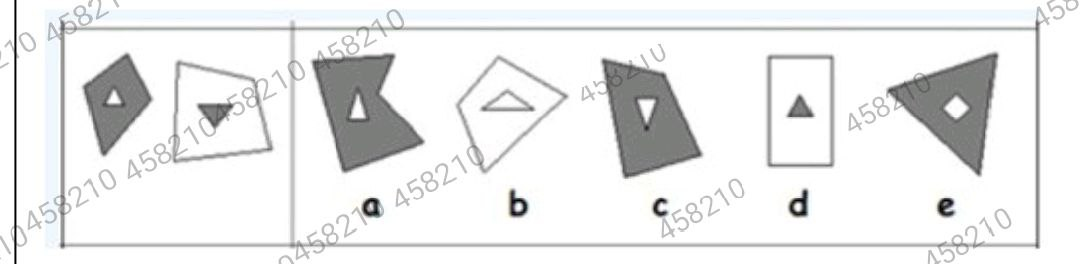
Which Shape or pattern on the right belongs with the two on the left?
- Aa
- Bb
- Cc
- Dd
- Ee
Show answerHide answer
Answer: D ✓ official key
Approach: Figure classification: list what the two given figures share, then match every feature.
Solution:
Both given figures: an outer shape with a rectangle placed diagonally (bottom-left to top-right), an upright triangle inside the rectangle, and a curved arrow outside turning clockwise.
a: triangle points down ⇒ out.
b: rectangle slants the other way (top-left to bottom-right) ⇒ out.
c: curved arrow turns anticlockwise ⇒ out.
e: a small square instead of a triangle ⇒ out.
d: diagonal rectangle with upright triangle and a clockwise arrow ⇒ belongs.
Why the other options are wrong:
A (a): inverted triangle.
B (b): rectangle slanted the other way.
C (c): anticlockwise arrow.
E (e): square inside instead of a triangle.
Cetking shortcut: Check one feature at a time across all options; each wrong option breaks exactly one feature.
Answer: D
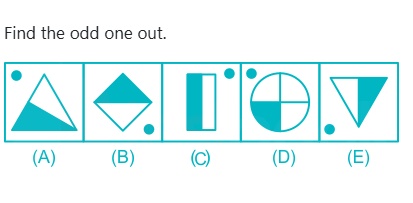
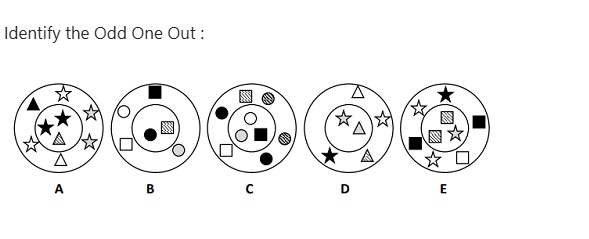
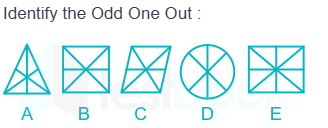
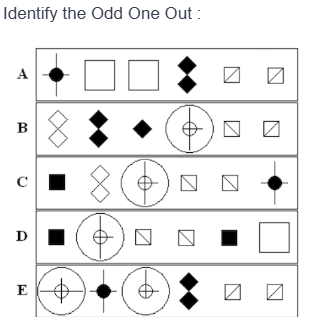
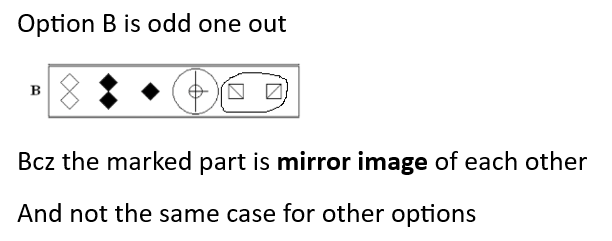
Find the odd one out.
- A(A)
- B(B)
- C(C)
- D(D)
- E(E)
Show answerHide answer
Official CET key: D · Cetking's answer: B — see why below
Approach: Odd one out: position of the dot relative to the shaded part.
Solution:
A: shading at the bottom, dot at the top (opposite side).
B: top half shaded, dot at the bottom.
C: left half shaded, dot at the top-right.
E: right half shaded, dot at the bottom-left.
In all of these the dot is on the side opposite the shaded part.
D: the shaded quarter is at the bottom-left and the dot is at the top-left — not opposite; D also has only a quarter shaded.
Why the other options are wrong:
A, B, C, E: dot always lies opposite the shaded region.
Cetking shortcut: Draw an imaginary line from the shading through the centre — the dot should be at the other end.
Answer: D
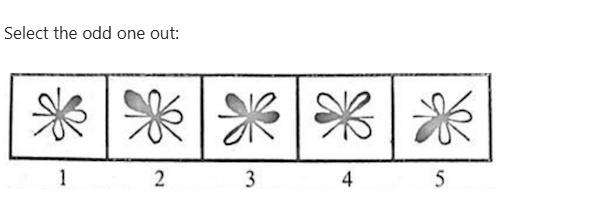
Select the odd one out:
- A1
- B2
- C3
- D4
- E5
Show answerHide answer
Official CET key: C · Cetking's answer: D — see why below
Approach: Odd one out: count the shaded petals.
Solution:
Each flower has 4 petals and 4 straight lines.
Figures 1, 2, 4 and 5 each have exactly one shaded petal.
Figure 3 has two shaded petals (upper-left and right) ⇒ odd one.
Why the other options are wrong:
Figures 1, 2, 4, 5: one shaded petal each.
Cetking shortcut: Before analysing positions, count simple things (petals, lines, shaded parts).
Answer: C
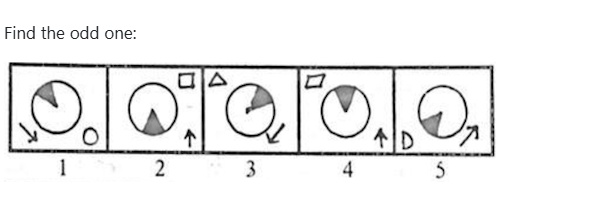
Find the odd one:
- A1
- B2
- C3
- D4
- E5
Show answerHide answer
Answer: D ✓ official key
Approach: Odd one out: direction of the arrow compared with the shaded sector.
Solution:
1: sector points up-left, arrow points down-right (opposite).
2: sector points down, arrow points up (opposite).
3: sector points up-right, arrow points down-left (opposite).
5: sector points down-left, arrow points up-right (opposite).
4: sector points up and the arrow also points up ⇒ not opposite ⇒ odd one.
Why the other options are wrong:
1, 2, 3, 5: the arrow points opposite to the shaded sector.
Cetking shortcut: Compare the two directional elements (sector and arrow) in each box; ignore the small shapes.
Answer: D
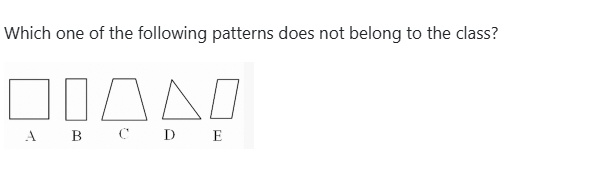
Which one of the following patterns does not belong to the class?
- AA
- BB
- CC
- DD
- EE
Show answerHide answer
Official CET key: D · Cetking's answer: E — see why below
Approach: Odd one out by number of sides.
Solution:
A: square (4 sides). B: rectangle (4). C: trapezium (4). E: parallelogram (4).
D: triangle (3 sides) ⇒ does not belong to the class of quadrilaterals.
Why the other options are wrong:
A, B, C, E: all are quadrilaterals.
Cetking shortcut: Count sides first — it is the fastest property to check in shape-classification questions.
Answer: D
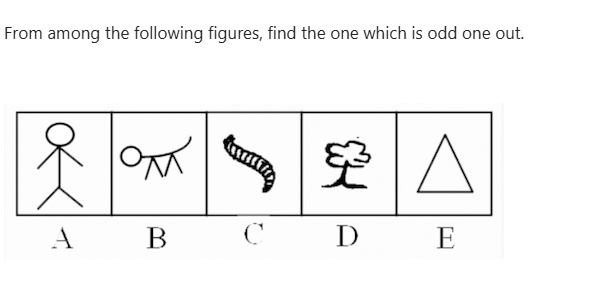
From among the following figures, find the one which is odd one out.
- AA
- BB
- CC
- DD
- EE
Show answerHide answer
Official CET key: E · Cetking's answer: B — see why below
Approach: Odd one out by meaning: living vs non-living.
Solution:
A: human figure; B: animal; C: caterpillar/worm; D: tree — all living things.
E: a triangle — a geometric shape, non-living ⇒ odd one.
Why the other options are wrong:
A, B, C, D: all show living things.
Cetking shortcut: When pictures show objects, classify them by what they represent before analysing lines.
Answer: E
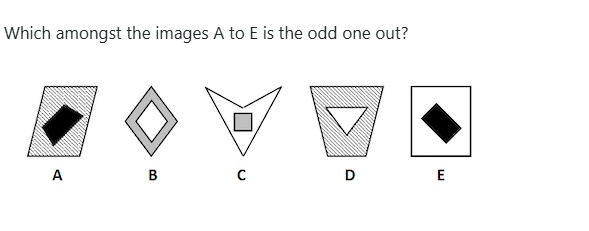
Which amongst the images A to E is the odd one out?
- AA
- BB
- CC
- DD
- EE
Show answerHide answer
Official CET key: D · Cetking's answer: C — see why below
Approach: Odd one out by number of sides of the inner shape.
Solution:
A: parallelogram with a four-sided shape inside.
B: rhombus with a rhombus inside.
C: four-sided arrowhead with a square inside.
E: rectangle with a four-sided shape inside.
D: trapezium with a triangle inside ⇒ inner shape is not four-sided ⇒ odd one.
Why the other options are wrong:
A, B, C, E: four-sided outer and four-sided inner shapes.
Cetking shortcut: Count sides of both shapes in each figure; the one with a different count stands out.
Answer: D
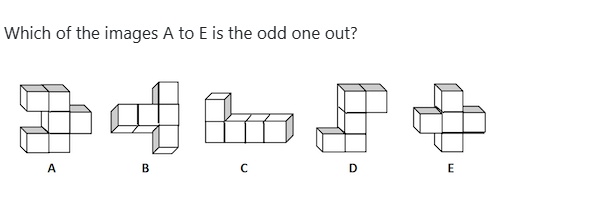
Which of the images A to E is the odd one out?
- AA
- BB
- CC
- DD
- EE
Show answerHide answer
Official CET key: A · Cetking's answer: C — see why below
Approach: Odd one out by counting cubes.
Solution:
B: row of 3 plus one above and one below the end ⇒ 5 cubes.
C: 4 in a row plus 1 on top ⇒ 5 cubes.
D: 2 + 1 + 2 ⇒ 5 cubes.
E: plus shape ⇒ 5 cubes.
A: 2 on top, 2 in the middle, 2 at the bottom ⇒ 6 cubes ⇒ odd one.
Why the other options are wrong:
B, C, D, E: each is made of 5 cubes.
Cetking shortcut: Count blocks before thinking about shapes — count is the most common rule for cube figures.
Answer: A
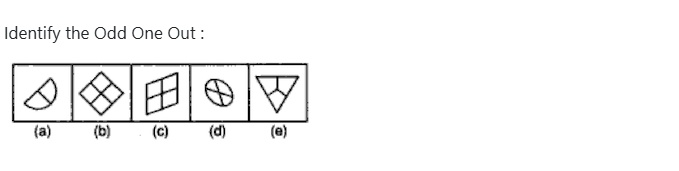
Identify the Odd One Out :
- A(a)
- B(b)
- C(c)
- D(d)
- E(e)
Show answerHide answer
Answer: D ✓ official key
Approach: Look at how the inner lines divide each shape.
Solution:
(a) semicircle cut into 2 equal halves.
(b) square cut into 4 equal squares.
(c) parallelogram cut into 4 equal parallelograms (lines join midpoints).
(e) triangle cut into 3 equal parts from its centre.
(d) ellipse cut by two slanted lines that do not run along its axes, so the 4 parts are unequal → odd one out.
Why the other options are wrong:
(a), (b), (c), (e): each is divided into equal, symmetric parts.
Answer: D
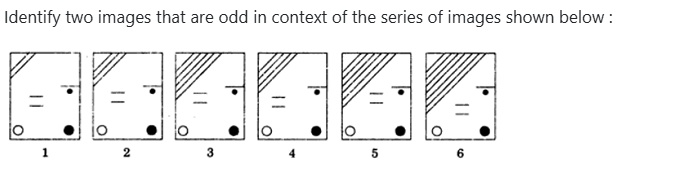
Identify two images that are odd in context of the series of images shown below :
- A1 and 4
- B3 and 5
- C4 and 6
- D2 and 3
- E3 and 4
Show answerHide answer
Answer: C ✓ official key
Approach: Compare each element across the six figures: hatched corner, '=' sign, dot with bar, two circles.
Solution:
Fixed in every figure: the dot under the short bar on the right, the hollow circle bottom-left, the solid circle bottom-right.
The hatched corner grows from figure to figure (1 → 2 → 3 → 5 → 6). Figure 4's hatched triangle is smaller than figure 3's, so it breaks the growth → odd.
The '=' sign stays in the upper middle in figures 1–5. In figure 6 it has dropped lower → odd.
Odd pair = 4 and 6.
Why the other options are wrong:
A, B, D, E: each includes a figure (1, 2, 3 or 5) that fits both patterns.
Answer: C
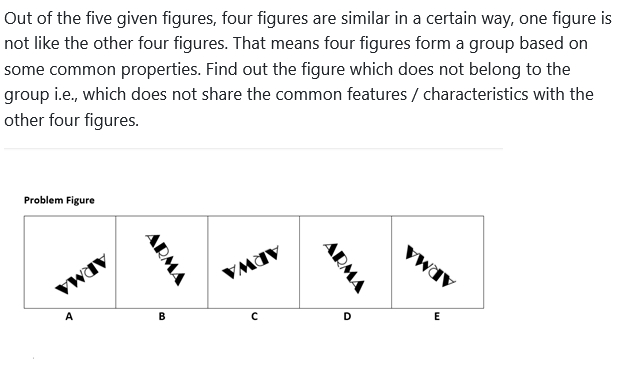
Out of the five given figures, four figures are similar in a certain way, one figure is not like the other four figures. That means four figures form a group based on some common properties. Find out the figure which does not belong to the group i.e., which does not share the common features / characteristics with the other four figures.
- AA
- BB
- CC
- DD
- EE
Show answerHide answer
Answer: C ✓ official key
Approach: Rotate each figure upright and read the letters.
Solution:
A, B, D and E are the same word ARMA, only turned through different angles.
In C the third letter is a W (the M is inverted), so it reads 'ARWA' — not a rotation of the others.
So C is the odd one out.
Why the other options are wrong:
A, B, D, E all become ARMA after rotation.
Cetking shortcut: For rotated words, check one asymmetric letter (here M/W) in every figure.
Answer: C
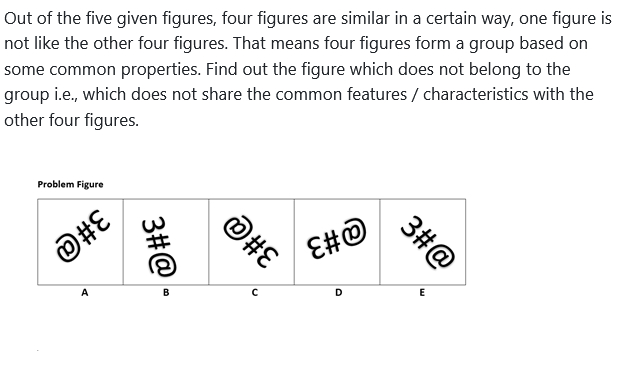
Out of the five given figures, four figures are similar in a certain way, one figure is not like the other four figures. That means four figures form a group based on some common properties. Find out the figure which does not belong to the group i.e., which does not share the common features / characteristics with the other four figures.
- AA
- BB
- CC
- DD
- EE
Show answerHide answer
Answer: D ✓ official key
Approach: Check whether each figure is a rotation of '3#@'.
Solution:
A, B, C and E are the same string '3#@' turned through different angles — the 3 and the @ keep their shapes.
In D the string is a mirror image: the 3 is reversed (looks like Ɛ), which no rotation can produce.
So D is the odd one out.
Why the other options are wrong:
A, B, C, E can all be rotated back to '3#@'.
Cetking shortcut: Look at the asymmetric symbol (3): rotation keeps its bulges on the same side relative to the string; a mirror flips them.
Answer: D
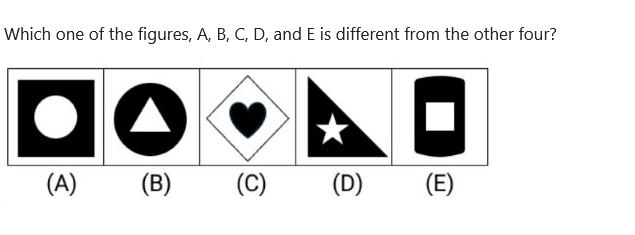
Which one of the figures, A, B, C, D, and E is different from the other four?
- AA
- BB
- CC
- DD
- EE
Show answerHide answer
Answer: C ✓ official key
Approach: Compare the fill of the outer and inner shapes.
Solution:
A: black square with a white circle inside.
B: black circle with a white triangle.
D: black triangle with a white star.
E: black rounded rectangle with a white square.
In each, a white shape sits inside a solid black shape.
C: an outline (white) diamond with a black heart inside — the colours are reversed.
So C is the odd one.
Answer: C
Identify the Odd One Out :
- AA
- BB
- CC
- DD
- EE
Show answerHide answer
Official CET key: E · Cetking's answer: C — see why below
Approach: Classify by the types of shapes used in each figure.
Solution: A: only stars and triangles. B: only squares and circles. C: only squares and circles. D: only stars and triangles.
E: stars and squares – the only figure that mixes a shape from each family.
So the figures pair up (A–D, B–C) and E is the odd one.
Why the other options are wrong: A and D share the star–triangle set; B and C share the square–circle set, so none of them is unique.
Cetking shortcut: Ignore shading and position first; list which shape types appear in each figure.
Answer: E
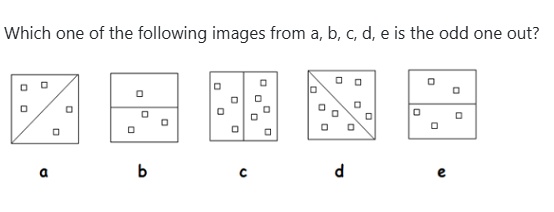
Which one of the following images from a, b, c, d, e is the odd one out?
- Aa
- Bb
- Cc
- Dd
- Ee
Show answerHide answer
Official CET key: B · Cetking's answer: C — see why below
Approach: Count the small squares on each side of the dividing line.
Solution: a: 3 and 2 (difference 1, total 5). b: 1 and 3 (difference 2, total 4). c: 4 and 5 (difference 1, total 9). d: 5 and 4 (difference 1, total 9). e: 2 and 3 (difference 1, total 5).
In every figure except b, the two parts differ by exactly one square, so the total is odd. In b they differ by 2.
Why the other options are wrong: a, c, d, e all follow the 'differ by one' rule; the direction of the dividing line does not matter.
Cetking shortcut: Count dots per region – line direction is a distractor.
Answer: B
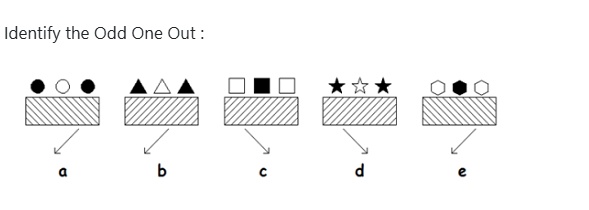
Identify the Odd One Out :
- Aa
- Bb
- Cc
- Dd
- Ee
Show answerHide answer
Official CET key: B · Cetking's answer: C — see why below
Approach: Relate the hatching direction to the arrow direction.
Solution: a: hatching '\' and arrow ↙ – perpendicular. c: hatching '/' and arrow ↘ – perpendicular. d: '/' and ↘ – perpendicular. e: '\' and ↙ – perpendicular.
b: hatching '/' and arrow ↙ – the arrow runs parallel to the hatching. So b is the odd one.
Why the other options are wrong: a, c, d, e all have the arrow at right angles to the hatch lines; the top shapes and their colours are distractors.
Cetking shortcut: When all figures share the same layout, compare the two directional elements (lines vs arrow) with each other.
Answer: B
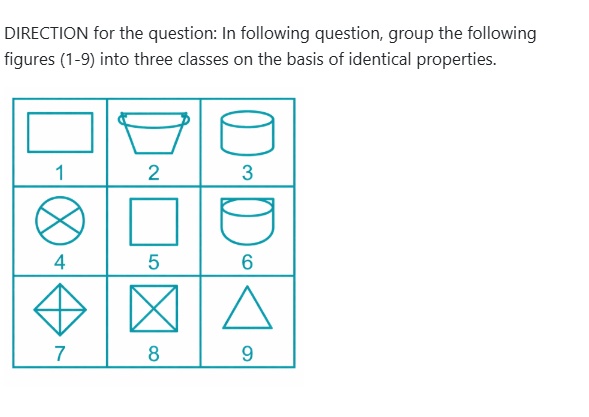
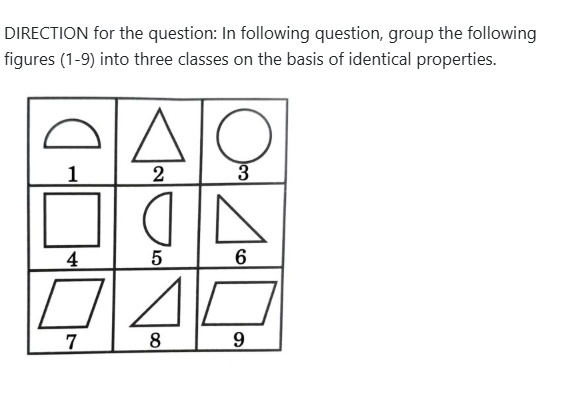
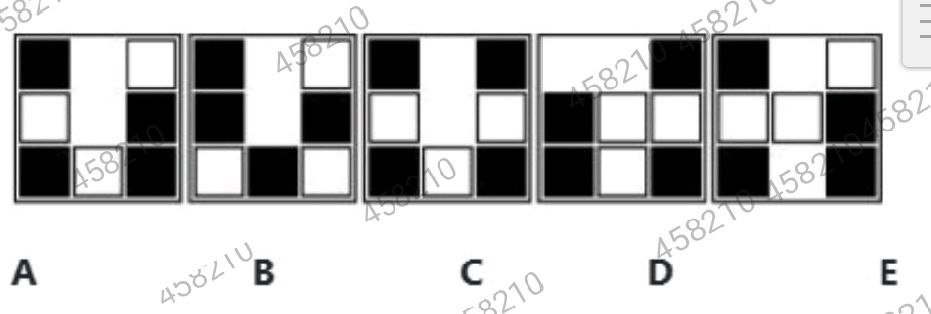
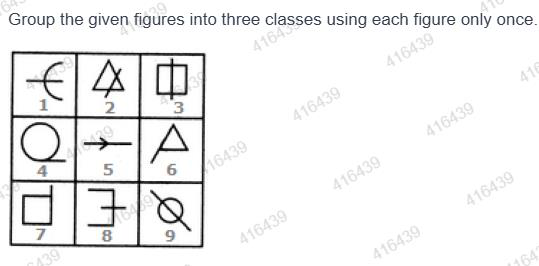
DIRECTION for the question: In following question, group the following figures (1-9) into three classes on the basis of identical properties.
- A1, 3, 9; 2, 4, 6; 5, 7, 8
- B1, 5, 9; 2, 4, 6; 3, 7, 8
- C1, 2, 5; 3, 6, 7; 4, 8, 9
- D1, 5, 9; 2, 3, 6; 4, 8, 7
- E1, 4, 8; 2, 7, 5; 3, 6, 9
Show answerHide answer
Official CET key: D · Cetking's answer: B — see why below
Approach: Group figures by a shared property.
Solution: Plain outline figures with no internal lines: 1 (rectangle), 5 (square), 9 (triangle).
Containers / 3-D vessels: 2 (bucket), 3 (cylinder), 6 (pot).
Shapes divided into four parts by two lines: 4 (circle with ×), 7 (rhombus with +), 8 (square with ×).
Groups: 1, 5, 9; 2, 3, 6; 4, 8, 7.
Why the other options are wrong: A, B, C, E split at least one natural group (e.g. B puts the cylinder 3 with 7 and 8; A puts 1 with 3 and 9).
Cetking shortcut: Fix the most obvious group first (2, 3, 6 vessels) and check which options contain it.
Answer: D
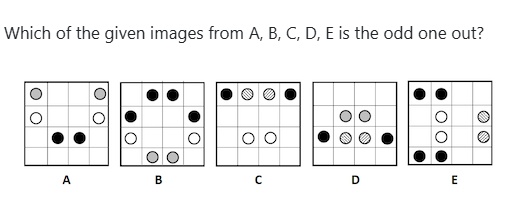
Which of the given images from A, B, C, D, E is the odd one out?
- AA
- BB
- CC
- DD
- EE
Show answerHide answer
Official CET key: E · Cetking's answer: C — see why below
Approach: Check each figure's line of symmetry.
Solution: A, B, C and D are each symmetric about the vertical centre line (the left half mirrors the right half).
E is symmetric about the horizontal centre line (the top half mirrors the bottom) but not about the vertical line.
So E is the odd one.
Why the other options are wrong: A–D all share vertical-axis symmetry; colours and counts are distractors.
Cetking shortcut: Fold each grid mentally along the vertical centre line first.
Answer: E
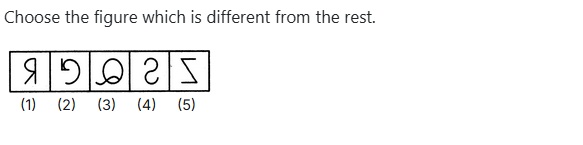
Choose the figure which is different from the rest.
- A1
- B2
- C3
- D4
- E5
Show answerHide answer
Answer: B ✓ official key
Approach: Odd figure out — check whether each letter is a mirror image or a rotated letter.
Solution:
(1) Я = mirror image of R.
(3) mirror image of Q (tail turns to the left).
(4) Ƨ = mirror image of S.
(5) mirror image of Z.
(2) is G turned upside down (rotated 180°) — its bar/hook is at the top, whereas a mirror G would keep the bar at the lower half.
So figure (2) is different.
Why the other options are wrong:
Figures 1, 3, 4, 5 are all plain lateral (mirror) images of R, Q, S, Z.
Cetking shortcut: In 'mirror letters' sets, check where the cross-bar/tail sits — a rotated letter moves it top↔bottom, a mirror only left↔right.
Answer: B
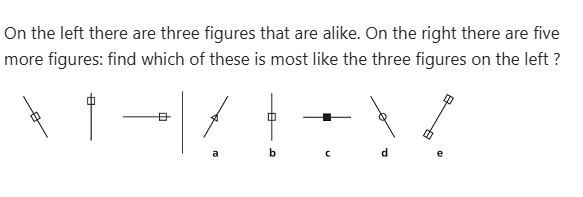
On the left there are three figures that are alike. On the right there are five more figures: find which of these is most like the three figures on the left ?
- Aa
- Bb
- Cc
- Dd
- Ee
Show answerHide answer
Answer: B ✓ official key
Approach: Figure classification — identify what the three left figures share.
Solution:
Each left figure: a single straight line with ONE small UNSHADED SQUARE on it (its position and the line's angle vary).
(b) is a line with one unshaded square on it ⇒ same type.
Why the other options are wrong:
(a) has a triangle. (c) square is shaded. (d) has a circle. (e) has two squares.
Cetking shortcut: Ignore the angle/position of the line — they vary in the given figures, so they can't be the rule.
Answer: B
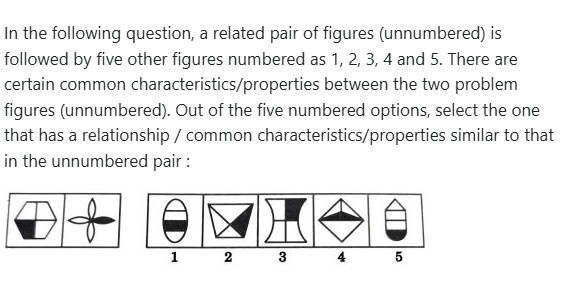
In the following question, a related pair of figures (unnumbered) is followed by five other figures numbered as 1, 2, 3, 4 and 5. There are certain common characteristics/properties between the two problem figures (unnumbered). Out of the five numbered options, select the one that has a relationship / common characteristics/properties similar to that in the unnumbered pair :
- A1
- B2
- C3
- D4
- E5
Show answerHide answer
Answer: C ✓ official key
Approach: Common-property pair — find what both given figures share.
Solution:
Hexagon: divided by one vertical and one horizontal line into 4 EQUAL parts, one part shaded.
Four-petal flower: 4 equal petals, one shaded.
Rule: a figure divided into 4 identical parts with exactly one part shaded.
Figure 3: the concave shape is cut by a vertical and a horizontal line into 4 equal quarters, one shaded ✓.
Why the other options are wrong:
1: 4 horizontal bands of unequal size. 2: diagonals of a trapezium give unequal triangles. 4: diamond parts are unequal. 5: pencil shape parts are unequal.
Cetking shortcut: Check 'equal parts' — most distractors also have one shaded part but unequal divisions.
Answer: C
In the following question, a related pair of figures (unnumbered) is followed by five other Figures numbered as 1, 2, 3, 4 and 5. There are certain common characteristics / properties between the two problem figures (unnumbered). Out of the five numbered figures, select the one that has a relationship / common characteristics / properties similar to that in the unnumbered pair.
- A1
- B2
- C3
- D4
- E5
Show answerHide answer
Answer: C ✓ official key
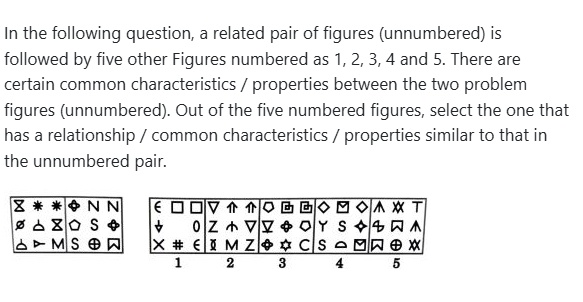
Approach: Common-property pair — 3×3 symbol grids with a fixed repetition pattern.
Solution:
Grid 1: three symbols appear twice (star, hour-glass, bell) and three appear once — and the pairs sit in the SAME cells: top-middle = top-right; top-left = middle-right; centre = bottom-left.
Grid 2: N at top-middle and top-right; flower-cross at top-left and middle-right; S at centre and bottom-left — the same pattern.
Figure 3: double-square at top-middle & top-right; pentagon at top-left & middle-right; flower-cross at centre & bottom-left ✓.
Why the other options are wrong:
1: one cell is empty. 2, 4, 5: repeated symbols sit in other cells / repeat a different number of times.
Cetking shortcut: Mark the three repeated pairs in one given grid; check only those cell positions in the options.
Answer: C
In the following question, a related pair of figures (unnumbered) is followed by five other figures numbered as 1, 2, 3, 4 and 5. There are certain common characteristics / properties between the two problem figures (unnumbered). Out of the five numbered figures, select the one that has a relationship / common characteristics / properties similar to that in the unnumbered pair.
- A1
- B2
- C3
- D4
- E5
Show answerHide answer
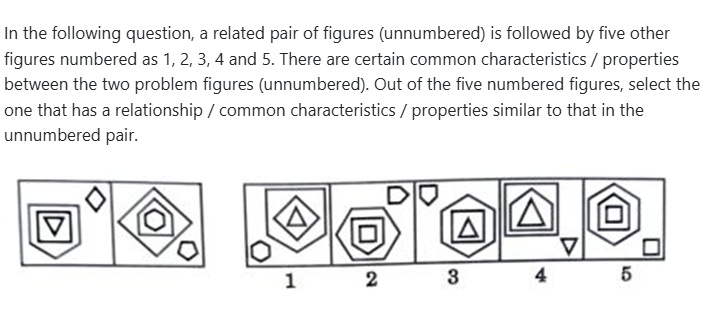
Answer: B ✓ official key
Approach: Common-property pair — nested polygons with consecutive side counts, plus an outside symbol copying the middle shape.
Solution:
Figure 1: pentagon ⊃ square ⊃ triangle (5, 4, 3) — outside small diamond (4) = middle shape.
Figure 2: diamond ⊃ pentagon ⊃ hexagon (4, 5, 6) — outside small pentagon (5) = middle shape.
Rule: three nested shapes with consecutive sides; the outside symbol has the same sides as the MIDDLE one.
Figure 2: hexagon ⊃ pentagon ⊃ square (6, 5, 4) with an outside pentagon (5) ✓.
Why the other options are wrong:
1: outside hexagon ≠ middle square. 3: hexagon–square–triangle is not consecutive. 4: outside triangle ≠ middle shape. 5: outside square ≠ middle pentagon.
Cetking shortcut: Look at the small outside symbol first — it must match the middle shape; that alone leaves option 2.
Answer: B
In the following question, a related pair of figures (unnumbered) is followed by five other figures numbered as 1, 2, 3, 4 and 5. There are certain common characteristics / properties between the two problem figures (unnumbered). Out of the five numbered figures, select the one that has a relationship / common characteristics / properties similar to that in the unnumbered pair.
- A1
- B2
- C3
- D4
- E5
Show answerHide answer
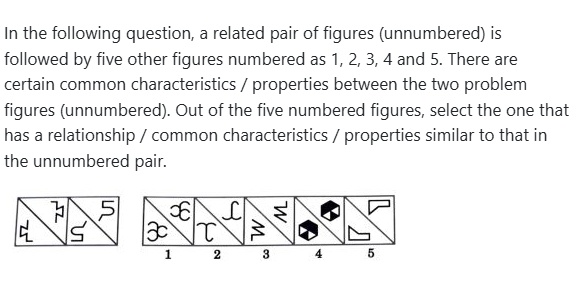
Answer: C ✓ official key
Approach: Common-property pair — the bottom-left symbol is the top-right symbol turned upside down (mirror + water image = 180° rotation).
Solution:
In both given squares, the diagonal splits the square; the symbol in the lower-left half is the upper-right symbol rotated by 180°.
Figure 3: the upper-right 'M-like' zig-zag appears in the lower-left as a 'W', i.e. rotated 180° ✓.
Why the other options are wrong:
1: the symbol is copied unchanged. 2, 4, 5: the lower symbol is only a single mirror/water image (or differently shaded), not a 180° turn of the upper one.
Cetking shortcut: Mirror + water image together = 180° rotation; check the symbol's 'top' end landing at the bottom.
Answer: C
In the following question, a related pair of figures (unnumbered) is followed by five other figures numbered as 1, 2, 3, 4 and 5. There are certain common characteristics / properties between the two problem figures (unnumbered). Out of the five numbered figures, select the one that has a relationship / common characteristics / properties similar to that in the unnumbered pair.
- A1
- B2
- C3
- D4
- E5
Show answerHide answer
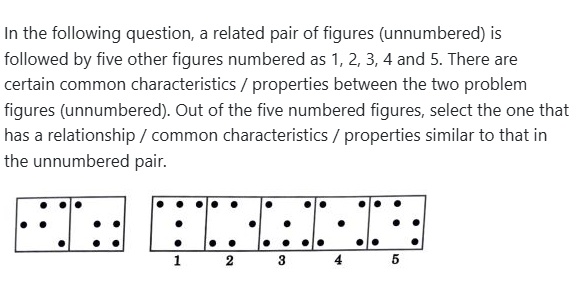
Answer: B ✓ official key
Approach: Common-property pair — dot figures: same number of dots in an unsymmetrical (scattered) layout.
Solution:
Figure 1: 5 dots, arranged with no line of symmetry.
Figure 2: 5 dots, again with an irregular scattered layout (the dots have only shifted positions).
Rule: exactly 5 dots in an irregular, non-patterned arrangement.
Figure 2 of the options: 5 dots (two top, one right-middle, two bottom) in an irregular layout ✓.
Why the other options are wrong:
1: 5 dots but a symmetric T-shape. 3: 6 dots. 4: 5 dots but the symmetric dice-five/X pattern. 5: 6 dots.
Cetking shortcut: Count dots first (removes 3 and 5), then reject the neat symmetric patterns.
Answer: B
DIRECTION for the question: In following question, group the following figures (1-9) into three classes on the basis of identical properties.
- A1,3,5 ; 2,6,9 ; 4,7,8
- B2,3,4 ; 5,6,8 ; 9,1,7
- C1,3,5 ; 2,6,8 ; 4,7,9
- D3,2,4 ; 6,5,8 ; 7,9,1
- E1,2,3 ; 4,5,6 ; 7,8,9
Show answerHide answer
Answer: C ✓ official key
Approach: Grouping figures into three classes by shape family.
Solution:
Curved shapes: 1 (semicircle), 3 (circle), 5 (semicircle).
Triangles: 2, 6, 8.
Four-sided figures: 4 (square), 7 (parallelogram), 9 (parallelogram).
Grouping: 1,3,5 ; 2,6,8 ; 4,7,9.
Why the other options are wrong:
A: puts 9 (four-sided) with triangles and 8 (triangle) with quadrilaterals. B, D, E: mix shapes from different families.
Cetking shortcut: Find one sure group (triangles 2, 6, 8) — only option C has it.
Answer: C
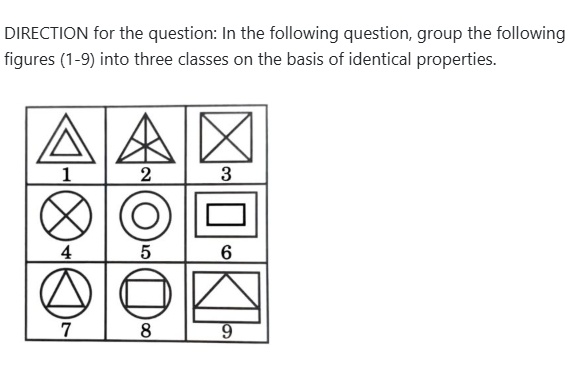
DIRECTION for the question: In the following question, group the following figures (1-9) into three classes on the basis of identical properties.
- A1,2,3 ; 4,5,8 ; 6,7,9
- B1,5,6 ; 2,3,4 ; 7,8,9
- C1,3,5 ; 2,4,8 ; 6,7,9
- D1,4,7 ; 2,5,8 ; 3,6,9
- E1,2,3 ; 4,5,6 ; 7,8,9
Show answerHide answer
Answer: B ✓ official key
Approach: Grouping figures by the kind of inner design.
Solution:
Same shape inside the same shape: 1 (triangle in triangle), 5 (circle in circle), 6 (rectangle in rectangle).
Crossing lines inside: 2 (lines meeting in the triangle), 3 (X in square), 4 (X in circle).
A different shape inside: 7 (triangle in circle), 8 (rectangle in circle), 9 (triangle in rectangle).
Grouping: 1,5,6 ; 2,3,4 ; 7,8,9.
Why the other options are wrong:
A, C, D, E: each mixes 'same-inside-same' figures with 'different-inside' or 'crossed-line' figures.
Cetking shortcut: The 'same shape inside itself' group (1, 5, 6) appears only in option B.
Answer: B
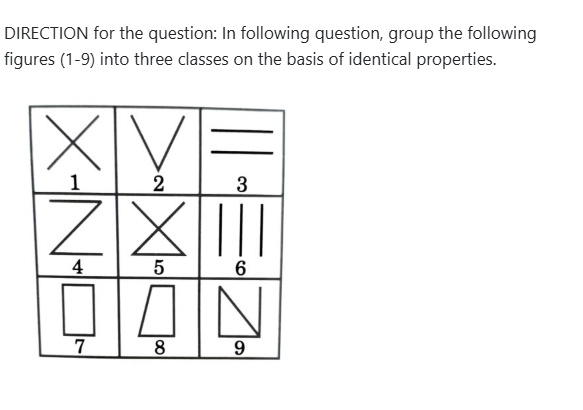
DIRECTION for the question: In following question, group the following figures (1-9) into three classes on the basis of identical properties.
- A1,2,3 ; 4,5,6 ; 7,8,9
- B1,3,5 ; 2,4,6 ; 7,8,9
- C1,5,9 ; 3,6,2 ; 4,7,8
- D1,9,7 ; 2,8,5 ; 3,4,6
- E1,2,3 ; 4,5,9 ; 6,7,8,
Show answerHide answer
Answer: A ✓ official key
Approach: Grouping figures by the number of straight lines used.
Solution:
Two lines: 1 (X), 2 (V), 3 (=).
Three lines: 4 (Z), 5 (crossed lines with a base), 6 (three verticals).
Four lines: 7 (rectangle), 8 (trapezium), 9 (N with a base).
Grouping: 1,2,3 ; 4,5,6 ; 7,8,9.
Why the other options are wrong:
B, C, D, E: each mixes figures with different line counts.
Cetking shortcut: For figures made of plain strokes, count the lines first — it's the most common rule.
Answer: A
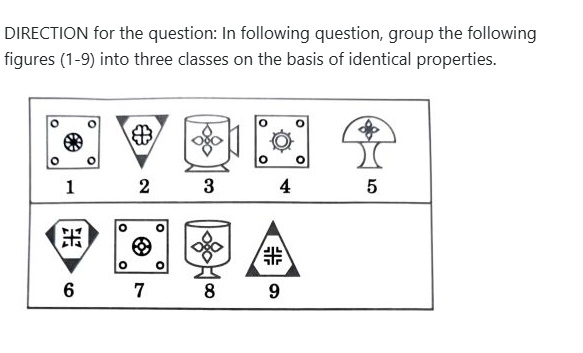
DIRECTION for the question: In following question, group the following figures (1-9) into three classes on the basis of identical properties.
- A1,4,7 ; 3,6,9 ; 2,5,8
- B1,6,9 ; 2,4,7 ; 3,5,8
- C1,4,7 ; 2,6,9 ; 3,5,8
- D1,5,7 ; 2,6,9 ; 3,4,8
- E1,2,3 ; 4,5,6 ; 7,8,9
Show answerHide answer
Answer: C ✓ official key
Approach: Grouping figures by outer frame type.
Solution:
Square frame with a small circle in each corner: 1, 4, 7.
Triangular/pointed shapes with black (shaded) corners: 2, 6, 9.
Cup / goblet / mushroom shapes standing on a base: 3, 5, 8.
Grouping: 1,4,7 ; 2,6,9 ; 3,5,8.
Why the other options are wrong:
A: puts 3 with the black-cornered shapes. B, D, E: break the corner-circle group or mix cup shapes with others.
Cetking shortcut: Spot the most obvious class (square with four corner circles: 1, 4, 7), then pick between A and C.
Answer: C
DIRECTION for the question: In following question, group the following figures (1-9) into three classes on the basis of identical properties.
- A1,2,5 ; 3,7,8 ; 4,6,9
- B1,7,2 ; 3,6,9 ; 4,5,8
- C2,3,8 ; 4,6,9 ; 1,5,7
- D5,6,9 ; 3,4,1 ; 2,7,8
- E1,2,3 ; 4,5,6 ; 7,8,9
Show answerHide answer
Answer: A ✓ official key
Approach: Grouping figures by the direction of the curved lines inside.
Solution:
Curves bending inward towards the centre (back-to-back arcs): 1, 2, 5.
Curves bulging outward, forming a rounded centre: 3, 7, 8.
Straight lines fanning out from one point: 4, 6, 9.
Grouping: 1,2,5 ; 3,7,8 ; 4,6,9.
Why the other options are wrong:
B, C, D, E: each mixes inward-curve figures with outward-curve or fan figures.
Cetking shortcut: The fan group (4, 6, 9) is easiest to spot — options A and C have it; then check the curve direction in 1 vs 3.
Answer: A
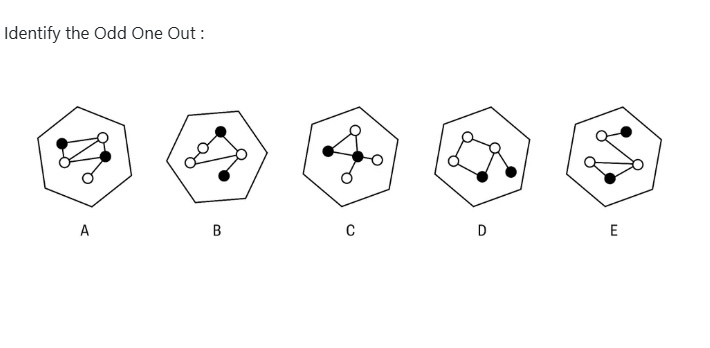
Identify the Odd One Out :
- AA
- BB
- CC
- DD
- EE
Show answerHide answer
Official CET key: C · Cetking's answer: D — see why below
Approach: Figure classification — check how the two black circles are connected.
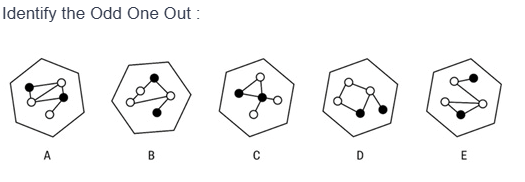
Solution:
Every figure has a hexagon with 5 small circles (2 black, 3 white) joined by lines.
A, B, D, E: the two black circles are never joined directly — each black circle is linked only to white circles.
C: the left black circle is joined directly to the central black circle.
So C is the odd one out.
Why the other options are wrong:
A, B, D, E all follow the rule 'no black–black line'; their different layouts are just rotations/rearrangements.
Cetking shortcut: Count circles first (all have 2 black + 3 white), then check the connections between same-colour circles.
Answer: C
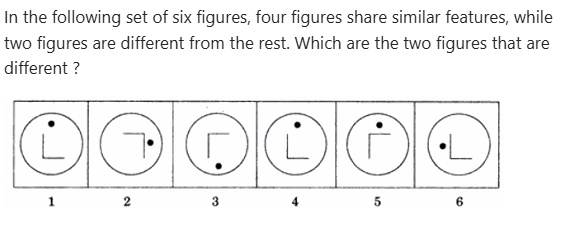
In the following set of six figures, four figures share similar features, while two figures are different from the rest. Which are the two figures that are different ?
- A1 and 6
- B2 and 4
- C3 and 4
- D4 and 6
- E5 and 6
Show answerHide answer
Answer: D ✓ official key
Approach: Figure classification — compare the L-shape and the position of the dot.
Solution:
Each figure is an L-shaped corner inside a circle, with one dot placed relative to the long (vertical) arm.
The official key groups figures 4 and 6 as the two different figures.
Figure 6: the dot sits beside the long arm on the side away from the short arm.
Figure 4: the L opens the same way as figure 6 (corner at bottom-left), with the dot beyond the tip of the long arm.
The remaining figures 1, 2, 3 and 5 are taken as the matching set.
Answer: D
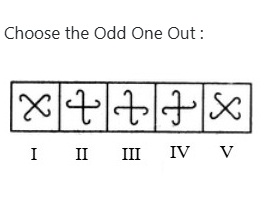
Choose the Odd One Out :
- AI
- BII
- CIII
- DIV
- EV
Show answerHide answer
Answer: E ✓ official key
Approach: Figure classification — direction in which the four hooked ends curl.
Solution:
Each figure is a cross (I and V diagonal, II–IV upright) with a hook at every arm end.
In I, II, III and IV the hooks all curl in the same rotational sense (they are rotations of one another).
In V the hooks curl the opposite way — V is the mirror image of I, not a rotation of it.
So V is the odd one out.
Why the other options are wrong:
I–IV: can be turned into one another by rotation only; V cannot.
Cetking shortcut: Compare the two X-shaped figures (I and V) first — if they are mirror images, one of them is the odd one.
Answer: E
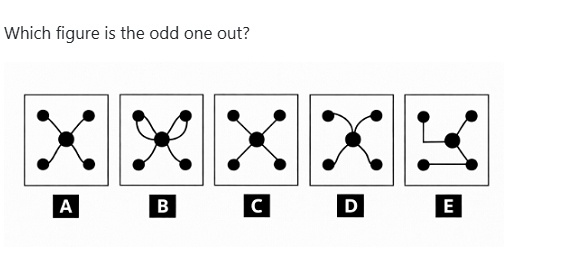
Which figure is the odd one out?
- AA
- BB
- CC
- DD
- EE
Show answerHide answer
Answer: E ✓ official key
Approach: Figure classification — how the four corner dots are joined.
Solution:
In A, B, C and D every corner dot is joined to the central dot (straight or curved lines), forming an X through the centre.
In E two dots are joined by right-angled bent lines and not all four corner dots meet at the centre.
So E is the odd one out.
Why the other options are wrong:
A, C: straight X through the centre.
B, D: curved arms, but all four still meet at the central dot.
Cetking shortcut: Check the common rule 'all four arms meet at the centre' — only E fails.
Answer: E
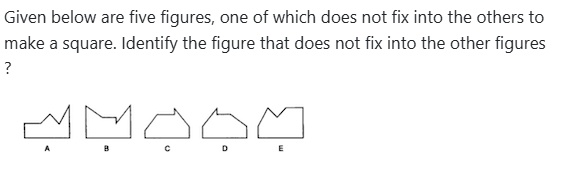
Given below are five figures, one of which does not fix into the others to make a square. Identify the figure that does not fix into the other figures ?
- AA
- BB
- CC
- DD
- EE
Show answerHide answer
Answer: C ✓ official key
Approach: Pairing pieces into squares — find which shapes have complementary edges.
Solution:
Each piece has a straight base and sides; its top edge is jagged.
A pairs with E: A's notched top fits into E's notched top when one is turned upside down.
B pairs with D: the small step in B's edge matches the step in D's edge.
C's profile (a step on the right with a sloping edge) has no matching partner, so C does not fit with the others.
Why the other options are wrong:
A, B, D, E: each has a complementary partner that completes a square.
Cetking shortcut: Turn one piece upside down in your mind and slide it onto another — matching notches complete the square.
Answer: C
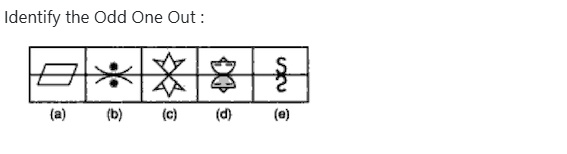
Identify the Odd One Out :
- A(a)
- B(b)
- C(c)
- D(d)
- E(e)
Show answerHide answer
Answer: A ✓ official key
Approach: Figure classification — symmetry about the horizontal line.
Solution:
Each box has a horizontal line through its middle.
(b), (c), (d), (e): the lower half is the mirror (water) image of the upper half.
(a): the parallelogram is slanted — its lower half is not the mirror image of its upper half.
So (a) is the odd one out.
Why the other options are wrong:
(b) dots and curves, (c) star halves, (d) bell halves, (e) S-curves: all reflect across the line.
Cetking shortcut: Fold each figure along the horizontal line — only the parallelogram fails to match.
Answer: A
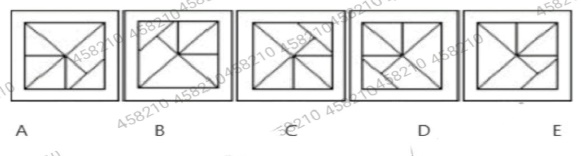
which figure is the odd one out
- AA
- BB
- CC
- DD
- EE
Show answerHide answer
Answer: E
Approach: Odd figure out — compare which two lines are missing and where the short cutting line sits.
Solution: Each figure is a square with a point inside from which six lines run out to the corners or sides. Of the eight possible directions, two neighbouring side-lines are missing, leaving a 'gap' in one quadrant, and one short cutting line crosses the diagonal in one corner.
A: gap top-right, cut in the bottom-right corner. B: gap bottom-left, cut top-left. C: gap top-left, cut top-right. D: gap bottom-right, cut bottom-left.
In all four the cut sits one quadrant clockwise from the gap.
E: gap bottom-left, but the cut is in the bottom-right corner — one quadrant anticlockwise. E is the mirror image of the pattern, so it is the odd one.
Why the other options are wrong: A, B, C and D all place the cut one quadrant clockwise from the gap, so they are rotations of one another.
Cetking shortcut: Find the gap first, then note on which side of it the corner cut lies — a flipped side means a mirror image.
Answer: E
which figure is the odd one out
- A1
- B2
- C3
- D4
- E5
Show answerHide answer
Answer: B
Approach: Odd figure out — check the order in which the numbers 1–5 are placed.
Solution: Reading clockwise from the top:
Fig 1: 5, 4, 3, 2, 1. Fig 3: 1, 5, 4, 3, 2. Fig 4: 3, 2, 1, 5, 4. Fig 5: 3, 2, 1, 5, 4 — always decreasing by 1 clockwise (cyclic).
Fig 2: 4, 2, 1, 5, 3 — breaks the sequence.
Why the other options are wrong: Figures 1, 3, 4 and 5 all follow the 'decreasing clockwise' order.
Answer: B
choose the figure that follows the pattern
- A
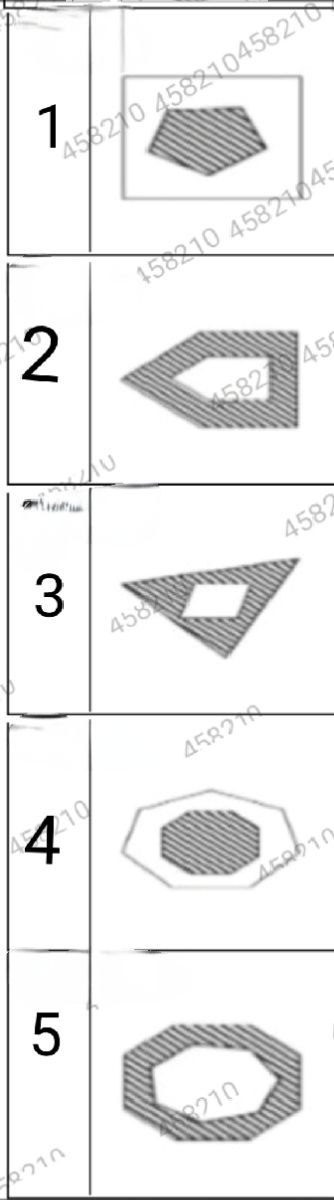
- B
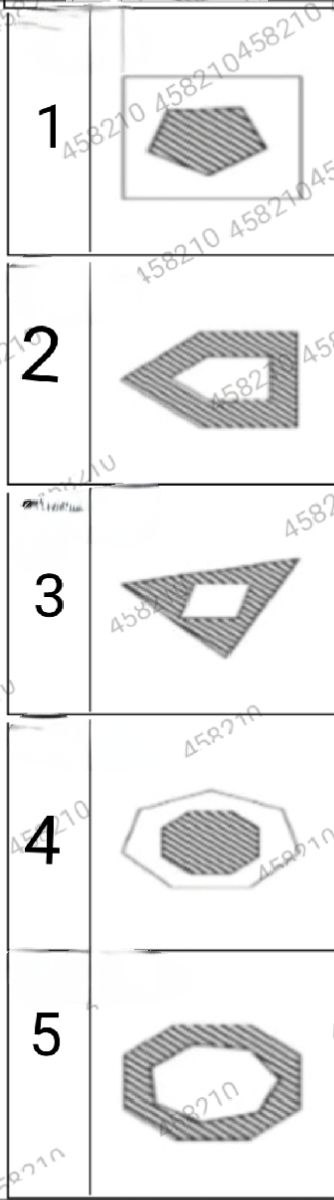
- C
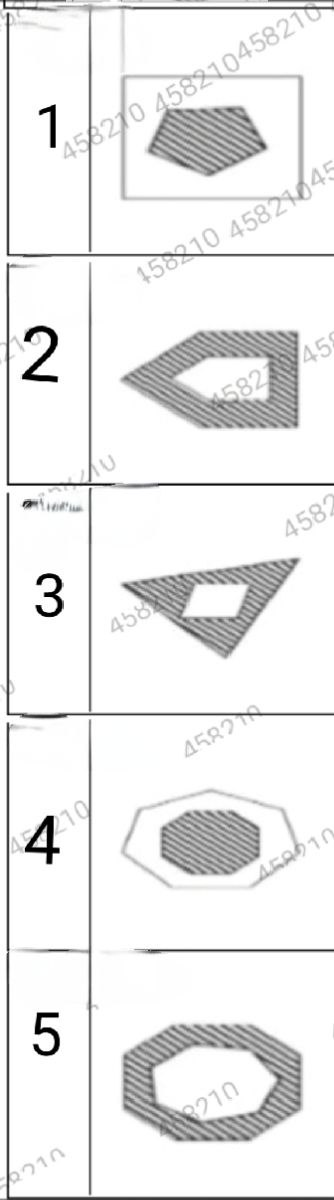
- D
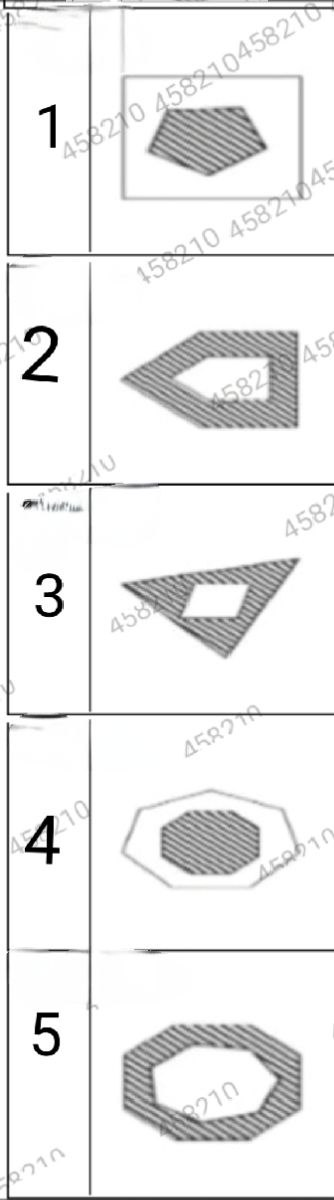
- E
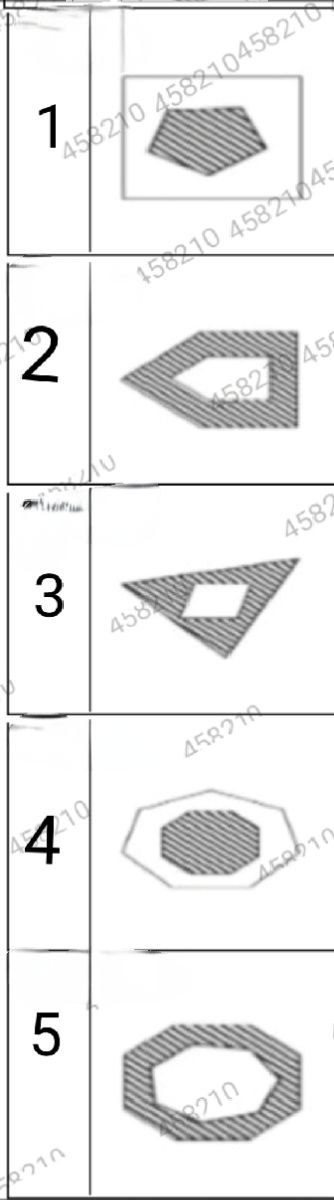
Show answerHide answer
Answer: E
Approach: Shape rule — shaded n-sided outer figure with an unshaded (n−1)-sided figure inside.
Solution: Rectangle (4) with triangle (3); heptagon (7) with hexagon (6); pentagon (5) with quadrilateral (4).
Outer shaded, inner white, inner has one side fewer.
Option E: shaded octagon (8) with white 7-sided figure inside — fits.
Why the other options are wrong: A: shaded figure inside an unshaded one. B: inner does not have one side fewer than the outer. C: triangle outside a quadrilateral (inner has more sides). D: shading reversed.
Cetking shortcut: Check shading first (outer dark, inner white) — it removes A and D at once.
Answer: E
which shape or pattern on the right belong to the two on the left
- AA
- BB
- CC
- DD
- EE
Show answerHide answer
Answer: C
Approach: Figure classification — find what the two given figures share.
Solution: Both given figures: an irregular, tilted four-sided shape containing a triangle, with opposite shading (dark outer with white triangle, white outer with dark triangle).
c: irregular dark quadrilateral with a white triangle — same features, continuing the alternation of shading.
Why the other options are wrong: a: the outer shape has more than four sides. b: outer and triangle are both unshaded. d: outer is a regular upright rectangle, unlike the irregular quadrilaterals given. e: outer is a triangle with a square inside (reversed).
Cetking shortcut: List the features (sides of outer, inner shape, shading contrast) and test each option against all of them.
Answer: C
which figure is odd one out
- AE
- BA
- CB
- DD
- EC
Show answerHide answer
Answer: E
Approach: Odd figure out — adjacency of the black boxes.
Solution: Every figure has 4 black boxes, 3 white boxes and 2 empty cells.
In figures A, B, D and E exactly two black boxes share a side (e.g. in A the middle-right and bottom-right boxes).
In figure C the four black boxes sit in the four corners — no two are adjacent.
So figure C is the odd one; it is listed as the fifth option.
Why the other options are wrong: Figures A, B, D, E each contain one adjacent pair of black boxes.
Cetking shortcut: When counts are equal in every figure, look at positions/adjacency next.
Answer: E
group the given figure into three classes using each figure only once.
- A1,2,5 ; 3,7,8 ; 4,6,9
- B1,7,2 ; 3,9,6 ; 4 ,5,8
- C2,3,8 ; 4,6,9 ; 1,5,7
- D5,6,9 ; 3,4,1 ; 2,7,8
- E4,5,8 ; 2,3,1 ; 9,7,8
Show answerHide answer
Answer: A
Approach: Grouping figures by the inner design.
Solution: Group 1 — 1, 2, 5: four curved arcs bending inward forming a small central square (in a circle, hexagon and square).
Group 2 — 3, 7, 8: curved lines forming a rounded square inside (square, circle, octagon).
Group 3 — 4, 6, 9: straight lines radiating from one point (triangle, hexagon, rectangle).
This is option A.
Why the other options are wrong: Every other option mixes radiating-line figures with curved-line figures (e.g. B puts 1, 7 together and 4, 5 together; E even repeats figure 8).
Cetking shortcut: Classify by the inner pattern, not the outer shape — the outer shapes vary inside each group.
Answer: A
- AA
- BB
- CC
- DD
- EE
Show answerHide answer
Answer: C
Approach: Odd one out: check symmetry about the central vertical line.
Solution: A – two identical rings, left and right: mirror symmetric.
B – crosses and dots placed identically on both sides: mirror symmetric.
D – two identical rectangles: mirror symmetric.
E – the triangles on the right are the mirror images of those on the left: mirror symmetric.
C – hearts sit in the top-right and bottom-left cells (diagonal), so the right half is not the mirror of the left half.
Cetking shortcut: Fold the figure along the middle line in your head – the one that does not overlap is the odd one.
Answer: C
Which figure is the odd one out?
- AA
- BB
- CC
- DD
- EE
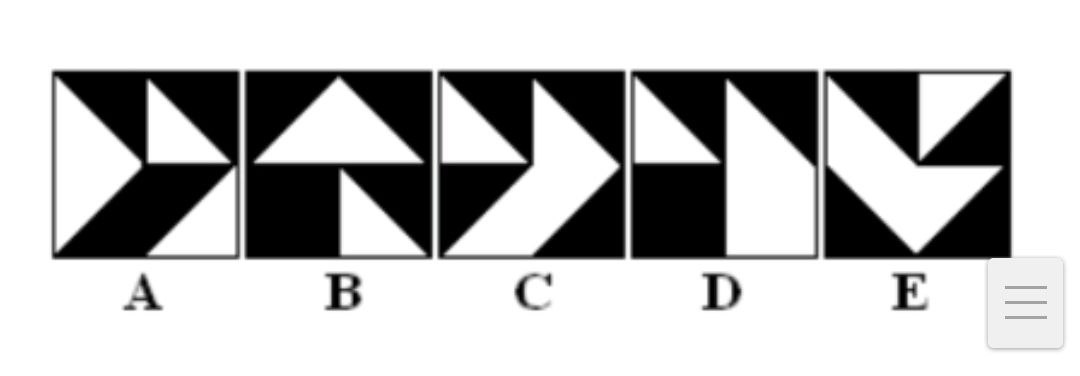
Show answerHide answer
Answer: B
Approach: Each figure is a black square cut into 8 equal small triangles (a 2 × 2 grid with both diagonals of every cell). Compare how much of each figure is white.
Solution: A – 4 of the 8 small triangles are white (half).
C – 4 of 8 white (half).
D – 4 of 8 white (half).
E – 4 of 8 white (half).
B – only 3 of 8 are white: the top triangle (worth 2) and one small triangle at the bottom right (worth 1); the rest is black.
So B is the only figure that is not half white.
Why the other options are wrong:
A, C, D, E all share the same white area (half the square), so none of them stands out.
Cetking shortcut: When shapes look different but similar in weight, compare the white-to-black area instead of the positions.
Answer: B
Which figure is the odd one out?
- AA
- BB
- CC
- DD
- EE
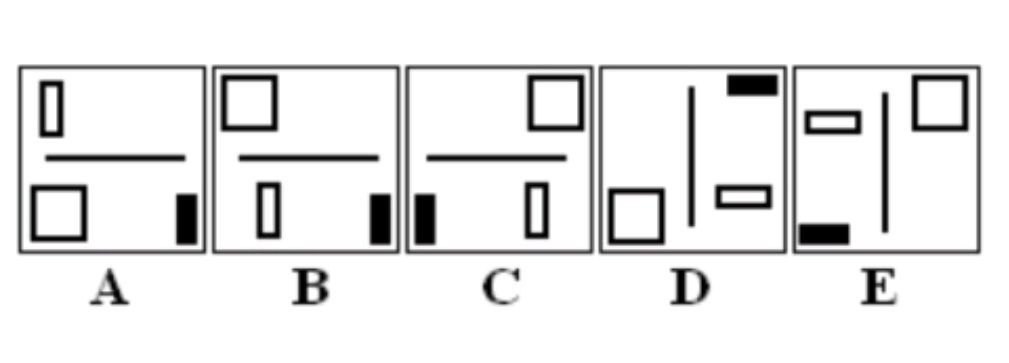
Show answerHide answer
Answer: A
Approach: Odd one out: see which shapes are on each side of the dividing line.
Solution: B – square on one side; white rectangle + black rectangle on the other.
C – square on one side; black + white rectangle on the other.
D – square on one side; black + white rectangle on the other.
E – square on one side; white + black rectangle on the other.
A – a small white rectangle alone on one side; the square and black rectangle together on the other.
Only in A is the square not alone.
Cetking shortcut: Find the shape that is 'alone' on one side – in four figures it is the square.
Answer: A
- AA
- BB
- CC
- DD
- EE
Show answerHide answer
Answer under review
We are re-checking this question. The solution will appear once the answer is confirmed.
- AA
- BB
- CC
- DD
- EE
Show answerHide answer
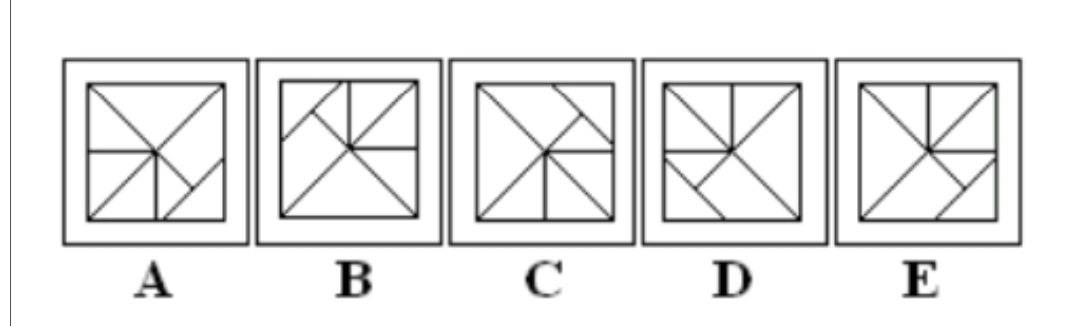
Answer: E
Approach: Odd one out by rotation and reflection: every figure has the same line elements, so find the one that is a mirror image rather than a turned copy.
Solution: Each square has a centre point with: three lines running to corners, a short fourth diagonal that stops at a small slanting cut near the fourth corner, and two straight lines running to the middles of two sides.
Take A: the short diagonal points to the bottom-right corner. Going clockwise from that cut corner you meet a side-line (bottom middle), then the bottom-left corner, then the second side-line (left middle).
B = A turned 180°, C = A turned 90° anticlockwise, D = A turned 90° clockwise – the same clockwise order is kept in each.
E also has the short diagonal at the bottom-right, but its side-lines (top middle and right middle) are met anticlockwise from the cut corner – E is the mirror image of A, and no rotation can turn a mirror image into the others.
Why the other options are wrong:
A, B, C, D are all rotations of one figure.
Cetking shortcut: Pin down the odd-looking element (the short diagonal with its cut) and check which way the other lines lie relative to it.
Answer: E
- AA
- BB
- CC
- DD
- EE
Show answerHide answer
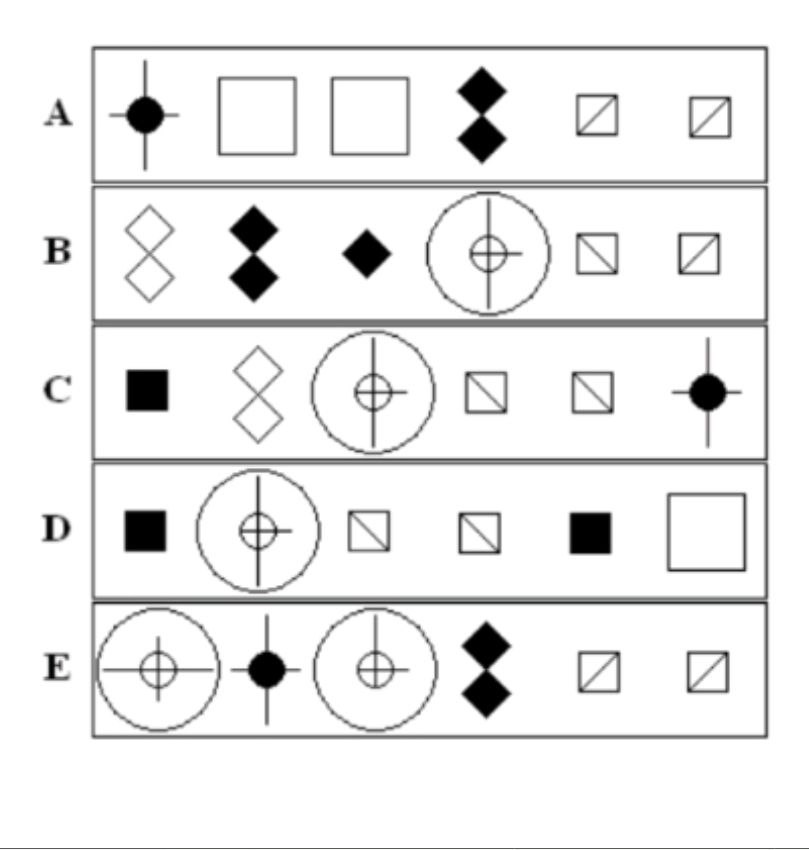
Answer: B
Approach: Odd one out: compare the pair of small squares with a diagonal in each row.
Solution: Each row ends with two small squares that have a diagonal.
A – both diagonals '/' (same).
C – both '\' (same).
D – both '\' (same).
E – both '/' (same).
B – one '\' and one '/' – the diagonals are different.
Cetking shortcut: In long rows of symbols, compare the repeated pair – the change is usually in the smallest detail.
Answer: B
- AA
- BB
- CC
- DD
- EE
Show answerHide answer
Answer: C
Approach: Odd one out: count shaded parts in each row (each figure has a square and two rectangles).
Solution: A: 1 + 1 + 3 + 1 + 3 = 9
B: 3 + 1 + 3 + 1 + 1 = 9
D: 1 + 3 + 3 + 1 + 1 = 9
E: 1 + 1 + 3 + 1 + 3 = 9
C: 3 + 3 + 1 + 1 + 3 = 11
C is the only row with 11 shaded parts.
Cetking shortcut: Count the fully black figures (3 parts each): A, B, D, E have two, C has three.
Answer: C
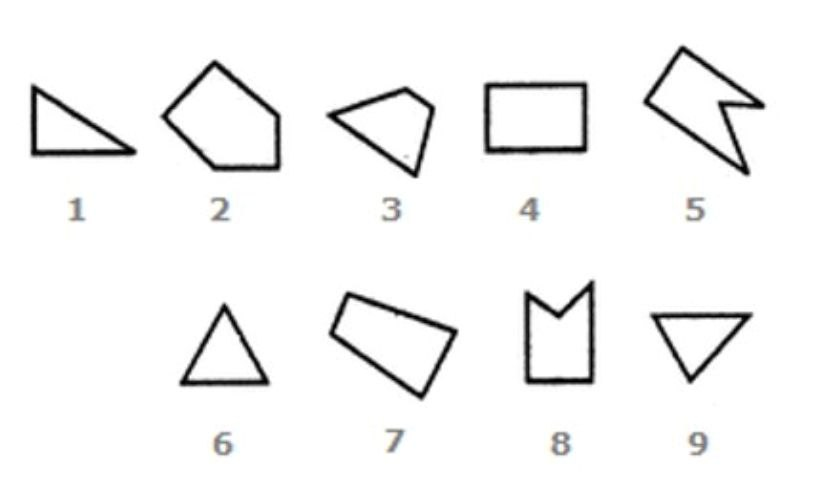
Group the given figures into three classes using each figure only once.
- A7,8,9 ; 2,4,3 ; 1,5,6
- B1,3,2 ; 4,5,7; 6,8,9
- C1,6,8 ; 3,4,7; 2,5,9
- D1,6,9; 3,4,7; 2,5,8
- E1,6,9; 3,4,8; 2,5,7
Show answerHide answer
Answer: D
Approach: Classification: group figures by the number of sides.
Solution: Three sides (triangles): 1, 6, 9.
Four sides (quadrilaterals): 3, 4, 7.
Five sides (pentagons): 2, 5, 8 (5 and 8 are notched figures with five sides).
Grouping = 1, 6, 9; 3, 4, 7; 2, 5, 8 → option D.
Why the other options are wrong:
A, B – mix triangles with other shapes.
C – 8 (pentagon) placed with triangles.
E – 8 and 7 swapped.
Cetking shortcut: Count the sides of only the doubtful figures (5 and 8) – the rest are obvious.
Answer: D
Group the given figures into three classes using each figure only once.
- A1,7,9 2,3,6 4,5,8
- B1,2,9 3,4,6 5,7,8
- C1,6,8 2,4,7 3,5,9
- D1,7,8 2,9,3 6,4,5
- E1,2,9 3,6,7 4,5,8
Show answerHide answer
Answer: A
Approach: Figure classification: group by the type of inner element.
Solution:
1, 7, 9: a smaller copy of the same shape sits inside (triangle in triangle, square in square, circle in circle).
2, 3, 6: a small copy of the same shape is attached at the edge/base of the bigger shape.
4, 5, 8: the shape is divided into equal parts by lines (square by diagonals, circle by a cross, triangle by lines from the vertices).
Groups: (1, 7, 9), (2, 3, 6), (4, 5, 8).
Why the other options are wrong:
B, C, D, E: each mixes a "divided" figure with a "same shape inside" figure in one group.
Cetking shortcut: Find one sure group (1, 7, 9 — concentric copies) and keep only the options containing it.
Answer: A
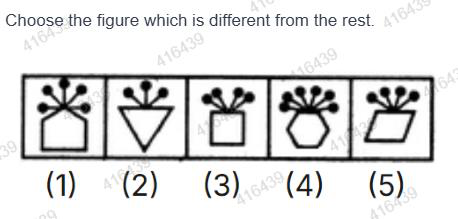
Choose the figure which is different from the rest.
- A1
- B2
- C3
- D4
- E5
Show answerHide answer
Answer: A
Approach: Odd one out: check where the "lollipop" sticks attach and how many there are.
Solution:
In each figure the number of sticks equals the number of sides of the shape (pentagon 5, triangle 3, square 4, hexagon 6, parallelogram 4).
In figures 2–5 the sticks come out of the middle of a side.
In figure 1 they come out of a vertex (the apex of the pentagon).
So figure 1 is the odd one.
Why the other options are wrong:
2, 3, 4, 5: sticks rise from a side, following the common rule.
Cetking shortcut: Look at the point of attachment first — it is the only feature that differs.
Answer: A
Choose the figure which is different from the rest.
- A1
- B2
- C3
- D4
- E5
Show answerHide answer
Answer: D
Approach: Odd one out: compare the small hooks at the ends of the two vertical bars.
Solution:
Every figure has a "<" shape crossing two vertical bars, with one small hook at the top end and one at the bottom end.
In figures 1, 2, 3 and 5 the top hook and the bottom hook point in opposite directions (one left, one right).
In figure 4 both hooks point the same way (left).
So figure 4 is the odd one.
Why the other options are wrong:
1, 2, 3, 5: hooks face opposite directions, following the common rule.
Cetking shortcut: Ignore the big "<" — it is identical everywhere; focus only on the tiny hooks.
Answer: D
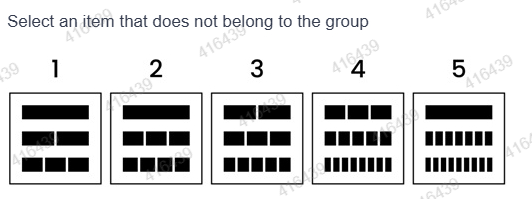
Select an item that does not belong to the group
- A1
- B2
- C3
- D4
- E5
Show answerHide answer
Answer: E
Approach: Odd one out: count the pieces in each row.
Solution:
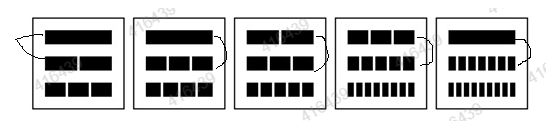
In each figure, (pieces in top row) + (pieces in middle row) = pieces in bottom row.
Fig 1: 1 + 2 = 3 ✔. Fig 2: 1 + 3 = 4 ✔. Fig 3: 2 + 3 = 5 ✔. Fig 4: 3 + 5 = 8 ✔.
Fig 5: top 1 + middle 7 = 8, but the bottom row has more than 8 pieces ✘.
So figure 5 is the odd one.
Why the other options are wrong:
1–4: all satisfy top + middle = bottom.
Cetking shortcut: When figures are made of countable parts, test a simple addition rule row-wise.
Answer: E
Choose the odd one out:
- AA
- BB
- CC
- DD
- EE
Show answerHide answer
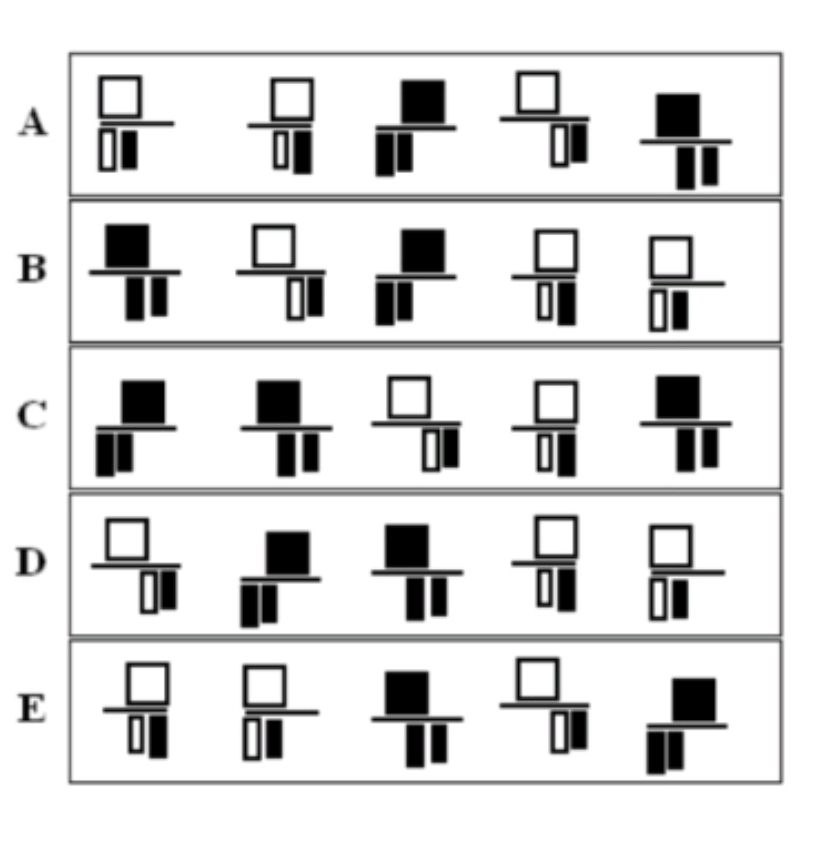
Answer: C
Approach: Odd one out: check left–right (vertical-axis) mirror symmetry.
Solution:
A: two concentric circles in the two bottom cells — mirror-symmetric.
B: crosses and dots placed in mirror pairs — symmetric.
D: two identical rectangles — symmetric.
E: two triangles that are mirror images — symmetric.
C: hearts in the top-right and bottom-left cells — diagonal placement, not mirror-symmetric.
Cetking shortcut: Fold each figure along the vertical centre line in your head; the one that does not match itself is odd.
Answer: C
Group the given figures into three classes using each figure only once.
- A1,3,9 2,5,8 4,5,8
- B1,5,8 4,6,7 2,3,9
- C2,5,9 1,3,8 2,6,7
- D1,8,9 4,6,7 2,3,5
- E1,2,9 4,6,7 8,3,5
Show answerHide answer
Answer: B
Approach: Figure classification: group by how the straight line relates to the figure.
Solution:
2, 3, 9: a closed shape (triangle, square, circle) cut right through by a line.
4, 6, 7: a shape with one side/line extended outward (circle with a tail, triangle with an extended side, square with an extended side).
1, 5, 8: open figures (arc, angle, bracket) with a line through them.
Groups: (1, 5, 8), (4, 6, 7), (2, 3, 9).
Why the other options are wrong:
A, C, D, E: none contains the group 2, 3, 9 (A and C even repeat figures).
Cetking shortcut: Spot the most obvious group (2, 3, 9: shape crossed by a line); only option B contains it.
Answer: B
Group the given figures into three classes using each figure only once.
- A1,2,4 3,5,6 7,8,9
- B1,7,8 3,5,6 2,4,9
- C1,3,4 2,8,9 5,6,7
- D1,7,8 2,3,6 4,5,9
- E1,4,8 2,3,6 7,5,9
Show answerHide answer
Answer: B
Approach: Figure classification: group by internal lines.
Solution:
1, 7, 8: plain shapes with no internal line (rectangle, hexagon, circle).
3, 5, 6: one internal line (pentagon/house with a vertical line, rectangle with a slanted line, triangle with a line).
2, 4, 9: divided into 4 parts (rectangle with both diagonals, window with a cross, circle with a cross).
Groups: (1, 7, 8), (3, 5, 6), (2, 4, 9).
Why the other options are wrong:
A, C, D, E: each mixes plain figures with divided figures.
Cetking shortcut: Count the parts each figure is divided into: 1, 2 or 4.
Answer: B
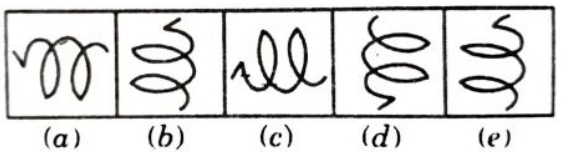
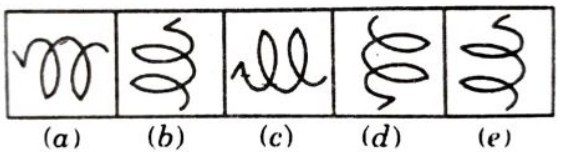
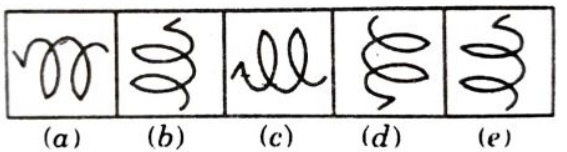
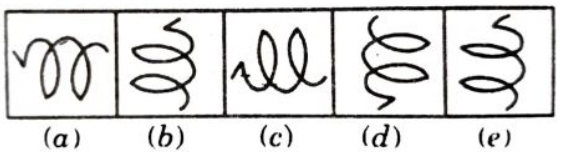
In the following problem, out of the five figures marked (a), (b), (c), (d), and (e), four are similar in a certain manner. However, one figure is not like the other four. Choose the figure which is different from the rest.
- A
 (Answer Figure 1)
 - B
 (Answer Figure 2)
 - C
 (Answer Figure 3)
 - D
 (Answer Figure 4)
 - E
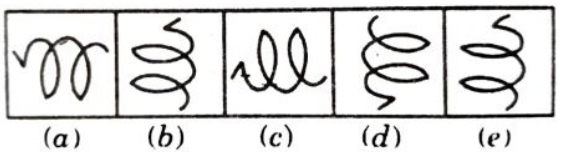 (Answer Figure 5)
Show answerHide answer
Answer: C
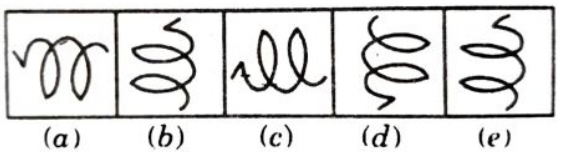
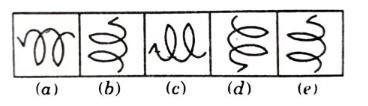
Approach: Figure classification: compare the figures as turned versions of one coil.
Solution:
Figures (a), (b), (d) and (e) are the same two-loop spring, only turned (rotated) to different positions.
In (c) the loops open the other way: it is the water image (top-to-bottom flip) of (a). A flip cannot be made by turning, so (c) is the odd one.
Why the other options are wrong:
(a), (b), (d), (e): each can be turned to match the others.
Cetking shortcut: When all the figures look alike, test whether each one is a turned copy or a flipped copy. The flipped one is the odd one out.
Answer: C
In the following problem, out of the five figures marked (a), (b), (c), (d), and (e), four are similar in a certain manner. However, one figure is not like the other four. Choose the figure which is different from the rest.
- A
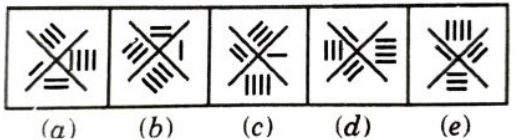 (Answer Figure 1)
 - B
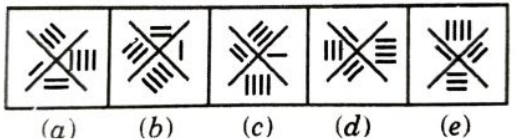 (Answer Figure 2)
 - C
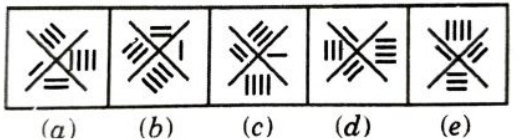 (Answer Figure 3)
 - D
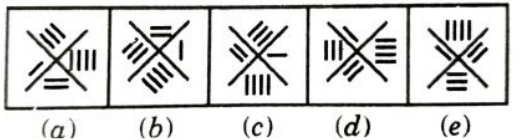 (Answer Figure 4)
 - E
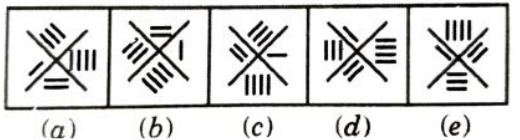 (Answer Figure 5)
Show answerHide answer
Answer: B
Approach: Figure classification: compare how the line groups are arranged around the central cross.
Solution:
Each figure has a cross with four groups of 1, 2, 3 and 4 short lines in the four spaces.
In (b), the groups are placed in a different order around the cross from the other figures, so (b) is the odd one.
Why the other options are wrong:
(a), (c), (d), (e): these follow the common arrangement (as per the Cetking key).
Answer: B
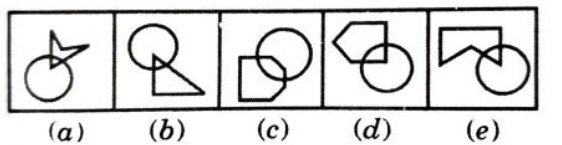
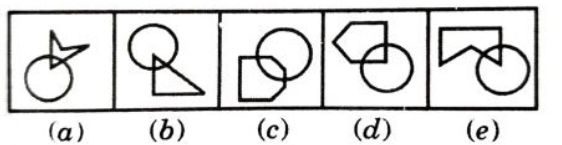
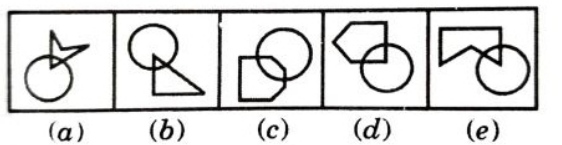
In the following problem, out of the five figures marked (a), (b), (c), (d), and (e), four are similar in a certain manner. However, one figure is not like the other four. Choose the figure which is different from the rest.
- A
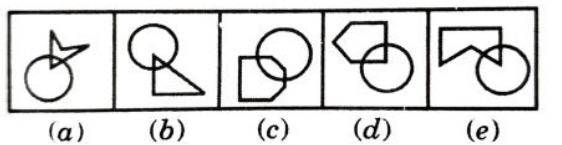 (Answer Figure 1)
 - B
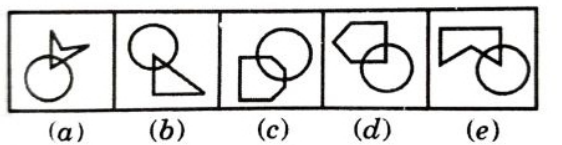 (Answer Figure 2)
 - C
 (Answer Figure 3)
 - D
 (Answer Figure 4)
 - E
 (Answer Figure 5)
Show answerHide answer
Answer: C
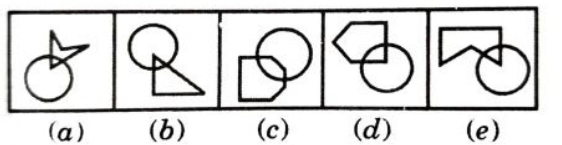
Approach: Figure classification: count how many corners of the polygon lie inside the circle.
Solution:
(a): one corner of the star-shape is inside the circle.
(b): one corner of the triangle is inside the circle.
(d), (e): one corner of the polygon is inside the circle.
(c): the cut corner of the polygon gives two corners inside the circle. So (c) is the odd one.
Why the other options are wrong:
(a), (b), (d), (e): exactly one corner inside the circle.
Cetking shortcut: For overlap figures, check what is inside the overlap: corners, number of crossing points, or which shape is on top.
Answer: C
In the following question, there are two problem figures (un-numbered figures) followed by five answer figures (numbered as 1, 2, 3, 4, and 5). There are certain common characteristics/properties between the two problem figures. Select a figure from amongst the answer figures which shows similar characteristics/properties as shown by the problem figures.
- A
 (Answer Figure 1)
 - B
 (Answer Figure 2)
 - C
 (Answer Figure 3)
 - D
 (Answer Figure 4)
 - E
 (Answer Figure 5)
Show answerHide answer
Answer: C
Approach: Common property: find the feature that both problem figures share.
Solution:
The triangle has lines from its centre to all 3 corners. The square has lines from its centre to all 4 corners (the two diagonals).
Common property: a regular polygon with lines from the centre to every corner.
Figure 3: a hexagon with lines from the centre to all 6 corners. ✔
Why the other options are wrong:
1: a rectangle cut by lines to the midpoints of its sides, not to the corners.
2: an envelope shape whose lines do not meet at the centre.
4: a hexagon with an inscribed rhombus; the lines do not run from the centre.
5: a pentagon with crossing lines, not lines from the centre to each corner.
Cetking shortcut: Check whether every corner is joined to the centre. One missed corner rules the figure out.
Answer: C
In the following question, there are two problem figures (un-numbered figures) followed by five answer figures (numbered as 1, 2, 3, 4, and 5). There are certain common characteristics/properties between the two problem figures. Select a figure from amongst the answer figures which shows similar characteristics/properties as shown by the problem figures.
- A
 (Answer Figure 1)
 - B
 (Answer Figure 2)
 - C
 (Answer Figure 3)
 - D
 (Answer Figure 4)
 - E
 (Answer Figure 5)
Show answerHide answer
Answer: C
Approach: Common property: find the feature that both problem figures share.
Solution:
Both figures are split by a vertical line. One side has one more horizontal line than the other, and the lines on the two sides do not line up.
Rectangle: left side 2 lines, right side 1 line. Triangle: left side 2 lines, right side 3 lines.
Figure 3 (circle): left side 3 lines, right side 4 lines, staggered. ✔
Why the other options are wrong:
1: the roof and the horizontal lines on the two sides line up.
2: left 3 lines vs right 1 line, a difference of 2.
4, 5: the line counts or the staggering do not fit the pattern.
Cetking shortcut: Count the horizontal lines on each side of the vertical divider. The counts must differ by exactly 1.
Answer: C
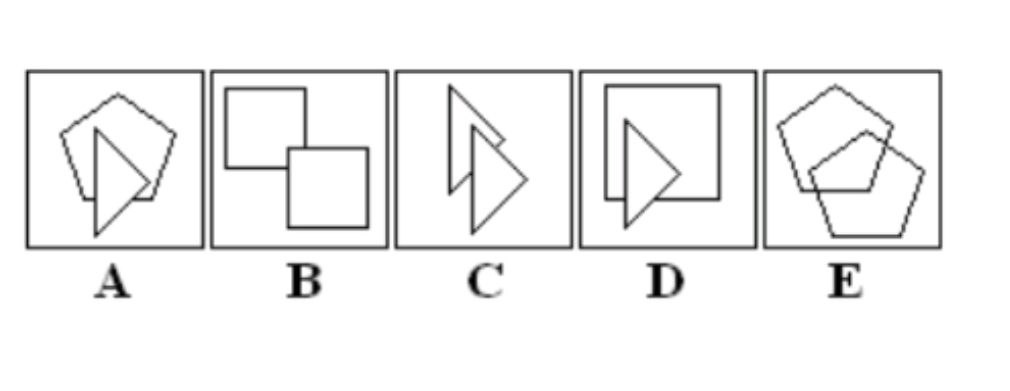
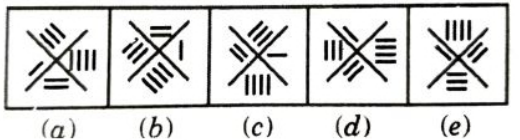
Out of the five figures marked (a), (b), (c), (d), and (e), four are similar in a certain manner. However, one figure is not like the other four. Choose the figure which is different from the rest.
- AOption A
- BOption B
- COption C
- DOption D
- EOption E
Show answerHide answer
Answer: C
Approach: Look at how the polygon overlaps the circle — count the polygon's corners that fall inside the circle.
Solution:
(a) arrow-shape, (b) triangle, (d) pentagon, (e) notched shape: in each, exactly one corner of the polygon lies inside the circle.
(c): the cut-corner square has two corners inside the circle.
So (c) is the odd one.
Cetking shortcut: When every figure is 'circle + polygon', compare the overlap region — corners inside, sides crossed.
Answer: C
In the following problem, out of the five figures marked (a), (b), (c), (d), and (e), four are similar in a certain manner. However, one figure is not like the other four. Choose the figure which is different from the rest.
- AOption A
- BOption B
- COption C
- DOption D
- EOption E
Show answerHide answer
Answer: B
Approach: Each figure has a cross with groups of 1, 2, 3 and 4 short lines in its four sectors; compare the order of the groups.
Solution:
In (b) the groups run 1 (right) → 2 (top) → 3 (left) → 4 (bottom), i.e. in strict order going anticlockwise.
In (a), (c), (d) and (e) the counts around the cross do not run in order (e.g. (c): top 3, right 1, bottom 4, left 2).
So (b) is the odd one.
Answer: B
In the following problem, out of the five figures marked (a), (b), (c), (d), and (e), four are similar in a certain manner. However, one figure is not like the other four. Choose the figure which is different from the rest.
- AOption A
- BOption B
- COption C
- DOption D
- EOption E
Show answerHide answer
Answer: C
Approach: Check whether each spring can be turned into the others by rotation alone.
Solution:
(a), (b), (d) and (e) show the same coiled spring drawn in different orientations (the coil turns the same way in each).
(c) has tall narrow loops rising upward from a horizontal base — its coil turns the opposite way and cannot be obtained by rotating the others.
So (c) is the odd one.
Answer: C
Identify the Odd One Out:
- AOption A
- BOption B
- COption C
- DOption D
- EOption E
Show answerHide answer
Answer: C
Approach: Check each figure for symmetry about its vertical centre line.
Solution:
A (two rings), B (crosses and dots), D (two rectangles), E (two triangles): the left half is the mirror image of the right half.
C: the hearts sit in the top-right and bottom-left cells — diagonally placed, not mirrored about the vertical line.
So C is the odd one.
Answer: C
Identify the Odd One Out :
- AA
- BB
- CC
- DD
- EE
Show answerHide answer
Answer: C
Approach: Check line symmetry of each figure about the vertical axis.
Solution:
A: two identical ring-symbols placed symmetrically → symmetric.
B: two crosses, two faint crosses and two dots placed symmetrically → symmetric.
D: two identical rectangles → symmetric.
E: two black triangles mirrored → symmetric.
C: the two hearts are in diagonally opposite cells → not symmetric.
Why the other options are wrong:
A, B, D, E: each is its own mirror image about the vertical line.
Cetking shortcut: Fold each box down the middle in your head – the one that doesn't match is odd.
Answer: C
Identify the Odd One Out :
- AA
- BB
- CC
- DD
- EE
Show answerHide answer
Answer: C
Approach: Check how the black dots are joined in each figure.
Solution:
A, B, D, E: the black dots are never joined directly to each other – there is always a white dot between them or they are on separate branches.
C: the two black dots are joined directly by a line → odd one out.
Why the other options are wrong:
A, B, D, E: follow the common rule (no black–black edge).
Cetking shortcut: In node figures, check colours of joined pairs first – it is the most common rule.
Answer: C
Identify the Odd One Out :
- AA
- BB
- CC
- DD
- EE
Show answerHide answer
Answer: E
Approach: Count the straight lines dividing each figure.
Solution:
A (triangle): 3 medians.
B (square): 2 diagonals + 1 horizontal = 3.
C (parallelogram): 3 lines.
D (circle): 3 diameters.
E (square): 2 diagonals + 1 horizontal + 1 vertical = 4 lines → odd one out.
Why the other options are wrong:
A, B, C, D: each divided by exactly 3 lines.
Cetking shortcut: Look at line count before shape – the outer shapes differ on purpose to mislead.
Answer: E
Identify the Odd One Out :
- AA
- BB
- CC
- DD
- EE
Show answerHide answer
Answer: B
Approach: Each row contains a pair of identical small squares-with-diagonal; check the pair in every row.
Solution:
A: two small squares, both with '/' diagonal – identical.
C and D: two small squares with '\' diagonal – identical.
E: two small squares with '/' – identical.
B: one small square has '\', the other '/' – they are mirror images, not identical → odd one out.
Why the other options are wrong:
A, C, D, E: contain an identical pair of diagonal squares.
Cetking shortcut: In long strip classification, compare the repeated element in each row – the odd row breaks the repetition.
Answer: B