Let’s Crack CET 2027

Your CET check-up · tap a ring to see yours

HCF LCM – MBA CET questions with solutions

24 questions · CET 2025–2026 · Easy 21 · Medium 3 · Hard 0. Newest paper first. Full papers

Q101EasyCET 2026 · Attempt 2 Slot 1 · Q101

Find the HCF and LCM of 0.36, 0.72, and 1.62.

  1. 1.8 and 6.48
  2. 0.18 and 6.48
  3. 0.18 and 64.8
  4. 1.8 and 64.8
  5. 0.18 and 0.648
Show answerHide answer

Answer: B official key

Approach: HCF/LCM of decimals: equalise decimal places, work with integers, put the decimal back.

Solution:
Write as 36, 72, 162 hundredths (two decimal places).
36 = 2²·3², 72 = 2³·3², 162 = 2·3⁴.
HCF = 2·3² = 18 → 0.18.
LCM = 2³·3⁴ = 648 → 6.48.

Cetking shortcut: HCF must divide 0.36, so it cannot be 1.8 — kills A and D instantly; LCM must be a multiple of 1.62 and 0.72 → 6.48 (= 4 × 1.62).

Answer: B
Q105EasyCET 2026 · Slot 5 · Q105

Find the HCF of (63/9), 5 (6/17) and (42/51).

  1. (1/17)
  2. (2/17)
  3. (7/17)
  4. (14/17)
  5. (1/51)
Show answerHide answer

Answer: C official key

Approach: HCF of fractions = HCF of numerators ÷ LCM of denominators.

Solution:
63/9 = 7 = 7/1; 5 (6/17) = (85 + 6)/17 = 91/17; 42/51 = 14/17 (lowest terms).
HCF of numerators (7, 91, 14) = 7.
LCM of denominators (1, 17, 17) = 17.
HCF = 7/17.

Why the other options are wrong:

  • A (1/17), B (2/17): numerator HCF is 7, not 1 or 2.
  • D (14/17): 14 does not divide 7 or 91.
  • E (1/51): comes from using 51 without reducing 42/51.

Cetking shortcut: Always reduce each fraction to lowest terms first — 42/51 → 14/17 — then the common denominator 17 is obvious.

Answer: C

Q105EasyCET 2026 · Slot 4 · Q105
Six bells commence tolling together and toll at intervals of 2, 4, 6, 8, 10, and 12 seconds, respectively. In 30 minutes, how many times do they toll together?
  1. 15
  2. 16
  3. 30
  4. 31
  5. 12
Show answerHide answer

Answer: B official key

Approach: Bells toll together at multiples of the LCM of their intervals; count the start too.

Solution:
LCM(2, 4, 6, 8, 10, 12) = 2³ × 3 × 5 = 120 s = 2 min.
In 30 min they toll together every 2 min: 30 / 2 = 15 times after the start.
Add the toll at the start (time 0): 15 + 1 = 16.

Why the other options are wrong:
A (15) – forgets the toll at the beginning.
C, D (30, 31) – assume they meet every minute.
E (12) – wrong LCM (150 s).

Cetking shortcut: 'Commence together' = add 1 to (total time ÷ LCM).

Answer: B

Q106EasyCET 2026 · Slot 4 · Q106
Three numbers are in the ratio of 3:4:5, and their least common multiple (LCM) is 2400. Their highest common factor (HCF) is
  1. 40
  2. 80
  3. 120
  4. 200
  5. 15
Show answerHide answer

Answer: A official key

Approach: For numbers in ratio a:b:c with a, b, c co-prime, numbers = ax, bx, cx; HCF = x and LCM = x × LCM(a, b, c).

Solution:
Numbers = 3x, 4x, 5x (3, 4, 5 pairwise co-prime).
LCM = x × LCM(3, 4, 5) = 60x.
60x = 2400 ⇒ x = 40.
HCF = x = 40 (numbers 120, 160, 200).

Why the other options are wrong:
B (80), C (120), D (200) – 120 and 200 are actual numbers, not the HCF; 80 is 2x.
E (15) – no basis.

Cetking shortcut: HCF = LCM ÷ (3 × 4 × 5) = 2400 ÷ 60 = 40.

Answer: A

Q101MediumCET 2026 · Slot 3 · Q101

The HCF of 2472, 1284, and a third number N is 12.

If their LCM is 2³ × 3² × 5 × 103 × 107, then which of the following could be the value of N?

  1. 2² × 3² × 7
  2. 2² × 3³ × 103
  3. 2² × 3² × 5
  4. 3³ × 103
  5. 2² × 3²
Show answerHide answer

Answer: C official key

Approach: HCF takes the lowest power of each common prime; LCM takes the highest power of every prime.

Solution:
2472 = 2³ × 3 × 103 and 1284 = 2² × 3 × 107.
HCF of all three = 12 = 2² × 3 → N must be divisible by 2² × 3, and N's power of 2 is at most 3.
LCM = 2³ × 3² × 5 × 103 × 107. The two given numbers supply 2³, 103, 107 but only 3¹ and no 5.
So N must supply 3² (exactly, not 3³) and 5¹, and must not bring any new prime.
Minimum such N = 2² × 3² × 5 = 180 → matches option C.

Why the other options are wrong:

  • A: contains 7 and no 5 → LCM would have 7 and lack 5.
  • B: 3³ makes LCM contain 3³, and 5 is missing.
  • D: no factor 2² → HCF would become 3, not 12; also 3³ and no 5.
  • E: no 5 → LCM would lack 5.

Cetking shortcut: Look only for the prime missing from the two given numbers (here 5) plus the exact power 3² — only C has both.

Answer: C

Q102EasyCET 2026 · Slot 3 · Q102
The smallest perfect square number that is exactly divisible by 2, 3, 4, 6, 9, 18, 30, and 60 is k², where k is a natural number.What is the sum of all prime factors of k?
  1. 8
  2. 9
  3. 10
  4. 11
  5. 12
Show answerHide answer

Answer: C official key

Approach: Least perfect square divisible by a set = LCM of the set made to have all even exponents.

Solution:
LCM(2, 3, 4, 6, 9, 18, 30, 60) = 2² × 3² × 5 = 180.
Exponent of 5 is odd → multiply by 5: 180 × 5 = 900 = 30².
k = 30 = 2 × 3 × 5.
Sum of prime factors of k = 2 + 3 + 5 = 10.

Cetking shortcut: Primes appearing anywhere in the list are 2, 3, 5 — k must contain each, so the sum is 10 directly.

Answer: C

Q103EasyCET 2026 · Slot 2 · Q103

DIRECTION for the question: Solve the following question and mark the best possible option.

The H.C.F. of 2923 and 3239 is?
  1. 37
  2. 47
  3. 73
  4. 79
  5. 22
Show answerHide answer

Answer: D official key

Approach: Euclid's division method.

Solution: 3239 − 2923 = 316, so HCF(3239, 2923) = HCF(2923, 316).
2923 = 316 × 9 + 79 (316 × 9 = 2844; 2923 − 2844 = 79).
316 = 79 × 4 + 0 → remainder 0.
HCF = 79. Check: 2923 = 79 × 37, 3239 = 79 × 41.

Cetking shortcut: The HCF must divide the difference 316 = 4 × 79. Among options only 79 divides 316 (and 37 does not divide 3239).

Answer: D

Q104EasyCET 2026 · Slot 1 · Q104

Three positive integers are such that the difference between the largest and the smallest number is 180.
The HCF of the three numbers is the greatest possible, and the smallest number is 90.
If the middle number differs from the smallest number by 60, what is the HCF of the three numbers?

  1. 14
  2. 21
  3. 28
  4. 30
  5. 35
Show answerHide answer

Answer: D official key

Approach: The HCF of numbers also divides every difference between them.

Solution:
Smallest = 90, largest = 90 + 180 = 270, middle = 90 + 60 = 150
HCF(90, 150, 270): 90 = 2·3²·5, 150 = 2·3·5², 270 = 2·3³·5
Common part = 2 × 3 × 5 = 30
Check via differences: HCF(60, 180, 90) = 30 ✓

Why the other options are wrong:
14, 21, 28, 35 contain a factor of 7, which does not divide 90.

Cetking shortcut: HCF must divide 90, 60 and 180 — among the options only 30 divides all three.

Answer: D

Q105EasyCET 2026 · Slot 1 · Q105

Three positive integers are in the ratio 3 : 5 : 7. The difference between the largest and the middle number is 56. The LCM of the smallest and the largest number is 588. What is the sum of the three numbers?

  1. 430
  2. 580
  3. 420
  4. 349
  5. 575
Show answerHide answer

Answer: C official key

Approach: Write numbers as 3k, 5k, 7k; use the difference to find k, verify with LCM.

Solution:
7k − 5k = 2k = 56 → k = 28
Numbers: 84, 140, 196
Check LCM(84, 196): 84 = 2²·3·7, 196 = 2²·7² → LCM = 2²·3·7² = 588 ✓
Sum = 15k = 15 × 28 = 420

Cetking shortcut: Sum = 15k and 2k = 56 → sum = 15 × 28 directly; the LCM is only a check.

Answer: C

Q106EasyCET 2026 · Slot 1 · Q106

Three bells ring at intervals of 30 seconds, 45 seconds, and 60 seconds.
After how much time will they ring together again?

  1. 90 seconds
  2. 180 seconds
  3. 120 seconds
  4. 240 seconds
  5. 300 seconds
Show answerHide answer

Answer: B official key

Approach: Bells ring together again after the LCM of their intervals.

Solution:
30 = 2·3·5, 45 = 3²·5, 60 = 2²·3·5
LCM = 2²·3²·5 = 180 seconds

Why the other options are wrong:
90 is not a multiple of 60; 120 not a multiple of 45; 240 not of 45; 300 not of 45.

Answer: B

Q132EasyCET 2025 · Slot 6 · Q132
Find the HCF of 405, 585, 765, 900
  1. 45
  2. 90
  3. 35
  4. 15
  5. 50
Show answerHide answer

Answer: A

Approach: HCF = product of common primes with lowest powers.

Solution:
405 = 3⁴ × 5; 585 = 3² × 5 × 13; 765 = 3² × 5 × 17; 900 = 2² × 3² × 5².
Common: 3² × 5 = 45.

Why the other options are wrong:
B 90: 405 is odd, so 2 cannot be a factor.
C 35: 7 does not divide any.
D 15: a common factor, but not the highest.
E 50: 405 is not divisible by 2 or 25.

Cetking shortcut: Check options from the largest: 90 fails (405 odd), 50 fails, 45 divides all four ⇒ 45.

Answer: A

Q133EasyCET 2025 · Slot 6 · Q133
Akshay has completely put each of three liquids, 558 liters of petrol, 682 liters of diesel and 589 liters of kerosene in bottles of equal size without mixing with any of the above three types of liquids such that each bottle is completely filled. What is the least possible number of bottles required?
  1. 56
  2. 59
  3. 63
  4. 66
  5. 60
Show answerHide answer

Answer: B

Approach: Largest equal bottle size = HCF of the volumes; bottles = sum of volumes ÷ HCF.

Solution:
558 = 2 × 3² × 31; 682 = 2 × 11 × 31; 589 = 19 × 31 ⇒ HCF = 31 L.
Bottles = 558/31 + 682/31 + 589/31 = 18 + 22 + 19 = 59.

Cetking shortcut: Differences 682 − 589 = 93 = 3 × 31 and 589 = 19 × 31 point straight to 31; total 1829/31 = 59.

Answer: B

Q134EasyCET 2025 · Slot 6 · Q134
Three runners, Harshad, Aniket, and Rajesh, running around a circular track can complete one revolution in 12, 18 and 24 minutes respectively. After how many minutes will they meet at the starting point?
  1. 70
  2. 73
  3. 75
  4. 72
  5. 76
Show answerHide answer

Answer: D

Approach: Meeting again at the start = LCM of individual lap times.

Solution:
12 = 2² × 3; 18 = 2 × 3²; 24 = 2³ × 3.
LCM = 2³ × 3² = 72 minutes.

Cetking shortcut: Check multiples of 24: 24, 48, 72 — 72 is the first divisible by 18.

Answer: D

Q135MediumCET 2025 · Slot 6 · Q135
Three wheels can complete 25, 21 and 16 revolutions per minute respectively. There is a red spot on each wheel that touches the ground at time zero. After how much time, all these spots will simultaneously touch the ground again?
  1. 58 second
  2. 60 second
  3. 62 second
  4. 59 second
  5. 61 second
Show answerHide answer

Answer: B

Approach: Spots touch the ground together after the LCM of the time per revolution; LCM of fractions = LCM(numerators)/HCF(denominators).

Solution:
Time per revolution: 1/25, 1/21, 1/16 minute.
LCM = LCM(1, 1, 1)/HCF(25, 21, 16) = 1/1 = 1 minute = 60 seconds.

Why the other options are wrong:
A 58, C 62, D 59, E 61 s: none is a whole number of revolutions for all three wheels (e.g. in 59 s the 25-rpm wheel turns 24.58 times).

Cetking shortcut: In 1 minute every wheel completes a whole number of turns (25, 21, 16); 25, 21, 16 share no common factor, so nothing shorter works.

Answer: B

Q136EasyCET 2025 · Slot 6 · Q136
If X,Y & Z are three numbers such that LCM of X & Y is X and LCM of Y & Z is Y then find the HCF of X, Y and Z
  1. X
  2. Y
  3. Z
  4. XY
  5. YZ
Show answerHide answer

Answer: C

Approach: LCM(a, b) = a means b divides a.

Solution:
LCM(X, Y) = X ⇒ Y is a factor of X.
LCM(Y, Z) = Y ⇒ Z is a factor of Y.
So Z | Y | X ⇒ Z divides all three and is the largest such number ⇒ HCF = Z.

Why the other options are wrong:
A X, B Y: X and Y do not divide Z (unless equal).
D XY, E YZ: an HCF cannot exceed the smallest number.

Cetking shortcut: Try numbers: X = 12, Y = 6, Z = 3 ⇒ HCF = 3 = Z.

Answer: C

Q104EasyCET 2025 · Slot 5 · Q104

Find the HCF of 405, 585, 765 and 900.

  1. 35
  2. 45
  3. 55
  4. 65
  5. 25
Show answerHide answer

Answer: B

Approach: HCF = product of common primes with their lowest powers.

Solution:
405 = 3⁴ × 5
585 = 3² × 5 × 13
765 = 3² × 5 × 17
900 = 2² × 3² × 5²
Common: 3² and 5 → HCF = 9 × 5 = 45

Cetking shortcut: All four numbers end in 5 or 0 and have digit sum divisible by 9 → divisible by 45. Only 45 among options works (55, 65, 35 fail on 405).

Answer: B

Q105EasyCET 2025 · Slot 5 · Q105

Two numbers are in the ratio 4:5. Their LCM is 240. Find the sum of numbers.

  1. 108
  2. 180
  3. 120
  4. 105
  5. 125
Show answerHide answer

Answer: A

Approach: Numbers in ratio a:b (co-prime) are ax and bx; their LCM is abx.

Solution:
Let numbers be 4x and 5x (4, 5 co-prime)
LCM = 4 × 5 × x = 20x = 240 → x = 12
Numbers: 48 and 60
Sum = 9x = 108

Cetking shortcut: Sum = (4 + 5) × (240/20) = 9 × 12 = 108.

Answer: A

Q104EasyCET 2025 · Slot 4 · Q104

The least multiple of 7, which leaves a remainder of 4, when divided by 6, 9, 15 and 18 is:

  1. 94
  2. 74
  3. 240
  4. 364
  5. 184
Show answerHide answer

Answer: D

Approach: LCM + common remainder, then the divisibility condition.

Solution:
LCM(6, 9, 15, 18) = 90, so the number = 90k + 4.
Test k = 1, 2, 3, 4: 94, 184, 274, 364.
Divisible by 7? 94 = 7×13 + 3 ✗; 184 = 7×26 + 2 ✗; 274 = 7×39 + 1 ✗; 364 = 7×52 ✓.
Least such multiple of 7 = 364.

Why the other options are wrong:
A (94), E (184): of the form 90k + 4 but not multiples of 7.
B (74): leaves remainder 2 on division by 6, so fails.
C (240): leaves remainder 0 on division by 6.

Cetking shortcut: 90k + 4 ≡ 6k + 4 (mod 7) = 0 ⇒ 6k ≡ 3 ⇒ k ≡ 4 → number = 364.

Answer: D

Q105EasyCET 2025 · Slot 4 · Q105

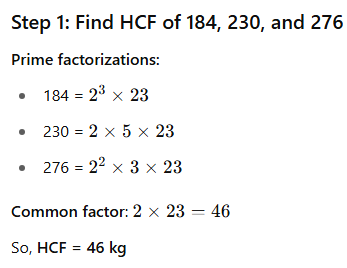
A shopkeeper has three kinds of sugar: 184 kg, 230 kg and 276 kg. He wants to store them in a minimum number of bags of equal size without mixing. Find the required number of bags

  1. 18
  2. 15
  3. 17
  4. 20
  5. 16
Show answerHide answer

Answer: B

Approach: Biggest equal bag = HCF ⇒ fewest bags.

Solution:
Largest bag size = HCF(184, 230, 276).
184 = 2³ × 23, 230 = 2 × 5 × 23, 276 = 2² × 3 × 23 → HCF = 2 × 23 = 46 kg.
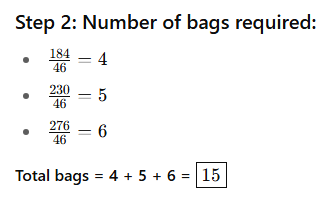
Bags = 184/46 + 230/46 + 276/46 = 4 + 5 + 6 = 15.

Cetking shortcut: Differences 46 and 46 hint the HCF directly: 230 − 184 = 46 and 46 divides all three.

Answer: B

Solution figure for question 105Solution figure for question 105
Q105EasyCET 2025 · Slot 3 · Q105
How many numbers less than 1000 are multiples of both 10 and 13?
  1. 6
  2. 7
  3. 8
  4. 9
  5. 13
Show answerHide answer

Answer: B

Approach: Multiples of both 10 and 13 = multiples of LCM(10, 13).

Solution: LCM(10, 13) = 130 (co-prime).
Multiples of 130 below 1000: 130, 260, …, 910.
Count = ⌊999 ÷ 130⌋ = 7 (since 130 × 8 = 1040 > 1000).

Answer: B

Q106EasyCET 2025 · Slot 3 · Q106
If the L.C.M of three numbers is 9570, then their H.C.F can be
  1. 11
  2. 12
  3. 19
  4. 23
  5. 10
Show answerHide answer

Answer: A

Approach: HCF must be a factor of LCM.

Solution: 9570 = 2 × 3 × 5 × 11 × 29.
Check options: 11 → 9570 ÷ 11 = 870 ✔; 12 = 2²×3 → needs 2², not present ✘; 19 → not a prime factor ✘; 23 → not a prime factor ✘.
So 11 can be the HCF (e.g. 11, 330 and 9570 have HCF 11 and LCM 9570).

Why the other options are wrong: 12, 19, 23 do not divide 9570. Note: 10 (E) also divides 9570 and is achievable (e.g. 10, 290, 330), so the question is ambiguous; the stored answer is 11.

Cetking shortcut: Prime-factorise the LCM once; any option with a prime (or power) not in it is out.

Answer: A

Q136EasyCET 2025 · Slot 2 · Q136
Four friends, A, B, C and D, decide to jog for 30 minutes inside a stadium with a circular running track that is 200 metres long.
  • A completes a lap every 60 seconds
  • B, C and D complete a lap every 90s, 40s, and 80s respectively
The friends begin together at 4 p.m. What is the total number of laps the friends would have completed when they next cross the start line together?
  1. 36
  2. 52
  3. 42
  4. 48
  5. 47
Show answerHide answer

Answer: E

Approach: All meet at the start after LCM of lap times.

Solution:
LCM(60, 90, 40, 80) s: 60 = 2²·3·5, 90 = 2·3²·5, 40 = 2³·5, 80 = 2⁴·5 → 2⁴·3²·5 = 720 s = 12 min (within 30 min).
Laps: A 720/60 = 12, B 720/90 = 8, C 720/40 = 18, D 720/80 = 9.
Total = 12 + 8 + 18 + 9 = 47.

Answer: E

Q137EasyCET 2025 · Slot 2 · Q137
The LCM and HCF of two numbers are 84 and 21 respectively. If the ratio of the two numbers is 1:4, what is the larger of the two numbers?
  1. 30
  2. 25
  3. 60
  4. 108
  5. 84
Show answerHide answer

Answer: E

Approach: Numbers = HCF × co-prime ratio terms.

Solution:
Ratio 1 : 4 with HCF 21 → numbers 21 and 84.
Check: LCM(21, 84) = 84 ✓, and 21 × 84 = HCF × LCM = 21 × 84 ✓.
Larger = 84.

Answer: E

Q131MediumCET 2025 · Slot 1 · Q131
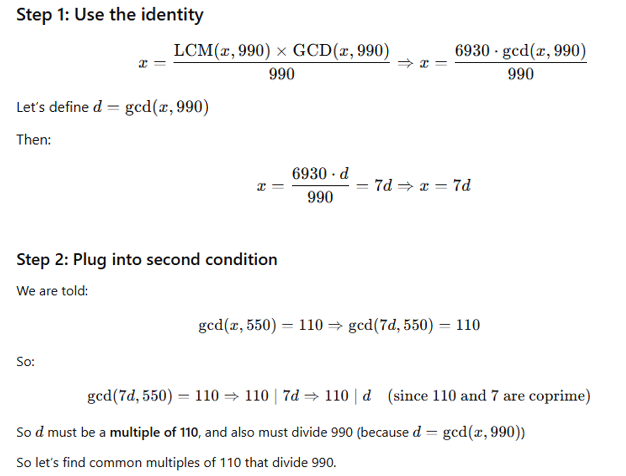
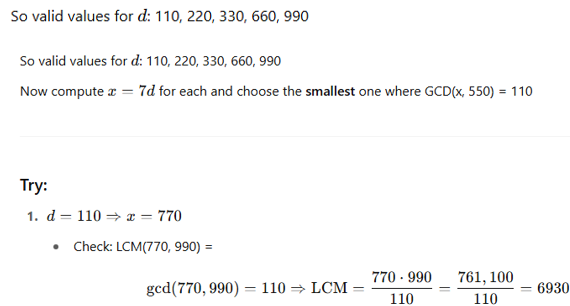
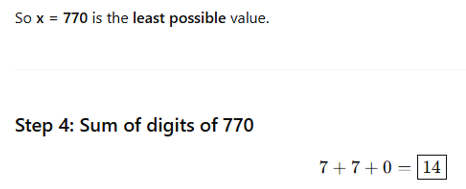
The least common multiple of a number and 990 is 6930. The greatest common divisor of that number and 550 is 110. What is the sum of the digits of the least possible value of that number ?
Figure for MBA CET 2025 Slot 1 question 131
  1. 16
  2. 14
  3. 3
  4. 9
  5. 18
Show answerHide answer

Answer: B

Approach: Prime-factorise and read each prime's exponent in x.

Solution:
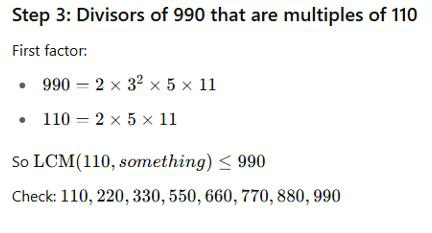
990 = 2 × 3² × 5 × 11; 6930 = 2 × 3² × 5 × 7 × 11
LCM has 7 and 990 has no 7 → x must contain 7
x divides 6930 → at most 2¹, 3², 5¹, 7¹, 11¹
550 = 2 × 5² × 11; GCD = 110 = 2 × 5 × 11 → x contains 2, 5 and 11
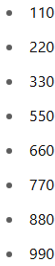
So x = 2 × 5 × 7 × 11 × 3ᵃ, a = 0, 1 or 2
Least x = 770 → digit sum = 7 + 7 + 0 = 14

Cetking shortcut: Least x = product of the forced primes 2 × 5 × 7 × 11 = 770.

Answer: B

Solution figure for question 131Solution figure for question 131Solution figure for question 131Solution figure for question 131Solution figure for question 131Solution figure for question 131Solution figure for question 131

Practise these in the Arena

Take timed tests built around MBA CET topics and see where you stand.

Open the Arena