Let’s Crack CET 2027

Your CET check-up · tap a ring to see yours

Inference – MBA CET questions with solutions

69 questions · CET 2025–2026 · Easy 23 · Medium 43 · Hard 3. Newest paper first. Full papers

Q155EasyCET 2026 · Attempt 2 Slot 2 · Q155

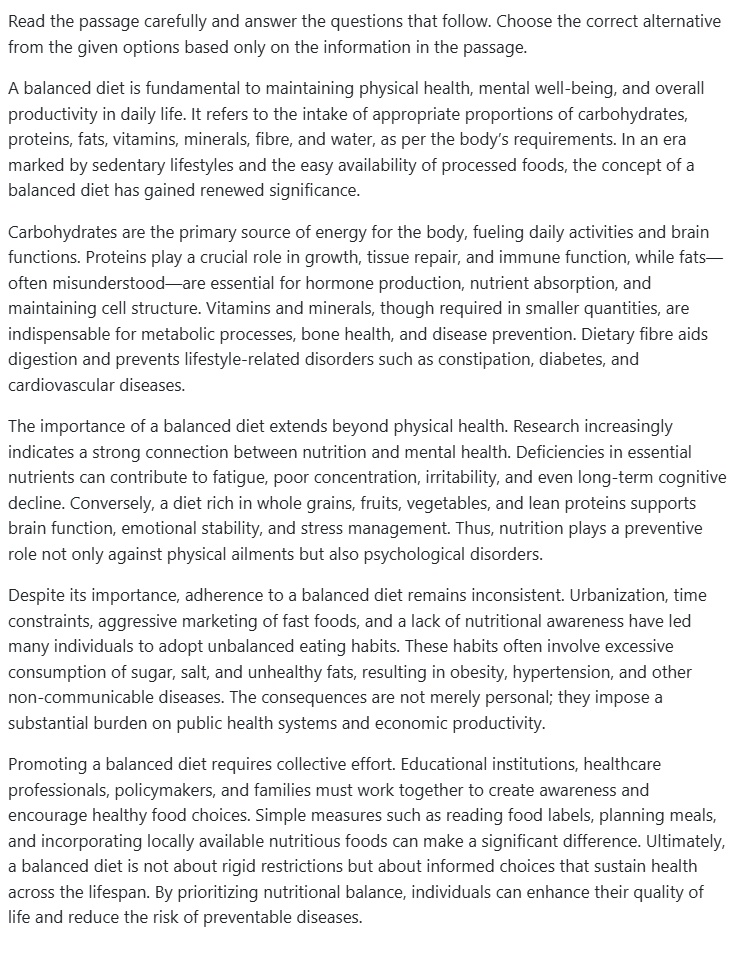
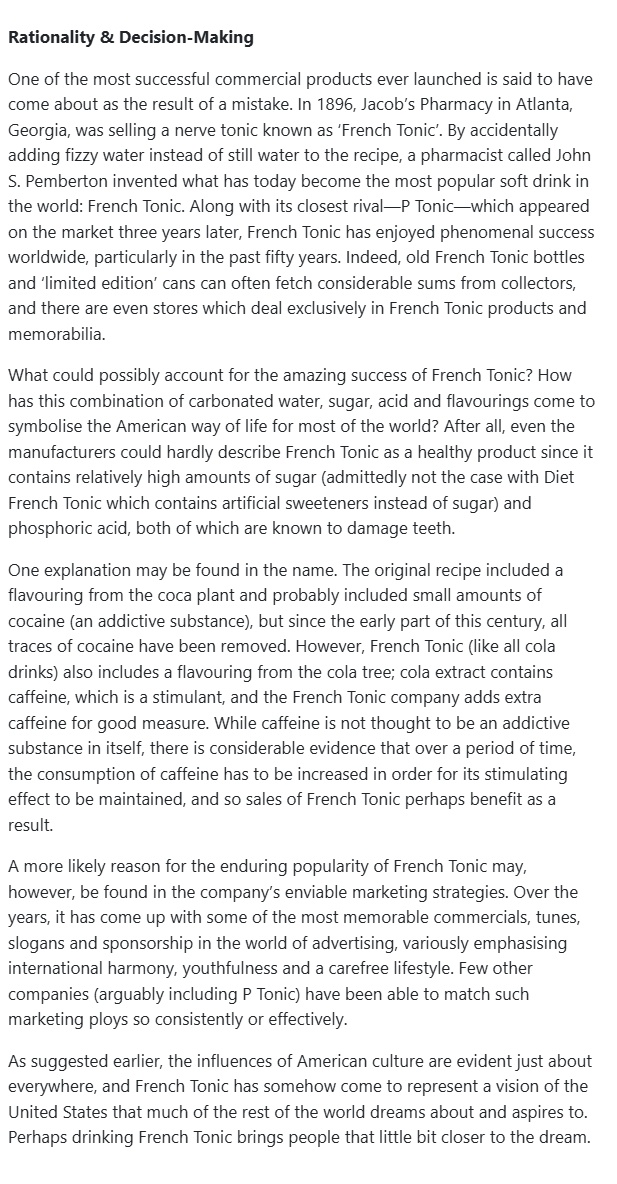
Passage shown as image

Why would tissue transplanted from father to daughter have a greater risk of being detected as foreign than a tissue transplanted between identical twins?

Figure for MBA CET 2026 Attempt 2 Slot 2 question 155
  1. The age of the twins' tissue would be the same and, therefore, less likely to be rejected
  2. The identical twins tissue would carry the same self-markers and would therefore be less likely to be rejected
  3. The difference in the sex of the father and daughter would cause the tissue to be rejected by the daughter's immune system
  4. The twins' immune systems would remember the same encounters with childhood illnesses
  5. The twins would be raised in similar external environment
Show answerHide answer

Answer: B official key

Approach: Inference from a stated rule — transplants and self-markers.

Solution: Para 3: tissues from another individual act as antigens and are rejected, 'except an identical twin, whose cells carry identical self-markers.' A father's tissue carries different self-markers, so the daughter's immune system reads it as non-self; a twin's tissue reads as self.

Why the other options are wrong:
A: Age of tissue is never a factor in the passage.
C: Sex difference is not mentioned; the reason is self-markers.
D: Immune memory is not inherited/shared, and is irrelevant to rejection.
E: Environment plays no role in self-markers.

Answer: B

Q159MediumCET 2026 · Attempt 2 Slot 2 · Q159

Passage shown as image

The passage infers which of the following relationship between the antiquity of ferns and palms?

Figure for MBA CET 2026 Attempt 2 Slot 2 question 159
  1. Their ability to live long.
  2. Their ability to purify air.
  3. Their ability to grow leaves that live long.
  4. Their ability to react successfully in research experiments.
  5. Their ability to reborn.
Show answerHide answer

Answer: B official key

Approach: Inference — what the author links to the plants' antiquity.

Solution: Last para: both species are ancient (over 100 million years) and long-lived, then the closing line: 'Perhaps it is their primal qualities that have contributed to their ability to purify their environment.' 'Primal qualities' = antiquity; the link drawn is to air purification.

Why the other options are wrong:
A, C: Long life and long-lived leaves are listed alongside antiquity as other shared traits, not as its result.
D: Research success is not linked to their age.
E: Rebirth is never mentioned.

Answer: B

Q163EasyCET 2026 · Attempt 2 Slot 2 · Q163
Passage / data for this question

Passage shown as image

Which of the following situation is most likely attributable to 'the effect of endorphins' as described in the passage?

Figure for MBA CET 2026 Attempt 2 Slot 2 question 163
  1. After an injection of novocaine, a patient has no feeling in the area where the injection was given.
  2. After taking ibuprofen, a person with a headache gets quick relief.
  3. After receiving a local anesthetic, an injured person reports relief in the anesthetized area.
  4. After getting influenza vaccine, a child falls sick less often.
  5. After acupuncture, a patient with chronic back pain reports that the pain is much less severe.
Show answerHide answer

Answer: E official key

Approach: Application — match the scenario to the mechanism the passage gives.

Solution: Last para: 'techniques for blocking chronic pain — such as acupuncture and electrical stimulation of the central brain stem — involve the release of endorphins.' A chronic back-pain patient relieved after acupuncture is exactly this case.

Why the other options are wrong:
A, C: Novocaine/local anaesthetics block nerve transmission (sodium ions), not endorphins.
B: Ibuprofen is an aspirin-like drug — blocks prostaglandin synthesis.
D: Vaccines concern immunity, not pain.

Cetking shortcut: Each blocker in the passage has its own mechanism: aspirin → prostaglandins, anaesthetic → sodium ions, acupuncture → endorphins.

Answer: E

Q164MediumCET 2026 · Attempt 2 Slot 2 · Q164
Passage / data for this question

Passage shown as image

It can be inferred from the passage that if the prostaglandin synthetase is only partially blocked, which of the following is most likely to be true?

Figure for MBA CET 2026 Attempt 2 Slot 2 question 164
  1. Some endorphins will be produced, and some pain signals will be intensified.
  2. Some pain killing substance P is likely to be produced, so some pain signals will reach the brain.
  3. Some sodium ions will be blocked, so some pain signals will not reach the brain.
  4. Some prostaglandins will be produced, but production of substance P will be prevented.
  5. Some peptides in the brain will receive pain signals and begin to regulate incoming pain traffic.
Show answerHide answer

Answer: B official key

Approach: Inference from a proportional rule.

Solution: Para 2: aspirin-type drugs block prostaglandin synthetase, and 'the drugs' effectiveness against pain is proportional to their success in blocking this enzyme.' Partial blocking → some prostaglandins are still made → some nerve endings are sensitised → some signals travel on (substance P is released at the spinal cord) → some pain reaches the brain. Option B states this outcome. (Note: B's label 'pain killing' is loose — substance P is a pain-signalling chemical — but its conclusion is the only correct inference.)

Why the other options are wrong:
A: Endorphins are not produced by this pathway, and signals would be reduced, not intensified.
C: Sodium ions are blocked by anaesthetics, not by aspirin.
D: If some prostaglandins are produced, signals continue, so substance P is not prevented.
E: Peptides (endorphins) regulating traffic is unrelated to the enzyme.

Cetking shortcut: Partial cause → partial effect: look for 'some … so some …'.

Answer: B

Q154MediumCET 2026 · Attempt 2 Slot 1 · Q154
Passage / data for this question

Passage shown as image

Based on the passage, which of the following can be most reasonably inferred about modern HR professionals?

Figure for MBA CET 2026 Attempt 2 Slot 1 question 154
  1. They must balance employee expectations with organisational accountability mechanisms.
  2. They are no longer responsible for administrative functions such as payroll and compliance.
  3. They prioritise innovation over fairness in workforce policies.
  4. They rely primarily on monetary incentives to address talent retention.
  5. They consider subjectivity in performance evaluation to be entirely unavoidable and unmanageable.
Show answerHide answer

Answer: A official key

Approach: Inference — combine two parts of the passage; reject anything stated as absolute.

Solution: Paras 2–4 show HR must respond to employee expectations (meaningful work, fairness, autonomy, inclusion). The last paragraph says HR's effectiveness depends on demonstrating measurable impact to a cost-conscious senior leadership. Together: modern HR professionals must balance employee expectations with organisational accountability — A.

Why the other options are wrong:
B: The passage says HR moved beyond admin work, not that payroll/compliance are no longer its job.
C: No ranking of innovation over fairness.
D: Contradicts para 2 — money alone no longer suffices.
E: Passage notes concerns about subjectivity, but never calls it 'entirely unavoidable and unmanageable'.

Cetking shortcut: Words like 'no longer', 'entirely', 'primarily' signal over-statement in inference options.

Answer: A

Q155MediumCET 2026 · Attempt 2 Slot 1 · Q155
Passage / data for this question

Passage shown as image

Which of the following can be most reasonably inferred from the passage regarding HR’s strategic role?

Figure for MBA CET 2026 Attempt 2 Slot 1 question 155
  1. HR strategies are effective only when employee behaviour can be precisely measured
  2. HR’s influence depends largely on alignment with senior leadership perspectives
  3. Administrative HR functions have become irrelevant in modern organisations
  4. HR initiatives automatically lead to innovation and higher profitability
  5. HR departments function independently of organisational cost constraints
Show answerHide answer

Answer: B official key

Approach: Inference — use the 'constraints' paragraph.

Solution: Last paragraph: HRM operates within organisational hierarchies; 'strategic initiatives may be diluted if senior leadership perceives HR interventions as expenses rather than investments'. So whether HR's strategic role actually takes effect depends largely on whether senior leadership shares (is aligned with) HR's perspective — B.

Why the other options are wrong:
A: 'Only when… precisely measured' is extreme; passage cautions against simplistic metrics.
C: Admin functions are not called irrelevant.
D: 'Automatically' — diversity is merely 'linked' to innovation; no guarantee.
E: Opposite — HR operates within cost constraints.

Cetking shortcut: When a question asks about HR's 'strategic role', look at what limits it — the leadership/cost paragraph.

Answer: B

Q157EasyCET 2026 · Attempt 2 Slot 1 · Q157
Passage / data for this question

Passage shown as image

Why does the author emphasize alignment of quality goals with organizational strategy?

Figure for MBA CET 2026 Attempt 2 Slot 1 question 157
  1. To ensure faster compliance with international standards
  2. To reduce reliance on skilled labor
  3. To eliminate the need for process documentation
  4. To transform quality into a source of competitive advantage
  5. To focus primarily on cost minimization
Show answerHide answer

Answer: D official key

Approach: Author's-purpose question — read the sentence that states the result of alignment.

Solution: Para 3: 'When quality goals are synchronized with organizational strategy, they drive innovation and competitive advantage.' So the author stresses alignment because it turns quality into a source of competitive advantage — D.

Why the other options are wrong:
A: ISO is an example of benefits, not the reason for alignment; 'faster compliance' is not mentioned.
B: Passage stresses training skilled employees, not reducing them.
C: Standards promote documentation, not eliminate it.
E: Passage frames quality as strategic, beyond cost minimisation.

Answer: D

Q158EasyCET 2026 · Attempt 2 Slot 1 · Q158
Passage / data for this question

Passage shown as image

Which of the following can be inferred about quality management standards like ISO 9001?

Figure for MBA CET 2026 Attempt 2 Slot 1 question 158
  1. They guarantee defect-free production
  2. They replace managerial judgment entirely
  3. They primarily benefit external stakeholders
  4. They encourage systematic learning and accountability
  5. They are relevant only to manufacturing industries
Show answerHide answer

Answer: D official key

Approach: Inference — paraphrase the ISO 9001 sentences.

Solution: Para 3: ISO 9001 'improves internal processes' and signals reliability; 'such standards promote documentation, accountability, and systematic evaluation, thereby reducing dependence on individual discretion and increasing organizational learning'. Systematic evaluation + learning + accountability = D.

Why the other options are wrong:
A: 'Guarantee defect-free' is extreme and unstated.
B: They reduce dependence on discretion, not replace judgment 'entirely'.
C: Benefits are internal too, so not 'primarily' external.
E: No restriction to manufacturing.

Cetking shortcut: Eliminate options with 'guarantee', 'entirely', 'only' — D is the one paraphrase left.

Answer: D

Q160MediumCET 2026 · Attempt 2 Slot 1 · Q160
Passage / data for this question

Passage shown as image

Which of the following statements, if true, would most strengthen the author’s argument regarding the strategic importance of quality management?

Figure for MBA CET 2026 Attempt 2 Slot 1 question 160
  1. Firms with advanced quality management systems experience lower employee absenteeism.
  2. Industries with mature quality management systems adapt more effectively to technological disruptions.
  3. Quality management systems standardize processes across different industries.
  4. Customer satisfaction surveys often reflect subjective perceptions rather than measurable outcomes.
  5. Organizations adopting quality management report higher short-term compliance costs.
Show answerHide answer

Answer: B official key

Approach: Strengthen — find the conclusion, then the option that supports it directly.

Solution: Conclusion: quality management is a 'strategic imperative'; firms that embed it 'are better equipped to adapt to change, manage risk, and sustain long-term growth', and quality systems provide the framework as industries adopt automation and data-driven decisions. B says industries with mature quality systems adapt more effectively to technological disruptions — direct evidence for the strategic, adapt-to-change claim.

Why the other options are wrong:
A: Lower absenteeism is an HR/operational benefit, not strategic importance.
C: Standardisation across industries is neutral to the strategic claim.
D: Questions customer-satisfaction measurement — weakens, if anything.
E: Higher costs weaken the case.

Cetking shortcut: Strengthen the exact word in the question stem ('strategic') — pick the option that links quality to long-term adaptation/competitive edge.

Answer: B

Q162EasyCET 2026 · Attempt 2 Slot 1 · Q162
Passage / data for this question

Passage shown as image

Which of the following concerns is implicitly associated with excessive reliance on AI-driven instruction?

Figure for MBA CET 2026 Attempt 2 Slot 1 question 162
  1. Reduction in socio-emotional learning
  2. Decline in institutional funding
  3. Standardization of global curricula
  4. Inaccuracy in objective assessments
  5. Increased workload for educators
Show answerHide answer

Answer: A official key

Approach: Detail/inference — find 'excessive dependence on AI-driven instruction'.

Solution: Para 4: 'excessive dependence on AI-driven instruction risks diminishing the socio-emotional dimensions of learning, which are inherently nurtured through human interaction.' Hence A.

Why the other options are wrong:
B: Funding is not discussed.
C: AI reduces standardisation; global curricula not raised.
D: Objective tests are graded 'with remarkable accuracy'.
E: AI frees educators' time — workload falls.

Cetking shortcut: Match the question's key phrase ('excessive reliance') to the identical phrase in the passage.

Answer: A

Q163EasyCET 2026 · Attempt 2 Slot 1 · Q163
Passage / data for this question

Passage shown as image

Which of the following statements would the author most likely disagree with?

Figure for MBA CET 2026 Attempt 2 Slot 1 question 163
  1. Ethical governance is essential for responsible AI implementation
  2. AI can help address individual differences among learners
  3. AI has the potential to democratize access to quality education
  4. Human judgment in education can be entirely replaced by algorithms
  5. Personalized learning can improve educational outcomes
Show answerHide answer

Answer: D official key

Approach: Agree/disagree question — test each option against the author's stated view.

Solution: The author says AI should be 'an augmentative tool that complements human expertise' rather than 'supplanting educators', and flags 'the potential erosion of human judgment' as a concern. So the author would disagree that human judgment can be entirely replaced by algorithms — D.

Why the other options are wrong:
A: Author stresses ethical governance — agrees.
B: AI tailors learning to heterogeneity — agrees.
C: 'Potential to democratize access to quality education' — agrees.
E: Personalisation enhances outcomes — agrees.

Cetking shortcut: Four options are near-quotes the author endorses; the absolute one ('entirely replaced') is the answer.

Answer: D

Q164MediumCET 2026 · Attempt 2 Slot 1 · Q164
Passage / data for this question

Passage shown as image

Which of the following conclusions can be most logically inferred from the passage, even though it is not explicitly stated?

Figure for MBA CET 2026 Attempt 2 Slot 1 question 164
  1. The success of AI in education is primarily contingent upon technological sophistication rather than pedagogical design.
  2. AI-driven personalization may inadvertently exacerbate educational inequity if ethical and human oversight mechanisms are weak.
  3. Administrative efficiency is the principal justification for integrating AI into educational institutions.
  4. Socio-emotional learning can be effectively replicated through advanced AI systems.
  5. Standardized curricula will become obsolete with widespread AI adoption.
Show answerHide answer

Answer: B official key

Approach: Inference — combine ideas not stated together in one line.

Solution: The passage (i) praises personalisation, (ii) warns of bias, data misuse and surveillance if 'inadequately regulated', and erosion of human judgment and socio-emotional learning, and (iii) ends that a balanced approach is needed so AI drives 'equitable educational advancement'. Implied but unstated: without ethical and human oversight, AI personalisation may end up worsening inequity — B.

Why the other options are wrong:
A: Opposite — efficacy 'depends on judicious implementation' and pedagogical integrity.
C: Admin efficiency is one benefit, not 'the principal justification'.
D: Contradicts para 4 — socio-emotional learning needs human interaction.
E: AI reduces dependency on standardised curricula; obsolescence is too extreme.

Cetking shortcut: In 'not explicitly stated' questions, prefer the cautious option ('may inadvertently') that links two stated ideas.

Answer: B

Q167EasyCET 2026 · Attempt 2 Slot 1 · Q167
Passage / data for this question

Passage shown as image

Which of the following can be logically inferred from the passage regarding preventive healthcare?

Figure for MBA CET 2026 Attempt 2 Slot 1 question 167
  1. Medical treatment is more effective than dietary control
  2. Balanced diet reduces only communicable diseases
  3. Psychological disorders are unrelated to nutrition
  4. Public health systems function independently of lifestyle choices
  5. Nutritional awareness can lower long-term healthcare burden
Show answerHide answer

Answer: E official key

Approach: Inference — link the 'burden' line with the 'awareness' remedy.

Solution: Para 4: lack of nutritional awareness leads to unbalanced eating, causing obesity, hypertension and NCDs that 'impose a substantial burden on public health systems'. Para 5: creating awareness and informed choices 'reduce the risk of preventable diseases'. So nutritional awareness can lower long-term healthcare burden — E.

Why the other options are wrong:
A: Passage never ranks treatment above diet; it stresses prevention.
B: It mentions non-communicable diseases, so 'only communicable' is wrong.
C: Para 3 links nutrition to psychological disorders.
D: Lifestyle diseases burden public health systems — they are linked.

Cetking shortcut: Preventive = reduce future cost; pick the option that joins cause (awareness) and effect (lower burden).

Answer: E

Q168MediumCET 2026 · Attempt 2 Slot 1 · Q168
Passage / data for this question

Passage shown as image

If the trend of unhealthy dietary habits described in the passage continues unchecked, which of the following outcomes would most logically undermine the author’s advocated approach to improving public health?

Figure for MBA CET 2026 Attempt 2 Slot 1 question 168
  1. Increased reliance on advanced medical technologies to manage lifestyle diseases
  2. Expansion of nutrition-related research in academic institutions
  3. Greater inclusion of dietary education in school curricula
  4. Higher availability of locally sourced nutritious foods
  5. Improved awareness of food labeling among consumers
Show answerHide answer

Answer: A official key

Approach: Weaken-the-approach question — identify the approach, then find the outcome that moves away from it.

Solution: The author's approach: a collective, preventive effort — awareness, food labels, meal planning, local nutritious food, informed choices. If unhealthy habits continue and society responds with increased reliance on advanced medical technologies to manage lifestyle diseases, the focus shifts from prevention to cure, undermining the advocated diet-first approach — A.

Why the other options are wrong:
B: More nutrition research supports the approach.
C: School dietary education is exactly the awareness the author wants.
D: Locally sourced nutritious foods are recommended in para 5.
E: Reading food labels is one of the author's suggested measures.

Cetking shortcut: Four options are taken from the author's own remedy list — they cannot undermine it; the odd one out wins.

Answer: A

Q154MediumCET 2026 · Slot 5 · Q154
Passage / data for this question

Study the following information carefully and answer the question given below.

When you are the chief executive of a public company, the temptation to opt for a merger or acquisition is great indeed. Many such bosses may get a call every week or so from an investment banker eager to offer the kind of deal that is sure to boost profits. Plenty of those calls are proving fruitful. In the first three quarters of 2017, just over $2.5trn-worth of transactions were agreed globally, according to Dealogic, a data provider. The total was virtually unchanged from the same period in 2016, but the number in Europe, the Middle East and Africa was up by 21%.

It is easy to understand why an executive opts for a deal. Buying another business looks like decisive action, and is a lot easier than coming up with a new, bestselling product. Furthermore, being the acquirer is far more appealing than being the prey; better to be the butcher than the cattle. A takeover may keep activist hedge funds off the management’s back for a while longer. And being in charge of a much bigger company is a more demanding task that will surely justify a larger salary for the executives in charge.

But these temptations, good and bad, should generally be resisted. S&P Global Market Intelligence, a research arm of the ratings agency, has updated a study on the impact of deals on the acquiring company’s share price. The study looked at M&A deals done by listed companies in America’s Russell 3000 index between January 2001 and August 2017; deals were only included if they cost more than 5% of the total enterprise value of the acquirer (5% of the equity value, for financial companies). The acquirers’ shares underperformed the market and those of rival firms in the same industry.

That share-price performance was understandable, in the light of what tended to happen to the fundamentals of the acquiring company’s business. The study finds that, relative to the company’s peer group, net profit margins fall, as do the returns on capital and on equity; earnings per share grow less quickly; and both debt and interest expenses increase. As the deal is done, however, the executives always sound bullish. Costs will be cut, the companies will benefit from selling a wide range of products and so on; a whole range of “synergies” will be achieved. Instead, the combined companies tend to suffer from clashes of culture and teething problems as systems prove hard to integrate. The AOL-Time Warner merger of 2000 is perhaps the most famous example of a dysfunctional deal; at the time, it was one of the biggest mergers in corporate history. Not every deal is that bad. But instead of two plus two equalling the promised five, all too often they add up to three-and-a-half.

Which of the following statements, if true, could be warning signs ahead of a takeover?

I. The faster the company was growing before the acquisition, the worse it tends to perform afterwards.

II. All-share deals tend to perform less well than cash offers.

III. Large deals perform less well than small ones.

  1. Only I
  2. Only III
  3. Only II and III
  4. All I,II and III
  5. Neither I, II nor III
Show answerHide answer

Answer: E official key

Approach: Scope check — accept only what the passage supports.

Solution: The passage's evidence is limited to: acquirers' shares underperform, margins and returns fall, EPS growth slows, debt and interest rise, and culture clashes/integration problems follow. It says nothing about the acquirer's growth rate before the deal (I), the mode of payment — shares vs cash (II), or deal size (III). Since none of the three can be drawn from the passage, none qualifies: Neither I, II nor III.

Why the other options are wrong:
A, B, C, D — each accepts at least one statement the passage never discusses; these are outside-knowledge claims.

Cetking shortcut: In MBA CET RC, if a statement introduces a brand-new factor not in the text, treat it as out of scope.

Answer: E

Q155EasyCET 2026 · Slot 5 · Q155
Passage / data for this question

Study the following information carefully and answer the question given below.

When you are the chief executive of a public company, the temptation to opt for a merger or acquisition is great indeed. Many such bosses may get a call every week or so from an investment banker eager to offer the kind of deal that is sure to boost profits. Plenty of those calls are proving fruitful. In the first three quarters of 2017, just over $2.5trn-worth of transactions were agreed globally, according to Dealogic, a data provider. The total was virtually unchanged from the same period in 2016, but the number in Europe, the Middle East and Africa was up by 21%.

It is easy to understand why an executive opts for a deal. Buying another business looks like decisive action, and is a lot easier than coming up with a new, bestselling product. Furthermore, being the acquirer is far more appealing than being the prey; better to be the butcher than the cattle. A takeover may keep activist hedge funds off the management’s back for a while longer. And being in charge of a much bigger company is a more demanding task that will surely justify a larger salary for the executives in charge.

But these temptations, good and bad, should generally be resisted. S&P Global Market Intelligence, a research arm of the ratings agency, has updated a study on the impact of deals on the acquiring company’s share price. The study looked at M&A deals done by listed companies in America’s Russell 3000 index between January 2001 and August 2017; deals were only included if they cost more than 5% of the total enterprise value of the acquirer (5% of the equity value, for financial companies). The acquirers’ shares underperformed the market and those of rival firms in the same industry.

That share-price performance was understandable, in the light of what tended to happen to the fundamentals of the acquiring company’s business. The study finds that, relative to the company’s peer group, net profit margins fall, as do the returns on capital and on equity; earnings per share grow less quickly; and both debt and interest expenses increase. As the deal is done, however, the executives always sound bullish. Costs will be cut, the companies will benefit from selling a wide range of products and so on; a whole range of “synergies” will be achieved. Instead, the combined companies tend to suffer from clashes of culture and teething problems as systems prove hard to integrate. The AOL-Time Warner merger of 2000 is perhaps the most famous example of a dysfunctional deal; at the time, it was one of the biggest mergers in corporate history. Not every deal is that bad. But instead of two plus two equalling the promised five, all too often they add up to three-and-a-half.

Which of the following statements can be inferred from the passage?

I. The acquirer firm’s share under performs most of the times.
II. The newly combined company tends to have culture clashes and teething issues.
III. The acquiring company’s fundamentals undergo a positive shift immediately after the acquisition.

  1. Only II
  2. Only III
  3. Only I and II
  4. Only I and III
  5. ALL I, II and III
Show answerHide answer

Answer: C official key

Approach: Verify each statement against paragraphs 3 and 4.

Solution: I — 'The acquirers' shares underperformed the market and those of rival firms.' ✔
II — 'the combined companies tend to suffer from clashes of culture and teething problems'. ✔
III — the opposite is true: margins, returns on capital and equity fall and debt rises. ✘
So only I and II.

Why the other options are wrong:
A Only II — leaves out I, which is stated.
B, D, E — include III, which contradicts the passage.

Answer: C

Q159EasyCET 2026 · Slot 5 · Q159

Read the following passage to answer the given questions based on it.

Vishnu Raman was an Indian magistrate who lived about a hundred years ago. He was famed for the fairness of his judgements. One day while the magistrate was walking through the market he saw a crowd outside a poultry shop. On enquiring what the matter was he learnt that a worker had accidentally dropped a heavy sack on a chicken, crushing it to death. The chicken was small, worth only about five rupees, but the owner of the shop had caught the worker by his throat and was demanding a hundred rupees. His argument was that the chicken would have grown into a plump bird in another two years and then it would have fetched him the amount he was asking for. Somebody in the crowd recognized the magistrate, and everybody made way for him.

“Judge our case, your honour!” said the owner of the chicken, letting go of the worker and bowing respectfully to the magistrate. “This man, through his carelessness has caused the death of a chicken that would have fetched me a hundred coins in another two years!” Fear had made the worker’s speech incoherent. Nobody could understand what he was saying. “The price put on the chicken is hundred rupees”, said the magistrate, to the worker. “I advise you to pay the owner.” There was a gasp from the crowd. Everybody had expected the magistrate to favour the poor worker. The owner of the chicken was overjoyed. “They said you were fair in your judgements” he said, rubbing his hands in glee, “Now I can say there is no one fairer than you!”

“The Law is always fair”, smiled the magistrate. “Tell me, how much grain a chicken would eat in a year? “About half a sack”, said the poultry shop owner. “So in two years the chicken who died would have eaten a whole sack of grain”, said Vishnu Raman. “Please give the sack of grain you’ve saved to the worker.” The chicken owner turned pale. A sack of grain would cost more than hundred rupees. Frightened by the shouts from the crowd, he declared he would not take any money from the worker, and retreated into the safety of his shop in the end.

Why was the shop owner asking for a hundred rupees?

  1. The worker could afford to pay him
  2. The worker purposely killed the chicken.
  3. He was a greedy man.
  4. He wanted to sell the chicken for a hundred rupees.
  5. It would cost that much to buy another chicken.
Show answerHide answer

Answer: C official key

Approach: Infer the motive from the facts.

Solution: The chicken was 'worth only about five rupees', yet he demanded a hundred rupees on the plea that it might grow into a plump bird in two years — and he held the poor worker by the throat. Charging twenty times the value marks him as a greedy man.

Why the other options are wrong:
A — the worker's ability to pay is never discussed (he is poor).
B — the death was accidental.
D — the hundred rupees was a speculative future value, not a sale he planned.
E — a replacement chicken would cost about five rupees.

Answer: C

Q163MediumCET 2026 · Slot 5 · Q163

Read the following passage carefully and answer the questions given below.

The second-largest colony of emperor penguins in the world appears to be collapsing, after rough seas drowned all of its babies three winters in a row. The Halley Bay colony once accounted for 5 to 9% of the global emperor penguin population, according to the British Antarctic Survey (BAC), which reported the catastrophe. That amounted to about 15,000 to 24,000 adult breeding pairs. But in 2016, the sea-ice platform on which the colony was raising its babies collapsed during rough weather, throwing infant penguins unable to swim into the frigid water. In 2017 and 2018, the rough weather pattern repeated itself.

The birds arrive at the site from their summer sea jaunts each April to breed; for the resulting chicks to survive, the site has to remain stable throughout the Southern Hemisphere’s winter, which lasts until December.

By 2018, a handful of adults — a "few hundred," or about 2 percent of the original population — turned up at the Halley Bay site, the researchers reported. The remaining colony appeared in disarray, with adults moving closer to the ice edge than is typical, and was difficult to count scattered among the roughened chunks of ice.

The good news is that at least some of the colony appears to have moved, rather than died out. The DawsonLambton Glacier colony 34 miles (55 kilometres) to the south has significantly swelled in numbers since the devastation of Halley Bay, the BAC reported. That colony, which had hit a low of just 1,280 pairs in the 2015 season, swelled in each succeeding year. In 2016, it reached 5,315 pairs. In 2017, there were 11,117 pairs. And by 2018, a full 14,612 pairs set up camp at the site.

What was/were the main reason/reasons behind the devastation of Halley Bay colony?

I. Killing infant babies by predators.
II. Drowning of infant penguins into frigid water.
III. The rough weather pattern that caused the collapse of the sea-ice platform on which the penguin babies were bred.

  1. Only I
  2. Only III
  3. Only I and III
  4. Only II and III
  5. All I, II and III
Show answerHide answer

Official CET key: B · Cetking's answer: D — see why below

Approach: Separate the root cause from its consequence.

Solution: Passage: 'the sea-ice platform … collapsed during rough weather, throwing infant penguins unable to swim into the frigid water. In 2017 and 2018, the rough weather pattern repeated itself.' The repeated rough weather that broke the platform is what devastated the colony; the drowning is the effect of that collapse. So the main reason is III only.

Why the other options are wrong:
A, C, E — predators (I) are never mentioned.
D — II describes how the chicks died, which is a result of III, not a separate main reason.

Cetking shortcut: When a 'main reason' question offers a cause and its effect, the root cause is the answer.

Answer: B

Q168EasyCET 2026 · Slot 5 · Q168

Read the following passage carefully and answer the questions given below it.

The Sun, while going on his daily rounds saw a princess and fell in love with her. Whenever he could slip away from the heavens he would take human form and go down to the princess to spend some time with her. The princess too became quite fond of him and would wait for him to come. One day the Sun decided to send her a blood-red ruby as a token of his love for her. He put the gem in a silk bag, and calling a crow that was flying past, asked the bird to deliver the gem to his beloved. Crows had milky white feathers in those days and it was considered auspicious if a crow came anywhere near you. So the Sun was pleased that he had found a crow to deliver the gem. As the crow sped through the sky with the silken bag, the aroma of food lured him. Looking down, the crow saw that a wedding feast was in progress, and immediately it was distracted from its mission. Food was one thing it could never resist.

Alighting on a tree nearby, it hung the bag on a twig and went off to find some food. While the crow was feasting, a merchant passing by saw the bag on the tree, and knocked it down with a pole. When he opened the bag and saw its contents he almost swooned in joy. Quickly pocketing the ruby, he filled the bag with dry cow dung that was lying there, and then deftly returned the bag to the branch. It was all done so quickly that the crow missed all the action. After having its fill, it flew up to the tree, and picking up the bag and took it to the person it was intended for. The princess was in the garden. When the crow gave her bag, she took it eagerly, knowing that it was from the Sun. But when she saw its contents she reeled back in shock and anger. Believing that it was the Sun's way to telling her that he did not care for her, she flung the bag away, rushed to her palace, and never came out again. When the Sun learnt of what had happened he was furious. So great was his anger that when he turned his scorching gaze on the crow, its feathers were burned black. Its feathers have been black ever since. The ruby did not stay with the man who stole it. It fell out of his pocket and rolled into a deep pit. Men have been trying to dig it out ever since. Many precious stones have been found in the process, making Myanmar one of the richest sources of rubbies and sapphires, but the ruby that the Sun sent to the princess is yet to be found.

What message did the princess get after opening the bag?

  1. That the Sun truly loved her
  2. That the crow was an evil bird
  3. That the crow was playing a joke on her
  4. That the Sun did not love her anymore
  5. That the cow dung was a token of the Sun's love for her.
Show answerHide answer

Answer: D official key

Approach: Read how she interpreted the contents.

Solution: She believed it was the Sun's way of telling her that he did not care for her, and flung the bag away. The message she took: the Sun did not love her anymore.

Why the other options are wrong:
A, E — the opposite of how she reacted.
B, C — she blamed the Sun, not the crow.

Answer: D

Q181MediumCET 2026 · Slot 4 · Q181

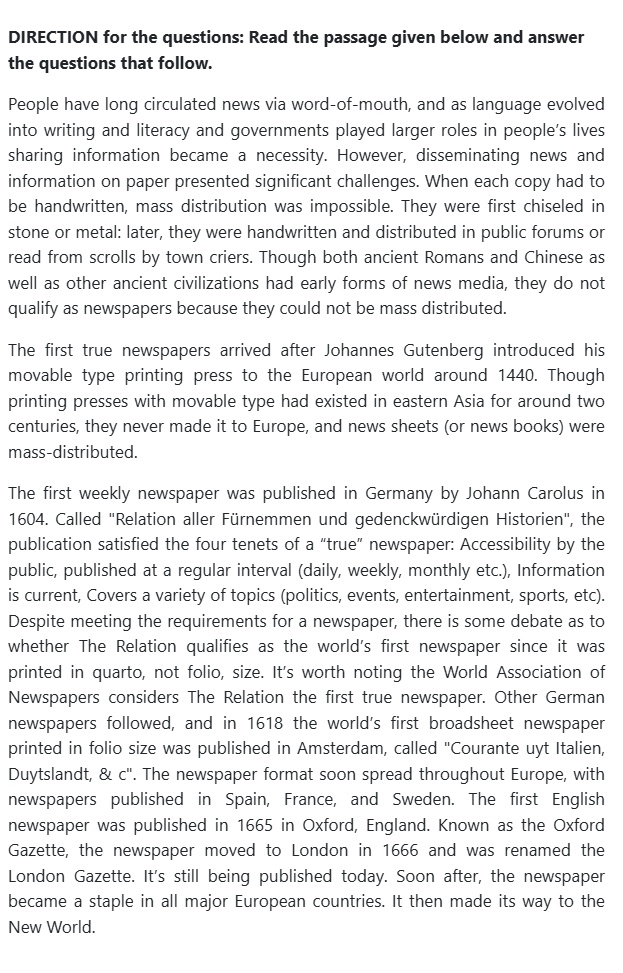
Passage shown as image

Which of the following options is satisfying the condition for being a tenet of a “true newspaper”?

Figure for MBA CET 2026 Slot 4 question 181
  1. A newspaper which is accessible to only Asian readers.
  2. A newspaper which was published once in a month
  3. A newspaper which was printed in quarto, not folio, size.
  4. A newspaper which covers historic developments leading to various events.
  5. A newspaper which is handwritten.
Show answerHide answer

Official CET key: B · Cetking's answer: D — see why below

Approach: Check each option against the four tenets of a 'true' newspaper listed in paragraph 3.

Solution: The passage lists the tenets: accessible to the public; published at a regular interval (daily, weekly, monthly etc.); information is current; covers a variety of topics.
Option B, a newspaper published once a month, directly satisfies the 'regular interval' tenet, which the passage itself illustrates with 'monthly'.

Why the other options are wrong:
A Accessible only to Asian readers: restricts access, violating 'accessibility by the public'.
C Printed in quarto, not folio: size is a debate point, not one of the four tenets.
D Covers historic developments: violates 'information is current'.
E Handwritten: the passage says handwritten copies could not be mass distributed.

Cetking shortcut: Underline the bracket '(daily, weekly, monthly etc.)'; the option that echoes it is the one the passage itself certifies.

Answer: B

Q191MediumCET 2026 · Slot 4 · Q191
Passage / data for this question

Passage shown as image

Which of these is not true in the context of the passage?

Figure for MBA CET 2026 Slot 4 question 191
  1. We speak in other people’s voices, most of time
  2. People are genuine in expressing their feelings.
  3. We generally imitate others in everything.
  4. People are happy to take on other’s roles.
  5. People are not genuine in expressing their feelings.
Show answerHide answer

Answer: B official key

Approach: 'NOT true' question: find the option that contradicts the passage's central claim.

Solution: Wilde's line: 'Most people are other people. Their thoughts are someone else's opinions, their lives a mimicry, their passions a quotation.' The author adds that 'the vast majority of us are not who we have been pretending to be'. So people's feelings are borrowed, not genuine. Option B ('People are genuine in expressing their feelings') is therefore NOT true.

Why the other options are wrong:
A True: our thoughts are 'someone else's opinions', so we speak in others' voices.
C True: 'their lives a mimicry'; we imitate others.
D Consistent: people stay 'content with admiring the wrapping' and would rather conform than break free.
E True: it is the direct restatement of 'their passions a quotation'.

Cetking shortcut: In NOT-true questions, look for the pair of opposites (B vs E); one is the passage's view and the other is the answer.

Answer: B

Q193MediumCET 2026 · Slot 4 · Q193
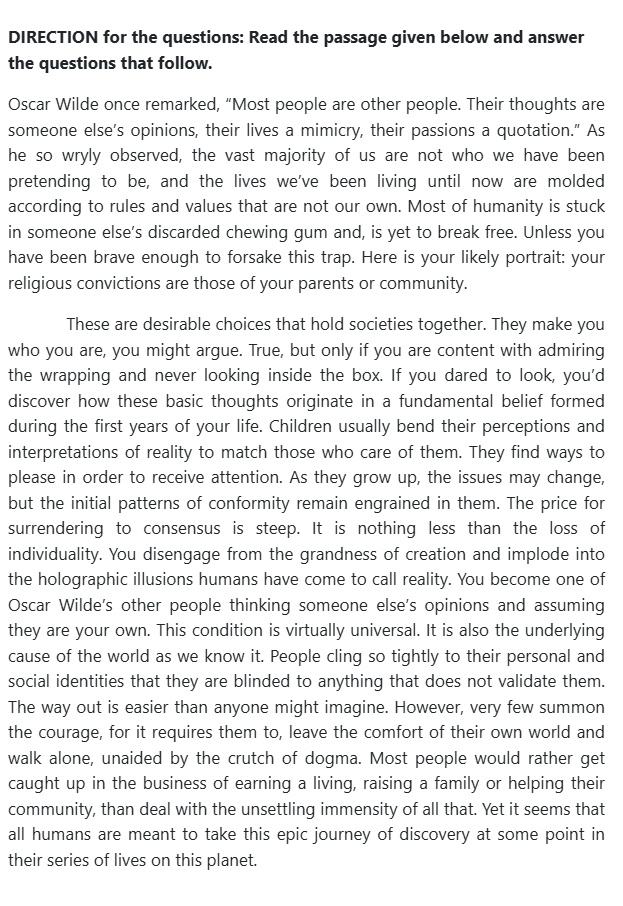
Passage / data for this question

Passage shown as image

In the context of the passage, how can humanity get stuck in someone else’s discarded chewing gum?

Figure for MBA CET 2026 Slot 4 question 193
  1. By giving preference to others’ views over one’s own views
  2. By choosing a product which is sponsored by some great personality
  3. By using discarded things
  4. By appreciating other’s ideas
  5. By criticizing other’s ideas
Show answerHide answer

Answer: A official key

Approach: Decode the metaphor from the sentence before it.

Solution: The previous line says our lives 'are molded according to rules and values that are not our own'. The 'discarded chewing gum' is those borrowed views. Humanity gets stuck by giving preference to others' views over its own, which is option A.

Why the other options are wrong:
B Sponsored products: not discussed.
C 'Using discarded things': a literal reading of the metaphor.
D Appreciating others' ideas is not being trapped by them; the passage criticises surrender, not appreciation.
E Criticising others' ideas is the opposite of conformity.

Answer: A

Q195EasyCET 2026 · Slot 4 · Q195
Passage / data for this question

Passage shown as image

‘Unless you have been brave enough to forsake this-trap’ implies that one has to be?

Figure for MBA CET 2026 Slot 4 question 195
  1. quite serious to give up the old values.
  2. daring enough to break free from the stranglehold of others’ views
  3. very pretentious to discard one’s convictions.
  4. coaxed to come out of the clutches of tradition.
  5. quite serious to hold up other’s views.
Show answerHide answer

Answer: B official key

Approach: Read 'brave enough to forsake this trap' with the trap identified earlier.

Solution: The 'trap' is living by others' opinions. 'Brave enough to forsake' it = daring enough to break free from it. Option B says exactly this; later the passage repeats that 'very few summon the courage ... to walk alone'.

Why the other options are wrong:
A 'Quite serious to give up the old values': courage, not seriousness, is the key quality.
C 'Pretentious to discard one's convictions': the wrong attitude and the wrong target.
D 'Coaxed': being persuaded by others is the opposite of bravery.
E 'Hold up others' views': the opposite of forsaking the trap.

Cetking shortcut: Match the key word: 'brave' = 'daring'. Only one option carries a courage word.

Answer: B

Q151MediumCET 2026 · Slot 3 · Q151
Passage / data for this question

Passage shown as image

Which of the following follows from the passage above?

Figure for MBA CET 2026 Slot 3 question 151
  1. A rhetoric laden talk can generate authentic democratic collective choice.
  2. Irrational persons alone can have values.
  3. Authenticity of democracy requires a strong reflection-action interaction.
  4. A paradigm of competition alone can sustain an authentic democracy.
  5. democracy requires a weak reflection-action interaction.
Show answerHide answer

Answer: C official key

Approach: Inference — paraphrase the second sentence of the passage.

Solution: Line 2: "The authenticity of democracy requires in addition that these reflective preferences influence collective outcomes and action." Reflection (reordering of preferences) must flow into action (collective outcomes). That is a strong reflection–action interaction — exactly option C.

Why the other options are wrong:
A: Rhetoric-laden talk is called strategic, "deceptive and coercive" — a threat to authenticity, not its source.
B: The passage says values may be realised only when individuals behave non-rationally; it never says only irrational persons have values.
D: Competition is an unstated theme that introduces strategy; 'alone can sustain' is unsupported and extreme.
E: Direct opposite of C — reflection must influence action, so the link is strong, not weak.

Cetking shortcut: When two options are exact opposites (C vs E), one of them is usually the answer — check which one the text supports.

Answer: C

Q152HardCET 2026 · Slot 3 · Q152
Passage / data for this question

Passage shown as image

Desire as ante-deliberation driving action refer to

Figure for MBA CET 2026 Slot 3 question 152
  1. Irrationality of deliberation.
  2. Uselessness of deliberation.
  3. Desire to act without thinking.
  4. Temporal inconsistency in a position that argues for deliberative action constituting democracy.
  5. Thoughtlessness of deliberation.
Show answerHide answer

Answer: D official key

Approach: Inference — decode 'ante' (= before) and see what it does to the deliberative-democracy argument.

Solution: Para 2: "Most human actions and discourses are actuated by a deeper or primordial ante-deliberation Desire… Engaging in a deliberation or else in an action is possible only since there has been such a Desire." So something non-deliberative comes before every deliberation. A position that says democracy is constituted by deliberative action is then undercut by its own starting point — a temporal (before/after) inconsistency. Option D captures this.

Why the other options are wrong:
A, B, E: The passage does not call deliberation irrational, useless or thoughtless — Desire is what makes deliberation possible.
C: Desire is the source of deliberation, not a substitute for it; the passage never says people act without thinking.

Cetking shortcut: 'Ante' = before (ante-date, ante-room). The only option dealing with timing/sequence is D.

Answer: D

Q154HardCET 2026 · Slot 3 · Q154
Passage / data for this question

Passage shown as image

A Foucauldian discourse as used in the passage does NOT refer to :

Figure for MBA CET 2026 Slot 3 question 154
  1. discourse based on power.
  2. community based discourse.
  3. strategic discourse.
  4. unplanned discourse
  5. non-strategic discourse.
Show answerHide answer

Official CET key: C · Cetking's answer: E — see why below

Approach: NOT question — list what the passage attributes to Foucauldian discourse, then find the label it does not carry.

Solution: The passage says two separate things. (1) "A talk or a rhetoric, otherwise, is strategic and is employed with the intention of signalling certain information." (2) "The illocutionary force and the normative trappings of a Foucauldian discourse, while allowing identification with a community and differences with the others, do simultaneously pose through coercion a threat…" So Foucauldian discourse = power-based (normative force, coercion, discipline), community-based (identification with a community), and it works without a deliberate plan: the norms discipline thought on their own (non-strategic, unplanned). Strategy, the intentional signalling of information, is the mark of rhetoric. So Foucauldian discourse does NOT refer to strategic discourse.

Why the other options are wrong:
A: Power-based — its 'illocutionary force' and coercion are power.
B: Community-based — it allows 'identification with a community'.
D, E: Unplanned / non-strategic — fits: the discipline comes from norms, not from a speaker's intent.

Cetking shortcut: In NOT questions on dense passages, map each option to a phrase; the one that belongs to a different subject in the passage (here rhetoric) is the odd one.

Answer: C

Q165MediumCET 2026 · Slot 3 · Q165

Passage shown as image

It can be inferred from the last sentence of the passage that:

Figure for MBA CET 2026 Slot 3 question 165
  1. Most people would like to live in America.
  2. Many people wish for a lifestyle like they imagine most Americans have.
  3. Drinking French Tonic reminds a lot of people of visiting America.
  4. Living in the United States is a bit like living in a dream.
  5. Drinking French Tonic is part of the American dream.
Show answerHide answer

Answer: B official key

Approach: Inference from the final sentence plus the one before it.

Solution: "French Tonic has somehow come to represent a vision of the United States that much of the rest of the world dreams about and aspires to. Perhaps drinking French Tonic brings people that little bit closer to the dream." The 'dream' is an imagined American way of life that people aspire to — so many people wish for a lifestyle like they imagine Americans have.

Why the other options are wrong:
A: 'Live in America' is too literal and too strong ('most people').
C: Nothing about remembering visits to America.
D: Says nothing about real life in the US.
E: The drink is a route to the dream, not a part of the 'American dream' idea.

Answer: B

Q171MediumCET 2026 · Slot 3 · Q171
Passage / data for this question

Passage shown as image

According to the passage, all of the following are not true, except:

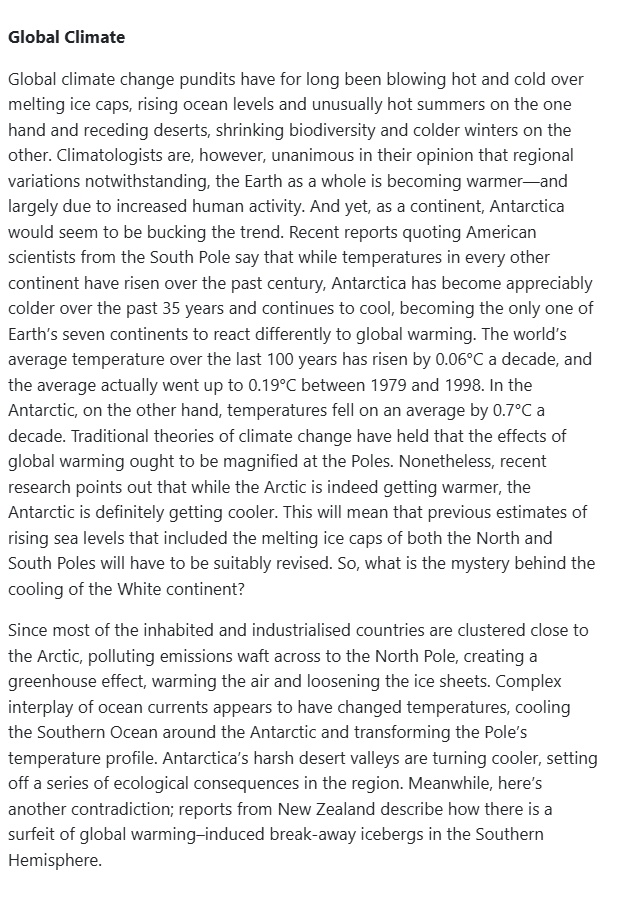
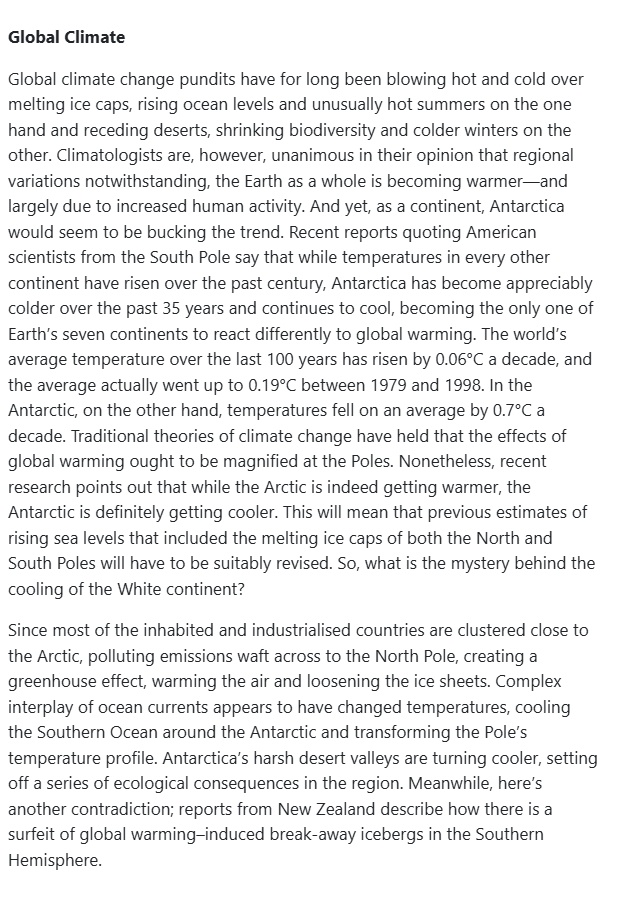
Figure for MBA CET 2026 Slot 3 question 171
  1. Traditional theories failed to calculate the effects of global warming.
  2. Fall in temperatures in the Antarctic is in accordance with the traditional theories.
  3. Effect of global warming is the maximum at the Poles.
  4. Effect of global warming on Antarctica is on unexpected lines.
  5. Effect of global warming on Antarctica is on expected lines.
Show answerHide answer

Answer: D official key

Approach: Decode the double negative — 'all are not true, except' means pick the one true statement.

Solution: Passage: "Traditional theories of climate change have held that the effects of global warming ought to be magnified at the Poles. Nonetheless… the Antarctic is definitely getting cooler." Antarctica is 'bucking the trend', the 'only one of Earth's seven continents to react differently'. So the effect on Antarctica is on unexpected lines — D is true.

Why the other options are wrong:
A: Theories did not 'fail to calculate' effects; they predicted magnification at the Poles.
B: Antarctic cooling goes against traditional theory.
C: Only the theory claims this; Antarctica is cooling, so not established as true.
E: Direct opposite of D.

Cetking shortcut: D and E are opposites — one of them is the true statement; 'bucking the trend' decides it.

Answer: D

Q173MediumCET 2026 · Slot 3 · Q173
Passage / data for this question

Passage shown as image

It can be inferred from the passage that:

Figure for MBA CET 2026 Slot 3 question 173
  1. Our knowledge and our theories about global climate change fails to explain what is happening across the globe.
  2. It is a matter of great contradiction that we failed to understand the full impact of global climatic change.
  3. We could not understand the importance of global climatic change.
  4. It was difficult for us to understand the full implication of global climatic change.
  5. The threat of global warming is accentuated due to what is happening in Antarctica.
Show answerHide answer

Answer: B official key

Approach: Inference — follow the passage's repeated word 'contradiction'.

Solution: The passage opens with pundits "blowing hot and cold", shows Antarctica cooling against traditional theory, says earlier sea-level estimates "will have to be suitably revised", asks "what is the mystery", and ends with "here's another contradiction" — icebergs breaking away in a cooling South. The inference: it is a matter of great contradiction that we have not understood the full impact of global climatic change — B.

Why the other options are wrong:
A: Too broad — the theories still explain the global warming trend; only Antarctica is the exception.
C: 'Importance' is never in doubt; the gap is in understanding effects.
D: Close, but drops the passage's key idea of contradiction — B states it.
E: The Antarctic cooling, if anything, runs against the warming trend; no 'accentuated threat' is drawn.

Cetking shortcut: When the passage literally uses a word (contradiction) twice, the inference option that carries it is usually the answer.

Answer: B

Q160EasyCET 2026 · Slot 2 · Q160

Passage shown as image

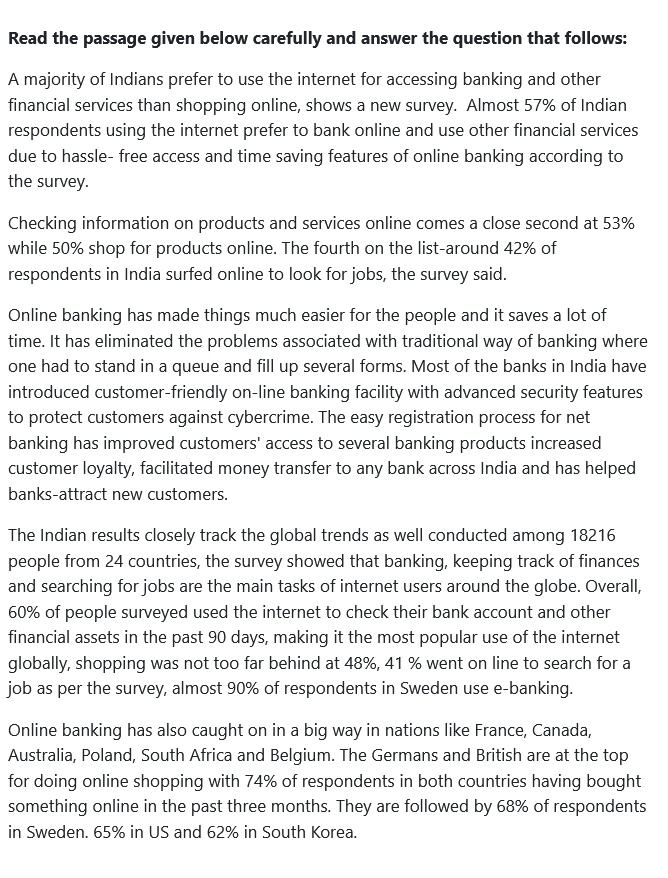
According to the passage, what inference can be made as regards the internet?

Figure for MBA CET 2026 Slot 2 question 160
  1. It has increased the number of cybercrimes
  2. It has made lives easier than before
  3. Internet is most popular for online shopping
  4. The registration process for netbanking is difiicult, yet people prefer online banking than traditional banking
  5. It is more popular for online shopping than anything else
Show answerHide answer

Answer: B official key

Approach: Inference — pick the option the passage supports without going beyond it.

Solution: Para 3: 'Online banking has made things much easier for the people and it saves a lot of time. It has eliminated the problems ... queue ... several forms.'
So the internet has made lives easier than before — option B.

Why the other options are wrong:
A — the passage mentions protection against cybercrime, not a rise in it.
C — globally banking (60%) beats shopping (48%).
D — the passage says registration is easy, not difficult.
E — same error as C; in India too, banking (57%) beats shopping (50%).

Cetking shortcut: C and E say the same thing — two options with the same claim are usually both wrong.

Answer: B

Q167MediumCET 2026 · Slot 2 · Q167

Passage shown as image

What would not happen if all paper money was abolished and only coins were used?

Figure for MBA CET 2026 Slot 2 question 167
  1. Carrying money would become heavier
  2. Money transactions will become easier
  3. Minting money will become difficult
  4. Making payments will become cumbersome
  5. Crores and crores of rupee coins would have to be maintained
Show answerHide answer

Official CET key: B · Cetking's answer: D — see why below

Approach: 'What would NOT happen' — list the consequences the passage predicts; the one that contradicts them is the answer.

Solution: If paper money were abolished: coins are heavy to carry (A happens), payments become cumbersome (D happens), 'crores and crores more of Rupee-coins would have to be minted' (E happens), and it is 'not at all easy to increase the number of Rupee-coins' (C happens).
Transactions becoming EASIER contradicts all of this — it would not happen.

Why the other options are wrong:
A — would happen: coins are heavy.
C — would happen: increasing coins is not easy.
D — would happen: paying in coins is 'cumbersome'.
E — would happen: crores more coins would have to be minted.

Cetking shortcut: In a NOT question, pick the only option with a positive outcome when the passage predicts only negatives.

Answer: B

Q153EasyCET 2026 · Slot 1 · Q153
Passage / data for this question

Read the passage carefully and answer the question that follows. Choose the correct alternative from the given options based only on the information in the passage.

Women empowerment refers to the process of enabling women to have equal access to education, employment, decision-making, and social freedoms, thereby enhancing their capacity to contribute meaningfully to society. Historically, gender inequality has been a persistent issue across cultures, often manifesting in restricted access to resources, limited participation in governance, and social discrimination. In recent decades, however, increasing awareness, legal reforms, and advocacy have paved the way for greater opportunities and recognition of women’s rights.

Education is widely recognized as a cornerstone of women empowerment. When women are educated, they not only gain knowledge and skills but also develop confidence and the ability to make informed decisions. Studies show that higher levels of female literacy correlate with improved health outcomes, reduced child mortality, and economic growth. Education empowers women to challenge societal norms, pursue careers, and participate actively in civic life.

Economic independence further strengthens women’s empowerment. Employment opportunities, access to financial resources, and entrepreneurship enable women to contribute to family income and community development. Economic empowerment reduces vulnerability to exploitation and social marginalization, giving women greater control over their personal and professional lives.

Social and political participation is another critical aspect. Representation in decision-making bodies ensures that policies reflect women’s perspectives and address issues like gender-based violence, maternal health, and workplace equality. Grassroots movements, non-governmental organizations, and international frameworks such as the Sustainable Development Goals have been instrumental in promoting gender equity worldwide.

Despite these advancements, challenges persist. Cultural biases, discriminatory laws, and societal expectations continue to impede full empowerment. Women in rural areas or marginalized communities often face compounded barriers, including limited access to education and economic opportunities. Moreover, empowerment is not merely about external opportunities; it also involves challenging internalized stereotypes and fostering self-efficacy.

Promoting women empowerment requires a multi-pronged approach: legislative measures, educational initiatives, financial inclusion, mentorship programs, and societal awareness campaigns. Empowerment is not just a moral imperative but also a strategic necessity, as gender equity enhances societal resilience, economic growth, and social justice. A society that empowers women invests in its own sustainable development and ensures that every individual can realize their potential without prejudice.

Which of the following best explains the statement that empowerment involves “challenging internalized stereotypes”?
  1. Women must reject all cultural values
  2. Empowerment requires psychological and social transformation
  3. Legal reforms alone are insufficient
  4. Education replaces economic independence
  5. Political participation precedes self-confidence
Show answerHide answer

Answer: B official key

Approach: Inference / meaning of a phrase — read the sentence around "internalized stereotypes".

Solution: Para 5: "empowerment is not merely about external opportunities; it also involves challenging internalized stereotypes and fostering self-efficacy." Internalized stereotypes are limiting beliefs women hold about themselves; challenging them is an inner (psychological) change, and doing so also shifts social norms. So empowerment needs psychological and social transformation — option B.

Why the other options are wrong:
A: Rejecting "all cultural values" is extreme; only biased stereotypes are challenged.
C: True elsewhere in spirit, but it does not explain this phrase about inner beliefs.
D: The passage never says education replaces economic independence.
E: No sequence between political participation and self-confidence is given.

Cetking shortcut: "Not merely external… also internal" — look for the option that mentions the inner/psychological side.

Answer: B

Q154EasyCET 2026 · Slot 1 · Q154
Passage / data for this question

Read the passage carefully and answer the question that follows. Choose the correct alternative from the given options based only on the information in the passage.

Women empowerment refers to the process of enabling women to have equal access to education, employment, decision-making, and social freedoms, thereby enhancing their capacity to contribute meaningfully to society. Historically, gender inequality has been a persistent issue across cultures, often manifesting in restricted access to resources, limited participation in governance, and social discrimination. In recent decades, however, increasing awareness, legal reforms, and advocacy have paved the way for greater opportunities and recognition of women’s rights.

Education is widely recognized as a cornerstone of women empowerment. When women are educated, they not only gain knowledge and skills but also develop confidence and the ability to make informed decisions. Studies show that higher levels of female literacy correlate with improved health outcomes, reduced child mortality, and economic growth. Education empowers women to challenge societal norms, pursue careers, and participate actively in civic life.

Economic independence further strengthens women’s empowerment. Employment opportunities, access to financial resources, and entrepreneurship enable women to contribute to family income and community development. Economic empowerment reduces vulnerability to exploitation and social marginalization, giving women greater control over their personal and professional lives.

Social and political participation is another critical aspect. Representation in decision-making bodies ensures that policies reflect women’s perspectives and address issues like gender-based violence, maternal health, and workplace equality. Grassroots movements, non-governmental organizations, and international frameworks such as the Sustainable Development Goals have been instrumental in promoting gender equity worldwide.

Despite these advancements, challenges persist. Cultural biases, discriminatory laws, and societal expectations continue to impede full empowerment. Women in rural areas or marginalized communities often face compounded barriers, including limited access to education and economic opportunities. Moreover, empowerment is not merely about external opportunities; it also involves challenging internalized stereotypes and fostering self-efficacy.

Promoting women empowerment requires a multi-pronged approach: legislative measures, educational initiatives, financial inclusion, mentorship programs, and societal awareness campaigns. Empowerment is not just a moral imperative but also a strategic necessity, as gender equity enhances societal resilience, economic growth, and social justice. A society that empowers women invests in its own sustainable development and ensures that every individual can realize their potential without prejudice.

Which of the following situations, if true, would most weaken the author’s argument regarding women empowerment as a driver of sustainable development?
  1. Educational access leads to higher workforce participation
  2. Increased political representation of women fails to influence policy decisions
  3. Economic participation of women reduces vulnerability to exploitation
  4. Countries with higher female literacy show long-term economic stability
  5. Women-led households demonstrate improved health and education outcomes
Show answerHide answer

Answer: B official key

Approach: Weaken — attack the link the author relies on: participation and representation lead to better outcomes and sustainable development.

Solution: The author argues that representation in decision-making "ensures that policies reflect women's perspectives" and that empowerment drives growth, resilience and sustainable development. If increased political representation of women fails to influence policy decisions, one of the mechanisms through which empowerment is supposed to deliver these results breaks down. So B weakens the argument.

Why the other options are wrong:
A: Education raising workforce participation supports the argument.
C: Reduced vulnerability to exploitation is exactly what para 3 claims — supports.
D: Female literacy with economic stability supports the growth link.
E: Better health and education outcomes support the argument.

Cetking shortcut: In weaken questions, four options usually restate the passage (support); the only one that says a claimed effect does NOT happen is the answer.

Answer: B

Q157EasyCET 2026 · Slot 1 · Q157
Passage / data for this question

Read the passage carefully and answer the question that follows. Choose the correct alternative from the given options based only on the information in the passage.

In the digital age, cyber crime has emerged as one of the most complex and rapidly evolving threats to individuals, organizations, and governments. Cyber crime refers to illegal activities conducted using computers, digital networks, or the internet, ranging from identity theft and online fraud to hacking, ransomware attacks, and cyber terrorism. As societies increasingly rely on digital infrastructure for communication, finance, healthcare, and governance, the potential impact of cyber crime has expanded exponentially.

One of the most alarming features of cyber crime is its anonymity. Unlike traditional crimes, cyber offences often transcend geographical boundaries, making it difficult for law enforcement agencies to identify perpetrators and enforce jurisdiction. A cyber criminal operating from one country can target victims across multiple continents within seconds. This borderless nature not only complicates investigations but also necessitates international cooperation, which is often hindered by differing legal frameworks and enforcement priorities.

Another critical dimension of cyber crime is its psychological manipulation. Many cyber attacks rely less on technical sophistication and more on exploiting human vulnerabilities. Phishing emails, fraudulent messages, and social engineering tactics deceive users into revealing sensitive information such as passwords, banking details, or one-time verification codes. Despite advances in cybersecurity technology, human error remains one of the weakest links in digital security systems.

The economic consequences of cyber crime are equally severe. Businesses suffer financial losses due to data breaches, operational disruptions, and reputational damage. Small and medium enterprises, often lacking robust cybersecurity infrastructure, are particularly vulnerable. On a broader scale, cyber crime can destabilize national economies by targeting financial institutions, stock markets, and critical infrastructure such as power grids and transportation systems.

Governments and organizations have responded by strengthening cybersecurity laws, investing in advanced detection technologies, and promoting digital literacy among citizens. However, cyber criminals continuously adapt, employing artificial intelligence, encrypted communication, and decentralized networks to evade detection. This ongoing arms race underscores the need for a holistic approach that combines technological innovation, legal reform, international collaboration, and public awareness.

Ultimately, combating cyber crime is not solely the responsibility of authorities or technology experts. Individuals must remain vigilant, adopt safe online practices, and understand that convenience in the digital world often comes with hidden risks. Only through collective effort can the pervasive threat of cyber crime be effectively mitigated.

Which of the following can be most reasonably inferred from the passage regarding technological advancement in cybersecurity?
  1. Technological progress has reduced cyber crime to a manageable level
  2. Advanced technology alone is insufficient without human and legal intervention
  3. Artificial intelligence has benefited defenders more than cyber criminals
  4. Technological innovation has made cyber crime easier to eliminate
  5. Increased digitalization automatically ensures better cyber safety
Show answerHide answer

Answer: B official key

Approach: Inference — combine para 3 and para 5 on technology.

Solution: Para 3: "Despite advances in cybersecurity technology, human error remains one of the weakest links." Para 5: criminals keep adapting, so a "holistic approach that combines technological innovation, legal reform, international collaboration, and public awareness" is needed. Hence technology alone is insufficient without human and legal intervention — option B.

Why the other options are wrong:
A: The passage calls cyber crime a rapidly evolving, expanding threat, not manageable.
C: Criminals also use AI; no claim that defenders benefited more.
D: Elimination is never suggested — only mitigation through collective effort.
E: More digitalization actually expands the impact of cyber crime.

Cetking shortcut: "Holistic approach" in the passage = "X alone is insufficient" in the options.

Answer: B

Q158EasyCET 2026 · Slot 1 · Q158
Passage / data for this question

Read the passage carefully and answer the question that follows. Choose the correct alternative from the given options based only on the information in the passage.

In the digital age, cyber crime has emerged as one of the most complex and rapidly evolving threats to individuals, organizations, and governments. Cyber crime refers to illegal activities conducted using computers, digital networks, or the internet, ranging from identity theft and online fraud to hacking, ransomware attacks, and cyber terrorism. As societies increasingly rely on digital infrastructure for communication, finance, healthcare, and governance, the potential impact of cyber crime has expanded exponentially.

One of the most alarming features of cyber crime is its anonymity. Unlike traditional crimes, cyber offences often transcend geographical boundaries, making it difficult for law enforcement agencies to identify perpetrators and enforce jurisdiction. A cyber criminal operating from one country can target victims across multiple continents within seconds. This borderless nature not only complicates investigations but also necessitates international cooperation, which is often hindered by differing legal frameworks and enforcement priorities.

Another critical dimension of cyber crime is its psychological manipulation. Many cyber attacks rely less on technical sophistication and more on exploiting human vulnerabilities. Phishing emails, fraudulent messages, and social engineering tactics deceive users into revealing sensitive information such as passwords, banking details, or one-time verification codes. Despite advances in cybersecurity technology, human error remains one of the weakest links in digital security systems.

The economic consequences of cyber crime are equally severe. Businesses suffer financial losses due to data breaches, operational disruptions, and reputational damage. Small and medium enterprises, often lacking robust cybersecurity infrastructure, are particularly vulnerable. On a broader scale, cyber crime can destabilize national economies by targeting financial institutions, stock markets, and critical infrastructure such as power grids and transportation systems.

Governments and organizations have responded by strengthening cybersecurity laws, investing in advanced detection technologies, and promoting digital literacy among citizens. However, cyber criminals continuously adapt, employing artificial intelligence, encrypted communication, and decentralized networks to evade detection. This ongoing arms race underscores the need for a holistic approach that combines technological innovation, legal reform, international collaboration, and public awareness.

Ultimately, combating cyber crime is not solely the responsibility of authorities or technology experts. Individuals must remain vigilant, adopt safe online practices, and understand that convenience in the digital world often comes with hidden risks. Only through collective effort can the pervasive threat of cyber crime be effectively mitigated.

If the author were to strengthen the argument about individual responsibility in combating cyber crime, which of the following statements would be most effective?
  1. A significant proportion of cyber fraud succeeds due to users ignoring basic security practices
  2. Most cyber criminals possess advanced degrees in computer science
  3. Governments invest heavily in cybersecurity infrastructure
  4. International cooperation against cyber crime is improving
  5. Cyber crime predominantly targets large financial institutions
Show answerHide answer

Answer: A official key

Approach: Strengthen — find the fact that makes individual vigilance matter.

Solution: The last paragraph says combating cyber crime is not only for authorities; "individuals must remain vigilant, adopt safe online practices". Para 3 adds that attacks exploit human vulnerabilities. If a significant share of cyber fraud succeeds because users ignore basic security practices, individual behaviour directly decides outcomes — this strengthens the claim most. Option A.

Why the other options are wrong:
B: Criminals' degrees say nothing about users' role.
C: Government investment points to authorities, not individuals.
D: International cooperation is again institutional.
E: If crime mainly targets large institutions, individual vigilance matters less — this weakens.

Cetking shortcut: For "individual responsibility", the strengthener must mention individuals/users — only A does.

Answer: A

Q162MediumCET 2026 · Slot 1 · Q162
Passage / data for this question

Read the passage carefully and answer the questions that follow. Choose the correct alternative from the given options based only on the information in the passage.

Tariffs have long been a significant instrument in the economic policy of the United States, used to regulate international trade, protect domestic industries, and exert geopolitical influence. A tariff is essentially a tax imposed on imported goods, making foreign products more expensive in the domestic market. The stated objective behind imposing tariffs is often to safeguard local manufacturers from cheaper imports and to encourage domestic production. However, the broader economic implications of tariffs are complex and frequently debated.

In recent decades, the USA has employed tariffs not merely as a revenue-generating mechanism but as a strategic tool to address trade imbalances. When the value of imports significantly exceeds exports, policymakers argue that tariffs can reduce dependency on foreign goods and revive domestic industries. For instance, tariffs on steel and aluminum were justified on grounds of national security, with the argument that a strong domestic metals industry is essential for defense preparedness. Such measures, however, often invite retaliation from trading partners, resulting in trade wars that can disrupt global supply chains.

Critics of tariffs contend that while they may offer short-term protection to specific sectors, they impose long-term costs on the economy. Higher import prices are often passed on to consumers, leading to inflationary pressures. Moreover, domestic firms that rely on imported raw materials may face increased production costs, reducing their competitiveness in both domestic and international markets. Economists frequently emphasize that tariffs distort market efficiency by interfering with the principle of comparative advantage, under which countries specialize in producing goods they can make most efficiently.

The impact of US tariffs extends beyond national borders. Developing countries that depend heavily on exports to the American market can experience reduced demand, affecting employment and economic growth. At the same time, multinational corporations may reconfigure their supply chains to circumvent tariffs, shifting production to alternative countries rather than bringing it back to the USA. This outcome often contradicts the original intent of tariff policies.

Thus, while tariffs remain a powerful policy instrument for the United States, their effectiveness depends on careful calibration. When used indiscriminately, tariffs risk triggering economic inefficiencies, diplomatic tensions, and unintended consequences that may outweigh their perceived benefits.

The reference to the principle of “comparative advantage” serves to emphasize that tariffs:
  1. Increase government revenue
  2. Encourage specialization
  3. Enhance economic cooperation
  4. Disrupt efficient allocation of resources
  5. Promote technological innovation
Show answerHide answer

Official CET key: D · Cetking's answer: B — see why below

Approach: Function of a reference — why does the author bring in comparative advantage?

Solution: Para 3: "Economists frequently emphasize that tariffs distort market efficiency by interfering with the principle of comparative advantage, under which countries specialize in producing goods they can make most efficiently." The principle is cited to show what tariffs damage: the efficient allocation of resources through specialization. So tariffs disrupt efficient allocation — option D.

Why the other options are wrong:
A: Revenue is mentioned in para 2, not in connection with comparative advantage.
B: Comparative advantage itself encourages specialization; tariffs interfere with it — B reverses the author's point.
C: Tariffs trigger trade wars, not cooperation.
E: Innovation is not discussed.

Cetking shortcut: Ask "what does the reference say about tariffs?", not "what does the term mean?" — that separates D from B.

Answer: D

Q163EasyCET 2026 · Slot 1 · Q163
Passage / data for this question

Read the passage carefully and answer the questions that follow. Choose the correct alternative from the given options based only on the information in the passage.

Tariffs have long been a significant instrument in the economic policy of the United States, used to regulate international trade, protect domestic industries, and exert geopolitical influence. A tariff is essentially a tax imposed on imported goods, making foreign products more expensive in the domestic market. The stated objective behind imposing tariffs is often to safeguard local manufacturers from cheaper imports and to encourage domestic production. However, the broader economic implications of tariffs are complex and frequently debated.

In recent decades, the USA has employed tariffs not merely as a revenue-generating mechanism but as a strategic tool to address trade imbalances. When the value of imports significantly exceeds exports, policymakers argue that tariffs can reduce dependency on foreign goods and revive domestic industries. For instance, tariffs on steel and aluminum were justified on grounds of national security, with the argument that a strong domestic metals industry is essential for defense preparedness. Such measures, however, often invite retaliation from trading partners, resulting in trade wars that can disrupt global supply chains.

Critics of tariffs contend that while they may offer short-term protection to specific sectors, they impose long-term costs on the economy. Higher import prices are often passed on to consumers, leading to inflationary pressures. Moreover, domestic firms that rely on imported raw materials may face increased production costs, reducing their competitiveness in both domestic and international markets. Economists frequently emphasize that tariffs distort market efficiency by interfering with the principle of comparative advantage, under which countries specialize in producing goods they can make most efficiently.

The impact of US tariffs extends beyond national borders. Developing countries that depend heavily on exports to the American market can experience reduced demand, affecting employment and economic growth. At the same time, multinational corporations may reconfigure their supply chains to circumvent tariffs, shifting production to alternative countries rather than bringing it back to the USA. This outcome often contradicts the original intent of tariff policies.

Thus, while tariffs remain a powerful policy instrument for the United States, their effectiveness depends on careful calibration. When used indiscriminately, tariffs risk triggering economic inefficiencies, diplomatic tensions, and unintended consequences that may outweigh their perceived benefits.

Which of the following can be most logically inferred about the long-term impact of US tariffs on employment?
  1. Employment effects will vary, potentially offsetting gains with losses
  2. Job creation will exceed job losses in import-dependent industries
  3. Employment will uniformly increase across all domestic sectors
  4. Tariffs will eliminate unemployment in protected industries
  5. Employment in exporting sectors will remain unaffected
Show answerHide answer

Answer: A official key

Approach: Inference — weigh protection gains against losses described in paras 3–4.

Solution: Tariffs offer "short-term protection to specific sectors" (jobs saved there), but firms using imported raw materials face higher costs and lower competitiveness, retaliation disrupts trade, and production may shift abroad. Gains in protected sectors can therefore be offset by losses elsewhere — mixed, varying employment effects, option A.

Why the other options are wrong:
B: Job creation exceeding losses is not supported; the author stresses long-term costs.
C: "Uniformly increase across all sectors" is extreme.
D: "Eliminate unemployment" is extreme.
E: Exporting sectors face retaliation, so they are not unaffected.

Cetking shortcut: In a balanced passage (short-term gain vs long-term cost), the hedged option ("vary", "potentially") is the safe inference.

Answer: A

Q164MediumCET 2026 · Slot 1 · Q164
Passage / data for this question

Read the passage carefully and answer the questions that follow. Choose the correct alternative from the given options based only on the information in the passage.

Tariffs have long been a significant instrument in the economic policy of the United States, used to regulate international trade, protect domestic industries, and exert geopolitical influence. A tariff is essentially a tax imposed on imported goods, making foreign products more expensive in the domestic market. The stated objective behind imposing tariffs is often to safeguard local manufacturers from cheaper imports and to encourage domestic production. However, the broader economic implications of tariffs are complex and frequently debated.

In recent decades, the USA has employed tariffs not merely as a revenue-generating mechanism but as a strategic tool to address trade imbalances. When the value of imports significantly exceeds exports, policymakers argue that tariffs can reduce dependency on foreign goods and revive domestic industries. For instance, tariffs on steel and aluminum were justified on grounds of national security, with the argument that a strong domestic metals industry is essential for defense preparedness. Such measures, however, often invite retaliation from trading partners, resulting in trade wars that can disrupt global supply chains.

Critics of tariffs contend that while they may offer short-term protection to specific sectors, they impose long-term costs on the economy. Higher import prices are often passed on to consumers, leading to inflationary pressures. Moreover, domestic firms that rely on imported raw materials may face increased production costs, reducing their competitiveness in both domestic and international markets. Economists frequently emphasize that tariffs distort market efficiency by interfering with the principle of comparative advantage, under which countries specialize in producing goods they can make most efficiently.

The impact of US tariffs extends beyond national borders. Developing countries that depend heavily on exports to the American market can experience reduced demand, affecting employment and economic growth. At the same time, multinational corporations may reconfigure their supply chains to circumvent tariffs, shifting production to alternative countries rather than bringing it back to the USA. This outcome often contradicts the original intent of tariff policies.

Thus, while tariffs remain a powerful policy instrument for the United States, their effectiveness depends on careful calibration. When used indiscriminately, tariffs risk triggering economic inefficiencies, diplomatic tensions, and unintended consequences that may outweigh their perceived benefits.

It can be inferred from the passage that the national security justification for tariffs is:
  1. Entirely symbolic in nature
  2. Universally accepted by economists
  3. Free from economic consequences
  4. Economically uncontested and effective
  5. Used to legitimize protectionist measures beyond pure economics
Show answerHide answer

Answer: E official key

Approach: Inference about author's attitude — how does the author present the national-security argument?

Solution: Para 2: tariffs on steel and aluminium "were justified on grounds of national security". The author then shows these measures invite retaliation and trade wars, and para 3 says tariffs mainly protect specific sectors at a cost. So national security is presented as a justification used to legitimize protectionist measures, beyond pure economic reasoning — option E.

Why the other options are wrong:
A: "Entirely symbolic" is extreme; the author does not dismiss it as empty.
B: Economists criticise tariffs; not universally accepted.
C: Retaliation and trade wars are economic consequences.
D: The passage contests tariffs' economic effects.

Cetking shortcut: Words like "justified on grounds of" signal a rationale offered by policymakers, which the author treats with scepticism.

Answer: E

Q165MediumCET 2026 · Slot 1 · Q165
Passage / data for this question

Read the passage carefully and answer the questions that follow. Choose the correct alternative from the given options based only on the information in the passage.

Tariffs have long been a significant instrument in the economic policy of the United States, used to regulate international trade, protect domestic industries, and exert geopolitical influence. A tariff is essentially a tax imposed on imported goods, making foreign products more expensive in the domestic market. The stated objective behind imposing tariffs is often to safeguard local manufacturers from cheaper imports and to encourage domestic production. However, the broader economic implications of tariffs are complex and frequently debated.

In recent decades, the USA has employed tariffs not merely as a revenue-generating mechanism but as a strategic tool to address trade imbalances. When the value of imports significantly exceeds exports, policymakers argue that tariffs can reduce dependency on foreign goods and revive domestic industries. For instance, tariffs on steel and aluminum were justified on grounds of national security, with the argument that a strong domestic metals industry is essential for defense preparedness. Such measures, however, often invite retaliation from trading partners, resulting in trade wars that can disrupt global supply chains.

Critics of tariffs contend that while they may offer short-term protection to specific sectors, they impose long-term costs on the economy. Higher import prices are often passed on to consumers, leading to inflationary pressures. Moreover, domestic firms that rely on imported raw materials may face increased production costs, reducing their competitiveness in both domestic and international markets. Economists frequently emphasize that tariffs distort market efficiency by interfering with the principle of comparative advantage, under which countries specialize in producing goods they can make most efficiently.

The impact of US tariffs extends beyond national borders. Developing countries that depend heavily on exports to the American market can experience reduced demand, affecting employment and economic growth. At the same time, multinational corporations may reconfigure their supply chains to circumvent tariffs, shifting production to alternative countries rather than bringing it back to the USA. This outcome often contradicts the original intent of tariff policies.

Thus, while tariffs remain a powerful policy instrument for the United States, their effectiveness depends on careful calibration. When used indiscriminately, tariffs risk triggering economic inefficiencies, diplomatic tensions, and unintended consequences that may outweigh their perceived benefits.

From the author’s analysis, when are tariffs least effective?
  1. Applied temporarily during economic crises
  2. Domestic industries lack competitive capacity
  3. Used selectively on strategic commodities
  4. Trading partners depend heavily on US imports
  5. Tariffs are accompanied by subsidies
Show answerHide answer

Answer: B official key

Approach: Inference — when does protection fail to deliver?

Solution: Para 3: tariffs offer only short-term protection, raise input costs for domestic firms and reduce "their competitiveness in both domestic and international markets"; they distort efficiency. If domestic industries already lack competitive capacity, a tariff only shelters them temporarily while their costs rise further, so the policy is least effective then — option B.

Why the other options are wrong:
A: Temporary crisis use is not discussed as a failure condition.
C: Selective use on strategic goods fits the author's call for "careful calibration" — this is the more effective case.
D: Partners depending on US imports is not discussed.
E: Subsidies are not discussed.

Cetking shortcut: The conclusion warns against indiscriminate use; option C describes careful use, so eliminate it and pick the weak-industry case.

Answer: B

Q168MediumCET 2026 · Slot 1 · Q168
Passage / data for this question

Read the passage carefully and answer the questions that follow. Choose the correct alternative from the given options based only on the information in the passage.

The global automobile industry is undergoing a fundamental transformation as electric vehicles (EVs) steadily move from the periphery to the mainstream. Driven by concerns over climate change, volatile fossil fuel prices, and tightening emission regulations, governments and manufacturers alike are increasingly investing in electric mobility. What was once considered a niche technology limited by high costs and inadequate infrastructure is now being positioned as the cornerstone of future transportation systems.

One of the most significant drivers of EV adoption is technological advancement in battery systems. Improvements in lithium-ion batteries have enhanced energy density, reduced charging time, and lowered production costs. Simultaneously, research into solid-state batteries promises even greater efficiency and safety. These innovations are gradually addressing the persistent concerns of range anxiety and long charging durations that once deterred potential buyers. However, battery production still relies heavily on rare minerals such as lithium and cobalt, raising questions about long-term sustainability and geopolitical dependence.

Infrastructure development plays an equally critical role in shaping the future of electric vehicles. Urban areas in many countries are witnessing a rapid expansion of public charging stations, while private players are experimenting with fast-charging networks and battery-swapping models. Nevertheless, the uneven distribution of charging infrastructure—particularly in rural and developing regions—continues to impede widespread adoption. Without a reliable and accessible charging ecosystem, consumer confidence in EVs may remain fragile.

Economic considerations further complicate the EV narrative. Although the total cost of ownership of electric vehicles is often lower due to reduced fuel and maintenance expenses, the initial purchase price remains relatively high. Government subsidies and tax incentives have temporarily bridged this gap, but their gradual withdrawal in some markets raises concerns about long-term affordability. Moreover, the transition to electric mobility threatens traditional automotive employment structures, necessitating large-scale reskilling of the workforce.

Despite these challenges, the future of electric vehicles appears increasingly inevitable. Major automakers have announced timelines to phase out internal combustion engines, while advancements in renewable energy integration strengthen the environmental case for EVs. The success of electric mobility, however, will ultimately depend on a coordinated approach involving technological innovation, infrastructure expansion, supportive policies, and consumer acceptance. Rather than a sudden revolution, the rise of electric vehicles is likely to be a gradual yet irreversible evolution.

Which of the following can be inferred about the relationship between EVs and renewable energy?
  1. EVs are environmentally beneficial only with renewable integration
  2. EVs increase dependence on fossil fuels
  3. Renewable energy adoption slows EV growth
  4. EVs increase dependence on fossil fuels
  5. EVs discourage investment in renewable sources
Show answerHide answer

Answer: A official key

Approach: Inference — the link between EVs and renewable energy in the last paragraph.

Solution: Last paragraph: "advancements in renewable energy integration strengthen the environmental case for EVs." So the environmental benefit of EVs depends on clean power; EVs charged on fossil-fuel electricity deliver much less. Option A captures this conditional relationship.

Why the other options are wrong:
B: EVs increasing fossil-fuel dependence contradicts the passage.
C: Renewables strengthen, not slow, EV growth.
D: Same as B — contradicts the passage.
E: Discouraging renewable investment is never suggested.

Cetking shortcut: B and D are identical options, so neither can be the single correct answer — eliminate both at once.

Answer: A

Q169EasyCET 2026 · Slot 1 · Q169
Passage / data for this question

Read the passage carefully and answer the questions that follow. Choose the correct alternative from the given options based only on the information in the passage.

The global automobile industry is undergoing a fundamental transformation as electric vehicles (EVs) steadily move from the periphery to the mainstream. Driven by concerns over climate change, volatile fossil fuel prices, and tightening emission regulations, governments and manufacturers alike are increasingly investing in electric mobility. What was once considered a niche technology limited by high costs and inadequate infrastructure is now being positioned as the cornerstone of future transportation systems.

One of the most significant drivers of EV adoption is technological advancement in battery systems. Improvements in lithium-ion batteries have enhanced energy density, reduced charging time, and lowered production costs. Simultaneously, research into solid-state batteries promises even greater efficiency and safety. These innovations are gradually addressing the persistent concerns of range anxiety and long charging durations that once deterred potential buyers. However, battery production still relies heavily on rare minerals such as lithium and cobalt, raising questions about long-term sustainability and geopolitical dependence.

Infrastructure development plays an equally critical role in shaping the future of electric vehicles. Urban areas in many countries are witnessing a rapid expansion of public charging stations, while private players are experimenting with fast-charging networks and battery-swapping models. Nevertheless, the uneven distribution of charging infrastructure—particularly in rural and developing regions—continues to impede widespread adoption. Without a reliable and accessible charging ecosystem, consumer confidence in EVs may remain fragile.

Economic considerations further complicate the EV narrative. Although the total cost of ownership of electric vehicles is often lower due to reduced fuel and maintenance expenses, the initial purchase price remains relatively high. Government subsidies and tax incentives have temporarily bridged this gap, but their gradual withdrawal in some markets raises concerns about long-term affordability. Moreover, the transition to electric mobility threatens traditional automotive employment structures, necessitating large-scale reskilling of the workforce.

Despite these challenges, the future of electric vehicles appears increasingly inevitable. Major automakers have announced timelines to phase out internal combustion engines, while advancements in renewable energy integration strengthen the environmental case for EVs. The success of electric mobility, however, will ultimately depend on a coordinated approach involving technological innovation, infrastructure expansion, supportive policies, and consumer acceptance. Rather than a sudden revolution, the rise of electric vehicles is likely to be a gradual yet irreversible evolution.

Suppose a country rapidly shifts to electric vehicles without simultaneously expanding renewable energy capacity or upgrading its electricity grid. Based on the arguments in the passage, which of the following is the most likely outcome?
  1. The environmental benefits of EVs may be partially undermined despite increased adoption
  2. EVs will become completely unsustainable in the long run
  3. Battery technology development will slow down significantly
  4. Charging infrastructure will automatically adapt to increased demand
  5. Employment in the automobile sector will remain unaffected
Show answerHide answer

Answer: A official key

Approach: Application — apply the passage's conditions to a new scenario.

Solution: The passage says renewable integration strengthens the environmental case for EVs and that success needs a coordinated approach (technology, infrastructure, policy). A fast EV shift without renewable capacity or grid upgrades means EVs run on fossil-heavy power and strain the grid, so their environmental benefit is partially undermined despite higher adoption — option A.

Why the other options are wrong:
B: "Completely unsustainable" is extreme.
C: Battery R&D is not linked to grid capacity.
D: The passage stresses that infrastructure needs deliberate expansion; it does not adapt automatically.
E: The passage says the transition threatens traditional auto jobs.

Cetking shortcut: Moderate words ("may be partially") beat absolutes ("completely", "automatically") in application questions.

Answer: A

Q159MediumCET 2025 · Slot 5 · Q159

Know Your Product. Believe in Your Product and sell with Enthusiasm.

These are the fundamental selling truths. If you don't know your product, people will resent your efforts to sell it, if you don't believe in it, no amount of personality and technique will cover that fact; if you can't sell with enthusiasm the lack of it will be infectious.

Nothing turns off a potential customer quicker than a salesman's lack of familiarity with his products. Have you ever walked into a department store, asked a clerk how a particular gadget or appliance worked, then stood by while he fiddled with the knobs and wondered out loud why they don't make things simple anymore? Even if he finally gets it to work, by that time your interest has diminished and you are not likely to make the purchase.

Knowing your product also means understanding the idea behind its projection, how it is perceived - the relationship between it and what someone wants to buy. How will it help the customer? What problem is it solving? What is its promise?

An understanding of these intangible features is at least as important as knowing a product's mechanical features. Yet precisely because they are intangible, and may even vary from customer to customer, they are more prone to being misinterpreted and misunderstood

Knowing your product also means understanding the image it is projecting. I believe all products project an image of some sort. It may be a positive one, which you want to promote, or a negative one, which you need to overcome.

The home computer industry, for instance, really didn't take off until it solved its image problem. Here was the device that saved time and simplified all sorts of tasks, yet it looked complicated and difficult to use. Until it was made to seem "friendlier", less forbidding, sales lagged.

How does the author relate the intangible features of a product to its mechanical ones?
  1. The intangible features are more powerful than the mechanical ones
  2. The mechanical features cause the sale of product
  3. Not understanding mechanical features can stagnate the sales
  4. The product can be thoroughly known only by knowledge of both.
  5. The mechanical features should outsmart the intangible ones.
Show answerHide answer

Answer: D

Approach: Inference — read the comparison phrase exactly.

Solution: "An understanding of these intangible features is at least as important as knowing a product's mechanical features." Both are parts of 'knowing your product', so the product is thoroughly known only with knowledge of both.

Why the other options are wrong:
A: 'at least as important' does not mean 'more powerful'.
B: ignores intangible features.
C: true-ish from the clerk example but does not relate the two kinds of features.
E: no rivalry between the two is suggested.

Cetking shortcut: 'At least as important as' = equality floor → look for the 'both' option.

Answer: D

Q161MediumCET 2025 · Slot 5 · Q161
Passage / data for this question

If translated into English, most of the ways economists talk among themselves would sound plausible enough to poets, journalists, business people, and other thoughtful though non-economical folk. Like serious talk anywhere— among boat designers and baseball fans, say — the talk is hard to follow when one has not made a habit of listening to it for a while. The culture of conversation makes the words arcane. But the people in the unfamiliar conversation are not Martians. Underneath it all (the economist’s favourite phrase), conversational habits are similar Economics uses mathematical models and statistical tests and market arguments, all of which look alien to the literary eye. But looked at closely, they are not so alien They may be seen as figures of speech-metaphors, analogies, and appeals to authority.

Figures of speech are not mere frills. They think for us. Someone who thinks of a market as an invisible hand' and the organization of work as a production function' and its coefficients as being significant, as an economist does, gives the language a lot of responsibility It seems a good idea to look hard at his language.

If economic conversation were found to depend a lot on its verbal forms, this would not mean that economics would be not a science, or just a matter of opinion, or some sort of confidence game. Good poets, though not scientists, are serious thinkers about symbols; good historians, though not scientists, are serious thinkers about data Good scientists also use language. What is more (though it remains to be shown) they use the cunning of language, without particularly meaning to. The language used is a social object, and using language in a social act. It requires cunning (or, if you prefer consideration) attention to the other and present when one speaks.

The paying of attention to one's audience is called 'rhetoric", a word that I later exercise hard. One uses rhetoric, of course, to warn of a fire in a theatre or to arouse the xenophobia of the electorate. This sort of yelling is the vulgar meaning of the word, like the president's heated rhetoric' in a press conference or the 'mere rhetoric to which our enemies stoop. Since the Greek flame was lit, though, the word has been used also in a broader and more amiable sense, to mean the study of all the ways of accomplishing things with language: inciting a mob to lynch the accused, to be sure, but also persuading readers of a novel that its characters breathe, or bringing scholars to accept the better argument and reject the worse. The question is whether the scholar- who usually fancies himself an announcer of 'results' or a starter of 'conclusions free of rhetoric speaks rhetorically. Does he try to persuade? It would seem so. Language, I just said, is not a solitary accomplishment. The scholar doesn't speak into the void, or to himself. He speaks to a community of voices. He desires to be heeded, praised, published, imitated, honoured, en-Nobeled. These are the desires. The devices of language are the means. Rhetoric is the proportioning of means to desires in speech.

Rhetoric is an economics of language, the study of how scarce means are allocated to the insatiable desires of people to be heard. It seems on the face of it a reasonable hypothesis that economists are like other people in being talkers, who desire listeners when they go to the library or the laboratory as much as when they go to the office or the polls. The purpose here is to see if this is true, and to see if it is useful: to study the rhetoric of economic scholarship. The subject is scholarship. It is not the economy, or the adequacy of economic theory as a description of the economy, or even mainly the economist's role in the economy.

The subject is the conversation economists have among themselves, for purposes of persuading each other that the interest elasticity of demand for investment is zero or that the money supply is controlled by the Federal Reserve.

Unfortunately, though, the conclusions are of more than academic interest. The conversations of classicists or of astronomers rarely affect the lives of other people. Those of economists do so on a large scale. A well known joke describes a May Day parade through Red Square with the usual mass of soldiers, guided missiles, rocket launchers. At last come rank upon rank of people in gray business suits. A bystander asks, "Who are those?" "Aha!" comes the reply, "Those are economists: you have no idea what damage they can do!" Their conversations do it.

According to the passage, which of the following is the best set of reasons for which one needs to 'look hard’ at an economist's language?
A. Economists accomplish a great deal through their language.
B. Economics is an opinion-based subject.
C. Economics has a great impact on others lives.
D. Economics is damaging.
  1. A & D
  2. B & D
  3. A & C
  4. B & C
  5. A & B
Show answerHide answer

Answer: C

Approach: Multi-statement inference — test each statement against the text.

Solution: A: "Figures of speech are not mere frills. They think for us... gives the language a lot of responsibility. It seems a good idea to look hard at his language." — true.
B: the author says dependence on verbal forms would not make economics 'just a matter of opinion' — false.
C: "The conversations of classicists... rarely affect the lives of other people. Those of economists do so on a large scale" — true.
D: the 'damage' line is a joke; the author does not call economics damaging — false.
So the set is A & C.

Why the other options are wrong:
A (A & D), B (B & D), D (B & C), E (A & B): each includes B or D, which the passage rejects.

Cetking shortcut: Kill B first (the author denies it outright) — that removes three options at once.

Answer: C

Q162MediumCET 2025 · Slot 5 · Q162
Passage / data for this question

If translated into English, most of the ways economists talk among themselves would sound plausible enough to poets, journalists, business people, and other thoughtful though non-economical folk. Like serious talk anywhere— among boat designers and baseball fans, say — the talk is hard to follow when one has not made a habit of listening to it for a while. The culture of conversation makes the words arcane. But the people in the unfamiliar conversation are not Martians. Underneath it all (the economist’s favourite phrase), conversational habits are similar Economics uses mathematical models and statistical tests and market arguments, all of which look alien to the literary eye. But looked at closely, they are not so alien They may be seen as figures of speech-metaphors, analogies, and appeals to authority.

Figures of speech are not mere frills. They think for us. Someone who thinks of a market as an invisible hand' and the organization of work as a production function' and its coefficients as being significant, as an economist does, gives the language a lot of responsibility It seems a good idea to look hard at his language.

If economic conversation were found to depend a lot on its verbal forms, this would not mean that economics would be not a science, or just a matter of opinion, or some sort of confidence game. Good poets, though not scientists, are serious thinkers about symbols; good historians, though not scientists, are serious thinkers about data Good scientists also use language. What is more (though it remains to be shown) they use the cunning of language, without particularly meaning to. The language used is a social object, and using language in a social act. It requires cunning (or, if you prefer consideration) attention to the other and present when one speaks.

The paying of attention to one's audience is called 'rhetoric", a word that I later exercise hard. One uses rhetoric, of course, to warn of a fire in a theatre or to arouse the xenophobia of the electorate. This sort of yelling is the vulgar meaning of the word, like the president's heated rhetoric' in a press conference or the 'mere rhetoric to which our enemies stoop. Since the Greek flame was lit, though, the word has been used also in a broader and more amiable sense, to mean the study of all the ways of accomplishing things with language: inciting a mob to lynch the accused, to be sure, but also persuading readers of a novel that its characters breathe, or bringing scholars to accept the better argument and reject the worse. The question is whether the scholar- who usually fancies himself an announcer of 'results' or a starter of 'conclusions free of rhetoric speaks rhetorically. Does he try to persuade? It would seem so. Language, I just said, is not a solitary accomplishment. The scholar doesn't speak into the void, or to himself. He speaks to a community of voices. He desires to be heeded, praised, published, imitated, honoured, en-Nobeled. These are the desires. The devices of language are the means. Rhetoric is the proportioning of means to desires in speech.

Rhetoric is an economics of language, the study of how scarce means are allocated to the insatiable desires of people to be heard. It seems on the face of it a reasonable hypothesis that economists are like other people in being talkers, who desire listeners when they go to the library or the laboratory as much as when they go to the office or the polls. The purpose here is to see if this is true, and to see if it is useful: to study the rhetoric of economic scholarship. The subject is scholarship. It is not the economy, or the adequacy of economic theory as a description of the economy, or even mainly the economist's role in the economy.

The subject is the conversation economists have among themselves, for purposes of persuading each other that the interest elasticity of demand for investment is zero or that the money supply is controlled by the Federal Reserve.

Unfortunately, though, the conclusions are of more than academic interest. The conversations of classicists or of astronomers rarely affect the lives of other people. Those of economists do so on a large scale. A well known joke describes a May Day parade through Red Square with the usual mass of soldiers, guided missiles, rocket launchers. At last come rank upon rank of people in gray business suits. A bystander asks, "Who are those?" "Aha!" comes the reply, "Those are economists: you have no idea what damage they can do!" Their conversations do it.
In the light of the definition of rhetoric given in the passage, which of the following will have the least element of rhetoric?
  1. An election speech
  2. An advertisement jingle
  3. Dialogues in a play
  4. Commands given by army officers
  5. Songs in concerts
Show answerHide answer

Answer: D

Approach: Apply the passage's definition to each option.

Solution: Rhetoric is "the study of all the ways of accomplishing things with language" by paying attention to one's audience — persuading, moving, convincing. Army commands are obeyed because of rank and discipline, not because the words persuade; they need the least attention to the audience's response.

Why the other options are wrong:
A: an election speech is classic persuasion.
B: a jingle is crafted to persuade buyers.
C: dialogues make readers/viewers believe characters 'breathe' — the passage's own example.
E: songs are shaped to move an audience.

Answer: D

Q163MediumCET 2025 · Slot 5 · Q163
Passage / data for this question

If translated into English, most of the ways economists talk among themselves would sound plausible enough to poets, journalists, business people, and other thoughtful though non-economical folk. Like serious talk anywhere— among boat designers and baseball fans, say — the talk is hard to follow when one has not made a habit of listening to it for a while. The culture of conversation makes the words arcane. But the people in the unfamiliar conversation are not Martians. Underneath it all (the economist’s favourite phrase), conversational habits are similar Economics uses mathematical models and statistical tests and market arguments, all of which look alien to the literary eye. But looked at closely, they are not so alien They may be seen as figures of speech-metaphors, analogies, and appeals to authority.

Figures of speech are not mere frills. They think for us. Someone who thinks of a market as an invisible hand' and the organization of work as a production function' and its coefficients as being significant, as an economist does, gives the language a lot of responsibility It seems a good idea to look hard at his language.

If economic conversation were found to depend a lot on its verbal forms, this would not mean that economics would be not a science, or just a matter of opinion, or some sort of confidence game. Good poets, though not scientists, are serious thinkers about symbols; good historians, though not scientists, are serious thinkers about data Good scientists also use language. What is more (though it remains to be shown) they use the cunning of language, without particularly meaning to. The language used is a social object, and using language in a social act. It requires cunning (or, if you prefer consideration) attention to the other and present when one speaks.

The paying of attention to one's audience is called 'rhetoric", a word that I later exercise hard. One uses rhetoric, of course, to warn of a fire in a theatre or to arouse the xenophobia of the electorate. This sort of yelling is the vulgar meaning of the word, like the president's heated rhetoric' in a press conference or the 'mere rhetoric to which our enemies stoop. Since the Greek flame was lit, though, the word has been used also in a broader and more amiable sense, to mean the study of all the ways of accomplishing things with language: inciting a mob to lynch the accused, to be sure, but also persuading readers of a novel that its characters breathe, or bringing scholars to accept the better argument and reject the worse. The question is whether the scholar- who usually fancies himself an announcer of 'results' or a starter of 'conclusions free of rhetoric speaks rhetorically. Does he try to persuade? It would seem so. Language, I just said, is not a solitary accomplishment. The scholar doesn't speak into the void, or to himself. He speaks to a community of voices. He desires to be heeded, praised, published, imitated, honoured, en-Nobeled. These are the desires. The devices of language are the means. Rhetoric is the proportioning of means to desires in speech.

Rhetoric is an economics of language, the study of how scarce means are allocated to the insatiable desires of people to be heard. It seems on the face of it a reasonable hypothesis that economists are like other people in being talkers, who desire listeners when they go to the library or the laboratory as much as when they go to the office or the polls. The purpose here is to see if this is true, and to see if it is useful: to study the rhetoric of economic scholarship. The subject is scholarship. It is not the economy, or the adequacy of economic theory as a description of the economy, or even mainly the economist's role in the economy.

The subject is the conversation economists have among themselves, for purposes of persuading each other that the interest elasticity of demand for investment is zero or that the money supply is controlled by the Federal Reserve.

Unfortunately, though, the conclusions are of more than academic interest. The conversations of classicists or of astronomers rarely affect the lives of other people. Those of economists do so on a large scale. A well known joke describes a May Day parade through Red Square with the usual mass of soldiers, guided missiles, rocket launchers. At last come rank upon rank of people in gray business suits. A bystander asks, "Who are those?" "Aha!" comes the reply, "Those are economists: you have no idea what damage they can do!" Their conversations do it.
As used in the passage, which of the following is the closest meaning to the statement The culture of the conversation makes the words arcane’?
  1. Economists belong to a different culture.
  2. Only mathematicians can understand economists.
  3. Economists tend to use terms unfamiliar to the lay person, but depend on familiar linguistic forms.
  4. Economists use similes and adjectives in their analysis.
  5. Economists are difficult to converse with.
Show answerHide answer

Answer: C

Approach: Meaning of a statement in context — read the sentences around it.

Solution: The words become arcane (obscure) because one has not 'made a habit of listening' to the conversation; yet 'underneath it all, conversational habits are similar' and models are really 'metaphors, analogies, and appeals to authority'. So economists use terms unfamiliar to a lay person but rely on familiar linguistic forms — option C.

Why the other options are wrong:
A: contradicted — 'the people in the unfamiliar conversation are not Martians'.
B: mathematics is only one tool; nothing says only mathematicians understand.
D: 'similes and adjectives' are not what the line means.
E: about difficulty of conversing, not about the words being obscure.

Answer: C

Q165MediumCET 2025 · Slot 5 · Q165
Passage / data for this question

If translated into English, most of the ways economists talk among themselves would sound plausible enough to poets, journalists, business people, and other thoughtful though non-economical folk. Like serious talk anywhere— among boat designers and baseball fans, say — the talk is hard to follow when one has not made a habit of listening to it for a while. The culture of conversation makes the words arcane. But the people in the unfamiliar conversation are not Martians. Underneath it all (the economist’s favourite phrase), conversational habits are similar Economics uses mathematical models and statistical tests and market arguments, all of which look alien to the literary eye. But looked at closely, they are not so alien They may be seen as figures of speech-metaphors, analogies, and appeals to authority.

Figures of speech are not mere frills. They think for us. Someone who thinks of a market as an invisible hand' and the organization of work as a production function' and its coefficients as being significant, as an economist does, gives the language a lot of responsibility It seems a good idea to look hard at his language.

If economic conversation were found to depend a lot on its verbal forms, this would not mean that economics would be not a science, or just a matter of opinion, or some sort of confidence game. Good poets, though not scientists, are serious thinkers about symbols; good historians, though not scientists, are serious thinkers about data Good scientists also use language. What is more (though it remains to be shown) they use the cunning of language, without particularly meaning to. The language used is a social object, and using language in a social act. It requires cunning (or, if you prefer consideration) attention to the other and present when one speaks.

The paying of attention to one's audience is called 'rhetoric", a word that I later exercise hard. One uses rhetoric, of course, to warn of a fire in a theatre or to arouse the xenophobia of the electorate. This sort of yelling is the vulgar meaning of the word, like the president's heated rhetoric' in a press conference or the 'mere rhetoric to which our enemies stoop. Since the Greek flame was lit, though, the word has been used also in a broader and more amiable sense, to mean the study of all the ways of accomplishing things with language: inciting a mob to lynch the accused, to be sure, but also persuading readers of a novel that its characters breathe, or bringing scholars to accept the better argument and reject the worse. The question is whether the scholar- who usually fancies himself an announcer of 'results' or a starter of 'conclusions free of rhetoric speaks rhetorically. Does he try to persuade? It would seem so. Language, I just said, is not a solitary accomplishment. The scholar doesn't speak into the void, or to himself. He speaks to a community of voices. He desires to be heeded, praised, published, imitated, honoured, en-Nobeled. These are the desires. The devices of language are the means. Rhetoric is the proportioning of means to desires in speech.

Rhetoric is an economics of language, the study of how scarce means are allocated to the insatiable desires of people to be heard. It seems on the face of it a reasonable hypothesis that economists are like other people in being talkers, who desire listeners when they go to the library or the laboratory as much as when they go to the office or the polls. The purpose here is to see if this is true, and to see if it is useful: to study the rhetoric of economic scholarship. The subject is scholarship. It is not the economy, or the adequacy of economic theory as a description of the economy, or even mainly the economist's role in the economy.

The subject is the conversation economists have among themselves, for purposes of persuading each other that the interest elasticity of demand for investment is zero or that the money supply is controlled by the Federal Reserve.

Unfortunately, though, the conclusions are of more than academic interest. The conversations of classicists or of astronomers rarely affect the lives of other people. Those of economists do so on a large scale. A well known joke describes a May Day parade through Red Square with the usual mass of soldiers, guided missiles, rocket launchers. At last come rank upon rank of people in gray business suits. A bystander asks, "Who are those?" "Aha!" comes the reply, "Those are economists: you have no idea what damage they can do!" Their conversations do it.
Based on your understanding of the passage, which of the following conclusions would you agree with?
  1. The geocentric and the heliocentric views of the solar system are equally tenable.
  2. The heliocentric view is superior because of better rhetoric.
  3. Both views use rhetoric to persuade.
  4. Scientists should not use rhetoric
  5. Economics is not as interesting as poetry.
Show answerHide answer

Answer: C

Approach: Conclusion question — pick the option consistent with the author's central thesis.

Solution: The author argues that scholars and scientists, who think they only announce 'results', actually speak rhetorically: 'Does he try to persuade? It would seem so.' Applied to any scientific debate, both sides use rhetoric to persuade — option C. This follows the thesis without claiming either side is right.

Why the other options are wrong:
A: the passage does not judge the truth of rival scientific views.

B: rhetoric is a means of persuasion, not proof of superiority.
D: opposite — the author says good scientists use language and rhetoric naturally.
E: no comparison of how interesting the subjects are.

Cetking shortcut: In author-agreement questions, reject options that pass value judgements the author never makes (B, D, E).

Answer: C

Q169EasyCET 2025 · Slot 5 · Q169

TO EACH WHAT SHE DESERVES

The second plan we now have to examine is that of giving each person what she deserves. Many people, especially those who are comfortably off, think that this is what happens at present: that the industrious and sober and thrifty are never in want, and that poverty is due to idleness, extravagance, drink, betting, dishonesty, and bad character generally.

They can point to the fact that a laborer whose character is bad finds it more difficult to get employment than one whose character is good; that a farmer or country gentleman who gambles and bets heavily, and mortgages his land to live wastefully and extravagantly, is soon reduced to poverty; and that a man of business who is lazy and does not attend to it becomes bankrupt.
But this proves nothing but that you cannot eat your cake and have it too: it does not prove that your share of the cake was a fair one

It shows that certain vices and weaknesses make us poor, but it forgets that certain other vices make us rich. People who are hard, grasping, selfish, cruel, and always ready to take advantage of their neighbours, become very rich if they are clever enough not to overreach themselves.
On the other hand, people who are generous, public-spirited, friendly, and not always thinking of the main chance, stay poor when they are born poor unless they have extraordinary talents.

Also, as things are today, some are born poor and others are born with silver spoons in their mouths that is to say, they are divided into rich and poor before they are old enough to have any character at all.

The notion that our present system distributes wealth according to merit, even roughly, may be dismissed at once as ridiculous. Everyone can see that it generally has the contrary effect, it makes a few idle people very rich, and a great many hardworking people very poor.

Which of the following about the author's thinking may be inferred from the passage?
  1. The poor should work harder to become rich
  2. The present system of distribution of wealth is biased in favour of rich
  3. The honest men should resort to trickery if they want to become rich
  4. The present system of government should give way to more progressive one
  5. There is nothing good or bad in making money
Show answerHide answer

Answer: B

Approach: Inference — stay within the author's last paragraph.

Solution: "The notion that our present system distributes wealth according to merit... may be dismissed at once as ridiculous... it makes a few idle people very rich, and a great many hardworking people very poor." So the system is biased in favour of the rich.

Why the other options are wrong:
A: the author says hard work does not make one rich.
C: no advice to use trickery.
D: government is never discussed — goes beyond the text.
E: the author clearly judges the outcome as unfair.

Answer: B

Q182MediumCET 2025 · Slot 4 · Q182
Passage / data for this question

Reading Comprehension passage — shown as image.

The sentence 'In giving freedom to the free' means
Figure for MBA CET 2025 Slot 4 question 182Figure for MBA CET 2025 Slot 4 question 182Figure for MBA CET 2025 Slot 4 question 182
  1. Option A
  2. Option B
  3. Option C
  4. Option D
  5. Option E
Show answerHide answer

Answer: D

Approach: Inference — meaning of a quoted line from its context.

Solution: Lincoln said "We must free the slaves, or be ourselves subdued" and then "In giving freedom to the slaves, we assure freedom to the free." Freeing the slaves protects the freedom of those already free — i.e. it safeguards our own interests (option D).

Why the other options are wrong:
A "they will serve us better": the passage never talks of slaves serving anyone after freedom.
B "they will free themselves": not suggested.
C "honouring the concept of freedom": an abstract idea; the line is about securing the freedom of the free, as "or be ourselves subdued" shows.
E "we are helping them": only the slaves' side; the line is about "the free".

Cetking shortcut: Read the sentence just before the quote — "or be ourselves subdued" points to self-protection.

Answer: D

Q184MediumCET 2025 · Slot 4 · Q184
Passage / data for this question

Reading Comprehension passage — shown as image.

Which of the following makes Abraham Lincoln a compassionate statesman?
Figure for MBA CET 2025 Slot 4 question 184Figure for MBA CET 2025 Slot 4 question 184Figure for MBA CET 2025 Slot 4 question 184
  1. Option A
  2. Option B
  3. Option C
  4. Option D
  5. Option E
Show answerHide answer

Answer: E

Approach: Inference — what shows his compassion.

Solution: Para 1: Lincoln "did not fancy himself a liberator. He thought it would be better for all if emancipation was a gradual process", with compensation for owners and rehabilitation grants for blacks. A slow plan that took care of every party is what the passage presents as his compassionate approach — option E.

Why the other options are wrong:
A His hesitation: not presented as a virtue.
B "His efforts to force the American blacks from slavery": "force" distorts the idea of freeing; the passage stresses gradual, not forced, change.
C His care and compassion: restates the question (circular) instead of naming what made him compassionate.
D Indifference in conducting the war: the passage praises his dignity in the war.

Cetking shortcut: Reject the circular option that repeats the question's own word ("compassion").

Answer: E

Q199MediumCET 2025 · Slot 4 · Q199

Reading Comprehension passage — shown as image.

In this passage, what does the phrase "God in man" imply?
Figure for MBA CET 2025 Slot 4 question 199
  1. Option A
  2. Option B
  3. Option C
  4. Option D
  5. Option E
Show answerHide answer

Answer: D

Approach: Inference — meaning of a phrase.

Solution: The author says salvation lies not in politics or trade but "in a deeper transformation of life, in the liberation of consciousness in love, in the realization of God in man." "God in man" = the divine qualities present within human beings, to be realised by inner growth — option D.

Why the other options are wrong:
A God assuming the shape of man: an incarnation idea, not the author's point.
B Neither fully godly nor fully human: not suggested.
C Man transformed into God: overstates; the author speaks of realizing the divine within, not becoming God.
E The divine qualities of God: refers to God, not to man.

Answer: D

Practise these in the Arena

Take timed tests built around MBA CET topics and see where you stand.

Open the Arena