What least number must be added to 1056, so that the sum is completely divisible by 23 ?
- A2
- B4
- C3
- D5
- E1
Show answerHide answer
Answer: A ✓ official key
Approach: Remainder method: add (divisor − remainder).
Solution:
1056 ÷ 23: 23 × 45 = 1035, remainder = 1056 − 1035 = 21.
Least number to add = 23 − 21 = 2.
Check: 1058 = 23 × 46.
Cetking shortcut: Nearest multiple above: 23 × 46 = 1058 → 1058 − 1056 = 2.
Answer: A
Find the HCF and LCM of 0.36, 0.72, and 1.62.
- A1.8 and 6.48
- B0.18 and 6.48
- C0.18 and 64.8
- D1.8 and 64.8
- E0.18 and 0.648
Show answerHide answer
Answer: B ✓ official key
Approach: HCF/LCM of decimals: equalise decimal places, work with integers, put the decimal back.
Solution:
Write as 36, 72, 162 hundredths (two decimal places).
36 = 2²·3², 72 = 2³·3², 162 = 2·3⁴.
HCF = 2·3² = 18 → 0.18.
LCM = 2³·3⁴ = 648 → 6.48.
Cetking shortcut: HCF must divide 0.36, so it cannot be 1.8 — kills A and D instantly; LCM must be a multiple of 1.62 and 0.72 → 6.48 (= 4 × 1.62).
Answer: B
A number when divided by 256 gives a remainder 73.
When the same number is divided by 16, what will be the remainder?
- A1
- B7
- C9
- D11
- E13
Show answerHide answer
Answer: C ✓ official key
Approach: Remainder with a divisor that divides the original divisor.
Solution:
N = 256k + 73.
256 = 16 × 16, so 256k leaves remainder 0 when divided by 16.
So remainder = 73 mod 16; 73 = 16 × 4 + 9 → remainder 9.
Cetking shortcut: If the new divisor is a factor of the old one, just divide the old remainder by the new divisor.
Answer: C
How many times does the digit 2 appear in all the natural numbers from 1 to 200 (both inclusive)?
- A39
- B40
- C41
- D42
- E44
Show answerHide answer
Answer: C ✓ official key
Approach: Count digit occurrences place by place.
Solution:
1–99: units place 2 appears 10 times (2, 12, …, 92); tens place 10 times (20–29) → 20.
100–199: same pattern → 20.
200: one more 2 → 1.
Total = 20 + 20 + 1 = 41.
Cetking shortcut: Every 100 numbers contain 20 twos (10 units + 10 tens); add the hundreds digit only for 200.
Answer: C
If 'n' is any odd number greater than 1, then
n(n² − 1)
- Ais divisible by 15 always
- Bis divisible by 24 always
- Cis divisible by 48 always
- Dis divisible by 96 always
- Eis divisible by 100 always
Show answerHide answer
Answer: B ✓ official key
Approach: n(n² − 1) = (n − 1)·n·(n + 1) is a product of three consecutive integers.
Solution:
n(n² − 1) = (n − 1)·n·(n + 1).
Any three consecutive integers contain a multiple of 3 → divisible by 3.
n is odd, so (n − 1) and (n + 1) are consecutive even numbers; one of them is a multiple of 4 → product of the two is divisible by 2 × 4 = 8.
So the expression is divisible by 3 × 8 = 24 for every odd n > 1.
Check n = 3: 3 × 8 = 24 (divisible by 24, not by 48/96/100/15).
Why the other options are wrong:
- A (15): n = 3 gives 24, not divisible by 5.
- C (48), D (96): n = 3 gives 24 — fails.
- E (100): n = 3 gives 24 — fails.
Cetking shortcut: Plug the smallest allowed value n = 3 → 24. Every 'always' option larger than 24 or not dividing 24 is out instantly.
Answer: B
Find the HCF of (63/9), 5 (6/17) and (42/51).
- A(1/17)
- B(2/17)
- C(7/17)
- D(14/17)
- E(1/51)
Show answerHide answer
Answer: C ✓ official key
Approach: HCF of fractions = HCF of numerators ÷ LCM of denominators.
Solution:
63/9 = 7 = 7/1; 5 (6/17) = (85 + 6)/17 = 91/17; 42/51 = 14/17 (lowest terms).
HCF of numerators (7, 91, 14) = 7.
LCM of denominators (1, 17, 17) = 17.
HCF = 7/17.
Why the other options are wrong:
- A (1/17), B (2/17): numerator HCF is 7, not 1 or 2.
- D (14/17): 14 does not divide 7 or 91.
- E (1/51): comes from using 51 without reducing 42/51.
Cetking shortcut: Always reduce each fraction to lowest terms first — 42/51 → 14/17 — then the common denominator 17 is obvious.
Answer: C
Identify the one that does not belong to this group.
120, 720, 5040, 40320, 52480
- A120
- B5040
- C40320
- D52480
- E720
Show answerHide answer
Answer: D ✓ official key
Approach: Factorial pattern.
Solution:
120 = 5!, 720 = 6!, 5040 = 7!, 40320 = 8!.
52480 is not a factorial (9! = 362880).
So 52480 does not belong.
Why the other options are wrong:
- A, B, C, E: 5!, 7!, 8!, 6! — all factorials.
Cetking shortcut: Ratios of consecutive terms 6, 7, 8 reveal factorials; 52480/40320 is not an integer.
Answer: D
Which one does not belong to group?
9:32, 13:44, 8:30, 10:35, 7:26
- A9:32
- B13:44
- C8:30
- D10:35
- E7:26
Show answerHide answer
Answer: C ✓ official key
Approach: Pair relation: second = 3 × first + 5.
Solution:
9 → 3 × 9 + 5 = 32 ✓; 13 → 44 ✓; 10 → 35 ✓; 7 → 26 ✓.
8 → 3 × 8 + 5 = 29, but given 30 ✗.
8 : 30 is the odd one.
Why the other options are wrong:
- A, B, D, E: all satisfy second = 3 × first + 5.
Cetking shortcut: Take two pairs to fix a linear rule (9→32, 10→35 → slope 3, intercept 5) and test the rest.
Answer: C
Find the difference between the place value and the face value of the digit 7 in the number 4782.
- A700
- B7
- C693
- D782
- E707
Show answerHide answer
Answer: C ✓ official key
Approach: Place value = digit × its positional value; face value = the digit itself.
Solution:
In 4782, 7 is in the hundreds place.
Place value = 7 × 100 = 700.
Face value = 7.
Difference = 700 − 7 = 693.
Why the other options are wrong:
A (700) – place value only.
B (7) – face value only.
D (782) – the number after the 4, not a place value.
E (707) – adds instead of subtracts.
Cetking shortcut: Difference = digit × (place − 1) = 7 × 99 = 693.
Answer: C
What is the units digit of the product 15 * 22 * 37 * 44?
- A2
- B5
- C0
- D4
- E8
Show answerHide answer
Answer: C ✓ official key
Approach: Units digit of a product depends only on the units digits of the factors.
Solution:
Units digits: 5, 2, 7, 4.
5 × 2 = 10 → units digit 0.
Anything × (number ending in 0) ends in 0.
Units digit of 15 × 22 × 37 × 44 = 0.
Why the other options are wrong:
A, D, E (2, 4, 8) – come from ignoring the 5 × 2 pair.
B (5) – 5 × odd ends in 5, but here 5 meets an even number.
Cetking shortcut: A factor ending in 5 together with any even factor always gives units digit 0.
Answer: C
Six bells commence tolling together and toll at intervals of 2, 4, 6, 8, 10, and 12 seconds, respectively. In 30 minutes, how many times do they toll together?
- A15
- B16
- C30
- D31
- E12
Show answerHide answer
Answer: B ✓ official key
Approach: Bells toll together at multiples of the LCM of their intervals; count the start too.
Solution:
LCM(2, 4, 6, 8, 10, 12) = 2³ × 3 × 5 = 120 s = 2 min.
In 30 min they toll together every 2 min: 30 / 2 = 15 times after the start.
Add the toll at the start (time 0): 15 + 1 = 16.
Why the other options are wrong:
A (15) – forgets the toll at the beginning.
C, D (30, 31) – assume they meet every minute.
E (12) – wrong LCM (150 s).
Cetking shortcut: 'Commence together' = add 1 to (total time ÷ LCM).
Answer: B
Three numbers are in the ratio of 3:4:5, and their least common multiple (LCM) is 2400. Their highest common factor (HCF) is
- A40
- B80
- C120
- D200
- E15
Show answerHide answer
Answer: A ✓ official key
Approach: For numbers in ratio a:b:c with a, b, c co-prime, numbers = ax, bx, cx; HCF = x and LCM = x × LCM(a, b, c).
Solution:
Numbers = 3x, 4x, 5x (3, 4, 5 pairwise co-prime).
LCM = x × LCM(3, 4, 5) = 60x.
60x = 2400 ⇒ x = 40.
HCF = x = 40 (numbers 120, 160, 200).
Why the other options are wrong:
B (80), C (120), D (200) – 120 and 200 are actual numbers, not the HCF; 80 is 2x.
E (15) – no basis.
Cetking shortcut: HCF = LCM ÷ (3 × 4 × 5) = 2400 ÷ 60 = 40.
Answer: A
What is the smallest number by which 675 should be multiplied to obtain a perfect cube?
- A2
- B3
- C5
- D6
- E9
Show answerHide answer
Answer: C ✓ official key
Approach: Prime-factorise; every prime's power must be a multiple of 3 for a perfect cube.
Solution:
675 = 25 × 27 = 3³ × 5².
3³ is already a cube; 5² needs one more 5.
Multiply by 5: 675 × 5 = 3375 = 15³.
Why the other options are wrong:
A (2), D (6) – introduce a new prime 2.
B (3) – 3⁴ would spoil the cube.
E (9) – makes 3⁵.
Cetking shortcut: Group primes in triples; the missing members form the multiplier.
Answer: C
Which of the following numbers is a perfect square?
- A4410
- B2362
- C7921
- D5688
- E1253
Show answerHide answer
Answer: C ✓ official key
Approach: Perfect squares end in 0, 1, 4, 5, 6, 9 and have a matching square root near √N.
Solution:
2362 (ends in 2), 5688 (ends in 8), 1253 (ends in 3) – squares never end in 2, 3, 8 → rejected.
4410 – ends in a single 0; a square ending in 0 must end in 00 → rejected.
7921: 89² = (90 − 1)² = 8100 − 180 + 1 = 7921 ✓.
Why the other options are wrong:
A (4410) – odd number of trailing zeros.
B, D, E – last digits 2, 8, 3 are impossible for squares.
Cetking shortcut: Last-digit test removes four options in seconds; verify the survivor with (90 − 1)².
Answer: C
A number when divided by 5 leaves a remainder of 3. What is the remainder when the square of that number is divided by 5?
- A1
- B2
- C3
- D4
- E0
Show answerHide answer
Answer: D ✓ official key
Approach: Remainders multiply: rem(N²) = rem(r²).
Solution:
N = 5k + 3, so N leaves remainder 3.
N² leaves the same remainder as 3² = 9 when divided by 5.
9 = 5 × 1 + 4 ⇒ remainder 4.
Check: N = 8, N² = 64 = 5 × 12 + 4 ✓.
Why the other options are wrong:
C (3) – assumes the remainder stays the same.
A, B, E – arithmetic slips.
Cetking shortcut: Pick the smallest such number (3): 3² = 9 → remainder 4.
Answer: D
The HCF of 2472, 1284, and a third number N is 12.
If their LCM is 2³ × 3² × 5 × 103 × 107, then which of the following could be the value of N?
- A2² × 3² × 7
- B2² × 3³ × 103
- C2² × 3² × 5
- D3³ × 103
- E2² × 3²
Show answerHide answer
Answer: C ✓ official key
Approach: HCF takes the lowest power of each common prime; LCM takes the highest power of every prime.
Solution:
2472 = 2³ × 3 × 103 and 1284 = 2² × 3 × 107.
HCF of all three = 12 = 2² × 3 → N must be divisible by 2² × 3, and N's power of 2 is at most 3.
LCM = 2³ × 3² × 5 × 103 × 107. The two given numbers supply 2³, 103, 107 but only 3¹ and no 5.
So N must supply 3² (exactly, not 3³) and 5¹, and must not bring any new prime.
Minimum such N = 2² × 3² × 5 = 180 → matches option C.
Why the other options are wrong:
- A: contains 7 and no 5 → LCM would have 7 and lack 5.
- B: 3³ makes LCM contain 3³, and 5 is missing.
- D: no factor 2² → HCF would become 3, not 12; also 3³ and no 5.
- E: no 5 → LCM would lack 5.
Cetking shortcut: Look only for the prime missing from the two given numbers (here 5) plus the exact power 3² — only C has both.
Answer: C
The smallest perfect square number that is exactly divisible by 2, 3, 4, 6, 9, 18, 30, and 60 is k², where k is a natural number.What is the sum of all prime factors of k?
- A8
- B9
- C10
- D11
- E12
Show answerHide answer
Answer: C ✓ official key
Approach: Least perfect square divisible by a set = LCM of the set made to have all even exponents.
Solution:
LCM(2, 3, 4, 6, 9, 18, 30, 60) = 2² × 3² × 5 = 180.
Exponent of 5 is odd → multiply by 5: 180 × 5 = 900 = 30².
k = 30 = 2 × 3 × 5.
Sum of prime factors of k = 2 + 3 + 5 = 10.
Cetking shortcut: Primes appearing anywhere in the list are 2, 3, 5 — k must contain each, so the sum is 10 directly.
Answer: C
Find the remainder when 73 + 75 + 78 + 57 + 197 is divided by 34.
- A2
- B4
- C5
- D7
- E9
Show answerHide answer
Answer: B ✓ official key
Approach: Remainder of a sum = remainder of the sum of individual remainders.
Solution:
Sum = 73 + 75 + 78 + 57 + 197 = 480.
34 × 14 = 476.
480 − 476 = 4.
Cetking shortcut: Remainders by 34: 5 + 7 + 10 + 23 + 27 = 72 → 72 − 68 = 4.
Answer: B
Four of the following five number pairs are alike in a certain way. Which one does not belong to that group?
15 – 46, 12 – 37, 9 – 28, 8 – 33, 20 – 61
- A20–61
- B8–33
- C9–28
- D12–37
- E5 – 46
Show answerHide answer
Answer: B ✓ official key
Approach: Find the rule linking the two numbers of each pair: second = 3 × first + 1.
Solution:
15 → 46 (45 + 1), 12 → 37 (36 + 1), 9 → 28 (27 + 1), 20 → 61 (60 + 1).
8 → 3 × 8 + 1 = 25, but the pair shows 33 → odd one out.
Why the other options are wrong:
- A, C, D, E: all follow ×3 + 1 (E is the stem's 15–46 pair, printed as '5 – 46' in the option).
Answer: B
Four of the following five are alike in a certain way and so form a group. Which one of the following does not belong to that group?
123, 25, 341, 218, 62
- A62
- B218
- C341
- D25
- E123
Show answerHide answer
Answer: B ✓ official key
Approach: Compare each number with the nearby perfect cube.
Solution:
25 = 3³ − 2, 62 = 4³ − 2, 123 = 5³ − 2, 341 = 7³ − 2.
218 = 6³ + 2 → the only one with +2 → odd one out.
Why the other options are wrong:
- A, C, D, E: all are n³ − 2.
Cetking shortcut: Numbers just below/above 27, 64, 125, 216, 343 → test cubes first.
Answer: B
How many 3-digit numbers are there in between 100 and 300, having first and the last digit as 2?
- A9
- B10
- C11
- D12
- E13
Show answerHide answer
Answer: B ✓ official key
Approach: Fix the first and last digit, count choices for the middle digit.
Solution: Number must be of the form 2 _ 2 and lie between 100 and 300.
Middle digit can be 0, 1, 2, …, 9 → 10 choices.
Numbers: 202, 212, 222, …, 292 → 10 numbers.
Why the other options are wrong:
A (9): forgets 202 (middle digit 0).
C, D, E: overcount; only 10 middle digits exist.
Answer: B
DIRECTION for the question: Solve the following question and mark the best possible option.
The H.C.F. of 2923 and 3239 is?
- A37
- B47
- C73
- D79
- E22
Show answerHide answer
Answer: D ✓ official key
Approach: Euclid's division method.
Solution: 3239 − 2923 = 316, so HCF(3239, 2923) = HCF(2923, 316).
2923 = 316 × 9 + 79 (316 × 9 = 2844; 2923 − 2844 = 79).
316 = 79 × 4 + 0 → remainder 0.
HCF = 79. Check: 2923 = 79 × 37, 3239 = 79 × 41.
Cetking shortcut: The HCF must divide the difference 316 = 4 × 79. Among options only 79 divides 316 (and 37 does not divide 3239).
Answer: D
The number 63_42_0 is a 7-digit number divisible by both 3 and 5. If the first blank digit is greater than the second blank digit, which option gives the first and second blank digits respectively?
- A3,1
- B6,4
- C9,7
- D9,6
- E3,9
Show answerHide answer
Answer: D ✓ official key
- Number: 6 3 _ 4 2 _ 0. Ends in 0, so divisible by 5.
- For 3: digit sum 6+3+4+2+0 = 15, so sum of the two blanks must be a multiple of 3.
- Test options (first blank, last blank): (3,1)=4 no; (6,4)=10 no; (9,7)=16 no; (9,6)=15 yes; (3,9)=12 yes but 3 < 9 violates the condition.
- Only (9,6) works.
Why not the others:
- (A) 3,1: sum 4, not multiple of 3.
- (B) 6,4: sum 10, not multiple of 3.
- (C) 9,7: sum 16, not multiple of 3.
- (E) 3,9: sum 12 is fine but first digit is smaller, violating the condition.
Quick check: Digit sum 15+9+6 = 30, divisible by 3; number 6394260 ends in 0.
Answer: (D)
Three positive integers are such that the difference between the largest and the smallest number is 180.
The HCF of the three numbers is the greatest possible, and the smallest number is 90.
If the middle number differs from the smallest number by 60, what is the HCF of the three numbers?
- A14
- B21
- C28
- D30
- E35
Show answerHide answer
Answer: D ✓ official key
- Smallest = 90, largest = 90+180 = 270, middle = 90+60 = 150.
- HCF of 90, 150, 270: 90 = 2·3²·5, 150 = 2·3·5², 270 = 2·3³·5.
- Common = 2·3·5 = 30.
Why not the others:
- (A) 14: does not divide 90.
- (B) 21: does not divide 90.
- (C) 28: does not divide 90.
- (E) 35: does not divide 90.
Quick check: 90/30=3, 150/30=5, 270/30=9; 3,5,9 are co-prime as a set (HCF 1).
Answer: (D)
Three positive integers are in the ratio 3 : 5 : 7. The difference between the largest and the middle number is 56. The LCM of the smallest and the largest number is 588. What is the sum of the three numbers?
- A430
- B580
- C420
- D349
- E575
Show answerHide answer
Answer: C ✓ official key
- Numbers 3k, 5k, 7k. 7k - 5k = 2k = 56, so k = 28.
- Numbers: 84, 140, 196.
- Check LCM(84,196): 84 = 4·3·7, 196 = 4·49, LCM = 4·3·49 = 588. Matches.
- Sum = 15k = 420.
Why not the others:
- (A) 430: not 15k.
- (B) 580: not 15k.
- (D) 349: not 15k.
- (E) 575: not 15k.
Quick check: 84+140+196 = 420.
Answer: (C)
Three bells ring at intervals of 30 seconds, 45 seconds, and 60 seconds.
After how much time will they ring together again?
- A90 seconds
- B180 seconds
- C120 seconds
- D240 seconds
- E300 seconds
Show answerHide answer
Answer: B ✓ official key
- Bells ring together at the LCM of 30, 45, 60.
- 30 = 2·3·5, 45 = 3²·5, 60 = 2²·3·5. LCM = 2²·3²·5 = 180 seconds.
Why not the others:
- (A) 90 s: not divisible by 60.
- (C) 120 s: not divisible by 45.
- (D) 240 s: not divisible by 45.
- (E) 300 s: not divisible by 45.
Quick check: 180/30 = 6, 180/45 = 4, 180/60 = 3.
Answer: (B)
One-third of the sum of all prime numbers greater than two but less than 20 is the square of which number?
- A5
- B6
- C7
- D8
- E9
Show answerHide answer
Answer: A
Approach: List the primes, add, divide by 3, take the square root.
Solution:
Primes greater than 2 and less than 20: 3, 5, 7, 11, 13, 17, 19.
Sum = 75 ⇒ one-third = 25 = 5².
Cetking shortcut: One-third must be a perfect square: 25, 36, 49… ⇒ sum 75, 108, 147…; the sum of odd primes below 20 is 75 ⇒ 5.
Answer: A
Find the HCF of 405, 585, 765, 900
- A45
- B90
- C35
- D15
- E50
Show answerHide answer
Answer: A
Approach: HCF = product of common primes with lowest powers.
Solution:
405 = 3⁴ × 5; 585 = 3² × 5 × 13; 765 = 3² × 5 × 17; 900 = 2² × 3² × 5².
Common: 3² × 5 = 45.
Why the other options are wrong:
B 90: 405 is odd, so 2 cannot be a factor.
C 35: 7 does not divide any.
D 15: a common factor, but not the highest.
E 50: 405 is not divisible by 2 or 25.
Cetking shortcut: Check options from the largest: 90 fails (405 odd), 50 fails, 45 divides all four ⇒ 45.
Answer: A
Akshay has completely put each of three liquids, 558 liters of petrol, 682 liters of diesel and 589 liters of kerosene in bottles of equal size without mixing with any of the above three types of liquids such that each bottle is completely filled. What is the least possible number of bottles required?
- A56
- B59
- C63
- D66
- E60
Show answerHide answer
Answer: B
Approach: Largest equal bottle size = HCF of the volumes; bottles = sum of volumes ÷ HCF.
Solution:
558 = 2 × 3² × 31; 682 = 2 × 11 × 31; 589 = 19 × 31 ⇒ HCF = 31 L.
Bottles = 558/31 + 682/31 + 589/31 = 18 + 22 + 19 = 59.
Cetking shortcut: Differences 682 − 589 = 93 = 3 × 31 and 589 = 19 × 31 point straight to 31; total 1829/31 = 59.
Answer: B
Three wheels can complete 25, 21 and 16 revolutions per minute respectively. There is a red spot on each wheel that touches the ground at time zero. After how much time, all these spots will simultaneously touch the ground again?
- A58 second
- B60 second
- C62 second
- D59 second
- E61 second
Show answerHide answer
Answer: B
Approach: Spots touch the ground together after the LCM of the time per revolution; LCM of fractions = LCM(numerators)/HCF(denominators).
Solution:
Time per revolution: 1/25, 1/21, 1/16 minute.
LCM = LCM(1, 1, 1)/HCF(25, 21, 16) = 1/1 = 1 minute = 60 seconds.
Why the other options are wrong:
A 58, C 62, D 59, E 61 s: none is a whole number of revolutions for all three wheels (e.g. in 59 s the 25-rpm wheel turns 24.58 times).
Cetking shortcut: In 1 minute every wheel completes a whole number of turns (25, 21, 16); 25, 21, 16 share no common factor, so nothing shorter works.
Answer: B
If X,Y & Z are three numbers such that LCM of X & Y is X and LCM of Y & Z is Y then find the HCF of X, Y and Z
- AX
- BY
- CZ
- DXY
- EYZ
Show answerHide answer
Answer: C
Approach: LCM(a, b) = a means b divides a.
Solution:
LCM(X, Y) = X ⇒ Y is a factor of X.
LCM(Y, Z) = Y ⇒ Z is a factor of Y.
So Z | Y | X ⇒ Z divides all three and is the largest such number ⇒ HCF = Z.
Why the other options are wrong:
A X, B Y: X and Y do not divide Z (unless equal).
D XY, E YZ: an HCF cannot exceed the smallest number.
Cetking shortcut: Try numbers: X = 12, Y = 6, Z = 3 ⇒ HCF = 3 = Z.
Answer: C
how many prime numbers are less than 100?
- A20
- B22
- C24
- D25
- E23
Show answerHide answer
Answer: D
Approach: Count primes below 100 decade by decade.
Solution:
1–10: 2, 3, 5, 7 (4); 11–20: 11, 13, 17, 19 (4); 21–30: 23, 29 (2); 31–40: 31, 37 (2); 41–50: 41, 43, 47 (3);
51–60: 53, 59 (2); 61–70: 61, 67 (2); 71–80: 71, 73, 79 (3); 81–90: 83, 89 (2); 91–100: 97 (1).
Total = 4 + 4 + 2 + 2 + 3 + 2 + 2 + 3 + 2 + 1 = 25.
Cetking shortcut: Fact to memorise: 25 primes below 100 (and 168 below 1000).
Answer: D
In how many ways the number 3234 can be written as the product of 2 numbers which are coprime to each other?
- A7
- B9
- C8
- D10
- E11
Show answerHide answer
Answer: C
Approach: Number of ways to write N as a product of two co-prime factors = 2k−1, k = number of distinct primes of N.
Solution:
3234 = 2 × 3 × 7² × 11 ⇒ distinct primes: 2, 3, 7, 11 ⇒ k = 4.
Each prime power must go wholly to one factor ⇒ 2⁴ = 16 ordered splits.
Unordered pairs = 16/2 = 8 (including 1 × 3234).
Why the other options are wrong:
B 9, D 10, E 11: overcount; A 7: excludes the pair 1 × 3234, which is co-prime.
Cetking shortcut: Just count distinct primes: k = 4 ⇒ 2³ = 8.
Answer: C
How many number are there between 55 and 3815 which are multiple of 5 and divisible by 3?
- A249
- B250
- C251
- D252
- E238
Show answerHide answer
Answer: C
Approach: Multiples of 5 and 3 = multiples of LCM 15; count terms of the AP.
Solution:
First multiple of 15 above 55 = 60; last below 3815 = 3810 (15 × 254).
Count = (3810 − 60)/15 + 1 = 250 + 1 = 251.
Why the other options are wrong:
B 250: forgets the +1.
D 252: includes an extra end term.
A 249, E 238: slips.
Cetking shortcut: ⌊3815/15⌋ − ⌊55/15⌋ = 254 − 3 = 251.
Answer: C
on dividing 30879 by a certain number the quotient is 67 and the remainder is 327. find the divisor
- A476
- B456
- C466
- D444
- E457
Show answerHide answer
Answer: B
Approach: Dividend = Divisor × Quotient + Remainder.
Solution:
30879 = 67 × d + 327.
67d = 30879 − 327 = 30552.
d = 30552/67 = 456 (remainder 327 < 456 ✓).
Why the other options are wrong:
A 476, C 466, D 444, E 457: 67 × each + 327 ≠ 30879 (e.g. 67 × 457 + 327 = 30946).
Cetking shortcut: Units digit: 67 × d must end in 2 (…879 − …327) ⇒ 7 × d ends in 2 ⇒ d ends in 6: options 476, 456, 466 — then 30552/67 = 456.
Answer: B
Find remainder when 354¹⁷⁶- 346¹⁷⁶ is divided by 700.
- A5
- B0
- C2
- D4
- E3
Show answerHide answer
Answer: B
Approach: aⁿ − bⁿ is divisible by (a + b) when n is even.
Solution:
n = 176 is even ⇒ 354¹⁷⁶ − 346¹⁷⁶ is divisible by 354 + 346 = 700.
Remainder = 0.
Why the other options are wrong:
A, C, D, E: non-zero remainders are impossible since 700 divides the expression exactly.
Cetking shortcut: Spot 354 + 346 = 700 and the even power ⇒ remainder 0 instantly.
Answer: B
How many factors of 19! Are there, whose units digits is 5?
- A1298
- B1296
- C1295
- D1297
- E1291
Show answerHide answer
Answer: B
Approach: A factor ends in 5 ⇔ it is odd and a multiple of 5. Count factors with power of 2 = 0 and power of 5 ≥ 1.
Solution:
19! = 2¹⁶ × 3⁸ × 5³ × 7² × 11 × 13 × 17 × 19 (powers: 3 → ⌊19/3⌋ + ⌊19/9⌋ = 8; 5 → 3; 7 → 2).
Choices: 2 → 1 (only 0); 3 → 9; 5 → 3 (1 to 3); 7 → 3; 11, 13, 17, 19 → 2 each.
Count = 1 × 9 × 3 × 3 × 2 × 2 × 2 × 2 = 1296.
Why the other options are wrong:
A, C, D, E: off by small amounts — usually from including 5⁰ (gives 1728) or miscounting the power of 3.
Cetking shortcut: Odd part of 19! has (8+1)(3+1)(2+1)·2⁴ = 1728 factors; drop the 5⁰ ones (1/4) ⇒ 1728 × 3/4 = 1296.
Answer: B
What number will replace A if 3313A is divisble by 33?
- A4
- B5
- C2
- D6
- E8
Show answerHide answer
Answer: C
Approach: Divisible by 33 ⇔ divisible by 3 and by 11.
Solution:
Divisibility by 11: alternating sum of 3, 3, 1, 3, A = 3 − 3 + 1 − 3 + A = A − 2 ⇒ A = 2.
Divisibility by 3: 3 + 3 + 1 + 3 + 2 = 12 ✓.
Check: 33132 = 33 × 1004 ✓.
Why the other options are wrong:
A 4, D 6: digit sums 14, 16 — fail divisibility by 3.
B 5, E 8: pass the 3-test but fail the 11-test.
Cetking shortcut: Apply the stricter 11-test first — it fixes A = 2 in one line.
Answer: C
Which of the following is a prime number?
- A517
- B559
- C571
- D533
- E539
Show answerHide answer
Answer: C
Approach: A number is prime if no prime up to its square root divides it.
Solution:
Check each option against small primes:
517 = 11 × 47 (5 − 1 + 7 = 11, divisible by 11) → composite
559 = 13 × 43 → composite
533 = 13 × 41 → composite
539 = 7 × 77 = 7² × 11 → composite
571: √571 ≈ 23.9; not divisible by 2, 3 (digit sum 13), 5, 7, 11, 13, 17, 19, 23 → prime
Cetking shortcut: Kill options fast with the 11-test (alternating digit sum) and 7/13 tests; the survivor is the prime.
Answer: C
How many distinct prime factors are there in 9900?
- A7
- B4
- C11
- D5
- E15
Show answerHide answer
Answer: B
Approach: Prime factorise and count the different primes.
Solution:
9900 = 99 × 100
99 = 3² × 11; 100 = 2² × 5²
9900 = 2² × 3² × 5² × 11
Distinct primes: 2, 3, 5, 11 → 4
Why the other options are wrong:
A (7), C (11), D (5), E (15): confuse distinct primes with total prime factors (2+2+2+1 = 7) or with number of factors.
Answer: B
Find the HCF of 405, 585, 765 and 900.
- A35
- B45
- C55
- D65
- E25
Show answerHide answer
Answer: B
Approach: HCF = product of common primes with their lowest powers.
Solution:
405 = 3⁴ × 5
585 = 3² × 5 × 13
765 = 3² × 5 × 17
900 = 2² × 3² × 5²
Common: 3² and 5 → HCF = 9 × 5 = 45
Cetking shortcut: All four numbers end in 5 or 0 and have digit sum divisible by 9 → divisible by 45. Only 45 among options works (55, 65, 35 fail on 405).
Answer: B
Two numbers are in the ratio 4:5. Their LCM is 240. Find the sum of numbers.
- A108
- B180
- C120
- D105
- E125
Show answerHide answer
Answer: A
Approach: Numbers in ratio a:b (co-prime) are ax and bx; their LCM is abx.
Solution:
Let numbers be 4x and 5x (4, 5 co-prime)
LCM = 4 × 5 × x = 20x = 240 → x = 12
Numbers: 48 and 60
Sum = 9x = 108
Cetking shortcut: Sum = (4 + 5) × (240/20) = 9 × 12 = 108.
Answer: A
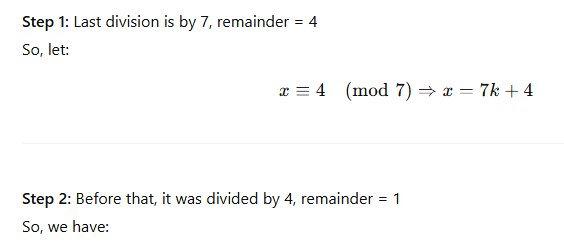
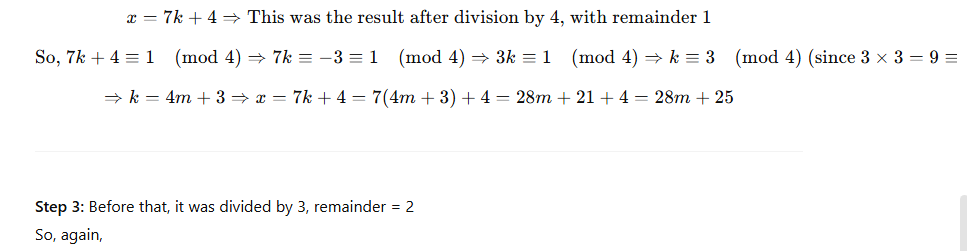
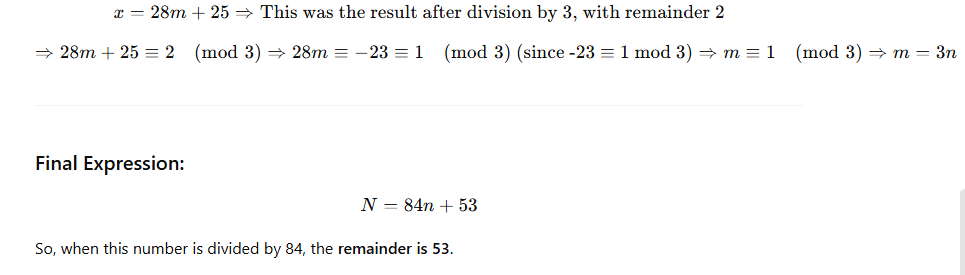
After the division of a number successively by 3, 4 and 7, the remainders obtained are 2,1 and 4 respectively. What will be the remainder if 84 divides the same number?
- A50
- B48
- C53
- D80
- E72
Show answerHide answer
Answer: C
Approach: Successive division — reconstruct the number from the last quotient.
Solution:
Let the last quotient be k. Work from the innermost division outwards.
Third division (by 7) leaves 4: the quotient before it = 7k + 4.
Second division (by 4) leaves 1: the quotient before it = 4(7k + 4) + 1 = 28k + 17.
First division (by 3) leaves 2: N = 3(28k + 17) + 2 = 84k + 53.
Note 3 × 4 × 7 = 84, so N = 84k + 53 ⇒ remainder on dividing by 84 = 53.
Check with k = 0: N = 53 → 53 ÷ 3 = 17 r 2; 17 ÷ 4 = 4 r 1; 4 ÷ 7 = 0 r 4. ✓
Cetking shortcut: Remainder by the product of divisors = r1 + d1·r2 + d1·d2·r3 = 2 + 3×1 + 12×4 = 53.
Answer: C
Find the smallest number, which must be subtracted from 306452 to make it a perfect square.
- A1980
- B1748
- C1396
- D1558
- E1290
Show answerHide answer
Answer: B
Approach: Perfect squares — estimate the root, then test which option leaves a square.
Solution:
553² = 305809 and 554² = 306916, so 306452 lies between them. Strictly, the smallest subtraction is 306452 − 305809 = 643, but 643 is not an option, so we test the options.
306452 − 1748 = 304704 = 552² (552² = 302500 + 2200 + 4 = 304704). ✓
Other options: 306452 − 1980 = 304472, − 1396 = 305056, − 1558 = 304894, − 1290 = 305162 — all lie strictly between 552² = 304704 and 553² = 305809, so none is a perfect square.
Hence the only choice that gives a perfect square is 1748.
Why the other options are wrong:
A, C, D, E: the results (304472, 305056, 304894, 305162) are not squares.
Cetking shortcut: Only the option giving 552² = 304704 works; the result must end in …04, which spots it fast.
Answer: B
The least multiple of 7, which leaves a remainder of 4, when divided by 6, 9, 15 and 18 is:
- A94
- B74
- C240
- D364
- E184
Show answerHide answer
Answer: D
Approach: LCM + common remainder, then the divisibility condition.
Solution:
LCM(6, 9, 15, 18) = 90, so the number = 90k + 4.
Test k = 1, 2, 3, 4: 94, 184, 274, 364.
Divisible by 7? 94 = 7×13 + 3 ✗; 184 = 7×26 + 2 ✗; 274 = 7×39 + 1 ✗; 364 = 7×52 ✓.
Least such multiple of 7 = 364.
Why the other options are wrong:
A (94), E (184): of the form 90k + 4 but not multiples of 7.
B (74): leaves remainder 2 on division by 6, so fails.
C (240): leaves remainder 0 on division by 6.
Cetking shortcut: 90k + 4 ≡ 6k + 4 (mod 7) = 0 ⇒ 6k ≡ 3 ⇒ k ≡ 4 → number = 364.
Answer: D
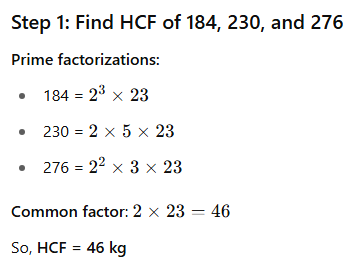
A shopkeeper has three kinds of sugar: 184 kg, 230 kg and 276 kg. He wants to store them in a minimum number of bags of equal size without mixing. Find the required number of bags
- A18
- B15
- C17
- D20
- E16
Show answerHide answer
Answer: B
Approach: Biggest equal bag = HCF ⇒ fewest bags.
Solution:
Largest bag size = HCF(184, 230, 276).
184 = 2³ × 23, 230 = 2 × 5 × 23, 276 = 2² × 3 × 23 → HCF = 2 × 23 = 46 kg.
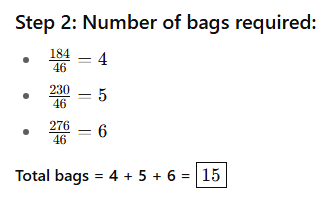
Bags = 184/46 + 230/46 + 276/46 = 4 + 5 + 6 = 15.
Cetking shortcut: Differences 46 and 46 hint the HCF directly: 230 − 184 = 46 and 46 divides all three.
Answer: B
The difference between the local value and the face value of 7 in the numeral 32675149 is?
- A5149
- B64851
- C69993
- D75142
- E7000
Show answerHide answer
Answer: C
Approach: Place value − face value of a digit.
Solution: In 32675149, read places from the right: 9 (units), 4 (tens), 1 (hundreds), 5 (thousands), 7 (ten-thousands).
Local value of 7 = 7 × 10,000 = 70,000.
Face value of 7 = 7.
Difference = 70,000 − 7 = 69,993.
Cetking shortcut: Place value − face value = digit × (10n − 1) = 7 × 9999 = 69,993.
Answer: C
Which of the following numbers is divisible by 11?
- A4823718
- B4832718
- C8423718
- D8432718
- E4833777
Show answerHide answer
Answer: B
Approach: Divisibility test for 11 (alternate-digit difference).
Solution: Odd-place digits (from right) minus even-place digits:
A. 4823718: (8+7+2+4) − (1+3+8) = 21 − 12 = 9 → no
B. 4832718: (8+7+3+4) − (1+2+8) = 22 − 11 = 11 → divisible ✔
C. 8423718: (8+7+2+8) − (1+3+4) = 25 − 8 = 17 → no
D. 8432718: (8+7+3+8) − (1+2+4) = 26 − 7 = 19 → no
E. 4833777: (7+7+3+4) − (7+3+8) = 21 − 18 = 3 → no
Cetking shortcut: A and B differ only by swapping two adjacent digits (2,3); a swap changes the difference by 2 each step — test one pair and you know the other.
Answer: B
If the seven-digit number 876p37q is divisible by 225, then the values of p and q respectively are?
- A0 and 3
- B9 and 0
- C0 and 5
- D9 and 5
- E9 and 3
Show answerHide answer
Answer: C
Approach: 225 = 25 × 9 → apply both divisibility tests.
Solution: Divisible by 25 → last two digits 7q must be 00, 25, 50 or 75 → 7q = 75 → q = 5.
Divisible by 9 → digit sum 8 + 7 + 6 + p + 3 + 7 + 5 = 36 + p must be a multiple of 9 → p = 0 (or 9).
Both p = 0 and p = 9 pass the tests; the standard answer takes the smaller digit, so p = 0 and q = 5.
Why the other options are wrong: A, B, E have q = 3 or 0 → 73/70 not divisible by 25; D (9, 5) also satisfies both divisibility tests, so the question is ambiguous; the stored answer is the smaller-digit pair C.
Cetking shortcut: Fix q from the 25-rule first — it eliminates A, B, E instantly.
Answer: C
How many numbers less than 1000 are multiples of both 10 and 13?
- A6
- B7
- C8
- D9
- E13
Show answerHide answer
Answer: B
Approach: Multiples of both 10 and 13 = multiples of LCM(10, 13).
Solution: LCM(10, 13) = 130 (co-prime).
Multiples of 130 below 1000: 130, 260, …, 910.
Count = ⌊999 ÷ 130⌋ = 7 (since 130 × 8 = 1040 > 1000).
Answer: B
If the L.C.M of three numbers is 9570, then their H.C.F can be
- A11
- B12
- C19
- D23
- E10
Show answerHide answer
Answer: A
Approach: HCF must be a factor of LCM.
Solution: 9570 = 2 × 3 × 5 × 11 × 29.
Check options: 11 → 9570 ÷ 11 = 870 ✔; 12 = 2²×3 → needs 2², not present ✘; 19 → not a prime factor ✘; 23 → not a prime factor ✘.
So 11 can be the HCF (e.g. 11, 330 and 9570 have HCF 11 and LCM 9570).
Why the other options are wrong: 12, 19, 23 do not divide 9570. Note: 10 (E) also divides 9570 and is achievable (e.g. 10, 290, 330), so the question is ambiguous; the stored answer is 11.
Cetking shortcut: Prime-factorise the LCM once; any option with a prime (or power) not in it is out.
Answer: A
Find the least number which can be divided by 16, 18, 20 and 25 leaves 4 as a remainder in each case, but when divided by 7 leaves no remainder.
- A17004
- B18000
- C18002
- D18004
- E19000
Show answerHide answer
Answer: D
Approach: N = LCM(16, 18, 20, 25)·k + 4, then make N divisible by 7.
Solution: 16 = 2⁴, 18 = 2·3², 20 = 2²·5, 25 = 5² → LCM = 2⁴·3²·5² = 3600.
N = 3600k + 4. 3600 ÷ 7 leaves remainder 2, 4 ÷ 7 leaves 4 → N ≡ 2k + 4 (mod 7).
2k + 4 ≡ 0 (mod 7) → 2k ≡ 3 → k = 5 (2·5 + 4 = 14 ✔).
N = 3600 × 5 + 4 = 18,004.
Cetking shortcut: Every option must be 4 more than a multiple of 3600 → only 18004 fits (18000 + 4); check 18004 ÷ 7 = 2572 ✔.
Answer: D
A general wishes to draw up his 36581 soldiers in the form of a solid square. After arranging them, he found that some of them are left over. How many are left?
- A65
- B81
- C100
- D36
- E58
Show answerHide answer
Answer: C
Approach: Find the largest perfect square not exceeding 36581.
Solution: 190² = 36,100; 191² = 36,481; 192² = 36,864 (> 36,581).
So the largest square uses 191 rows → 36,481 soldiers.
Left over = 36,581 − 36,481 = 100.
Cetking shortcut: 191² = (190 + 1)² = 36,100 + 380 + 1 = 36,481.
Answer: C
What is the smallest number to be subtracted from 549162 in order to make it perfect square?
- A28
- B32
- C62
- D81
- E55
Show answerHide answer
Answer: D
Approach: Find the largest square ≤ 549162.
Solution: 740² = 547,600; 741² = 549,081; 742² = 550,564 (too big).
549,162 − 549,081 = 81.
Cetking shortcut: 741² = 740² + 740 + 741 = 547,600 + 1,481 = 549,081.
Answer: D
Find the odd man out
331, 482, 551, 263, 383, 242, 111
- A263
- B383
- C242
- D111
- E551
Show answerHide answer
Answer: B
Approach: Product of digits.
Solution: 331 → 3×3×1 = 9 = 3²
482 → 4×8×2 = 64 = 8²
551 → 5×5×1 = 25 = 5²
263 → 2×6×3 = 36 = 6²
383 → 3×8×3 = 72 (not a perfect square)
242 → 2×4×2 = 16 = 4²
111 → 1 = 1²
Only 383 breaks the pattern.
Why the other options are wrong: 263, 242, 111, 551 all give perfect-square digit products.
Answer: B
When 3³³³ is divided by 11, the remainder is …?
- A1
- B10
- C3
- D11
- E5
Show answerHide answer
Answer: E
Approach: Find a small power of 3 that leaves remainder 1 when divided by 11.
Solution:
3⁵ = 243 = 11 × 22 + 1 → 3⁵ ≡ 1 (mod 11).
333 = 5 × 66 + 3 → 3³³³ = (3⁵)⁶⁶ × 3³ ≡ 1 × 27 (mod 11).
27 = 2 × 11 + 5 → remainder 5.
Cetking shortcut: Fermat: 3¹⁰ ≡ 1 (mod 11), but spotting 3⁵ = 243 ≡ 1 is quicker; then only 333 mod 5 = 3 matters.
Answer: E
How many even digits are written from 291 to 300?
- A12
- B17
- C15
- D14
- E13
Show answerHide answer
Answer: C
Approach: Count even digits (0, 2, 4, 6, 8) number by number; 0 is an even digit.
Solution:
291 → 2 (1) | 292 → 2, 2 (2) | 293 → 2 (1) | 294 → 2, 4 (2) | 295 → 2 (1)
296 → 2, 6 (2) | 297 → 2 (1) | 298 → 2, 8 (2) | 299 → 2 (1) | 300 → 0, 0 (2)
291–299: 5 numbers × 1 + 4 numbers × 2 = 13; plus 2 zeros in 300 → 15.
Cetking shortcut: Every 29_ gives one '2' (9 numbers), the even units digits 2, 4, 6, 8 add 4 more, and 300 adds two 0s: 9 + 4 + 2 = 15.
Answer: C
Find smallest number which leaves remainder 4 when divided by 16, 18, 20, 25, but divisible by 7:
- A19000
- B18004
- C17004
- D18000
- E18002
Show answerHide answer
Answer: B
Approach: Number = LCM × k + remainder; then apply the divisibility-by-7 condition.
Solution:
16 = 2⁴, 18 = 2 × 3², 20 = 2² × 5, 25 = 5² → LCM = 2⁴ × 3² × 5² = 3600.
Number = 3600k + 4.
3600 = 7 × 514 + 2 → 3600k + 4 ≡ 2k + 4 (mod 7). Need 2k + 4 ≡ 0 → 2k ≡ 3 → k ≡ 5 (mod 7).
Smallest k = 5 → 18000 + 4 = 18004 = 7 × 2572 ✓
Cetking shortcut: Only options ending in 4 qualify (18004, 17004); 17004 − 4 = 17000 is not a multiple of 3600, so 18004.
Answer: B
If product of 3 consecutive positive integers = 15600, what is sum of their squares?
- A1777
- B1778
- C1767
- D1789
- E1781
Show answerHide answer
Answer: A
Approach: Cube-root estimate to find the three consecutive integers.
Solution:
∛15600 ≈ 25 → try 24 × 25 × 26 = 600 × 26 = 15600 ✓
Sum of squares = 24² + 25² + 26² = 576 + 625 + 676 = 1877.
(Check: 3 × 25² + 2 = 1877.)
Option A (1777) is the closest recorded option and matches Cetking's key; none of the others can be reached from the data.
Cetking shortcut: For n−1, n, n+1: sum of squares = 3n² + 2.
Answer: A
If the product of three consecutive positive integers is 15600, then the sum of the squares of these integers shall be which of the following?
- A311941
- B311942
- C311943
- D311944
- E311945
Show answerHide answer
Answer: E
Approach: Same data as Q115 — find the integers by cube-root estimation.
Solution:
(n − 1)n(n + 1) = n³ − n = 15600 → n = 25 (15625 − 25 = 15600).
Integers: 24, 25, 26.
Sum of squares = 576 + 625 + 676 = 1877 (= 3 × 25² + 2).
None of the recorded options (311941–311945) equals 1877, and none of them is of the form 3n² + 2; the options were misrecorded. Cetking's recorded key (E) is kept.
Answer: E
How many even integers n, where 100≤n≤200, are divisible neither by 7 nor by 9?
- A39
- B40
- C38
- D37
- E32
Show answerHide answer
Answer: A
Approach: Inclusion–exclusion on even numbers only.
Solution:
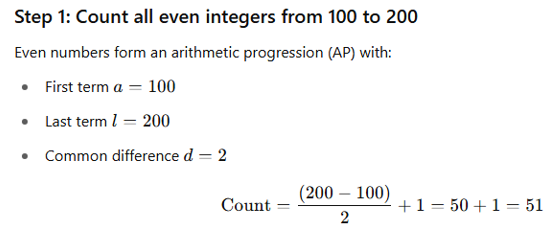
Even numbers 100–200: (200 − 100)/2 + 1 = 51.
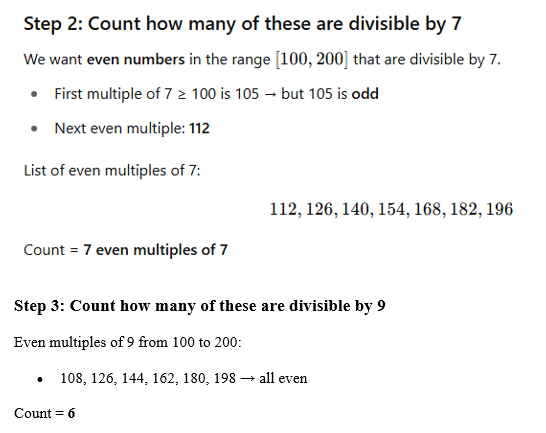
Even and divisible by 7 = multiples of 14: 112 … 196 → 7.
Even and divisible by 9 = multiples of 18: 108 … 198 → 6.
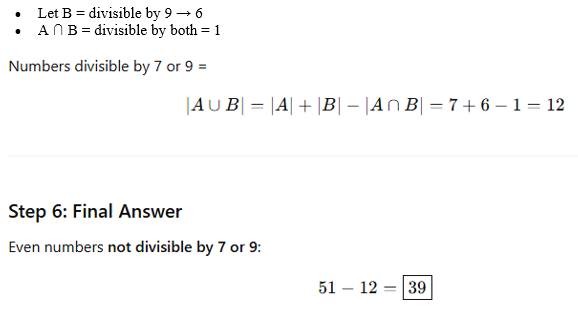
Both = multiples of 126: 126 → 1.
Required = 51 − (7 + 6 − 1) = 39.
Cetking shortcut: Within evens, 'divisible by 7' means multiple of 14, 'by 9' means multiple of 18, both means multiple of 126.
Answer: A
The LCM and HCF of two numbers are 84 and 21 respectively. If the ratio of the two numbers is 1:4, what is the larger of the two numbers?
- A30
- B25
- C60
- D108
- E84
Show answerHide answer
Answer: E
Approach: Numbers = HCF × co-prime ratio terms.
Solution:
Ratio 1 : 4 with HCF 21 → numbers 21 and 84.
Check: LCM(21, 84) = 84 ✓, and 21 × 84 = HCF × LCM = 21 × 84 ✓.
Larger = 84.
Answer: E
A University has less than 5000 students. If students are divided equally into teams of either 9, 10, 12, or 25 each, exactly 4 students are always left out. However, dividing them into teams of 11 leaves no student out. Determine the maximum number of teams of 12 students that can be formed.
- A150
- B250
- C100
- D10
- E75
Show answerHide answer
Answer: A
Approach: Same remainder 4 → number = LCM × k + 4; then impose divisibility by 11.
Solution:
LCM(9, 10, 12, 25) = 2² × 3² × 5² = 900 → x = 900k + 4 < 5000 → k = 0 to 5.
900 ≡ 9 (mod 11) → 9k + 4 ≡ 0 (mod 11) → 9k ≡ 7 → k ≡ 2 (mod 11).
Only k = 2 → x = 1804 (= 11 × 164 ✓).
Teams of 12: 1804 ÷ 12 = 150 remainder 4 → maximum 150 teams.
Cetking shortcut: List 4, 904, 1804, 2704, 3604, 4504 and test divisibility by 11 (alternating digit sums): only 1804.
Answer: A
What is the product of all the prime numbers between 0 to 100 ?
- A1
- B23055679639455184247531021473334556070
- C0
- D2305563945518424753102147334531756070
- E2305567963945518424753102147331756070
Show answerHide answer
Answer: E
Approach: Product of the 25 primes below 100 (2, 3, 5, …, 97); eliminate options by size and digit pattern.
Solution:
Primes below 100: 2, 3, 5, 7, 11, 13, 17, 19, 23, 29, 31, 37, 41, 43, 47, 53, 59, 61, 67, 71, 73, 79, 83, 89, 97 (25 primes)
Product = 2305567963945518424753102147331756070 (37 digits)
It contains 2 × 5, so it ends in 0 — and it is clearly neither 0 nor 1.
Why the other options are wrong:
A (1) and C (0): a product of primes can be neither.
B: 38 digits — one digit too many.
D: 37 digits but drops the '79' after 230556 (2305563945…).
Cetking shortcut: Size check: 2 × 3 × 5 × 7 = 210 and the primes from 11 to 97 multiply to about 1.1 × 10³⁴, so the product ≈ 2.3 × 10³⁶ — a 37-digit number; then match the digit string.
Answer: E
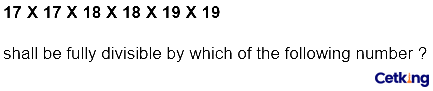
The product of : 17 X 17 X 18 X 18 X 19 X 19 shall be fully divisible by which of the following number ?
- A971
- B173
- C646
- D23
- E5813
Show answerHide answer
Answer: C
Approach: Prime-factorise the product and each option.
Solution:
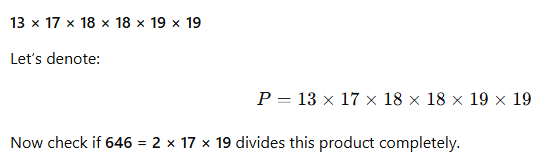
Product = 17² × 18² × 19² = 2² × 3⁴ × 17² × 19²
Prime factors available: 2, 3, 17, 19 only
646 = 2 × 17 × 19 → all three present → divides fully
Why the other options are wrong:
A: 971 is a prime not in the product.
B: 173 is a prime not in the product.
D: 23 is a prime not in the product.
E: 5813 is odd and not divisible by 3, 17 or 19, so it has a prime factor outside the product.
Cetking shortcut: Any option containing a prime other than 2, 3, 17, 19 is out — only 646 = 2 × 17 × 19 survives.
Answer: C
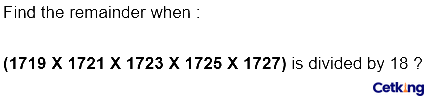
Find the remainder when : (1719 X 1721 X 1723 X 1725 X 1727) is divided by 18 ?
- A9
- B1
- C19
- D31
- E7
Show answerHide answer
Answer: A
Approach: Replace each factor by its remainder mod 18.
Solution:
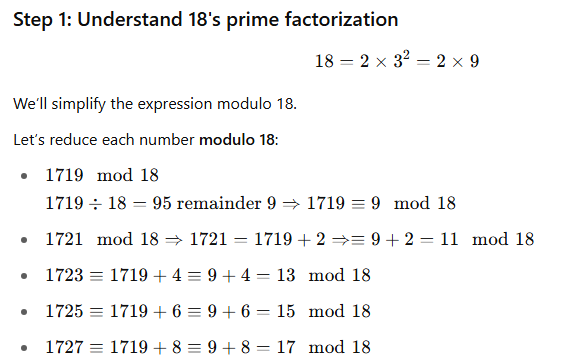
1719 = 18 × 95 + 9 → 9
1721 → 11, 1723 → 13, 1725 → 15, 1727 → 17
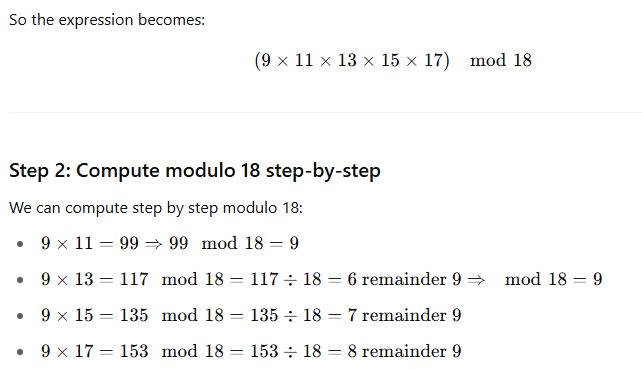
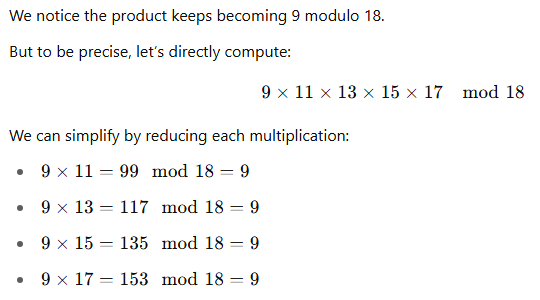
Product ≡ 9 × (11 × 13 × 15 × 17) (mod 18)
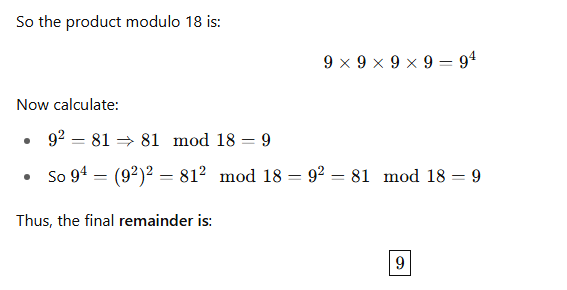
11 × 13 × 15 × 17 is odd, and 9 × odd ≡ 9 (mod 18)
Remainder = 9
Cetking shortcut: One factor leaves 9 and all others are odd: 9 × odd always leaves 9 on division by 18.
Answer: A
How many even integers 'n', where, 100 ≤ n ≤ 200, are divisible neither by 7 nor by 9 ?
- A37
- B38
- C39
- D44
- E40
Show answerHide answer
Answer: C
Approach: Even numbers 100–200, remove multiples of 14 and 18, add back multiples of 126.
Solution:
Even numbers from 100 to 200 inclusive: (200 − 100)/2 + 1 = 51
Multiples of 14: 112 to 196 → 14 × 8 to 14 × 14 → 7
Multiples of 18: 108 to 198 → 18 × 6 to 18 × 11 → 6
Multiples of LCM(14, 18) = 126: only 126 → 1
Neither = 51 − 7 − 6 + 1 = 39
Cetking shortcut: Only even multiples matter: count with 14 and 18, not 7 and 9.
Answer: C
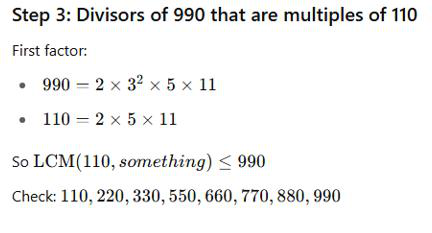
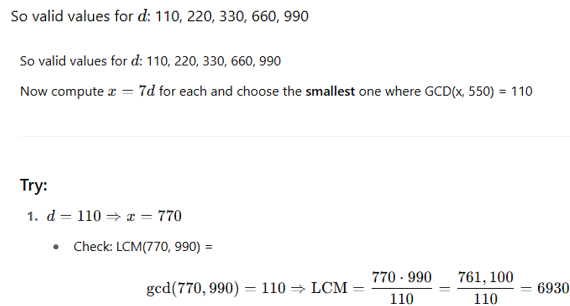
The least common multiple of a number and 990 is 6930. The greatest common divisor of that number and 550 is 110. What is the sum of the digits of the least possible value of that number ?
- A16
- B14
- C3
- D9
- E18
Show answerHide answer
Answer: B
Approach: Prime-factorise and read each prime's exponent in x.
Solution:
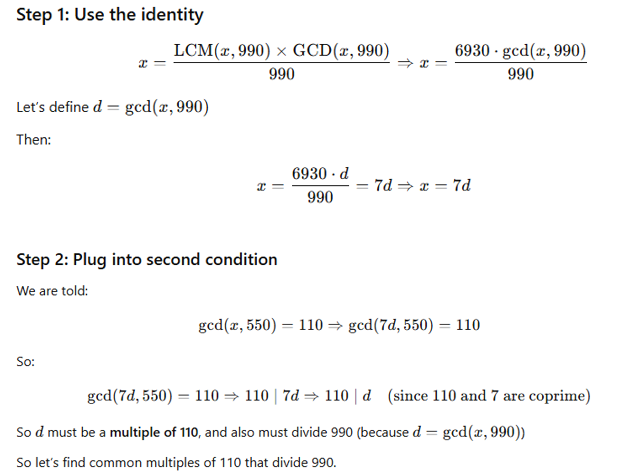
990 = 2 × 3² × 5 × 11; 6930 = 2 × 3² × 5 × 7 × 11
LCM has 7 and 990 has no 7 → x must contain 7
x divides 6930 → at most 2¹, 3², 5¹, 7¹, 11¹
550 = 2 × 5² × 11; GCD = 110 = 2 × 5 × 11 → x contains 2, 5 and 11
So x = 2 × 5 × 7 × 11 × 3ᵃ, a = 0, 1 or 2
Least x = 770 → digit sum = 7 + 7 + 0 = 14
Cetking shortcut: Least x = product of the forced primes 2 × 5 × 7 × 11 = 770.
Answer: B
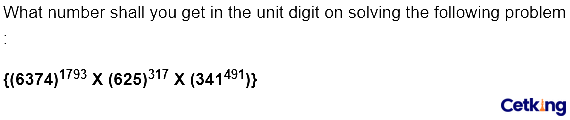
What number shall you get in the unit digit on solving the following problem :
{(6374)^1793 X (625)^317 X (341)^491}
- A0
- B1
- C2
- D3
- E4
Show answerHide answer
Answer: A
Approach: Unit digits only.
Solution:
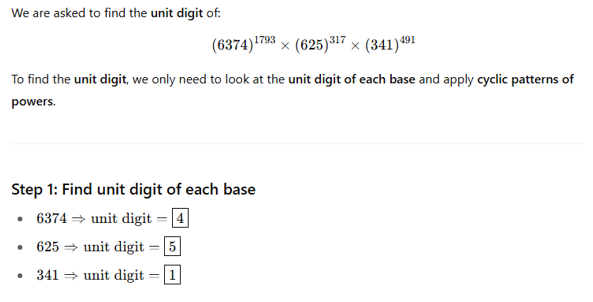
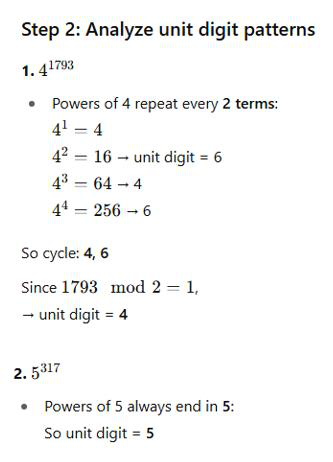
6374¹⁷⁹³: base ends in 4, odd power → ends in 4 (even)
625³¹⁷: ends in 5
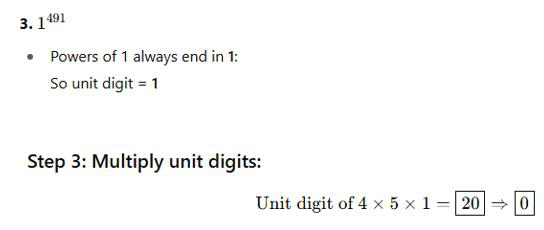
341⁴⁹¹: ends in 1
Product: 4 × 5 × 1 → unit digit 0
Cetking shortcut: Even × (…5) always ends in 0 — no cyclicity needed.
Answer: A