Five boys took part in a race. Raj finished before Mohit but behind Gaurav. Ashish finished before Sanchet but behind Mohit. Who won the race?
- ARaj
- BGaurav
- CMohit
- DAshish
- ESanchet
Show answerHide answer
Answer: B ✓ official key
Approach: Ranking by chaining 'before/behind' clues.
Solution:
Raj finished before Mohit but behind Gaurav: Gaurav > Raj > Mohit.
Ashish finished before Sanchet but behind Mohit: Mohit > Ashish > Sanchet.
Join at Mohit: Gaurav > Raj > Mohit > Ashish > Sanchet.
Gaurav finished first.
Why the other options are wrong:
A: Raj is behind Gaurav.
C, D, E: Mohit, Ashish, Sanchet are all behind Raj.
Cetking shortcut: The winner is the one never said to be 'behind' anyone — Gaurav.
Answer: B
In a class of 60 students where girls are twice that of boys, Ashwini ranked 27th from the top. If there are 9 boys ahead of Ashwini, how many girls are after her rank ?
- A23
- B21
- C22
- D24
- E27
Show answerHide answer
Answer: C ✓ official key
Approach: Rank arithmetic with a boys–girls split.
Solution:
Girls = 2 × Boys and total 60 → Boys = 20, Girls = 40.
Ashwini is 27th from top → 26 students ahead of her.
Boys ahead = 9 → Girls ahead = 26 − 9 = 17.
Ashwini is a girl, so girls up to and including her = 17 + 1 = 18.
Girls after her = 40 − 18 = 22.
Why the other options are wrong:
A: 23 forgets to exclude Ashwini herself.
B, D: arithmetic slips around 22.
E: 27 is her rank, not a count of girls.
Cetking shortcut: Girls after = Total girls − girls ahead − 1 (herself) = 40 − 17 − 1.
Answer: C
There are 64 Music books arranged in a row at central library Pune. Western Music is 25th from the left side of the row and Classical Music is 30th from the right side of the row. What is the total number of books between Western Music and Classical Music ?
- A6
- B7
- C8
- D9
- E5
Show answerHide answer
Answer: D ✓ official key
Approach: Row counting — positions from both ends.
Solution:
Total books = 64.
Western Music is 25th from left; Classical Music is 30th from right.
25 + 30 = 55 < 64, so the two books do not overlap and the gap lies between them.
Books between = 64 − 55 = 9.
Cetking shortcut: Between = Total − (left rank + right rank) when the sum is less than the total.
Answer: D
Aman is 16th from the left end in a row of boys and Vivek is 18th from the right end. Gagan is 11th from Aman towards the right and 3rd from Vivek towards the right end. How many boys are there in the row ?
- A40
- B42
- C48
- D41
- E43
Show answerHide answer
Official CET key: D · Cetking's answer: B — see why below
Approach: Row ranking — get one person's rank from both ends, then total = left + right − 1.
Solution:
Aman is 16th from left; Gagan is 11th to the right of Aman → Gagan is 16 + 11 = 27th from left.
Vivek is 18th from right; Gagan is 3rd from Vivek towards the right end → Gagan is 18 − 3 = 15th from right.
Total boys = 27 + 15 − 1 = 41.
Why the other options are wrong:
A, B: off by one — forgetting or double-subtracting Gagan.
C, E: adding ranks of different people.
Cetking shortcut: Convert everything to the common person (Gagan), then Total = L + R − 1.
Answer: D
Arrange the words given below in a meaningful sequence.
1. Elephant
2. Cat
3. Mosquito
4. Tiger
5. Whale
- A3,2,5,1,4
- B2,5,1,4,3
- C3,2,4,1,5
- D5,3,1,2,4
- E4,5,2,1,3
Show answerHide answer
Answer: C ✓ official key
Approach: Logical sequence — arrange by increasing size.
Solution:
Sizes: Mosquito (3) < Cat (2) < Tiger (4) < Elephant (1) < Whale (5).
Sequence: 3, 2, 4, 1, 5.
Why the other options are wrong:
A: puts Whale before Elephant and Tiger last.
B, D, E: start from a larger animal and break the size order.
Cetking shortcut: Smallest (mosquito) first and largest (whale) last — only C starts with 3 and ends with 5.
Answer: C
Arrange the given words in a logical and meaningful order.
1. Atomic Age
2. Metallic Age
3. Stone Age
4. Alloy Age
- A4,3,2,1
- B2,3,1,4
- C3,2,4,1
- D4,3,2,1
- E3,2,1,4
Show answerHide answer
Answer: C ✓ official key
Approach: Logical sequence — order of human technological ages.
Solution:
Stone Age came first (3).
Then the Metallic Age — copper/bronze/iron (2).
Then the Alloy Age — mixed metals like steel (4).
Finally the modern Atomic Age (1).
Sequence: 3, 2, 4, 1.
Why the other options are wrong:
A, D: the same sequence (4,3,2,1); it starts with Alloy Age.
B: starts with Metallic Age, before Stone Age.
E: puts Atomic Age before Alloy Age.
Cetking shortcut: Stone Age must come first and Atomic Age last — only C does both.
Answer: C
Directions: Select the correct option that indicates the arrangement of the following words in a logical and meaningful order.
1. Scrutiny
2. Application
3. Interview
4. Job Offer
5. Joining
- A2,4,1,5,3
- B2,1,3,4,5
- C1,3,2,4,5
- D2,1,4,3,5
- E2,3,1,4,5
Show answerHide answer
Answer: B ✓ official key
Approach: Logical sequence of a hiring process.
Solution:
A candidate first sends an Application (2).
Applications go through Scrutiny (1).
Shortlisted candidates face the Interview (3).
Selected candidates get the Job Offer (4).
Finally comes Joining (5).
Order: 2, 1, 3, 4, 5.
Why the other options are wrong:
A: Job Offer before Scrutiny and Interview.
C: Scrutiny before any Application exists.
D: Job Offer before Interview.
E: Interview before Scrutiny.
Cetking shortcut: Fix the ends first: starts with Application (2), ends with Joining (5) → B, D and E remain; Job Offer must follow Interview (kills D) and Scrutiny must precede Interview (kills E) → B.
Answer: B
Arrange the following words in a logical sequence.
1. College, 2. Child, 3. Salary, 4. School, 5. Employment
- A1, 2, 4, 3, 5
- B2, 4, 1, 5, 3
- C2, 4, 1, 3, 5
- D5, 3, 2, 1, 4
- E5, 4, 3, 2, 1
Show answerHide answer
Answer: B ✓ official key
Approach: Logical sequence of life stages.
Solution:
Child (2) → School (4) → College (1) → Employment (5) → Salary (3).
Order: 2, 4, 1, 5, 3.
Why the other options are wrong:
A: starts with College before Child.
C: Salary before Employment.
D, E: start from Employment/Salary — reverse logic.
Cetking shortcut: Salary comes only after Employment ⇒ sequence must end 5, 3: only B.
Answer: B
Arrange the following words in a logical sequence.
1. Patient, 2. Diagnosis, 3. Bill, 4. Doctor, 5. Treatment
- A1, 4, 2, 3, 5
- B1, 4, 3, 2, 3
- C1, 4, 2, 5, 3
- D4, 1, 2, 3, 5
- E5, 1, 2, 3, 4
Show answerHide answer
Answer: C ✓ official key
Approach: Logical sequence of a hospital visit.
Solution:
Patient (1) visits the Doctor (4), who makes a Diagnosis (2), then gives Treatment (5), and finally the Bill (3).
Order: 1, 4, 2, 5, 3.
Why the other options are wrong:
A: Bill before Treatment.
B: repeats 3 and puts Bill before Diagnosis.
D: Doctor before Patient and Bill before Treatment.
E: starts with Treatment.
Cetking shortcut: Bill comes last ⇒ the sequence must end in 3: B and C remain; B repeats 3 and puts Bill before Diagnosis ⇒ only C.
Answer: C
DIRECTION for the questions: Solve the following question and mark the best possible option.
Ravi is 7 ranks ahead of Sumit in a class of 39. If Sumit's rank is seventeenth from the last, what is Ravi's rank from the start?
- A14th
- B15th
- C16th
- D17th
- E30th
Show answerHide answer
Answer: C ✓ official key
Approach: Convert Sumit's rank from the end into a rank from the start, then move 7 places ahead.
Solution:
Sumit from start = 39 − 17 + 1 = 23rd.
Ravi is 7 ranks ahead → 23 − 7 = 16th.
Why the other options are wrong:
A 14th / B 15th: arithmetic slips (forgetting the +1 or subtracting 8–9).
D 17th: uses Sumit's rank from the end directly.
E 30th: adds 7 instead of subtracting.
Cetking shortcut: Ravi from the end = 17 + 7 = 24th, so from start = 39 − 24 + 1 = 16.
Answer: C
Arrange the words given below in a meaningful sequence.
1. Word 2. Paragraph 3. Sentence
4. Letters 5. Phrase
- A4, 1, 5, 2, 3
- B4, 2, 5, 1, 3
- C1, 4, 5, 3, 2
- D4, 1, 5, 3, 2
- E4, 1, 3, 5, 2
Show answerHide answer
Official CET key: D · Cetking's answer: A — see why below
Approach: Logical sequence — order from the smallest unit of language to the largest.
Solution:
Letters (4) form a Word (1); words form a Phrase (5); phrases form a Sentence (3); sentences form a Paragraph (2).
Sequence = 4, 1, 5, 3, 2
Why the other options are wrong:
A) puts Paragraph before Sentence.
B) puts Paragraph second.
C) starts with Word before Letters.
E) puts Sentence before Phrase.
Answer: D
Arrange the words given below in a meaningful sequence :
| 1. Family | 2. Community | 3. Member |
| 4. Locality | 5. Country | |
- A3, 1, 4, 2, 5
- B3, 1, 2, 5, 4
- C3, 1, 4, 5, 2
- D3, 4, 2, 1, 5
- E3, 1, 2, 4, 5
Show answerHide answer
Official CET key: A · Cetking's answer: E — see why below
Approach: Logical sequence — order from the smallest social unit to the largest.
Solution:
Member (3) → Family (1) → Locality (4) → Community (2) → Country (5).
A member belongs to a family, families live in a locality (neighbourhood), localities together form a community, and communities make up the country.
Sequence = 3, 1, 4, 2, 5
Why the other options are wrong:
B) puts Country before Locality.
C) puts Country before Community.
D) puts Locality before Family.
E) places Community before Locality, but a locality (neighbourhood) is the smaller unit.
Answer: A
Arrange the words given below in a meaningful sequence :
| 1. Poverty | 2. Population | 3. Death |
| 4. Unemployment | 5. Disease | |
- A3, 4, 2, 5, 1
- B1, 2, 3, 4, 5
- C2, 3, 4, 5, 1
- D2, 4, 1, 5, 3
- E1, 2, 4, 3, 5
Show answerHide answer
Answer: D ✓ official key
Approach: Logical sequence — follow the cause-to-effect chain.
Solution:
Rising Population (2) → Unemployment (4) → Poverty (1) → Disease (5) → Death (3).
Sequence = 2, 4, 1, 5, 3
Why the other options are wrong:
A) starts with Death.
B) starts with Poverty before its cause.
C) puts Death second.
E) puts Death before Disease.
Answer: D
Arrange the words given below in a meaningful sequence :
| 1. Cut | 2. Put on | 3. Mark |
| 4. Measure | 5. Tailor | |
- A4, 3, 1, 5, 2
- B4, 3, 5, 1, 2
- C3, 1, 5, 4, 2
- D1, 3, 2, 4, 5
- E2, 4, 3, 1, 5
Show answerHide answer
Answer: A ✓ official key
Approach: Logical sequence — follow the order of the process.
Solution:
Measure (4) the cloth → Mark (3) it → Cut (1) → Tailor (5) / stitch it → Put on (2) the garment.
Sequence = 4, 3, 1, 5, 2
Why the other options are wrong:
B) tailors before cutting.
C) marks before measuring.
D) cuts first.
E) puts on the garment first.
Answer: A
Arrange the words given below in a meaningful sequence :
| 1. Probation | 2. Interview | 3. Selection |
| 4. Appointment | 5. Advertisement | 6. Application |
- A5, 6, 1, 4, 2, 3
- B5, 6, 2, 3, 4, 1
- C5, 6, 3, 2, 4, 1
- D6, 5, 4, 2, 3, 1
- E5, 6, 4, 2, 3, 1
Show answerHide answer
Answer: B ✓ official key
Approach: Logical sequence — follow the order of the process.
Solution:
Advertisement (5) → Application (6) → Interview (2) → Selection (3) → Appointment (4) → Probation (1).
Sequence = 5, 6, 2, 3, 4, 1
Why the other options are wrong:
A) puts Probation before Interview.
C) selects before the interview.
D) applies before the advertisement.
E) appoints before the interview.
Answer: B
In a row of persons, Sapkal's position from the left is 27th and Sapkal's position from the right side of the row is 34th. Find the total number of students in the row?
- A63
- B61
- C60
- D62
- E38
Show answerHide answer
Answer: C ✓ official key
Approach: Total = position from left + position from right − 1.
Solution:
Total = 27 + 34 − 1 = 60.
(Sapkal is counted in both positions, so subtract 1.)
Answer: C
There are 64 books arranged in a row in a school library. Ancient History is 25th from the left side of the row and Mongolian History is 30th from the right side of the row. What is the total number of books between Ancient and Mongolian History?
- A25
- B8
- C16
- D9
- E10
Show answerHide answer
Official CET key: D · Cetking's answer: E — see why below
Approach: Convert both positions to the same end, then count the gap.
Solution:
Mongolian History from left = 64 − 30 + 1 = 35th.
Ancient History is 25th from left.
Books between = 35 − 25 − 1 = 9.
Why the other options are wrong:
E (10) forgets to subtract 1; C (16) and A (25) mix up the two ends.
Answer: D
Group of Lioness and their young cubs are in a row. The position of the eldest lioness from the left side of the row is 9th & position of the youngest lioness from the right side of the row is 8th. If a newborn cub is sitting just in the middle of eldest & youngest and position of cub from the left side of the row is 15th. Find the total number of lioness and cubs in the row.
- A29
- B26
- C17
- D28
- E27
Show answerHide answer
Answer: D ✓ official key
Approach: Use the middle position to locate the youngest lioness, then apply the total formula.
Solution:
Eldest = 9th from left; cub (exactly in the middle) = 15th from left.
Gap from eldest to cub = 15 − 9 = 6 places, so the youngest is 6 places beyond the cub: 15 + 6 = 21st from left.
Youngest is 8th from right.
Total = 21 + 8 − 1 = 28.
Answer: D
In a queue, the position of a person is 7th from the left side and 6th from the right hand side. How many persons must be removed to make it a group of exactly 6 persons ?
- A5
- B4
- C7
- D3
- E6
Show answerHide answer
Official CET key: E · Cetking's answer: A — see why below
Approach: Find the total, then subtract the target size.
Solution:
Total = 7 + 6 − 1 = 12 persons.
To leave exactly 6: remove 12 − 6 = 6.
Why the other options are wrong:
A (5) comes from taking the total as 11 or 13 incorrectly.
Answer: E
Shashi is shorter than Kunal but taller than Rakesh. Madhur is the tallest. Aashish is a little shorter than Kunal and little taller than Shashi. If they stand in the order of increasing heights, who will be the second ?
- AShashi
- BAashish
- CMadhur
- DRakesh
- EKunal
Show answerHide answer
Answer: A ✓ official key
Approach: Build the height chain from the clues.
Solution:
Rakesh < Shashi < Kunal.
Aashish is between Shashi and Kunal: Shashi < Aashish < Kunal.
Madhur is the tallest.
Increasing order: Rakesh, Shashi, Aashish, Kunal, Madhur.
Second = Shashi.
Why the other options are wrong:
D (Rakesh) is first; B (Aashish) is third; E (Kunal) fourth; C (Madhur) fifth.
Answer: A
In a row of boys, Amar is 8th from the left and 15th from the right. How many boys are there in the row?
- A23
- B20
- C21
- D22
- E18
Show answerHide answer
Answer: D ✓ official key
Approach: Rank formula.
Solution:
Total = 8 + 15 − 1 = 22 (Amar is counted twice).
Answer: D
Five students P, Q, R, S, T are ranked based on marks.
P is better than Q but worse than R.
S is better than T but worse than Q.
- AP
- BQ
- CR
- DS
- ET
Show answerHide answer
Answer: A ✓ official key
Approach: Merge the inequality chains.
Solution:
P better than Q, worse than R → R > P > Q.
S better than T, worse than Q → Q > S > T.
Combined: R > P > Q > S > T → 2nd = P.
Answer: A
Among A, B, C, D, E:
- A is taller than B but shorter than D
- C is taller than E but shorter than A
- AD
- BA
- CE
- DC
- EB
Show answerHide answer
Answer: A ✓ official key
Approach: Merge the height chains.
Solution:
D > A > B (A taller than B, shorter than D).
A > C > E (C taller than E, shorter than A).
A is taller than B, C, E and only D is taller than A → tallest = D.
Answer: A
Five students P, Q, R, S, T are ranked by marks.
Conditions:
- P scored more than Q but less than R
- S scored more than T but less than Q
Question: Who is ranked third?
- AR
- BP
- CS
- DQ
- ET
Show answerHide answer
Answer: D ✓ official key
Approach: Merge the inequality chains.
Solution:
P > Q and P < R → R > P > Q.
S > T and S < Q → Q > S > T.
Combined: R > P > Q > S > T → 3rd = Q.
Answer: D
Arrange the given words in a meaningful and logical sequence. Then, choose the correct sequence from the options.
1.Novice 2.Advanced Beginner 3.Intermediate 4.Expert 5.Master
- A2-1-3-4-5
- B1-2-3-4-5
- C1-3-2-4-5
- D2-1-4-3-5
- E1-2-4-3-5
Show answerHide answer
Answer: B ✓ official key
Approach: Order stages of skill development from lowest to highest.
Solution: Skill grows in stages: Novice (1) → Advanced Beginner (2) → Intermediate (3) → Expert (4) → Master (5).
Sequence: 1-2-3-4-5.
Why the other options are wrong: A and D put Advanced Beginner before Novice; C and E swap middle stages (Intermediate/Expert).
Cetking shortcut: This is the Dreyfus skill model – the order is already as listed.
Answer: B
Arrange the given words in a meaningful and logical sequence. Then, choose the correct sequence from the options.
1.Thought 2.Concept 3.Theory 4.Hypothesis 5.Law
- A1-2-4-3-5
- B2-1-4-3-5
- C1-2-3-4-5
- D1-4-2-3-5
- E2-4-1-3-5
Show answerHide answer
Answer: A ✓ official key
Approach: Order the stages of building scientific knowledge.
Solution: A Thought (1) is refined into a Concept (2); a Concept leads to a testable Hypothesis (4); a tested hypothesis becomes a Theory (3); a theory proven universally becomes a Law (5).
Sequence: 1-2-4-3-5.
Why the other options are wrong: B starts with Concept before Thought; C puts Theory before Hypothesis; D and E put Hypothesis before Concept or Concept after Hypothesis.
Cetking shortcut: Remember: Hypothesis → Theory → Law is the fixed scientific tail; only check the first two.
Answer: A
Which one would be a meaningful order of the following?
1. Consultation
2. Illness
3. Doctor
4. Treatment
5. Recovery
- A4 3 1 2 5
- B2 3 4 1 5
- C5 1 4 3 2
- D2 3 1 4 5
- E3 1 4 2 5
Show answerHide answer
Answer: D ✓ official key
Approach: Order the events of a patient's journey.
Solution: First comes Illness (2), then the patient goes to the Doctor (3), gets a Consultation (1), receives Treatment (4) and finally Recovery (5).
Sequence: 2 3 1 4 5.
Why the other options are wrong: A and C start with Treatment/Recovery; B puts Treatment before Consultation; E starts with Doctor before Illness.
Cetking shortcut: Start = cause (Illness), End = result (Recovery): only B and D survive; Consultation must precede Treatment → D.
Answer: D
Arrange the given words in a meaningful and logical sequence. Then, choose the correct sequence from the options.
1.Inflation 2.Demand 3.Reduced Purchasing Power 4.Price Rise 5.Consumption
- A2-5-3-4-1
- B2-4-1-3-5
- C2-5-4-1-3
- D5-2-4-1-3
- E5-3-2-4-1
Show answerHide answer
Official CET key: C · Cetking's answer: B — see why below
Approach: Order the cause-and-effect chain of inflation.
Solution: Demand (2) leads to Consumption (5); rising consumption pushes Price Rise (4); sustained price rise is Inflation (1); inflation causes Reduced Purchasing Power (3).
Sequence: 2-5-4-1-3.
Why the other options are wrong: A ends with Inflation and puts Reduced Purchasing Power before Price Rise; B moves Consumption to the end, though consumption is what drives prices; D and E start with Consumption before Demand.
Cetking shortcut: End of chain = final effect (Reduced Purchasing Power) → only C and D end in 3; demand must come before consumption → C.
Answer: C
Arrange the given words in a meaningful and logical sequence. Then, choose the correct sequence from the options.
1.Assumption 2.Validation 3.Observation 4.Inference 5.Conclusion
- A1-3-4-5-2
- B3-1-2-4-5
- C1-4-3-5-2
- D3-4-1-5-2
- E1-3-2-4-5
Show answerHide answer
Answer: B ✓ official key
Approach: Order the steps of logical/scientific reasoning.
Solution: We begin with Observation (3), form an Assumption (1), test it through Validation (2), draw an Inference (4) and finally reach a Conclusion (5).
Sequence: 3-1-2-4-5.
Why the other options are wrong: A, C and E start with Assumption without observing first; D puts Validation at the very end after the Conclusion.
Cetking shortcut: Observation must be first and Conclusion last → only B fits.
Answer: B
Find the logical sequence of words
1. Trillion
2. Thousand
3. Billion
4. Hundred
5. Million
- A1,2, 4, 3,5
- B1,5,3,2,4
- C4,2,3,5,1
- D4,2,5,3,1
- E1,2,5,3,4
Show answerHide answer
Answer: D ✓ official key
Approach: Arrange the number names in increasing value.
Solution:
Hundred (10²) < Thousand (10³) < Million (10⁶) < Billion (10⁹) < Trillion (10¹²)
= 4, 2, 5, 3, 1.
Why the other options are wrong: A, B, E start from Trillion and break the order; C places Billion before Million.
Answer: D
In a school, final selection list of the class 12th students who opted for extracurricular activities was posted in the corridor. In the list Vinay was ranked 18th from the top and 36th from the bottom among those who got selected. 12 students did not opt for any extracurricular activity and 7 were disqualified from it. How many students were there in the class ?
- A61
- B72
- C57
- D65
- E82
Show answerHide answer
Answer: B ✓ official key
Approach: Total in a list = rank from top + rank from bottom – 1.
Solution:
Selected students = 18 + 36 – 1 = 53.
Add those not in the list: 12 (did not opt) + 7 (disqualified) = 19.
Class strength = 53 + 19 = 72.
Why the other options are wrong: 61 / 57 / 65 omit one group or miscount Vinay; 82 adds wrongly.
Answer: B
In a row of 68 people, Smita is 22nd from the left and Riya is 17th from the right. Counting from the left end, what will be the position of Priya who is sitting exactly in the middle of Smita and Riya ?
- A27
- B41
- C37
- D34
- E39
Show answerHide answer
Answer: C ✓ official key
Approach: Convert both positions to the same end, then take the midpoint.
Solution:
Riya from left = 68 – 17 + 1 = 52.
Smita = 22nd from left.
Middle position = (22 + 52) ÷ 2 = 37.
Why the other options are wrong: 34 is the middle of the whole row; others come from not converting Riya's position.
Answer: C
Which one of the given responses would be a meaningful order of the following ?
1. Epilogue
2. Chapter
3. Index
4. Prologue
5. Cover
- A3, 4, 2, 1, 5
- B5, 3, 4, 2, 1
- C1, 5, 2, 4, 3
- D5, 3, 4, 1, 2
- E5, 2, 4, 3, 1
Show answerHide answer
Answer: B ✓ official key
Approach: Order the parts as a reader meets them in a book.
Solution:
Cover comes first; the epilogue is the last part of the text.
Prologue comes before the chapters.
Only option B keeps Cover first, Prologue → Chapter, and Epilogue last: 5, 3, 4, 2, 1 (Cover, Index, Prologue, Chapter, Epilogue) — here 'Index' is read as the contents list at the front.
Why the other options are wrong:
A, C: do not start with the cover.
D: places Epilogue before Chapter.
E: places Chapter before Prologue.
Cetking shortcut: Fix the sure ends (Cover first, Epilogue last) and the sure pair (Prologue before Chapter) — only one option survives.
Answer: B
The age of Raju is twice the age of Sharad and half the age of Somnath, Sharad is elder than Moreshwar. Who is the eldest ?
- ASharad
- BMoreshwar
- CSomnath
- DRaju
- ERaju and Sharad are of same age are both oldest
Show answerHide answer
Answer: C ✓ official key
Approach: Turn the statements into an age chain.
Solution:
Raju = 2 × Sharad → Raju > Sharad.
Raju = ½ × Somnath → Somnath = 2 × Raju → Somnath > Raju.
Sharad > Moreshwar.
Chain: Somnath > Raju > Sharad > Moreshwar → Somnath is the eldest.
Answer: C
DEN, RAT, EAR, OWL, CUB
If all the words in the series given above are arranged as per the ordinary English Dictionary are ordered from left to right, then find that which of the following is the third letter of the second word from the right end ?
- AN
- BR
- CC
- DL
- EW
Show answerHide answer
Answer: D ✓ official key
Approach: Dictionary order, then count from the right.
Solution:
Sorted: CUB, DEN, EAR, OWL, RAT.
Second from right = OWL.
Third letter of OWL = L.
Answer: D
Each of P, Q, T, A and B have different heights. T is taller than P and B but shorter than A and Q. P is not the shortest, determine who is the tallest in the group ?
- AA
- BQ
- CEither P or B
- DP
- EEither A or Q
Show answerHide answer
Answer: E ✓ official key
Approach: Ranking by comparison — split people into 'taller than T' and 'shorter than T'.
Solution:
T is taller than P and B ⇒ P, B are below T.
T is shorter than A and Q ⇒ A, Q are above T.
Order: {A, Q} > T > {P, B}. 'P is not the shortest' ⇒ B is shortest, but nothing compares A with Q.
So the tallest is either A or Q.
Why the other options are wrong:
A alone / Q alone: A vs Q is never compared. Either P or B / P: both are shorter than T.
Answer: E
Study the following information carefully and answer the question that follows :
Each of the six friend - A, B, C, D, E and F - scored different marks in an examination. C scored more than only A and E. D scored less than only B. E did not score the least. The one who scored the third highest marks scored 81 marks. E scored 62 marks.
The person who scored the maximum scored 13 marks more than F's marks. Which of the following can be D's score ?
- A81
- B67
- C89
- D78
- E75
Show answerHide answer
Answer: C ✓ official key
Approach: Ranking puzzle — fix positions from 'more than only' / 'less than only' clues, then use the given marks.
Solution:
C scored more than only A and E ⇒ C is 4th (two people below him).
D scored less than only B ⇒ B is 1st, D is 2nd.
E did not score the least ⇒ E is 5th, A is 6th. Remaining F is 3rd.
3rd highest = F = 81. E = 62.
Maximum (B) = F + 13 = 94.
D lies between B and F: 81 < D < 94 ⇒ only 89 fits.
Why the other options are wrong:
81: that is F's score (all scores are different). 67, 78, 75: below F's 81, but D is 2nd.
Cetking shortcut: 'More than only X and Y' = exactly two below; 'less than only B' = exactly one above — place these first.
Answer: C
In a single row of 54 persons, Manoj is seated 35th from the left end and Suraj is seated 22nd from the right end. How many persons are seated between Manoj and Suraj?
- A4
- B6
- C2
- D5
- E1
Show answerHide answer
Answer: E ✓ official key
Approach: Position conversion in a row: left position = Total − right position + 1.
Solution:
Suraj is 22nd from the right → from the left = 54 − 22 + 1 = 33rd.
Manoj is 35th from the left.
Persons between 33rd and 35th = 35 − 33 − 1 = 1 (the 34th person).
Cetking shortcut: Between = |p₁ − p₂| − 1 once both positions are from the same end.
Answer: E
There are 25 persons in a row.
Rahul is 10th from the left.
Five persons sitting to the left of Rahul leave the row.
What is Rahul’s new position from the right end?
- A17th
- B9th
- C16th
- D11th
- E7th
Show answerHide answer
Answer: C ✓ official key
Approach: People leaving on one side do not change the rank counted from the other side.
Solution:
Rahul is 10th from the left in 25 → from the right = 25 − 10 + 1 = 16th.
5 persons to his left leave – nobody to his right moves.
So he is still 16th from the right (row now has 20; from the left he is 5th: 20 − 5 + 1 = 16 ✓).
Cetking shortcut: Changes on the left never affect the count from the right.
Answer: C
Three persons Amey, Bhavan and Charan are standing in a queue. There are 5 people between Amey and Bhavan and 8 people between Bhavan and Charan. If there are three people ahead of Charan and 21 people behind Amey, then what could be the minimum number of persons in the queue?
- A38
- B35
- C23
- D32
- E28
Show answerHide answer
Answer: E ✓ official key
Approach: Queue positions from the front; minimise by packing everyone close to the front.
Solution:
3 people ahead of Charan → Charan is 4th.
8 people between Bhavan and Charan → Bhavan is 4 + 9 = 13th (cannot be in front: 4 − 9 < 1).
5 people between Amey and Bhavan → Amey is 13 − 6 = 7th or 13 + 6 = 19th; take 7th for the minimum.
21 people behind Amey → total = 7 + 21 = 28.
Cetking shortcut: Total = Amey's position + 21, so just place Amey as far forward as the gaps allow.
Answer: E
Lata is elder than Meera. Lalita is elder than Meera but younger than Lata. Lila is younger than both Meera and Hema but Hema is younger than Meera. Who is the youngest?
- ALata
- BLalita
- CHema
- DLila
- EMeera
Show answerHide answer
Answer: D ✓ official key
Approach: Build an age order from the comparisons.
Solution:
Lata > Lalita > Meera (Lalita elder than Meera, younger than Lata).
Hema is younger than Meera: Meera > Hema.
Lila is younger than both Meera and Hema: Hema > Lila.
Order: Lata > Lalita > Meera > Hema > Lila → Lila is youngest.
Cetking shortcut: Lila is younger than Hema, who is already the lowest of the others – no need to rank everyone.
Answer: D
Priya scored more than Raju, Yamini scored as much as Diya. Laxmi scored less than Manisha. Raju scored more than Yamini. Manisha scored less than Diya. Who scored the lowest?
- ALaxmi
- BRaju
- CManisha
- DYamini
- EDiya
Show answerHide answer
Answer: A ✓ official key
Approach: Chain the score comparisons.
Solution:
Priya > Raju; Raju > Yamini; Yamini = Diya; Diya > Manisha; Manisha > Laxmi.
Order: Priya > Raju > Yamini = Diya > Manisha > Laxmi.
Lowest = Laxmi.
Answer: A
Arrange the given words in logical and meaningful sequence:
1. Hecto
2. Centi
3. Deca
4. Kilo
5. Deci
- A1,3,4,5,2
- B1,5,3,4,2
- C2,5,3,1,4
- D5,2,1,4,3
- E1,4,5,3,2
Show answerHide answer
Answer: C ✓ official key
Approach: Arrange metric prefixes by size.
Solution:
Centi = 1/100, Deci = 1/10, Deca = 10, Hecto = 100, Kilo = 1000.
Increasing order: Centi (2) → Deci (5) → Deca (3) → Hecto (1) → Kilo (4) = 2, 5, 3, 1, 4.
Why the other options are wrong:
A, B, E start with Hecto and are not monotonic.
D puts Deci before Centi and Kilo before Deca.
Cetking shortcut: Memorise "King Henry Died By Drinking Chocolate Milk": kilo, hecto, deca, base, deci, centi, milli.
Answer: C
If the following five words are arranged in alphabetical order, then which word will come in the middle ?
(a) Electric
(b) Elector
(c) Electrode
(d) Elect
(e) Electron
- Aa
- Bb
- Cc
- Dd
- Ee
Show answerHide answer
Answer: A ✓ official key
Approach: Dictionary order: compare letter by letter after the common prefix "Elect".
Solution:
Elect is shortest → first.
After "Elect": Elector has "o", Electric/Electrode/Electron have "r" → Elector second.
Among Electr-: Electric (i) < Electrode (o-d) < Electron (o-n).
Order: Elect, Elector, Electric, Electrode, Electron.
Middle (3rd) word = Electric = (a).
Why the other options are wrong:
B (Elector) is 2nd, C (Electrode) 4th, D (Elect) 1st, E (Electron) 5th.
Cetking shortcut: Strip the common prefix and compare only the leftovers: "", "or", "ric", "rode", "ron".
Answer: A
Arrange the following in a logical order:
1. Millennium 2. Diamond Jubilee 3. Silver Jubilee 4. Centenary 5. Golden Jubilee
- A2, 3, 5, 4, 1
- B3, 2, 4, 1, 5
- C3, 5, 2, 4, 1
- D3, 1, 5, 2, 4
- E2, 4, 1, 3, 5
Show answerHide answer
Answer: C ✓ official key
Approach: Order anniversaries by number of years.
Solution:
Silver Jubilee = 25, Golden Jubilee = 50, Diamond Jubilee = 60, Centenary = 100, Millennium = 1000.
Increasing order: 3, 5, 2, 4, 1.
Why the other options are wrong:
A starts with Diamond (60).
B puts Diamond (60) before Golden (50) and Millennium last-but-one.
D puts Millennium second.
E starts with Diamond.
Cetking shortcut: Only C starts 3, 5 (Silver, Golden) — the rest is automatic.
Answer: C
Arrange the following in a logical order:
1. Never
2. Sometimes
3. Generally
4. Seldom
5. Always
- A5, 2, 1, 3, 4
- B5, 2, 4, 1, 3
- C5, 3, 2, 1, 4
- D5, 3, 2, 4, 1
- E5, 2, 4, 3, 1
Show answerHide answer
Answer: D ✓ official key
Approach: Order frequency adverbs from most to least frequent.
Solution:
Always (5) → Generally (3) → Sometimes (2) → Seldom (4) → Never (1).
Sequence: 5, 3, 2, 4, 1.
Why the other options are wrong:
A, B, E put Sometimes before Generally.
C puts Never before Seldom.
Cetking shortcut: All options start with 5 and end in 1 or 4/3 — decide only "Generally vs Sometimes" and "Seldom vs Never".
Answer: D
Arrange the following steps involved in policy formulation and implementation in the correct chronological order.
A. Monitoring and evaluation
B. Identification of public problem
C. Policy approval by authority
D. Policy design and drafting
E. Policy impact assessment
F. Stakeholder consultation
G. Policy implementation
- AB → F → D → C → G → A → E
- BB → D → F → C → G → A → E
- CB → F → C → D → G → A → E
- DB → D → C → F → G → A → E
- EF → B → D → C → G → A → E
Show answerHide answer
Answer: A ✓ official key
Approach: Policy cycle: problem → consultation → design → approval → implementation → monitoring → impact assessment.
Solution:
B: identify the public problem first.
F: consult stakeholders to understand needs and options.
D: design and draft the policy using that input.
C: get approval from the authority.
G: implement the approved policy.
A: monitor and evaluate while it runs.
E: assess the final impact.
Sequence: B → F → D → C → G → A → E.
Why the other options are wrong:
B: drafts before consulting stakeholders.
C: approval before the policy is drafted.
D: consults after approval.
E: consults before the problem is even identified.
Cetking shortcut: Fix the anchors: B first, G after C, A & E last — only F/D order varies; consultation precedes drafting.
Answer: A
In the following set of numbers, if 1 is added to the last digit and then the order of the digits is reversed, and then the numbers are arranged in ascending order, which of the following original numbers will be fourth in the arrangement?
567, 284, 696, 865, 738
- A696
- B284
- C738
- D567
- E865
Show answerHide answer
Answer: D ✓ official key
Approach: Apply the operations in the given order to each number, then rank the results.
Solution:
Add 1 to the last digit: 567→568, 284→285, 696→697, 865→866, 738→739.
Reverse the digits: 568→865, 285→582, 697→796, 866→668, 739→937.
Ascending order: 582 (284), 668 (865), 796 (696), 865 (567), 937 (738).
4th position = 865, which came from the original number 567.
Cetking shortcut: After reversing, only the original first digit becomes the last digit and the new first digit is (last digit + 1) — rank by that leading digit: 2→5, 8→6, 6→7, 5→8, 7→9; the 4th is 567.
Answer: D
If the digits in the number 79246358 are arranged in descending order from left to right, then, what will be the difference between the digits which are third from the right and second from the left in the new arrangement ?
- AThree
- BOne
- CFive
- DTwo
- EFour
Show answerHide answer
Answer: E ✓ official key
Approach: Rearrange the digits, then read positions from each end.
Solution:
Digits of 79246358 in descending order: 9 8 7 6 5 4 3 2.
Second from the left = 8.
Third from the right (2, 3, 4) = 4.
Difference = 8 − 4 = 4.
Answer: E
In a School, there are 147 people, the ratio of girls : boys is 1:6. These are standing in a row. Soumya is a girl who stands 15th from the top of that row and 7 girls are in front of her. How many boys are behind her ?
- A121
- B123
- C126
- D119
- E120
Show answerHide answer
Official CET key: D · Cetking's answer: E — see why below
Approach: Split the people ahead of Soumya into girls and boys.
Solution:
Girls : Boys = 1 : 6 → girls = 147 × 1/7 = 21, boys = 126.
Soumya is 15th → 14 people are in front of her.
7 of them are girls → 14 − 7 = 7 boys in front.
Boys behind her = 126 − 7 = 119.
Cetking shortcut: Boys behind = total boys − (people ahead − girls ahead) = 126 − 7 = 119.
Answer: D
Study the below given five numbers carefully and answer the question that follows :
6208 2571 7032 4817 5064
If the numbers are arranged in asceding order from left to right, then what shall be the product of the third digit of the first even number from left and the second digit of the first odd number from the right side of the formed series ?
- A42
- B56
- C48
- D0
- E30
Show answerHide answer
Answer: C ✓ official key
Approach: Sort, then locate each required number from the correct end.
Solution:
Ascending: 2571, 4817, 5064, 6208, 7032.
First even number from the left: 2571 odd, 4817 odd, 5064 even → third digit = 6.
First odd number from the right: 7032 even, 6208 even, 5064 even, 4817 odd → second digit = 8.
Product = 6 × 8 = 48.
Cetking shortcut: Only the last digit decides odd/even — scan the unit digits (1, 7, 4, 8, 2) instead of whole numbers.
Answer: C
If the digits of the number series given below were to be rearranged in ascending order and then the numbers so formed were to be arranged in descending order, what would be the second digit of the third highest number of the new series ?
435 224 786 823 902
- A3
- B0
- C2
- D8
- E9
Show answerHide answer
Answer: A ✓ official key
Approach: Rearrange digits within each number, then rank the new numbers.
Solution:
Digits ascending in each: 435→345, 224→224, 786→678, 823→238, 902→029.
Descending order: 678, 345, 238, 224, 029.
Third highest = 238 → second digit = 3.
Answer: A
A person is sixth in the queue from either end. How many people are there in the queue ?
- A12
- B10
- C11
- D9
- E13
Show answerHide answer
Answer: C ✓ official key
Approach: Total = position from left + position from right − 1.
Solution:
Total = 6 + 6 − 1 = 11 (the person is counted in both positions, so subtract once).
Answer: C
The positions of the first and the sixth digit in the number 5109238674 are interchanged. Similarly, the positions of the second and seventh digit are interchanged and so on. Which of the following will be the third digit from the right end after the rearrangement ?
- A1
- B0
- C5
- D6
- E4
Show answerHide answer
Answer: B ✓ official key
Approach: Swapping digit k with digit k+5 for all k simply exchanges the first half and second half.
Solution:
Original: 5 1 0 9 2 | 3 8 6 7 4
Swap 1↔6, 2↔7, 3↔8, 4↔9, 5↔10 → 3 8 6 7 4 | 5 1 0 9 2
From the right: 2 (1st), 9 (2nd), 0 (3rd).
Cetking shortcut: The new last five digits are the old first five (5 1 0 9 2), so 3rd from the right = old 3rd digit = 0.
Answer: B
Arrange the words given below in a meaningful sequence :
1. Police 2. Punishment 3. Crime 4. Trial 5. Judgement
- A3, 1, 5, 4, 2
- B3, 1, 5, 2, 4
- C4, 1, 5, 3, 2
- D1, 2, 3, 4, 5
- E3, 1, 4, 5, 2
Show answerHide answer
Answer: E ✓ official key
Approach: Logical sequence of words — follow the real-life order of events.
Solution:
A crime (3) is committed → the police (1) investigate → a trial (4) is held → the judgement (5) is given → punishment (2) follows.
Sequence = 3, 1, 4, 5, 2.
Why the other options are wrong:
A, B: put judgement before trial or punishment before judgement.
C: starts with trial — there is no trial before a crime.
D: starts with police and puts punishment second.
Cetking shortcut: Fix the first (Crime) and last (Punishment) words, then only E remains.
Answer: E
Arrange the words given below in a meaningful sequence :
1. Yarn 2. Plant 3. Saree 4. Cotton 5. Cloth
- A2, 4, 1, 5, 3
- B3, 1, 4, 5, 2
- C4, 3, 2, 1, 5
- D4, 1, 5, 3, 2
- E2, 1, 5, 4, 3
Show answerHide answer
Answer: A ✓ official key
Approach: Logical sequence — follow the production chain.
Solution:
Plant (2) → Cotton (4) → Yarn (1) → Cloth (5) → Saree (3).
Sequence = 2, 4, 1, 5, 3.
Why the other options are wrong:
B, C, D: start with Saree or Cotton — the chain begins with the plant.
E: puts Yarn before Cotton — yarn is spun from cotton.
Cetking shortcut: Start = Plant and End = Saree leaves only A.
Answer: A
Arrange the words given below in a meaningful sequence :
1. Poverty 2. Population 3. Death 4. Unemployment 5. Disease
- A3, 1, 4, 5, 2
- B2, 4, 1, 5, 3
- C4, 1, 5, 3, 2
- D2, 4, 5, 1, 3
- E2, 1, 4, 5, 3
Show answerHide answer
Official CET key: B · Cetking's answer: D — see why below
Approach: Logical sequence — cause-and-effect chain of a social problem.
Solution:
A rising population (2) leads to unemployment (4).
Unemployment causes poverty (1).
Poverty leads to disease (5) (poor nutrition, no healthcare).
Disease ends in death (3).
Sequence = 2, 4, 1, 5, 3.
Why the other options are wrong:
A, C: do not begin with Population, the root cause.
D (2, 4, 5, 1, 3): puts Disease before Poverty — unemployment leads directly to poverty, and poverty then breeds disease.
E (2, 1, 4, 5, 3): puts Poverty before Unemployment — poverty is the result of unemployment.
Cetking shortcut: Each word must be the direct cause of the next: unemployment → poverty is the direct link.
Answer: B
Arrange the words given below in a meaningful sequence :
1. Meter 2. Mile 3. Millimeter 4. Centimeter 5. Kilometer
- A3, 4, 1, 2, 5
- B4, 3, 1, 5, 2
- C3, 4, 1, 5, 2
- D2, 4, 1, 3, 5
- E3, 4, 5, 1, 2
Show answerHide answer
Answer: C ✓ official key
Approach: Logical sequence — arrange units of length from smallest to largest.
Solution:
Millimetre (3) < Centimetre (4) < Metre (1) < Kilometre (5) < Mile (2).
1 mile ≈ 1.609 km, so Mile comes after Kilometre.
Sequence = 3, 4, 1, 5, 2.
Why the other options are wrong:
A: puts Mile before Kilometre.
B, D: do not start with the smallest unit (millimetre).
E: puts Kilometre before Metre.
Cetking shortcut: Remember 1 mile ≈ 1.6 km — that decides the last two positions.
Answer: C
Arrange the words given below in a meaningful sequence :
1. Diagnosis 2. Doctor 3. Prescription 4. Medicine 5. Recovery
- A1, 2, 3, 4, 5
- B2, 1, 3, 4, 5
- C2, 1, 4, 3, 5
- D1, 2, 4, 3, 5
- E4, 1, 2, 5, 3
Show answerHide answer
Answer: B ✓ official key
Approach: Logical sequence — order of a medical treatment.
Solution:
A patient first goes to the Doctor (2).
The doctor makes a Diagnosis (1).
Then writes a Prescription (3).
The patient takes the Medicine (4).
Finally comes Recovery (5). Sequence = 2, 1, 3, 4, 5.
Why the other options are wrong:
A, D: begin with diagnosis — diagnosis needs a doctor first.
C: medicine before prescription — medicine is bought as per the prescription.
E: starts with medicine and ends with prescription.
Cetking shortcut: Doctor first, Recovery last → only B and C; prescription comes before medicine → B.
Answer: B
Anu and Vinay are ranked seventh and eleventh respectively from the top in a class of thirty one students. What will be their respective ranks from the bottom in the class ?
- A25th and 21st
- B25th and 20th
- C20th and 24th
- D24th and 21st
- E24th and 20th
Show answerHide answer
Answer: A ✓ official key
Approach: Ranking — rank from bottom = total − rank from top + 1.
Solution:
Anu: 31 − 7 + 1 = 25th from the bottom.
Vinay: 31 − 11 + 1 = 21st from the bottom.
Why the other options are wrong:
B, E: use 20th for Vinay (forgot +1).
C, D: use 24th for Anu (forgot +1) or mix the order.
Cetking shortcut: Top rank + bottom rank = total + 1 = 32 → 32 − 7 = 25, 32 − 11 = 21.
Answer: A
Mohan is taller than Shyam but shorter than Ramesh. Ramesh is taller than Rajat but shorter than Gautam. If Shyam is taller than Rajat, then who is the shortest among all ?
- ARajat
- BRamesh
- CMohan
- DShyam
- EGautam
Show answerHide answer
Answer: A ✓ official key
Approach: Height comparison — chain the inequalities.
Solution:
Mohan > Shyam and Ramesh > Mohan → Ramesh > Mohan > Shyam.
Gautam > Ramesh > Rajat.
Shyam > Rajat.
Combined: Gautam > Ramesh > Mohan > Shyam > Rajat → Rajat is the shortest.
Why the other options are wrong:
B Ramesh, C Mohan, D Shyam: each is taller than at least Rajat.
E Gautam is the tallest.
Cetking shortcut: Find the person who is never on the 'taller' side of any statement — Rajat.
Answer: A
In a class, Samiksha ranks 12th from the top. Divya is 12 ranks ahead of Medha and 5 ranks behind Samiksha. Reshma who is 7th from the bottom is 29 ranks behind Medha.
How many students are there in class?
- A61
- B57
- C66
- D63
- E64
Show answerHide answer
Answer: E
Approach: Convert every 'ahead/behind' into a rank from the top, then Total = rank from top + rank from bottom − 1.
Solution:
Samiksha = 12th from top.
Divya is 5 behind Samiksha → 12 + 5 = 17th.
Divya is 12 ahead of Medha → Medha = 17 + 12 = 29th.
Reshma is 29 behind Medha → 29 + 29 = 58th from top.
Reshma is 7th from bottom → Total = 58 + 7 − 1 = 64.
Cetking shortcut: 'Behind' always adds to the rank from top, 'ahead' subtracts. Remember the −1 in the total formula.
Answer: E
Sushil is taller than Aniket and Rahil is taller than Chaitanya but shorter than Vishal. Sushil is shorter than Chaitanya so who is the tallest among them?
- AChaitanya
- BSushil
- CVishal
- DAniket
- ERahil
Show answerHide answer
Answer: C
Approach: Build one chain from all comparisons.
Solution:
Vishal > Rahil > Chaitanya (Rahil taller than Chaitanya, shorter than Vishal).
Chaitanya > Sushil > Aniket.
Chain: Vishal > Rahil > Chaitanya > Sushil > Aniket → Vishal is tallest.
Answer: C
Mohan and Ramesh are ranked seventh and eleventh respectively from the top in a class of 41 students. What will be their respective ranks from the bottom in the class?
- A30th and 34th
- B35th and 31st
- C34th and 30th
- D34th and 31st
- E36th and 32nd
Show answerHide answer
Answer: B
Approach: Rank from bottom = Total + 1 − Rank from top.
Solution: Mohan: 41 + 1 − 7 = 35th.
Ramesh: 41 + 1 − 11 = 31st.
Order asked: Mohan then Ramesh → 35th and 31st.
Why the other options are wrong:
A — 41 − 11 and 41 − 7, wrong formula and wrong order.
C — 41 − 7 and 41 − 11, forgot the +1.
D, E — inconsistent values.
Cetking shortcut: The two bottom ranks must differ by the same 4 as the top ranks, and the better top rank gets the worse bottom rank — only B (35, 31) fits with the +1 formula.
Answer: B
Passage / data for this question
Consider a group comprising 4 students- Reena, Beena, Meena and Neena, who stand in a row. Reena and Beena stand in sixth and seventh position respectively from the left Meena and Neena stand in the fourth and fifth positions, respectively from the right. When Beena and Meena exchange their positions, then Beena will be fifteenth from the left.
Reena's position from the right is
- A11
- B6
- C13
- D14
- E18
Show answerHide answer
Answer: C
Approach: Ranking: total = left rank + right rank − 1; swap tells you a hidden position.
Solution: Reena = 6th from left, Beena = 7th from left; Meena = 4th from right, Neena = 5th from right.
After Beena and Meena swap, Beena is 15th from left → Meena's original place = 15th from left.
Meena: 15th from left and 4th from right → total = 15 + 4 − 1 = 18 persons.
Reena from right = 18 − 6 + 1 = 13.
Cetking shortcut: A person swapping into a place takes on that place's rank – use the swap to find the total first.
Answer: C
Passage / data for this question
Consider a group comprising 4 students- Reena, Beena, Meena and Neena, who stand in a row. Reena and Beena stand in sixth and seventh position respectively from the left Meena and Neena stand in the fourth and fifth positions, respectively from the right. When Beena and Meena exchange their positions, then Beena will be fifteenth from the left.
Originally, Neena's position from the left is
- A10
- B14
- C8
- D13
- E16
Show answerHide answer
Answer: B
Approach: Convert right rank to left rank: left = total − right + 1.
Solution: Reena = 6th from left, Beena = 7th from left; Meena = 4th from right, Neena = 5th from right.
After Beena and Meena swap, Beena is 15th from left → Meena's original place = 15th from left.
Meena: 15th from left and 4th from right → total = 15 + 4 − 1 = 18 persons.
Neena from left = 18 − 5 + 1 = 14.
Answer: B
Passage / data for this question
Consider a group comprising 4 students- Reena, Beena, Meena and Neena, who stand in a row. Reena and Beena stand in sixth and seventh position respectively from the left Meena and Neena stand in the fourth and fifth positions, respectively from the right. When Beena and Meena exchange their positions, then Beena will be fifteenth from the left.
If Neena and Reena also exchange their positions between themselves, then after exchange Neena's position from the left will be?
- A6
- B8
- C10
- D12
- E14
Show answerHide answer
Answer: A
Approach: Exchange: the mover takes the other person's place.
Solution: Reena = 6th from left, Beena = 7th from left; Meena = 4th from right, Neena = 5th from right.
After Beena and Meena swap, Beena is 15th from left → Meena's original place = 15th from left.
Meena: 15th from left and 4th from right → total = 15 + 4 − 1 = 18 persons.
Reena is 6th from left. If Neena and Reena exchange, Neena takes Reena's place → Neena = 6th from left.
Cetking shortcut: In any swap question, the answer is just the other person's original position – no calculation.
Answer: A
Passage / data for this question
Consider a group comprising 4 students- Reena, Beena, Meena and Neena, who stand in a row. Reena and Beena stand in sixth and seventh position respectively from the left Meena and Neena stand in the fourth and fifth positions, respectively from the right. When Beena and Meena exchange their positions, then Beena will be fifteenth from the left.
After the exchange of positions between Beena and Meena, what is Meena's position from right?
- A5
- B8
- C10
- D12
- E14
Show answerHide answer
Answer: D
Approach: Exchange then convert left rank to right rank.
Solution: Reena = 6th from left, Beena = 7th from left; Meena = 4th from right, Neena = 5th from right.
After Beena and Meena swap, Beena is 15th from left → Meena's original place = 15th from left.
Meena: 15th from left and 4th from right → total = 15 + 4 − 1 = 18 persons.
After the swap, Meena stands at Beena's original place = 7th from left.
Meena from right = 18 − 7 + 1 = 12.
Answer: D
In a row at a bus stop, 'A' is 7th from the left and 'B' is 9th from the right. They both interchange their positions. Now A becomes 11th from the left. How many people are there in the row?
- A15
- B16
- C17
- D19
- E21
Show answerHide answer
Answer: D
Approach: Order & ranking — total = position from left + position from right − 1.
Solution:
A is 7th from left; B is 9th from right.
After interchange, A stands at B's old place and is 11th from left.
So B's old place = 11th from left and 9th from right.
Total = 11 + 9 − 1 = 19.
Why the other options are wrong:
A, B, C: use A's original 7th position or forget to subtract/add correctly (e.g. 7 + 9 = 16).
E (21): adds 11 + 9 + 1.
Cetking shortcut: After a swap, the new position of one person + the old position of the other from the opposite end gives the total (minus 1).
Answer: D
Passage / data for this question
Study the following information and answer the question that follows:
A blacksmith has five iron articles A, B, C, D, and E, each having a different weight.
1) A weighs twice as much as B.
2) B weighs four-and-a-half times as much as C.
3) C weighs half as much as D.
4) D weighs half as much as E.
5) E weighs less than A but more than C.
Which of the following is the lightest in weight?
- AA
- BB
- CC
- DD
- EE
Show answerHide answer
Answer: C
Approach: Convert all weights into one variable and rank.
Solution:
Let C = x.
D = 2x (C is half of D).
E = 2D = 4x.
B = 4.5C = 4.5x.
A = 2B = 9x.
Check (5): E (4x) is less than A (9x) and more than C (x) ✓.
Order: A (9x) > B (4.5x) > E (4x) > D (2x) > C (x).
Lightest = C.
Why the other options are wrong:
A, B, D, E are 9x, 4.5x, 2x and 4x — all heavier than x.
Cetking shortcut: C is 'half of D' and B is a multiple of C — C is the base of every chain, so it is the lightest.
Answer: C
Passage / data for this question
Study the following information and answer the question that follows:
A blacksmith has five iron articles A, B, C, D, and E, each having a different weight.
1) A weighs twice as much as B.
2) B weighs four-and-a-half times as much as C.
3) C weighs half as much as D.
4) D weighs half as much as E.
5) E weighs less than A but more than C.
E is lighter than which of the following two articles?
- AA,B
- BB,C
- CA,D
- DA,C
- EB,D
Show answerHide answer
Answer: A
Approach: Convert all weights into one variable and rank.
Solution:
Let C = x.
D = 2x (C is half of D).
E = 2D = 4x.
B = 4.5C = 4.5x.
A = 2B = 9x.
Check (5): E (4x) is less than A (9x) and more than C (x) ✓.
Order: A (9x) > B (4.5x) > E (4x) > D (2x) > C (x).
E (4x) is lighter than A (9x) and B (4.5x).
Why the other options are wrong:
B, D: E is heavier than C.
C, E: E is heavier than D.
Answer: A
Passage / data for this question
Study the following information and answer the question that follows:
A blacksmith has five iron articles A, B, C, D, and E, each having a different weight.
1) A weighs twice as much as B.
2) B weighs four-and-a-half times as much as C.
3) C weighs half as much as D.
4) D weighs half as much as E.
5) E weighs less than A but more than C.
E is heavier than which of the following two articles?
- AA,C
- BD,C
- CB,C
- DA,B
- EA,C
Show answerHide answer
Answer: B
Approach: Convert all weights into one variable and rank.
Solution:
Let C = x.
D = 2x (C is half of D).
E = 2D = 4x.
B = 4.5C = 4.5x.
A = 2B = 9x.
Check (5): E (4x) is less than A (9x) and more than C (x) ✓.
Order: A (9x) > B (4.5x) > E (4x) > D (2x) > C (x).
E (4x) is heavier than D (2x) and C (x).
Why the other options are wrong:
A, E (A, C): E is lighter than A.
C (B, C): E is lighter than B.
D (A, B): E is lighter than both.
Answer: B
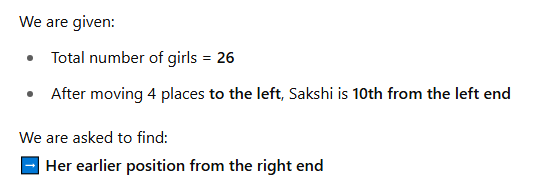
In a row of 26 girls, when Sakshi shifted four places towards the left, she became 10th from the left end. What was her earlier position form the right end of the row?
- A10th
- B14th
- C15th
- D12th
- E13th
Show answerHide answer
Answer: E
Approach: Ranking: undo the shift, then convert left rank to right rank with total = left + right − 1.
Solution:
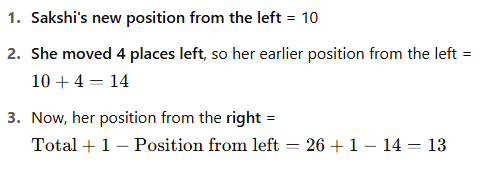
After moving 4 places left she is 10th from the left.
So before moving she was 10 + 4 = 14th from the left.
Position from right = 26 − 14 + 1 = 13th.
Cetking shortcut: Right rank = N − left rank + 1.
Answer: E
Passage / data for this question
DIRECTIONS for the question: Study the following information and answer the questions given below.
At the end of the cricket series, when 5 players were arranged in the ascending order of runs scored by them, O was 4th, while N was 1st. When they were arranged in descending order of wickets taken by them, K replaces O, while O replaces L. M’s position remain unchanged. K has scored more runs than M. L is having 1st rank in one ranking and fifth in another.
Who has scored highest runs in the series?
- AK
- BL
- CM
- DN
- EO
Show answerHide answer
Answer: B
Approach: Two ranking lists linked by 'replaces' clues; build both lists together.
Solution:
Runs (ascending, 1 = least): N = 1st, O = 4th. L is 1st in one list and 5th in the other; 1st is taken by N, so L = 5th in runs (most runs) and 1st in wickets.
M keeps the same rank in both lists; K scored more runs than M → M = 2nd, K = 3rd in runs.
Runs ascending: N, M, K, O, L.
Wickets descending: K takes O's place (4th), O takes L's place (5th), L = 1st, M = 2nd (unchanged), N = 3rd.
Wickets descending: L, M, N, K, O.
Highest runs = 5th in ascending order = L.
Why the other options are wrong:
A K: 3rd in runs.
C M: 2nd in runs.
D N: lowest runs.
E O: 4th in runs.
Cetking shortcut: '1st in one list, 5th in the other' with N already 1st in runs fixes L = 5th in runs immediately.
Answer: B
Passage / data for this question
DIRECTIONS for the question: Study the following information and answer the questions given below.
At the end of the cricket series, when 5 players were arranged in the ascending order of runs scored by them, O was 4th, while N was 1st. When they were arranged in descending order of wickets taken by them, K replaces O, while O replaces L. M’s position remain unchanged. K has scored more runs than M. L is having 1st rank in one ranking and fifth in another.
Who has taken lowest number of wickets?
- AL
- BM
- CN
- DK
- EO
Show answerHide answer
Answer: E
Approach: Two ranking lists: read the bottom of the wickets list.
Solution:
Runs (ascending, 1 = least): N = 1st, O = 4th. L is 1st in one list and 5th in the other; 1st is taken by N, so L = 5th in runs (most runs) and 1st in wickets.
M keeps the same rank in both lists; K scored more runs than M → M = 2nd, K = 3rd in runs.
Runs ascending: N, M, K, O, L.
Wickets descending: K takes O's place (4th), O takes L's place (5th), L = 1st, M = 2nd (unchanged), N = 3rd.
Wickets descending: L, M, N, K, O.
Lowest wickets = 5th in descending order = O (O takes L's runs rank, 5th).
Why the other options are wrong:
A L: highest wickets.
B M: 2nd.
C N: 3rd.
D K: 4th.
Cetking shortcut: 'O replaces L' puts O at L's runs rank — 5th — so O is last in wickets.
Answer: E
Passage / data for this question
DIRECTIONS for the question: Study the following information and answer the questions given below.
At the end of the cricket series, when 5 players were arranged in the ascending order of runs scored by them, O was 4th, while N was 1st. When they were arranged in descending order of wickets taken by them, K replaces O, while O replaces L. M’s position remain unchanged. K has scored more runs than M. L is having 1st rank in one ranking and fifth in another.
Who has taken the highest number of wickets?
- AL
- BM
- CN
- DK
- EO
Show answerHide answer
Answer: A
Approach: Two ranking lists: read the top of the wickets list.
Solution:
Runs (ascending, 1 = least): N = 1st, O = 4th. L is 1st in one list and 5th in the other; 1st is taken by N, so L = 5th in runs (most runs) and 1st in wickets.
M keeps the same rank in both lists; K scored more runs than M → M = 2nd, K = 3rd in runs.
Runs ascending: N, M, K, O, L.
Wickets descending: K takes O's place (4th), O takes L's place (5th), L = 1st, M = 2nd (unchanged), N = 3rd.
Wickets descending: L, M, N, K, O.
Highest wickets = 1st in descending order = L.
Why the other options are wrong:
B M: 2nd.
C N: 3rd.
D K: 4th (took O's 4th rank).
E O: last.
Answer: A
Passage / data for this question
Direction for the question: Read the following information carefully and answer the question given below it:
The sum of the incomes of A and B is more than that of C and D taken together. The sum of the incomes of A and C is the same as that of B and D taken together. Moreover, A earns half as much as the sum of the incomes of B and D.
Whose income is the highest?
- AA
- BB
- CC
- DD
- EA or C
Show answerHide answer
Answer: B
Approach: Convert the statements into equations and compare.
Solution:
Given: (1) A + B > C + D, (2) A + C = B + D, (3) A = ½(B + D).
From (3): B + D = 2A. Put in (2): A + C = 2A → C = A.
Put C = A in (1): A + B > A + D → B > D.
Since B + D = 2A and B > D: B > A > D.
Order: B > A = C > D.
Highest income = B.
Why the other options are wrong:
A A, C C, E A or C: A = C, and both are below B.
D D: lowest.
Cetking shortcut: A is the average of B and D, so A lies between them; A = C, and B > D puts B on top.
Answer: B
Passage / data for this question
Direction for the question: Read the following information carefully and answer the question given below it:
The sum of the incomes of A and B is more than that of C and D taken together. The sum of the incomes of A and C is the same as that of B and D taken together. Moreover, A earns half as much as the sum of the incomes of B and D.
which of the statement is not correct?
- AA earns more than B
- BB earns more than D
- CC earns more than D
- DB earns more than C
- EB earns highest income
Show answerHide answer
Answer: A
Approach: Use the derived order to test each statement.
Solution:
Given: (1) A + B > C + D, (2) A + C = B + D, (3) A = ½(B + D).
From (3): B + D = 2A. Put in (2): A + C = 2A → C = A.
Put C = A in (1): A + B > A + D → B > D.
Since B + D = 2A and B > D: B > A > D.
Order: B > A = C > D.
A. A earns more than B — false (B > A).
B. B earns more than D — true.
C. C earns more than D — true (C = A > D).
D. B earns more than C — true.
E. B earns the highest — true.
Answer: A
Passage / data for this question
Direction for the question: Read the following information carefully and answer the question given below it:
The sum of the incomes of A and B is more than that of C and D taken together. The sum of the incomes of A and C is the same as that of B and D taken together. Moreover, A earns half as much as the sum of the incomes of B and D.
If A’s income be Rs 80,000 per annum and the difference between the incomes of B and D be the same as A’s income, B’s income is?
- A40,000
- B60,000
- C80,000
- D1,20,000
- E20,000
Show answerHide answer
Answer: D
Approach: Sum and difference of two unknowns.
Solution:
A = 80,000 → B + D = 2A = 1,60,000.
B − D = A = 80,000 (B > D from the earlier result).
Adding: 2B = 2,40,000 → B = 1,20,000 (and D = 40,000).
Why the other options are wrong:
A 40,000: that is D.
B 60,000, E 20,000: do not satisfy B + D = 1,60,000 with B − D = 80,000.
C 80,000: that is A (= C).
Cetking shortcut: B = (sum + difference)/2 = (1,60,000 + 80,000)/2.
Answer: D
Nitin ranks eighteenth in a class of 49 students. What is his rank from the last?
- A18
- B19
- C31
- D32
- E33
Show answerHide answer
Answer: D
Approach: Rank from the other end = Total + 1 − rank from this end.
Solution:
Total = 49 and rank from the top = 18.
Rank from the last = 49 + 1 − 18 = 32.
Why the other options are wrong:
C (31): uses 49 − 18 and forgets the +1.
E (33): adds 1 twice.
A (18), B (19): these just repeat or shift the given rank.
Cetking shortcut: Ranks from both ends always add up to Total + 1: 18 + 32 = 50.
Answer: D
In a row of girls, Rimmi and Mimmi occupy ninth place from right end and tenth place from left end respectively. If they interchange their positions then Rimmi and Mimmi will occupy seventeenth place from right end and eighteenth place from left end respectively.
How many girls are there over all in all the given row :
- A18
- B27
- C26
- D25
- E35
Show answerHide answer
Answer: C
Approach: Ranking with interchange: Total = (position from left) + (position from right) − 1 for the same seat.
Solution:
Before swap: Mimmi's seat is 10th from left.
After swap, Rimmi sits in that seat and is 17th from right.
So that seat is 10th from left and 17th from right → Total = 10 + 17 − 1 = 26.
Check with the other seat: Rimmi's old seat is 9th from right; Mimmi there is 18th from left → 18 + 9 − 1 = 26 ✓.
Why the other options are wrong:
B 27 — forgot to subtract 1.
D 25 — subtracted 2.
A 18, E 35 — do not use the same seat from both ends.
Cetking shortcut: Pair the old rank of one girl with the new rank of the other — they describe the same seat.
Answer: C
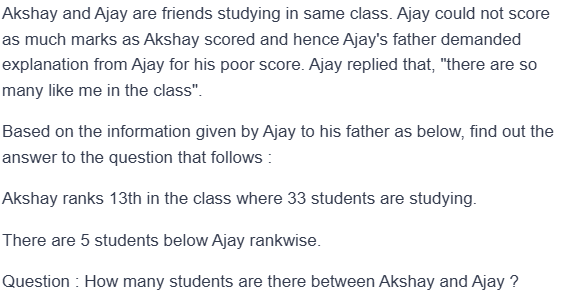
Akshay and Ajay are friends studying in same class. Ajay could not score as much marks as Akshay scored and hence Ajay's father demanded explanation from Ajay for his poor score. Ajay replied that, "there are so many like me in the class".
Based on the information given by Ajay to his father as below, find out the answer to the question that follows :
Akshay ranks 13th in the class where 33 students are studying.
There are 5 students below Ajay rankwise.
Question : How many students are there between Akshay and Ajay ?
- A13
- B14
- C15
- D17
- E16
Show answerHide answer
Answer: B
Approach: Convert 'students below' into rank from top, then count positions strictly between.
Solution:
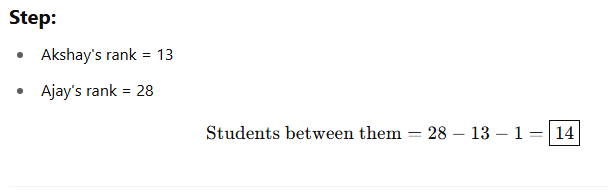
Total 33; 5 students below Ajay → Ajay's rank = 33 − 5 = 28th from top.
Akshay's rank = 13th.
Students between = 28 − 13 − 1 = 14.
Why the other options are wrong:
15: forgets to subtract 1 (counts one of the two boys).
13 / 16 / 17: wrong rank conversion.
Cetking shortcut: Between two ranks a and b: |a − b| − 1.
Answer: B