Let’s Crack CET 2027

Your CET check-up · tap a ring to see yours

Probability – MBA CET questions with solutions

25 questions · CET 2025–2026 · Easy 22 · Medium 3 · Hard 0. Newest paper first. Full papers

Q14EasyCET 2026 · Attempt 2 Slot 2 · Q14
In a 400 m race, A runs @ 10 m/s and B @ 8 m/s. If B is given a head start of 50 m, what is the probability that A wins the race ?
  1. 0
  2. 1
  3. 0.50
  4. 0.33
  5. 0.88
Show answerHide answer

Answer: B official key

Approach: Time comparison in a race — certain event has probability 1.

Solution:
A runs the full 400 m: time = 400 ÷ 10 = 40 s.
B starts 50 m ahead, so runs 350 m: time = 350 ÷ 8 = 43.75 s.
A always finishes 3.75 s earlier — no chance involved.
An event that is certain has probability 1.

Why the other options are wrong:
A: 0 would mean A can never win.
C, D, E: fractional values imply uncertainty, but the speeds fix the result.

Cetking shortcut: Head start 50 m at 8 m/s is worth 6.25 s, but A already gains 10 s over 400 m (50 vs 40 s) — A wins for sure.

Answer: B
Q133EasyCET 2026 · Attempt 2 Slot 1 · Q133

A card is drawn from a set of playing cards. What is the probability that card drawn is a king or a queen?

  1. 1/2
  2. 1/4
  3. 2/13
  4. 5/13
  5. 1/13
Show answerHide answer

Answer: C official key

Approach: Simple probability with a standard 52-card deck.

Solution:
Kings = 4, Queens = 4 → favourable = 8.
P = 8/52 = 2/13.

Cetking shortcut: Each rank is 1/13; two ranks → 2/13.

Answer: C

Q134EasyCET 2026 · Attempt 2 Slot 1 · Q134

A card is drawn from a set of playing cards. What is the probability that a card of red suit?

  1. 1/2
  2. 1/4
  3. 1/13
  4. 2/13
  5. 13/25
Show answerHide answer

Answer: A official key

Approach: Simple probability with a standard 52-card deck.

Solution:
Red suits: hearts and diamonds = 26 cards.
P = 26/52 = 1/2.

Cetking shortcut: Two of four suits are red → 1/2.

Answer: A

Q135EasyCET 2026 · Attempt 2 Slot 1 · Q135

A card is drawn from a set of playing cards. What is the probability that a card having a number less than 9?

  1. 1/2
  2. 1/4
  3. 7/13
  4. 8/13
  5. 2/13
Show answerHide answer

Answer: C official key

Approach: Count numbered cards below 9 in a 52-card deck.

Solution:
Number cards less than 9: 2, 3, 4, 5, 6, 7, 8 → 7 per suit (Ace is not treated as a number card).
Favourable = 7 × 4 = 28.
P = 28/52 = 7/13.

Why the other options are wrong:
D (8/13) counts the Ace as 1; A, B, E do not match the count.

Cetking shortcut: 7 of the 13 ranks qualify → 7/13 directly.

Answer: C

Q131EasyCET 2026 · Slot 5 · Q131

A box contains one dozen mangoes. One-third of the mangoes are bad. If three mangoes are chosen at random from the box, what is the probability that at least one of the selected mangoes is good?

  1. 1/55
  2. 51/55
  3. 53/55
  4. 54/55
  5. 3/55
Show answerHide answer

Answer: D official key

Approach: 'At least one' = 1 − P(none).

Solution:
Total mangoes = 12; bad = 12/3 = 4; good = 8.
P(all three bad) = ⁴C₃/¹²C₃ = 4/220 = 1/55.
P(at least one good) = 1 − 1/55 = 54/55.

Why the other options are wrong:

  • A (1/55): that is P(all bad).
  • B (51/55), C (53/55): wrong count of all-bad selections.
  • E (3/55): no meaning here.

Cetking shortcut: When 'at least one' appears, compute the single complementary case — here only 4 ways to pick 3 bad mangoes.

Answer: D

Q132EasyCET 2026 · Slot 5 · Q132

Three unbiased coins are tossed simultaneously. What is the probability of getting at least two heads?

  1. 1/8
  2. 3/8
  3. 1/2
  4. 5/8
  5. 2/8
Show answerHide answer

Answer: C official key

Approach: List outcomes of 3 coins (8 equally likely).

Solution:
Total outcomes = 2³ = 8.
At least two heads: HHT, HTH, THH, HHH = 4 outcomes.
P = 4/8 = 1/2.

Why the other options are wrong:

  • A (1/8): only HHH.
  • B (3/8): exactly two heads.
  • D (5/8), E (2/8): miscounts.

Cetking shortcut: By symmetry, P(≥ 2 heads) = P(≥ 2 tails), and they cover all outcomes → each is 1/2.

Answer: C

Q135EasyCET 2026 · Slot 5 · Q135

Four events A, B, C and D are mutually exclusive and exhaustive.
If
P(A) = 1/3 P(B),
P(B) = 1/4 P(C),
P(C) = 1/5 P(D),

then find the value of P(D).

  1. 1/2
  2. 3/15
  3. 15/19
  4. 15/31
  5. 7/12
Show answerHide answer

Answer: C official key

Approach: Mutually exclusive and exhaustive → probabilities add to 1.

Solution:
Let P(D) = x. Then P(C) = x/5, P(B) = x/20, P(A) = x/60.
x + x/5 + x/20 + x/60 = 1 → x(60 + 12 + 3 + 1)/60 = 1 → 76x/60 = 1.
x = 60/76 = 15/19.

Why the other options are wrong:

  • A (1/2), B (3/15), E (7/12): do not make the four probabilities sum to 1.
  • D (15/31): wrong denominator from mis-adding the parts.

Cetking shortcut: Ratio A : B : C : D = 1 : 3 : 12 : 60 → total 76 parts → P(D) = 60/76 = 15/19.

Answer: C

Q139EasyCET 2026 · Slot 4 · Q139
In a single throw of two dice, find the probability of getting a sum of 7 or 11.
  1. 1/6
  2. 1/9
  3. 7/36
  4. 5/36
  5. 2/9
Show answerHide answer

Answer: E official key

Approach: Classical probability with two dice: 36 outcomes.

Solution:
Sum 7: (1,6), (2,5), (3,4), (4,3), (5,2), (6,1) = 6 ways.
Sum 11: (5,6), (6,5) = 2 ways.
Mutually exclusive ⇒ favourable = 8; P = 8/36 = 2/9.

Why the other options are wrong:
A (1/6) – sum 7 only.
B (1/9) – 4/36, undercounts.
C (7/36), D (5/36) – miscounted pairs.

Cetking shortcut: Remember: P(sum 7) = 6/36 and P(sum 11) = 2/36.

Answer: E

Q132EasyCET 2026 · Slot 3 · Q132
A bag contains 5 red and 7 green balls. Two balls are drawn one after the other, with replacement of the first ball before drawing the second. What is the probability that both balls drawn are red?
  1. 5/12
  2. 25/144
  3. 5/24
  4. 35/144
  5. 1/2
Show answerHide answer

Answer: B official key

Approach: With replacement the draws are independent: multiply probabilities.

Solution:
P(red) = 5/12 on each draw.
P(both red) = 5/12 × 5/12 = 25/144.

Why the other options are wrong:

  • A: probability of a single red.
  • C, D: mix of without-replacement / red-green products (35/144 = one red and one green in a fixed order).

Answer: B

Q133EasyCET 2026 · Slot 3 · Q133
In a class, 30% of the students passed Mathematics, 20% passed Science, and 10% passed both subjects. If a student is selected at random, what is the probability that the student has passed Mathematics or Science?
  1. 2/5
  2. 3/4
  3. 5/3
  4. 3/10
  5. 1/2
Show answerHide answer

Answer: A official key

Approach: Addition rule: P(M ∪ S) = P(M) + P(S) − P(M ∩ S).

Solution:
P(M ∪ S) = 0.30 + 0.20 − 0.10 = 0.40 = 2/5.

Why the other options are wrong:

  • B, E: too large; would require fewer students in both.
  • C: 5/3 > 1 — impossible as a probability.
  • D: 3/10 is P(Maths) alone.

Answer: A

Q138EasyCET 2026 · Slot 2 · Q138

DIRECTION for the question: Solve the following question and mark the best possible option.

In a class, there are 15 boys and 10 girls. Three students are selected at random. The probability that the selected students are 2 boys and 1 girl is:

  1. (21/46)
  2. (25/117)
  3. (1/50)
  4. (3/25)
  5. (21/31)
Show answerHide answer

Answer: A official key

Approach: Combinations.

Solution: Total = C(25, 3) = 25 × 24 × 23/6 = 2300.
Favourable = C(15, 2) × C(10, 1) = 105 × 10 = 1050.
P = 1050/2300 = 21/46.

Why the other options are wrong:
B, C, D, E: do not equal 1050/2300; e.g. D (3/25) ignores combinations.

Answer: A

Q139EasyCET 2026 · Slot 2 · Q139

DIRECTION for the question: Solve the following question and mark the best possible option.

Two dice are tossed. The probability that the total score is a prime number is

  1. (1/6)
  2. (1/2)
  3. (5/12)
  4. (7/9)
  5. (2/3)
Show answerHide answer

Answer: C official key

Approach: Count outcomes for each prime sum.

Solution: Sum 2: 1; Sum 3: 2; Sum 5: 4; Sum 7: 6; Sum 11: 2.
Favourable = 1 + 2 + 4 + 6 + 2 = 15.
P = 15/36 = 5/12.

Why the other options are wrong:
B (1/2): 18/36 — includes a non-prime sum.
A (1/6): only sum 7.
D, E: overcount.

Answer: C

Q140MediumCET 2026 · Slot 1 · Q140
A book has 15 pages: 1 cover page, 9 theory pages (fixed order), and 5 drawing pages. The cover page is always first. The drawing pages must remain together but can be in any order. What is the probability that the pages are arranged according to the requirement?
  1. 10·8! / 14!
  2. 10·5! / 14!
  3. 10·8! / 10!
  4. 8·5! / 13!
  5. 10·8! / 7!
Show answerHide answer

Official CET key: B · Cetking's answer: A — see why below

Approach: Probability = favourable arrangements / total arrangements, with the cover fixed first.

Solution:
Total: cover is first, other 14 distinct pages in any order → 14!
Favourable: tie the 5 drawing pages into one block → 9 theory pages + 1 block = 10 units
Theory pages have a fixed order, so only the block's position varies: 10 positions
Drawing pages inside the block: 5!
Favourable = 10 × 5!
P = 10 · 5! / 14!

Why the other options are wrong:
A (10·8!/14!): 8! has no meaning here — only the 5 drawing pages permute.
C and E: denominator must be 14! (all arrangements after the cover).
D (8·5!/13!): wrong count of units and total.

Cetking shortcut: 'Fixed order' items act as identical slots: choose the block's slot (10 ways) × 5!.

Answer: B

Q104EasyCET 2025 · Slot 6 · Q104
What is the probability of getting a red numbered card greater than 6 from a well shuffled deck of 52 cards?
  1. 4/13
  2. 2/13
  3. 5/13
  4. 3/13
  5. 6/13
Show answerHide answer

Answer: B

Approach: Probability = favourable cards / 52.

Solution:
Red suits: hearts and diamonds (13 each).
Numbered cards greater than 6: 7, 8, 9, 10 ⇒ 4 per suit.
Favourable = 4 × 2 = 8 ⇒ P = 8/52 = 2/13.

Why the other options are wrong:
A 4/13: counts all four suits (16 cards).
C, D, E: include face cards or the 6 itself.

Cetking shortcut: Per suit 4 of 13 cards qualify; red = half the deck ⇒ (4/13) × (1/2) = 2/13.

Answer: B

Q105EasyCET 2025 · Slot 6 · Q105
A bag contains 10 black balls 5 red balls and 5 white balls and a ball is drawn randomly from it. what is the probability of getting either a red or a white ball.
  1. 1/4
  2. 1/2
  3. 3/4
  4. 1
  5. 4/5
Show answerHide answer

Answer: B

Approach: Addition rule for mutually exclusive events.

Solution:
Total balls = 10 + 5 + 5 = 20.
Red or white = 5 + 5 = 10.
P = 10/20 = 1/2.

Cetking shortcut: P(red or white) = 1 − P(black) = 1 − 10/20 = 1/2.

Answer: B

Q148MediumCET 2025 · Slot 5 · Q148

It has been found that if A and B play a game 12 times, A wins 6 times, B wins 4 times and they draw twice. A and B take part in a series of 3 games. The probability that they will win alternately is:

  1. 5/72
  2. 5/36
  3. 7/72
  4. 7/36
  5. 1/36
Show answerHide answer

Answer: B

Approach: 'Win alternately' over 3 games means the sequences A-B-A or B-A-B (independent games).

Solution:
P(A wins) = 6/12 = 1/2, P(B wins) = 4/12 = 1/3 (draw = 1/6)
P(A, B, A) = 1/2 × 1/3 × 1/2 = 1/12
P(B, A, B) = 1/3 × 1/2 × 1/3 = 1/18
Total = 1/12 + 1/18 = 3/36 + 2/36 = 5/36

Why the other options are wrong:
A (5/72): halves the result wrongly.
E (1/36)/C/D: count only one sequence or mis-add.

Answer: B

Q136EasyCET 2025 · Slot 3 · Q136
A box contains 10 white and 10 black balls. What is the probability of drawing 2 balls of the same color?
  1. 9/19
  2. 3/38
  3. 10/29
  4. 5/49
  5. 7/39
Show answerHide answer

Answer: A

Approach: Combinations without replacement.

Solution: Total ways = ²⁰C₂ = 190.
Both white = ¹⁰C₂ = 45; both black = 45 → favourable = 90.
P = 90/190 = 9/19.

Cetking shortcut: First ball any colour; second must match: 9 of remaining 19 → 9/19.

Answer: A

Q137EasyCET 2025 · Slot 3 · Q137
A speaks truth in 75% cases and B in 80% of the cases, in what percentage of cases are they likely to contradict each other, in narrating the same incident?
  1. 5%
  2. 15%
  3. 35%
  4. 45%
  5. 55%
Show answerHide answer

Answer: C

Approach: P(exactly one truthful).

Solution: A true, B lies = 0.75 × 0.20 = 0.15.
A lies, B true = 0.25 × 0.80 = 0.20.
Total = 0.35 = 35%.

Answer: C

Q138MediumCET 2025 · Slot 2 · Q138
A small store has five units of a new phone model in stock — two white, two black, and one red. Three customers arrive at the shop to buy a unit each. Each one has a predetermined choice of the colour and will not buy a unit of any other colour. All three customers are equally likely to have any of the three colours as preference. What is the probability that the store will be able to satisfy all three customers?
  1. 4/15
  2. 2/3
  3. 2/15
  4. 7/9
  5. 1/3
Show answerHide answer

Answer: B

Approach: 3 independent customers × 3 colours = 27 equally likely outcomes; count failures (demand > stock).

Solution:
Stock: W 2, B 2, R 1. The store fails if 2 or more customers want red, or all 3 want white, or all 3 want black.
Exactly 2 red: C(3,2) × 2 = 6; 3 red: 1; WWW: 1; BBB: 1 → failures = 9.
P(satisfy all) = (27 − 9)/27 = 18/27 = 2/3.

Why the other options are wrong: 1/3 is the probability of failure, not success.

Answer: B

Q146EasyCET 2025 · Slot 2 · Q146
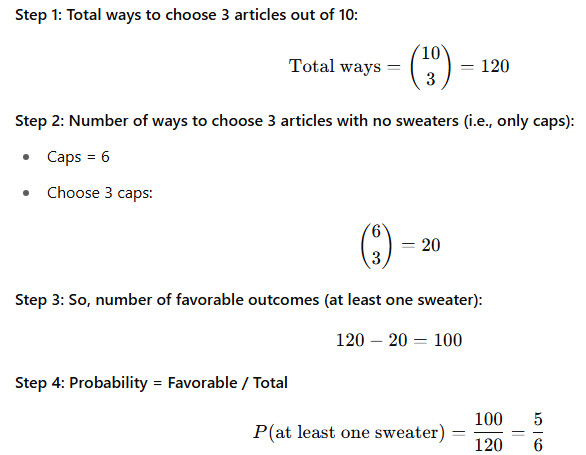
A cricket umpire has to pick 3 articles from 6 caps and 4 sweaters before a match. What is the probability that at least one sweater was picked?
  1. 5/11
  2. 3/5
  3. 5/6
  4. 2/7
  5. 2/3
Show answerHide answer

Answer: C

Approach: 'At least one' → 1 − P(none).

Solution:
Total ways = C(10, 3) = 120. No sweater (all caps) = C(6, 3) = 20.
P(at least one sweater) = 1 − 20/120 = 5/6.

Answer: C

Q31EasyCET 2025 · Slot 1 · Q31

Determine the probability of getting a 'nine' or 'ten' on a single throw of two dice simultaneously ?

  1. 4/12
  2. 1/30
  3. 7/36
  4. 5/36
  5. 7/18
Show answerHide answer

Answer: C

Approach: Classical probability: favourable ÷ 36.

Solution:
Sum 9: (3,6), (4,5), (5,4), (6,3) → 4.
Sum 10: (4,6), (5,5), (6,4) → 3.
Favourable = 7 → P = 7/36.

Why the other options are wrong:
D 5/36 — counts only one of the sums correctly.
E 7/18 — doubled.
A 4/12, B 1/30 — wrong total outcomes.

Cetking shortcut: Ways to get a sum s with two dice = 13 − s for s ≥ 7: 4 for 9 and 3 for 10.

Answer: C

Q48EasyCET 2025 · Slot 1 · Q48

A cricket umpire has to pick 6 caps and 4 sweaters before a match. She picks up 3 articles at random. Determine the probability that at least one sweater was picked by the umpire ?

  1. 1/6
  2. 1/12
  3. 2/3
  4. 5/6
  5. 5/11
Show answerHide answer

Answer: D

Approach: Complement rule.

Solution:
Total ways = 10C3 = 120.
No sweater (all 3 caps) = 6C3 = 20.
P(at least one sweater) = 1 − 20/120 = 1 − 1/6 = 5/6.

Why the other options are wrong:
A 1/6 — P(no sweater).
C 2/3, B 1/12, E 5/11 — wrong counts.

Cetking shortcut: P(all caps) = 6/10 × 5/9 × 4/8 = 1/6 → answer 5/6.

Answer: D

Solution figure for question 48
Q110EasyCET 2025 · Slot 1 · Q110
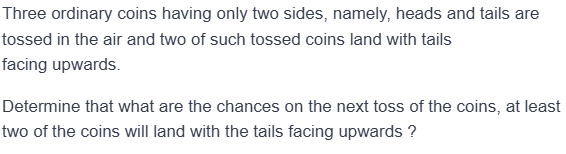
Three ordinary coins having only two sides, namely, heads and tails are tossed in the air and two of such tossed coins land with tails facing upwards. Determine that what are the chances on the next toss of the coins, at least two of the coins will land with the tails facing upwards ?
Figure for MBA CET 2025 Slot 1 question 110
  1. 80%
  2. 33.33%
  3. 66.67%
  4. 50%
  5. 25%
Show answerHide answer

Answer: D

Approach: Independent events: P(at least 2 tails with 3 coins).

Solution:
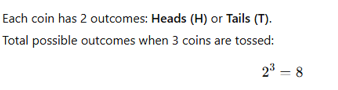
Total outcomes = 2³ = 8
Exactly 2 tails: HTT, THT, TTH = 3
3 tails: TTT = 1
P = 4/8 = 1/2 = 50%

Cetking shortcut: By symmetry, 'at least 2 tails' and 'at least 2 heads' are complementary and equally likely → 50%.

Answer: D

Solution figure for question 110Solution figure for question 110Solution figure for question 110
Q142EasyCET 2025 · Slot 1 · Q142
Two friends, Alka and Alkit appear for an interview for two vacancies for the same post in an Organisation. The probability of Alka's selection is 1/7 and Alkit is 1/5. What is the probability that only one of them will be selected ?
Figure for MBA CET 2025 Slot 1 question 142
  1. 1/35
  2. 8/15
  3. 4/5
  4. 4/35
  5. 2/7
Show answerHide answer

Answer: E

Approach: Two exclusive cases: only Alka or only Alkit.

Solution:
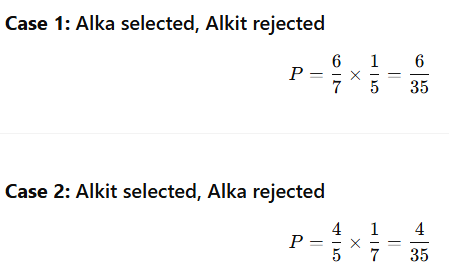
P(Alka) = 1/7 → P(not Alka) = 6/7; P(Alkit) = 1/5 → P(not Alkit) = 4/5
Only Alka: 1/7 × 4/5 = 4/35
Only Alkit: 6/7 × 1/5 = 6/35
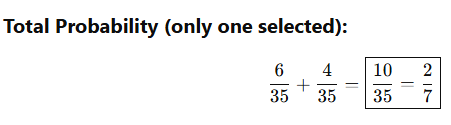
P(only one) = 4/35 + 6/35 = 10/35 = 2/7

Why the other options are wrong:
A (1/35): both selected.
D (4/35): only Alka's case.
B (8/15), C (4/5): mix up selection and rejection probabilities.

Cetking shortcut: P(exactly one) = p + q − 2pq = 1/7 + 1/5 − 2/35 = 10/35 = 2/7.

Answer: E

Solution figure for question 142Solution figure for question 142
Q148EasyCET 2025 · Slot 1 · Q148
Gajodhar throws two ordinary dice simultaneously. What is the probability that he shall get two numbers whose product shall be an even number ?
Figure for MBA CET 2025 Slot 1 question 148
  1. 1/3
  2. 2/3
  3. 5/16
  4. 3/8
  5. 3/4
Show answerHide answer

Answer: E

Approach: Complement of 'both odd'.

Solution:
P(both odd) = 3/6 × 3/6 = 1/4
P(product even) = 1 − 1/4 = 3/4 (27 of 36 outcomes)

Why the other options are wrong:
A (1/3), B (2/3), C (5/16), D (3/8): none matches 27/36.

Answer: E

Practise these in the Arena

Take timed tests built around MBA CET topics and see where you stand.

Open the Arena