Let’s Crack CET 2027

Your CET check-up · tap a ring to see yours

Profit Loss – MBA CET questions with solutions

29 questions · CET 2025–2026 · Easy 24 · Medium 5 · Hard 0. Newest paper first. Full papers

Q110EasyCET 2026 · Attempt 2 Slot 2 · Q110
A trader sells his articles at 10% higher than their original price. Due to higher demand, he again increases the price by 15%. Calculate the percentage of profit the trader makes ?
  1. 25.5%
  2. 26.5%
  3. 22%
  4. 27.33%
  5. 24.5%
Show answerHide answer

Official CET key: B · Cetking's answer: A — see why below

Approach: Successive percentage increase: a + b + ab/100.

Solution:
Assume the article's cost (original price) = 100.
After +10%: 110. After a further +15%: 110 × 1.15 = 126.5.
Profit = 126.5 − 100 = 26.5%.

Why the other options are wrong:
A (25.5%) and C (22%) miss or mis-add the 1.5% compounding term; D, E have no basis.

Cetking shortcut: 10 + 15 + (10 × 15)/100 = 26.5%.

Answer: B
Q111EasyCET 2026 · Attempt 2 Slot 2 · Q111
A person sold a radio at a loss of 5%. Had he sold it for Rs. 210 more, he would have gained 25%. For what value should he sell it in order to gain 35% ?
  1. Rs. 950
  2. Rs. 945
  3. Rs. 935
  4. Rs. 850
  5. Rs. 845
Show answerHide answer

Answer: B official key

Approach: Gap between two percentages of CP equals the money gap.

Solution:
Loss 5% → SP = 0.95 CP; gain 25% → SP = 1.25 CP.
Difference = 30% of CP = Rs. 210 → CP = Rs. 700.
For 35% gain: SP = 1.35 × 700 = Rs. 945.

Cetking shortcut: 30% ↔ 210 → 1% = 7 → 135% = 945.

Answer: B

Q112EasyCET 2026 · Attempt 2 Slot 2 · Q112
Mahan bought a bag with a 15% discount on the labeled price. He sold the bag for Rs. 2880 with a 20% profit on the labeled price. At what price did he buy the bag?
  1. 2400
  2. 2200
  3. 2040
  4. 2020
  5. 2025
Show answerHide answer

Answer: C official key

Approach: Work everything from the labeled (marked) price.

Solution:
SP = LP + 20% of LP = 1.2 LP = 2880 → LP = Rs. 2400.
Purchase price = LP − 15% = 0.85 × 2400 = Rs. 2040.

Cetking shortcut: 2880 ÷ 1.2 = 2400 (option A is the trap) → × 0.85 = 2040.

Answer: C

Q115EasyCET 2026 · Slot 5 · Q115

A sells an article to B at a profit of 20%.
B sells it to C at a profit of 25%.
C sells it to D at a loss of 10%.
D sells it back to A at a profit of 12½%.

If A finally pays ₹486 to get back the article, what was the original cost price of the article for A?

  1. ₹300
  2. ₹320
  3. ₹360
  4. ₹400
  5. ₹450
Show answerHide answer

Answer: B official key

Approach: Successive profit/loss — multiply the factors.

Solution:
Let A's cost price = x.
A → B at +20%: 1.2x; B → C at +25%: 1.2 × 1.25 = 1.5x; C → D at −10%: 1.5 × 0.9 = 1.35x; D → A at +12.5%: 1.35 × 1.125 = 1.51875x.
1.51875x = 486 → x = 486/1.51875 = ₹320.

Why the other options are wrong:

  • A, C, D, E: give final prices of ₹455.6, ₹546.75, ₹607.5, ₹683.4 — not ₹486.

Cetking shortcut: Fractions: 6/5 × 5/4 × 9/10 × 9/8 = 243/160 → x = 486 × 160/243 = 2 × 160 = 320.

Answer: B

Q117EasyCET 2026 · Slot 5 · Q117

A trader first incurs a loss of x % on an article and then makes a profit of y %. If the final selling price equals the original cost price, then the relation between x and y is:

  1. x = y
  2. y = 100x/(100 − x)
  3. y = 100x/(100 + x)
  4. y = x + (x²/100)
  5. y = x − 1
Show answerHide answer

Answer: B official key

Approach: Gain needed to recover a loss is measured on the reduced price.

Solution:
Let CP = 100. After x% loss, price = 100 − x.
A gain of y% on (100 − x) must bring it back to 100: (100 − x)(1 + y/100) = 100.
1 + y/100 = 100/(100 − x) → y/100 = x/(100 − x).
y = 100x/(100 − x).

Why the other options are wrong:

  • A (x = y): ignores that the base changed.
  • C: uses (100 + x) as base — that is the formula for losing back a gain.
  • D, E: not derived from the base-change equation.

Cetking shortcut: Test x = 50: price 50 must double → y = 100. Only 100x/(100 − x) = 100 ✓.

Answer: B

Q119EasyCET 2026 · Slot 4 · Q119
By selling 12 oranges for a rupee, a man loses 20%. How many for a rupee should he sell to gain 20%?
  1. 8
  2. 10
  3. 15
  4. 16
  5. 9
Show answerHide answer

Answer: A official key

Approach: Fix the cost of one orange from the loss case, then price it for the gain.

Solution:
SP of 1 orange = Re 1/12 at 20% loss ⇒ CP = (1/12)/0.8 = 5/48.
For 20% gain: SP = 1.2 × 5/48 = 1/8.
So he must sell 8 oranges for a rupee.

Why the other options are wrong:
C (15), D (16) – sell more per rupee, i.e. a bigger loss.
B (10), E (9) – do not reach 20% gain.

Cetking shortcut: Count × (1 + profit%) is constant: 12 × 0.8 = n × 1.2 ⇒ n = 8.

Answer: A

Q120MediumCET 2026 · Slot 4 · Q120
A man bought an article and sold it at a gain of 5%. If he had bought it at 5% less and sold it for Rs. 1 less, he would have made a profit of 10%. The cost price of the article is:
  1. Rs. 100
  2. Rs. 150
  3. Rs. 200
  4. Rs. 250
  5. Rs. 300
Show answerHide answer

Answer: C official key

Approach: Set CP = 100x and compare the two scenarios.

Solution:
Original: CP = 100x, SP = 105x.
New: CP = 95x, SP = 105x − 1, profit 10% ⇒ SP = 1.1 × 95x = 104.5x.
105x − 1 = 104.5x ⇒ 0.5x = 1 ⇒ x = 2.
CP = Rs. 200. Check: 190 → 209 = 10% profit ✓.

Why the other options are wrong:
A, B, D, E – on testing, the two SPs do not differ by Rs. 1.

Cetking shortcut: Difference in the two SPs = 105% − (110% of 95%) = 105% − 104.5% = 0.5% of CP = Rs. 1 ⇒ CP = 200.

Answer: C

Q121EasyCET 2026 · Slot 3 · Q121
A dishonest shopkeeper uses a 900 gram weight instead of a 1 kilogram weight. He sells goods per kilogram at the same price at which he buys one kilogram. What is his profit percentage?
  1. 10%
  2. 11 (1/9)%
  3. 12 (1/2)%
  4. 15%
  5. 9 %
Show answerHide answer

Answer: B official key

Approach: False weight: Profit % = error / (true value given) × 100.

Solution:
Let CP of 1 kg = ₹100.
He gives 900 g (cost ₹90) but charges ₹100.
Profit = 10 on cost 90 → 10/90 × 100 = 11 1/9 %.

Cetking shortcut: Profit % = shortfall / weight actually given = 100/900 = 1/9 = 11.11%.

Answer: B

Q122EasyCET 2026 · Slot 3 · Q122
A person sold an article for ₹3600 and got a profit of 20%. Had he sold the article for ₹3150, how much profit would he have got?
  1. 4 %
  2. 5 %
  3. 6 %
  4. 7 %
  5. 8 %
Show answerHide answer

Answer: B official key

Approach: Find CP from the first sale, then profit % for the new SP.

Solution:
CP = 3600 / 1.2 = ₹3000.
New SP = 3150 → profit = 150.
Profit % = 150/3000 × 100 = 5%.

Cetking shortcut: 3150/3600 = 7/8 of the old SP → 1.2 × 7/8 = 1.05 → 5% profit.

Answer: B

Q112EasyCET 2026 · Slot 2 · Q112

DIRECTION for the question: Solve the following question and mark the best possible option.

The profit earned by selling an article for Rs. 900 is double the loss incurred when the same article is sold for Rs. 450. At what price should the article be sold to make a 25% profit?
  1. Rs. 600
  2. Rs. 750
  3. Rs. 800
  4. Rs. 900
  5. Rs. 450
Show answerHide answer

Answer: B official key

Approach: Find CP from the profit–loss relation, then apply 25% markup.

Solution: Let CP = x. Profit at 900 = 900 − x; loss at 450 = x − 450.
900 − x = 2(x − 450) ⇒ 900 − x = 2x − 900 ⇒ 3x = 1800 ⇒ x = 600.
SP for 25% profit = 1.25 × 600 = 750.

Why the other options are wrong:
A (600): that is the CP.
C, D, E: 33%, 50% profit and a loss price respectively.

Cetking shortcut: CP divides 450 to 900 in ratio loss : profit = 1 : 2 ⇒ CP = 450 + 450/3 = 600.

Answer: B

Q113EasyCET 2026 · Slot 2 · Q113

DIRECTION for the question: Solve the following question and mark the best possible option.

A fan is listed at Rs. 1500 and a discount of 20% is offered on the list price. What additional discount must be offered to the customer to bring the net price to Rs. 1104?
  1. 8%
  2. 10%
  3. 12%
  4. 15%
  5. 20%
Show answerHide answer

Official CET key: A · Cetking's answer: C — see why below

Approach: Successive discounts — second discount on the reduced price.

Solution: After 20% discount: 1500 × 0.8 = 1200.
Additional discount needed = 1200 − 1104 = 96.
Rate = 96/1200 × 100 = 8%.

Why the other options are wrong:
C (12%): would give 1200 × 0.88 = 1056.
B (10%): gives 1080.
D, E: far too large.

Answer: A

Q116EasyCET 2026 · Slot 1 · Q116

The marked price of an article is ₹2500. Two successive discounts of 10% and 5% are allowed. Even then, the shopkeeper earns a 20% profit.
Find the cost price of the article.

  1. ₹2137.50
  2. ₹2257.50
  3. ₹1668.50
  4. ₹1752.75
  5. ₹1781.25
Show answerHide answer

Answer: E official key

Approach: Find SP after successive discounts, then CP = SP / (1 + profit%).

Solution:
SP = 2500 × 0.90 × 0.95 = 2250 × 0.95 = 2137.50
SP = 1.2 × CP → CP = 2137.50/1.2 = ₹1781.25

Why the other options are wrong:
A (₹2137.50) is the selling price, not the cost price.

Cetking shortcut: CP = 2500 × 0.9 × 0.95 / 1.2 = 2500 × 0.7125 = 1781.25.

Answer: E

Q117EasyCET 2026 · Slot 1 · Q117

A shopkeeper marks an article 40% above its cost price. He offers a two-stage discount — first a 10% discount, and then an additional 5% discount on the reduced price. Find his overall profit percentage if the cost price of the article is Rs. 200.

  1. 26.8%
  2. 30%
  3. 25.4%
  4. 19.7%
  5. 14.5%
Show answerHide answer

Answer: D official key

Approach: Apply mark-up then successive discounts as multipliers on CP.

Solution:
MP = 200 × 1.4 = 280
After 10%: 280 × 0.9 = 252
After 5%: 252 × 0.95 = 239.40
Profit = 239.40 − 200 = 39.40 → 39.40/200 = 19.7%

Cetking shortcut: 1.4 × 0.9 × 0.95 = 1.197 → 19.7% profit.

Answer: D

Q118MediumCET 2026 · Slot 1 · Q118

A person bought a book and a novel for ₹2800. He sold the book at 10% profit and the novel at 15.25% profit. If his overall profit was 13%, then what is the difference between the cost prices of the book and the novel?

  1. Rs. 200
  2. Rs. 400
  3. Rs. 350
  4. Rs. 450
  5. Rs. 389
Show answerHide answer

Answer: B official key

Approach: Overall profit is a weighted average of the two profit rates (alligation).

Solution:
Let book = b, novel = 2800 − b
0.10b + 0.1525(2800 − b) = 0.13 × 2800 = 364
427 − 0.0525b = 364 → b = 1200; novel = 1600
Difference = 1600 − 1200 = ₹400

Cetking shortcut: Alligation: book : novel = (15.25 − 13) : (13 − 10) = 2.25 : 3 = 3 : 4 → 1200 : 1600 → difference = 2800/7 = 400.

Answer: B

Q107MediumCET 2025 · Slot 6 · Q107
The market value of a share is 35% of the face value and 30% less than the selling price. find the profit or loss percentage
  1. 50% loss
  2. 50% profit
  3. 49% profit
  4. 48% loss
  5. 45% profit
Show answerHide answer

Answer: A

Approach: Percent-of chain: fix Face Value = 100 and convert each statement.

Solution:
Let Face Value (FV) = ₹100 ⇒ Market Value (MV) = 35% of 100 = ₹35.
MV is 30% less than SP ⇒ MV = 0.70 × SP ⇒ SP = 35/0.70 = ₹50.
Taking FV as the cost (the share was bought at par), loss = 100 − 50 = ₹50.
Loss % = 50/100 × 100 = 50% loss.

Why the other options are wrong:
B 50% profit: sign reversed — SP (50) is below cost (100).
C, D, E: arithmetic slips; no route gives 49%, 48% or 45%.

Cetking shortcut: SP = 35/0.7 = 50 = half the face value ⇒ 50% loss straight away.

Answer: A

Q120EasyCET 2025 · Slot 6 · Q120
The cost price of an article is twice the discount. if the discount is 40% of the selling price find the profit or loss percent
  1. 25% loss
  2. 25% profit
  3. 20% loss
  4. 20 % profit
  5. 30% profit
Show answerHide answer

Answer: B

Approach: Assume SP = 100 and translate each statement.

Solution:
Discount = 40% of SP = ₹40.
CP = 2 × discount = ₹80.
Profit = 100 − 80 = ₹20 ⇒ Profit % = 20/80 × 100 = 25% profit.

Why the other options are wrong:
D 20% profit: divides profit by SP instead of CP.
A, C: SP is above CP, so it cannot be a loss.
E: arithmetic slip.

Cetking shortcut: CP = 0.8 × SP ⇒ SP/CP = 5/4 ⇒ 25% profit.

Answer: B

Q113EasyCET 2025 · Slot 5 · Q113

A shopkeeper bought 150 calculators at the rate of Rs 250 per calculator. He spent Rs 2500 on transportation and packing If the marked price of a calculator is Rs. 320 per calculator and the shopkeeper gives a discount of 5% on the marked price, then what will be the percentage profit gained by the shopkeeper?

  1. 12%
  2. 13%
  3. 14%
  4. 15%
  5. 16%
Show answerHide answer

Answer: C

Approach: Profit % = (Total SP − Total CP)/Total CP × 100, with overheads added to CP.

Solution:
CP = 150 × 250 + 2500 = 37,500 + 2,500 = ₹40,000
SP per unit = 320 × 0.95 = ₹304
Total SP = 150 × 304 = ₹45,600
Profit = ₹5,600 → 5600/40000 × 100 = 14%

Cetking shortcut: Per unit: CP = 250 + 2500/150 = 266.67; SP = 304; 304/266.67 = 1.14 → 14%.

Answer: C

Q114EasyCET 2025 · Slot 5 · Q114

An uneducated retailer marks all his goods at 50% above the cost price and thinking that he will still make 25% profit, offers a discount of 25% on the marked price. What is his actual profit on the sales?

  1. 12%
  2. 12.5%
  3. 15%
  4. 10%
  5. 11%
Show answerHide answer

Answer: B

Approach: Markup followed by discount: net factor = 1.5 × 0.75.

Solution:
CP = 100 → MP = 150
Discount 25% of 150 = 37.5 → SP = 112.5
Profit = 12.5 on CP 100 → 12.5%

Why the other options are wrong:
A/D/E: arithmetic slips; C (15%): wrong net factor.

Cetking shortcut: Successive: +50% then −25% → 50 − 25 − (50 × 25)/100 = 12.5%.

Answer: B

Q115EasyCET 2025 · Slot 5 · Q115

On selling a pen at 5% loss and a book at 15% gain Karim gains Rs. 7. If he sells the pen at 5% gain and the book at 10% gain then he gains Rs. 13. The actual price of the book (in Rs.) is :

  1. 100
  2. 60
  3. 80
  4. 75
  5. 95
Show answerHide answer

Answer: C

Approach: Write gain/loss on each item as a % of its CP and solve the two equations.

Solution:
Let CP of pen = P, book = B
Case 1: −0.05P + 0.15B = 7
Case 2: 0.05P + 0.10B = 13
Add: 0.25B = 20 → B = 80
(Check: P = 100 → −5 + 12 = 7 ✓; 5 + 8 = 13 ✓)

Cetking shortcut: The pen terms are equal and opposite, so simply add the two equations: 25% of B = 20 → B = 80.

Answer: C

Q115EasyCET 2025 · Slot 4 · Q115

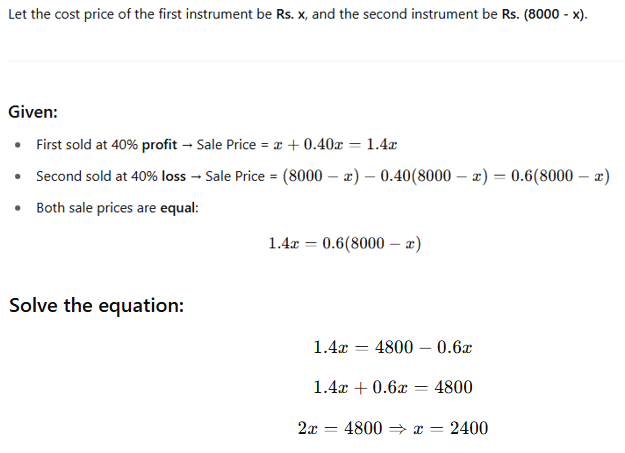
Two musical instruments were purchased for Rs. 8,000. The first was sold at a profit of 40% and the second at a loss of 40%. If the sale price was the same in both cases, then the cost price of the cheaper instrument (in Rs.) was:

  1. 2500
  2. 2400
  3. 2200
  4. 2000
  5. 2300
Show answerHide answer

Answer: B

Approach: Same SP ⇒ CP ratio = inverse of multiplying factors.

Solution:
Let the costs be x (profit 40%) and y (loss 40%).
Same SP: 1.4x = 0.6y ⇒ x : y = 0.6 : 1.4 = 3 : 7.
x + y = 8000 ⇒ x = 3/10 × 8000 = 2400, y = 5600.
Cheaper instrument = Rs. 2400.

Cetking shortcut: CP ratio = 60 : 140 = 3 : 7 ⇒ 8000 × 3/10 = 2400.

Answer: B

Solution figure for question 115
Q116EasyCET 2025 · Slot 4 · Q116

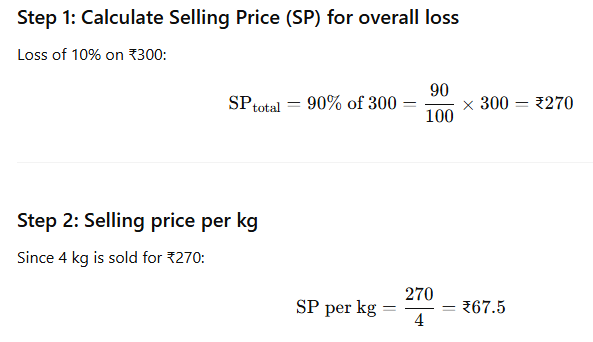
Five kg of butter was bought by a shopkeeper for ₹300. One kg becomes unsaleable. He sells the remaining in such a way that, on the whole, he incurs a loss of 10%. At what price (in Rs. per kg) was the butter sold?

  1. 67.50
  2. 52.5
  3. 72.5
  4. 60
  5. 55
Show answerHide answer

Answer: A

Approach: Total SP from overall loss, then per-unit price.

Solution:
Cost = Rs. 300; overall loss 10% ⇒ total SP = 0.9 × 300 = Rs. 270.
Saleable butter = 5 − 1 = 4 kg.
SP per kg = 270/4 = Rs. 67.50.

Why the other options are wrong:
E (55) / B (52.5): dividing over 5 kg or wrong loss base.
D (60): that is the cost price per kg.

Answer: A

Solution figure for question 116
Q117MediumCET 2025 · Slot 4 · Q117

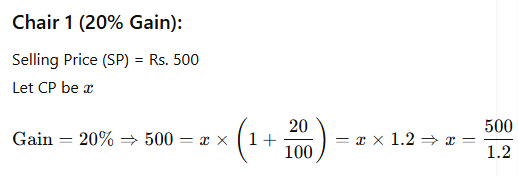
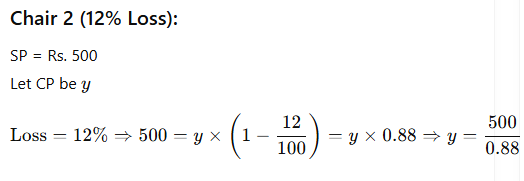
A man sold two steel chairs for Rs. 500 each. On one, he gains 20% and on the other, he loses 12%. How much does he gain or lose in the whole transaction?

  1. 1.5% gain
  2. 1.5% loss
  3. 2% gain
  4. 2% loss
  5. 1% loss
Show answerHide answer

Answer: A

Approach: Compute both cost prices from the same SP.

Solution:
CP₁ = 500/1.20 = 416.67.
CP₂ = 500/0.88 = 568.18.
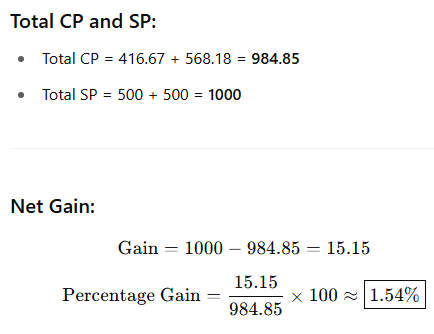
Total CP = 984.85; total SP = 1000.
Gain = 15.15 ⇒ gain% = 15.15/984.85 × 100 ≈ 1.54% ≈ 1.5% gain.

Why the other options are wrong:
B, D, E: give a loss, but total CP is below total SP.
C (2% gain): over-estimates; exact value ≈ 1.54%.

Cetking shortcut: Take SP = 1320 (LCM-friendly): CP₁ = 1100, CP₂ = 1500 ⇒ CP total 2600, SP 2640 ⇒ gain 40/2600 ≈ 1.54%.

Answer: A

Solution figure for question 117Solution figure for question 117Solution figure for question 117
Q118EasyCET 2025 · Slot 4 · Q118

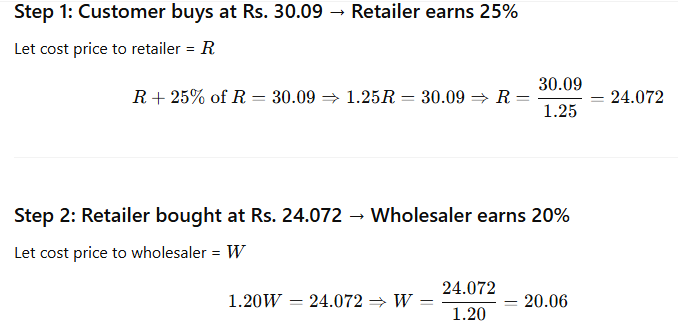
A manufacturer sells a pair of glasses to a wholesale dealer at a profit of 18%. The wholesaler sells the same to a retailer at a profit of 20%. The retailer in turn sells them to a customer for Rs. 30.09, thereby earning a profit of 25%. What is the cost price of the pair of glasses to the manufacturer?

  1. 15
  2. 20
  3. 17
  4. 18
  5. 16
Show answerHide answer

Answer: C

Approach: Successive multiplying factors, reversed.

Solution:
Customer price = CP × 1.18 × 1.20 × 1.25.
1.18 × 1.20 = 1.416; × 1.25 = 1.77.
CP = 30.09/1.77 = Rs. 17.

Cetking shortcut: Test the options: 17 × 1.77 = 30.09 ✓.

Answer: C

Solution figure for question 118Solution figure for question 118
Q118EasyCET 2025 · Slot 3 · Q118
After successive discounts of 12% and 5% an article was sold for Rs. 209. What was the original price of the article?
  1. 226
  2. 250
  3. 252
  4. 269
  5. 209
Show answerHide answer

Answer: B

Approach: Final price = MP × 0.88 × 0.95.

Solution: 0.88 × 0.95 = 0.836.
0.836 × MP = 209 → MP = 209 ÷ 0.836 = 250.

Cetking shortcut: Check options: 250 × 0.88 = 220, 220 × 0.95 = 209 ✔.

Answer: B

Q119EasyCET 2025 · Slot 3 · Q119
The cost of an article is 64% of marked price. Calculate the percent gain after allowing a discount of 12%?
  1. 37.5%
  2. 48%
  3. 50.5%
  4. 52%
  5. 64%
Show answerHide answer

Answer: A

Approach: Assume MP = 100.

Solution: CP = 64.
SP after 12% discount = 88.
Profit = 88 − 64 = 24.
Gain % = 24/64 × 100 = 37.5%.

Answer: A

Q120EasyCET 2025 · Slot 3 · Q120
Komal buys an article at a discount of 25%. At what % above the cost price should he sell it to make a profit of 25% over the original list price?
  1. 25
  2. 30
  3. 40
  4. 66.67
  5. 50
Show answerHide answer

Answer: D

Approach: Let list price = 100.

Solution: CP = 100 − 25% = 75.
Required SP = 100 + 25% of 100 = 125.
% above CP = (125 − 75)/75 × 100 = 50/75 × 100 = 66.67%.

Why the other options are wrong: 50% uses the list price as base; 25% ignores the discount.

Answer: D

Solution figure for question 120
Q109EasyCET 2025 · Slot 2 · Q109
The cost price of an article is 64% of the marked price. Calculate the percent gain after allowing a discount of 12%?
  1. 87.5%
  2. 33.3%
  3. 52.5%
  4. 37.5%
  5. 62.5%
Show answerHide answer

Answer: D

Approach: Take MP = 100.

Solution:
MP = 100 → CP = 64.
Discount 12% → SP = 88.
Profit = 88 − 64 = 24 → gain% = 24/64 × 100 = 37.5%.

Cetking shortcut: 24/64 = 3/8 = 37.5%.

Answer: D

Q101EasyCET 2025 · Slot 1 · Q101
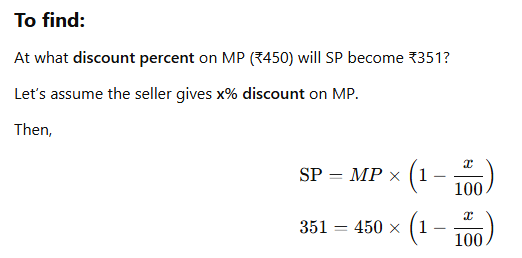
The cost price of a toy is Rs. 225. The marked price is twice of the cost price. What will be the discount offered to get profit of 56% on the sale of the toy ?
Figure for MBA CET 2025 Slot 1 question 101
  1. 30%
  2. 20%
  3. 33%
  4. 22%
  5. 28%
Show answerHide answer

Answer: D

Approach: Required SP from target profit; discount = (MP − SP)/MP × 100.

Solution:
CP = ₹225, MP = 2 × 225 = ₹450
Required SP for 56% profit = 1.56 × 225 = ₹351
Discount = 450 − 351 = ₹99
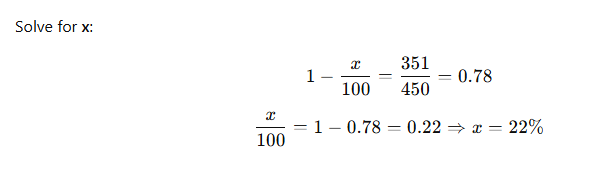
Discount % = 99/450 × 100 = 22%

Cetking shortcut: MP = 2 × CP, so SP/MP = 1.56/2 = 0.78 → discount = 22% directly.

Answer: D

Solution figure for question 101Solution figure for question 101
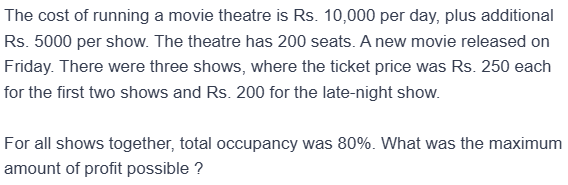
Q130MediumCET 2025 · Slot 1 · Q130

The cost of running a movie theatre is Rs. 10,000 per day, plus additional Rs. 5000 per show. The theatre has 200 seats. A new movie released on Friday. There were three shows, where the ticket price was Rs. 250 each for the first two shows and Rs. 200 for the late-night show.

For all shows together, total occupancy was 80%. What was the maximum amount of profit possible ?
Figure for MBA CET 2025 Slot 1 question 130
  1. 120000rs
  2. 116000rs
  3. 91000rs
  4. 95000rs
  5. 87500rs
Show answerHide answer

Answer: C

Approach: Fix total tickets, push them into ₹250 shows, then subtract all costs.

Solution:
Cost = 10,000 + 3 × 5,000 = ₹25,000
Tickets sold = 80% of (3 × 200) = 480
Max revenue: 200 + 200 tickets at ₹250 and 80 at ₹200
Revenue = 50,000 + 50,000 + 16,000 = ₹1,16,000
Profit = 1,16,000 − 25,000 = ₹91,000

Why the other options are wrong:
B (116000): that is revenue, not profit.
A (120000): puts all 480 tickets in ₹250 shows, ignoring the 200-seat limit per show.
E (87500): near the equal-occupancy profit (₹87,000), not the maximum.
D (95000): that is 120000 − 25000, built on the same seat-limit mistake.

Cetking shortcut: Equal split gives 160 × (250 + 250 + 200) = 1,12,000; moving 80 tickets from ₹200 to ₹250 shows adds 80 × 50 = 4,000 → 1,16,000 − 25,000 = 91,000.

Answer: C

Solution figure for question 130

Practise these in the Arena

Take timed tests built around MBA CET topics and see where you stand.

Open the Arena