At a start of a seminar, the ratio of the number of male participants to the number of female participants was 3:1. During the tea break, 12 male and 4 female participants left the seminar and 6 new female participants joined the seminar. The ratio of the male to the female participants now is 2:1. What was the total number of participants at the start of the seminar ?
- A64
- B48
- C50
- D52
- E72
Show answerHide answer
Answer: A ✓ official key
Approach: Write the initial ratio with one variable and set up the new ratio.
Solution:
Start: males 3x, females x.
After break: males 3x − 12; females x − 4 + 6 = x + 2.
(3x − 12)/(x + 2) = 2 → 3x − 12 = 2x + 4 → x = 16.
Total at start = 3x + x = 4x = 64.
Cetking shortcut: Total must be a multiple of 4 (3 : 1) → 64, 48, 52, 72; test 64: 48 − 12 = 36 males, 16 + 2 = 18 females → 2 : 1 ✔
Answer: A
In a manufacturing company, three distinct types of gadgets—A, B, and C—were produced in January in the ratio 3:4:5. Due to varying market demands in February, the company decided to retain the production level of A unchanged, double the production of B, and increase the production of C by fifty percent, resulting in a total combined output of 5402 units across all three types.
Considering these adjustments, determine the number of units produced in February for each type of gadget.
- AA = 886, B = 2346, C = 2190
- BA = 876, B = 2336, C = 2187
- CA = 876, B = 2336, C = 2190
- DA = 875, B = 2350, C = 2182
- EA = 890, B = 2360, C = 2282
Show answerHide answer
Answer: C ✓ official key
Approach: Ratio with a multiplier k; apply the changes and solve for k.
Solution:
January: A = 3k, B = 4k, C = 5k.
February: A = 3k, B = 8k, C = 7.5k → total 18.5k.
18.5k = 5402 → k = 292.
A = 876, B = 2336, C = 7.5 × 292 = 2190.
Why the other options are wrong:
B (2187) and others fail the total 5402 or the 3 : 8 : 7.5 ratio.
Cetking shortcut: Only C sums to 5402 with A divisible by 3 and B = 8/3 of A — check sums: 876 + 2336 + 2190 = 5402.
Answer: C
The ratio of the sum of two positive numbers to their difference is
(2x + 1) : (x − 1), x ≠ 1
If the ratio of the larger number to the smaller number is an integer, then which of the following must be true?
- Ax = 3
- Bx = 4
- Cx = 5
- Dx = 6
- Ex=7
Show answerHide answer
Answer: B ✓ official key
Approach: Componendo–dividendo converts (sum : difference) into (larger : smaller).
Solution:
Let the numbers be a > b. (a + b)/(a − b) = (2x + 1)/(x − 1).
Componendo–dividendo: a/b = [(2x + 1) + (x − 1)] / [(2x + 1) − (x − 1)] = 3x/(x + 2).
Test options: x = 3 → 9/5; x = 4 → 12/6 = 2 ✓; x = 5 → 15/7; x = 6 → 18/8; x = 7 → 21/9.
Only x = 4 makes a : b an integer.
Why the other options are wrong:
- A, C, D, E: give 9/5, 15/7, 9/4, 7/3 — not integers.
Cetking shortcut: 3x/(x + 2) = 3 − 6/(x + 2), so (x + 2) must divide 6 → x + 2 = 6 → x = 4 (x + 2 = 3 gives x = 1, excluded).
Answer: B
If A : B = 2 : 3 and B : C = 4 : 5, find the ratio A : C.
- A2:5
- B8:15
- C3:5
- D8:12
- E6:15
Show answerHide answer
Answer: B ✓ official key
Approach: Chain two ratios by making the common term (B) equal.
Solution:
A : B = 2 : 3 and B : C = 4 : 5.
Make B equal: LCM of 3 and 4 = 12.
A : B = 8 : 12 and B : C = 12 : 15.
So A : B : C = 8 : 12 : 15 ⇒ A : C = 8 : 15.
Why the other options are wrong:
A (2:5) – simply multiplies the outer terms, ignoring B.
C (3:5) – uses B's term from the second ratio wrongly.
D (8:12) – this is A : B, not A : C.
E (6:15) – multiplies 2 × 3 instead of 2 × 4.
Cetking shortcut: A : C = (2 × 4) : (3 × 5) = 8 : 15 — multiply the 'A-side' numerators and the 'C-side' denominators directly.
Answer: B
If A : B = 3 : 4
B : C = 8 : 10
C : D = 15 : 17
and if A+B+C+D=212
then the value of D is ?
- A68
- B65
- C76
- D85
- E90
Show answerHide answer
Answer: A ✓ official key
Approach: Chain the ratios by making the common term equal.
Solution:
A : B = 3 : 4 = 6 : 8 and B : C = 8 : 10 → A : B : C = 6 : 8 : 10.
C : D = 15 : 17; make C = 30 (LCM of 10 and 15): A : B : C = 18 : 24 : 30 and C : D = 30 : 34.
A : B : C : D = 18 : 24 : 30 : 34, total 106 parts.
1 part = 212 / 106 = 2 → D = 34 × 2 = 68.
Cetking shortcut: 212 = 2 × 10⁶, so the answer must be 2 × (D's parts); only 68 = 2 × 34 fits once C is scaled to 30.
Answer: A
Mr Sharma owns 2505 rice bags and distributes them among his three sons Aman Rohit and Suresh in a certain ratio Out of the total bags received by each of them Aman sells 30 bags Rohit donates 30 bags and Suresh loses 25 bags Now the ratio of bags with them is 46 : 41 : 34 respectively How many bags did Rohit receive from his father.
- A840
- B850
- C870
- D890
- E900
Show answerHide answer
Answer: B ✓ official key
Approach: Write the final quantities as ratio multiples k, then add back what was removed.
Solution:
After changes: Aman = 46k, Rohit = 41k, Suresh = 34k.
Original: Aman = 46k + 30, Rohit = 41k + 30, Suresh = 34k + 25.
Total: 121k + 85 = 2505 → 121k = 2420 → k = 20.
Rohit received 41 × 20 + 30 = 850.
Cetking shortcut: 2505 − 85 = 2420 is divisible by 121 (= 46 + 41 + 34) → k = 20 at once.
Answer: B
DIRECTION for the question: Solve the following question and mark the best possible option.
When a sum of money was distributed to 12 persons instead of 16 persons, each person got Rs. 400 more. What was the sum?
- ARs. 14400
- BRs. 16000
- CRs. 19200
- DRs. 14151
- ERs. 16987
Show answerHide answer
Answer: C ✓ official key
Approach: Equate the difference in per-head shares.
Solution: Let the sum be S. S/12 − S/16 = 400.
LCM 48: (4S − 3S)/48 = 400 ⇒ S/48 = 400.
S = 19200.
Cetking shortcut: The 4 removed people's money (4 × S/16) is now shared as 400 each by 12 people = 4800 ⇒ S/16 = 1200 ⇒ S = 19200.
Answer: C
DIRECTION for the question: Solve the following question and mark the best possible option.
The expenses of A and B are in the ratio 2 : 3. A sum of Rs. 2800 is equally divided between them. If A saves Rs. 600, then B saves?
- ARs.200
- BRs.300
- CRs.400
- DRs.500
- ERs.600
Show answerHide answer
Official CET key: A · Cetking's answer: B — see why below
Approach: Income − expense = saving.
Solution: Each gets 2800 ÷ 2 = 1400.
A's expense = 1400 − 600 = 800.
A : B expense = 2 : 3 ⇒ B's expense = 800 × 3/2 = 1200.
B's saving = 1400 − 1200 = Rs. 200.
Why the other options are wrong:
B (300): no consistent working gives this.
E (600): assumes equal savings.
C, D: misuse the ratio on savings.
Answer: A
DIRECTION for the question: Solve the following question and mark the best possible option.
There are 420 coins consisting of one-rupee coins, 50-paise coins and 25-paise coins. If the ratio of their values is 2 : 3 : 5, then the number of one-rupee coins is
- A20
- B30
- C90
- D300
- E50
Show answerHide answer
Answer: B ✓ official key
Approach: Convert value ratio to number ratio.
Solution: Values = 2k, 3k, 5k rupees.
Counts: ₹1 coins = 2k; 50p coins = 3k ÷ 0.5 = 6k; 25p coins = 5k ÷ 0.25 = 20k.
2k + 6k + 20k = 28k = 420 ⇒ k = 15.
One-rupee coins = 2 × 15 = 30.
Why the other options are wrong:
D (300): number of 25p coins.
C (90): number of 50p coins.
A, E: arithmetic slips.
Answer: B
DIRECTION for the question: Solve the following question and mark the best possible option.
The cost of 16 packets of salt, each weighing 900 grams, is Rs. 28. What will be the cost of 27 packets if each packet weighs 1 kg?
- ARs. 52.50
- BRs. 56
- CRs. 58.50
- DRs. 64.75
- ERs. 28.50
Show answerHide answer
Answer: A ✓ official key
Approach: Unitary method on total weight.
Solution: Weight bought = 16 × 900 g = 14,400 g for Rs. 28.
Required weight = 27 × 1000 g = 27,000 g.
Cost = 28 × 27000/14400 = 28 × 15/8 = Rs. 52.50.
Why the other options are wrong:
B (56): doubles 28.
C, D, E: calculation slips; 47.25 (packets only) is not offered.
Answer: A
There are two children named p and q . If it is known that the ages of p and q are in a ratio of 4:20. and the sum of their ages is 10 years and 6months. Find the age of q
- A5 years
- B8 years
- C4 years
- D7 years
- E6 years
Show answerHide answer
Answer: B
Approach: Ratio split of a total.
Solution:
p : q = 4 : 20 = 1 : 5.
Sum = 10 years 6 months = 10.5 years ⇒ 6 parts = 10.5 ⇒ 1 part = 1.75.
q = 5 × 1.75 = 8.75 years = 8 years 9 months.
Why the other options are wrong:
Only B (8 years) carries q's age in whole years; A 5, C 4, D 7, E 6 years do not fit 5/6 of 10.5.
Cetking shortcut: q = 5/6 × 10.5 = 8.75 ⇒ 8 years (9 months).
Answer: B
Aman divides his property so that his son’s share to his wife's and the wife's share to his daughter are both in the ratio 3:1. If the daughter gets 10,000 less than the son, find the total worth of the property.
- A20,000
- B16,000
- C15,750
- D16,250
- E20,500
Show answerHide answer
Answer: D
Approach: Chain the two ratios by making the common term (wife) equal.
Solution:
Son : Wife = 3 : 1 = 9 : 3
Wife : Daughter = 3 : 1
Son : Wife : Daughter = 9 : 3 : 1
Son − Daughter = 8 units = ₹10,000 → 1 unit = ₹1,250
Total = 13 units = 13 × 1,250 = ₹16,250
Cetking shortcut: Total must be a multiple of 13 × 1250; only 16,250 = 13 × 1250 fits.
Answer: D
In a camp, there is a meal for 120 men or 200 children. If 150 children have taken the meal, how many men will be catered to with the remaining meal?
- A20
- B30
- C40
- D50
- E60
Show answerHide answer
Answer: B
Approach: Equivalence: 120 men's meal = 200 children's meal.
Solution:
1 man ≡ 200/120 = 5/3 children
150 children eat 150/200 = 3/4 of the meal
Remaining 1/4 of the meal feeds 1/4 × 120 = 30 men
Cetking shortcut: Children left unfed = 50 → men = 50 × 120/200 = 30.
Answer: B
A fires 5 shots to B's 3 but A kills only once in 3 shots while B kills once in 2 shots. When B has missed 27 times, A has killed how many?
- A20
- B30
- C40
- D35
- E25
Show answerHide answer
Answer: B
Approach: Ratio chain: convert B's misses to B's shots, then to A's shots and A's kills.
Solution:
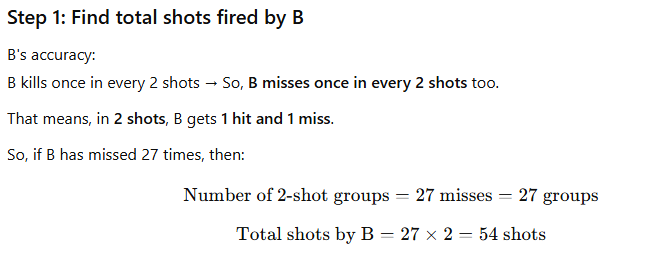
B kills once in 2 shots ⇒ B misses 1 in every 2 shots.
B missed 27 times ⇒ B fired 27 × 2 = 54 shots.
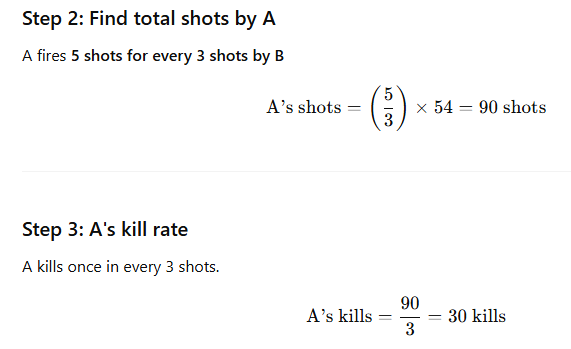
A : B shots = 5 : 3 ⇒ A fired 54 × 5/3 = 90 shots.
A kills once in 3 shots ⇒ A killed 90 / 3 = 30.
Cetking shortcut: Kills of A = misses of B × 2 × (5/3) × (1/3) = 27 × 10/9 = 30.
Answer: B
At a college football game, 4/5 of the seats on the lower deck of the stadium were sold. If 1/4 of all the seating in the stadium is located on the lower deck, and if 2/3 of all the seats in the stadium were sold, what is the fraction of unsold seats on the lower deck to the total number of unsold seats?
- A3/20
- B1/20
- C1/2
- D1/5
- E2/5
Show answerHide answer
Answer: A
Approach: Assume a convenient total and convert each fraction to counts.
Solution:
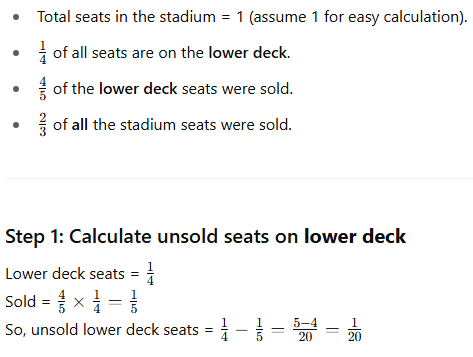
Let total seats = 60 (LCM of 4, 5, 3).
Lower deck = 1/4 × 60 = 15 seats; sold = 4/5 × 15 = 12 → unsold on lower deck = 3.
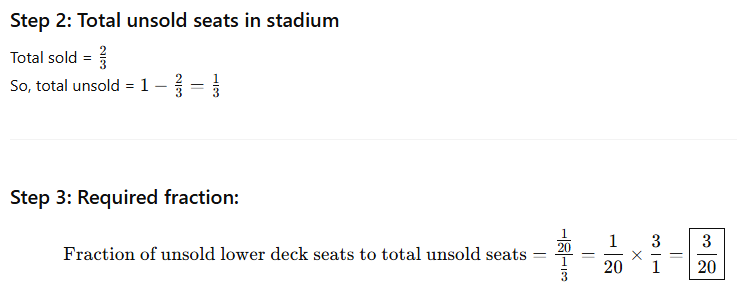
Total sold = 2/3 × 60 = 40 → total unsold = 20.
Required fraction = 3/20.
Why the other options are wrong:
B (1/20): this is unsold lower-deck seats as a fraction of all seats, not of unsold seats.
C, D, E: do not follow from the counts 3 and 20.
Cetking shortcut: Take total = 60 (LCM of denominators) — all counts become integers instantly.
Answer: A
Rs. 8400 is divided among A, B, C, and D in such a way that the shares of A and B, B and C as well as C and D are in the ratios of 2:3, 4:5, and 6:7 respectively. What will be the share of A?
- A1280
- B1320
- C8210
- D8400
- E4200
Show answerHide answer
Answer: A
Approach: Build one continued ratio A : B : C : D.
Solution: A:B = 2:3, B:C = 4:5 → make B equal (LCM 12): A:B:C = 8:12:15.
C:D = 6:7 → make C equal (LCM of 15 and 6 = 30): A:B:C:D = 16:24:30:35.
Sum = 16 + 24 + 30 + 35 = 105 parts.
A = 16/105 × 8400 = 16 × 80 = 1280.
Cetking shortcut: A:B:C:D = (2·4·6) : (3·4·6) : (3·5·6) : (3·5·7) = 48:72:90:105 = 16:24:30:35.
Answer: A
The ratio of incomes of two persons is 5:3 and that of their expenditures is 9:5. If they save Rs 2600 and Rs 1800 respectively, their incomes are?
- A9000, 5400
- B10000, 6000
- C6000, 3600
- D8000, 4800
- E2600, 1800
Show answerHide answer
Answer: D
Approach: Incomes 5x, 3x; expenditures 9y, 5y.
Solution: 5x − 9y = 2600 …(1)
3x − 5y = 1800 …(2)
(1)×5: 25x − 45y = 13000; (2)×9: 27x − 45y = 16200.
Subtract: 2x = 3200 → x = 1600.
Incomes = 5 × 1600 = 8000 and 3 × 1600 = 4800.
Check: expenditures 8000 − 2600 = 5400, 4800 − 1800 = 3000 → 5400:3000 = 9:5 ✔
Cetking shortcut: Option check — subtract savings from each option's incomes and test 9:5: only D gives 5400:3000 = 9:5.
Answer: D
Rs. 8400 are divided among A, B, C, and D in such a way that the shares of A and B, B and C, as well as C and D are in the ratios of 2:3, 4:5, and 6:7 respectively. Determine the share of A.
- A₹1020
- B₹1280
- C₹8450
- D₹4200
- E₹1320
Show answerHide answer
Answer: B
Approach: Chain the ratios A : B : C : D by making common terms equal.
Solution:
A : B = 2 : 3 = 8 : 12; B : C = 4 : 5 = 12 : 15 → A : B : C = 8 : 12 : 15.
C : D = 6 : 7 → scale: A : B : C = 48 : 72 : 90 and C : D = 90 : 105.
A : B : C : D = 48 : 72 : 90 : 105, sum = 315.
A = 8400 × 48/315 = ₹1280.
Why the other options are wrong: ₹4200 is half the total; ₹8450 exceeds the total; ₹1020 and ₹1320 do not match 48/315.
Cetking shortcut: A share = 2×4×6 : 3×4×6 : 3×5×6 : 3×5×7 = 48 : 72 : 90 : 105 (multiply across).
Answer: B
Alifa’s marks in 5 subjects are in ratio 10:9:8:7:6. Passing marks = 50%.
If she scores an average of 60%, how many subjects did she pass?
- A1
- B2
- C3
- D5
- E4
Show answerHide answer
Answer: E
Approach: Ratio scores out of 100 each; average fixes the multiplier.
Solution:
Scores = 10x, 9x, 8x, 7x, 6x (each out of 100). Total = 40x.
Average 60% → total = 300 → x = 7.5.
Scores: 75, 67.5, 60, 52.5, 45.
Pass mark 50 → four subjects pass (75, 67.5, 60, 52.5); 45 fails.
Cetking shortcut: The middle term (8x) equals the average, 60; one step is 60/8 = 7.5, so 6x = 45 is the only score below 50.
Answer: E
One third of the buses from City A to City B stop at City C, while the rest go non-stop to City B. One third of the passengers in the buses stopping at City C, continue to City B, while the rest alight at City C. All the buses have equal capacity and always start full from City A. What proportion of the passengers going to City B from City A travel by a bus stopping at City C?
- A4/9
- B6/7
- C1/7
- D2/7
- E7/9
Show answerHide answer
Answer: C
Approach: Assume convenient numbers: 3 buses of capacity k.
Solution:
1 bus stops at C, 2 go non-stop.
Bus via C: k passengers, 1/3 continue to B → k/3.
Non-stop buses: 2k to B.
Total going to B = 2k + k/3 = 7k/3.
Share by the stopping bus = (k/3)/(7k/3) = 1/7.
Cetking shortcut: Take k = 3: via C → 1 passenger, non-stop → 6; answer 1/(1 + 6) = 1/7.
Answer: C
a, b, c are in ratios a:b = 3:4 and b:c = 2:1. Find possible value of (a + b + c)
- A210
- B201
- C213
- D207
- E205
Show answerHide answer
Answer: D
Approach: Combine the ratios; the sum must be a multiple of the ratio-sum.
Solution:
a : b = 3 : 4, b : c = 2 : 1 = 4 : 2 → a : b : c = 3 : 4 : 2.
a + b + c = 9k → must be divisible by 9.
Digit sums: 210 → 3, 201 → 3, 213 → 6, 207 → 9 ✓, 205 → 7.
207 = 9 × 23 (a = 69, b = 92, c = 46).
Cetking shortcut: Divisibility by 9 = digit sum divisible by 9 — only 207.
Answer: D
Value of coin ∝ square of diameter (if thickness constant), and ∝ thickness (if diameter constant). Diameter ratio = 4:3, value ratio = 4:1. Find thickness ratio?
- A9:16
- B9:4
- C16:25
- D16:9
- E4:9
Show answerHide answer
Answer: B
Approach: Joint variation: value ∝ d² × t.
Solution:
V = k d² t → V₁/V₂ = (d₁/d₂)² × (t₁/t₂).
4/1 = (4/3)² × (t₁/t₂) = (16/9)(t₁/t₂).
t₁/t₂ = 4 × 9/16 = 9/4 → thickness ratio = 9 : 4.
Why the other options are wrong: 16 : 9 is just the diameter-squared ratio; 9 : 16 and 4 : 9 invert the relation.
Answer: B
The ratio of weight of three friends, namely, Aashiqui, Aarohi and Aamrohi is 4:9:7. Their total weight is 100 kilograms. How much weight would Aamrohi would have put on if the ratio after her weight gain is 4 : 7 : 9 and their collective weight becomes 140 kilograms ?
- A28kg
- B63kg
- C49kg
- D21kg
- E35kg
Show answerHide answer
Answer: A
Approach: Ratio → actual weight before and after.
Solution:
Before: 4 + 9 + 7 = 20 parts = 100 kg → 1 part = 5 kg
Aamrohi before = 7 × 5 = 35 kg
After: 4 + 7 + 9 = 20 parts = 140 kg → 1 part = 7 kg
Aamrohi after = 9 × 7 = 63 kg
Weight gained = 63 − 35 = 28 kg
Why the other options are wrong:
B (63): that is her new weight, not the gain.
E (35): her original weight.
C (49), D (21): come from using the wrong ratio position (7 × 7, 7 × 3).
Cetking shortcut: Both totals are 20 parts: gain = 9 × 7 − 7 × 5 = 28.
Answer: A
If a certain wheel turns at a constant rate of x revolutions per minute, how many revolutions will the wheel make in k seconds ?
- Akx/60
- Bx/(60k)
- Ckx
- Dx/k
- E60kx
Show answerHide answer
Answer: A
Approach: Convert k seconds to minutes and multiply by the rate.
Solution:
Rate = x revolutions per minute = x/60 revolutions per second
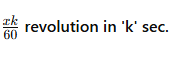
In k seconds: (x/60) × k = kx/60
Why the other options are wrong:
B, D: divide by k — revolutions must grow with time.
C: forgets the minute-to-second conversion.
E: converts the wrong way (× 60).
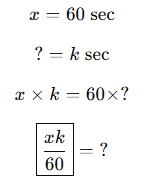
Cetking shortcut: Plug numbers: x = 60 rpm, k = 1 s → 1 revolution; only kx/60 gives 1.
Answer: A