A sentence is divided in parts in the given alternatives. Analyse the given parts of sentence to find out if there is any grammatical error in it. The error, if any, will be in one part of the sentence. Mark 'No error' as your answer if there is no grammatical error in any part of the given sentence. (Ignore punctuation errors)
Having received your letter this morning we are writing to thank you
- AHaving received your letter
- Bthis morning
- Cwe are writing
- Dto thank you
- ENo error
Show answerHide answer
Answer: E ✓ official key
Approach: Participle phrase — check the subject and tense.
Solution: 'Having received your letter this morning, we are writing to thank you.' The perfect participle 'having received' shows the earlier action and correctly refers to the subject 'we'. 'Are writing' (action in progress) and 'to thank you' (purpose) are both correct. No part has an error.
Why the other options are wrong:
A: Correctly attached to 'we' — not dangling.
B: 'this morning' fits the past action of receiving.
C: Present continuous is correct for the current act of writing.
D: Infinitive of purpose is correct.
Answer: E
Analyse the given sentence to find out if there is any grammatical error in it. The error, if any, will be in one part of the sentence. Mark 'No error' as your answer if there is no grammatical error in the given sentence. (Ignore punctuation errors)
A lot of travel delay is caused due to the inefficiency and lack of good management infront of the railways
- AA lot of travel delay is caused
- Bdue to the inefficiency
- Cand lack of good management
- Dinfront of the railways
- ENo error
Show answerHide answer
Answer: D ✓ official key
Approach: Preposition/phrase usage — 'on the part of'.
Solution: The delay is due to inefficiency and poor management on the part of the railways (= by the railways). 'Infront of' means physical position, which makes no sense here — and is also wrongly written as one word ('in front of'). Correct: '…lack of good management on the part of the railways.'
Why the other options are wrong:
A: 'A lot of travel delay is caused' — acceptable.
B: 'due to the inefficiency' — acceptable in this exam context.
C: 'and lack of good management' — correct.
Cetking shortcut: Responsibility of a person/organisation → 'on the part of'.
Answer: D
Analyse the given sentence to find out if there is any grammatical error in it. The error, if any, will be in one part of the sentence. Mark 'No error' as your answer if there is no grammatical error in the given sentence. (Ignore punctuation errors)
Do the roses in your garden smell more sweetly than those in ours
- ADo the roses
- Bin your garden smell
- Cmore sweetly
- Dthan those in ours
- ENo error
Show answerHide answer
Answer: C ✓ official key
Approach: Linking (sense) verbs take adjectives, not adverbs.
Solution: 'Smell' here describes the roses' quality (a linking verb, like look/taste/feel/seem), so it needs an adjective: 'Do the roses in your garden smell sweeter than those in ours?' 'More sweetly' (adverb) is wrong — part C.
Why the other options are wrong:
A: 'Do the roses' — plural subject with 'do', correct.
B: 'in your garden smell' — base form after 'do', correct.
D: 'those in ours' — correct pronoun comparison.
Cetking shortcut: Replace the verb with 'are': 'Are the roses sweeter?' makes sense → adjective needed.
Answer: C
Analyse the given sentence to find out if there is any grammatical error in it. The error, if any, will be in one part of the sentence. Mark 'No error' as your answer if there is no grammatical error in the given sentence. (Ignore punctuation errors).
It is easy to see that a lawyer's demeanour in court may be prejudicial against the interests of his client.
- AIt is easy to see that
- Ba lawyer's demeanour in court
- Cmay be prejudicial
- Dagainst the interests of his client
- ENo error
Show answerHide answer
Answer: D ✓ official key
Approach: Fixed preposition — 'prejudicial to'.
Solution: The adjective 'prejudicial' (= harmful) takes 'to': 'prejudicial to the interests of his client.' 'Prejudicial against' is incorrect, so the error is in part D.
Why the other options are wrong:
A: 'It is easy to see that' — correct.
B: 'a lawyer's demeanour in court' — correct possessive.
C: 'may be prejudicial' — correct modal + adjective.
Cetking shortcut: Learn the pair list: prejudicial to, detrimental to, averse to, prior to.
Answer: D
In the question below, four words printed in bold type are given. These are numbered (A), (B), (C) and (D). One of these words might either be wrongly spelt or inappropriate in the context of the sentence. Find out the word that is inappropriate or wrongly spelt, if any. If all are correct, mark (E).
The committee (A) has (B) advised (C) the government to adopt a more pragmatic approach (D) to the crisis.
- Acommittee
- Bhas
- Cadvised
- Dpragmatic
- EAll correct
Show answerHide answer
Answer: E ✓ official key
Approach: Spelling/context check of each bold word.
Solution: 'The committee has advised the government to adopt a more pragmatic approach to the crisis.'
A. committee — spelt correctly (double m, double t, double e).
B. has — singular verb correct for the collective noun acting as one body.
C. advised — correct verb form and spelling.
D. pragmatic approach — 'pragmatic' is correctly spelt and fits the context (practical, realistic).
Nothing is wrong — E.
Why the other options are wrong:
A: Correctly spelt.
B: Committee acting as one unit takes 'has'.
C: Correct past participle.
D: Correct spelling and usage.
Cetking shortcut: 'Committee' is the classic spelling trap — mm, tt, ee; once it checks out, look for 'All correct'.
Answer: E
The given sentence has been broken up into four different parts. The error, if any, will be in any one part of the sentence. Select the option which contains the part of the sentence which has an error (spelling, grammatical or contextual). If there is no error, choose option E.
Properties of the willful defaulters (A) / were confisceted by the government (B) / last month after the Enforcement Directorate (C) / filed a charge sheet against them. (D) / No Error (E)
- AA
- BB
- CC
- DD
- EE
Show answerHide answer
Answer: B ✓ official key
Approach: Error spotting covers spelling too — scan every word.
Solution: Part B has 'confisceted'; the correct spelling is 'confiscated'. The rest is fine: 'Properties … were confiscated' (plural agreement), 'last month after the Enforcement Directorate filed a charge sheet against them'.
Why the other options are wrong:
A, C, D — grammatically and spelling-wise correct.
E — there is an error in B.
Answer: B
The given sentence has been broken into four parts. Identify the part that contains an error. If there is no error, choose option E.
She is more smarter (A) / than her sister (B) / in solving (C) / mathematical problems. (D) / No Error (E)
- AA
- BB
- CC
- DD
- EE
Show answerHide answer
Answer: A ✓ official key
Approach: Comparatives: either 'more + adjective' or 'adjective + -er', never both.
Solution: 'She is more smarter' is a double comparative; correct: 'She is smarter than her sister in solving mathematical problems.' Error in A.
Why the other options are wrong:
B 'than her sister', C 'in solving', D 'mathematical problems' — all correct.
E — there is an error in A.
Answer: A
DIRECTION for the question: Read the sentence given below to find out whether there is any grammatical or idiomatic error in it. The error, if any, will be in one part of the sentence. That part of the sentence is the answer. If there is no error, the answer is ‘No error’.
Even now when I see the spot (A)/ I am reminded of an unique incident (B)/ that took place (C)/ several years ago. (D)/ No error (E)
- AEven now when I see the spot
- BI am reminded of an unique incident
- Cthat took place
- Dseveral years ago.
- ENo error
Show answerHide answer
Answer: B ✓ official key
Approach: Article rule: 'a' before a consonant sound, 'an' before a vowel sound.
Solution: 'Unique' is pronounced 'yoo-neek'; it begins with the consonant sound /j/. So it takes 'a', not 'an'.
Correct part B: 'I am reminded of a unique incident'.
Why the other options are wrong:
A 'Even now when I see the spot' is correct.
C 'that took place' correctly uses past tense for a past event.
D 'several years ago' correctly pairs with simple past.
E There is an error in B.
Cetking shortcut: Same trap words: a university, a European, a one-day match, a useful tip; but an hour, an honest man, an MBA.
Answer: B
DIRECTION for the question: Read the sentence given below to find out whether there is any grammatical or idiomatic error in it. The error, if any, will be in one part of the sentence. That part of the sentence is the answer. If there is no error, the answer is ‘No error’.
The need to set up (A)/ a good library in the locality (B)/ has been in the minds of people (C)/ for some time now (D)/ No error (E)
- AThe need to set up
- Ba good library in the locality
- Chas been in the minds of people
- Dfor some time now
- ENo error
Show answerHide answer
Official CET key: C · Cetking's answer: E — see why below
Approach: Preposition in a fixed expression: something you are concerned about is 'on your mind'.
Solution: The sentence says a need 'has been in the minds of people for some time now', i.e. it has been a concern people kept thinking about. The standard idiom for that is 'on the minds of people' / 'on people's minds'.
Correct part C: 'has been on the minds of people'.
Subject-verb ('The need ... has been') and the present perfect with 'for some time now' are both correct.
Why the other options are wrong:
A 'The need to set up' is correct.
B 'a good library in the locality' is correct.
D 'for some time now' correctly pairs with present perfect 'has been'.
E 'No error' is wrong because the preposition in C is idiomatically incorrect.
Cetking shortcut: When grammar (tense, agreement, articles) is clean, check the prepositions in fixed phrases: on one's mind, in one's opinion, at one's wits' end.
Answer: C
DIRECTION for the question: Read the sentence given below to find out whether there is any grammatical or idiomatic error in it. The error, if any, will be in one part of the sentence. That part of the sentence is the answer. If there is no error, the answer is ‘No error’.
It being rainy day, (A) / we decided not to go out (B) / but to stay at home (C) / and watch a movie. (D) / No error (E)
- AIt being rainy day,
- Bwe decided not to go out
- Cbut to stay at home
- Dand watch a movie.
- ENo error
Show answerHide answer
Answer: A ✓ official key
Approach: Articles: a singular countable noun cannot stand alone.
Solution: 'Day' is a singular countable noun; with an adjective before it, it still needs 'a'.
Correct part A: 'It being a rainy day,'.
The rest ('we decided not to go out but to stay at home and watch a movie') is parallel and correct.
Why the other options are wrong:
B 'we decided not to go out' is correct.
C 'but to stay at home' is parallel with 'not to go out'.
D 'and watch a movie' correctly continues 'to stay ... and (to) watch'.
E There is an error in A.
Answer: A
In the following question, a sentence is written in different ways. Choose the sentence that is grammatically correct.
a) Knowing the area is prone for earthquakes, all the buildings were reinforced with additional steel and concrete.
b) Since the area was knowing to be prone to earthquakes, all the buildings were reinforced with additional steel and concrete.
c) Being prone to earthquake, all the buildings were reinforced with additional steel and concrete.
d) Since the area was prone to earthquakes, all the buildings were reinforced with additional steel and concrete.
e) As the area was known to earthquakes, all the buildings were reinforced with additional steel and concrete.
- AKnowing the area is prone for earthquakes, all the buildings were reinforced with additional steel and concrete.
- BSince the area was knowing to be prone to earthquakes, all the buildings were reinforced with additional steel and concrete.
- CBeing prone to earthquake, all the buildings were reinforced with additional steel and concrete.
- DSince the area was prone to earthquakes, all the buildings were reinforced with additional steel and concrete.
- EAs the area was known to earthquakes, all the buildings were reinforced with additional steel and concrete.
Show answerHide answer
Answer: D ✓ official key
Approach: Check each version for modifier, preposition and verb-form errors.
Solution: D: 'Since the area was prone to earthquakes, all the buildings were reinforced ...' — clear cause clause, correct preposition 'prone to', correct tense.
Why the other options are wrong:
A — dangling 'Knowing ...' (the buildings did not know) + 'prone for'.
B — 'was knowing' is wrong; should be 'was known'.
C — dangling 'Being prone ...' and 'earthquake' should be plural.
E — 'known to earthquakes' is meaningless; should be 'prone to'.
Cetking shortcut: Any sentence opening with a participle (-ing) must have the doer as the next noun — A and C fail that test instantly.
Answer: D
In the following question, a sentence is written in different ways. Choose the sentence that is grammatically correct.
a) It must be noted that under no circumstance should the company go in for diversification.
b) It must be noticed that under no circumstance should the company go in for diversification.
c) It must be noted that under no circumstance should the company enter for diversification.
d) It must be noted that under no circumstance should, company go in for diversification.
e) It must be noted that under no circumstance should the company go in diversification.
- AIt must be noted that under no circumstance should the company go in for diversification.
- BIt must be noticed that under no circumstance should the company go in for diversification.
- CIt must be noted that under no circumstance should the company enter for diversification.
- DIt must be noted that under no circumstance should, company go in for diversification.
- EIt must be noted that under no circumstance should the company go in diversification.
Show answerHide answer
Answer: A ✓ official key
Approach: Negative inversion + correct phrasal verb.
Solution: A: 'It must be noted that under no circumstance should the company go in for diversification.' — 'should the company go' is correct inversion; 'go in for' = choose to take up.
Why the other options are wrong:
B — 'noticed' wrong word; 'noted' = kept in mind.
C — 'enter for diversification' wrong phrasal verb.
D — stray comma and missing article 'the'.
E — 'go in diversification' drops 'for'.
Cetking shortcut: All five share the frame; spot the single change in each and reject it.
Answer: A
In the following question, a sentence is written in different ways. Choose the sentence that is grammatically correct.
a) The article tells the story of the famous author and the effective strategy he used to overcome his chronic illness.
b) The article tells the story of the famous author and the effective strategy he used to overcoming his chronic illness.
c) These article tells the story of the famous author and the effective strategy he used to overcome his chronic illness.
d) The article tells the story of the famous author and his effective strategy, he used to overcome his chronic illness.
e) The article tells the story of the famous author and how his effective strategy helped him to overcoming chronic illness.
- AThe article tells the story of the famous author and the effective strategy he used to overcome his chronic illness.
- BThe article tells the story of the famous author and the effective strategy he used to overcoming his chronic illness.
- CThese article tells the story of the famous author and the effective strategy he used to overcome his chronic illness.
- DThe article tells the story of the famous author and his effective strategy, he used to overcome his chronic illness.
- EThe article tells the story of the famous author and how his effective strategy helped him to overcoming chronic illness.
Show answerHide answer
Answer: A ✓ official key
Approach: Infinitive of purpose, determiner agreement and clause structure.
Solution: A: 'The article tells the story of the famous author and the effective strategy he used to overcome his chronic illness.' — 'to overcome' is the infinitive of purpose; all parts agree.
Why the other options are wrong:
B — 'to overcoming' wrong after 'used' (purpose).
C — 'These article' — plural determiner with singular noun.
D — the comma makes 'he used to overcome ...' a run-on clause.
E — 'helped him to overcoming' — wrong verb form.
Answer: A
Choose the correct sentence:
A. When Ramesh met Suresh, he was nervous.
B. When Ramesh met Suresh, the latter was nervous.
C. When Ramesh met Suresh, he felt anxiety.
D. When Ramesh met Suresh, nervousness was present.
E. When Ramesh met Suresh, his nervousness increased.
- AWhen Ramesh met Suresh, he was nervous.
- BWhen Ramesh met Suresh, the latter was nervous.
- CWhen Ramesh met Suresh, he felt anxiety.
- DWhen Ramesh met Suresh, nervousness was present.
- EWhen Ramesh met Suresh, his nervousness increased.
Show answerHide answer
Answer: B ✓ official key
Approach: Pronoun ambiguity — a pronoun must point clearly to one noun.
Solution: "When Ramesh met Suresh, he was nervous" — "he" could be Ramesh or Suresh. Option B uses "the latter" (= the second-named person, Suresh), removing the ambiguity. B is the correct sentence.
Why the other options are wrong:
A: "he" is ambiguous.
C: "he" is still ambiguous.
D: Whose nervousness is unclear; awkward and vague.
E: "his" is ambiguous.
Cetking shortcut: When two same-gender people are named, any option still using he/his/him is out.
Answer: B
In the following sentence, one part of the sentence has an error. Find out that particular part and select the appropriate option. If there is no error in the sentence, choose E as your answer.
The number of students (A)who has applied (B)for the scholarship (C)is increasing.(D)
- AThe number of students
- Bwho has applied
- Cfor the scholarship
- Dis increasing.
- ENo error
Show answerHide answer
Answer: B ✓ official key
Approach: Subject–verb agreement in a relative clause.
Solution: "The number of students … is increasing" — "the number" is singular, so "is" (D) is correct. But the relative pronoun "who" refers to "students" (plural), so its verb must be plural: "who have applied". Error in part B.
Why the other options are wrong:
A: "The number of students" is correct.
C: "for the scholarship" is correct.
D: "is increasing" agrees with singular "the number".
E: There is an error in B.
Cetking shortcut: "The number of" → singular verb; "A number of" → plural verb. Then check every relative clause against its own antecedent.
Answer: B
In the following sentence, one part of the sentence has an error. Find out that particular part and select the appropriate option. If there is no error in the sentence, choose E as your answer.
Hardly had he (A)entered the room (B)when the lights (C)went off suddenly. (D)
- AHardly had he
- Bentered the room
- Cwhen the lights
- Dwent off suddenly.
- ENo error
Show answerHide answer
Answer: E ✓ official key
Approach: Correlative "Hardly … when" with inversion.
Solution: "Hardly had he entered the room when the lights went off suddenly." "Hardly" at the start needs inversion ("had he") and pairs with "when" (not "than"); past perfect "had entered" for the earlier action, simple past "went off" for the later one. No error.
Why the other options are wrong:
A: "Hardly had he" is the correct inverted form.
B: "entered the room" — correct past participle.
C: "when" is the right partner for "hardly".
D: "went off suddenly" — correct simple past.
Cetking shortcut: Pairs to memorise: Hardly/Scarcely … when; No sooner … than.
Answer: E
In this question, four words are given in bold. One of these words given in bold may be wrongly spelt or inappropriate, in the context of the sentence. Find out the word that is inappropriately or wrongly spelt, if any. That word is your answer, If all the words given in bold are correctly spelt or appropriate in the context of the sentence, then mark 'All correct as your answer.
We are now facing stiff competing from foreign companies manufacturing similar products.
- AStiff
- BCompeting
- CManufacturing
- DSimilar
- EAll correct
Show answerHide answer
Answer: B
Approach: Word form — an adjective needs a noun after it.
Solution: 'Stiff' is an adjective and must qualify a noun: 'face stiff competition from foreign companies'. 'Competing' is a verb/participle form and makes the phrase ungrammatical. Manufacturing and similar are correct.
Why the other options are wrong:
A: 'stiff competition' is the standard collocation.
C: 'companies manufacturing similar products' is a correct participle phrase.
D: 'similar products' is correct.
E: 'competing' is wrong.
Cetking shortcut: Remember the collocation 'stiff competition' — the noun is fixed.
Answer: B
Find if there is any grammatical error in any part of the sentence below and mark that part as your answer. If there is no error. Mark 5 as your answer.
He loosened his temper/whenever he knows/things do not take place/ as per the planning.
- AHe loosened his temper
- BWhenever he knows
- CThings do not take place
- DAs per the planning
- ENo error
Show answerHide answer
Answer: A
Approach: Idiom + tense: the idiom is 'lose one's temper'; habitual action needs simple present.
Solution: 'Whenever he knows things do not take place...' describes a habit in the present, so the main verb must be simple present. Also the idiom is 'lose one's temper', not 'loosen'. Correct: 'He loses his temper whenever he knows things do not take place as per the planning.' The error is in part 1.
Why the other options are wrong:
B: 'whenever he knows' — correct present tense for a habit.
C: 'things do not take place' — correct.
D: 'as per the planning' — acceptable.
E: part 1 has an error.
Cetking shortcut: lose (misplace/fail to keep) vs loose/loosen (not tight) — a frequent CET confusable.
Answer: A
Find if there is any grammatical error in any part of the sentence below and mark that part as your answer. If there is no error. Mark 5 as your answer.
So longer as/you are honest/and forthright, they will/support you in this task.
- ASo longer as
- BYou are honest
- CAnd forthright, they will
- DSupport you in this task
- ENo error
Show answerHide answer
Answer: A
Approach: Fixed conjunction 'so long as' (= provided that).
Solution: The correct expression is 'So long as' / 'as long as'; the comparative 'longer' cannot be used in this conjunction. Correct: 'So long as you are honest and forthright, they will support you in this task.'
Why the other options are wrong:
B: 'you are honest' — correct.
C: 'and forthright, they will' — correct.
D: 'support you in this task' — correct.
E: part 1 has an error.
Answer: A
Find if there is any grammatical error in any part of the sentence below and mark that part as your answer. If there is no error. Mark 5 as your answer.
One of the party/members were dismissed/for speaking against/ the leader.
- AOne of the party
- BMembers were dismissed
- CFor speaking against
- DThe leader
- ENo error
Show answerHide answer
Answer: B
Approach: Subject–verb agreement with 'One of the + plural noun'.
Solution: The subject is 'One of the party members' — the head word 'one' is singular, so the verb must be singular: 'One of the party members was dismissed'. 'Were' is wrong.
Why the other options are wrong:
A: 'One of the party' — correct.
C: 'for speaking against' — correct gerund after preposition.
D: 'the leader' — correct.
E: part 2 has an error.
Cetking shortcut: 'One of the + plural noun' always takes a singular verb (unless a relative clause 'who/that' follows).
Answer: B
Find if there is any grammatical error in any part of the sentence below and mark that part as your answer. If there is no error. Mark 5 as your answer.
His father promised to/ give him anything what he/wants if he/ passes in the examination.
- AHis father promised to
- BGive him anything what he
- CWants if he
- DPasses in the examination
- ENo error
Show answerHide answer
Answer: B
Approach: Relative pronoun after 'anything': use 'that' (or 'whatever'), never 'what'.
Solution: 'What' already contains its own antecedent (= the thing that), so 'anything what' doubles it. Correct: 'give him anything that he wants' or 'give him whatever he wants'. The error is in part 2.
Why the other options are wrong:
A: 'His father promised to' — correct.
C: 'wants if he' — correct.
D: 'passes in the examination' — correct (simple present after 'if'); the error is in part 2.
E: part 2 has an error.
Cetking shortcut: After all / anything / everything / nothing, the relative pronoun is 'that'.
Answer: B
Find if there is any grammatical error in any part of the sentence below and mark that part as your answer. If there is no error. Mark 5 as your answer.
Mahatma Gandhi did not solve/ all the problems of the future/ but he did solve/ problems of his own age.
- AMahatma Gandhi did not solve
- BAll the problems of the future
- Cbut he did solve
- Dproblems of his own age.
- ENo error
Show answerHide answer
Answer: D
Approach: Article usage — a plural noun made specific by an 'of' phrase takes 'the'.
Solution: The sentence is logical: Gandhi did not solve all future problems, but he did solve those of his own time. Grammatically, the contrast pairs 'all the problems of the future' with 'problems of his own age'. 'Problems of his own age' is a specific, defined set, so it needs the definite article: '...but he did solve the problems of his own age.' The error is in part 4.
Why the other options are wrong:
A: 'did not solve' — correct negative past.
B: 'all the problems of the future' — grammatical and logical (it says what he did NOT do).
C: 'but he did solve' — correct emphatic 'did'.
E: part 4 lacks the article.
Cetking shortcut: Check parallel halves of a contrast ('not ... but') — the missing word in one half is usually the error.
Answer: D
Read each sentence to find out whether there is any grammatical error in it. The error, if any will be in one part of the sentence.
Solve as per the direction given above
- AWe discussed about the problem so thoroughly
- Bon the eve of the examination
- Cthat I found it
- Dvery easy to work it out
- ENo error
Show answerHide answer
Answer: A
Approach: Error spotting — check each part for the grammar or usage rule it might break.
Solution: Discuss takes a direct object: 'We discussed the problem', not 'discussed about the problem'. Correct: We discussed the problem so thoroughly on the eve of the examination that I found it very easy to work it out.
Why the other options are wrong:
B, C, D: correct as written ('so... that' construction is fine).
Cetking shortcut: Verbs like discuss, describe, enter, resemble, order take no preposition.
Answer: A
Read each sentence to find out whether there is any grammatical error in it. The error, if any will be in one part of the sentence.
Solve as per the direction given above
- AAn Indian ship
- Bladen with merchandise
- Cgot drowned
- Din the Pacific Ocean.
- ENo error
Show answerHide answer
Answer: C
Approach: Error spotting — check each part for the grammar or usage rule it might break.
Solution: Only living beings drown; a ship sinks. Correct: An Indian ship laden with merchandise sank in the Pacific Ocean.
Why the other options are wrong:
A, B, D: correct ('laden with' is the right phrase).
Answer: C
Read each sentence to find out whether there is any grammatical error in it. The error, if any will be in one part of the sentence.
Solve as per the direction given above
- AI could not
- Bput up in a hotel
- Cbecause the boarding and lodging charges
- Dwere exorbitant.
- ENo error
Show answerHide answer
Answer: B
Approach: Error spotting — check each part for the grammar or usage rule it might break.
Solution: The phrasal verb is put up at (a hotel/inn), meaning to stay there. Correct: I could not put up at a hotel because the boarding and lodging charges were exorbitant.
Why the other options are wrong:
A, C, D: correct; 'charges were' agrees with the plural subject.
Answer: B
Read each sentence to find out whether there is any grammatical error in it. The error, if any will be in one part of the sentence.
Solve as per the direction given above
- AHe deserted the path of honour
- Bin order to
- Csatisfy his ambition
- Dand then went down his doom very quickly.
- ENo error
Show answerHide answer
Answer: D
Approach: Error spotting — check each part for the grammar or usage rule it might break.
Solution: The idiom needs to: 'went down to his doom'. Correct: He deserted the path of honour in order to satisfy his ambition and then went down to his doom very quickly.
Why the other options are wrong:
A, B, C: correct.
Answer: D
Read each sentence to find out whether there is any grammatical error in it. The error, if any will be in one part of the sentence.
Solve as per the direction given above
- AThis is one of
- Bthe most interesting book
- CI have
- Dever read.
- ENo error
Show answerHide answer
Answer: B
Approach: Error spotting — check each part for the grammar or usage rule it might break.
Solution: 'One of the most interesting books' — 'one of' picks one from a group, so the noun must be plural. Correct: This is one of the most interesting books I have ever read.
Why the other options are wrong:
A, C, D: correct.
Cetking shortcut: 'One of the ___' → always a plural noun.
Answer: B
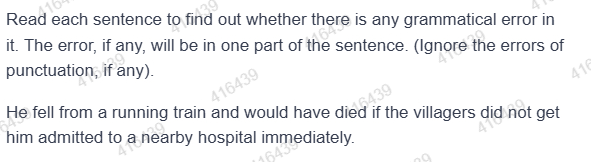
Read each sentence to find out whether there is any grammatical error in it. The error, if any, will be in one part of the sentence. (Ignore the errors of punctuation, if any.)
He fell from a running train and would have died if the villagers did not get him admitted to a nearby hospital immediately.
- A

- B

- C

- D

- E

Show answerHide answer
Answer: C
Approach: Third conditional (past unreal condition): if + had + V3, would have + V3.
Solution: The main clause "would have died" is a past unreal result, so the if-clause must be in the past perfect: "if the villagers had not got him admitted". "Did not get" (simple past) is wrong. The error is in part C.
Why the other options are wrong:
A "He fell from a running train": correct simple past.
B "and would have died": correct third-conditional result.
D "to a nearby hospital immediately": correct.
E No error: there is a tense error in C.
Cetking shortcut: "Would have + V3" in one clause → "had + V3" in the if-clause.
Answer: C
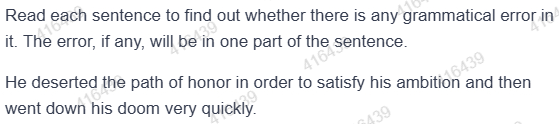
Read each sentence to find out whether there is any grammatical error in it. The error, if any, will be in one part of the sentence.
He deserted the path of honor in order to satisfy his ambition and then went down his doom very quickly.
- A

- B

- C

- D

- E

Show answerHide answer
Answer: D
Approach: Phrasal idiom: "go down to one's doom".
Solution: The idiom is "to go (down) to one's doom" — the preposition "to" is missing. Correct: "and then went down to his doom very quickly". The error is in part D.
Why the other options are wrong:
A "He deserted the path of honor": correct.
B "in order to": correct purpose phrase.
C "satisfy his ambition": correct.
E No error: the preposition is missing in D.
Cetking shortcut: When a verb of motion is followed by a destination noun (doom, death, ruin), check for "to".
Answer: D
Read each sentence to find out whether there is any grammatical error in it. The error, if any, will be in one part of the sentence.
This is one of the most interesting book I have ever read.
- A

- B

- C

- D

- E

Show answerHide answer
Answer: B
Approach: "One of the + superlative + plural noun".
Solution: "One of the ..." picks one item from a group, so the noun must be plural: "one of the most interesting books". The error is in part B.
Why the other options are wrong:
A "This is one of the": correct.
C "I have": correct present perfect.
D "ever read": correct.
E No error: "book" must be plural.
Cetking shortcut: "One of the" is always followed by a plural noun.
Answer: B
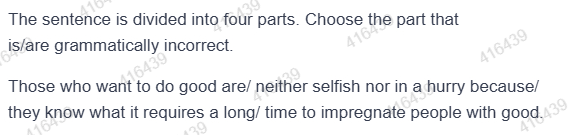
The sentence is divided into four parts. Choose the part that is/are grammatically incorrect.
Those who want to do good are / neither selfish nor in a hurry because / they know what it requires a long / time to impregnate people with good.
- A

- B

- C

- D

- E

Show answerHide answer
Answer: C
Approach: Conjunction "that" vs. relative "what".
Solution: "Know" needs a noun clause: "they know that it requires a long time". "What it requires a long time" is ungrammatical because "what" would need a missing object, but "a long time" already fills it. Error in part C.
Why the other options are wrong:
A "Those who want to do good are": correct.
B "neither selfish nor in a hurry because": correct neither-nor pair.
D "time to impregnate people with good": correct.
E No error: C is wrong.
Cetking shortcut: If the clause after "what" is already complete, "what" must become "that".
Answer: C
It being a holiday (A)/ all the hostel inmates (B)/ decided to celebrate (C)/ by going out to a movie. (D)/ No error (E)
- AA
- BB
- CC
- DD
- EE
Show answerHide answer
Answer: E
Approach: Error spotting — check each part; if every part is correct, mark No error.
Solution: (A) 'It being a holiday' — a correct absolute phrase (its own subject 'It').
(B) 'all the hostel inmates' — correct plural subject.
(C) 'decided to celebrate' — correct (decide + to-infinitive).
(D) 'by going out to a movie' — 'by + -ing' correctly shows how they celebrated.
No part has an error.
Why the other options are wrong:
A, B, C, D — each part is grammatically correct, as shown above.
Cetking shortcut: 'By + -ing' to show the means of an action is standard; do not change it to 'with'.
Answer: E
The higher we climb (A)/ up the mountain peak (B)/ the cooler (C)/ we feel (D)/ No error (E)
- AA
- BB
- CC
- DD
- EE
Show answerHide answer
Answer: B
Approach: Error spotting — redundancy (superfluous word).
Solution: 'The higher we climb … the cooler we feel' is the correct 'the + comparative …, the + comparative' structure, so parts (A), (C) and (D) are fine.
In (B), 'up' is superfluous because climb already means 'go up'.
Correct: 'The higher we climb the mountain peak, the cooler we feel.'
Why the other options are wrong:
A. 'The higher we climb' — correct comparative structure.
C. 'the cooler' — correct parallel comparative.
D. 'we feel' — correct verb.
E. No error — wrong, because (B) contains the redundant 'up'.
Cetking shortcut: Common redundancies in CET: climb up, return back, repeat again, revert back.
Answer: B
The angry boatman threw (A)/ the cracked oar (B)/ in the river (C)/ and returned home. (D)/ No error (E)
- AA
- BB
- CC
- DD
- EE
Show answerHide answer
Answer: C
Approach: Error spotting — 'in' (rest) vs 'into' (motion inside).
Solution: The boatman threw the oar so that it moved from his hand inside the water — this is motion, so into is required.
Correct: 'The angry boatman threw the cracked oar into the river and returned home.'
Why the other options are wrong:
A. 'The angry boatman threw' — correct.
B. 'the cracked oar' — correct.
D. 'and returned home' — correct (home without 'to').
E. No error — wrong, (C) has the error.
Cetking shortcut: Verbs of movement (throw, jump, fall, walk) + 'inside' → into.
Answer: C
Parul was trying for admission (A)/ in the engineering college (B)/ even though her parents wanted (C)/ her to take to medicine. (D)/ No error (E)
- AA
- BB
- CC
- DD
- EE
Show answerHide answer
Answer: B
Approach: Error spotting — fixed preposition with 'admission'.
Solution: 'Admission' takes to: admission to a school/college/course.
Part (B) 'in the engineering college' should be 'to the engineering college'.
Correct: 'Parul was trying for admission to the engineering college even though her parents wanted her to take to medicine.'
Why the other options are wrong:
A. 'Parul was trying for admission' — correct.
C. 'even though her parents wanted' — correct.
D. 'her to take to medicine' — correct ('take to' = adopt as a career).
E. No error — wrong, (B) has the error.
Cetking shortcut: Admission to, entrance to/into, enrol in — memorise the noun–preposition pairs.
Answer: B
This fact makes it very clear (A)/ that he had hand in the murder, (B)/ though he still (C)/ pleads innocence. (D)/ No error (E)
- AA
- BB
- CC
- DD
- EE
Show answerHide answer
Answer: B
Approach: Error spotting — fixed idiom 'have a hand in'.
Solution: 'To have a hand in' = to be involved in. Part (B) drops the article: 'that he had hand in the murder' → 'that he had a hand in the murder'.
Correct: 'This fact makes it very clear that he had a hand in the murder, though he still pleads innocence.'
Why the other options are wrong:
A. 'This fact makes it very clear' — correct (singular subject, singular verb).
C. 'though he still' — correct.
D. 'pleads innocence' — correct (present, he still pleads now).
E. No error — wrong, (B) has the error.
Answer: B
Choose the options containing grammatically correct sentences:
A. There are less cars on the road today.
B. She is nicer than her sister.
C. I have been here from Monday.
D. I know how to swim.
E. She is the girl that won the case competition.
F. The media are divided on the issue.
- AB, C & E
- BA, D & E
- CA, D & F
- DB, D & F
- ED, E & F
Show answerHide answer
Answer: D
Approach: Check each sentence for count nouns, preposition with time, relative pronoun and collective nouns.
Solution:
A ✗ — 'cars' is countable: 'fewer cars', not 'less cars'.
B ✓ — correct comparative 'nicer than'.
C ✗ — with the present perfect, a starting point takes 'since': 'I have been here since Monday'.
D ✓ — 'know how to swim' is correct.
E — borderline: for a person 'who' is preferred ('the girl who won'), though 'that' is tolerated; the intended correct set excludes it.
F ✓ — 'media' as a plural takes 'are'.
Correct set = B, D & F.
Why the other options are wrong: A (B, C & E) and B (A, D & E) include the 'from Monday' or 'less cars' errors; C (A, D & F) includes 'less cars'; E (D, E & F) leaves out the clearly correct B and includes E.
Cetking shortcut: B is clearly correct → only options A and D contain B; A contains C ('from Monday') → D.
Answer: D
Read the following sentences carefully and determine which of the following options contain grammatically CORRECT sentences.
A. There are less cars on the road today.
B. She is nicer than her sister.
C. I have been here from Monday.
D. I know how to swim.
E. She is the girl that won the case competition.
F. The media are divided on the issue.
- AB, D & E
- BB, C & E
- CC, D & F
- DA, D & E
- EB, D & F
Show answerHide answer
Answer: E
Approach: Check each sentence against standard rules: fewer/less, since/from, who/that for persons, collective 'media'.
Solution: A. 'less cars' – wrong; countable noun → 'fewer cars'.
B. 'nicer than her sister' – correct comparative.
C. 'been here from Monday' – wrong; with perfect continuous/perfect tense and a point of time use 'since Monday'.
D. 'I know how to swim' – correct.
E. 'the girl that won' – in exam grammar the relative pronoun for a person is 'who': 'the girl who won'.
F. 'The media are divided' – correct; 'media' is the plural of 'medium' and takes a plural verb.
Correct: B, D, F.
Why the other options are wrong:
A (B, D, E): E uses 'that' for a person.
B (B, C, E): C needs 'since'.
C (C, D, F): C needs 'since'.
D (A, D, E): A needs 'fewer'.
Cetking shortcut: Kill A and C first (fewer/since) – that leaves options A and E; decide between E and F: 'media are' is textbook-correct.
Answer: E
Select the grammatically correct sentence :
- A

- B

- C

- D

- E

Show answerHide answer
Answer: D
Approach: 'Although' already shows contrast, so it takes no 'but', 'yet' or 'that' in the main clause.
Solution: 'Although he had failed in Mathematics' is a complete subordinate clause; the main clause 'he received a Degree in Engineering' follows after a comma with no extra connector. The past perfect 'had failed' correctly marks the earlier action. Sentence D is correct.
Why the other options are wrong:
A: 'that he received…' turns the main clause into a fragment.
B: 'Although, having failed…' joins a participle phrase to 'although'; 'the Engineering Degree' is also unidiomatic.
C: uses 'Although… but' (double connector) and 'that' as well.
E: 'failed in that Mathematics' is wrong, and 'Although… but' is a double connector.
Cetking shortcut: Strike any option with 'although/though… but'; that removes most choices at once.
Answer: D