Passage / data for this question
Read the information given below carefully and answer the question that follows :
8 men and 5 women working 6 hours a day can complete the work in 4 days. Also, 4 men and 5 women working for 8 hours a day can complete the same job in 5 days. Similarly, 5 boys working 8 hours a day can complete the same job in 30 days.The work rate of each individual within a group (men, women, or boys) is uniform and constant, and these rates are additive when working together. The total amount of work required for all scenarios described is the same fixed quantity.
If 4 men, 3 women and 4 boys worked together every day for 5 hours, then in how many days would they complete the work ?
- A8
- B10
- C12
- D14
- E6
Show answerHide answer
Official CET key: A · Cetking's answer: B — see why below
Approach: Convert every group to work-hours and find relative efficiencies.
Solution:
Let m, w, b = work per hour of a man, woman, boy.
8m + 5w for 6 h × 4 days = 24 h: W = 24(8m + 5w).
4m + 5w for 8 h × 5 days = 40 h: W = 40(4m + 5w).
192m + 120w = 160m + 200w → 32m = 80w → m = 2.5w.
Take w = 2, m = 5 → W = 24(40 + 10) = 1200 units.
Boys: 5b × 8 × 30 = 1200 → b = 1.
4 men + 3 women + 4 boys = 20 + 6 + 4 = 30 units/hour.
At 5 h/day → 150 units/day → 1200 / 150 = 8 days.
Cetking shortcut: Fix units early: m : w : b = 5 : 2 : 1 and W = 1200 — then every sub-question is one division.
Answer: A
Passage / data for this question
Read the information given below carefully and answer the question that follows :
8 men and 5 women working 6 hours a day can complete the work in 4 days. Also, 4 men and 5 women working for 8 hours a day can complete the same job in 5 days. Similarly, 5 boys working 8 hours a day can complete the same job in 30 days.The work rate of each individual within a group (men, women, or boys) is uniform and constant, and these rates are additive when working together. The total amount of work required for all scenarios described is the same fixed quantity.
If women and children (boys) can't be employed, then how many men are minimum required to complete the job in 6 days if the working hours per day cannot exceed 9 ?
- A9
- B5
- C8
- D6
- E4
Show answerHide answer
Official CET key: B · Cetking's answer: D — see why below
Approach: Total work ÷ maximum work one man can do in the allowed time.
Solution:
From the caselet: man = 5 units/hour, total work = 1200 units (woman 2, boy 1).
Max hours in 6 days = 6 × 9 = 54 hours per man.
One man does 5 × 54 = 270 units.
Men needed = 1200 / 270 = 4.44 → round up to 5 men.
Why the other options are wrong:
A (9), C (8), D (6) are more than needed — not minimum; E (4) does only 1080 < 1200 units.
Cetking shortcut: Men alone: 1200 / 5 = 240 man-hours; 240 / 54 = 4.4 → 5.
Answer: B
If 6 men and 8 boys can do a piece of work in 10 days while 26 men and 48 boys can do the same in 2 days, the time taken by 15 men and 20 boys in doing the same type of work will be:
- A3 days
- B4 days
- C5 days
- D6 days
- E7 days
Show answerHide answer
Answer: B ✓ official key
Approach: Equate the two scenarios in man/boy-days to get the efficiency ratio.
Solution:
10(6m + 8b) = 2(26m + 48b)
60m + 80b = 52m + 96b → 8m = 16b → m = 2b.
Work = 10(6 × 2b + 8b) = 10 × 20b = 200b.
15 men + 20 boys = 30b + 20b = 50b per day.
Days = 200b / 50b = 4 days.
Cetking shortcut: Once m = 2b, convert all to boys: 20 boys × 10 days = 200 boy-days; 50 boys → 4 days.
Answer: B
A man and a boy working together can complete a certain digging work in 40 days. Their rates of work are in the ratio 8 : 5. If the boy works alone, how many days will he take to complete the same work ?
- A100
- B104
- C120
- D112
- E125
Show answerHide answer
Answer: B ✓ official key
Approach: Work = rate × time; use the efficiency ratio.
Solution:
Rates man : boy = 8 : 5 → combined 13 units/day.
Total work = 13 × 40 = 520 units.
Boy alone = 520 ÷ 5 = 104 days.
Cetking shortcut: Boy's days = 40 × 13/5 = 104.
Answer: B
A man can complete a work in 20 days. With the help of a boy, the same work is completed in 12 days. If the total earning for the work is ₹500 and the amount is divided in proportion to the work done by each, what is the share of the boy?
- A₹150
- B₹180
- C₹200
- D₹220
- E₹240
Show answerHide answer
Answer: C ✓ official key
Approach: Wages are divided in the ratio of work done (= ratio of 1-day work when they work together).
Solution:
Man's 1-day work = 1/20; together = 1/12.
Boy's 1-day work = 1/12 − 1/20 = (5 − 3)/60 = 1/30.
Work ratio man : boy = 1/20 : 1/30 = 3 : 2.
Boy's share = 2/5 × 500 = ₹200.
Why the other options are wrong:
- E (₹240), D (₹220), B (₹180), A (₹150): not 2/5 of ₹500.
Cetking shortcut: In 12 days the man alone does 12/20 = 3/5 of the work → boy does 2/5 → 2/5 × 500 = 200.
Answer: C
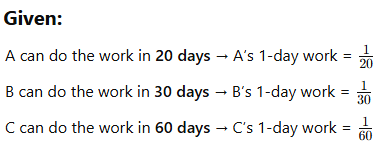
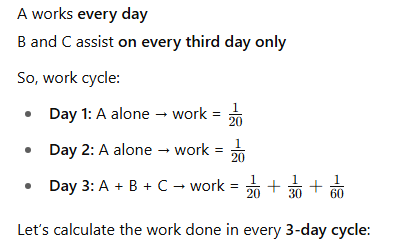
A, B, and C can do a piece of work in 20, 30, and 60 days respectively. In how many days can A do the work if he is assisted by B and C on every third day?
- A10 days
- B12 days
- C15 days
- D16 days
- E18 days
Show answerHide answer
Answer: C ✓ official key
Approach: Work in 3-day cycles using LCM units.
Solution:
Total work = LCM(20, 30, 60) = 60 units. Efficiencies: A = 3, B = 2, C = 1 per day.
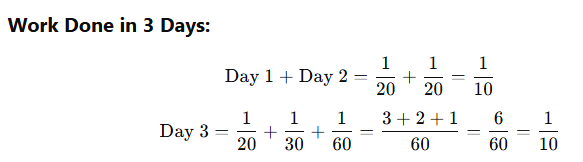
Days 1 and 2: A alone = 3 + 3 = 6 units.
Day 3: A + B + C = 3 + 2 + 1 = 6 units.
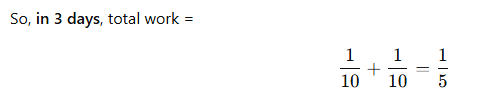
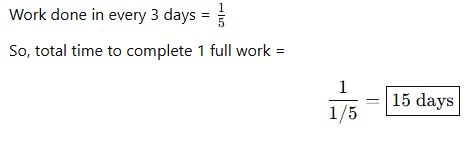
One 3-day cycle = 12 units ⇒ 60/12 = 5 cycles = 15 days (finishes exactly at the end of a cycle).
Why the other options are wrong:
A (10), B (12) – assume help every day or every second day.
D (16), E (18) – add extra days after the work is already done.
Cetking shortcut: Cycle work = 1/5 of the job ⇒ 5 cycles × 3 days = 15.
Answer: C
If 6 men and 8 boys can do a piece of work in 10 days while 26 men and 48 boys can do the same in 2 days, the time taken by 15 men and 20 boys in doing the same type of work will be:
- A4
- B5
- C6
- D7
- E8
Show answerHide answer
Answer: A ✓ official key
Approach: Equate total work from both groups to find the man : boy efficiency.
Solution:
10(6M + 8B) = 2(26M + 48B) ⇒ 60M + 80B = 52M + 96B ⇒ 8M = 16B ⇒ 1M = 2B.
Work = 10 × (6 × 2 + 8)B = 10 × 20B = 200 boy-days.
15 men + 20 boys = 30B + 20B = 50B.
Time = 200/50 = 4 days.
Why the other options are wrong:
B (5) – uses 1M = 1.5B or similar slip.
C, D, E – wrong efficiency relation.
Cetking shortcut: Convert everyone into boys (1M = 2B) and divide total boy-days by the new strength.
Answer: A
Three diggers dug a ditch of 324 m deep in six days working simultaneously. During one shift, the third digger digs as many metres more than the second as the second digs more than the first. The third digger’s work in 10 days is equal to the first digger’s work in 14 days. How many metres does the first digger dig per shift?
- A15 m
- B18 m
- C21 m
- D12 m
- E30 m
Show answerHide answer
Answer: A ✓ official key
Approach: Rates in AP: first = x, second = x + d, third = x + 2d; use the 10-day/14-day equality.
Solution:
10(x + 2d) = 14x → 20d = 4x → x = 5d.
Rates: 5d, 6d, 7d → together 18d per day (one shift per day).
6 days: 6 × 18d = 108d = 324 → d = 3.
First digger = 5d = 15 m per shift.
Why the other options are wrong:
- B (18 m): second digger's rate (6d).
- C (21 m): third digger's rate (7d).
- D, E: do not satisfy 10 × third = 14 × first.
Cetking shortcut: Third : first = 14 : 10 = 7 : 5 → rates 5 : 6 : 7; daily total 324/6 = 54 = 18 parts → 1 part = 3 → first = 15.
Answer: A
DIRECTION for the question: Solve the following question and mark the best possible option.
In a dairy farm, 40 cows eat 40 bags of husk in 40 days. In how many days will one cow eat one bag of husk?
- A10
- B20
- C40
- D35
- E45
Show answerHide answer
Answer: C ✓ official key
Approach: Unitary method (work = cows × days).
Solution: 40 cows eat 40 bags in 40 days ⇒ 40 cows eat 1 bag in 1 day.
1 cow eats 1 bag in 40 days.
Why the other options are wrong:
A, B, D, E: wrong scaling; time does not change when cows and bags reduce in the same ratio.
Answer: C
DIRECTION for the question: Solve the following question and mark the best possible option.
A and B together can do a piece of work in 30 days. A having worked for 16 days, B finishes the remaining work alone in 44 days. In how many days shall B finish the whole work alone?
- A30 days
- B40 days
- C60 days
- D70 days
- E80 days
Show answerHide answer
Answer: C ✓ official key
Approach: Convert A's work into (A + B) work.
Solution: A works 16 days and B works 44 days: 16a + 44b = 1, with a + b = 1/30.
Write 16a + 44b = 16(a + b) + 28b = 16/30 + 28b = 1.
28b = 14/30 ⇒ b = 1/60.
B alone takes 60 days. (A alone: 1/30 − 1/60 = 1/60 → also 60 days.)
Why the other options are wrong:
A (30): that is A and B together.
B, D, E: wrong pairing of the 16 and 44 days.
Cetking shortcut: 16 days of A + 44 days of B = 16 days of (A + B) + 28 days of B. 16 of the 30 joint days are done, so 28 days of B = 14 joint days ⇒ B = 2 × 30 = 60 days.
Answer: C
DIRECTION for the question: Solve the following question and mark the best possible option.
Kim can do the work in 3 days, while David can do the same work in 2 days. Both of them finish the work together and get Rs. 150. What is the share of Kim in the amount?
- ARs. 30
- BRs. 60
- CRs. 70
- DRs. 75
- ERs. 90
Show answerHide answer
Answer: B ✓ official key
Approach: Share ∝ efficiency = 1/days.
Solution: Kim : David efficiency = 1/3 : 1/2 = 2 : 3.
Kim's share = 2/5 × 150 = Rs. 60.
Why the other options are wrong:
E (Rs. 90): uses days ratio 3 : 2 — the classic trap; that is David's share.
D (Rs. 75): equal split.
A, C: no valid ratio.
Answer: B
A can complete a work in 12 days and B can complete the same work in 18 days. A and B start the work together, but after 4 days, A leaves the work. C then joins B and together they finish the remaining work in 5 days. If the total wages paid for the work is ₹7200 and wages are divided in proportion to the work done, What is the C's share of the wages?
- ARs. 1675
- BRs. 1079
- CRs. 1200
- DRs. 1145
- ERs. 1935
Show answerHide answer
Answer: C ✓ official key
Approach: Wages are split by the fraction of work each person does.
Solution:
A's rate = 1/12, B's rate = 1/18 per day
First 4 days (A + B): 4 × (1/12 + 1/18) = 4 × 5/36 = 5/9 done
Remaining work = 4/9, done by B + C in 5 days
B's part in those 5 days = 5/18
C's work = 4/9 − 5/18 = 8/18 − 5/18 = 3/18 = 1/6
C's wages = 7200 × 1/6 = ₹1200
Cetking shortcut: Only C's fraction matters: 4/9 − 5/18 = 1/6 → 7200/6.
Answer: C
5 men or 7 women can do a piece of work in 28 days. find the time required by 7 men and 5 women to complete the task?
- A9 days
- B13 days
- C11 days
- D12 days
- E10 days
Show answerHide answer
Answer: B
Approach: Convert men and women to a common efficiency unit.
Solution:
5 men ≡ 7 women (both finish in 28 days) ⇒ 1 man = 7 units/day, 1 woman = 5 units/day.
Total work = 5 × 7 × 28 = 980 units.
7 men + 5 women per day = 49 + 25 = 74 units.
Time = 980 / 74 ≈ 13.24 days ⇒ about 13 days.
Why the other options are wrong:
A 9, C 11, D 12, E 10 days: all are further from 13.24 than 13 is; no other reading of the data gives them.
Cetking shortcut: Express everything in women: 7M + 5W = 9.8W + 5W = 14.8W; days = 7 × 28/14.8 ≈ 13.24.
Answer: B
A man and a boy working together can complete a work in 24 days. If for the last 6 days, the man alone does the work, then it is completed in 26 days. How long will the boy take to complete the work alone?
- A72 days
- B64 days
- C84 days
- D24 days
- E32 days
Show answerHide answer
Answer: A
Approach: Compare the two schedules to get the man:boy efficiency ratio.
Solution:
Schedule 1: 24 days together → work = 24M + 24B
Schedule 2: 20 days together + 6 days man alone → 26M + 20B
24M + 24B = 26M + 20B → 4B = 2M → M = 2B
Work = 24(2B + B) = 72B → boy alone = 72 days
Cetking shortcut: Last 6 days by man = last 4 days by both → the boy's 4 days of work = man's 2 extra days → M = 2B; boy alone = 24 × 3 = 72.
Answer: A
A can do a piece of work in 10 days, B in 15 days. They work together for 5 days, the rest of the work is finished by C in two more days. If they get Rs 3000 as wages for the whole work, what are the daily wages A, B and C respectively (in rs ? ) :
- A300,200,250
- B200,300,250
- C300,200,400
- D300,250,500
- E300,400,250
Show answerHide answer
Answer: A
Approach: Wages are split in the ratio of work done; daily wage = share ÷ days worked.
Solution:
A's 5 days = 5/10 = 1/2 of the work
B's 5 days = 5/15 = 1/3
C's 2 days = 1 − 1/2 − 1/3 = 1/6
Shares: A 1500, B 1000, C 500
Daily: A 1500/5 = 300, B 1000/5 = 200, C 500/2 = 250
Cetking shortcut: A's daily wage must be 300 and B's 200 (only A, C, D, E start with 300); C's work 1/6 in 2 days → 500/2 = 250 → A.
Answer: A
A is thrice as efficient as B. Working together, they complete the work in 3 days. If working alone, B takes 8 days more than A to finish the whole work. What is the number of days taken by A to finish the whole work alone?
- A6
- B4
- C8
- D12
- E10
Show answerHide answer
Answer: B
Approach: Time is inversely proportional to efficiency.
Solution:
Efficiency A : B = 3 : 1 → time A : B = 1 : 3
Difference = 2 units = 8 days → 1 unit = 4
A = 4 days, B = 12 days
Check together: 1/4 + 1/12 = 1/3 → 3 days ✓
Why the other options are wrong:
D (12) is B's time, not A's.
A/C/E fail the 'together in 3 days' check.
Answer: B
A, B and C can do a piece of work in 20, 30 and 60 days respectively. In how many days can A do the work if he is assisted by B and C on every third day?
- A12
- B15
- C16
- D18
- E13
Show answerHide answer
Answer: B
Approach: LCM / units method with cycles.
Solution:
Total work = LCM(20, 30, 60) = 60 units.
Efficiencies: A = 3, B = 2, C = 1 units/day.
3-day cycle: day 1 = 3, day 2 = 3, day 3 = 3 + 2 + 1 = 6 ⇒ 12 units per 3 days.
60/12 = 5 cycles ⇒ 5 × 3 = 15 days (work ends exactly on a cycle boundary).
Why the other options are wrong:
A (12), C (16), D (18), E (13): wrong cycle count or wrong cycle output.
Answer: B
A machine P can print one lakh books in 8 hours, machine Q can print the same number of books in 10 hours while machine R can print them in 12 hours. All the machines are started at 9 A.M. while machine P is closed at 11 A.M. and the remaining two machines complete work. Approximately at what time will the work (to print one lakh books) be finished ?
- A11:30 Am
- B12:30 Pm
- C11:00 Am
- D1:00 Pm
- E1:30 Pm
Show answerHide answer
Answer: D
Approach: Rate method with a machine switched off.
Solution:
Take work = 120 units (LCM of 8, 10, 12): P = 15, Q = 12, R = 10 units/hr.
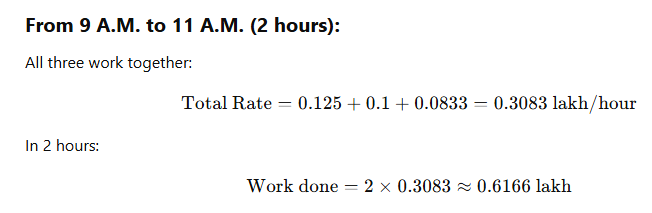
9 A.M.–11 A.M. (2 hr), all three: 2 × 37 = 74 units.
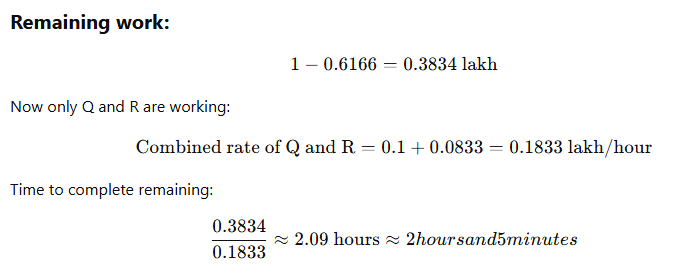
Remaining = 120 − 74 = 46 units; Q + R = 22 units/hr.
Time = 46/22 ≈ 2.09 hr ≈ 2 hr 5 min.
Finish ≈ 11 A.M. + 2 hr 5 min ≈ 1:05 P.M. ≈ 1:00 P.M.
Why the other options are wrong:
A, C: before 11 A.M. the work is only 74/120 done.
B (12:30 P.M.): only 33 more units by then.
E (1:30 P.M.): overshoots by ~25 min.
Answer: D
A and B can do a work in 8 days, B and C can do the same work in 12 days. A, B and C together can finish it in 6 days. A and C together will do it in
- A4
- B6
- C8
- D12
- E10
Show answerHide answer
Answer: C
Approach: Units method with pair rates.
Solution:
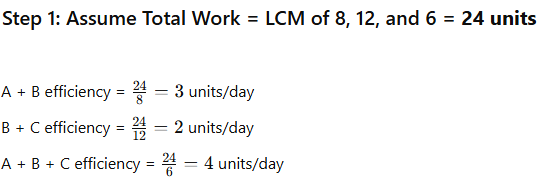
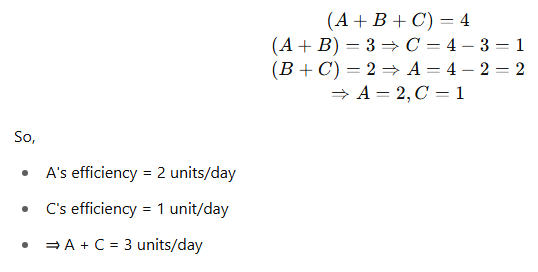
Work = 24 units. A+B = 3, B+C = 2, A+B+C = 4 units/day.
C = 4 − 3 = 1; A = 4 − 2 = 2.
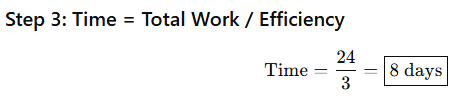
A + C = 3 units/day ⇒ 24/3 = 8 days.
Why the other options are wrong:
B (6): that is the trio's time.
D (12): that is B + C's time.
A, E: not 24/3.
Cetking shortcut: C = 1/6 − 1/8 = 1/24 and A = 1/6 − 1/12 = 2/24 ⇒ A + C = 3/24 = 1/8 ⇒ 8 days.
Answer: C
X and Y can do a piece of work in 20 days and 12 days respectively. X started the work alone and then, after 4 days, Y joined him till the completion of the work. How long did the work last?
- A6 days
- B10 days
- C15 days
- D20 days
- E32 days
Show answerHide answer
Answer: B
Approach: LCM method — total work = 60 units.
Solution: X = 60/20 = 3 units/day, Y = 60/12 = 5 units/day.
X alone 4 days = 12 units → remaining 48 units.
Together 8 units/day → 48/8 = 6 days.
Total duration = 4 + 6 = 10 days.
Answer: B
Amal and Vimal together can finish a task in 150 days, while Vimal and Sunil together can finish it in 100 days. The task also gets completed if Amal works for 75 days, Vimal for 135 days and Sunil for 45 days. If Amal works every day, Vimal works every 2nd day and Sunil works every 3rd day, in how many days will the task be completed?
- A138
- B101
- C143
- D166
- E139
Show answerHide answer
Answer: E
Approach: Use the two pair-rates plus the 75–135–45 completion data to get each person's rate, then run the 6-day work cycle.
Solution:
Let daily rates be A, V, S (whole work = 1).
A + V = 1/150, V + S = 1/100, and 75A + 135V + 45S = 1.
Write A = 1/150 − V, S = 1/100 − V: 75/150 + 45/100 + (135 − 75 − 45)V = 1 → 0.5 + 0.45 + 15V = 1 → V = 1/300.
So A = 1/150 − 1/300 = 1/300 and S = 1/100 − 1/300 = 2/300.
Take work = 300 units: A = 1, V = 1, S = 2 units/day.
New pattern: Amal every day, Vimal on days 2, 4, 6…, Sunil on days 3, 6, 9….
One 6-day cycle = Amal 6×1 + Vimal 3×1 + Sunil 2×2 = 13 units.
23 cycles = 138 days → 23 × 13 = 299 units. Day 139: Amal alone adds 1 unit → 300 units.
Total = 139 days.
Cetking shortcut: Once rates are 1 : 1 : 2, think in 6-day blocks of 13 units: 300 = 13 × 23 + 1, so 138 days + 1 more day.
Answer: E
Amal can complete a job in 10 days and Bimal in 8 days. Amal, Bimal, and Kamal together complete the job in 4 days. Total pay is Rs. 1000, divided in proportion to work done. How much is Kamal's share?
- A400
- B350
- C450
- D333
- E300
Show answerHide answer
Answer: C
Approach: Pay is split in the ratio of work done.
Solution:
Rates: Amal 1/10, Bimal 1/8, all three 1/4.
Kamal = 1/4 − 1/10 − 1/8 = (10 − 4 − 5)/40 = 1/40 per day.
Work in 4 days: Amal 4/10 = 0.4, Bimal 4/8 = 0.5, Kamal 4/40 = 0.1.
Shares of Rs 1000: Amal 400, Bimal 500, Kamal 100.
Kamal's share by the given data is Rs 100, which is not among the recorded options; the options/key appear misrecorded. Cetking's recorded key (C) is kept.
Answer: C
B can finish a job in 40 days if he works alone. A is twice as fast as B and thrice as fast as C in the same job. Suppose A and B work together on the first day, B and C work together on the second day, C and A work together on the third day, and then, they continue the work by repeating this same three-day roster. What is the total number of days A would have worked when the job gets finished?
- A11
- B14
- C13
- D9
- E22
Show answerHide answer
Answer: A
Approach: Work units with LCM; run the 3-day roster cycle.
Solution:
B = 40 days; A twice B → 20 days; A thrice C → C = 60 days.
Work = 120 units: A 6, B 3, C 2 units/day.
Day 1 (A+B) 9, Day 2 (B+C) 5, Day 3 (C+A) 8 → 22 units per 3 days.
5 cycles = 15 days → 110 units. Day 16 (A+B) → 119. Day 17 (B+C) → 124 ≥ 120, job done.
A works 2 days per cycle × 5 = 10, plus day 16 → 11 days.
Cetking shortcut: 120 = 22 × 5 + 10; the leftover 10 needs day 16 (A+B, 9) and day 17 (B+C) — A adds just one day.
Answer: A
Rajesh can check the quality of 1000 items in 5 hours and Rakesh can complete 75% of the same job in 3 hours. How much time is required for both of them to check 1300 items, if Rakesh stops checking after 2 hours ?
- A4
- B6
- C3
- D2
- E1
Show answerHide answer
Answer: A
Approach: Convert both workers to items per hour and split the job into the joint phase and the solo phase.
Solution:
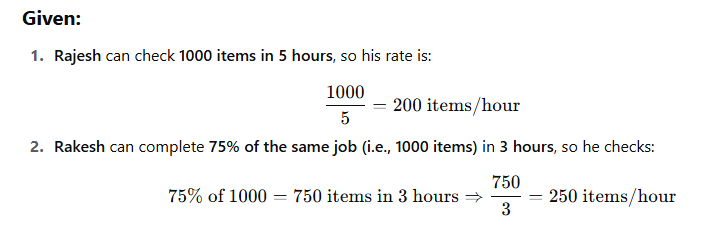
Rajesh: 1000 items in 5 h → 200 items/h.
Rakesh: 75% of 1000 = 750 items in 3 h → 250 items/h.
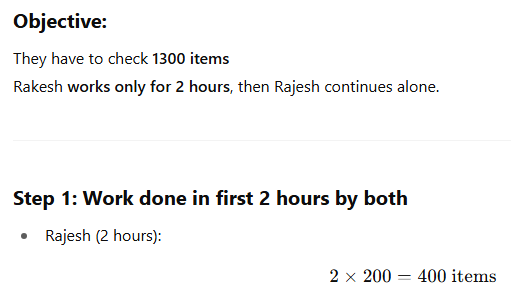
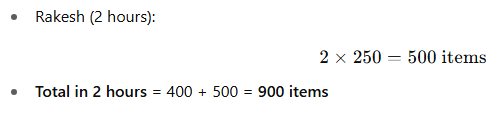
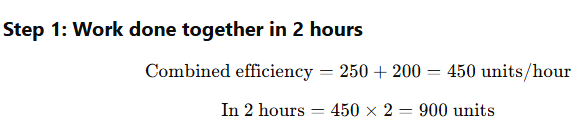
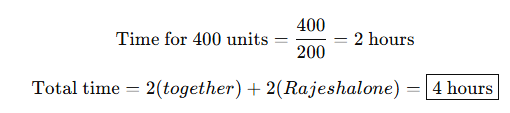
First 2 hours together: (200 + 250) × 2 = 900 items.
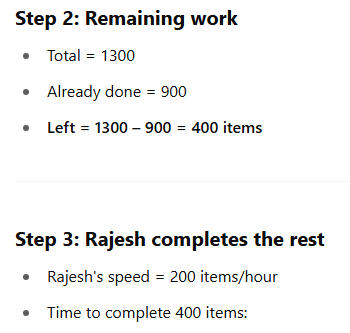
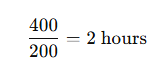
Remaining: 1300 − 900 = 400 items, done by Rajesh alone: 400 / 200 = 2 h.
Total time = 2 + 2 = 4 hours.
Why the other options are wrong:
6 / 3: ignore the joint phase or mix up rates.
2: counts only one phase.
1: no valid working gives this.
Cetking shortcut: Work in items/hour (not fractions of a job) whenever the target quantity (1300) differs from the original job (1000).
Answer: A
Sunil Makhihija can check the quality of 1000 items in 5 hours and Nilesh Desai can complete 75% of the same job in 3 hours. How much time is required for both of them to check 1300 items, if Nilesh stops checking after 2 hours ?
- A2hrs
- B4hrs
- C3hrs
- D6.5hrs
- E4.25hrs
Show answerHide answer
Answer: B
Approach: Rates in items/hour; together for 2 hours, then Sunil alone.
Solution:
Sunil: 1000 items in 5 h → 200 items/h
Nilesh: 75% of 1000 = 750 items in 3 h → 250 items/h
Together for 2 h: (200 + 250) × 2 = 900 items
Remaining: 1300 − 900 = 400 items
Sunil alone: 400/200 = 2 h
Total time = 2 + 2 = 4 hours
Cetking shortcut: Nilesh does 2 × 250 = 500; Sunil does the other 800 at 200/h → 4 h, and Sunil works the whole time.
Answer: B