Two trains, 130 m and 110 m long, are going in the same direction. The faster train takes one minute to pass the other completely. If they are moving in opposite directions, they pass each other completely in 3 seconds. Find the speed of the faster train and slower train respectively ?
- A42 m/s, 38 m/s
- B40 m/s, 36 m/s
- C52 m/s, 36 m/s
- D50 m/s, 38 m/s
- E45 m/s, 38 m/s
Show answerHide answer
Official CET key: A · Cetking's answer: B — see why below
Approach: Same direction → relative speed = difference; opposite → sum.
Solution:
Total length = 130 + 110 = 240 m.
Same direction: 240/60 = 4 m/s = a − b.
Opposite: 240/3 = 80 m/s = a + b.
a = (80 + 4)/2 = 42 m/s; b = (80 − 4)/2 = 38 m/s.
Why the other options are wrong:
B: difference 4 but sum 76. C, D, E: sum/difference do not match 80 and 4.
Cetking shortcut: Options must sum to 80 and differ by 4: only 42, 38.
Answer: A
Aman is sitting in a train which is moving at a speed of 50 km/hr. Aman observes that a goods train traveling in the opposite direction takes 9 seconds to pass him completely. If the length of the goods train is 280 metres, find its speed ?
- A60 km/hr
- B62 km/hr
- C58 km/hr
- D55 km/hr
- E50 km/hr
Show answerHide answer
Answer: B ✓ official key
Approach: Passing a person: distance = train length; opposite direction → relative speed = sum.
Solution:
Relative speed = 280 m / 9 s = 280/9 m/s = (280/9) × 18/5 = 112 km/h.
Goods train speed = 112 − 50 = 62 km/h.
Cetking shortcut: 280/9 × 3.6 = 112 → subtract 50.
Answer: B
A jogger running @ 9 km/ph alongside a railway track is 240 metres ahead of the engine of a 120 metre long train which is running @ 45 km/ph in the same direction. In how much time will the train pass the jogger ?
- A36 seconds
- B25 seconds
- C28 seconds
- D32 seconds
- E48 seconds
Show answerHide answer
Answer: A ✓ official key
Approach: Same direction → relative speed = difference; distance = gap + train length.
Solution:
Relative speed = 45 − 9 = 36 km/h = 10 m/s.
Distance to cover = 240 + 120 = 360 m.
Time = 360 / 10 = 36 s.
Cetking shortcut: 36 km/h = 10 m/s is a must-know conversion.
Answer: A
A jogger running at 12 km/hr along a railway track is 300 m ahead of the engine of a 150 m long train running at 48 km/hr in the same direction.
In how much time will the train pass the jogger?
- A20 Seconds
- B25 Seconds
- C30 Seconds
- D45 Seconds
- E50 Seconds
Show answerHide answer
Answer: D ✓ official key
Approach: Relative speed in the same direction; distance = gap + train length.
Solution:
Relative speed = 48 − 12 = 36 km/hr = 36 × 5/18 = 10 m/s.
To pass the jogger the train covers the 300 m gap + its own 150 m = 450 m.
Time = 450 / 10 = 45 s.
Why the other options are wrong:
C (30 s) ignores the train length; A, B, E come from wrong distance or unconverted speed.
Cetking shortcut: 36 km/hr = 10 m/s is a must-know conversion.
Answer: D
The speed of a boat in still water is 8 km/hr, and the speed of the stream is 2 km/hr.
A man rows to a place 30 km and then returns to the starting point.
Find the total time taken.
- A6 hours
- B7.5 hours
- C8 hours
- D8.5 hours
- E9 hours
Show answerHide answer
Answer: C ✓ official key
Approach: Boats and streams: downstream = b + s, upstream = b − s.
Solution:
Downstream speed = 8 + 2 = 10 km/hr → 30/10 = 3 h.
Upstream speed = 8 − 2 = 6 km/hr → 30/6 = 5 h.
Total = 3 + 5 = 8 hours.
Cetking shortcut: Total time = 2bd/(b² − s²) = 2 × 8 × 30 / 60 = 8 h.
Answer: C
Train A, 600 mts long is running at 80 kmph. How much time will it take to cross a man sitting in another train which is 400 mtres long, running at 64 kmph in the opposite direction?
- A10 seconds
- B12 seconds
- C15 seconds
- D18 seconds
- E21 seconds
Show answerHide answer
Answer: C ✓ official key
Approach: Crossing a man (a point) — only the moving train's length counts.
Solution:
Relative speed (opposite directions) = 80 + 64 = 144 km/h = 144 × 5/18 = 40 m/s.
Train A must pass a man sitting in the other train → distance = length of train A = 600 m (the 400 m length is irrelevant).
Time = 600/40 = 15 s.
Why the other options are wrong:
- A (10 s): 400/40 — uses the other train's length.
- B, D, E: need relative speeds of 50, 33.3 or 28.6 m/s — wrong addition/conversion.
Cetking shortcut: If both lengths (1000 m) were used you'd get 25 s — not in options — a hint that only 600 m counts.
Answer: C
A boat travels 10 km upstream in 30 minutes and the same distance downstream in 25 minutes. What is the speed of the river current (in km/h)?
- A1 km/h
- B2 km/h
- C3 km/h
- D4 km/h
- E5 km/h
Show answerHide answer
Answer: B ✓ official key
Approach: Speed of current = (downstream − upstream)/2.
Solution:
Upstream speed = 10/(30/60) = 20 km/h.
Downstream speed = 10/(25/60) = 24 km/h.
Current = (24 − 20)/2 = 2 km/h.
Why the other options are wrong:
- D (4): forgets to divide the difference by 2.
- A, C, E: arithmetic slips in converting minutes to hours.
Cetking shortcut: Boat speed = (24 + 20)/2 = 22, current = 2 — both from the two speeds in one line.
Answer: B
A train 108 m long moving at a speed of 50 km/hr crosses a train 112 m long coming from the opposite direction in 6 seconds. The speed of the second train is:
- A48 km/hr
- B54 km/hr
- C66 km/hr
- D82 km/hr
- E90 km/hr
Show answerHide answer
Answer: D ✓ official key
Approach: Opposite directions ⇒ relative speed = sum; distance = sum of lengths.
Solution:
Distance = 108 + 112 = 220 m; time = 6 s.
Relative speed = 220/6 = 110/3 m/s = 110/3 × 18/5 = 132 km/h.
Speed of second train = 132 − 50 = 82 km/h.
Why the other options are wrong:
A (48), B (54), C (66) – use relative speed as a difference or forget the conversion.
E (90) – arithmetic slip.
Cetking shortcut: 220 m in 6 s ⇒ 220 × 3.6/6 = 132 km/h; subtract 50.
Answer: D
A train overtakes two persons who are walking in the same direction in which the train is going, at the rate of 2 km/hr and 4 km/hr and passes them completely in 9 and 10 seconds respectively. The length of the train is:
- A45 m
- B50 m
- C54 m
- D72 m
- E60 m
Show answerHide answer
Answer: B ✓ official key
Approach: Same direction ⇒ relative speed = difference; train length is the same in both cases.
Solution:
Let train speed = v km/h. Relative speeds: (v − 2) and (v − 4) km/h.
L = (v − 2) × 5/18 × 9 = (v − 4) × 5/18 × 10.
9v − 18 = 10v − 40 ⇒ v = 22 km/h.
L = 20 × 5/18 × 9 = 50 m (check: 18 × 5/18 × 10 = 50 m ✓).
Why the other options are wrong:
A (45), C (54), D (72), E (60) – do not give the same length from both persons.
Cetking shortcut: Test options: 50 m in 9 s = 20 km/h relative and in 10 s = 18 km/h relative — the 2 km/h gap matches the walkers' 4 − 2.
Answer: B
A train crosses a pole in 8 seconds. If the length of the train is 200 metres, find the speed of the train.
- A18 km/h
- B72 km/h
- C90 km/h
- D25 m/s
- E30 m/s
Show answerHide answer
Answer: C ✓ official key
Approach: Crossing a pole: distance = length of the train.
Solution:
Speed = 200 m / 8 s = 25 m/s.
In km/h: 25 × 18/5 = 90 km/h.
Why the other options are wrong:
- A, B: wrong conversions (18 and 72 km/h = 5 and 20 m/s).
- D: 25 m/s is numerically the same speed as 90 km/h; the official key takes the km/h form.
- E: 30 m/s = 108 km/h.
Cetking shortcut: m/s → km/h: multiply by 3.6.
Answer: C
If the speed of a boat in still water is 8 km/h and the rate of stream is 4 km/h, what is the upstream speed of the boat?
- A12 km/h
- B8 km/h
- C6 km/h
- D4 km/h
- E3 km/h
Show answerHide answer
Answer: D ✓ official key
Approach: Upstream speed = boat speed − stream speed.
Solution:
Upstream = 8 − 4 = 4 km/h.
Why the other options are wrong:
- A: 12 km/h is the downstream speed (8 + 4).
Answer: D
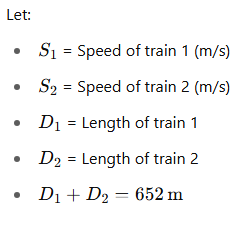
Two trains A and B are running in opposite directions and cross a man standing on the platform in 27 seconds and 17 seconds respectively. They cross each other in 23 seconds. Find the ratio of the speeds of the two trains. A and B ?
- A2 : 3
- B3 : 1
- C3 : 4
- D27 : 17
- E3 : 2
Show answerHide answer
Answer: E ✓ official key
Approach: Trains crossing each other — lengths from 'crossing a man', then relative speed.
Solution:
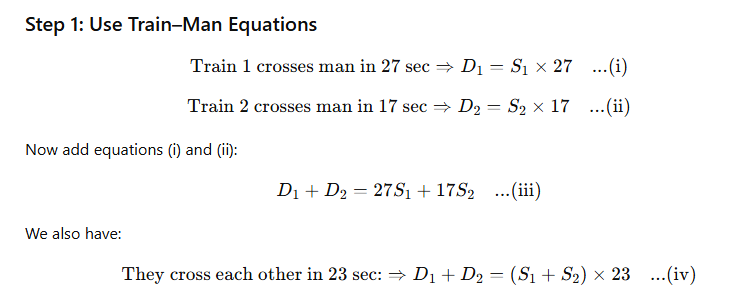
Let speeds be a and b. Length of A = 27a, length of B = 17b.
Opposite directions: (27a + 17b) / (a + b) = 23.
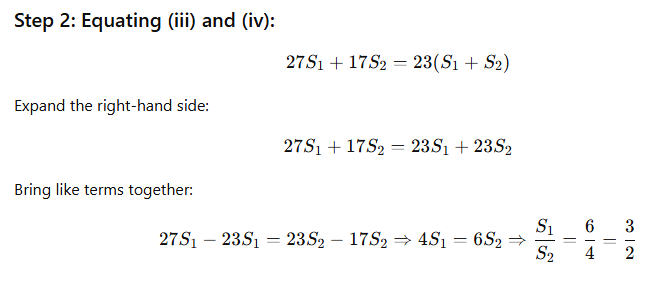
27a + 17b = 23a + 23b → 4a = 6b → a : b = 3 : 2.
Why the other options are wrong:
A 2 : 3: the reverse ratio.
D 27 : 17: ratio of times, not speeds.
B, C: do not satisfy 4a = 6b.
Cetking shortcut: Speed ratio = (T − t₂) : (t₁ − T) = (23 − 17) : (27 − 23) = 6 : 4 = 3 : 2.
Answer: E
A train 800 metres long is running at a speed of 78 km/hr. If it crosses a tunnel in 1 minute, then find the length of the tunnel (in meters) ?
- A630
- B320
- C500
- D550
- E540
Show answerHide answer
Answer: C ✓ official key
Approach: Train crossing a tunnel — distance covered = train length + tunnel length.
Solution:
Speed = 78 km/h = 78 × 5/18 = 65/3 m/s.
Time = 1 minute = 60 s.
Distance = 65/3 × 60 = 1300 m.
Tunnel = 1300 − 800 = 500 m.
Why the other options are wrong:
A 630, B 320, D 550, E 540: do not give 1300 m when added to 800 m.
Cetking shortcut: 78 km/h for 1 minute = 78000/60 = 1300 m directly.
Answer: C
A train of length 100 metres is moving at a speed of 72 km/h. A man is walking in the same direction at a speed of 6 km/h. How much time will the train take to completely pass the man?
- A6.45 seconds
- B5.45 seconds
- C3.25 seconds
- D7.35 seconds
- E4.23 seconds
Show answerHide answer
Answer: B ✓ official key
Approach: Same direction → relative speed = difference; distance = train length.
Solution:
Relative speed = 72 − 6 = 66 km/h = 66 × 5/18 = 55/3 m/s
Time = 100 ÷ (55/3) = 300/55 = 5.45 s
Cetking shortcut: Time = length × 18/(5 × relative km/h) = 100 × 18/330 = 5.45 s.
Answer: B
A train 150 m long is running at 54 km/h. It crosses a bridge in 20 seconds. Find the length of the bridge.
- A250 m
- B340 m
- C150 m
- D190 m
- E140 m
Show answerHide answer
Official CET key: C · Cetking's answer: A — see why below
Approach: Crossing a bridge: distance = train length + bridge length.
Solution:
54 km/h = 54 × 5/18 = 15 m/s
Distance in 20 s = 15 × 20 = 300 m
Bridge = 300 − 150 = 150 m
Why the other options are wrong:
A (250 m): not consistent — 150 + 250 = 400 m would need 26.7 s at 15 m/s.
Cetking shortcut: 15 m/s × 20 s = 300 m total; subtract the train.
Answer: C
Two trains of length 350m and 250m completely cross each other when running in same and opposite direction in 10 sec. and 5 sec. respectively. Find the speed of faster train in kmph?
- A328 km/h
- B324 km/h
- C454 km/h
- D226 km/h
- E594 km/h
Show answerHide answer
Answer: B ✓ official key
Approach: Same direction → difference of speeds; opposite → sum; distance = sum of lengths.
Solution:
Total length = 350 + 250 = 600 m
Same direction: a − b = 600/10 = 60 m/s
Opposite direction: a + b = 600/5 = 120 m/s
Faster train a = (60 + 120)/2 = 90 m/s = 90 × 18/5 = 324 km/h
Cetking shortcut: Faster = half of (sum + difference) = 90 m/s → × 3.6 = 324 km/h.
Answer: B
Two trains cross each other at a speed of 70 KMPH and 50 KMPH respectively. if the total length of both the trains is 1500 m find the time in which they cross each other the trains were moving in opposite direction?
- A43 second
- B41 second
- C45 second
- D49 second
- E42 second
Show answerHide answer
Answer: C
Approach: Trains in opposite directions: relative speed = sum of speeds; distance = sum of lengths.
Solution:
Relative speed = 70 + 50 = 120 km/h = 120 × 5/18 = 100/3 m/s.
Distance to cover = 1500 m (total length).
Time = 1500 ÷ (100/3) = 45 s.
Why the other options are wrong:
Using the difference of speeds (20 km/h) gives 270 s — not offered; A, B, D, E are slips.
Cetking shortcut: 1500 × 18/(120 × 5) = 1500 × 3/100 = 45 s.
Answer: C
The speed of the stream is 25 KMPH the speed of the boat downstream is 15 m/s. find the speed of the boat in Still water?
- A8.06
- B6.05
- C5.23
- D7.05
- E8.56
Show answerHide answer
Answer: A
Approach: Downstream speed = boat speed + stream speed (same units).
Solution:
Stream = 25 km/h = 25 × 5/18 = 6.944 m/s.
Downstream = 15 m/s ⇒ boat in still water = 15 − 6.944 = 8.056 ≈ 8.06 m/s.
Why the other options are wrong:
E 8.56, D 7.05, B 6.05, C 5.23: arithmetic or conversion slips.
Cetking shortcut: Convert 15 m/s to km/h: 54 km/h; boat = 54 − 25 = 29 km/h = 29 × 5/18 = 8.06 m/s.
Answer: A
Two trains 130 m and 110m long are going in the same direction. The faster train takes one minute to pass the other completely. If they are moving in opposite directions, they pass each other completely in 3 seconds. Find the speed of each train?
- A42 m/s, 38 m/s
- B36 m/s, 42 m/s
- C38 m/s, 36 m/s
- D40 m/s, 36 m/s
- E42 m/s, 36 m/s
Show answerHide answer
Answer: A
Approach: Crossing distance = sum of lengths; relative speed is difference (same direction) or sum (opposite).
Solution:
Total length = 130 + 110 = 240 m
Same direction: F − S = 240/60 = 4 m/s
Opposite: F + S = 240/3 = 80 m/s
F = 42 m/s, S = 38 m/s
Why the other options are wrong:
E (42, 36) and D (40, 36): sum 78/76, not 80.
B, C: difference not 4 or sum wrong.
Cetking shortcut: Options must sum to 80 and differ by 4: only (42, 38).
Answer: A
Aman rows to a place 48 km distant and come back in 14 hours. He finds that he can row 4 km with the stream in the same time as 3 km against the stream. The rate of the stream is:
- A1 km/hr
- B1.5 km/hr
- C2 km/hr
- D3 km/hr
- E1.75 km/hr
Show answerHide answer
Answer: A
Approach: Equal time → distance ∝ speed; then use the total-time equation.
Solution:
4/(x + y) = 3/(x − y) → x = 7y
Downstream = 8y, upstream = 6y
48/8y + 48/6y = 14 → 6/y + 8/y = 14 → y = 1 km/h
Cetking shortcut: Downstream : upstream speed = 4 : 3 = 8 : 6 → stream = (8 − 6)/2 = 1 unit; total time 48/8 + 48/6 = 14 ✓ with unit = 1.
Answer: A
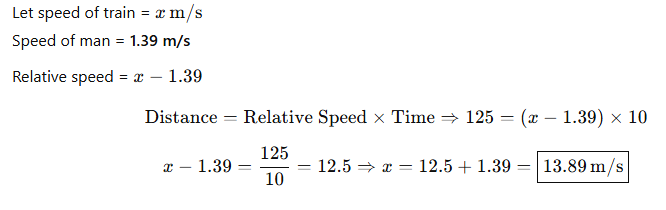
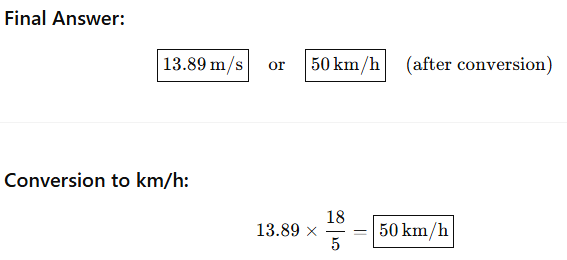
A train 125 m long passes a man, running at 5 km/hr in the same direction in which the train is going, in 10 seconds. The speed of the train is
- A45km/hrs.
- B50km/hrs.
- C54km/hrs.
- D53km/hrs.
- E55km/hrs.
Show answerHide answer
Answer: B
Approach: Relative speed, same direction.
Solution:
Relative speed = 125/10 = 12.5 m/s = 12.5 × 18/5 = 45 km/hr.
Same direction ⇒ train speed − 5 = 45 ⇒ train speed = 50 km/hr.
Why the other options are wrong:
A (45): relative speed, forgot to add the man's 5 km/hr.
C, D, E: arithmetic slips.
Answer: B
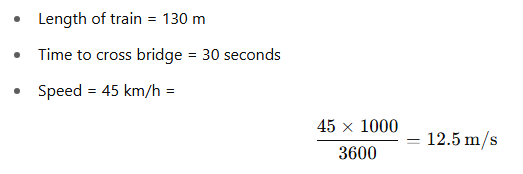
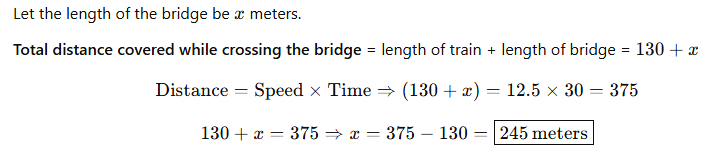
The length of the bridge, which a train 130 metres long and travelling at, 45 km/hr can cross in 30 seconds, is
- A200m
- B230m
- C245m
- D250m
- E220m
Show answerHide answer
Answer: C
Approach: Train length + bridge length = speed × time.
Solution:
45 km/hr = 45 × 5/18 = 12.5 m/s.
Distance in 30 s = 12.5 × 30 = 375 m.
Bridge = 375 − 130 = 245 m.
Why the other options are wrong:
D (250), B (230), A (200), E (220): miscalculated distance or wrong subtraction.
Answer: C
Two trains running in opposite directions cross a man standing on the platform in 27 seconds and 17 seconds respectively and they cross each other in 23 seconds. The ratio of their speeds is
- A1:3
- B3:2
- C3:4
- D1:4
- E3:5
Show answerHide answer
Answer: B
Approach: Relative speed — opposite direction trains.
Solution:
Let speeds be x and y; lengths = 27x and 17y.
Opposite directions: (27x + 17y)/(x + y) = 23.
27x + 17y = 23x + 23y ⇒ 4x = 6y ⇒ x : y = 3 : 2.
Why the other options are wrong:
A, C, D, E: do not satisfy 4x = 6y.
Cetking shortcut: Ratio = (t₂ − t)/(t − t₁) = (23 − 17)/(27 − 23) = 6/4 = 3 : 2.
Answer: B
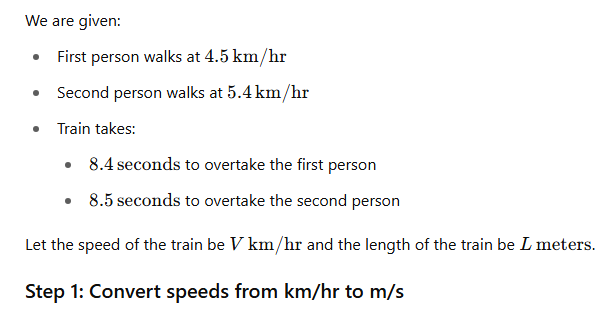
A train overtakes two persons walking along a railway track. The first one walks at 4.5 km/hr. The other one walks at 5.4 km/hr. The train needs 8.4 and 8.5 seconds respectively to overtake them. What is the speed of the train if both the persons are walking in the same direction as the train?
- A66km/hrs.
- B76km/hrs.
- C71km/hrs.
- D81km/hrs.
- E80km/hrs.
Show answerHide answer
Answer: D
Approach: Equal train length in both cases.
Solution:
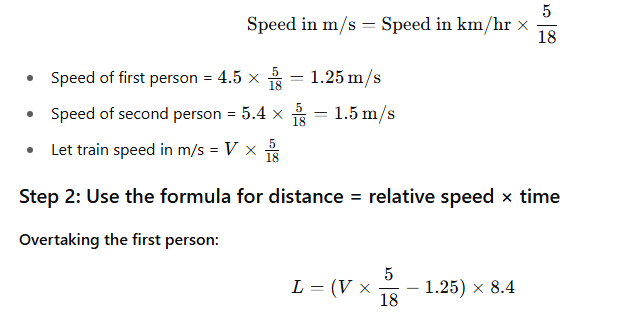
4.5 km/hr = 1.25 m/s; 5.4 km/hr = 1.5 m/s. Let the train speed = v m/s.
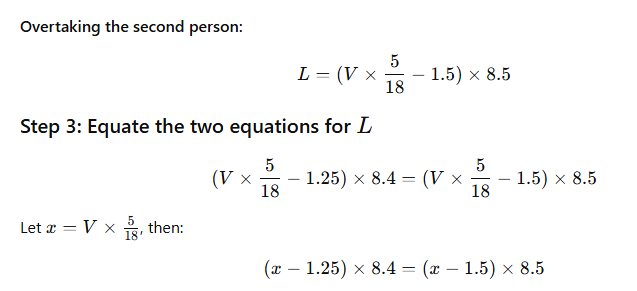
Length = 8.4(v − 1.25) = 8.5(v − 1.5).
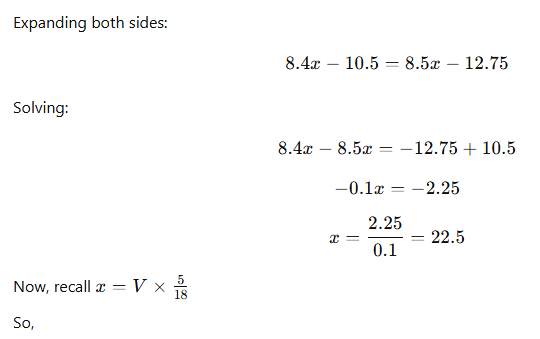
8.4v − 10.5 = 8.5v − 12.75 ⇒ 0.1v = 2.25 ⇒ v = 22.5 m/s.
v = 22.5 × 18/5 = 81 km/hr.
Check: length = 8.4 × 21.25 = 178.5 m = 8.5 × 21 ✓.
Why the other options are wrong:
A, B, C, E: substituting gives unequal train lengths.
Cetking shortcut: Test options in m/s: 81 km/hr = 22.5 m/s ⇒ 8.4 × 21.25 = 8.5 × 21 = 178.5 ✓.
Answer: D
A boat running upstream takes 8 hours 48 minutes to cover a certain distance, while it takes 4 hours to cover the same distance running downstream. What is the ratio between the speed of the boat and speed of the water current respectively?
- A2:1
- B2:3
- C8:3
- D3:5
- E5:8
Show answerHide answer
Answer: C
Approach: Speed ∝ 1/time for a fixed distance.
Solution:
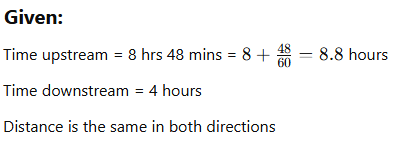
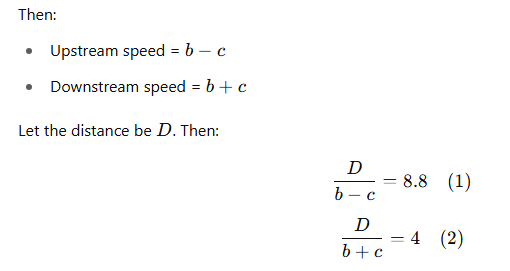
Upstream time = 8 h 48 min = 8.8 hr; downstream time = 4 hr.
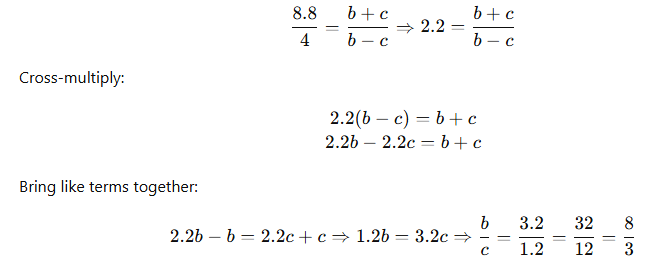
Downstream : upstream speed = 8.8 : 4 = 11 : 5.
b + c = 11k, b − c = 5k ⇒ b = 8k, c = 3k.
Boat : current = 8 : 3.
Why the other options are wrong:
A, B, D, E: do not give (b + c)/(b − c) = 11/5.
Cetking shortcut: b : c = (11 + 5)/2 : (11 − 5)/2 = 8 : 3.
Answer: C
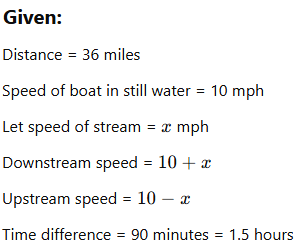
A boat takes 90 minutes less to travel 36 miles downstream than to travel the same distance upstream. If the speed of the boat in still water is 10 mph, the speed of the stream is
- A2mph
- B2.5mph
- C3mph
- D4mph
- E3.2mph
Show answerHide answer
Answer: A
Approach: Boats and streams — time difference equation.
Solution:
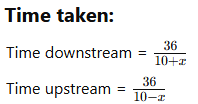
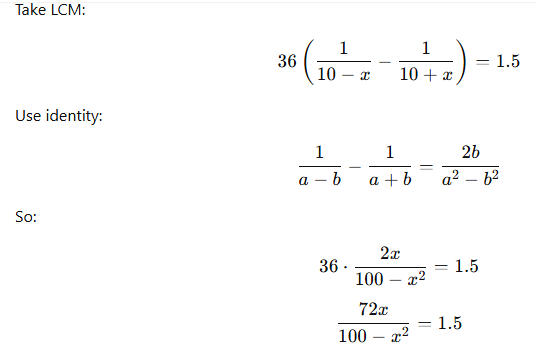
36/(10 − s) − 36/(10 + s) = 1.5.
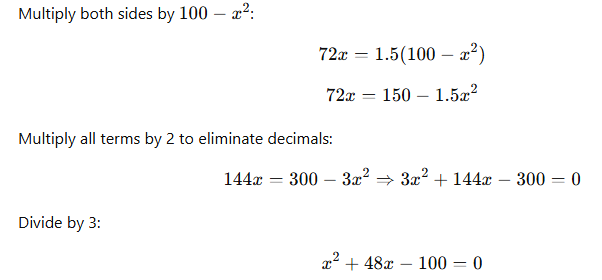
36 × 2s = 1.5(100 − s²) ⇒ 72s = 150 − 1.5s² ⇒ s² + 48s − 100 = 0.
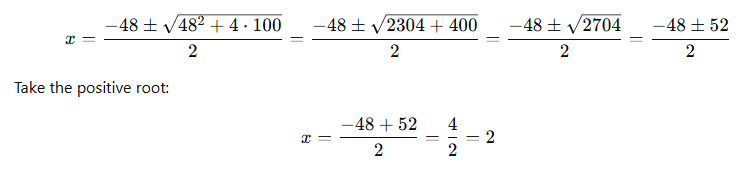
(s + 50)(s − 2) = 0 ⇒ s = 2 mph.
Check: 36/8 − 36/12 = 4.5 − 3 = 1.5 hr = 90 min ✓.
Why the other options are wrong:
B (2.5): 36/7.5 − 36/12.5 = 1.92 hr.
C (3): 36/7 − 36/13 ≈ 2.37 hr.
D, E: even larger gaps.
Cetking shortcut: Option test is fastest: s = 2 gives 4.5 − 3 = 1.5 hr ✓.
Answer: A
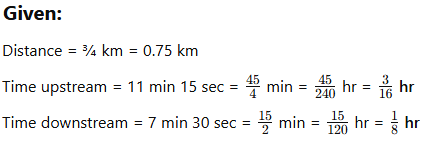
A man can row three-quarters of a kilometer against the stream in 11 minutes 15 seconds and down the stream in 7 minutes 30 seconds. What is the speed of the man (in km/hr) in still water?
- A1
- B2
- C3
- D4
- E5
Show answerHide answer
Answer: E
Approach: Average of downstream and upstream speeds.
Solution:
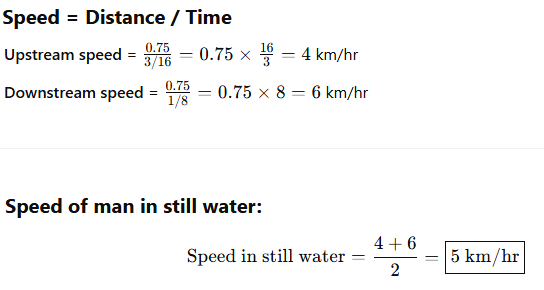
Upstream: 0.75 km in 11 min 15 s = 11.25 min ⇒ speed = 0.75 × 60/11.25 = 4 km/hr.
Downstream: 0.75 km in 7.5 min ⇒ speed = 0.75 × 60/7.5 = 6 km/hr.
Still water speed = (6 + 4)/2 = 5 km/hr.
Why the other options are wrong:
A (1 km/hr): that is the stream speed.
B, C, D: not (6 + 4)/2.
Answer: E
A boat takes 8 hours to cover a distance while traveling upstream, whereas while traveling downstream it takes 6 hours. If the speed of the current is 4 kmph, what is the speed of the boat in still water?
- A12
- B16
- C28
- D14
- E8
Show answerHide answer
Answer: C
Approach: Distance is equal both ways.
Solution: 8(x − 4) = 6(x + 4) → 8x − 32 = 6x + 24 → 2x = 56 → x = 28 km/h.
Cetking shortcut: Speeds are in ratio 6:8 = 3:4 (up:down) → difference 1 part = 2 × current = 8 → part = 8 → still water = (3 + 4)/2 × 8 = 28.
Answer: C
Two trains each 100m long, moving in opposite directions, cross each other in 8 sec. If one is moving twice as fast as other, then what is the speed of faster train?
- A30
- B45
- C60
- D75
- E80
Show answerHide answer
Answer: C
Approach: Relative speed = (sum of lengths) ÷ time.
Solution: Relative speed = (100 + 100)/8 = 25 m/s.
Speeds x and 2x → 3x = 25 → faster = 2x = 50/3 m/s.
In km/h: 50/3 × 18/5 = 60 km/h.
Answer: C
A boat takes 8 hrs upstream and 6 hrs downstream. Current speed = 4 kmph. Find boat speed in still water.
- A28 kmph
- B8 kmph
- C32 kmph
- D30 kmph
- E14 kmph
Show answerHide answer
Answer: A
Approach: Same distance up and down: D = time × speed.
Solution:
Let still-water speed = x.
8(x − 4) = 6(x + 4) → 8x − 32 = 6x + 24 → 2x = 56 → x = 28 km/h.
Cetking shortcut: Speeds are inversely as times: (x+4):(x−4) = 8:6 = 4:3 → difference 1 part = 8 → x = 3.5 parts = 28.
Answer: A
A train 400 m long overtakes a man walking at 5 km/h in the same direction in 40 seconds. The train reaches a station 20 minutes after it has overtaken the man. How long after being overtaken will the man reach the station?
- A2 hr 24 min 48 sec
- B2 hr 24 min 42 sec
- C2 hr 30 min 40 sec
- D2 hr 36 min 48 sec
- E2 hr 48 min 48 sec
Show answerHide answer
Answer: E
Approach: Relative speed gives train speed; at the end of overtaking the train's front is 400 m ahead of the man.
Solution:
Relative speed = 400 m / 40 s = 10 m/s = 36 km/h → train speed = 36 + 5 = 41 km/h.
Train's front reaches the station 20 min later: distance = 41 × 20/60 = 41/3 km = 13.667 km.
At that instant the front was 0.4 km ahead of the man, so man's distance to station = 13.667 + 0.4 = 14.0667 km (= 211/15 km).
Man's time = (211/15) ÷ 5 = 211/75 h = 2.8133 h = 2 h 48.8 min = 2 h 48 min 48 s after being overtaken.
Answer: E
Swati can row a boat on still water at a speed of 5 km/h. She rows the boat on a river from point X to point Y and back, where Y is N km upstream from X. It takes her 1 hour more to row 12 km upstream than to row 12 km downstream on this river. If she takes at least 2 hours to complete this round trip, what is the minimum possible value of N?
- A3.9 km
- B22 km
- C3.8 km
- D3.6 km
- E4.8 km
Show answerHide answer
Answer: E
Approach: Use the 12 km condition to find the stream speed, then apply the round-trip time bound.
Solution:
Still-water speed = 5 km/h, stream = v.
12/(5 − v) − 12/(5 + v) = 1 → 24v = 25 − v² → v² + 24v − 25 = 0 → (v + 25)(v − 1) = 0 → v = 1.
Upstream 4 km/h, downstream 6 km/h.
Round trip: N/4 + N/6 = 5N/12 ≥ 2 → N ≥ 24/5 = 4.8 km.
Minimum N = 4.8 km.
Cetking shortcut: Try v = 1: 12/4 − 12/6 = 3 − 2 = 1 ✓ instantly.
Answer: E
The speed of a boat in still water is 5 km/hr. If it takes thrice as much time in going 20 km upstream as in going the same distance downstream, find the speed of the stream :
- A5.5kmph
- B2.5kmph
- C6.5kmph
- D15.5kmph
- E3.5kmph
Show answerHide answer
Answer: B
Approach: Same distance → speeds are inversely proportional to times.
Solution:
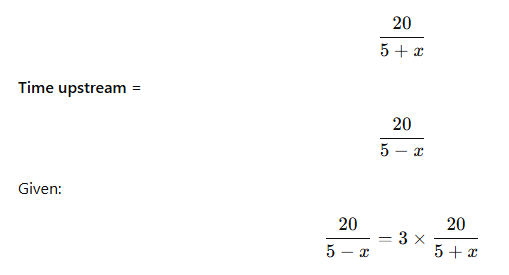
Downstream speed = 5 + x, upstream speed = 5 − x
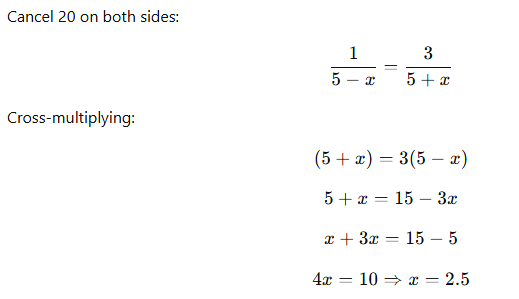
t_up = 3 × t_down → (5 + x) = 3(5 − x)
5 + x = 15 − 3x → 4x = 10 → x = 2.5 km/h
Cetking shortcut: Down : Up speed = 3 : 1 → boat = (3 + 1)/2 = 2 units, stream = (3 − 1)/2 = 1 unit; 2 units = 5 → stream = 2.5.
Answer: B