Pointing to a lady, Aradhya said, "She is the mother-in-law of the husband of my mother". How is that lady related to Aradhya?
- APaternal Grandmother
- BAunt
- CMaternal Grandmother
- DSister
- EGrand Daughter
Show answerHide answer
Answer: C ✓ official key
Approach: Decode the relation from the speaker outwards, one link at a time.
Solution:
'Husband of my mother' = Aradhya's father.
'Mother-in-law of Aradhya's father' = mother of his wife.
His wife is Aradhya's mother, so the lady is the mother of Aradhya's mother.
Mother's mother = Maternal Grandmother.
Why the other options are wrong:
A: Paternal grandmother is the father's mother, not his mother-in-law.
B, D, E: Aunt, sister and grand-daughter are not two generations above via the mother.
Cetking shortcut: 'Mother-in-law of my father' is always 'my mother's mother'.
Answer: C
“Her mother’s brother is the only son of my mother’s father,” Ben remarked, pointing to a girl in the photograph. What is the relationship between the girl’s mother and Ben ?
- AMother
- BSister
- CAunt
- DGrandmother
- EBrother
Show answerHide answer
Official CET key: C · Cetking's answer: B — see why below
Approach: Blood relation — identify the common person and place both sides around him.
Solution:
'The only son of my mother's father' = Ben's mother's only brother = Ben's maternal uncle (call him U).
Ben says the girl's mother's brother is U, so the girl's mother is a sister of U.
U's sisters are Ben's mother and Ben's mother's sisters.
Ben speaks of 'her mother' as a separate person from his own mother, so the standard reading is that she is another sister of U, i.e. Ben's mother's sister.
Mother's sister = Ben's Aunt.
Why the other options are wrong:
A: this would make the girl Ben's own sister, but the question treats the girl's mother as a different person from Ben's mother.
B, E: the girl's mother is one generation above Ben, so she cannot be his sister or brother.
D: grandmother is two generations above.
Cetking shortcut: Same maternal uncle for both ⇒ the two mothers are sisters ⇒ the girl's mother is Ben's (maternal) aunt.
Answer: C
If A + B means A is the brother of B; A – B means A is the sister of B and A x B means A is the father of B. Which of the following means that C is the son of M ?
- AM – N x C + F
- BF – C + N x M
- CN + M – F x C
- DM x N – C + F
- EF-N+C
Show answerHide answer
Answer: D ✓ official key
Approach: Coded blood relations — decode each option, looking for 'M is father of C' and 'C is male'.
Solution:
Need: M is the father (or mother) of C, and C is male.
D: M x N → M is father of N.
N – C → N is sister of C, so C is also M's child.
C + F → C is brother of F, so C is male.
Hence C is the son of M.
Why the other options are wrong:
A: M – N x C → M is sister of N, who is C's father → M is C's aunt.
B: N x M → N is father of M; C is N's brother → C is M's uncle.
C: F x C → F is C's father; M is F's sister → M is C's aunt.
E: F–N+C does not mention M at all.
Cetking shortcut: Start from options where M is followed by 'x' (father) — only D begins 'M x'.
Answer: D
Pointing to a photograph of a boy Suresh said, "He is the son of the only son of my mother." How is Suresh related to that boy?
- ABrother
- BUncle
- CCousin
- DFather
- ESister
Show answerHide answer
Answer: D ✓ official key
Approach: Pointing relation — 'only son of my mother' is the speaker himself.
Solution:
Suresh is male, so 'the only son of my mother' = Suresh himself.
'He is the son of Suresh' → the boy is Suresh's son.
So Suresh is the boy's Father.
Why the other options are wrong:
A, C: brother / cousin would need the boy to be in Suresh's generation.
B: uncle would need the boy's father to be Suresh's brother, but Suresh is the only son.
E: Suresh is male, not a sister.
Cetking shortcut: A male speaker's 'mother's only son' = himself.
Answer: D
In a joint family, there are ; father, mother, 3 married sons and one unmarried daughter. Of the sons, two have 2 daughters each, and one has a son. How many female members are there in the family ?
- A2
- B3
- C6
- D9
- E7
Show answerHide answer
Answer: D ✓ official key
Approach: Blood relations counting: list every female member generation by generation.
Solution:
Mother: 1.
3 married sons ⇒ their 3 wives: 3.
Unmarried daughter: 1.
Two sons have 2 daughters each: 2 × 2 = 4 (the third son's child is a son).
Total females = 1 + 3 + 1 + 4 = 9.
Why the other options are wrong:
A, B: count only one generation.
C (6): misses the daughters-in-law or granddaughters.
E (7): misses the mother and the unmarried daughter, or counts 2 daughters-in-law.
Cetking shortcut: 'Married sons' always hide wives — add them first, it is the most-missed group.
Answer: D
Priya says about Neha: “Neha’s father is the only son of my grandfather.”
How is Priya related to Neha?
- AMother
- BSister
- CCousin Sister
- DAunt
- ENiece
Show answerHide answer
Answer: B ✓ official key
Approach: Blood relation: decode 'only son of my grandfather'.
Solution:
Priya's grandfather's only son must be Priya's father.
Priya says this person is Neha's father ⇒ both share the same father.
Priya is a female name, so Priya is Neha's Sister.
Why the other options are wrong:
A (Mother), D (Aunt), E (Niece): different generation.
C (Cousin Sister): a cousin would need a different father; the 'only son' rules that out.
Cetking shortcut: 'Only son of my grandfather' (paternal side) = 'my father'; reduce such phrases to a direct relation first.
Answer: B
DIRECTION for the questions: Study the following information and answer the question given below.
Pointing to a man in a photograph, Asha said, "His mother's only daughter is my mother." How is Asha related to that man?
- ANephew
- BSister
- CWife
- DNiece
- EGrand daughter
Show answerHide answer
Answer: D ✓ official key
Approach: Decode the phrase from the inside out.
Solution:
His mother's only daughter = his sister.
His sister is Asha's mother → the man is Asha's maternal uncle.
Asha (female) is his niece.
Why the other options are wrong:
A Nephew: wrong gender.
B Sister: his sister is Asha's mother, not Asha.
C Wife, E Grand daughter: one generation off / not linked.
Cetking shortcut: 'Mother's only daughter' = sister; then it's a one-generation gap.
Answer: D
DIRECTION for the questions: Study the following information and answer the question given below.
Pointing to an old man, Kunal said, "His son is my son's uncle." How is the old man related to Kunal?
- ABrother
- BUncle
- CFather
- DGrandfather
- ENephew
Show answerHide answer
Answer: C ✓ official key
Approach: Work from Kunal's son.
Solution:
Kunal's son's uncle = Kunal's brother.
The old man's son is Kunal's brother → the old man is Kunal's father.
Why the other options are wrong:
A Brother: the brother is the old man's son.
B Uncle, D Grandfather: one generation off.
E Nephew: wrong direction.
Cetking shortcut: Son's uncle = my brother → his father = my father.
Answer: C
DIRECTION for the questions: Study the following information and answer the question given below.
A girl introduced a boy as the son of the daughter of the father of her uncle. The boy is girl's
- ABrother
- BSon
- CUncle
- DSon-in-law
- ENephew
Show answerHide answer
Answer: A ✓ official key
Approach: Decode step by step.
Solution:
Her uncle's father = her grandfather.
Grandfather's daughter = her mother (or aunt).
Son of her mother = her brother (cousin is not offered).
Why the other options are wrong:
B Son, D Son-in-law: wrong generation.
C Uncle: the boy is a grandchild of the grandfather, same generation as the girl.
E Nephew: one generation below.
Cetking shortcut: Grandfather's daughter's son is in the girl's own generation → brother.
Answer: A
DIRECTION for the questions: Study the following information and answer the question given below.
Pointing to a person, a man said to a woman, "His mother is the only daughter of your father." How was the woman related to the person?
- AAunt
- BMother
- CWife
- DDaughter
- EGrandmother
Show answerHide answer
Answer: B ✓ official key
Approach: Identify the only daughter.
Solution:
The man speaks to a woman: 'only daughter of your father' = the woman herself.
His (the person's) mother = the woman → she is his mother.
Why the other options are wrong:
A Aunt: would need a sister, but she is the only daughter.
C Wife, D Daughter, E Grandmother: wrong generation/relation.
Cetking shortcut: 'Only daughter of your father' addressed to a woman always means 'you'.
Answer: B
DIRECTION for the questions: Study the following information and answer the question given below.
Pointing to a photograph, a woman says, "This man's son's sister is my mother-in-law." How is the woman's husband related to the man in the photograph?
- AGrandson
- BSon
- CSon-in-law
- DNephew
- EBrother
Show answerHide answer
Answer: A ✓ official key
Approach: Decode the chain.
Solution:
This man's son's sister = this man's daughter.
She is the woman's mother-in-law → mother of the woman's husband.
So the husband is the son of the man's daughter → the man's grandson.
Why the other options are wrong:
B Son: the husband's mother is the man's daughter.
C Son-in-law: that is the husband's father.
D Nephew, E Brother: not linked this way.
Cetking shortcut: Mother-in-law → husband's mother; count down one generation from the man's daughter.
Answer: A
Read the information given below carefully and answer the question that follows :
There are two grandfathers and two grandmothers in a family of 21. There are six couples each having at least one child. The grandparents have 9 grandchildren altogether, among them three are Anne, Jerry and Ravi. Their father and mother are a physician and physiotherapist respectively. The Physician has a sister who is an Economist. The Physiotherapist has two brothers, one Engineer and a banker. Among the 9 grandchildren there are 5 granddaughters and 4 grandsons. The mother of two granddaughters among the five is the Economist whose husband is not in the party. The father of two grandsons among the four is an Engineer, whose wife is a homemaker.
Question : The Banker has how many children ?
- A1
- B3
- C4
- D2
- E0
Show answerHide answer
Answer: D ✓ official key
Approach: Account for all 9 grandchildren by parent and by gender.
Solution:
Physician + Physiotherapist: Anne, Jerry, Ravi = 3 children
Economist: 2 granddaughters
Engineer: 2 grandsons
Total so far = 3 + 2 + 2 = 7, so the Banker has 9 − 7 = 2 children.
Gender check: grandsons 4 = Jerry, Ravi + Engineer's 2; granddaughters 5 = Anne + Economist's 2 + Banker's 2 ✓
Cetking shortcut: Only the Banker's share is not stated → subtract from 9.
Answer: D
In a family of seven people, the Lawyer is married to a Teacher and has three sons, one Engineer, one Doctor and one Actor. The Actor’s wife is a Dancer and aunt of Ela. Ela, the daughter of Engineer, learns martial arts with her brother Jola. How is the Doctor related to Jola ?
- ABrother
- BSon
- CUncle
- DFather
- ENephew
Show answerHide answer
Answer: C ✓ official key
Approach: Build a two-generation family tree.
Solution:
Lawyer + Teacher → sons: Engineer, Doctor, Actor.
Ela is the Engineer's daughter; Jola is Ela's brother → Jola is the Engineer's son.
The Doctor is the Engineer's brother → Doctor is Jola's uncle.
Why the other options are wrong:
A) Brother — Jola's brother would be the Engineer's son, not the Doctor.
B) Son, E) Nephew — Doctor is a generation above Jola.
D) Father — Jola's father is the Engineer.
Answer: C
If :
A $ B means A is mother of B.
A # B means A is father of B.
A @ B means A is husband of B.
A % B means A is daughter of B
Then ;
G $ M @ K would mean that K is related to G as :
- AMother
- BMother-in-law
- CDaughter-in-law
- DSister
- EDaughter
Show answerHide answer
Official CET key: C · Cetking's answer: B — see why below
Approach: Decode each symbol and link the relations.
Solution:
G $ M → G is the mother of M.
M @ K → M is the husband of K, so K is M's wife.
K is the wife of G's son → K is G's daughter-in-law.
Why the other options are wrong:
A) Mother, B) Mother-in-law — that is G's relation to K, not K's to G.
D) Sister, E) Daughter — K is related by marriage, not blood.
Answer: C
Pointing to a photograph of a boy, Ramani, a smart looking man said, “He is the son of the only son of my mother.” How is Ramani related to the boy in the photograph ?
- ABrother
- BFather
- CSon
- DUncle
- EGrandfather
Show answerHide answer
Answer: B ✓ official key
Approach: Reduce the phrase from the speaker's side.
Solution:
'The only son of my mother' = Ramani himself.
The boy is the son of Ramani → Ramani is the boy's father.
Why the other options are wrong:
A) Brother — would need 'son of my mother/father'.
C) Son — reverses the relation.
D) Uncle — needs another son of his mother.
E) Grandfather — one generation too many.
Answer: B
Bhanu is the sister of Chirag. Aryan is the father of Bhanu. Chirag is the brother of Dewan. Dewan is the husband of Esha. How is Esha related to Aryan ?
- ADaughter
- BNiece
- CWife
- DSister
- EDaughter-in-law
Show answerHide answer
Answer: E ✓ official key
Approach: Chain the sibling and marriage links.
Solution:
Bhanu is Chirag's sister; Aryan is Bhanu's father → Aryan is also Chirag's father.
Chirag is Dewan's brother → Aryan is Dewan's father.
Esha is Dewan's wife → Esha is Aryan's daughter-in-law.
Why the other options are wrong:
A) Daughter — Esha is related by marriage.
B) Niece, D) Sister — wrong generation/branch.
C) Wife — Esha is married to Dewan.
Answer: E
P is the father of Q. R is the sister of P.
How is R related to Q?
- AAunt
- BMother
- CBrother
- DCousin
- ESister
Show answerHide answer
Answer: A ✓ official key
Approach: Two-generation relation.
Solution:
P is Q's father.
R is P's sister → R is the sister of Q's father.
Father's sister = aunt.
Answer: A
Pointing to a woman, Aarav said,“She is the mother of the only son of my father’s sister.”
How is the woman related to Aarav?
- ASister
- BMother
- CCousin
- DAunt
- ENiece
Show answerHide answer
Answer: D ✓ official key
Approach: Pointing-type relation — decode right to left.
Solution:
My father's sister = Aarav's aunt.
Her only son = Aarav's cousin.
Mother of that son = the father's sister herself → aunt.
Why the other options are wrong:
C Cousin – that is the son, not the woman.
A, B, E – no link to sister, mother or niece.
Answer: D
Pointing to a woman, Rahul said, “She is the mother of my father’s only daughter.” How is she related to Rahul?
- AMother
- BSister
- CAunt
- DGrandmother
- EMother-in-law
Show answerHide answer
Answer: A ✓ official key
Approach: Pointing-type relation.
Solution:
Rahul is male, so his father's only daughter is Rahul's sister.
The mother of Rahul's sister = Rahul's mother.
Answer: A
A is the brother of B.
C is the father of A.
D is the brother of E.
E is the daughter of B.
Then how A is related to D?
- AUncle
- BFather
- CFather-in-law
- DCousin
- EGrandfather
Show answerHide answer
Answer: A ✓ official key
Approach: Build a family tree.
Solution:
C is the father of A; A is the brother of B → A and B are siblings.
E is B's daughter; D is E's brother → D is B's son.
A is the brother of D's parent → A is D's uncle (true whether B is father or mother).
Why the other options are wrong:
B Father – D's parent is B, not A.
D Cousin – A is one generation above D.
C, E – no in-law or grandparent link; C is the grandfather.
Answer: A
Pointing to a man at a party, Rohan said,
“He is the son of the only daughter of the father of my mother’s husband.”
How is the man related to Rohan?
- ABrother
- BCousin
- CUncle
- DGrandfather
- ENephew
Show answerHide answer
Answer: B ✓ official key
Approach: Long relation chain — reduce step by step.
Solution:
My mother's husband = Rohan's father.
Father of my father = paternal grandfather.
Only daughter of the grandfather = father's sister (paternal aunt).
Son of the paternal aunt = Rohan's cousin.
Why the other options are wrong:
A Brother – he is not a child of Rohan's parents.
C Uncle – would be grandfather's son.
D Grandfather / E Nephew – wrong generation.
Answer: B
Arun is the son of Chitra; Chitra and Qadira are sisters; Zara is the mother of Qadira and Prem is the son of Zara. Which of the following statements is true ?
- APrem and Arun are cousins
- BPrem is the maternal uncle of Arun
- CQadira is the maternal grandmother of Arun
- DChitra and zara are sisters
- EPrem is grandfather of Arun
Show answerHide answer
Answer: B ✓ official key
Approach: Build the family tree from the given links.
Solution:
Zara is the mother of Qadira; Chitra and Qadira are sisters → Zara is also Chitra's mother.
Prem is Zara's son → Prem is the brother of Chitra.
Arun is Chitra's son → Prem is the brother of Arun's mother = maternal uncle of Arun.
Why the other options are wrong:
A: Prem is Arun's uncle, not cousin.
C: Qadira is Arun's maternal aunt; Zara is the grandmother.
D: Zara is Chitra's mother.
E: Prem is one generation above Arun, not two.
Answer: B
If P + Q means P is the daughter of Q; P - Q means P is the brother of Q; P % Q means P is the father of Q and P x Q means P is the sister of Q. Which of the following means I is the niece of J?
- AJ - N % C x I
- BI x C - N % J
- CJ + M x C % I
- DI x C + N – J
- EN – C % M + I
Show answerHide answer
Answer: D ✓ official key
Approach: Decode each symbol and look for: I is female, I is the child of J's sibling.
Solution: Option D: I × C + N – J
I × C → I is the sister of C (I is female).
C + N → C is the daughter of N → I is also N's child.
N – J → N is the brother of J.
So I is the daughter of J's brother → I is J's niece.
Why the other options are wrong:
A: J – N % C × I → I is N's child, but I's gender is not fixed (could be nephew).
B: I × C – N % J → C is brother of N, N is father of J → I is J's aunt.
C: J + M × C % I → J is M's daughter, M is C's sister, C is I's father → I and J are cousins.
E: N – C % M + I → M is the daughter of I, so I is a parent (C's wife), not a niece of J.
Cetking shortcut: A niece needs a female marker on I — only options starting with 'I ×' (I is sister) qualify; check those first.
Answer: D
If Neha says, “Priyanka’s father Omveer is the only son of my Father-in-law Chandrapal”, then how is Ruchi, who is the sister of Priyanka, related to Chandrapal ?
- ANiece
- BDaughter
- CWife
- DDaughter-in-law
- EGrand Daughter
Show answerHide answer
Answer: E ✓ official key
Approach: Decode the speaker's relation step by step.
Solution:
Chandrapal is Neha's father-in-law; his only son Omveer must be Neha's husband.
Priyanka is Omveer's daughter → Chandrapal's granddaughter.
Ruchi is Priyanka's sister → also Omveer's daughter → Chandrapal's granddaughter.
Why the other options are wrong: Niece, daughter, wife, daughter-in-law are the wrong generation or link (Neha is the daughter-in-law).
Answer: E
There are six members, P, Q, R, S, T and U in a family. T is the brother of P's husband. U is the mother of T. Q is the daughter of S and P and granddaughter of R. How is R related to T ?
- ABrother
- BUncle
- CFather
- DSon
- ENephew
Show answerHide answer
Answer: C ✓ official key
Approach: Build the tree for six members.
Solution:
Q is the daughter of S and P → S is P's husband.
T is the brother of P's husband → T is S's brother.
U is T's mother → U is also S's mother.
Q is R's granddaughter; the only member left for the grandfather slot is R → R is U's husband, father of S and T.
So R is T's father.
Why the other options are wrong: R is one generation above T, so brother, son and nephew are out; uncle would need R to be a sibling of T's parent.
Answer: C
Study the regulations given here under and answer the Question that follows :
Regulations :
(i) If 'A × B' means 'A is father of B'.
(ii) If 'A + B' means 'A is wife of B'.
(iii) If 'A ÷ B' means 'A is daughter of B'.
(iv) If 'A – B' means 'A is son of B'.
Question :
What will come in the place of the question mark, to establish that Q is the nephew of T in the expression 'Q ? R ÷ S × T'
- A+
- B×
- C–
- D÷
- Ex and ÷
Show answerHide answer
Official CET key: C · Cetking's answer: D — see why below
Approach: Decode the known links, then choose the symbol that makes Q a male child of T's sibling.
Solution:
R ÷ S → R is the daughter of S.
S × T → S is the father of T.
So R and T are siblings (R is T's sister).
For Q to be T's nephew, Q must be the son of R → 'Q – R' (Q is son of R).
Q – R ÷ S × T → Q is the son of T's sister → nephew.
Why the other options are wrong:
A (+): Q would be R's wife.
B (×): Q would be R's father.
D (÷): Q would be R's daughter → niece, not nephew.
E: is not a single symbol.
Answer: C
Savita is mother-in-law of Eashita who is sister-in-law of Aniket. Pranjal is father of Sanjeev, the only brother of Aniket. How is Savita related to Aniket?
- AMother
- BMother-in-law
- CDaughter
- DSister
- ENiece
Show answerHide answer
Answer: A ✓ official key
Approach: Decode 'sister-in-law' through the only brother.
Solution:
Sanjeev is the only brother of Aniket.
Eashita is Aniket's sister-in-law → she is the wife of Aniket's brother Sanjeev.
Savita is Eashita's mother-in-law → Savita is the mother of Eashita's husband Sanjeev.
Sanjeev and Aniket are brothers, so Savita is Aniket's mother too (Pranjal, the father, is her husband).
Why the other options are wrong:
- B Mother-in-law – she is the brother's mother, not the wife's mother.
- C Daughter, D Sister, E Niece – wrong generation.
Answer: A
If Aruna is the sister of Babita, Babita is the daughter of Chitra, and Chitra is the wife of Dinesh, how is Dinesh related to Aruna?
- AUncle
- BSon-in-law
- CFather-in-law
- DFather
- ENephew
Show answerHide answer
Answer: D ✓ official key
Approach: Simple parent chain.
Solution:
Babita is the daughter of Chitra; Chitra is Dinesh's wife → Dinesh is Babita's father.
Aruna is Babita's sister → Dinesh is Aruna's father too.
Answer: D
Looking at the photo of a man. David said, “His mother is the wife of my father’s son. Brothers and sisters I have none”. Whose photo was David looking at?
- AHis uncle
- BHis nephew
- CHis son
- DHis cousin
- EHis Father-in-law
Show answerHide answer
Answer: C ✓ official key
Approach: 'My father's son' with no siblings = the speaker himself.
Solution:
David has no brothers or sisters, so 'my father's son' = David.
'The wife of my father's son' = David's wife.
The man's mother is David's wife → the man is David's son.
Why the other options are wrong:
- A Uncle, B Nephew, D Cousin – need a sibling, but David has none.
- E Father-in-law – wrong generation.
Cetking shortcut: The phrase 'brothers and sisters I have none' always collapses 'my father's son' into 'me'.
Answer: C
Pointing to Tanya, a woman says,
“She is the daughter of the only brother of the only daughter of my father.”
How is Tanya related to the woman?
- AMother
- BSister
- CNiece
- DCousin sister
- EAunt
Show answerHide answer
Answer: C ✓ official key
Approach: Collapse 'only daughter of my father' to the speaker.
Solution:
The only daughter of the woman's father = the woman herself.
Her only brother = Tanya's father.
Tanya is her brother's daughter → Tanya is her niece.
Why the other options are wrong:
- B Sister / D Cousin sister – same generation, wrong.
- A Mother / E Aunt – older generation, wrong.
Answer: C
If Ajit is the brother of Balaji, Balaji is the son of Chaya, Chaya is the daughter of Diya, and Diya is the wife of Eknath, how is Eknath related to Balaji?
- AUncle
- BFather
- CGrandfather
- DMother
- EGrandmother
Show answerHide answer
Official CET key: C · Cetking's answer: B — see why below
Approach: Three-generation chain.
Solution:
Balaji is the son of Chaya.
Chaya is the daughter of Diya; Diya is Eknath's wife → Chaya is Eknath's daughter.
Eknath is the father of Balaji's mother → Eknath is Balaji's (maternal) grandfather.
Why the other options are wrong:
- A Uncle / B Father – wrong generation.
- D Mother / E Grandmother – Eknath is male (husband of Diya).
Cetking shortcut: Count generations: Eknath → Chaya → Balaji = two steps down → grandfather.
Answer: C
If P + Q means, P is the mother of Q; P - Q means, P is the brother Q; P % Q means, P is the father of Q and P x Q means, P is the sister of Q, then, which of the following shows that P is the maternal uncle of Q ?
- AN - M x Q % S
- BP - M + N x Q
- CQ - N + M x P
- DQ - S % P
- EP + S x N - Q
Show answerHide answer
Answer: B ✓ official key
Approach: Coded blood relations — decode each symbol and build the family chain.
Solution:
Maternal uncle of Q = brother of Q's mother.
Option B: P − M + N × Q.
P − M → P is the brother of M (P is male).
M + N → M is the mother of N.
N × Q → N is the sister of Q, so M is also the mother of Q.
P is the brother of Q's mother → P is the maternal uncle of Q.
Why the other options are wrong:
A: starts with N, not P — says nothing about P.
C: Q − N + M × P → Q is the brother of N, N is the mother of M, M is the sister of P → Q is the maternal uncle of P (reverse of what is asked).
D: Q − S % P → S is the father of P; Q is S's brother → Q is P's paternal uncle (reverse, and paternal).
E: P + S → P is the mother of S, so P is female — cannot be an uncle.
Cetking shortcut: Answer must start with 'P −' (P is a brother) and the middle link must be '+' (mother) — only B.
Answer: B
If A + B means, A is the brother of B; A - B means, A is the sister of B and A x B means, A is the father of B. Which of the following means that C is the son of M ?
- AN + M - F x C
- BF x N - M x C
- CM x N - C + F
- DF - C + N x M
- EM - N x C + F
Show answerHide answer
Answer: C ✓ official key
Approach: Coded blood relations — C must be male and a child of M.
Solution:
Option C: M × N − C + F.
M × N → M is the father of N.
N − C → N is the sister of C, so C is also M's child.
C + F → C is the brother of F, so C is male.
C is a male child of M → C is the son of M.
Why the other options are wrong:
A: N + M − F × C → F is the father of C; M is F's sister → M is C's aunt.
B: F × N − M × C → M is the father of C, but C's gender is never fixed (no '+' after C), so C may be a daughter.
D: F − C + N × M → N is the father of M; C is N's brother → C is M's uncle.
E: M − N × C → M is a sister of N, who is C's father → M is C's aunt.
Cetking shortcut: C must appear after M's child link and must be followed by '+' (brother) to fix gender — only option C.
Answer: C
Veena who is the sister-in-law of Ashok, is the daughter-in-law of Kalyani. Dheeraj is the father of Sudeep, who is the only brother of Ashok. How is Kalyani related to Ashok?
- AMother
- BSister-in-law
- CMother-in-law
- DPaternal Aunt
- EWife
Show answerHide answer
Answer: A ✓ official key
Approach: Blood relations — locate the married couple, then the parents.
Solution:
Sudeep is the only brother of Ashok, so Sudeep and Ashok share the same parents (Dheeraj is their father).
Veena is Ashok's sister-in-law and Kalyani's daughter-in-law → Veena is the wife of Kalyani's son.
The only brother of Ashok is Sudeep, so Veena is Sudeep's wife and Sudeep is Kalyani's son.
Kalyani is Sudeep's mother (Dheeraj's wife) and therefore Ashok's mother.
Why the other options are wrong:
B, C, E: these are in-law/spouse relations — Kalyani is in the generation above Ashok.
D: a paternal aunt would be Dheeraj's sister; Kalyani is the mother-in-law of Sudeep's wife, i.e. Sudeep's mother.
Answer: A
If A + B means, A is the sister of B; A x B means, A is the wife of B, A % B means, A is the father of B and A - B means, A is the brother of B. Which of the following means T is the daughter of P ?
- AP x Q % R + T - S
- BP x S % R + S + Q
- CP x Q % R + S + T
- DP x Q % R - T + S
- EP x Q % R + S - T
Show answerHide answer
Answer: D ✓ official key
Approach: Coded blood relations — T must be female and P's child.
Solution:
Option D: P × Q % R − T + S.
P × Q → P is the wife of Q.
Q % R → Q is the father of R, so P is R's mother.
R − T → R is the brother of T, so T is also P's child.
T + S → T is the sister of S, so T is female.
T is a female child of P → T is P's daughter.
Why the other options are wrong:
A: T − S → T is a brother (male) → son, not daughter.
B: T does not appear at all.
C: T is the last term — her gender is never stated.
E: T is the last term — gender unknown.
Cetking shortcut: T must be followed by '+' (sister) in the code — only option D.
Answer: D
Read the information with respect to relationships between family members is concerned carefully and answer the question that follows :
A3P means A is the mother of P
A4P means A is the brother of P
A9P means A is the husband of P
A5P means A is the daughter of P
Which of the following means that K is the mother-in-law of M ?
- AM9N3K4J
- BM9K5S4M
- CK3J9N4M
- DK5J9M3N
- EM9N5K3J
Show answerHide answer
Answer: E ✓ official key
Approach: Number-coded blood relations — decode, then check K is a female parent of M's spouse.
Solution:
Option E: M9N5K3J.
M9N → M is the husband of N.
N5K → N is the daughter of K.
K3J → K is the mother of J, so K is female.
K is the mother of M's wife N → K is M's mother-in-law.
Why the other options are wrong:
A: M9N3K4J → N (M's wife) is the mother of K, so K is M's son, not mother-in-law.
B: M9K → K is M's wife, not her mother.
C: K3J9N4M → K is J's mother, J is N's husband and N is M's brother — K is never the mother of M's spouse.
D: K5J9M3N → K is the daughter of J, and J is M's husband → K is M's daughter, not mother-in-law.
Cetking shortcut: Mother-in-law of M = mother of M's spouse: look for 'M9_' followed by '_5K' (daughter of K) and confirm K is female.
Answer: E
Puja is the mother-in-law of Sunita who is the wife of Rohit. Rohit whose father is Gajanan, is the father of Rupali. Dhanashree is the daughter of Puja.
Find how Puja is related to Rupali?
- AGrandson
- BGrandmother
- CGranddaughter
- DAunt
- EMother-in-law
Show answerHide answer
Answer: B
Approach: Decode each link, then chain generations.
Solution:
Sunita is Rohit's wife; Puja is Sunita's mother-in-law → Puja is Rohit's mother.
Rohit is Rupali's father → Puja is the mother of Rupali's father.
So Puja is Rupali's paternal grandmother. (Gajanan is the grandfather; Dhanashree, Puja's daughter, is Rupali's aunt — extra information.)
Why the other options are wrong:
A, C: grandson/granddaughter reverse the generation and Puja is female-elder.
D: aunt is Dhanashree, not Puja.
E: Puja is mother-in-law of Sunita, not of Rupali.
Cetking shortcut: Mother-in-law of X's wife = X's mother. One step down from there = grandmother.
Answer: B
If Neetu says, “Priya’s father Omkar is the only son of my father in law Chandrakant”, then how is Ruchi, who is sister of priya, related to Chandrakant?
- ANiece
- BDaughter
- CWife
- DDaughter in law
- EGranddaughter
Show answerHide answer
Answer: E
Approach: Decode the speaker's statement, then place Ruchi.
Solution:
Neetu's father-in-law is Chandrakant; his only son is Omkar → Omkar is Neetu's husband.
Omkar is Priya's father; Ruchi is Priya's sister → Ruchi is Omkar's daughter.
Chandrakant is Omkar's father → Ruchi is Chandrakant's granddaughter.
Why the other options are wrong:
A: niece is a sibling's daughter.
B: daughter would be Omkar's sister.
C, D: wife / daughter-in-law relate to Chandrakant and Neetu, not Ruchi.
Answer: E
If 'P+Q' means P is brother of Q "P*Q' means P is sister of Q, P-Q means P is mother of Q and 'P@Q means P is father of Q then which of the following is correct about E+F@G*H?
- AG is the mother of H
- BG is the daughter of F
- CF is brother of E
- DE is sister of H
- EF is sister of E
Show answerHide answer
Answer: C
Approach: Decode each symbol and note the gender each one fixes.
Solution:
E + F → E is brother of F (E male).
F @ G → F is father of G (F male).
G * H → G is sister of H (G female).
E and F are siblings and F is male → F is the brother of E.
Why the other options are wrong:
A: G is H's sister, not mother.
D: E is male (brother), so cannot be a sister; E is H's uncle.
E: F is male (father), so not a sister.
B: G is female and F is G's father, so G is also F's daughter — this statement is also true from the data.
Answer: C
A woman introduces a man as the son of the brother of her mother. How is the man related to the woman?
- ABrother
- BUncle
- CNephew
- DCousin
- EFather
Show answerHide answer
Answer: D
Approach: Decode the relation chain from the woman.
Solution: Her mother's brother = her maternal uncle.
The uncle's son = her cousin.
Why the other options are wrong:
A Brother — would be her mother's son.
B Uncle — would be the mother's brother himself.
C Nephew — would be her sibling's son.
E Father — mother's husband, not mother's brother's son.
Answer: D
If A is the mother of B, B is the son of C, and D is the brother of C, how is D related to A?
- ABrother-in-law
- BUncle
- CNephew
- DCousin
- EFather
Show answerHide answer
Answer: A
Approach: Build a family tree.
Solution: A is the mother of B; B is the son of C → C is B's father, so A and C are husband and wife.
D is the brother of C → D is the brother of A's husband.
Husband's brother = brother-in-law.
Why the other options are wrong:
B Uncle — D is B's uncle, not A's.
C Nephew, D Cousin, E Father — no link supports these.
Answer: A
Vinod is the brother of Bhaskar. Manohar is the sister of Vinod. Biswal is the brother of Preetam and Preetam is the daughter of Bhaskar. Who is the uncle of Biswal?
- ABhaskar
- BManohar
- CPreetam
- DVinod
- EData not sufficient
Show answerHide answer
Answer: D
Approach: Family tree; ignore distractor names.
Solution: Vinod is Bhaskar's brother; Manohar is Vinod's (and Bhaskar's) sister.
Preetam is Bhaskar's daughter, Biswal is Preetam's brother → Biswal is Bhaskar's son.
Father's brother = paternal uncle → Vinod.
Why the other options are wrong:
A Bhaskar — father of Biswal.
B Manohar — sister of Bhaskar, i.e. aunt.
C Preetam — sister of Biswal.
E — data is sufficient.
Cetking shortcut: Names do not reveal gender here — "Manohar is the sister" makes Manohar female; trust the stated relation, not the name.
Answer: D
If A # B means A is brother of B, A @ B means A is mother of B, A $ B means A is father of B, A & B means A is sister of B. In the expression G @ O & S # V $ J, how is S related to father of J, who is a male?
- ABrother
- BUncle
- CSon
- DNephew
- EBrother-in-law
Show answerHide answer
Answer: A
Approach: Coded relations — decode the chain left to right.
Solution: G @ O → G is the mother of O.
O & S → O is the sister of S.
S # V → S is the brother of V.
V $ J → V is the father of J (male).
So the father of J is V, and S is V's brother.
Why the other options are wrong:
B Uncle — S is J's uncle, but the question asks S's relation to J's father.
C Son, D Nephew — S and V are siblings, same generation.
E Brother-in-law — S and V share mother G, so they are real brothers.
Cetking shortcut: Read the question twice: "related to father of J" — stop at V.
Answer: A
Read the following information carefully to answer the questions given below :
(i) ‘A × B’ means A is the brother of B;
(ii) ‘A ÷ B’ means B is the father of A;
(iii) ‘A + B’ means A is the sister of B;
(iv) ‘A − B’ means A is the mother of B;
Which of the following means 'Q is the paternal uncle of K'?
- AK + B ÷ N × Q + D
- BK × B ÷ N × Q × D
- CQ × L ÷ R × K
- DK × P ÷ M × Q
- EK + P ÷ M × Q
Show answerHide answer
Answer: B
Approach: Coded relations — the expression must fix both "sibling of K's father" and "Q is male".
Solution: Option B: K × B → K is B's brother; B ÷ N → N is B's (and K's) father; N × Q → N is Q's brother, so Q is N's sibling; Q × D → Q is D's brother, so Q is male.
Q = male sibling of K's father = paternal uncle.
Why the other options are wrong:
A — Q + D makes Q a sister → paternal aunt.
C — Q is L's brother and R (L's father) is K's brother → Q is K's nephew.
D — Q's gender is not fixed (could be aunt).
E — Q's gender is not fixed (could be aunt).
Cetking shortcut: Paternal uncle needs two things: Q is a sibling of K's father AND Q is male. Eliminate options where Q is the last term (gender unknown) — only A and B remain, and A makes Q a sister.
Answer: B
Passage / data for this question
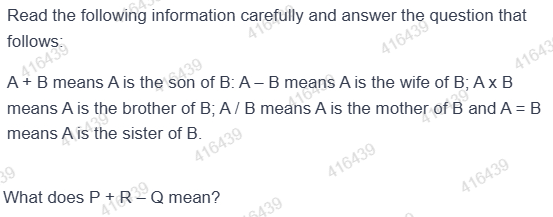
A + B means A is the son of B: A – B means A is the wife of B; A x B means A is the brother of B; A / B means A is the mother of B and A = B means A is the sister of B.
What does P + R – Q mean?
- AQ is the father of P
- BQ is the son of P
- CQ is the uncle of P
- DQ is the brother of P
- EQ is the nephew of P
Show answerHide answer
Answer: A
Approach: Coded blood relations: decode each symbol left to right and join the links.
Solution:
Codes: + = son of, − = wife of, × = brother of, / = mother of, = = sister of.
P + R: P is the son of R.
R − Q: R is the wife of Q, so Q is R's husband (male).
P is the son of R and R's husband Q ⇒ Q is the father of P.
Why the other options are wrong:
B, D, E: these put Q in P's generation or below, but Q is the husband of P's mother.
C: Q is P's parent's husband, i.e. father, not uncle.
Cetking shortcut: Mother's husband = father — two links collapse to one.
Answer: A
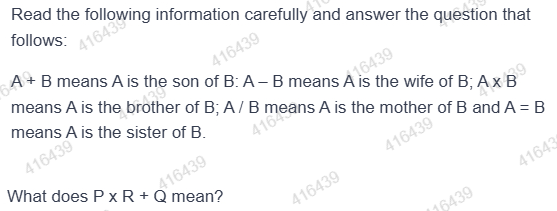
Passage / data for this question
A + B means A is the son of B: A – B means A is the wife of B; A x B means A is the brother of B; A / B means A is the mother of B and A = B means A is the sister of B.
What does P x R + Q mean?
- AP is the sister of Q
- BP is the father of Q
- CP is the uncle of Q
- DP is the nephew of Q
- EP is the son of Q
Show answerHide answer
Answer: E
Approach: Coded blood relations: decode each symbol and combine.
Solution:
Codes: + = son of, − = wife of, × = brother of, / = mother of, = = sister of.
P × R: P is the brother of R (P is male).
R + Q: R is the son of Q.
P is R's brother, so P is also a child of Q; being male, P is the son of Q.
Why the other options are wrong:
A: P is male (brother), so not sister.
B, C, D: P is in the generation below Q, as Q's child.
Cetking shortcut: Sibling of a son = another child of the same parent; gender comes from the first link.
Answer: E
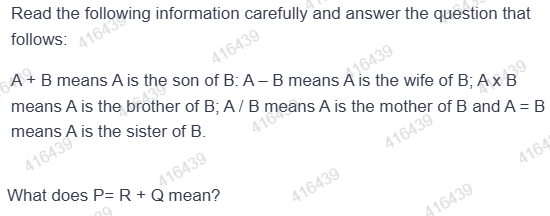
Passage / data for this question
A + B means A is the son of B: A – B means A is the wife of B; A x B means A is the brother of B; A / B means A is the mother of B and A = B means A is the sister of B.
What does P= R + Q mean?
- AP is the daughter of Q
- BP is the wife of Q
- CP is the niece of Q
- DP is the sister of Q
- EP is the aunt of Q
Show answerHide answer
Answer: A
Approach: Coded blood relations: decode each symbol and combine.
Solution:
Codes: + = son of, − = wife of, × = brother of, / = mother of, = = sister of.
P = R: P is the sister of R (P is female).
R + Q: R is the son of Q.
P is R's sister, so P is also Q's child; being female, P is the daughter of Q.
Why the other options are wrong:
B: P is Q's child, not spouse.
C, E: niece/aunt need another generation link, which is not there.
D: P is the sister of R, not of Q.
Cetking shortcut: Sister of Q's son = Q's daughter.
Answer: A
Mohan said to Nitin, "That boy playing football is the younger of the two brothers of the daughter of my father's wife." How is the boy playing football related to Mohan?
- ASon
- BBrother
- CFather
- DNephew
- ECousin
Show answerHide answer
Answer: B
Approach: Blood relation by description: reduce the chain from the speaker outward.
Solution:
"My father's wife" = Mohan's mother.
"Daughter of my mother" = Mohan's sister.
"The two brothers of my sister" = Mohan himself and one more brother.
The boy playing football is the younger of these two brothers, i.e. Mohan's brother.
Why the other options are wrong:
A, C, D, E: the boy is a child of Mohan's mother, so he is in Mohan's own generation — a brother, not son/father/nephew/cousin.
Cetking shortcut: Father's wife's daughter's brother — every link stays in the same family, so the answer is a sibling.
Answer: B
Veena who is the sister-in-law of Ashok, is the daughter-in-law of Kalyani. Dheeraj is the father of Sudeep who is the only brother of Ashok. How Kalyani is related to Ashok?
- ASister-in-law
- BSister
- CMother
- DDaughter
- EMother-in-law
Show answerHide answer
Answer: C
Approach: Blood relation: build a small family tree from the clues.
Solution:
Sudeep is the only brother of Ashok; Dheeraj is the father of Sudeep (and so of Ashok).
Veena is the sister-in-law of Ashok and the daughter-in-law of Kalyani — so Veena is Sudeep's wife.
Kalyani's daughter-in-law is Sudeep's wife, so Kalyani is Sudeep's mother (Dheeraj's wife).
Ashok is Sudeep's sibling, so Kalyani is Ashok's mother.
Why the other options are wrong:
A, B: Kalyani is a generation above Ashok.
D: she is the parent, not the child.
E: mother-in-law would need Ashok to be married to her child; Ashok is her own child.
Cetking shortcut: Daughter-in-law of K + sister-in-law of A (whose brother is K's son) ⇒ K is the mother of both brothers.
Answer: C
Passage / data for this question
DIRECTIONS for the question: Study the following information and answer the questions given below.
- A, B, C, D, E and F are six members of family.
- One couple has parents and children in the family.
- A is the son of C and E is the daughter of A.
- D is the daughter of F who is the mother of E.
Which among the following pair is the parents of the children?
- ABC
- BCF
- CBF
- DCD
- EAF
Show answerHide answer
Answer: E
Approach: Blood relations: draw the three-generation family tree.
Solution:
A is the son of C; E is the daughter of A → A is E's father.
F is the mother of E (and of D) → A and F are a couple.
Tree: C (and spouse B) → son A. A is married to F (F is the mother of E, A is E's father). A and F → daughters E and D.
The 'one couple with parents and children' is A–F: parents B, C above; children E, D below.
Parents of the children (E, D) = A and F.
Why the other options are wrong:
A BC: parents of A (the couple), not of the children.
B CF, C BF, D CD: mix members of different generations.
Answer: E
Passage / data for this question
DIRECTIONS for the question: Study the following information and answer the questions given below.
- A, B, C, D, E and F are six members of family.
- One couple has parents and children in the family.
- A is the son of C and E is the daughter of A.
- D is the daughter of F who is the mother of E.
Which among the following pair is the parents of the couple?
- AAB
- BBC
- CAF
- DCF
- EDE
Show answerHide answer
Answer: B
Approach: Blood relations: identify the top-generation pair.
Solution:
Tree: C (and spouse B) → son A. A is married to F (F is the mother of E, A is E's father). A and F → daughters E and D.
The 'one couple with parents and children' is A–F: parents B, C above; children E, D below.
Six members: A, F (couple), E, D (children), C (A's parent) and B — the only member left, who must be C's spouse.
Parents of the couple (A–F) = B and C.
Why the other options are wrong:
A AB, C AF, D CF, E DE: each includes someone from the middle or bottom generation.
Cetking shortcut: Six people, three generations: once A–F and E, D are fixed, B and C are the only pair left for the top.
Answer: B
Passage / data for this question
DIRECTIONS for the question: Study the following information and answer the questions given below.
- A, B, C, D, E and F are six members of family.
- One couple has parents and children in the family.
- A is the son of C and E is the daughter of A.
- D is the daughter of F who is the mother of E.
How many female members are there in a family of six persons?
- ATwo
- BThree
- CFour
- DFive
- ESix
Show answerHide answer
Answer: C
Approach: Blood relations: fix genders from the tree.
Solution:
Tree: C (and spouse B) → son A. A is married to F (F is the mother of E, A is E's father). A and F → daughters E and D.
The 'one couple with parents and children' is A–F: parents B, C above; children E, D below.
Female: F (mother), E and D (daughters).
Male: A (son).
B and C are a married couple → exactly one of them is female.
Females = F, E, D + one of B/C = 4.
Why the other options are wrong:
A Two, B Three: miss the female among B and C or one daughter.
D Five, E Six: A is male and one of B/C is male.
Cetking shortcut: A couple always contributes exactly one female — no need to know which of B, C is the mother.
Answer: C
DIRECTIONS for the question: solve the following question and mark the best possible option
Anil introduces Rohit as a son of the only brother of his father’s wife.
How is Rohit related to Anil?
- ACousin
- BSon
- CUncle
- DSon-in-law
- EGrandFather
Show answerHide answer
Answer: A
Approach: Blood relations: decode the chain from the end.
Solution:
Anil's father's wife = Anil's mother.
Only brother of Anil's mother = Anil's maternal uncle.
Son of Anil's maternal uncle = Anil's cousin.
Why the other options are wrong:
B Son, D Son-in-law: Rohit is in Anil's generation, not the next.
C Uncle, E Grandfather: older generations.
Cetking shortcut: 'Father's wife' is simply 'mother' — replace and the chain becomes mother's brother's son = cousin.
Answer: A
DIRECTIONS for the question: solve the following question and mark the best possible option
Deepak has a brother Anil. Deepak is the son of Prem. Bimal is Prem’s father. In terms of relationship, what is Anil of Bimal?
- ASon
- BGrandson
- CBrother
- DGrandfather
- EUncle
Show answerHide answer
Answer: B
Approach: Blood relations: two generations down.
Solution:
Deepak and Anil are brothers → both are sons of Prem.
Bimal is Prem's father.
So Anil is the son's son of Bimal → grandson.
Why the other options are wrong:
A Son: that is Prem.
C Brother, E Uncle: wrong generation.
D Grandfather: reversed relation.
Answer: B
Passage / data for this question
Read the information and answer:
A, B, C, D, E, and F are six members of a family. One couple has parents and children in the family. A is the son of C and E is the daughter of A. D is the daughter of F who is the mother of E.
Which of the following pairs is the parents of the couple?
- AB A
- BA F
- CC F
- DD E
- EB C
Show answerHide answer
Answer: E
Approach: Draw the family tree and locate the couple that has both parents and children in the family.
Solution:
A is the son of C; E is the daughter of A; F is the mother of E → A (male) and F (female) are husband and wife.
D is the daughter of F → D and E are the children of A and F.
So the couple with parents and children is A–F. Their parents: C is A's parent and the only remaining member B must be C's spouse.
Parents of the couple = B and C.
Why the other options are wrong: B A and A F include A, who is part of the couple; C F – F is a spouse, not a parent; D E are the children.
Answer: E
Passage / data for this question
Read the information and answer:
A, B, C, D, E, and F are six members of a family. One couple has parents and children in the family. A is the son of C and E is the daughter of A. D is the daughter of F who is the mother of E.
How many female members are there in the family?
- AThree
- BTwo
- CFour
- DSix
- ETwo
Show answerHide answer
Answer: C
Approach: Use the tree from the common information and mark genders.
Solution:
Females certain: E (daughter), D (daughter), F (mother).
Males certain: A (son).
B and C are a married couple (parents of A), so one of them is female.
Females = E, D, F + one of B/C = 4.
Why the other options are wrong: Three misses the female among B and C; Two counts only the daughters; Six would make A female.
Answer: C
Passage / data for this question
Read the information and answer:
A, B, C, D, E, and F are six members of a family. One couple has parents and children in the family. A is the son of C and E is the daughter of A. D is the daughter of F who is the mother of E.
What relationship do D and E bear to each other?
- ASisters
- BSister and Brother
- CGrandmother and Granddaughter
- DMother and Son
- EUncle and Niece
Show answerHide answer
Answer: A
Approach: Use the same family tree: A and F are the parents of D and E.
Solution:
E is the daughter of A and of F (F is E's mother).
D is the daughter of F.
Both are daughters of the same mother → D and E are sisters.
Why the other options are wrong: Both D and E are stated as daughters, so no brother/son/uncle; they are the same generation, so not grandmother–granddaughter.
Answer: A
D is the mother of J and L. J is the brother of F. F is the son of K. K has only three children. Y is the son-in-law of D. M is the son of Y. M is the brother of S.
How is D related to M?
- ABrother-in-law
- BMother-in-law
- CSister-in-law
- DGrandmother
- EMother
Show answerHide answer
Answer: D
Approach: Build the tree generation by generation.
Solution:
D is the mother of J and L; J is F's brother; F is K's son and K has only three children → K and D are the parents of J, F and L.
Y is D's son-in-law → Y is married to D's daughter (L).
M is Y's son (and S's brother) → M is D's grandchild.
D (mother) is M's grandmother.
Why the other options are wrong: In-law relations apply only to Y; D is two generations above M, so not mother.
Answer: D
Pointing to a man in a photograph, a lady said: “The father of his brother is the only son of my grandfather.”
How is the lady related to the man in the photograph?
- ACousin
- BAunt
- CDaughter
- DSister
- EMother
Show answerHide answer
Answer: D
Approach: Decode the statement from the end.
Solution:
'Only son of my grandfather' = my father.
'Father of his brother' = his (the man's) father.
So the man's father = the lady's father → the lady is the man's sister.
Why the other options are wrong: Cousin would need different fathers; aunt/mother/daughter are other generations.
Answer: D
Neena told Deepali that, "your mother-in-law is my father's granddaughter's father's grandfather's daughter-in-law". How is Deepali related to Neena ?
- Asister
- Bmother
- Cmother-in-law
- Ddaughter-in-law
- Edaughter
Show answerHide answer
Answer: A
Approach: Blood relations — decode the chain from Neena outwards.
Solution:
Neena's father's granddaughter = daughter of Neena's brother (Neena is his daughter, not granddaughter).
That girl's father = Neena's brother.
Brother's grandfather = Neena's grandfather; his daughter-in-law = Neena's mother.
So Deepali's mother-in-law = Neena's mother → Deepali is married to Neena's brother.
Deepali is Neena's brother's wife, i.e. her sister-in-law — the 'sister' option.
Why the other options are wrong:
B mother — would need Deepali's husband to be Neena's father; the chain lands one generation lower.
C mother-in-law, D daughter-in-law, E daughter — all require a generation gap; Deepali is in Neena's own generation.
Cetking shortcut: Count generations: father's granddaughter (−1) → her father (0) → his grandfather (+2) → daughter-in-law (+1). Generation +1 = Neena's mother, so Deepali is in Neena's generation.
Answer: A
If:
A#B means B is the mother of A;
A$B means A is the father of B;
A%B means A is the sister of B;
A*B means A is the son of B;
A@B means A is the brother of B;
A!B means A is the daughter of B
Then determine that if:
P $ Q # R % S
Then, how is R related to P ?
- Asister
- Bson
- Cniece
- Dwife
- Emother
Show answerHide answer
Answer: D
Approach: Coded blood relations.
Solution:
P $ Q → P is the father of Q.
Q # R → R is the mother of Q.
R % S → R is the sister of S (so R is female, as already known).
P is Q's father and R is Q's mother → R is P's wife.
Why the other options are wrong:
A sister, C niece — no such link between P and R.
B son — R is female (mother).
E mother — R is the mother of Q, not of P.
Answer: D
Looking at Sweety, Raj says to his friend, "Sweety is the grand-daughter of the elder brother of my father". How is Sweety related to Raj?
- Aniece
- Bgrand daughter
- Cdaughter
- Dsister
- Esister-in-law
Show answerHide answer
Answer: A
Approach: Blood relations — go up then down the family tree.
Solution:
Elder brother of Raj's father = Raj's uncle.
Uncle's granddaughter = daughter of Raj's cousin.
Raj's cousin's daughter is his niece (first cousin once removed) — the 'niece' option.
Why the other options are wrong:
B granddaughter — she is the uncle's granddaughter, not Raj's.
C daughter, D sister, E sister-in-law — different branches/generations.
Answer: A
P, Q, R, S, T and U are six members of a family. R is not the mother of Q but Q is the son of R. P and R are a married couple. T is the brother of R. U is the brother of Q. S is the daughter of P. In this case, T is related to S as being :
- AS's uncle
- BS's father
- CS's brother
- DS's nephew
- ES's husband
Show answerHide answer
Answer: A
Approach: Family tree.
Solution:
Q is R's son and R is not his mother → R is Q's father.
P and R are a couple → P is the mother.
S is P's daughter and U is Q's brother → Q, U, S are children of P and R.
T is R's brother → T is S's uncle (paternal uncle).
Why the other options are wrong:
B father — R is the father.
C brother — Q and U are S's brothers.
D nephew, E husband — wrong generation.
Answer: A
A, B, C, D, E and F are six members of a family. A is mother of B, who is the husband of D. F is the brother of one of the parents of C. D is the daughter in law of E and has no siblings. C is son of D. How C is related to A?
- Abrother in law
- Bgrandfather
- Cson
- Dbrother
- Egrandson
Show answerHide answer
Answer: E
Approach: Draw the family tree generation by generation.
Solution:
A is the mother of B; B is the husband of D → B–D are a couple, A is B's mother.
D is the daughter-in-law of E → E is B's other parent (A and E are B's parents).
C is the son of D → C is the son of B and D.
So C is the son of A's son → C is A's grandson.
(F is the brother of one of C's parents; D has no siblings, so F is B's brother – not needed.)
Why the other options are wrong:
Son: C is one generation below B, not A.
Brother / brother-in-law: wrong generation.
Grandfather: reverses the relation (A is C's grandmother).
Cetking shortcut: Count generations: A → B → C is two steps down and C is male → grandson.
Answer: E
If A + B means A is the sister of B; A x B means A is the wife of B, A % B means A is the father of B and A – B means A is the brother of B, then which of the following means T is the daughter of P ?
- APXQ%R+S-T
- BPXQ%R+T-S
- CPXQ%R+T+S
- DPXQ%R-T+S
- EP%QXR-T+S
Show answerHide answer
Answer: D
Approach: Decode each chain: P × Q fixes P as Q's wife (mother side); then T must be a child of Q and shown female.
Solution:
P × Q: P is the wife of Q. Q % R: Q is the father of R → R is a child of P.
R − T: R is the brother of T → T is also a child of P.
T + S: T is the sister of S → T is female.
Hence T is the daughter of P.
Why the other options are wrong:
A (R + S − T): T's gender is not stated.
B (… + T − S): T is a brother – male.
C (… R + T + S): R is T's sister and T is S's sister, so this chain too makes T a female child of Q and P; it decodes to the same relation, and the paper's key is D.
E (P % Q × R …): P is the father of Q and T is R's sister, i.e. Q's sister-in-law – not P's daughter.
Cetking shortcut: Look for (i) P married to the father/mother of the children and (ii) a '+' immediately after T (T is sister of someone) – that proves T is female.
Answer: D