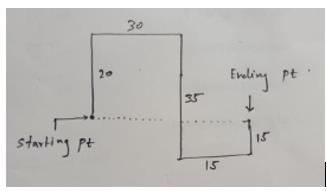
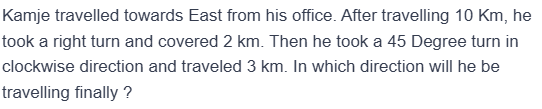
Rohit walked 25 meters towards South. Then he turned to his left and walked 20 meters. He then turned to his left and walked 25 meters. He again turned to his right and walked 15 meters. At what distance is he from the starting point and in which direction?
- A35 meters, East
- B30 meters, North East
- C40 meters, East
- D60 meters, East
- E35 meters, North East
Show answerHide answer
Answer: A ✓ official key
Approach: Direction tracking with coordinates (left of South = East, left of East = North).
Solution:
Start at O(0, 0).
25 m South → (0, −25).
Facing South, left turn = East; 20 m → (20, −25).
Facing East, left turn = North; 25 m → (20, 0).
Facing North, right turn = East; 15 m → (35, 0).
Final point is on the same horizontal line as O, 20 + 15 = 35 m away, towards East.
Why the other options are wrong:
B, E: he ends exactly back on the start's East–West line (the 25 m South and 25 m North cancel), so no North-East component.
C, D: 40 / 60 m add distances wrongly; only the East moves (20 + 15) count.
Cetking shortcut: The two 25 m legs (South and North) cancel; just add the East legs 20 + 15 = 35 m East.
Answer: A
Mr Deepak Mohan walks 5 km towards the south and then turns to the right. After walking 3 km he turns to the left and walks 5 km. What direction is he facing right now?
- AWest
- BSouth
- CNorth-East
- DSouth-West
- EEast
Show answerHide answer
Answer: B ✓ official key
Approach: Facing-direction tracking (right of South = West, left of West = South).
Solution:
Walks South → facing South.
Turns right: right of South is West; walks 3 km facing West.
Turns left: left of West is South; walks 5 km.
He is now facing South.
Why the other options are wrong:
A: West was the direction of the middle leg only.
C, D: no diagonal movement is involved.
E: East would need a right turn from South twice.
Cetking shortcut: A right turn followed by a left turn cancels out — he faces his original direction, South.
Answer: B
At a crossing, there was a direction pole, which was showing all the four correct directions. But due to the wind, it turns in such a manner that now West pointer is showing South. Harish went in the wrong direction thinking that he was travelling East. In what direction he was actually travelling?
- ASouth
- BNorth
- CWest
- DEast
- ESouth-West
Show answerHide answer
Answer: B ✓ official key
Approach: Rotated direction pole — find the rotation, then apply it to the pointer followed.
Solution:
The West pointer now points South. Going from West to South is a 90° anticlockwise turn.
So every pointer has turned 90° anticlockwise: North→West, East→North, South→East, West→South.
Harish follows the pointer marked 'East'.
That pointer now actually points North, so he is travelling North.
Why the other options are wrong:
A: South is where the West pointer points, not the East pointer.
C: West is where the North pointer now points.
D: East would mean the pole had not turned.
E: a 90° turn cannot produce a diagonal direction.
Cetking shortcut: Opposite pointers stay opposite: West→South means East→North.
Answer: B
A person walks 6 km north, then 8 km west, and finally 6 km south. What is the distance from the starting point?
- A4 KM
- B6 KM
- C8 KM
- D10 KM
- E12 KM
Show answerHide answer
Answer: C ✓ official key
Approach: Direction distance — opposite legs cancel.
Solution:
Start (0, 0) → 6 km North → (0, 6).
8 km West → (−8, 6).
6 km South → (−8, 0).
Distance from start = 8 km (due West).
Why the other options are wrong:
D: 10 km uses √(6² + 8²), ignoring the return 6 km South.
A, B, E: do not match the net displacement.
Cetking shortcut: North 6 and South 6 cancel — only the 8 km West remains.
Answer: C
Location of B is north of A and location of C is east of A. The distances AB and AC are 5 km and 12 km respectively. The shortest distance (in km) between the locations B and C is ;
- A60
- B13
- C17
- D7
- E14
Show answerHide answer
Answer: B ✓ official key
Approach: Right-angled triangle from perpendicular directions (Pythagoras).
Solution:
B is North of A and C is East of A → angle BAC = 90°.
BC² = AB² + AC² = 5² + 12² = 25 + 144 = 169.
BC = 13 km.
Why the other options are wrong:
A: 60 is the product 5 × 12.
C: 17 is the path B → A → C, not the shortest distance.
D: 7 is the difference.
E: 14 has no basis.
Cetking shortcut: 5-12-13 is a standard Pythagorean triplet.
Answer: B
DIRECTION for the question: Solve the following question and mark the best possible option.
Laxman went 15 km to the west from his house, then turned left and walked 20 km. He then turned East and walked 25 km and finally turning left covered 20 km. How far was he from his house?
- A5 km
- B10 km
- C40 km
- D80 km
- E60 km
Show answerHide answer
Answer: B ✓ official key
Approach: Track east-west and north-south separately.
Solution:
West 15 → turn left (facing west, left = south) 20 → east 25 → turn left (facing east, left = north) 20.
North-south: −20 + 20 = 0.
East-west: −15 + 25 = 10 km east.
Distance from house = 10 km.
Why the other options are wrong:
A 5 km: subtracts wrongly.
C 40 km: adds the two 20 km legs.
D 80 km: total distance walked.
E 60 km: no link.
Cetking shortcut: The two 20 km legs cancel; answer = 25 − 15 = 10.
Answer: B
DIRECTION for the question: Solve the following question and mark the best possible option.
If A is to the south of B and C is to the east of B, in which direction is A with respect to C?
- ANorth-east
- BNorth-west
- CSouth-east
- DSouth-west
- EWest
Show answerHide answer
Answer: D ✓ official key
Approach: Place B at the origin.
Solution:
A is south of B → A at (0, −y).
C is east of B → C at (x, 0).
From C, A is to the west and to the south → south-west.
Why the other options are wrong:
A North-east: direction of C from A (reversed).
B North-west, C South-east: one axis wrong.
E West: ignores the south component.
Cetking shortcut: A is left-and-down of C → south-west.
Answer: D
DIRECTION for the question: Solve the following question and mark the best possible option.
A is 40 m South-west of B. C is 40 m South-east of B. Then, C is in which direction of A?
- AEast
- BWest
- CNorth-east
- DSouth
- ENorth-west
Show answerHide answer
Answer: A ✓ official key
Approach: Place B at the origin.
Solution:
A: 40 m SW → (−a, −a). C: 40 m SE → (a, −a).
Same y-coordinate, C has larger x → C is due east of A.
Why the other options are wrong:
B West: A is west of C, not C of A.
C North-east, E North-west: both points are at the same level.
D South: they differ only east-west.
Cetking shortcut: Equal SW and SE legs are mirror images about the N-S line → the points are level.
Answer: A
DIRECTION for the question: Solve the following question and mark the best possible option.
P, Q, R and S are playing a game of carom. P, R and S, Q are partners. S is to the right of R who is facing west. Then, Q is facing
- ANorth
- BSouth
- CEast
- DWest
- ENorth-east
Show answerHide answer
Answer: A ✓ official key
Approach: Fix R and place the others.
Solution:
Partners sit opposite: P opposite R, S opposite Q.
R faces west → R's right side is north → S sits on the north side, facing south.
Q sits opposite S (south side) and faces the board → north.
Why the other options are wrong:
B South: that is S's facing direction.
C East: P's facing direction.
D West: R's direction.
E North-east: players face straight across the board.
Cetking shortcut: Facing west, right = north; Q opposite S faces the opposite way to S.
Answer: A
DIRECTION for the question: Solve the following question and mark the best possible option.
A boy rode his bicycle northwards, he then turned leftwards and rode one km. He again turned left and rode 2 km. Finally, he found himself exactly one km west of his starting point. How far did the boy ride northward initially?
- A1 km
- B2 km
- C3 km
- D5 km
- E11 km
Show answerHide answer
Answer: B ✓ official key
Approach: Let the first northward leg be x.
Solution:
North x → left (west) 1 km → left (south) 2 km.
Final position: (−1, x − 2). It is exactly 1 km west of start → x − 2 = 0.
x = 2 km.
Why the other options are wrong:
A 1 km: would leave him 1 km south-west.
C 3 km, D 5 km, E 11 km: leave him north/south of the start line.
Cetking shortcut: 'Exactly west' means no north-south gap: north leg = south leg = 2 km.
Answer: B
Aarcee walks 10 m towards East and then turns left and walks 12 m, he then turns right and walks 18 m. Finally, he turns to his right and walks 12 m.
How far has Aarcee reached finally ?
- A32 m
- B28 m
- C24 m
- D40 m
- E30 m
Show answerHide answer
Official CET key: B · Cetking's answer: A — see why below
Approach: Track the net East–West and North–South movement.
Solution:
Start facing East: walk 10 m East.
Turn left → North: walk 12 m.
Turn right → East: walk 18 m.
Turn right → South: walk 12 m.
North–South: 12 − 12 = 0.
East: 10 + 18 = 28 m.
He ends 28 m due East of the start.
Cetking shortcut: Equal and opposite legs (12 N, 12 S) cancel — just add the parallel legs.
Answer: B
Some boys are sitting in three rows all facing North such that B is in the middle row. C is just to the right of B but in the same row. D is just behind of C while A is in the North of B.
In which direction of A is D?
- ANorth-West
- BSouth-West
- CSouth-East
- DNorth-East
- ENorth
Show answerHide answer
Official CET key: C · Cetking's answer: D — see why below
Approach: Place everyone on a grid with North at the top.
Solution:
All face North, so 'right' = East and 'behind' = South.
B is in the middle row. C is just to the right of B → C is East of B.
D is just behind C → D is South of C (back row).
A is North of B (front row).
From A: D is one column East and two rows South → South-East.
Why the other options are wrong:
A, D, E: D is below A, so no North component.
B: D is to the East of A, not West.
Answer: C
If South-East becomes North, North-East becomes West and so on. What will West become ?
- ANorth-West
- BNorth-East
- CNorth
- DSouth-West
- ESouth-East
Show answerHide answer
Official CET key: E · Cetking's answer: B — see why below
Approach: Find the fixed rotation that maps old directions to new ones.
Solution:
Measure clockwise from North: SE = 135°, N = 0°, NE = 45°, W = 270°.
SE (135°) → N (0°): change = −135° (135° anticlockwise).
NE (45°) → W (270° = −90°): change = −135° ✓.
So every direction turns 135° anticlockwise.
West = 270° → 270° − 135° = 135° = South-East.
Why the other options are wrong:
B (North-East) comes from rotating the wrong way (clockwise 135°).
A, C, D do not match a 135° anticlockwise shift.
Cetking shortcut: Count 45° steps on the compass: SE → N is 3 steps anticlockwise, so move West 3 steps anticlockwise: W → SW → S → SE.
Answer: E
2 cars start from the opposite places of a main road, 300 km apart. First car runs for 50 km and takes a right turn and then runs 30 km. It then turns left and then runs for another 50 km and then takes the direction back to reach the main road. In the meantime, due to minor break down the other car has run only 70 km along the main road.
What would be the distance between two cars at this point ?
- A130 km
- B75 km
- C65 km
- D70 km
- E150 km
Show answerHide answer
Answer: A ✓ official key
Approach: Only movement along the main road reduces the gap between the cars.
Solution:
Car 1: 50 km along the road → right turn 30 km (away from the road) → left turn 50 km (parallel to the road) → turns back 30 km to rejoin the road.
Progress along the road = 50 + 50 = 100 km; the two 30 km legs cancel.
Car 2 covers 70 km along the road from the other end.
Distance = 300 − 100 − 70 = 130 km.
Why the other options are wrong:
E (150) and others come from counting the 30 km detours or dropping one car's progress.
Cetking shortcut: Detours perpendicular to the line of approach cancel out — add only the parallel legs.
Answer: A
Mohan is facing North and walks 20 km. He turns 270° anti-clockwise and walks 20 km. He again turns 45° clockwise and walks for 20 km.
Which direction is he facing finally ?
- ASouth-West
- BNorth-West
- CNorth-East
- DNorth
- ESouth-East
Show answerHide answer
Official CET key: E · Cetking's answer: B — see why below
Approach: Convert each turn into a bearing change.
Solution:
Start facing North (0°).
270° anticlockwise = 90° clockwise → facing East.
45° clockwise from East → facing South-East (135°).
The distances walked do not affect the facing direction.
Why the other options are wrong:
B (North-West): turning 270° clockwise instead of anticlockwise gives West, then 45° clockwise gives North-West.
A, C, D: do not follow the two turns.
Cetking shortcut: 270° one way = 90° the other way.
Answer: E
A man walks 15 m South, turns right and walks 10 m, then turns left and walks 5 m. In which direction is he facing now?
- ANorth
- BSouth
- CEast
- DWest
- ENorth-East
Show answerHide answer
Answer: B ✓ official key
Approach: Track the facing direction after each turn.
Solution:
Walks South → facing South.
Turns right → facing West.
Turns left → facing South.
Cetking shortcut: One right + one left cancel out, so he faces his original direction, South. Distances are irrelevant.
Answer: B
A man starts facing North. He turns 90° clockwise, then 180° anticlockwise, then 90° clockwise. Which direction is he facing now?
- ANorth
- BSouth
- CEast
- DWest
- ENorth-East
Show answerHide answer
Answer: A ✓ official key
Approach: Net rotation.
Solution:
+90° (clockwise) − 180° (anticlockwise) + 90° (clockwise) = 0°.
Net rotation 0° → still facing North.
Answer: A
A person walks 10 m North-East, then 10 m South-East. In which direction is he from start?
- AEast
- BWest
- CNorth
- DSouth
- ESouth-East
Show answerHide answer
Answer: A ✓ official key
Approach: Resolve each diagonal into components.
Solution:
10 m NE = 10/√2 m North + 10/√2 m East.
10 m SE = 10/√2 m South + 10/√2 m East.
North and South cancel; net = 10√2 m due East.
Answer: A
Amol decides to explore his surroundings. First, he walks 5 km north, passing a small grove of trees. Then, he changes direction and walks 3 km east, reaching an open meadow. From there, he moves 2 km south towards a small pond, and finally, he heads 3 km west, arriving at another spot. How far is Amol from where he originally started?
- A3 km
- B4 km
- C2 km
- D5 km
- E8 km
Show answerHide answer
Answer: A ✓ official key
Approach: Net displacement along each axis.
Solution:
North–South: 5 N − 2 S = 3 km North.
East–West: 3 E − 3 W = 0.
Distance from start = 3 km.
Answer: A
Anjali said, pointing in a direction:“My school is towards the South-West.”
Later she realized that she pointed correctly towards her school, but South-West was exactly behind her.
Which direction was Anjali pointing in?
- ANorth-East
- BNorth-West
- CSouth
- DSouth-East
- EWest
Show answerHide answer
Answer: A ✓ official key
Approach: Opposite directions.
Solution:
South-West was exactly behind her, so she was facing the opposite of South-West.
Opposite of South-West = North-East; she pointed straight ahead, i.e. North-East.
Answer: A
Pritam starts from his house and walked straight for 10 metres towards North and turned left and walked 25 metres. He then turned right and walked 5 metres and again turned right and walked 25 metres. Which direction is he facing now ?
- AEast
- BNorth
- CWest
- DSouth
- ESouth-west
Show answerHide answer
Answer: A ✓ official key
Approach: Track the facing direction after each turn.
Solution:
Walks North 10 m.
Turns left → faces West, walks 25 m.
Turns right → faces North, walks 5 m.
Turns right → faces East, walks 25 m.
He is now facing East.
Answer: A
Shreya walked 20 m towards the north. Then she turned right and walks 30 m. Then she turns right and walks 35 m. Then she turns left and walks 15 m. Finally she turns left and walks 15 m. In which direction and how many meters is she from the starting position ?
- A15 m West
- B30 m East
- C30 m south
- D45 m East
- E35 m North
Show answerHide answer
Answer: D ✓ official key
Approach: Coordinates — North +y, East +x.
Solution:
Start (0, 0). North 20 → (0, 20).
Right → East 30 → (30, 20).
Right → South 35 → (30, –15).
Left → East 15 → (45, –15).
Left → North 15 → (45, 0).
She is 45 m East of the start.
Cetking shortcut: Net N–S: 20 – 35 + 15 = 0; net E–W: 30 + 15 = 45 East.
Answer: D
Raman facing North and moves 20 km, then he turned to his right and moves 20 km and then he moves 10 km in North-East, then he turned to his right and moves 20 km and then he turned to his right and moves 20 km, and again he turned to his left and moves 20 km. Now in which direction is Raman facing ?
- ASouth-East
- BNorth-West
- CNorth-East
- DSouth- West
- ENorth
Show answerHide answer
Answer: A ✓ official key
Approach: Direction sense — track only the facing direction through each turn.
Solution:
Start facing North; moves 20 km North.
Turns right ⇒ East (20 km).
Moves 10 km North-East ⇒ now facing North-East.
Turns right (90°) from NE ⇒ South-East (20 km).
Turns right from SE ⇒ South-West (20 km).
Turns left from SW ⇒ South-East (20 km).
Final facing direction: South-East.
Cetking shortcut: Only the turns matter for facing direction — ignore all distances.
Answer: A
Passage / data for this question
Read the given information carefully and answer the question that follows :
Lihaan walks 8m towards south from his office to reach park. Then takes a left and walks 15m to reach traffic signal. Then he turns 90 degree in anti-clock wise direction and walks 8m to reach a coffee shop. From the coffee shop he takes left and walks 8m to reach home.
What is the shortest distance between Lihaan's office and Traffic signal?
- A30 m
- B25 m
- C17 m
- D15 m
- E22 m
Show answerHide answer
Answer: C ✓ official key
Approach: Direction sense with coordinates; shortest distance by Pythagoras.
Solution:
Take office = (0, 0).
8 m South ⇒ park = (0, −8).
Facing South, a left turn = East; 15 m ⇒ traffic signal = (15, −8).
Office to signal: √(15² + 8²) = √(225 + 64) = √289 = 17 m.
Cetking shortcut: 8–15–17 is a Pythagorean triplet — spot it and answer instantly.
Answer: C
Passage / data for this question
Read the given information carefully and answer the question that follows :
Lihaan walks 8m towards south from his office to reach park. Then takes a left and walks 15m to reach traffic signal. Then he turns 90 degree in anti-clock wise direction and walks 8m to reach a coffee shop. From the coffee shop he takes left and walks 8m to reach home.
Park is in which direction with respect to Lihaan's Home?
- ASouth-West
- BSouth
- CNorth-West
- DNorth
- EEast
Show answerHide answer
Answer: A ✓ official key
Approach: Direction sense — plot all points, then compare park and home.
Solution:
Office (0, 0) → park (0, −8) → signal (15, −8).
At the signal he faces East; 90° anticlockwise ⇒ North; 8 m ⇒ coffee shop (15, 0).
Facing North, left = West; 8 m ⇒ home (7, 0).
Park (0, −8) relative to home (7, 0): 7 m West and 8 m South ⇒ South-West.
Why the other options are wrong:
South/North/East: park is both west and south of home, so a pure direction is wrong. North-West: park is lower (south), not north.
Cetking shortcut: Direction of X w.r.t. Y = look from Y towards X; here both x and y decrease ⇒ South-West.
Answer: A
Rajesh walks 15 km towards North. He turns right and walks another 15 km. He turns right and walks another 15 km. In which direction is he with respect to the starting point?
- ANorth
- BNorth-west
- CWest
- DSouth
- EEast
Show answerHide answer
Answer: E ✓ official key
Approach: Direction tracing with right turns.
Solution:
Start O. 15 km North → (0, 15).
Turn right → East, 15 km → (15, 15).
Turn right → South, 15 km → (15, 0).
Final point is 15 km directly East of O.
Cetking shortcut: Two equal opposite legs (North 15, South 15) cancel – only the East leg remains.
Answer: E
Ram is facing west. He turns 45° clockwise, 135° counter clockwise, and 135° counter clockwise again. Which direction is he now facing?
- ANorth-West
- BNorth-East
- CSouth-East
- DSouth-West
- ESouth
Show answerHide answer
Answer: B ✓ official key
Approach: Track facing direction as a bearing (N = 0°, clockwise positive).
Solution:
Facing West = 270°.
45° clockwise → 315° = North-West.
135° anticlockwise → 315° − 135° = 180° = South.
135° anticlockwise again → 180° − 135° = 45° = North-East.
Cetking shortcut: Net turn = +45 − 135 − 135 = −225° (i.e. 135° clockwise). West + 135° clockwise = North-East.
Answer: B
A person facing South-West turns and faces East. In the same way, if a person facing North-East turns, which direction will she face?
- ASouth
- BEast
- CWest
- DNorth
- ENorth-West
Show answerHide answer
Answer: C ✓ official key
Approach: Same rotation applied to a new starting direction.
Solution:
South-West (225°) → East (90°): a turn of 135° anticlockwise (equivalently 225° clockwise).
North-East (45°) turned 135° anticlockwise → 45° − 135° = −90° = 270° = West.
(225° clockwise also gives 45° + 225° = 270° = West.)
Cetking shortcut: SW and NE are opposite, so the results are opposite too: opposite of East = West.
Answer: C
Mahesh is facing North and walks 10kms. He turns 270° anti-clockwise and walks 15kms. Now, he again turns 45° clockwise and walks for 25kms. Which direction is he facing now?
- ANorth-east
- BSouth-east
- CSouth-west
- DNorth-west
- ESouth
Show answerHide answer
Answer: B ✓ official key
Approach: Convert turns into facing directions; distances are irrelevant to the question.
Solution:
Starts facing North, walks 10 km.
270° anticlockwise = 90° clockwise → faces East, walks 15 km.
45° clockwise from East → South-East, walks 25 km.
He is now facing South-East.
Cetking shortcut: 270° anticlockwise = 90° clockwise – always convert large turns to the smaller equivalent.
Answer: B
Rohit starts from a point A and travels 3 km eastwards to B and then turns left and travels thrice that distance to reach C. He again turns left and travels five times the distance he covered between A and B and reaches his destination D. What is the shortest distance between the starting point and the destination ?
- A15 km
- B20 km
- C25 km
- D18 km
- E19 km
Show answerHide answer
Answer: A ✓ official key
Approach: Coordinate tracing + Pythagoras.
Solution:
A = (0, 0). 3 km East → B = (3, 0).
Turn left → North, 3 × 3 = 9 km → C = (3, 9).
Turn left → West, 5 × 3 = 15 km → D = (3 − 15, 9) = (−12, 9).
AD = √(12² + 9²) = √(144 + 81) = √225 = 15 km.
Cetking shortcut: (12, 9) is 3 × (4, 3) – a 3-4-5 triangle, so the distance is 3 × 5 = 15.
Answer: A
A group of hikers begin their journey by walking 7 km north along a straight path. Then, they turn right and head 6 km east towards a nearby town. Finally, they turn right again and walk 7 km south, finding themselves in a new location. How far are they now from their original starting point ?
- A6 km
- B9 km
- C5 km
- D8 km
- E7 km
Show answerHide answer
Answer: A ✓ official key
Approach: Direction sense — net displacement using N–S and E–W components.
Solution:
Take start as (0, 0).
7 km North → (0, 7).
Turn right (facing East), 6 km → (6, 7).
Turn right again (facing South), 7 km → (6, 0).
North and South cancel; distance from start = 6 km (due East).
Why the other options are wrong:
B, C, D, E: come from adding paths or using Pythagoras wrongly — the 7 km legs cancel exactly.
Cetking shortcut: Equal and opposite legs cancel; only the 6 km East leg remains.
Answer: A
Scoralis mentioned pointing in a direction that his home is towards the West. Later, he realised that he pointed correctly in the direction of his home, but West was exactly to the right of where he pointed. Which direction was he pointing at ?
- ANorth
- BNorth-east
- CWest
- DSouth
- EEast
Show answerHide answer
Answer: D ✓ official key
Approach: Direction sense — fix the facing direction from the 'right-hand' clue.
Solution:
West is exactly to the right of the direction he pointed.
If you face South, your right hand points West.
So he was pointing towards South (his home is South, not West).
Why the other options are wrong:
A North: right side would be East.
B North-East: right side would be South-East.
C West: right side would be North.
E East: right side would be South.
Cetking shortcut: Right of X = X turned 90° clockwise; so X = West turned 90° anticlockwise = South.
Answer: D
Hrishnan walked 20 m towards the north. Then, he turned right and walked 30 m. Then, he turned right and walked 35 m. Then, he turned left and walked 15 m. Finally, he turned left and walked 15 m. Finally, then in which direction and how many meters is he from the starting position ?
- A45 m West
- B45 m East
- C30 m West
- D30 m East
- E15 m West
Show answerHide answer
Answer: B ✓ official key
Approach: Direction sense — track each turn with coordinates.
Solution:
Start (0, 0), facing North; walk 20 m → (0, 20).
Turn right (East), 30 m → (30, 20).
Turn right (South), 35 m → (30, −15).
Turn left (from South, left = East), 15 m → (45, −15).
Turn left (from East, left = North), 15 m → (45, 0).
Final point is 45 m due East of the start.
Why the other options are wrong:
A: correct distance but wrong side (West).
C, D: 30 m ignores the extra 15 m East leg.
E: 15 m West mixes up the left turn from South.
Cetking shortcut: Add East moves: 30 + 15 = 45; North–South: +20 − 35 + 15 = 0 → 45 m East.
Answer: B
An ordinary clock is so placed that at 2:00 p.m., the minute hand points towards North-West. In which direction would the hour hand of this clock point at 6:00 p.m. ?
- ASouth-East
- BNorth-West
- CNorth-East
- DSouth-West
- EEast
Show answerHide answer
Answer: A ✓ official key
Approach: Clock-orientation direction — rotate the whole dial so 12 points to the given direction.
Solution:
At 2:00 p.m. the minute hand points at 12, so the '12' mark faces North-West.
So the '6' mark (opposite 12) faces South-East.
At 6:00 p.m. the hour hand points at 6.
Hence the hour hand points South-East.
Why the other options are wrong:
B North-West: that is where 12 points, not 6.
C North-East, D South-West: these are the 3 and 9 marks (90° away).
E East: not an angle consistent with the rotated dial.
Cetking shortcut: At any 'o'clock', the minute hand shows where 12 is; 6 is always directly opposite.
Answer: A
J, K, L, M, N, O, P and R are eight huts. L is 2 km east of K. J is 1 km north of K and Q is 2 km south of J. P is 1 km west of Q while M is 3 km east of P and O is 2 km north of P. R is situated right in the middle of K and L, while N is just in the middle of Q and M. Find the distance between the huts K and P ?
- A1.61 km
- B1.51 km
- C1.31 km
- D1.41 km
- E1.23 km
Show answerHide answer
Answer: D ✓ official key
Approach: Direction sense with coordinates — place K at the origin.
Solution:
K = (0, 0). J is 1 km north of K → J = (0, 1).
Q is 2 km south of J → Q = (0, −1).
P is 1 km west of Q → P = (−1, −1).
KP = √(1² + 1²) = √2 ≈ 1.41 km.
(L, M, N, O, R are not needed for this question.)
Why the other options are wrong:
A 1.61, B 1.51, C 1.31, E 1.23: none equals √2 = 1.414.
Cetking shortcut: A 1 km × 1 km offset always gives √2 ≈ 1.41 km.
Answer: D
N is to the east of E, G is to the South of E and L is to the West of G. N is in which direction with respect to L?
- ASouth West
- BNorth West
- CSouth East
- DNorth East
- ESouth
Show answerHide answer
Answer: D
Approach: Place points on a grid with E at the origin.
Solution:
E = (0, 0). N is east of E → N = (1, 0).
G is south of E → G = (0, −1). L is west of G → L = (−1, −1).
From L to N: +2 east and +1 north → N is North-East of L.
Why the other options are wrong:
A, C, E: N is above L (north), not south.
B: N is to the east of L, not west.
Answer: D
Ram walks 5 km towards South and then turns to the right. After walking 6 km he turns to the left and walks 4 km. Now in which direction is he from the starting place?
- AWest
- BSouth
- CNorth East
- DSouth West
- ENorth
Show answerHide answer
Answer: D
Approach: Track facing direction after each turn.
Solution:
Start facing South, walk 5 km → (0, −5).
Right turn while facing South → now facing West; walk 6 km → (−6, −5).
Left turn while facing West → now facing South; walk 4 km → (−6, −9).
Final point is west and south of start → South-West.
Why the other options are wrong:
A: he is also 9 km south.
B: he is also 6 km west.
C, E: he is never north of the start.
Cetking shortcut: Right of South = West; left of West = South.
Answer: D
if North is replaced by South East then east will be replaced by which of the following direction?
- ANorth East
- BSouth East
- CSouth West
- DNorth West
- ESouth
Show answerHide answer
Answer: C
Approach: Find the rotation that maps North to South-East and apply it to East.
Solution:
North → South-East is a clockwise turn of 135° (N 0°, E 90°, SE 135°).
East (90°) + 135° = 225° = South-West.
Why the other options are wrong:
A: NE is a 45° turn.
B: SE is what North became.
D: NW is the opposite (anticlockwise) result.
E: South is a 90° turn.
Cetking shortcut: Each direction moves 3 steps clockwise on the 8-point compass (N→NE→E→SE); East moves E→SE→S→SW.
Answer: C
A clock is so placed that at 12 noon its minute hand points towards northeast. In which direction does its hour hand point at 1:30 p.m.?
- ANorth
- BSouth
- CEast
- DWest
- ENorth-East
Show answerHide answer
Answer: C
Approach: Rotated clock — find the rotation, then turn the hand by its angle.
Solution: At 12 noon the minute hand is on 12, and it points north-east. So the "12" mark faces NE: the clock is turned 45° clockwise from normal.
At 1:30 the hour hand is 1.5 × 30° = 45° clockwise from 12.
Direction = NE + 45° clockwise = East.
Why the other options are wrong:
A North — would need the hand 45° anticlockwise of 12.
B South, D West — 135°/225° away from 12 on this clock.
E North-East — that is the 12 position, hour hand is at 12 only at 12:00.
Cetking shortcut: Hour hand moves 30° per hour, so 1:30 = 45° — exactly one compass step (NE → E).
Answer: C
A man is facing west. He turns 45° clockwise, then 180° clockwise, and then 270° counterclockwise. In which direction is he facing now?
- ASouth
- BSouth-West
- CNorth
- DNorth-West
- ENorth-East
Show answerHide answer
Answer: B
Approach: Net rotation.
Solution: Clockwise: 45° + 180° = 225°. Anticlockwise: 270°.
Net = 225° − 270° = −45°, i.e. 45° anticlockwise.
From West, 45° anticlockwise → South-West.
Why the other options are wrong:
A South — 90° anticlockwise of West.
C North — 90° clockwise of West.
D North-West — 45° clockwise of West.
E North-East — opposite of South-West.
Cetking shortcut: Net every turn to one number first; never trace turn by turn.
Answer: B
A man is facing East. He turns 120° in the clockwise direction and then 210° in the anti-clock wise direction. Which direction is he facing now?
- ANorth
- BWest
- CNorth-East
- DNorth-West
- ESouth-East
Show answerHide answer
Answer: A
Approach: Direction by turning angles: find the net turn.
Solution:
Start facing East.
Turn 120° clockwise, then 210° anticlockwise.
Net turn = 210° − 120° = 90° anticlockwise.
90° anticlockwise from East = North.
Cetking shortcut: Cancel the turns first (net angle and its direction), then turn once from the starting direction.
Answer: A
Samesh starts walking from a point a walks 12 kms towards north. From there he turns right and walks 4 km, then he again turns right and walks 9 km. How far and in what direction is he from his starting point?
- A10 km North
- B10 km North-East
- C5 km North
- D5 km North-East
- E6 km North
Show answerHide answer
Answer: D
Approach: Direction and distance: net displacement on N–S and E–W axes, then Pythagoras.
Solution:
12 km North; turns right → faces East, walks 4 km; turns right → faces South, walks 9 km.
North–South: 12 − 9 = 3 km North.
East–West: 4 km East.
Distance = √(3² + 4²) = √25 = 5 km, direction North-East.
Why the other options are wrong:
A, B: 10 km ignores that 9 km is walked back South.
C, E: the 4 km East leg is ignored.
Cetking shortcut: 3-4-5 triangle: spot it without calculating.
Answer: D
Sapna travels 10 kms. to the north, turns left travels 4 km and then again turns right and cover another 5 km. And then turns right and travels another 4 km. How far Sapna from the starting point and in which direction she is from the starting point?
- A15 km South
- B10 km North
- C15 km East
- D15 km North
- E10 km East
Show answerHide answer
Answer: D
Approach: Direction and distance: track each leg on a grid.
Solution:
10 km North.
Turns left → faces West, 4 km West.
Turns right → faces North, 5 km North.
Turns right → faces East, 4 km East — this cancels the 4 km West.
Net: 10 + 5 = 15 km North of the start.
Why the other options are wrong:
A: she never moves South.
B: ignores the second 5 km northward leg.
C, E: the East and West legs cancel, so there is no East displacement.
Cetking shortcut: Equal and opposite legs (4 W, 4 E) cancel — add only the North legs.
Answer: D
DIRECTIONS for the question: Solve the following question and mark the best possible option.
Rashik walk 20m North. Then he turns right and walk 30m. Then he turns right and walk 35m. Then turns left and walk 15m. Then again turn left and walk 15m. In which direction and how many metres away is he from his original position?
- A15m West
- B30m East
- C30m West
- D45m East
- E45m West
Show answerHide answer
Answer: D
Approach: Direction sense: track coordinates (East = +x, North = +y).
Solution:
Start (0, 0).
20 m North → (0, 20).
Right = East, 30 m → (30, 20).
Right = South, 35 m → (30, −15).
Left = East, 15 m → (45, −15).
Left = North, 15 m → (45, 0).
He is 45 m East of the start.
Why the other options are wrong:
A 15 m West, C 30 m West, E 45 m West: he only ever moves East horizontally.
B 30 m East: forgets the second 15 m eastward leg.
Cetking shortcut: North moves: +20 −35 +15 = 0; East moves: 30 + 15 = 45 → straight East 45 m.
Answer: D
DIRECTION for the question: Solve the following question and mark the best possible option.
A child is looking for his father. He went 90 metres in the East before turning to his right. He went 20 metres before turning to his right again to look for his father at his uncle's place 30 metres from this point. His father was not there. From here he went 100 metres to the North before meeting his father in a street. How far did the son meet his father from the starting point?
- A80m
- B100m
- C140m
- D260m
- E90m
Show answerHide answer
Answer: B
Approach: Direction sense: net displacement and Pythagoras.
Solution:
Start (0, 0). 90 m East → (90, 0).
Right = South, 20 m → (90, −20).
Right = West, 30 m → (60, −20) (uncle's place).
100 m North → (60, 80).
Distance = √(60² + 80²) = √(3600 + 6400) = √10000 = 100 m.
Why the other options are wrong:
A 80 m: only the north–south part.
C 140 m: adds 60 + 80.
D 260 m: total path walked.
E 90 m: only the first leg.
Cetking shortcut: 60 and 80 form a 3-4-5 triple (×20) → 100 directly.
Answer: B
DIRECTIONS for the question: Solve the following question and mark the best possible option.
P, Q, R, S, T, U, V, W are sitting around round table in same order, for group discussion at equal distances. Their position are clockwise. If V sits in North, then what will be position of S?
- AEast
- BSouth-East
- CSouth
- DSouth-West
- ENorth
Show answerHide answer
Answer: D
Approach: Circular arrangement mapped on the 8 compass points.
Solution:
8 people at equal distances = 8 compass points, 45° apart, clockwise order P, Q, R, S, T, U, V, W.
V = North; moving clockwise: W = NE, P = E, Q = SE, R = S, S = South-West, T = W, U = NW.
Why the other options are wrong:
A East: P.
B South-East: Q.
C South: R.
E North: V.
Cetking shortcut: S is 5 places clockwise after V (or 3 places anticlockwise): N → NW → W → SW.
Answer: D
DIRECTIONS for the question: Solve the following question and mark the best possible option.
P, Q, R and S are playing a game of carrom. P, R and S, Q are partners. S is to the right of R who is facing West. Then, Q is facing?
- ANorth
- BSouth
- CEast
- DWest
- ESouth-West
Show answerHide answer
Answer: A
Approach: Direction sense on a square table: partners sit opposite and face each other.
Solution:
R faces West → R sits on the East side.
R's right hand points North → S sits on the North side, facing South.
Q is S's partner → Q sits opposite S, on the South side, facing North.
(P sits on the West side facing East.)
Why the other options are wrong:
B South: that is the direction S faces.
C East: P's facing direction.
D West: R's facing direction.
E South-West: no player faces a diagonal.
Cetking shortcut: Partners always face opposite directions: S faces South, so Q faces North.
Answer: A
DIRECTIONS for the question: Solve the following question and mark the best possible option.
There are 4 towns P, Q, R and T. Q is to the South-West of P, R is to the east of Q and South-east of P, and T is to the North of R in line with Q and P. In which direction of P is T located?
- ASouth-East
- BNorth
- CNorth-East
- DEast
- EWest
Show answerHide answer
Answer: C
Approach: Direction sense with coordinates: T lies on line QP extended.
Solution:
Put P at (0, 0). Q is South-West → Q = (−1, −1).
R is East of Q and South-East of P → R = (1, −1).
T is North of R and on the line Q–P (the line y = x) → T = (1, 1).
(1, 1) from P(0, 0) is North-East.
Why the other options are wrong:
A South-East: that is R.
B North: T has an East component.
D East: T is above P's level.
E West: T is on the right of P.
Cetking shortcut: Line Q→P runs towards NE; extending it past P keeps going NE — T must be NE of P.
Answer: C
R walks 20 m North. Then he turns right and walks 30 m. Then he turns right and walks 35 m. Then he turns left and walks 15 m. Then he again turns left and walks 15 m.
Determine finally in which direction and how many metres away is he from his original position?
- A30 metres West
- B15 metres West
- C45 metres East
- D45 metres West
- E30 metres East
Show answerHide answer
Answer: C
Approach: Track direction after each turn and add East–West and North–South moves separately.
Solution:
Walk 20 m North.
Turn right → East, 30 m.
Turn right → South, 35 m.
Turn left → East, 15 m.
Turn left → North, 15 m.
North–South: 20 − 35 + 15 = 0.
East–West: 30 + 15 = 45 m East.
He is 45 m East of the start.
Why the other options are wrong: West options reverse the right turns; 30 m East ignores the last East leg of 15 m.
Cetking shortcut: The vertical legs cancel (20 + 15 = 35), so only the two East legs count: 30 + 15.
Answer: C
Ajoy stood facing East. He turns left and walks 10m, turns left, walks 5m, turns right, walks 2m. What is the shortest distance between start and end point, and what direction is Ajoy facing?
- A13m, North
- B12m, North
- C11m, North
- D13m, West
- E12m, West
Show answerHide answer
Answer: A
Approach: Track the facing direction after each turn; use Pythagoras for the shortest distance.
Solution:
Facing East, turns left → North, walks 10 m.
Turns left → West, walks 5 m.
Turns right → North, walks 2 m.
Net: North 10 + 2 = 12 m, West 5 m.
Distance = √(12² + 5²) = √169 = 13 m; he is facing North.
Why the other options are wrong: 12 m counts only the northward legs; 11 m is a wrong sum; 'West' is his direction of displacement on one leg, not his final facing.
Cetking shortcut: 5–12–13 triangle.
Answer: A