Some friends planned on a leisure trip where they had planned Rs.96 on eatables. 4 of them did not come. So the rest of them had to pay Rs. 4 extra each. The number of people who turned up on the trip was ;
- A4
- B8
- C12
- D16
- E24
Show answerHide answer
Answer: B ✓ official key
Approach: Equal sharing — fixed total, fewer people, higher share.
Solution:
Let the planned number be x; share = 96/x.
4 dropped out → share = 96/(x − 4).
96/(x − 4) − 96/x = 4 → 96 × 4 = 4x(x − 4) → x² − 4x − 96 = 0.
(x − 12)(x + 8) = 0 → x = 12.
People who turned up = 12 − 4 = 8. Check: 96/8 = 12, 96/12 = 8, extra 4 ✓.
Cetking shortcut: Pick factors of 96 differing by 4 with shares differing by 4: 8 and 12 people → shares 12 and 8.
Answer: B
Lata has the same number of sisters as brothers.
Her brother Shyam has twice as many sisters as brothers.
How many children are there in the family?
- A3
- B5
- C6
- D7
- E8
Show answerHide answer
Answer: D ✓ official key
Approach: Count siblings excluding the person themselves.
Solution:
Let g girls and b boys.
Lata (a girl): sisters = g − 1, brothers = b → g − 1 = b.
Shyam (a boy): sisters = g, brothers = b − 1 → g = 2(b − 1).
g = 2(g − 2) → g = 4, b = 3 → total = 7.
Cetking shortcut: Option check: 4 girls + 3 boys — Lata sees 3 sisters, 3 brothers; Shyam sees 4 sisters, 2 brothers ✓.
Answer: D
When a certain amount is distributed equally among 14 girls, each girl receives ₹160 more than what she would receive if the same amount were distributed equally among 18 girls.
If ₹1,120 is kept aside before distribution and the remaining amount is then distributed among 14 girls, each girl now receives ₹80 less than before.
Find the original total amount.
- A₹8,640
- B₹9,600
- C₹10,080
- D₹11,520
- E₹12,520
Show answerHide answer
Answer: C ✓ official key
Approach: Equal distribution: difference in shares gives the total.
Solution:
T/14 − T/18 = 160 → T(18 − 14)/252 = 160 → T = 160 × 63 = 10,080.
Check: 10,080/14 = 720; (10,080 − 1,120)/14 = 8,960/14 = 640 = 720 − 80 ✓.
Cetking shortcut: 1,120/14 = 80 — the second statement is automatically true; use only the first. Also total must be divisible by 14 and 18 (LCM 126): 10,080 = 126 × 80.
Answer: C
The sum of two integers, when multiplied with each of the numbers separately, gives 4332 and 8664, respectively. Find the difference between the two numbers.
- A19
- B28
- C38
- D48
- E76
Show answerHide answer
Answer: C ✓ official key
Approach: Add the two equations to get (sum)².
Solution:
Let the integers be a, b: (a + b)·a = 4332, (a + b)·b = 8664.
Adding: (a + b)² = 12996 → a + b = 114.
a = 4332/114 = 38, b = 8664/114 = 76.
Difference = 76 − 38 = 38.
Why the other options are wrong:
- A (19), B (28), D (48): do not come from a + b = 114.
- E (76): that is the larger number, not the difference.
Cetking shortcut: Ratio of products = a : b = 4332 : 8664 = 1 : 2 → b = 2a, (3a)·a = 4332 → a² = 1444 → a = 38; difference = a = 38.
Answer: C
Two bus tickets from city A to B and three tickets from city A to C cost Rs. 77 but three tickets from city A to B and two tickets from city A to C cost Rs. 73. What are the fares for cities B and C from A ?
- ARs. 4, Rs. 23
- BRs. 13, Rs. 17
- CRs. 15, Rs. 14
- DRs. 17, Rs. 15
- ERs. 14, Rs. 21
Show answerHide answer
Answer: B ✓ official key
Approach: Two linear equations in two variables.
Solution: Let B and C be the fares. 2B + 3C = 77 and 3B + 2C = 73.
Adding: 5B + 5C = 150 → B + C = 30.
Subtracting: (3B + 2C) − (2B + 3C) = B − C = −4.
B = 13, C = 17.
Check: 2(13) + 3(17) = 26 + 51 = 77 ✔.
Cetking shortcut: Symmetric coefficients → add and subtract the equations. Or test options: only B gives 2B + 3C = 77.
Answer: B
In a sanctuary, there are horses and ostriches. Each animal has one head. The total number of heads is 86 and the total number of legs is 250. How many ostriches are there?
- A45
- B46
- C47
- D48
- E49
Show answerHide answer
Answer: C ✓ official key
Approach: Heads–legs problem: two linear equations in two unknowns.
Solution:
Let horses = h, ostriches = o.
Heads: h + o = 86. Legs: 4h + 2o = 250.
Halve legs: 2h + o = 125 → subtract heads equation: h = 39.
o = 86 − 39 = 47.
Cetking shortcut: If all 86 were ostriches → 172 legs; extra 250 − 172 = 78 legs ÷ 2 per horse = 39 horses → ostriches = 47.
Answer: C
There are two examination halls, X and Y.
Statement I:
If 15 students are shifted from hall X to hall Y, then the number of students in both halls, becomes equal.
Statement II:
If 25 students are shifted from hall Y to hall X, then the number of students in hall X becomes twice the number of students in hall Y.
Based on the above statements, answer the following question:
The number of students in halls, X and Y, respectively, is:
- A90, 60
- B105, 75
- C120, 90
- D135, 105
- E140, 60
Show answerHide answer
Answer: D ✓ official key
Approach: Translate each transfer statement into a linear equation and solve.
Solution:
Let hall X = x, hall Y = y.
I: x − 15 = y + 15 → x − y = 30.
II: x + 25 = 2(y − 25) → x = 2y − 75.
Substitute: 2y − 75 − y = 30 → y = 105, x = 135.
Check: 135+25 = 160 = 2 × 80 = 2 × (105−25). ✓
Cetking shortcut: Only options with x − y = 30 survive (A, B, C, D); test II on them — only 135, 105 gives 160 = 2 × 80.
Answer: D
DIRECTION for the question: Solve the following question and mark the best possible option.
On a 26 question test, five points were deducted for each wrong answer and eight points were credited for each correct answer. If all the questions were answered, how many were correct if the score was zero?
- A6
- B9
- C10
- D13
- E17
Show answerHide answer
Answer: C ✓ official key
Approach: Linear equation in number of correct answers.
Solution: Let correct = x, wrong = 26 − x.
8x − 5(26 − x) = 0 ⇒ 13x = 130 ⇒ x = 10.
Check: 10 × 8 = 80 and 16 × 5 = 80 → score 0.
Cetking shortcut: For zero score, correct : wrong = 5 : 8 ⇒ correct = 5/13 × 26 = 10.
Answer: C
A, B, C and D play a game of cards. A says to B. "If I give you 8 cards, you will have as many as C has and I shall have 3 less than what C has. Also if I take 6 cards from C, I shall have twice as many as D has." If B and D together have 50 cards, how many cards does A have ?
- A41
- B49
- C39
- D40
- E37
Show answerHide answer
Answer: D ✓ official key
Approach: Translate each statement into an equation in A, B, C, D.
Solution:
A gives 8 to B: B + 8 = C and A − 8 = C − 3 → A = C + 5, B = C − 8.
A takes 6 from C: A + 6 = 2D → D = (C + 11)/2.
B + D = 50 → (C − 8) + (C + 11)/2 = 50 → 2C − 16 + C + 11 = 100 → 3C = 105 → C = 35.
A = 35 + 5 = 40 (B = 27, D = 23; check: 40 + 6 = 46 = 2 × 23 ✓).
Cetking shortcut: A + 6 must be even (= 2D), so A is even — only 40 among the options; verify once.
Answer: D
Village P has a population of 78000 which is decreasing at the rate 1800 per year. Village Q has a population of 54000, which is increasing at the rate of 600 per year. in how many years will the population of the two villages be equal?
- A14
- B15
- C10
- D12
- E13
Show answerHide answer
Answer: C
Approach: Equate the two linear population expressions.
Solution:
P after x years = 78000 − 1800x.
Q after x years = 54000 + 600x.
78000 − 1800x = 54000 + 600x ⇒ 24000 = 2400x ⇒ x = 10 years.
Cetking shortcut: Gap 24000 closes at 1800 + 600 = 2400 per year ⇒ 10 years.
Answer: C
A drum of kerosene is ¾ full. When 50 liters of kerosene is drawn from it, it remains 11/16 full, What is the capacity of the drum?
- A900
- B750
- C800
- D850
- E875
Show answerHide answer
Answer: C
Approach: Fraction removed × capacity = quantity drawn.
Solution:
3/4 − 11/16 = 12/16 − 11/16 = 1/16 of the drum.
1/16 × capacity = 50 L ⇒ capacity = 800 L.
Cetking shortcut: Drop in fraction = 1/16 ⇒ 16 × 50 = 800.
Answer: C
Sujit and Suraj each have some money. If Sujit gives Rs. 10 to Suraj, then Suraj will have twice the money left with Sujit. But, if Suraj gives Rs. 10 to Sujit, then they both have an equal amount of money. How much money does Sujit have?
- ARs 70
- BRs 80
- CRs 60
- DRs 50
- ERs 40
Show answerHide answer
Answer: D
Approach: Form two linear equations from the two exchanges.
Solution:
Let Sujit = S, Suraj = R.
Suraj gives ₹10 ⇒ equal: S + 10 = R − 10 ⇒ R = S + 20.
Sujit gives ₹10 ⇒ R + 10 = 2(S − 10) ⇒ S + 30 = 2S − 20 ⇒ S = 50.
Check: R = 70; 70 + 10 = 80 = 2 × 40 ✓.
Why the other options are wrong:
A ₹70: that is Suraj's money.
B, C, E: fail the checks.
Cetking shortcut: Test options: S = 50 ⇒ R = 70 ⇒ 80 vs 40 ✓ twice.
Answer: D
A sum of Rs 8.75 is made up of 105 coins, which are of either 10 paise or 5 paise. How many 5 paise coins are there?
- A40
- B38
- C37
- D39
- E35
Show answerHide answer
Answer: E
Approach: Two-variable coin equation (or alligation on coin values).
Solution:
₹8.75 = 875 paise. Let 10-paise coins = x ⇒ 5-paise coins = 105 − x.
10x + 5(105 − x) = 875 ⇒ 5x + 525 = 875 ⇒ x = 70.
5-paise coins = 105 − 70 = 35.
Cetking shortcut: If all 105 were 5-paise: 525 p; extra 350 p comes from 10-paise coins at 5 p each ⇒ 70 of them ⇒ 35 five-paise coins.
Answer: E
An employer engaged a servant with free boarding and lodging for one year with the condition that the servant will be given Rs.15000 and a cycle at the end of the year. The servant agreed but served the employer only for 9 months and thus received Rs. 11000 and a cycle. The price of the cycle is:
- ARs.1100
- BRs.1000
- CRs.1200
- DRs.1500
- ERs.1300
Show answerHide answer
Answer: B
Approach: Total yearly pay = cash + cycle; pay for 9 months = 3/4 of it.
Solution:
Let cycle = ₹x. Full-year pay = 15000 + x
9 months = 3/4 year → (3/4)(15000 + x) = 11000 + x
45000 + 3x = 44000 + 4x
x = ₹1000
Cetking shortcut: Missing 3 months cost him 15000 − 11000 = 4000 cash, which is 1/4 of the yearly pay → yearly pay = 16000 → cycle = 16000 − 15000 = ₹1000.
Answer: B
A farmer travelled a distance of 61 km in 9 hours. He travelled partly on foot at the rate 4 kmph and partly on bicycle at the rate 9 kmph. The distance travelled on foot is
- A16 km
- B14 km
- C15 km
- D13 km
- E18 km
Show answerHide answer
Answer: A
Approach: Total time = time on foot + time on bicycle.
Solution:
Foot = x km, bicycle = 61 − x km
x/4 + (61 − x)/9 = 9
× 36: 9x + 4(61 − x) = 324 → 5x + 244 = 324 → x = 16 km
Why the other options are wrong:
B (14 km): 3.5 h on foot + 47 km/9 ≠ 9 h.
Others fail the time check.
Cetking shortcut: Alligation on time: if all 9 h by cycle → 81 km; 20 km extra; each foot-hour loses 5 km → 4 h on foot → 16 km.
Answer: A
A woman sells to the first customer half of her stock of apples and half an apple, to the second customer she sells half her remaining stock and half an apple, and so on to the third and to the fourth customer. She finds that she now has 15 apples left. How many apples did she have before she started selling them?
- A250
- B255
- C254
- D270
- E350
Show answerHide answer
Answer: B
Approach: Reverse the operations from the end.
Solution:
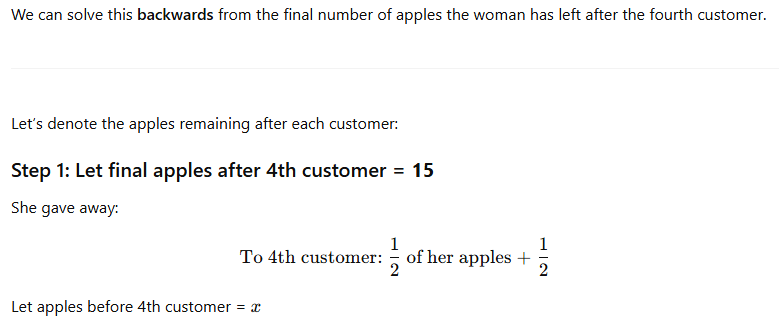
After a sale: left = x/2 − ½ ⇒ before the sale x = 2(left + ½) = 2 × left + 1.
After 4th customer: 15 ⇒ before 4th = 31.
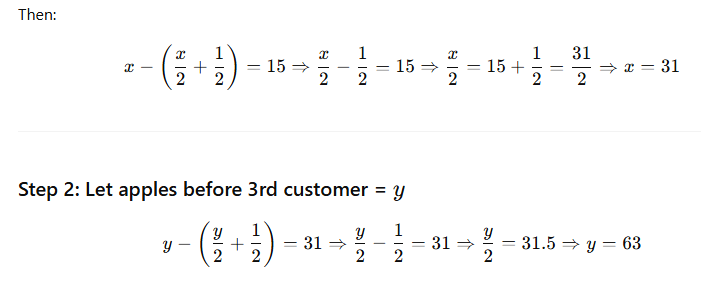
Before 3rd = 2 × 31 + 1 = 63.
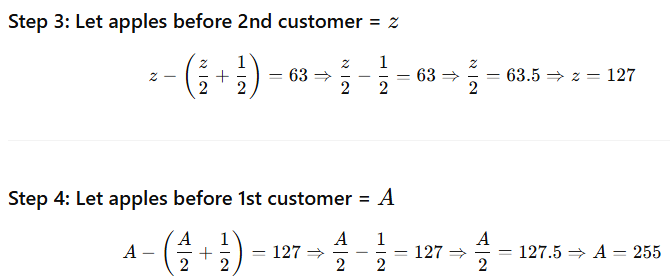
Before 2nd = 2 × 63 + 1 = 127.
Before 1st = 2 × 127 + 1 = 255.
Cetking shortcut: Each step maps L → 2L + 1, i.e. (L + 1) doubles: 16 × 2⁴ = 256 ⇒ start = 255.
Answer: B
A boy has enough money to buy 20 exercise books. If each book cost 25 paise less, he could buy two more books and still have 70 paise left. How much money did he have originally?
- A35
- B42
- C48
- D52
- E50
Show answerHide answer
Answer: C
Approach: Form one linear equation in the price.
Solution:
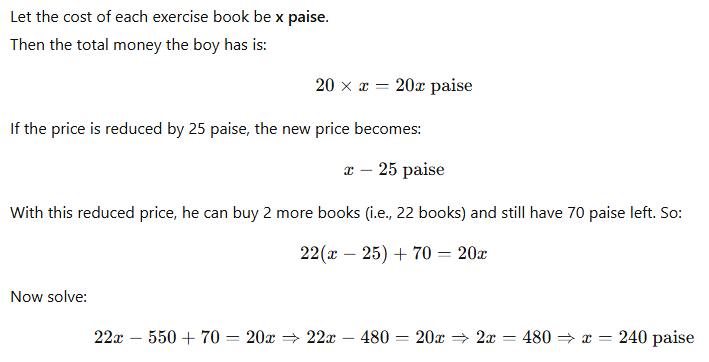
Let price per book = p paise ⇒ money = 20p paise.
New price = (p − 25) paise; 22 books + 70 paise left: 22(p − 25) + 70 = 20p.
22p − 550 + 70 = 20p ⇒ 2p = 480 ⇒ p = 240 paise.
Money = 20 × 240 = 4800 paise = Rs. 48.
Check: 22 × 215 = 4730; 4800 − 4730 = 70 paise. ✓
Cetking shortcut: Options ÷ 20 give the price; only Rs. 48 → Rs. 2.40 per book works: Rs. 2.15 × 22 = 47.30, leaving 70 paise.
Answer: C
A number of friends decided to go on a picnic and planned to spend Rs. 96 on eatables. Four of them, however, did not turn up. As a consequence, the remaining ones had to contribute Rs. 4 each extra. The number of those who attended the picnic was?
- A8
- B12
- C16
- D24
- E92
Show answerHide answer
Answer: A
Approach: Equal sharing: form an equation from the per-head change.
Solution:
Let the original number of friends be n. Then 96/(n − 4) − 96/n = 4.
96 × 4 / [n(n − 4)] = 4, so n(n − 4) = 96.
n = 12 (12 × 8 = 96). Those who attended = 12 − 4 = 8.
Check: 96/12 = 8 each, 96/8 = 12 each, an extra Rs. 4 ✔.
Why the other options are wrong:
B (12): this is the planned number, not the number who attended.
C, D, E: these do not satisfy n(n − 4) = 96.
Cetking shortcut: Test the options as the number who attended (a): the planned number is a + 4, and 96/a − 96/(a + 4) must be 4. a = 8 gives 12 − 8 = 4 ✔.
Answer: A
In a group of buffaloes and ducks, the number of legs is 24 more than twice the number of heads. What is the number of buffalo in a group?
- A6
- B8
- C10
- D12
- E4
Show answerHide answer
Answer: D
Approach: Heads–legs equation.
Solution: Let buffaloes = B, ducks = D.
Heads = B + D; legs = 4B + 2D.
4B + 2D = 2(B + D) + 24 → 4B + 2D = 2B + 2D + 24 → 2B = 24 → B = 12.
Cetking shortcut: Each buffalo has 2 'extra' legs over 2-per-head; 24 extra legs ÷ 2 = 12 buffaloes.
Answer: D
The price of the item X rises by Rs 40 per year and that of item Y by Rs 15 per year. If the price of item X and Y in the year 2002 was Rs 420 and Rs 630 respectively, in which year the price of item X will be Rs 40 more than the price of item Y?
- A2010
- B2011
- C2012
- D2013
- E2014
Show answerHide answer
Answer: C
Approach: Track the gap Y − X year by year.
Solution: In 2002, Y − X = 630 − 420 = 210 (Y higher).
Each year X gains 40 − 15 = 25 on Y.
Required: X − Y = +40 → total change needed = 210 + 40 = 250.
Years = 250 ÷ 25 = 10 → 2002 + 10 = 2012.
Answer: C
A class starts at 10 am and lasts till 1.27 pm. Four periods are held during this interval. After every period, 5 minutes are given free to the students. What is the exact duration of each period?
- A42min
- B48min
- C51min
- D53min
- E60min
Show answerHide answer
Answer: B
Approach: Total time = 4 periods + 3 breaks (no break after the last period).
Solution: 10:00 am to 1:27 pm = 3 h 27 min = 207 min.
Breaks = 3 × 5 = 15 min.
Period time = 207 − 15 = 192 min → each period = 192 ÷ 4 = 48 min.
Answer: B
A, B, C, D and E play a game of cards.
Statements: A says to B: “If you give me 3 cards, I'll have as many as you.”
D takes 5 from B and equals E.
A and C together = twice E
B and D together = same as A and C
Total = 150 cards
What is the number of cards B had originally?
Show answerHide answer
Answer under review
We are re-checking this question. The solution will appear once the answer is confirmed.
A test has 50 questions. A student scores 1 mark for a correct answer, −1/3 mark for a wrong answer, and −1/6 mark for not attempting a question.
If the net score of Ananyaa is 32, then the number of questions answered wrongly by her cannot be less than how much?
- A6
- B4
- C3
- D12
- E9
Show answerHide answer
Answer: C
Approach: Two linear equations in R, W, U; express W in terms of R and use non-negativity.
Solution:
R + W + U = 50 … (1)
R − W/3 − U/6 = 32 → 6R − 2W − U = 192 … (2)
(1) + (2): 7R − W = 242 → W = 7R − 242.
W ≥ 0 → R ≥ 242/7 ≈ 34.6 → R ≥ 35.
U = 50 − R − W = 292 − 8R ≥ 0 → R ≤ 36.
R = 35: W = 3, U = 12. Check: 35 − 1 − 2 = 32 ✓.
R = 36: W = 10, U = 4.
Minimum wrong answers = 3.
Cetking shortcut: Add the equations to eliminate U in one step; W grows by 7 for every extra right answer, so the smallest feasible R gives the smallest W.
Answer: C
P, Q, and R are three consecutive odd numbers in ascending order. If the value of three times P is 3 less than two times R, find the value of R.
- A7
- B11
- C3
- D9
- E5
Show answerHide answer
Answer: D
Approach: Write consecutive odd numbers as x, x + 2, x + 4.
Solution:
P = x, Q = x + 2, R = x + 4.
3P = 2R − 3 → 3x = 2x + 8 − 3 → x = 5.
R = 5 + 4 = 9. Check: 3 × 5 = 15 = 18 − 3 ✓.
Cetking shortcut: Test options for R: R = 9 → P = 5 → 15 = 18 − 3 ✓.
Answer: D
Number of non-negative real roots of the equation 2^x − x − 1 = 0:
- A1
- B3
- C2
- D0
- E4
Show answerHide answer
Answer: C
Approach: Spot obvious roots, then use convexity of 2^x to limit the count.
Solution:
x = 0: 1 − 0 − 1 = 0 ✓. x = 1: 2 − 1 − 1 = 0 ✓.
y = 2^x is convex and y = x + 1 is a straight line, so they meet at most twice.
Both roots (0 and 1) are non-negative → 2 roots.
Cetking shortcut: A convex curve and a line cross at most twice — test x = 0, 1, 2 quickly.
Answer: C
Ajosey buys some avocados. 2 are rotten. From remaining, 5/9 go to her fridge, rest to hostel fridge. She eats 2 and puts rest in hostel fridge. Max fridge capacity = 5. Find original number.
- A9
- B11
- C14
- D29
- E20
Show answerHide answer
Answer: B
Approach: The fraction 5/9 forces (x − 2) to be a multiple of 9; the fridge cap of 5 bounds it.
Solution:
Good avocados = x − 2; her fridge gets (5/9)(x − 2) → x − 2 must be a multiple of 9 → x = 11, 20, 29, ….
Fridge capacity 5: (5/9)(x − 2) ≤ 5 → x − 2 ≤ 9 → x = 11.
Check x = 11: 9 good, 5 to her fridge, 4 left; she eats 2 and 2 go to the hostel fridge ✓
Options 20 and 29 put 10 and 15 in a 5-capacity fridge; 9 and 14 do not give a whole number.
Answer: B
Datta purchased two oranges, three bananas and four apples for Rs. 15. Had he instead bought 3 oranges, 2 bananas, and 1 apple, it would have cost Rs. 10. If Datta bought 3 oranges, 3 bananas and 3 apples, how much did he pay?
- ARs. 7.50
- BRs. 12
- CRs. 12.50
- DRs. 15
- ERs. 10
Show answerHide answer
Answer: D
Approach: Add the two equations — the coefficients become equal.
Solution:
2o + 3b + 4a = 15 and 3o + 2b + a = 10.
Add: 5o + 5b + 5a = 25 → o + b + a = 5.
3 oranges + 3 bananas + 3 apples = 3 × 5 = Rs 15.
Cetking shortcut: When individual prices can't be found, look for a combination of the equations that matches the target.
Answer: D
Neena purchased two oranges, three bananas and four apples which cost her Rs. 15.
Had Neena purchased three oranges, two bananas and one apple, it would have cost her only Rs. 10.
If Neeena bought 3 oranges, 3 bananas and 3 apples, determine as to how much did she have to pay ?
- A10rs
- B7.5rs
- C12rs
- D5rs
- E15rs
Show answerHide answer
Answer: E
Approach: Combine the equations.
Solution:
2O + 3B + 4A = 15 …(i)
3O + 2B + A = 10 …(ii)
(i) + (ii): 5O + 5B + 5A = 25 → O + B + A = 5.
3 oranges + 3 bananas + 3 apples = 3 × 5 = Rs 15.
Why the other options are wrong:
D Rs 5 — the cost of one of each, not three.
A 10, B 7.5, C 12 — not 3 × (O + B + A).
Cetking shortcut: Coefficients in (i) + (ii) are all 5 — always try adding first.
Answer: E
If the sum of three consecutive odd numbers is 20 more than the first number. What is the middle number ?
- A5
- B13
- C7
- D11
- E9
Show answerHide answer
Answer: E
Approach: Write consecutive odd numbers as x, x+2, x+4 and form one equation.
Solution:
Sum = x + (x+2) + (x+4) = 3x + 6.
Given: 3x + 6 = x + 20 → 2x = 14 → x = 7.
Numbers: 7, 9, 11 (sum 27 = 7 + 20 ✓).
Middle number = 9.
Why the other options are wrong:
7: that is the first number, not the middle.
11: that is the last number.
5 / 13: do not satisfy the equation.
Cetking shortcut: Take middle = m: (m−2)+m+(m+2) = 3m = (m−2)+20 → 2m = 18 → m = 9 directly.
Answer: E
A test has 50 questions. A student scores 1 mark for a correct answer, -1/3 for a wrong answer, and -1/6 for not attempting a question. If the net score of a student is 32, the number of questions answered wrongly by that student cannot be less than :
- A12
- B3
- C4
- D9
- E2
Show answerHide answer
Answer: B
Approach: Form two equations (count and score) and solve the integer equation for W.
Solution:
C + W + U = 50 and C − W/3 − U/6 = 32.
Substitute C = 50 − W − U: 50 − (4/3)W − (7/6)U = 32.
Multiply by 6: 8W + 7U = 108.
U must make 108 − 7U divisible by 8: U = 4 → W = 10; U = 12 → W = 3 (U = 20 makes W negative).
Check U = 12, W = 3, C = 35: 35 − 1 − 2 = 32 ✓.
Minimum wrong answers = 3.
Why the other options are wrong:
2: 8W + 7U = 108 has no integer U for W = 2.
4 / 9 / 12: not solutions (only W = 3 or 10 work).
Cetking shortcut: 108 ≡ 4 (mod 8) and 7U ≡ −U (mod 8) → U ≡ 4 (mod 8): U = 4, 12 only.
Answer: B
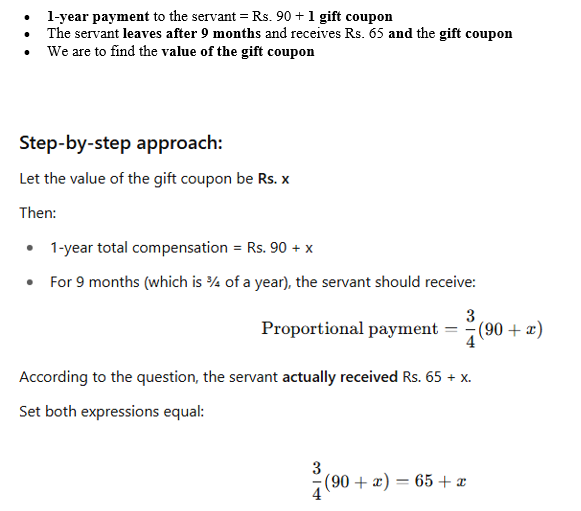
One year payment to the servant is Rs. 90 plus one gift coupon. The servant leaves after 9 months and receives Rs. 65 and a gift coupon. Determine the value of the gift coupon ?
- A7.5
- B15
- C10
- D12
- E18
Show answerHide answer
Answer: C
Approach: Prorate the whole annual package.
Solution:
Let gift = G. Annual pay = 90 + G
9 months' pay = (3/4)(90 + G)
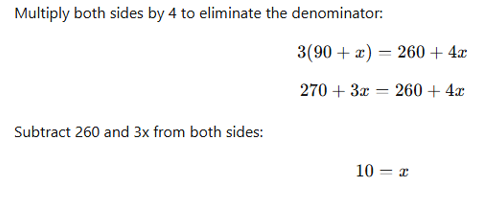
(3/4)(90 + G) = 65 + G
67.5 + 0.75G = 65 + G → 0.25G = 2.5 → G = ₹10
Cetking shortcut: 3 months' pay = (90 + G) − (65 + G) = 25 → annual = 100 → G = 100 − 90 = 10.
Answer: C
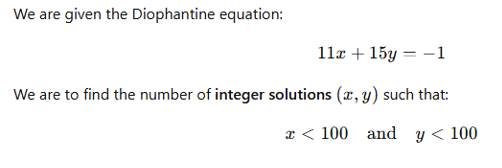
How many integer solutions exists for the equation 11x + 15y = -1 such that both x and y are less than 100
- A1
- B15
- C17
- D16
- E20
Show answerHide answer
Answer: D
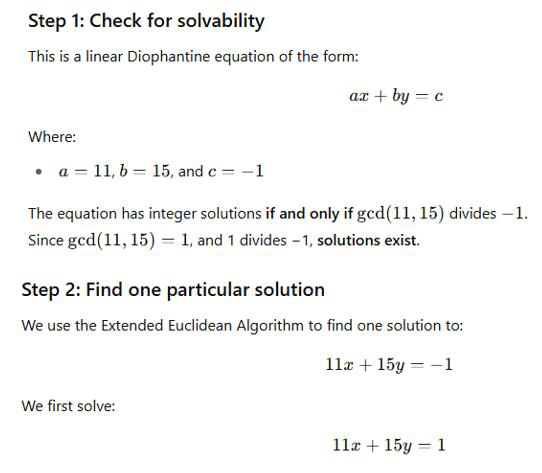
Approach: Find one solution, write the general form, count valid t.
Solution:
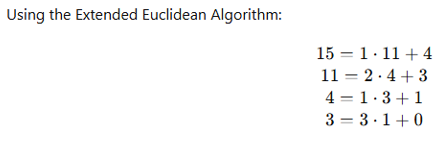
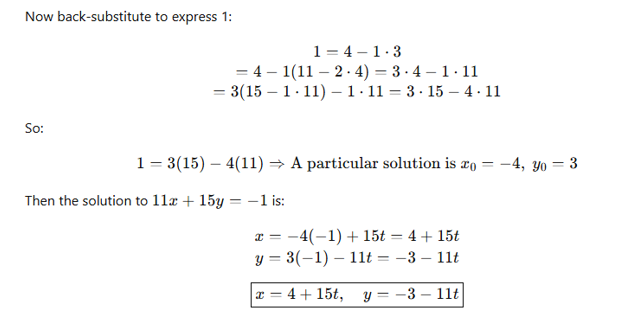
Particular solution: x = 4, y = −3 (44 − 45 = −1)
General: x = 4 + 15t, y = −3 − 11t
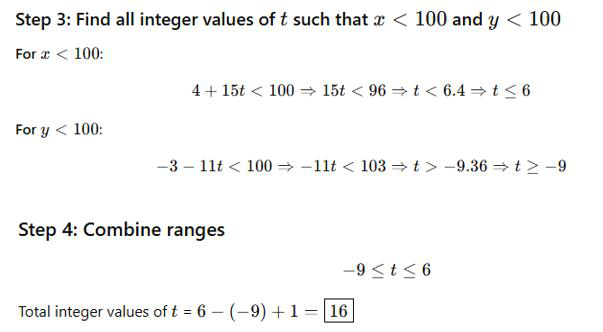
x < 100 → 15t < 96 → t ≤ 6
y < 100 → −11t < 103 → t ≥ −9
t = −9, −8, …, 6 → 16 values
Cetking shortcut: Count t-values as 6 − (−9) + 1 = 16; watch the off-by-one traps (15 and 17).
Answer: D
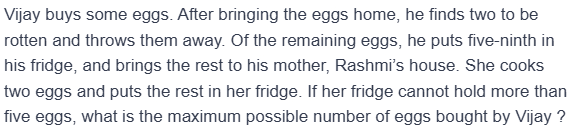
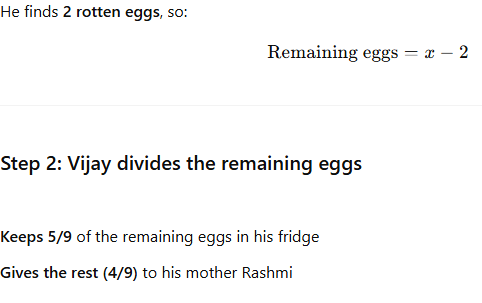
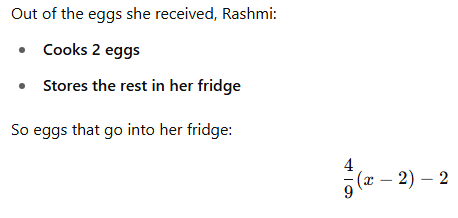
Vijay buys some eggs. After bringing the eggs home, he finds two to be rotten and throws them away. Of the remaining eggs, he puts five-ninth in his fridge, and brings the rest to his mother, Rashmi's house. She cooks two eggs and puts the rest in her fridge. If her fridge cannot hold more than five eggs, what is the maximum possible number of eggs bought by Vijay ?
- A17
- B11
- C16
- D23
- E20
Show answerHide answer
Answer: B
Approach: Inequality from the fridge limit + whole-number condition.
Solution:
Vijay buys x; good eggs = x − 2
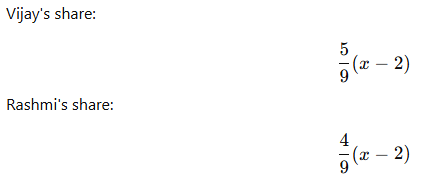
His fridge: 5/9(x − 2); to mother: 4/9(x − 2)
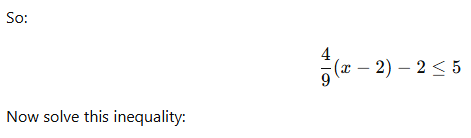
Her fridge: 4/9(x − 2) − 2 ≤ 5 → x − 2 ≤ 15.75 → x ≤ 17.75
Eggs are whole → x − 2 must be a multiple of 9 → x − 2 = 9 (18 exceeds 15.75)
x = 11: 9 good eggs, 5 in his fridge, 4 to mother, she cooks 2, 2 go in her fridge ✓
Why the other options are wrong:
A (17): 15 good eggs → 5/9 × 15 = 8⅓ eggs — impossible.
C (16), D (23): x − 2 = 14 and 21 — not multiples of 9.
E (20): 18 good eggs → 8 to mother → 6 in her fridge, more than 5.
Cetking shortcut: Check options for (x − 2) divisible by 9: only 11 and 20 qualify; 20 puts 6 eggs in her fridge, so 11.
Answer: B