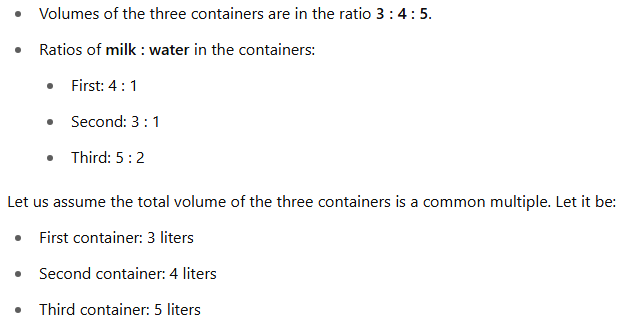
Three containers have capacities in the ratio 3 : 4 : 5 and are completely filled with mixtures of milk and water. The ratios of milk to water in the three containers are 4 : 1, 3 : 1, and 5 : 2 respectively. If the contents of all three containers are poured into a fourth container, determine the resulting ratio of milk to water in the fourth container.
- A153 : 33
- B157 : 53
- C151 : 48
- D5 : 2
- E17 : 3
Show answerHide answer
Answer: B ✓ official key
Approach: Find milk and water in each container on a common base, then add.
Solution:
Take capacities 3, 4, 5 litres.
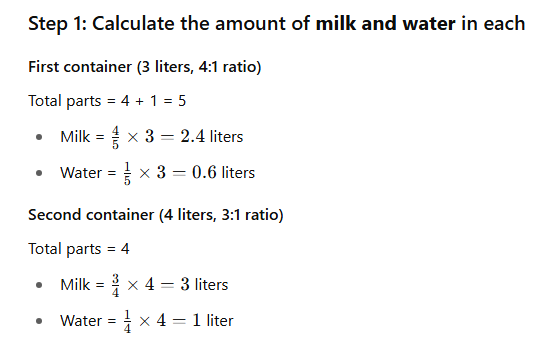
Container 1 (4 : 1): milk 12/5, water 3/5.
Container 2 (3 : 1): milk 3, water 1.
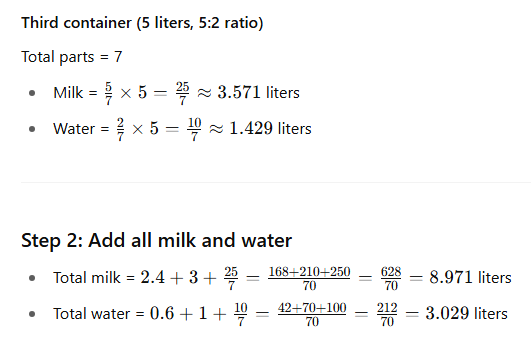
Container 3 (5 : 2): milk 25/7, water 10/7.
Multiply all by 35: milk = 84 + 105 + 125 = 314; water = 21 + 35 + 50 = 106.
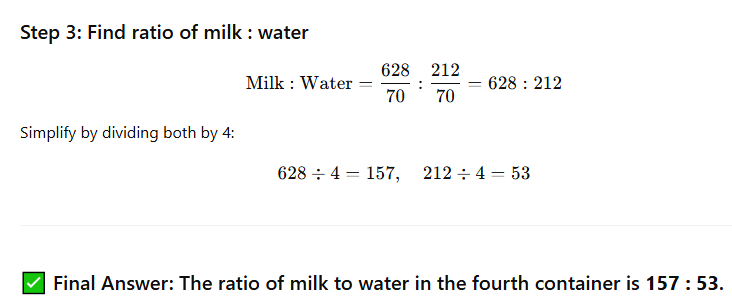
Milk : water = 314 : 106 = 157 : 53.
Cetking shortcut: Multiply every container by 35 (LCM of 5, 4, 7) at the start to avoid fractions.
Answer: B
How many kilograms of tea powder costing ₹31 per kg be mixed with thirty-six kilograms of tea powder costing ₹43 per kg, such that the mixture when sold at ₹44 per kg gives a profit of 10% ?
- A12 kg
- B14 kg
- C10 kg
- D15 kg
- E13 kg
Show answerHide answer
Answer: A ✓ official key
Approach: Find the cost price of the mixture, then alligation.
Solution:
SP = 44 at 10% profit → CP of mixture = 44 / 1.1 = Rs. 40/kg.
Alligation: cheap 31, dear 43, mean 40.
Cheap : Dear = (43 − 40) : (40 − 31) = 3 : 9 = 1 : 3.
Dear = 36 kg → cheap = 36/3 = 12 kg.
Cetking shortcut: Always convert SP to CP before alligation: 44 → 40.
Answer: A
An alloy contains copper, zinc and nickel in the ratio of 5 : 3 : 2. The quantity of nickel in kg that must be added to 100 kg of this alloy to have the new ratio as 5 : 3 : 3 should be :
- A10 kg
- B12 kg
- C15 kg
- D8 kg
- E20 kg
Show answerHide answer
Answer: A ✓ official key
Approach: Only nickel changes; copper and zinc stay fixed.
Solution:
100 kg in 5 : 3 : 2 → Cu 50, Zn 30, Ni 20 kg.
New ratio 5 : 3 : 3 with Cu = 50 → 1 part = 10 kg → Ni must be 30 kg.
Nickel to add = 30 − 20 = 10 kg.
Cetking shortcut: Cu and Zn parts unchanged → Ni goes from 2 parts to 3 parts = +1 part = 10 kg.
Answer: A
The cost of Type 1 rice is Rs 15 per kg and Type 2 rice is Rs 20 per kg. If both Type 1 and Type 2 are mixed in the ratio of 2:3, then the price per kg of the mixed variety of rice is :
- A18
- B22
- C20
- D14
- E16
Show answerHide answer
Answer: A ✓ official key
Approach: Weighted average price.
Solution:
Mixed price = (2 × 15 + 3 × 20) / (2 + 3) = (30 + 60)/5 = 90/5 = Rs. 18/kg.
Cetking shortcut: Mean lies 3/5 of the way from 15 to 20: 15 + 3 = 18.
Answer: A
Chemical A costs Rs.1000 per kg and chemical B costs Rs.150 per kg.
A chemist mixes the two chemicals and sells the mixture at Rs.840 per kg, thereby making a 20% profit.
In what ratio are chemical A and chemical B mixed?
- A11:6
- B6:11
- C10:15
- D10:1.5
- E100:84
Show answerHide answer
Answer: A ✓ official key
Approach: Find cost price of mixture from SP and profit, then alligation.
Solution:
CP of mixture = 840 / 1.20 = Rs 700 per kg.
Alligation: A (1000) and B (150) around mean 700.
A : B = (700 − 150) : (1000 − 700) = 550 : 300 = 11 : 6.
Why the other options are wrong:
B reverses the ratio; C, D, E do not reduce to 11 : 6.
Cetking shortcut: Always convert SP to CP before alligation; 840 itself is a trap mean.
Answer: A
A mixture contains alcohol and water in the ratio 4:3. If 5 liters of water is added to the mixture, the ratio of alcohol to water becomes 4:5.
What is the quantity of alcohol in the original mixture?
- A8 liters
- B10 liters
- C12 liters
- D16 liters
- E20 litres
Show answerHide answer
Answer: B ✓ official key
Approach: Alcohol stays constant when water is added.
Solution:
Original: alcohol 4k, water 3k.
After adding 5 L water: 4k/(3k + 5) = 4/5.
20k = 12k + 20 → 8k = 20 → k = 2.5.
Alcohol = 4 × 2.5 = 10 litres.
Why the other options are wrong:
- A (8), C (12), D (16), E (20): with alcohol 4k fixed, these give water increase ≠ 5 L.
Cetking shortcut: Alcohol part '4' is the same in both ratios, so water goes from 3 to 5 parts: 2 parts = 5 L → 1 part = 2.5 L → alcohol = 4 × 2.5 = 10 L.
Answer: B
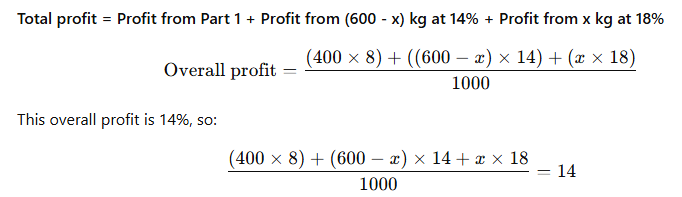
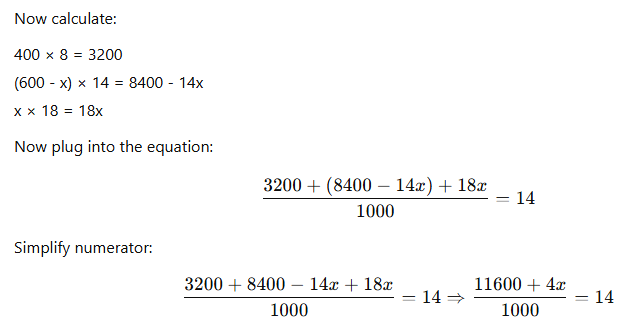
A merchant has 1000 kg of sugar, part of which he sells at 8% profit and the rest at 18% profit. He gains 14% on the whole. The quantity sold at 18% profit is:
- A400 kg
- B500 kg
- C600 kg
- D640 kg
- E700 kg
Show answerHide answer
Answer: C ✓ official key
Approach: Alligation on profit percentages.
Solution:
Profits: 8% and 18%; mean 14%.
Quantity at 8% : quantity at 18% = (18 − 14) : (14 − 8) = 4 : 6 = 2 : 3.
Quantity at 18% = 3/5 × 1000 = 600 kg.
Why the other options are wrong:
A (400 kg) – this is the part sold at 8%.
B (500 kg) – would give an average of 13%.
D, E – average would exceed 14%.
Cetking shortcut: 14% is closer to 18% than to 8% ⇒ more than half (600) is at 18%.
Answer: C
A vessel is filled with liquid, 3 parts of which are water and 5 parts syrup. How much of the mixture must be drawn off and replaced with water so that the mixture may be half water and half syrup?
- A1/3
- B1/4
- C2/7
- D1/7
- E1/5
Show answerHide answer
Answer: E ✓ official key
Approach: Replacement: only syrup is removed-and-not-replaced; track the syrup fraction.
Solution:
Syrup = 5/8 of the vessel. Draw off fraction f and replace with water.
Syrup left = 5/8 × (1 − f). Need it = 1/2.
1 − f = (1/2)/(5/8) = 4/5 ⇒ f = 1/5.
Why the other options are wrong:
A (1/3), B (1/4), C (2/7), D (1/7) – leave syrup at 5/12, 15/32, 25/56, 15/28 of the vessel, not 1/2.
Cetking shortcut: Fraction to replace = 1 − (target syrup / present syrup) = 1 − (4/8 ÷ 5/8) = 1/5.
Answer: E
Anita mixes two mixtures of milk and water. She mixes 40 litres of the first mixture containing 20% water and 60 litres of the second mixture containing 30% water. Find the percentage of water in the final mixture.
- A24%
- B26%
- C28%
- D30%
- E32%
Show answerHide answer
Answer: B ✓ official key
Approach: Add the actual water quantities and divide by total volume.
Solution:
Water in first = 20% of 40 = 8 L.
Water in second = 30% of 60 = 18 L.
Total water = 26 L in 100 L → 26%.
Cetking shortcut: Weighted average: (40 × 20 + 60 × 30)/100 = 26%.
Answer: B
DIRECTION for the question: Solve the following question and mark the best possible option.
In what ratio must water be mixed with milk to gain 16 (2/3)% on selling the mixture at cost price?
- A1:6
- B6:1
- C2:3
- D4:3
- E5:6
Show answerHide answer
Answer: A ✓ official key
Approach: Profit comes only from the free water.
Solution: Gain = 16 2/3% = 1/6.
If 6 litres of milk are bought, selling 7 litres at CP gives revenue for 7 litres → profit 1 litre's cost = 1/6 of cost.
So water : milk = 1 : 6.
Why the other options are wrong:
B (6 : 1): reversed ratio.
C, D, E: do not give a 1/6 gain.
Answer: A
DIRECTION for the question: Solve the following question and mark the best possible option.
A vessel is filled with liquid, 3 parts of which are water and 5 parts of syrup. How much of the mixture must be drawn off and replaced with water so that the mixture may be half water and half syrup?
- A(1/3)
- B(1/4)
- C(1/5)
- D(1/7)
- E(3/5)
Show answerHide answer
Answer: C ✓ official key
Approach: Track the syrup, which is only removed, never added.
Solution: Take 8 litres: water 3, syrup 5.
Draw off x litres and add x water. Syrup left = 5 − (5/8)x.
Need syrup = 4 (half of 8): 5 − 5x/8 = 4 ⇒ x = 8/5 litres.
Fraction of mixture = (8/5) ÷ 8 = 1/5.
Why the other options are wrong:
E (3/5): would remove too much, leaving only 2 litres of syrup out of 8.
A, B, D: give syrup 3.33, 3.75, 4.29 out of 8 — not half.
Cetking shortcut: Syrup fraction 5/8 must become 1/2: (5/8)(1 − x) = 1/2 ⇒ 1 − x = 4/5 ⇒ x = 1/5.
Answer: C
A 30-litre mixture of milk and water is in the ratio 2 : 1. 15 litres of the mixture is removed and replaced with pure milk. This process is repeated one more time. What is the final ratio of milk to water in the mixture?
- A10:1
- B12:5
- C8:3
- D11:1
- E15:7
Show answerHide answer
Answer: D ✓ official key
Approach: Track milk and water after each removal (half the mixture) and refill with milk.
Solution:
Start: milk 20 L, water 10 L
Remove 15 L (half): milk 10, water 5; add 15 milk → milk 25, water 5
Remove 15 L (half): milk 12.5, water 2.5; add 15 milk → milk 27.5, water 2.5
Milk : water = 27.5 : 2.5 = 11 : 1
Cetking shortcut: Water is never added, so it halves each time: 10 → 5 → 2.5. Milk = 30 − 2.5 = 27.5 → 11 : 1.
Answer: D
Tea worth ₹120 per kg and ₹150 per kg are mixed with a third variety of tea in the ratio 1 : 2 : 3. If the cost price of the mixture is ₹165 per kg, what is the cost price per kg of the third variety of tea?
- A₹150 per kg
- B₹290 per kg
- C₹190 per kg
- D₹180 per kg
- E₹100 per kg
Show answerHide answer
Answer: C ✓ official key
Approach: Weighted average of prices with weights 1 : 2 : 3.
Solution:
(1 × 120 + 2 × 150 + 3 × x)/6 = 165
120 + 300 + 3x = 990 → 3x = 570 → x = 190
Cetking shortcut: Deviations from 165: −45 × 1 + (−15) × 2 = −75 must be balanced by 3(x − 165) = 75 → x = 190.
Answer: C
A container contains 60 litres of milk. Some milk is replaced by water twice. Each time 12 litres of mixture is replaced. After the two replacements, What is the final ratio of milk to water?
- A16:9
- B18:7
- C17:3
- D11:4
- E15:4
Show answerHide answer
Answer: A ✓ official key
Approach: Repeated replacement: milk left = initial × (1 − x/V)ⁿ.
Solution:
Milk left = 60 × (1 − 12/60)² = 60 × (4/5)² = 60 × 16/25 = 38.4 L
Water = 60 − 38.4 = 21.6 L
Milk : water = 38.4 : 21.6 = 16 : 9
Cetking shortcut: Milk fraction = (4/5)² = 16/25 → milk : water = 16 : 9 directly.
Answer: A
A mixture containing 43% of acid is mixed with another mixture containing 82% acid in the ratio 10:9.find the percentage of acid in the mixture formed?
- A60.45%
- B61.25%
- C64.25%
- D63.2%
- E61.47%
Show answerHide answer
Answer: E
Approach: Weighted average (alligation) of concentrations.
Solution:
Acid % = (43 × 10 + 82 × 9)/(10 + 9)
= (430 + 738)/19 = 1168/19 = 61.47%.
Why the other options are wrong:
A 60.45%, B 61.25%, C 64.25%, D 63.2%: arithmetic slips; 62.5% would be the simple average, which ignores the 10:9 weights.
Cetking shortcut: Answer must be slightly below the simple average 62.5% (more of the weaker mixture): 43 + 39 × 9/19 = 43 + 18.47 = 61.47%.
Answer: E
A mixture contains milk and water in a ratio of 7:11. When 7 liters of water is added, the ratio changes to 7:13. Find the quantity of milk in the initial mixture.
- A23.5
- B24.8
- C22.4
- D24.5
- E25.3
Show answerHide answer
Answer: D
Approach: Milk stays constant when water is added.
Solution:
Initially milk = 7x, water = 11x.
After adding 7 L water: 7x/(11x + 7) = 7/13 ⇒ 91x = 77x + 49 ⇒ 14x = 49 ⇒ x = 3.5.
Milk = 7 × 3.5 = 24.5 L.
Cetking shortcut: Milk part fixed at 7; water goes 11 → 13, so 2 parts = 7 L ⇒ 1 part = 3.5 L ⇒ milk = 24.5 L.
Answer: D
An empty fuel tank of a car was filled with A type petrol. When the tank was half-empty, it was filled with B type petrol. Again when the tank was half empty, it was filled with A type petrol. When the tank was half-empty again, it was filled with B type petrol. What is the percentage of A type petrol present in the tank?
- A35%
- B37%
- C40%
- D37.5%
- E32.5%
Show answerHide answer
Answer: D
Approach: Each 'half empty then refill' keeps half of what was there and adds the new type.
Solution:
Tank = 1. Fill A: A = 1
Half out, fill B: A = 0.5, B = 0.5
Half out, fill A: A = 0.25 + 0.5 = 0.75, B = 0.25
Half out, fill B: A = 0.375, B = 0.125 + 0.5 = 0.625
A = 37.5%
Cetking shortcut: Work backwards: last fill is B (50%), so A = ½ × (A before) = ½ × 75% = 37.5%.
Answer: D
Alcohol costs Rs.3.50 per litre and kerosene oil costs Rs. 2.50 per litre. In what proportion should these be mixed so that the resulting mixture may be Rs. 2.75 per litre?
- A1:2
- B1:4
- C1:5
- D1:3
- E1:1
Show answerHide answer
Answer: D
Approach: Alligation: quantity ratio = (dearer − mean) : (mean − cheaper), inverted to the cheaper/dearer items.
Solution:
Alcohol ₹3.50, kerosene ₹2.50, mean ₹2.75
Alcohol : Kerosene = (2.75 − 2.50) : (3.50 − 2.75)
= 0.25 : 0.75 = 1 : 3
Why the other options are wrong:
E (1:1) would give mean ₹3.00; A (1:2) gives ₹2.83; B (1:4) gives ₹2.70; C (1:5) gives ₹2.67.
Cetking shortcut: Mean 2.75 is one-quarter of the way from 2.50 to 3.50 → only 1 part of the dearer liquid in 4 → 1 : 3.
Answer: D
Three containers have their volumes in the ratio 3:4:5 They are full of mixtures of milk and water. The mixtures contain milk and water in the ratio of (4:1),(3:1) and (5:2) respectively The contents of all these three containers are poured into a fourth container. The ratio of milk and water in the fourth container is
- A89:71
- B191:72
- C157:71
- D157:53
- E151:48
Show answerHide answer
Answer: D
Approach: Find milk and water in each container on a common base, then add.
Solution:
Volumes 3 : 4 : 5; take them as 3k, 4k, 5k and scale by 35 to clear fractions: 105, 140, 175
C1 (4:1): milk 84, water 21
C2 (3:1): milk 105, water 35
C3 (5:2): milk 125, water 50
Total milk = 314, water = 106 → 157 : 53
Cetking shortcut: Milk = 3×(4/5) + 4×(3/4) + 5×(5/7) = 2.4 + 3 + 3.57 = 8.971 out of 12 = 0.7476 milk fraction; 157/(157 + 53) = 157/210 = 0.7476 ✓ (151:48 gives 0.759, so compute, don't eyeball).
Answer: D
Three containers have their volumes in the ratio 3 : 4 : 5. The containers are filled with a mixture of milk and water. The containers have milk and water in the ratio 4 : 1, 3 : 1 and 5 : 2 respectively. The contents of these three mixtures are poured into a fourth container. The ratio of milk and water in the fourth container is?
- A4:1
- B157:53
- C160:53
- D151:48
- E5:2
Show answerHide answer
Answer: B
Approach: Absolute quantities of each component, then add.
Solution:
Volumes 3 : 4 : 5.
Milk = 3 × 4/5 + 4 × 3/4 + 5 × 5/7 = 12/5 + 3 + 25/7.
Water = 3 × 1/5 + 4 × 1/4 + 5 × 2/7 = 3/5 + 1 + 10/7.
Multiply by 35: milk = 84 + 105 + 125 = 314; water = 21 + 35 + 50 = 106.
Ratio = 314 : 106 = 157 : 53.
Why the other options are wrong:
A (4:1), E (5:2): just one container's ratio.
C, D: arithmetic slips in the LCM step.
Cetking shortcut: Total = 12 parts; water total ≈ 106/35 ≈ 3.03 ⇒ milk : water ≈ 2.96 : 1 — only 157:53 (≈ 2.96) fits.
Answer: B
A cane contains a mixture of two liquids, 'A' and 'B' in the ratio 7 : 5. When 9 liters of mixture are drawn off and the cane is filled with 'B', the ratio of 'A' and 'B' becomes 7 : 9 liters. How many liters of Liquid 'A' was initially contained by the cane?
- A15.25
- B18
- C21
- D17.5
- E16.75
Show answerHide answer
Answer: C
Approach: Replacement — component removed in proportion.
Solution:
Let A = 7k, B = 5k (total 12k).
9 L drawn: A removed = 9 × 7/12 = 21/4, B removed = 9 × 5/12 = 15/4.
After refilling with 9 L of B: A = 7k − 21/4, B = 5k − 15/4 + 9 = 5k + 21/4.
(7k − 21/4) : (5k + 21/4) = 7 : 9 ⇒ 63k − 189/4 = 35k + 147/4 ⇒ 28k = 84 ⇒ k = 3.
Initial A = 7 × 3 = 21 litres.
Why the other options are wrong:
A, B, D, E: the equation fixes k = 3 uniquely, so A must be 7 × 3 = 21; e.g. A = 18 gives final ratio 12.75 : 18.11, not 7 : 9.
Cetking shortcut: A is unchanged except for the proportional removal: total after = 12k and A share falls from 7/12 to 7/16 ⇒ A after = 7k − 21/4 = 7/16 × 12k ⇒ k = 3.
Answer: C
A can contains a mixture of liquids, A and B in ratio 7:5. When 9 litres of mixture are drawn off and the can is filled with B, the ratio of A and B becomes 7:9. How many litres A was contained by the can initially?
- A10
- B20
- C21
- D25
- E35
Show answerHide answer
Answer: C
Approach: A is untouched by the replacement except for the removed share.
Solution: Let the can hold 12k litres: A = 7k, B = 5k.
9 litres drawn: A removed = 9 × 7/12 = 5.25, B removed = 3.75.
After adding 9 litres of B: A = 7k − 5.25, B = 5k + 5.25.
(7k − 5.25)/(5k + 5.25) = 7/9 → 63k − 47.25 = 35k + 36.75 → 28k = 84 → k = 3.
Initial A = 7k = 21 litres.
Cetking shortcut: Total stays 12k. A goes from 7/12 to 7/16 of it → A × (1 − 9/12k) = 7/16·12k → 7k − 5.25 = 5.25k → k = 3.
Answer: C
A can contains a mixture of two liquids A and B in the ratio 7:5. When 9 litres are drawn off and replaced with B, the ratio becomes 7:9. How many litres of A were in the can initially?
- A14
- B15
- C21
- D35
- E28
Show answerHide answer
Answer: C
Approach: Drawing off mixture removes A and B in the same 7 : 5 ratio; replacing with B adds only to B.
Solution:
Let the can hold 12k litres: A = 7k, B = 5k.
9 L drawn: A removed = 9 × 7/12 = 5.25, B removed = 3.75.
After adding 9 L of B: A = 7k − 5.25, B = 5k − 3.75 + 9 = 5k + 5.25.
(7k − 5.25)/(5k + 5.25) = 7/9 → 63k − 47.25 = 35k + 36.75 → 28k = 84 → k = 3.
Can = 36 L; initial A = 7 × 3 = 21 L.
Why the other options are wrong: 35 comes from removing 9 L of A only (and does not even give a whole-number can); 14, 15, 28 fail the 7 : 9 check.
Cetking shortcut: The A left after drawing off is 7/12 of (T − 9) and, after refilling, must be 7/16 of T: (T − 9) × 7/12 = T × 7/16 → 4(T − 9) = 3T → T = 36, so A = 36 × 7/12 = 21.
Answer: C
A vessel had acid and water. Adding 2L water made it 50% acid. Adding 15L acid more made it 80% acid. What was the original water:acid ratio?
- A5:3
- B3:5
- C7:8
- D4:5
- E2:3
Show answerHide answer
Answer: B
Approach: Form equations from the two concentration conditions.
Solution:
Let acid = A L, water = W L.
After adding 2 L water, acid is 50%: A = W + 2.
After adding 15 L acid, acid is 80%: (A + 15) / (A + 15 + W + 2) = 4/5.
Substitute W + 2 = A: (A + 15)/(2A + 15) = 4/5 → 5A + 75 = 8A + 60 → A = 5, W = 3.
Original water : acid = 3 : 5.
Cetking shortcut: At 80% acid, water (W + 2 = A) is 1/4 of acid: A = (A + 15)/4 → A = 5.
Answer: B
A glass contains 500 ml of milk and a cup contains 500 ml of water. From the glass, 150 ml of milk is transferred to the cup and mixed thoroughly. Next, 150 ml of this mixture is transferred from the cup to the glass. Now, the amount of water in the glass and the amount of milk in the cup will be in what specific ratio?
- A1:1
- B1:2
- C2:3
- D10:13
- E10:11
Show answerHide answer
Answer: A
Approach: Equal-volume exchange — whatever water entered the glass equals the milk that left into the cup.
Solution:
After step 1: cup = 500 water + 150 milk = 650 ml.
150 ml of cup mixture → water = 150 × 500/650 = 1500/13 ml, milk = 150 × 150/650 = 450/13 ml.
Water in glass = 1500/13 ml. Milk in cup = 150 − 450/13 = 1500/13 ml.
Ratio = 1 : 1.
Cetking shortcut: Each vessel ends with 500 ml, so the water that moved into the glass must equal the milk left in the cup — always 1 : 1.
Answer: A
Bottle 1 contains a mixture of milk and water in 7:2 ratio and Bottle 2 contains a mixture of milk and water in 9:4 ratio. In what ratio of volumes should the liquids in Bottle 1 and Bottle 2 be combined to obtain a mixture of milk and water in 3:1 ratio?
- A27:14
- B27:13
- C14:27
- D27:16
- E17:27
Show answerHide answer
Answer: B
Approach: Alligation on the fraction of milk.
Solution: Milk fraction: Bottle 1 = 7/9, Bottle 2 = 9/13, target = 3/4.
Bottle 1 − target = 7/9 − 3/4 = (28 − 27)/36 = 1/36.
Target − Bottle 2 = 3/4 − 9/13 = (39 − 36)/52 = 3/52.
Bottle 1 : Bottle 2 = (target − B2) : (B1 − target) = 3/52 : 1/36.
Multiply by 468 (LCM of 52 and 36): 3 × 9 : 1 × 13 = 27 : 13.
Check: 27 parts of 7/9 → 21 milk, 6 water; 13 parts of 9/13 → 9 milk, 4 water; total 30 : 10 = 3 : 1 ✓.
Why the other options are wrong:
C (14:27) / E (17:27): reverse ratios – Bottle 1 is closer to the target, so it must be used more.
A, D: off by one step in the cross-multiplication.
Cetking shortcut: Bottle 1 (0.778) is nearer to 0.75 than Bottle 2 (0.692), so Bottle 1's share is larger – eliminate C and E at once.
Answer: B
Cost of Type - I Liquid is Rs. 32 per ltr;
Cost of Type - II Liquid is Rs. 40 per ltr.
If both types of liquids are mixed in the ratio 3 : 5 to create a new type of Liquid (named Type - III), then determine the cost per ltr of the the newly created Type - III Liquid, considering the fact that there have been no other costs involved in creation of the new liquid ?
- A37/liters
- B42/liters
- C36/liters
- D35/liters
- E40/liters
Show answerHide answer
Answer: A
Approach: Weighted average.
Solution:
Cost = 3 × 32 + 5 × 40 = 96 + 200 = 296 for 8 litres.
Price per litre = 296 ÷ 8 = Rs 37.
Why the other options are wrong:
C 36 — simple average (ignores the 3:5 weights).
E 40 and B 42 — at or above the dearer liquid; impossible.
D 35 — weights reversed is 35 (5 × 32 + 3 × 40 = 280 ÷ 8).
Cetking shortcut: 32 + (5/8) × 8 = 32 + 5 = 37.
Answer: A
Male and female students from a particular subject took a class test. The average score of male students was 70 and of female students was 83. The class average however was 76. Determine the ratio of males to females in the class ?
- A8:7
- B6:7
- C7:8
- D14:17
- E7:6
Show answerHide answer
Answer: E
Approach: Alligation.
Solution:
Males 70, Females 83, Mean 76.
Males : Females = (83 − 76) : (76 − 70) = 7 : 6.
Why the other options are wrong:
B 6:7 — reversed.
A 8:7, C 7:8, D 14:17 — not from the alligation differences.
Cetking shortcut: The mean (76) is closer to 70, so there are more males → ratio > 1 → only 7:6 or 8:7; differences give 7:6.
Answer: E
A dealer has 1000 kg sugar and he sells a part of it at 8% profit and the rest of it at 18% profit. The overall profit he earns is 14%. What is the quantity which is sold at 18% profit ?
- A450kg
- B900kg
- C630kg
- D400kg
- E600kg
Show answerHide answer
Answer: E
Approach: Alligation of profit rates 8% and 18% around mean 14%.
Solution:
8% part : 18% part = (18 − 14) : (14 − 8) = 4 : 6 = 2 : 3
18% part = 3/5 × 1000 = 600 kg
Check: 400 × 8% + 600 × 18% = 32 + 108 = 140 = 14% of 1000 ✓
Cetking shortcut: Mean 14 is closer to 18 than to 8, so the 18% part is more than half — alligation fixes it at 600.
Answer: E