Find the next number in the sequence given below :
10, 22, 46, 94, ?
- A178
- B182
- C190
- D192
- E200
Show answerHide answer
Answer: C ✓ official key
Approach: Number series with ×2 + 2 rule (differences doubling).
Solution:
10 × 2 + 2 = 22
22 × 2 + 2 = 46
46 × 2 + 2 = 94
94 × 2 + 2 = 190
Check: differences 12, 24, 48 double → next 96; 94 + 96 = 190.
Cetking shortcut: Differences 12, 24, 48 double each time — add 96.
Answer: C
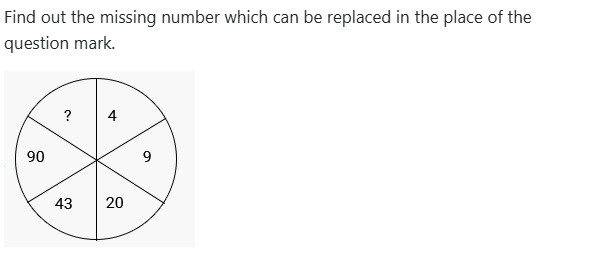
Find out the missing number which can be replaced in the place of the question mark.
Data read from diagram: circle divided into 6 sectors; going clockwise from top-right: 4, 9, 20, 43, 90, ? (top-left sector).
- A185
- B126
- C239
- D184
- E125
Show answerHide answer
Official CET key: A · Cetking's answer: B — see why below
Approach: Number series in a circle — ×2 plus an increasing number.
Solution:
Clockwise from the top-right sector: 4, 9, 20, 43, 90, ?
4 × 2 + 1 = 9
9 × 2 + 2 = 20
20 × 2 + 3 = 43
43 × 2 + 4 = 90
90 × 2 + 5 = 185
Why the other options are wrong:
B: 126 assumes n³ + 1, which fails (2³ + 1 = 9 but 3³ + 1 = 28 ≠ 20).
C, D, E: break the ×2 + n pattern.
Cetking shortcut: Each term is a little more than double the previous — 2 × 90 = 180, so the answer is just above 180: 185.
Answer: A
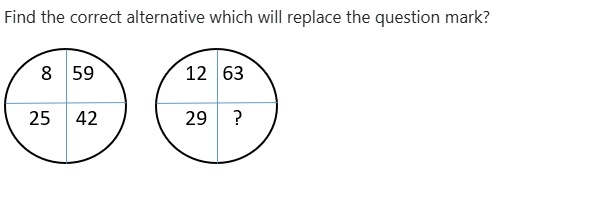
Find the correct alternative which will replace the question mark?
Data read from diagram:
| Circle | Top-left | Top-right | Bottom-left | Bottom-right |
|---|
| First | 8 | 59 | 25 | 42 |
| Second | 12 | 63 | 29 | ? |
- A46
- B88
- C32
- D54
- E25
Show answerHide answer
Answer: A ✓ official key
Approach: Missing number in figure — compare corresponding cells.
Solution:
First circle: 8, 59, 25, 42. Second circle: 12, 63, 29, ?
8 → 12 (+4), 59 → 63 (+4), 25 → 29 (+4).
So 42 + 4 = 46.
Check within circles: 59 − 8 = 51 = 63 − 12, and 42 − 25 = 17 = 46 − 29 ✓.
Cetking shortcut: Every cell of the second circle is +4 over the same cell of the first.
Answer: A
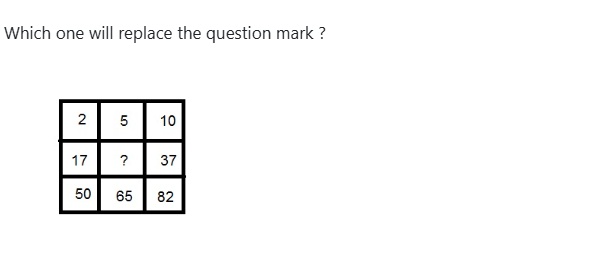
Which one will replace the question mark ?
Data read from diagram:
- A20
- B26
- C27
- D32
- E36
Show answerHide answer
Answer: B ✓ official key
Approach: Missing number in grid — n² + 1 sequence read row-wise.
Solution:
Row-wise: 2, 5, 10, 17, ?, 37, 50, 65, 82.
These are n² + 1: 1²+1, 2²+1, 3²+1, 4²+1, …
Missing term = 5² + 1 = 26.
Check: 6² + 1 = 37 ✓, 9² + 1 = 82 ✓.
Cetking shortcut: Differences 3, 5, 7, … (odd numbers): 17 + 9 = 26, 26 + 11 = 37 ✓.
Answer: B
Look at this series: 53, 53, 40, 40, 27, 27, ... What number should come next?
- A14
- B27
- C12
- D15
- E21
Show answerHide answer
Answer: A ✓ official key
Approach: Number series: each term appears twice, then 13 is subtracted.
Solution:
53, 53 → 53 − 13 = 40, 40 → 40 − 13 = 27, 27.
27 has already appeared twice, so the next term is 27 − 13 = 14.
Why the other options are wrong:
B (27): 27 is already repeated twice.
C, D, E: do not follow the −13 step.
Cetking shortcut: Repeated-pair series: drop the duplicates (53, 40, 27, ?) and the rule is −13.
Answer: A
Complete the following series.
4, 6, 12, 14, 28, 30, ?
- A32
- B60
- C62
- D36
- E66
Show answerHide answer
Answer: B ✓ official key
Approach: Number series with two alternating operations.
Solution:
4 + 2 = 6; 6 × 2 = 12; 12 + 2 = 14; 14 × 2 = 28; 28 + 2 = 30.
Next operation is ×2: 30 × 2 = 60.
Why the other options are wrong:
A (32): applies +2 twice in a row.
C (62): applies ×2 then +2.
D, E: fit no step of the pattern.
Cetking shortcut: Look at the jumps: +2, ×2 alternate; the last step was +2, so now ×2.
Answer: B
DIRECTION for the question: In the following question, a series is given with term/s missing. Choose the correct alternative to replace the question mark in the given series.
589654237, 89654237, 8965423, 965423, ?
- A58965
- B65423
- C89654
- D96542
- E38965
Show answerHide answer
Answer: D ✓ official key
Approach: Alternate-end digit removal.
Solution:
589654237 → drop first digit (5) → 89654237
89654237 → drop last digit (7) → 8965423
8965423 → drop first digit (8) → 965423
965423 → next drop is the last digit (3) → 96542
Why the other options are wrong:
A (58965), C (89654), E (38965): contain digits (5/8) already removed from the front.
B (65423): drops the first digit again; the pattern alternates, so the last digit goes now.
Cetking shortcut: Compare lengths: each term is one digit shorter, so the answer must be 5 digits starting with 9 — only D.
Answer: D
DIRECTION for the question: In the following question, one term in the number series is wrong. Find out the wrong term.
125,126,124,127,123,129
- A126
- B124
- C123
- D129
- E125
Show answerHide answer
Answer: D ✓ official key
Approach: Difference series with alternating signs.
Solution:
125 → 126 (+1) → 124 (−2) → 127 (+3) → 123 (−4) → next should be 123 + 5 = 128.
The series shows 129, so 129 is the wrong term.
Why the other options are wrong:
A, B, C, E: 126, 124, 123, 125 all fit +1, −2, +3, −4.
Cetking shortcut: Write the differences first: 1, −2, 3, −4, 6 — the 6 breaks the 1-2-3-4-5 run.
Answer: D
Passage / data for this question
Direction for the question: Study the following number sequence and answer the question given below it.
5 1 4 7 3 9 8 5 7 2 6 3 1 5 8 6 3 8 5 2 2 4 3 4 9 6
How many odd numbers are there in the sequence each of which is immediately followed by an odd number?
- A8
- B2
- C3
- D6
- E5
Show answerHide answer
Official CET key: D · Cetking's answer: E — see why below
Approach: Mark each number O (odd) or E (even), then scan for the pattern.
Solution:
Sequence: 5 1 4 7 3 9 8 5 7 2 6 3 1 5 8 6 3 8 5 2 2 4 3 4 9 6.
Parity: O O E O O O E O O E E O O O E E O E O E E E O E O E.
Odd → odd pairs: (5,1), (7,3), (3,9), (5,7), (3,1), (1,5).
Count = 6.
Why the other options are wrong:
E 5: misses one overlapping pair such as (3,9) after (7,3).
A 8, B 2, C 3: miscount the pairs.
Cetking shortcut: Each run of k odd numbers gives k − 1 pairs: runs 5 1 (1), 7 3 9 (2), 5 7 (1), 3 1 5 (2) → 6.
Answer: D
Passage / data for this question
Direction for the question: Study the following number sequence and answer the question given below it.
5 1 4 7 3 9 8 5 7 2 6 3 1 5 8 6 3 8 5 2 2 4 3 4 9 6
How many even numbers are there in the sequence which are immediately preceded by an odd but immediately followed by an even number ?
- A1
- B2
- C3
- D4
- Emore than 4
Show answerHide answer
Answer: C ✓ official key
Approach: Mark each number O (odd) or E (even), then scan for the pattern.
Solution:
Sequence: 5 1 4 7 3 9 8 5 7 2 6 3 1 5 8 6 3 8 5 2 2 4 3 4 9 6.
Pattern needed: odd, even, even.
7 2 6 ✓; 5 8 6 ✓; 5 2 2 ✓. (9 8 5, 3 8 5, 3 4 9, 1 4 7 fail.)
Count = 3.
Why the other options are wrong:
A 1, B 2: miss a match.
D 4, E more than 4: include cases like 3 8 5 or 3 4 9.
Cetking shortcut: Check only evens that start an even pair: 2 6, 8 6, 2 2, 2 4 — then see which has an odd before it.
Answer: C
Passage / data for this question
Direction for the question: Study the following number sequence and answer the question given below it.
5 1 4 7 3 9 8 5 7 2 6 3 1 5 8 6 3 8 5 2 2 4 3 4 9 6
How many odd numbers are there in the sequence which are immediately preceded and also immediately followed by an even number?
- A1
- B2
- C3
- D4
- Emore than 4
Show answerHide answer
Answer: D ✓ official key
Approach: Mark each number O (odd) or E (even), then scan for the pattern.
Solution:
Sequence: 5 1 4 7 3 9 8 5 7 2 6 3 1 5 8 6 3 8 5 2 2 4 3 4 9 6.
Pattern needed: even, odd, even.
6 3 8 ✓; 8 5 2 ✓; 4 3 4 ✓; 4 9 6 ✓.
Count = 4.
Why the other options are wrong:
A 1, B 2, C 3: miss a match near the end.
E more than 4: includes cases like 4 7 3 or 8 5 7.
Cetking shortcut: Isolated odd numbers (odd with evens on both sides) are easy to spot on the parity string: E O E.
Answer: D
Find the missing number in the series :
353, 354, 351, 356, 349, ?
- A348
- B338
- C340
- D357
- E358
Show answerHide answer
Answer: E ✓ official key
Approach: Alternating add/subtract with consecutive odd numbers.
Solution:
353 + 1 = 354
354 − 3 = 351
351 + 5 = 356
356 − 7 = 349
Next: 349 + 9 = 358
Cetking shortcut: When terms zig-zag up and down, write the differences first: +1, −3, +5, −7 → the next is +9.
Answer: E
What will come in place of the "?" in the following numerical series :
6, 9, 14, 21, 30, ?
- A31
- B43
- C46
- D49
- E41
Show answerHide answer
Answer: E ✓ official key
Approach: Differences are consecutive odd numbers.
Solution:
6 + 3 = 9
9 + 5 = 14
14 + 7 = 21
21 + 9 = 30
30 + 11 = 41
Cetking shortcut: Terms are n² + 5 (1+5, 4+5, 9+5, 16+5, 25+5) → 36 + 5 = 41.
Answer: E
Identify the wrong digit in the given number series :
4, 2, 3.5, 7.5, 26.25, 118.125
- A4
- B3.5
- C26.25
- D118.125
- E2
Show answerHide answer
Answer: B ✓ official key
Approach: Multiplier series ×0.5, ×1.5, ×2.5, ×3.5, ×4.5 — find the term that breaks it.
Solution:
4 × 0.5 = 2 ✓
2 × 1.5 = 3 (series shows 3.5 ✗)
3 × 2.5 = 7.5 ✓ (the next term fits 3, not 3.5)
7.5 × 3.5 = 26.25 ✓
26.25 × 4.5 = 118.125 ✓
So 3.5 is the wrong term; it should be 3.
Cetking shortcut: Check ratios from the end: 118.125/26.25 = 4.5, 26.25/7.5 = 3.5 — the multiplier drops by 1 each step, so 7.5/2.5 = 3 must be the third term.
Answer: B
Find the next number of the given series :
1, 1, 2, 3, 5, 8, 13, ?
- A21
- B32
- C54
- D24
- E34
Show answerHide answer
Answer: A ✓ official key
Approach: Fibonacci series — each term is the sum of the previous two.
Solution:
1 + 1 = 2, 1 + 2 = 3, 2 + 3 = 5, 3 + 5 = 8, 5 + 8 = 13
Next: 8 + 13 = 21
Answer: A
What shall be the sum of the first 2007 terms of the series given below :
1, 2, 3, 4, 1, 2, 3, 4, 1, 2, 3, 4, ........
- A5016
- B5024
- C8888
- D5052
- E5116
Show answerHide answer
Answer: A ✓ official key
Approach: Repeating block — count full cycles and the leftover terms.
Solution:
Block = 1, 2, 3, 4 with sum 10 and length 4.
2007 ÷ 4 = 501 full blocks, remainder 3.
Sum of full blocks = 501 × 10 = 5010
Leftover terms = 1 + 2 + 3 = 6
Total = 5010 + 6 = 5016
Cetking shortcut: 2008 terms would be 502 × 10 = 5020; drop the last term (4) → 5016.
Answer: A
Find the digit that shall come in place of "?" in the given series :
5, 10, 17, 26, ?, 50
- A41
- B37
- C29
- D43
- E44
Show answerHide answer
Answer: B ✓ official key
Approach: Differences are consecutive odd numbers.
Solution:
5 + 5 = 10
10 + 7 = 17
17 + 9 = 26
26 + 11 = 37
Check: 37 + 13 = 50 ✓
Cetking shortcut: Terms are n² + 1: 4+1, 9+1, 16+1, 25+1, 36+1, 49+1.
Answer: B
Choose the option that correctly completes the given series.
2, 6, 14, 30, 62, ?
- A124
- B126
- C128
- D129
- E136
Show answerHide answer
Answer: B ✓ official key
Approach: Multiplicative series: next term = previous × 2 + 2.
Solution:
2 × 2 + 2 = 6
6 × 2 + 2 = 14
14 × 2 + 2 = 30
30 × 2 + 2 = 62
62 × 2 + 2 = 126
Cetking shortcut: Differences 4, 8, 16, 32 double each time, so the next difference is 64: 62 + 64 = 126. Also every term = 2n+1 − 2.
Answer: B
Choose the option that correctly completes the series:
5, 14, 41, 122, ?
- A245
- B365
- C371
- D374
- E380
Show answerHide answer
Answer: B ✓ official key
Approach: Multiplicative series: next term = previous × 3 − 1.
Solution:
5 × 3 − 1 = 14
14 × 3 − 1 = 41
41 × 3 − 1 = 122
122 × 3 − 1 = 365
Cetking shortcut: Differences 9, 27, 81 are powers of 3, so the next difference is 243: 122 + 243 = 365.
Answer: B
Choose the option that correctly completes the given series
7, 20, 47, 94, 167, ?
- A272
- B274
- C276
- D278
- E280
Show answerHide answer
Answer: A ✓ official key
Approach: Difference table — second differences in AP.
Solution:
Terms: 7, 20, 47, 94, 167
1st differences: 13, 27, 47, 73
2nd differences: 14, 20, 26 (rising by 6)
Next 2nd difference = 26 + 6 = 32
Next 1st difference = 73 + 32 = 105
Next term = 167 + 105 = 272
Answer: A
Choose the option that correctly completes the series:
4, 18, 48, 100, ?, 294
- A126
- B168
- C180
- D192
- E200
Show answerHide answer
Answer: C ✓ official key
Approach: Power-based series: term = n³ − n² = n²(n − 1), n = 2, 3, 4…
Solution:
2³ − 2² = 4
3³ − 3² = 18
4³ − 4² = 48
5³ − 5² = 100
6³ − 6² = 216 − 36 = 180
Check: 7³ − 7² = 343 − 49 = 294 ✓
Cetking shortcut: Factor each term: 4 = 2²×1, 18 = 3²×2, 48 = 4²×3, 100 = 5²×4 → 6²×5 = 180.
Answer: C
Choose the option that correctly completes the given series.
6, 24, 60, 120, 210, ?
- A336
- B330
- C360
- D390
- E420
Show answerHide answer
Answer: A ✓ official key
Approach: Power-based series: term = n³ − n = (n − 1) × n × (n + 1).
Solution:
6 = 1×2×3, 24 = 2×3×4, 60 = 3×4×5
120 = 4×5×6, 210 = 5×6×7
Next = 6×7×8 = 336
Cetking shortcut: Second differences 18, 24, 30 rise by 6 → next 36; differences 18, 36, 60, 90 → next 126; 210 + 126 = 336.
Answer: A
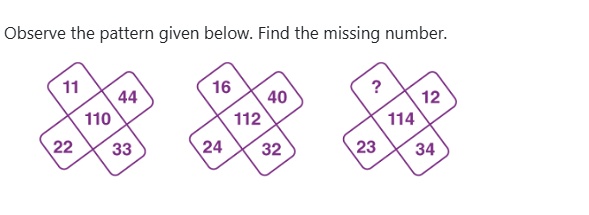
Observe the pattern given below. Find the missing number.
Data read from diagram (three cross-shaped figures, each with five numbers):
| Figure | Top | Right | Centre | Left | Bottom |
|---|
| 1 | 11 | 44 | 110 | 22 | 33 |
| 2 | 16 | 40 | 112 | 24 | 32 |
| 3 | ? | 12 | 114 | 23 | 34 |
- A36
- B56
- C52
- D45
- E75
Show answerHide answer
Official CET key: D · Cetking's answer: B — see why below
Approach: Centre number = sum of the four outer numbers.
Solution: Figure 1: 11 + 44 + 22 + 33 = 110 ✔.
Figure 2: 16 + 40 + 24 + 32 = 112 ✔.
Figure 3: ? + 12 + 23 + 34 = 114 → ? = 114 − 69 = 45.
Cetking shortcut: When the centre is much larger than the arms and close across figures, test the plain sum first.
Answer: D
In the following question find the missing number?
- A4
- B2
- C3
- D5
- E6
Show answerHide answer
Official CET key: C · Cetking's answer: D — see why below
Approach: Column rule: (row 1 × row 2) ÷ row 3 = row 4.
Solution: Column 1: 18 × 12 = 216; 216 ÷ 3 = 72 ✔.
Column 3: 32 × 16 = 512; 512 ÷ 4 = 128 ✔.
Column 2: 24 × 14 = 336; 336 ÷ ? = 112 → ? = 3.
Cetking shortcut: The large bottom row usually comes from a product; divide the product by the bottom value to find the link.
Answer: C
What option shall come in the blank space in the number series given below :
7, 10, 35, 13, __, 40, 19, 22
- A16
- B18
- C23
- D31
- E28
Show answerHide answer
Official CET key: A · Cetking's answer: C — see why below
Approach: Interleaved series — a +3 series with two odd terms (35, 40) inserted after every two terms.
Solution:
Mark the terms that clearly break the flow: 35 and 40.
Remaining terms: 7, 10, 13, __, 19, 22 → each term is +3.
13 + 3 = 16, and 16 + 3 = 19 confirms it.
Full series: 7, 10, [35], 13, 16, [40], 19, 22 — the inserted terms themselves rise by 5 (35 → 40).
Why the other options are wrong: 18, 23, 31, 28 do not keep the 13 → ? → 19 gap of +3, +3.
Cetking shortcut: When one or two terms are far out of line, strike them out first and read the remaining series.
Answer: A
Look carefully for the pattern in the series given below and then choose which pair of numbers comes next :
28, 25, 5, 21, 18, 5, 14
- A10,5
- B10, 7
- C5, 10
- D11,8
- E11, 5
Show answerHide answer
Answer: E ✓ official key
Approach: Interleaved series — main terms with alternating differences, and a fixed 5 after every two terms.
Solution:
Main terms: 28 → 25 (–3) → 21 (–4) → 18 (–3) → 14 (–4) → next –3 = 11.
Pattern of the series: two main terms, then 5 → 28, 25, 5, 21, 18, 5, 14, 11, 5.
Why the other options are wrong: 10 uses –4 twice in a row; (5, 10) and (11, 8) break the 'two terms then 5' rhythm.
Answer: E
Choose the option that shall correctly come in place of ' ? ' :
16, ?, 21, 30, 46, 71, 107
- A18
- B25
- C35
- D17
- E45
Show answerHide answer
Answer: D ✓ official key
Approach: Differences are consecutive squares.
Solution:
107 – 71 = 36 (6²), 71 – 46 = 25 (5²), 46 – 30 = 16 (4²), 30 – 21 = 9 (3²).
So ? → 21 is 2² = 4 → ? = 17, and 16 → 17 is 1² = 1 ✓.
Answer: D
Study the number series given below and answer the question that follows:
253, 883, 535, 738, 467
What will be the resultant figure if the first digit of the second lowest number divides the second digit of the highest number ?
- A4
- B5
- C10
- D12
- E2
Show answerHide answer
Answer: E ✓ official key
Approach: Sort the numbers, pick the required digits, then divide.
Solution:
Ascending: 253, 467, 535, 738, 883.
Second lowest = 467 → first digit = 4.
Highest = 883 → second digit = 8.
'4 divides 8' → 8 ÷ 4 = 2.
Answer: E
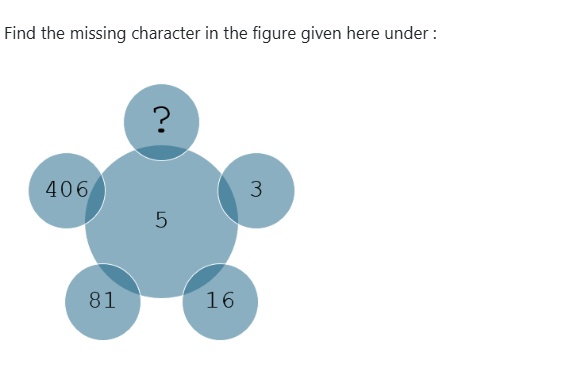
Figure: a large central circle containing 5, surrounded by five small overlapping circles containing 406 (left), ? (top), 3 (right), 16 (bottom right), 81 (bottom left).
Find the missing character in the figure given here under :
- A2031
- B1
- C1625
- D835
- E2120
Show answerHide answer
Answer: A ✓ official key
Approach: The centre number 5 drives the chain around the outer circles: next = previous × 5 + 1.
Solution: Going clockwise from the right:
3 × 5 + 1 = 16
16 × 5 + 1 = 81
81 × 5 + 1 = 406
406 × 5 + 1 = 2031 → the top circle.
Why the other options are wrong: 1625 and 2120 do not fit ×5 + 1 from 406; 1 and 835 break the growth.
Cetking shortcut: Ratio of consecutive outer numbers ≈ centre number → try ×centre ± small constant.
Answer: A
What will come in the place of (?) in the following series :
4 , 2 , ?, 7.5, 26.25, 118.125
- A5
- B4
- C3.5
- D4.5
- E3
Show answerHide answer
Answer: E ✓ official key
Approach: Multiplicative series with multipliers rising by 1 each step.
Solution:
Multipliers: ×0.5, ×1.5, ×2.5, ×3.5, ×4.5.
4 × 0.5 = 2
2 × 1.5 = 3
3 × 2.5 = 7.5 ✓
7.5 × 3.5 = 26.25 ✓
26.25 × 4.5 = 118.125 ✓
Cetking shortcut: Find a ratio from the known end: 118.125 ÷ 26.25 = 4.5, 26.25 ÷ 7.5 = 3.5 ⇒ multipliers fall by 1 going back ⇒ ?: 7.5 ÷ 2.5 = 3.
Answer: E
14, 28, 20, 40, 32, 64, ?
Determine the option that shall come in place of ' ? ' :
- A52
- B56
- C61
- D62
- E58
Show answerHide answer
Answer: B ✓ official key
Approach: Alternating operations series: ×2, −8.
Solution:
14 × 2 = 28
28 − 8 = 20
20 × 2 = 40
40 − 8 = 32
32 × 2 = 64
64 − 8 = 56
Cetking shortcut: Every second term doubles (14, 20, 32 → 28, 40, 64); the next step is the −8 one.
Answer: B
Find the missing number in the series:
11, 19, 31, 43, ____, 71
- A47
- B53
- C59
- D71
- E67
Show answerHide answer
Answer: C ✓ official key
Approach: Prime-number series: every third prime.
Solution:
Primes in order: 11, 13, 17, 19, 23, 29, 31, 37, 41, 43, 47, 53, 59, 61, 67, 71.
Series picks every 3rd prime: 11, (13, 17) 19, (23, 29) 31, (37, 41) 43, (47, 53) 59, (61, 67) 71.
So the missing term is 59.
Cetking shortcut: Notice all terms are prime; count how many primes are skipped between 11 and 19 (two) – keep skipping two.
Answer: C
Complete the series
1, 2, 6, 24, 120, ?
- A720
- B600
- C687
- D268
- E432
Show answerHide answer
Answer: A ✓ official key
Approach: Factorial series: each term = previous term × next natural number.
Solution:
1 ×2 = 2, 2 ×3 = 6, 6 ×4 = 24, 24 ×5 = 120, 120 ×6 = 720.
(Terms are 1!, 2!, 3!, 4!, 5!, 6!.)
Cetking shortcut: 1, 2, 6, 24, 120 is the factorial sequence – recognise it on sight.
Answer: A
Find the missing number in the series:
94, 99, 108, 119, 130, ? , 144
- A128
- B135
- C139
- D140
- E132
Show answerHide answer
Answer: C ✓ official key
Approach: Number series with symmetric differences.
Solution:
Differences: 99 − 94 = 5, 108 − 99 = 9, 119 − 108 = 11, 130 − 119 = 11.
The gaps mirror: 5, 9, 11, 11, 9, 5.
130 + 9 = 139, and 139 + 5 = 144 ✓
Cetking shortcut: When gaps rise then repeat (11, 11), expect them to fall back in reverse – verify with the last term 144.
Answer: C
Determine the number which will come in place of ' ? ' in the following given series :
0 9 0 1 9 0 1 2 9 0 1 2 3 9 0 1 2 3 4 9 0 1 2 3 4 5 9 0 1 2 3 4 5 ?
- A0
- B6
- C9
- D4
- E5
Show answerHide answer
Official CET key: B · Cetking's answer: A — see why below
Approach: Break the series into repeating blocks that end in 9.
Solution:
Group the terms at every 9:
0 | 9
0 1 | 9
0 1 2 | 9
0 1 2 3 | 9
0 1 2 3 4 | 9
0 1 2 3 4 5 | 9
0 1 2 3 4 5 | ?
Each block counts up from 0 one step further than the previous block before the 9.
The last block must be 0 1 2 3 4 5 6 (then 9 would follow).
Why the other options are wrong:
0 – a block restarts with 0 only after a 9; here 5 is followed by the next count.
9 – the block 0–5 already appeared; this block must go one step further.
4, 5 – would repeat or go backwards within a counting block.
Cetking shortcut: Use 9 as a separator — the length of each block before 9 grows by one.
Answer: B
Determine the number which will come in place of ' ? ' in the following given series :
5, 13, 29, ?, 125, 253
- A65
- B83
- C81
- D61
- E59
Show answerHide answer
Answer: D ✓ official key
Approach: Ratio of about 2 between terms → test ×2 + constant.
Solution:
5 × 2 + 3 = 13
13 × 2 + 3 = 29
29 × 2 + 3 = 61
61 × 2 + 3 = 125
125 × 2 + 3 = 253 ✓
Cetking shortcut: Differences are 8, 16, ?, ?, 128 — doubling: 8, 16, 32, 64, 128 → 29 + 32 = 61.
Answer: D
Determine the number which will come in place of ' ? ' in the following given series :
1.5, 4, 20, 126, ?, 10265
- A1024
- B1142
- C1044
- D1052
- E1548
Show answerHide answer
Official CET key: A · Cetking's answer: D — see why below
Approach: Multipliers grow as even numbers (2, 4, 6, 8, 10) with a square added each step.
Solution:
Rule: next = previous × 2n + n².
1.5 × 2 + 1² = 4
4 × 4 + 2² = 20
20 × 6 + 3² = 129 (printed as 126)
126 × 8 + 4² = 1008 + 16 = 1024
1024 × 10 + 5² = 10240 + 25 = 10265 ✓
Cetking shortcut: Work backwards from the last term: 10265 − 25 = 10240 = 1024 × 10. Only 1024 among the options gives 10265 with ×10; e.g. 1052 × 10 = 10520 already exceeds it.
Answer: A
Determine the number which will come in place of ' ? ' in the following given series :
89250, 17850, 7140, 1428, 571.2, ?
- A114.24
- B116.64
- C246.48
- D228.48
- E126.12
Show answerHide answer
Answer: A ✓ official key
Approach: Check successive ratios.
Solution:
89250 ÷ 5 = 17850
17850 ÷ 2.5 = 7140
7140 ÷ 5 = 1428
1428 ÷ 2.5 = 571.2
571.2 ÷ 5 = 114.24
Cetking shortcut: Divisors alternate 5, 2.5 — the next divisor is 5, and 571.2 ÷ 5 = 114.24 (÷10 × 2).
Answer: A
Determine the number which will come in place of ' ? ' in the following given series :
3, 1731, ?, 3243, 3459, 3523
- A3127
- B3731
- C2713
- D2371
- E2731
Show answerHide answer
Answer: E ✓ official key
Approach: Differences are cubes of decreasing even numbers.
Solution:
3 + 12³ (1728) = 1731
1731 + 10³ (1000) = 2731
2731 + 8³ (512) = 3243
3243 + 6³ (216) = 3459
3459 + 4³ (64) = 3523 ✓
Cetking shortcut: Read the known differences first: 3459 − 3243 = 216 = 6³ and 3523 − 3459 = 64 = 4³ → cubes of 12, 10, 8, 6, 4; then 1731 + 1000 = 2731.
Answer: E
Determine the number that shall come in place of the ' ? ' :
51, 66, ?, 102, 123, 146
- A85
- B81
- C84
- D83
- E82
Show answerHide answer
Answer: D ✓ official key
Approach: Check differences.
Solution:
Known differences: 123 − 102 = 21, 146 − 123 = 23 → differences rise by 2.
Sequence of differences: 15, 17, 19, 21, 23.
66 + 17 = 83; check 83 + 19 = 102 ✓.
Answer: D
Determine the number that shall come in place of ' ? ' :
- A92
- B81
- C63
- D71
- E49
Show answerHide answer
Official CET key: C · Cetking's answer: D — see why below
Approach: Find one rule that turns the first two numbers of a row into the third.
Solution:
Rule: third = 2 × first − second − 8.
Row 1: 2 × 67 − 25 − 8 = 134 − 33 = 101 ✓
Row 2: 2 × 61 − 17 − 8 = 122 − 25 = 97 ✓
Row 3: 2 × 45 − 19 − 8 = 90 − 27 = 63.
Why the other options are wrong: 71 = 2 × 45 − 19 forgets the −8 that rows 1 and 2 need; 92, 81, 49 fit no rule consistent with both rows.
Cetking shortcut: Compute 2 × first − second for the known rows (109, 105): both exceed the third number by exactly 8 — apply the same to row 3.
Answer: C
In the following series, find which of the given numbers is wrong and does not follow the pattern:
21 105 525 2615 13125 65625
- A13125
- B525
- C65625
- D2615
- E105
Show answerHide answer
Answer: D
Approach: Find the constant ratio between terms.
Solution:
21 × 5 = 105, 105 × 5 = 525, 525 × 5 = 2625, 2625 × 5 = 13125, 13125 × 5 = 65625.
The term given as 2615 should be 2625 → 2615 is wrong.
Cetking shortcut: All correct terms of a ×5 series from 525 onward end in 25; 2615 does not.
Answer: D
Look carefully for the pattern and then choose which number comes next
20, 110, 210, 320,
- A454
- B452
- C440
- D461
- E425
Show answerHide answer
Answer: C
Approach: Check the differences between consecutive terms.
Solution:
110 − 20 = 90, 210 − 110 = 100, 320 − 210 = 110.
Differences increase by 10 → next difference 120.
320 + 120 = 440.
Answer: C
Look carefully for the pattern, and choose which pairs of numbers comes next.
12 16 78 22 26 78 32
- A36 78
- B38 75
- C35 77
- D36 75
- E37 79
Show answerHide answer
Answer: A
Approach: Split into interleaved series of period 3.
Solution:
Positions 1, 4, 7: 12, 22, 32 → +10 each.
Positions 2, 5, 8: 16, 26, 36 → +10 each.
Positions 3, 6, 9: 78, 78, 78 → constant.
Next pair (8th, 9th) = 36, 78.
Cetking shortcut: A repeating number (78) every third term signals a period-3 interleave.
Answer: A
Look carefully for the pattern and then choose which pair of numbers comes next
4 7 26 10 13 20 16
- A14 4
- B14 17
- C18 14
- D19 13
- E19 14
Show answerHide answer
Answer: E
Approach: Interleaved series — the terms run in groups of three, each position following its own rule.
Solution: Group the terms in threes: (4, 7, 26), (10, 13, 20), (16, ?, ?).
1st terms: 4 → 10 → 16 (+6).
2nd terms: 7 → 13 → 19 (+6).
3rd terms: 26 → 20 → 14 (−6).
So the next pair is 19, 14.
Why the other options are wrong: A (14 4), B (14 17), C (18 14) break the +6 rule for the 2nd position; D (19 13) gives −7 instead of −6 for the 3rd position.
Cetking shortcut: When a series jumps up and down, split it into groups of 2 or 3 and check each position separately.
Answer: E
Complete the series:
4, 7, 12, 19, 28, ?
- A37
- B29
- C39
- D32
- E35
Show answerHide answer
Answer: C
Approach: Differences form a series.
Solution: 7−4 = 3, 12−7 = 5, 19−12 = 7, 28−19 = 9 → differences are consecutive odd numbers.
Next difference = 11 → 28 + 11 = 39.
Cetking shortcut: Terms are n² + 3 (1+3, 4+3, 9+3, 16+3, 25+3) → 36 + 3 = 39.
Answer: C
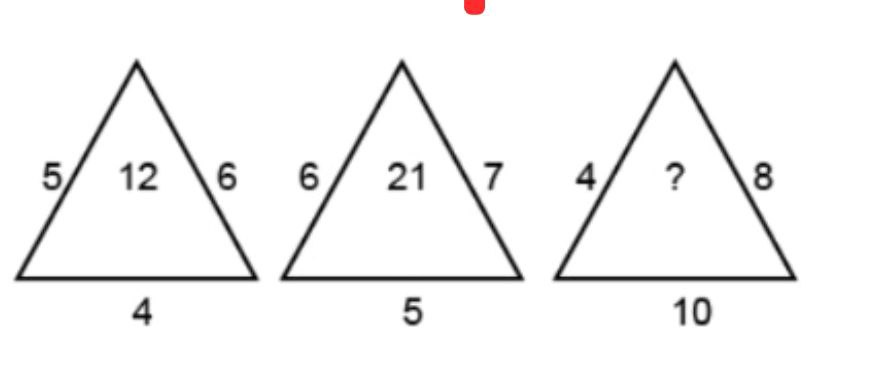
Find the missing character from among the given options.
- A30
- B32
- C34
- D22
- E24
Show answerHide answer
Answer: B
Approach: Missing number in figure: relate the three outer numbers to the inside number.
Solution: Figure 1: (5 × 6 × 4) ÷ 10 = 120 ÷ 10 = 12 ✓
Figure 2: (6 × 7 × 5) ÷ 10 = 210 ÷ 10 = 21 ✓
Figure 3: (4 × 8 × 10) ÷ 10 = 320 ÷ 10 = 32.
Cetking shortcut: Inside numbers 12 and 21 are small compared with the sides' product (120, 210) – try 'product ÷ 10'.
Answer: B
Look carefully for the pattern, and then choose which pair of numbers comes next.
28 25 5 21 18 5 14
- A11,5
- B10,7
- C11,8
- D5,10
- E10,5
Show answerHide answer
Answer: A
Approach: Interleaved series — a repeating constant plus a main series with alternating differences.
Solution:
28, 25, 5, 21, 18, 5, 14, ...
The number 5 appears after every two terms.
Remove the 5s: 28, 25, 21, 18, 14 → differences −3, −4, −3, −4.
Next difference is −3: 14 − 3 = 11.
After 14 and 11 comes the pair-breaker 5 again.
So the next two terms are 11, 5.
Why the other options are wrong:
B (10,7), C (11,8): 7 and 8 break the repeating 5.
D (5,10): 5 cannot come before 11; 10 also breaks −3/−4.
E (10,5): 14 − 4 = 10 uses the wrong difference (−3 is due).
Cetking shortcut: When a number repeats at fixed gaps, strike it out first — the rest is usually a simple difference series.
Answer: A
Look carefully for the pattern, and then choose which pair of numbers comes next.
13 29 15 26 17 23 19
- A21,23
- B20,21
- C20,17
- D25,27
- E22,20
Show answerHide answer
Answer: B
Approach: Two alternating series.
Solution:
Odd positions: 13, 15, 17, 19 → +2 each time.
Even positions: 29, 26, 23 → −3 each time.
The last given term 19 is an odd-position term, so the next term belongs to the even series: 23 − 3 = 20.
Then the odd series continues: 19 + 2 = 21.
Next pair = 20, 21.
Why the other options are wrong:
A (21,23): puts the odd-series term first and repeats 23.
C (20,17): 17 already used; odd series is increasing.
D, E: neither number fits either series in order.
Cetking shortcut: Note which series the last given term belongs to — the very next term comes from the other series.
Answer: B
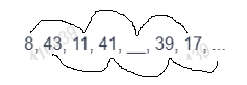
Look at this series: 8, 43, 11, 41, ___, 39, 17, ... What number should fill in the blank?
- A13
- B15
- C14
- D16
- E40
Show answerHide answer
Answer: C
Approach: Two alternating arithmetic series.
Solution:
Odd positions: 8, 11, __, 17 → +3 each time, so blank = 11 + 3 = 14 (check: 14 + 3 = 17).
Even positions: 43, 41, 39 → −2 each time.
Missing number = 14.
Why the other options are wrong:
A (13), B (15), D (16): do not keep the +3 step from 11 to 17.
E (40): belongs to the pattern of the even series, but the blank is an odd-position term.
Cetking shortcut: The blank sits between 11 and 17 in its own series — just take the midpoint: (11 + 17)/2 = 14.
Answer: C
Find the next term in the series
4, 6, 12, 14, 28, 30, ______
- A44
- B60
- C52
- D32
- E40
Show answerHide answer
Answer: B
Approach: Alternating operations series (+2, ×2).
Solution:
4 + 2 = 6
6 × 2 = 12
12 + 2 = 14
14 × 2 = 28
28 + 2 = 30
30 × 2 = 60
Why the other options are wrong:
D (32): applies +2 again instead of ×2.
A, C, E: fit no consistent operation.
Cetking shortcut: Differences 2, 6, 2, 14, 2 — every alternate difference is 2, so the other step must be a multiplication.
Answer: B
Complete the series
10000, 11000, 9900, 10890, 9801, ?
- A10781
- B10241
- C10423
- D10929
- E10900
Show answerHide answer
Answer: A
Approach: Alternating multipliers ×1.1 and ×0.9.
Solution:
10000 × 1.1 = 11000
11000 × 0.9 = 9900
9900 × 1.1 = 10890
10890 × 0.9 = 9801
9801 × 1.1 = 10781.1 → written as 10781
Check with alternate terms: 11000 → 10890 → 10781 is a fall of 1% each time (110, then 109), and 10000 → 9900 → 9801 also falls 1% each time.
Why the other options are wrong:
B (10241), C (10423), D (10929): none is about 1% below 10890.
E (10900): rises from 10890 instead of falling.
Cetking shortcut: Alternate terms 10000 → 9900 → 9801 drop by 1%, so 10890 − 1% ≈ 10890 − 109 = 10781.
Answer: A
- A24
- B12
- C18
- D30
- E6
Show answerHide answer
Answer: B
Approach: Missing number in a grid — find one rule that works for every row.
Solution:
Rule: (middle × last) ÷ 2 = first.
Row 1: 24 × 6 = 144; 144 ÷ 2 = 72 ✓.
Row 2: 16 × 12 = 192; 192 ÷ 2 = 96 ✓.
Row 3: ? × 18 = 2 × 108 = 216 → ? = 216 ÷ 18 = 12.
Why the other options are wrong:
A (24): 24 × 18 = 432 = 4 × 10⁸.
C (18): 324.
D (30): 540.
E (6): 108 — misses the factor 2.
Cetking shortcut: When the first column is big and the others small, test product (and half/double of the product) first.
Answer: B
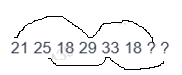
Which of the following alternatives will come next in the series?
21 25 18 29 33 18 ? ?
- A37,41
- B41,44
- C43,18
- D36,41
- E38,41
Show answerHide answer
Answer: A
Approach: Interleaved series with a repeating term.
Solution:
21, 25, 18, 29, 33, 18, ?, ?
18 repeats after every two terms.
Remove it: 21, 25, 29, 33 → +4 each.
Next two: 33 + 4 = 37, 37 + 4 = 41 (then 18 would follow).
Answer: 37, 41.
Why the other options are wrong:
B (41,44), D (36,41), E (38,41): break the +4 step.
C (43,18): 18 comes only after two terms, and 43 does not follow 33.
Cetking shortcut: Strike out the repeating 18 — what remains is a plain +4 AP.
Answer: A
How many pairs of digits in the number 95137248 have the same number of digits between them as they would if the digits were arranged in ascending order?
- A4
- B2
- C3
- D5
- E6
Show answerHide answer
Answer: C
Approach: Digit pairs: compare the gap between two digits in the number with their gap in ascending order.
Solution:
Number: 9 5 1 3 7 2 4 8 (positions 1–8). Ascending: 1 2 3 4 5 7 8 9 (ranks 1–8).
A pair qualifies if |position difference| = |rank difference|.
(5, 3): positions 2, 4 → gap 2; ranks 5, 3 → gap 2 ✔.
(3, 8): positions 4, 8 → gap 4; ranks 3, 7 → gap 4 ✔.
(7, 4): positions 5, 7 → gap 2; ranks 6, 4 → gap 2 ✔.
No other pair matches ⇒ 3 pairs.
Cetking shortcut: Write the ascending rank under each digit (9→8, 5→5, 1→1, 3→3, 7→6, 2→2, 4→4, 8→7); a pair qualifies when the difference of positions equals the difference of ranks.
Answer: C
DIRECTION for the question: In the following question, a series is given with term/s missing. Choose the correct alternative to replace the question mark in the given series.
5, 6, 9, 15, ?, 40
- A21
- B25
- C27
- D33
- E48
Show answerHide answer
Answer: B
Approach: Second-order differences (differences form the triangular numbers).
Solution:
Differences: 6−5 = 1, 9−6 = 3, 15−9 = 6.
1, 3, 6 are triangular numbers (+2, +3, ...), so the next differences are 10 and 15.
Missing term = 15 + 10 = 25.
Check: 25 + 15 = 40 ✓
Why the other options are wrong:
A (21), C (27), D (33), E (48): none gives a difference pattern that also lands on 40.
Cetking shortcut: When the last term is given, test each option: only 25 makes both gaps (10 and 15) fit the 1, 3, 6, 10, 15 chain.
Answer: B
DIRECTION for the question: In the following question, a series is given with term/s missing. Choose the correct alternative to replace the question mark in the given series.
1, 3, 4, 8, 15, 27, ?
- A37
- B44
- C50
- D55
- E95
Show answerHide answer
Answer: C
Approach: Tribonacci rule: each term = sum of the previous three terms.
Solution:
1 + 3 + 4 = 8
3 + 4 + 8 = 15
4 + 8 + 15 = 27
Next = 8 + 15 + 27 = 50
Why the other options are wrong:
A 37, B 44, D 55, E 95: none equals 8 + 15 + 27.
Cetking shortcut: When differences (2, 1, 4, 7, 12) look irregular and terms roughly double, try sum of previous two/three terms.
Answer: C
DIRECTIONS for the question: In the following question, one term in the number series is wrong. Find out the wrong term
196, 169, 144, 121, 101
- A101
- B121
- C169
- D196
- E144
Show answerHide answer
Answer: A
Approach: Wrong-term series: consecutive perfect squares.
Solution:
196 = 14², 169 = 13², 144 = 12², 121 = 11², so the last term must be 10² = 100.
101 breaks the pattern → 101 is wrong.
Why the other options are wrong:
B, C, D, E: 121, 169, 196, 144 are all perfect squares in sequence.
Cetking shortcut: Numbers near 100, 121, 144... — test perfect squares first.
Answer: A
Find the wrong number in the series
789, 645, 545, 481, 440, 429, 425
- A645
- B545
- C481
- D440
- E429
Show answerHide answer
Answer: D
Approach: Successive differences.
Solution: 789 − 144 (12²) = 645
645 − 100 (10²) = 545
545 − 64 (8²) = 481
481 − 36 (6²) = 445 (given 440 ✘)
445 − 16 (4²) = 429 ✔
429 − 4 (2²) = 425 ✔
The wrong term is 440; it should be 445.
Answer: D
Identify the number that does not belong to the number series given below
789, 645, 545, 481, 440, 429, 425
- A789
- B545
- C440
- D429
- E425
Show answerHide answer
Answer: C
Approach: Check successive differences; here they are squares of even numbers in descending order.
Solution:
789 − 12² (144) = 645
645 − 10² (100) = 545
545 − 8² (64) = 481
481 − 6² (36) = 445 (the series shows 440)
445 − 4² (16) = 429
429 − 2² (4) = 425
Every term fits except 440; the correct term is 445.
Why the other options are wrong: 789, 545, 429 and 425 all sit exactly on the −144, −100, −64, −16, −4 chain. 429 looks odd only if you take 440 as correct; check it from 445 instead.
Cetking shortcut: Differences 144, 100, 64, 41, 11, 4 – two broken differences next to each other point to the single term between them (440).
Answer: C
Find the correct option at the place of the question mark:
2, 4, 12, 6, 12, 36, 18, 36, 108, ?
- A72
- B54
- C90
- D108
- E75
Show answerHide answer
Answer: B
Approach: Look at the operation between consecutive terms.
Solution:
2 ×2 = 4, ×3 = 12, ÷2 = 6, ×2 = 12, ×3 = 36, ÷2 = 18, ×2 = 36, ×3 = 108, ÷2 = 54.
Equivalently, the series is in groups of three (a, 2a, 6a) with a = 2, 6, 18, and the next group starts at 18 × 3 = 54.
Why the other options are wrong: 72 = 36 × 2 breaks the ×2, ×3, ÷2 cycle; 90, 108 and 75 do not follow from 108 by the cycle.
Cetking shortcut: Every third term from the start (2, 6, 18, …) is ×3 → next is 54.
Answer: B
Determine the number of times 3 is present in the given series where it is followed by a prime number but not preceded by a number which is a multiple of 2 ?
3 5 4 8 4 3 7 0 9 8 3 9 4 3 7 7 5 3 1 2 0 7 3 2
- A3
- B2
- C0
- D6
- E4
Show answerHide answer
Answer: B
Approach: Scan every 3 and test: next number prime AND previous number not even.
Solution:
Series: 3 5 4 8 4 3 7 0 9 8 3 9 4 3 7 7 5 3 1 2 0 7 3 2
3 (1st): no number before, next 5 (prime) ✓
3 (6th): before 4 (even) ✗
3 (11th): before 8 (even) ✗
3 (14th): before 4 (even) ✗
3 (18th): next 1 (not prime) ✗
3 (23rd): before 7, next 2 (prime) ✓
Count = 2.
Cetking shortcut: First strike out every 3 preceded by an even digit — only three 3s remain to check.
Answer: B
Determine the number that shall come in place of ? in the given series -
8 13 10 15 12 ?
- A13
- B14
- C16
- D20
- E17
Show answerHide answer
Answer: E
Approach: Alternate (interleaved) series.
Solution:
Odd positions: 8, 10, 12 (+2 each).
Even positions: 13, 15, ? (+2 each) → 17.
The missing term is the 6th (even) position = 17.
Why the other options are wrong:
B 14 — continues the odd-position series, but ? is at an even position.
A 13, C 16, D 20 — break both patterns.
Cetking shortcut: Also seen as +5, −3 alternately: 12 + 5 = 17.
Answer: E