Let’s Crack CET 2027

Your CET check-up · tap a ring to see yours

Numbers – MBA CET questions with solutions

30 questions · CET 2025–2026 · Easy 25 · Medium 5 · Hard 0. Newest paper first. Full papers

Q102EasyCET 2026 · Attempt 2 Slot 2 · Q102
The difference between a two-digit number and the number obtained by interchanging the positions of its digits is 36. What is the difference between the two digits of that number?
  1. 3
  2. 4
  3. 5
  4. 6
  5. 8
Show answerHide answer

Answer: B official key

Approach: Two-digit number 10a + b; reversing gives 10b + a; difference = 9(a − b).

Solution:
(10a + b) − (10b + a) = 9(a − b) = 36.
a − b = 36 ÷ 9 = 4.

Cetking shortcut: Difference of a number and its reverse ÷ 9 = difference of digits → 36/9 = 4.

Answer: B

Q105EasyCET 2026 · Attempt 2 Slot 1 · Q105

If the dates of birth of four persons are prime numbers, find the maximum possible average of the sum of their dates of birth.

  1. 25.5
  2. 27.2
  3. 26.4
  4. 31
  5. 25
Show answerHide answer

Answer: D official key

Approach: Maximise each value: the largest prime date of a month is 31.

Solution:
Dates of birth lie between 1 and 31; the largest prime date is 31.
The question does not require the four dates to be different, so each person can be born on the 31st.
Sum = 31 × 4 = 124; average = 124 / 4 = 31.

Why the other options are wrong:
A (25.5) is the average if the four dates had to be distinct (31, 29, 23, 19) — no such condition is given. B, C, E are not achievable maxima.

Cetking shortcut: Maximum average can never exceed the maximum single value — and it equals it when all values can be the same.

Answer: D

Q138EasyCET 2026 · Attempt 2 Slot 1 · Q138

How many times does the digit 2 appear in all the natural numbers from 1 to 200 (both inclusive)?

  1. 39
  2. 40
  3. 41
  4. 42
  5. 44
Show answerHide answer

Answer: C official key

Approach: Count digit occurrences place by place.

Solution:
1–99: units place 2 appears 10 times (2, 12, …, 92); tens place 10 times (20–29) → 20.
100–199: same pattern → 20.
200: one more 2 → 1.
Total = 20 + 20 + 1 = 41.

Cetking shortcut: Every 100 numbers contain 20 twos (10 units + 10 tens); add the hundreds digit only for 200.

Answer: C

Q101EasyCET 2026 · Slot 5 · Q101

If 'n' is any odd number greater than 1, then

n(n² − 1)

  1. is divisible by 15 always
  2. is divisible by 24 always
  3. is divisible by 48 always
  4. is divisible by 96 always
  5. is divisible by 100 always
Show answerHide answer

Answer: B official key

Approach: n(n² − 1) = (n − 1)·n·(n + 1) is a product of three consecutive integers.

Solution:
n(n² − 1) = (n − 1)·n·(n + 1).
Any three consecutive integers contain a multiple of 3 → divisible by 3.
n is odd, so (n − 1) and (n + 1) are consecutive even numbers; one of them is a multiple of 4 → product of the two is divisible by 2 × 4 = 8.
So the expression is divisible by 3 × 8 = 24 for every odd n > 1.
Check n = 3: 3 × 8 = 24 (divisible by 24, not by 48/96/100/15).

Why the other options are wrong:

  • A (15): n = 3 gives 24, not divisible by 5.
  • C (48), D (96): n = 3 gives 24 — fails.
  • E (100): n = 3 gives 24 — fails.

Cetking shortcut: Plug the smallest allowed value n = 3 → 24. Every 'always' option larger than 24 or not dividing 24 is out instantly.

Answer: B

Q103EasyCET 2026 · Slot 4 · Q103
Find the difference between the place value and the face value of the digit 7 in the number 4782.
  1. 700
  2. 7
  3. 693
  4. 782
  5. 707
Show answerHide answer

Answer: C official key

Approach: Place value = digit × its positional value; face value = the digit itself.

Solution:
In 4782, 7 is in the hundreds place.
Place value = 7 × 100 = 700.
Face value = 7.
Difference = 700 − 7 = 693.

Why the other options are wrong:
A (700) – place value only.
B (7) – face value only.
D (782) – the number after the 4, not a place value.
E (707) – adds instead of subtracts.

Cetking shortcut: Difference = digit × (place − 1) = 7 × 99 = 693.

Answer: C

Q110EasyCET 2026 · Slot 4 · Q110
Which of the following numbers is a perfect square?
  1. 4410
  2. 2362
  3. 7921
  4. 5688
  5. 1253
Show answerHide answer

Answer: C official key

Approach: Perfect squares end in 0, 1, 4, 5, 6, 9 and have a matching square root near √N.

Solution:
2362 (ends in 2), 5688 (ends in 8), 1253 (ends in 3) – squares never end in 2, 3, 8 → rejected.
4410 – ends in a single 0; a square ending in 0 must end in 00 → rejected.
7921: 89² = (90 − 1)² = 8100 − 180 + 1 = 7921 ✓.

Why the other options are wrong:
A (4410) – odd number of trailing zeros.
B, D, E – last digits 2, 8, 3 are impossible for squares.

Cetking shortcut: Last-digit test removes four options in seconds; verify the survivor with (90 − 1)².

Answer: C

Q21EasyCET 2026 · Slot 3 · Q21

Ranjita & Rampal are playing a game, Ranjita writes down all the natural numbers from 1 to 100, how many times will Ranjita write four in the said given list ?

  1. 25
  2. 35
  3. 20
  4. 32
  5. 15
Show answerHide answer

Answer: C official key

Approach: Count the digit 4 in the units place and the tens place separately.

Solution:
Units place: 4, 14, 24, …, 94 → 10 times.
Tens place: 40, 41, …, 49 → 10 times (44 counted again here — it has two 4s).
100 has no 4.
Total = 10 + 10 = 20.

Why the other options are wrong: 15 counts tens only partly; 25/32/35 over-count.

Cetking shortcut: For any digit 1–9 in 1 to 100, the count is always 20.

Answer: C

Q102EasyCET 2026 · Slot 2 · Q102
How many 3-digit numbers are there in between 100 and 300, having first and the last digit as 2?
  1. 9
  2. 10
  3. 11
  4. 12
  5. 13
Show answerHide answer

Answer: B official key

Approach: Fix the first and last digit, count choices for the middle digit.

Solution: Number must be of the form 2 _ 2 and lie between 100 and 300.
Middle digit can be 0, 1, 2, …, 9 → 10 choices.
Numbers: 202, 212, 222, …, 292 → 10 numbers.

Why the other options are wrong:
A (9): forgets 202 (middle digit 0).
C, D, E: overcount; only 10 middle digits exist.

Answer: B

Q3EasyCET 2026 · Slot 1 · Q3
The sum of the squares of two odd numbers is 11570. The square of one of the number is 5329. What is the other number ?
  1. 83
  2. 75
  3. 77
  4. 79
  5. 73
Show answerHide answer

Answer: D official key

Approach: Subtract the known square from the total and take the square root.

Solution:
Known square = 5329 = 73².
Other square = 11570 − 5329 = 6241.
√6241: ends in 1 → root ends in 1 or 9; 80² = 6400, so the root is just below 80 → 79² = 6241.
Other number = 79.

Cetking shortcut: Square-ending check: 6241 ends in 1, so only 79 (or 71/81) can work — among the options only 79 fits.

Answer: D

Q45EasyCET 2026 · Slot 1 · Q45
Aruna cuts a cake into two halves and cuts one of such half into smaller pieces of equal size. Each of the small pieces is twenty grams in weight. If she has seven pieces of the cake in all with her, what was the weight of the original cake ?
  1. 140 grams
  2. 240 grams
  3. 480 grams
  4. 250 grams
  5. 220 grams
Show answerHide answer

Official CET key: B · Cetking's answer: C — see why below

Approach: Count how many pieces come from the cut half.

Solution:
7 pieces in all = 1 uncut half + 6 small pieces.
The 6 small pieces make up the other half: 6 × 20 = 120 g.
Each half = 120 g → whole cake = 2 × 120 = 240 grams.

Why the other options are wrong: 140 g – treats all 7 pieces as 20 g each; 480 g – doubles twice; 220 g, 250 g – no consistent split.

Answer: B

Q102EasyCET 2026 · Slot 1 · Q102

The number 63_42_0 is a 7-digit number divisible by both 3 and 5. If the thousands digit is greater than the tens digit, then which of the following options gives the correct digits in the thousands place and the tens place respectively?

  1. 3,1
  2. 6,4
  3. 9,7
  4. 9,6
  5. 3,9
Show answerHide answer

Answer: D official key

Approach: Divisibility by 5 (last digit 0/5) and by 3 (digit sum multiple of 3), then the given order condition.

Solution:
Number: 6 3 _ 4 2 _ 0 → ends in 0, so divisible by 5 already.
Known digit sum = 6 + 3 + 4 + 2 + 0 = 15, so (first blank + second blank) must be a multiple of 3.
Check options: 3+1 = 4 ✗, 6+4 = 10 ✗, 9+7 = 16 ✗, 9+6 = 15 ✓, 3+9 = 12 ✓
Condition: first blank (called the thousands digit) > second blank (called the tens digit). 9 > 6 ✓, 3 > 9 ✗.
So the digits are 9 and 6.

Why the other options are wrong:
A (3,1), B (6,4), C (9,7): digit sum 19, 25, 31 — not divisible by 3.
E (3,9): divisible by 3, but 3 < 9 breaks the order condition.

Cetking shortcut: Since 15 is already a multiple of 3, just pick the pair whose sum is a multiple of 3 with the first digit larger.

Answer: D

Q108MediumCET 2025 · Slot 6 · Q108
it was sunday on 12 february. 1882 what was the day on 12 february 1885?
  1. Wednesday
  2. Thursday
  3. Friday
  4. Saturday
  5. Sunday
Show answerHide answer

Answer: B

Approach: Odd days: each ordinary year adds 1 odd day, a leap year adds 2 — but only if its 29 February falls inside the interval.

Solution:
12 Feb 1882 → 12 Feb 1883: no 29 Feb in between ⇒ 1 odd day.
12 Feb 1883 → 12 Feb 1884: 29 Feb 1884 comes AFTER 12 Feb 1884 ⇒ 1 odd day.
12 Feb 1884 → 12 Feb 1885: includes 29 Feb 1884 ⇒ 2 odd days.
Total = 1 + 1 + 2 = 4 odd days ⇒ Sunday + 4 = Thursday.

Why the other options are wrong:
A Wednesday: only 3 odd days (ignores the leap day).
C Friday: 5 odd days — counts the leap day twice or counts 1884 from 1 Jan.
D, E: wrong count.

Cetking shortcut: 3 years apart = 3 odd days + 1 for every 29 Feb crossed (only 29 Feb 1884) = 4.

Answer: B

Q124EasyCET 2025 · Slot 6 · Q124
One-third of the sum of all prime numbers greater than two but less than 20 is the square of which number?
  1. 5
  2. 6
  3. 7
  4. 8
  5. 9
Show answerHide answer

Answer: A

Approach: List the primes, add, divide by 3, take the square root.

Solution:
Primes greater than 2 and less than 20: 3, 5, 7, 11, 13, 17, 19.
Sum = 75 ⇒ one-third = 25 = 5².

Cetking shortcut: One-third must be a perfect square: 25, 36, 49… ⇒ sum 75, 108, 147…; the sum of odd primes below 20 is 75 ⇒ 5.

Answer: A

Q137EasyCET 2025 · Slot 6 · Q137
how many prime numbers are less than 100?
  1. 20
  2. 22
  3. 24
  4. 25
  5. 23
Show answerHide answer

Answer: D

Approach: Count primes below 100 decade by decade.

Solution:
1–10: 2, 3, 5, 7 (4); 11–20: 11, 13, 17, 19 (4); 21–30: 23, 29 (2); 31–40: 31, 37 (2); 41–50: 41, 43, 47 (3);
51–60: 53, 59 (2); 61–70: 61, 67 (2); 71–80: 71, 73, 79 (3); 81–90: 83, 89 (2); 91–100: 97 (1).
Total = 4 + 4 + 2 + 2 + 3 + 2 + 2 + 3 + 2 + 1 = 25.

Cetking shortcut: Fact to memorise: 25 primes below 100 (and 168 below 1000).

Answer: D

Q143EasyCET 2025 · Slot 6 · Q143
How many number are there between 55 and 3815 which are multiple of 5 and divisible by 3?
  1. 249
  2. 250
  3. 251
  4. 252
  5. 238
Show answerHide answer

Answer: C

Approach: Multiples of 5 and 3 = multiples of LCM 15; count terms of the AP.

Solution:
First multiple of 15 above 55 = 60; last below 3815 = 3810 (15 × 254).
Count = (3810 − 60)/15 + 1 = 250 + 1 = 251.

Why the other options are wrong:
B 250: forgets the +1.
D 252: includes an extra end term.
A 249, E 238: slips.

Cetking shortcut: ⌊3815/15⌋ − ⌊55/15⌋ = 254 − 3 = 251.

Answer: C

Q149EasyCET 2025 · Slot 6 · Q149
What number will replace A if 3313A is divisble by 33?
  1. 4
  2. 5
  3. 2
  4. 6
  5. 8
Show answerHide answer

Answer: C

Approach: Divisible by 33 ⇔ divisible by 3 and by 11.

Solution:
Divisibility by 11: alternating sum of 3, 3, 1, 3, A = 3 − 3 + 1 − 3 + A = A − 2 ⇒ A = 2.
Divisibility by 3: 3 + 3 + 1 + 3 + 2 = 12 ✓.
Check: 33132 = 33 × 1004 ✓.

Why the other options are wrong:
A 4, D 6: digit sums 14, 16 — fail divisibility by 3.
B 5, E 8: pass the 3-test but fail the 11-test.

Cetking shortcut: Apply the stricter 11-test first — it fixes A = 2 in one line.

Answer: C

Q101EasyCET 2025 · Slot 5 · Q101

Which of the following is a prime number?

  1. 517
  2. 559
  3. 571
  4. 533
  5. 539
Show answerHide answer

Answer: C

Approach: A number is prime if no prime up to its square root divides it.

Solution:
Check each option against small primes:
517 = 11 × 47 (5 − 1 + 7 = 11, divisible by 11) → composite
559 = 13 × 43 → composite
533 = 13 × 41 → composite
539 = 7 × 77 = 7² × 11 → composite
571: √571 ≈ 23.9; not divisible by 2, 3 (digit sum 13), 5, 7, 11, 13, 17, 19, 23 → prime

Cetking shortcut: Kill options fast with the 11-test (alternating digit sum) and 7/13 tests; the survivor is the prime.

Answer: C

Q69EasyCET 2025 · Slot 4 · Q69
A Printer numbers the pages of a book starting with 1 and uses 3189 digits in all. How many pages does the book have?
Figure for MBA CET 2025 Slot 4 question 69
  1. 1000
  2. 1074
  3. 1025
  4. 1080
  5. 1098
Show answerHide answer

Answer: B

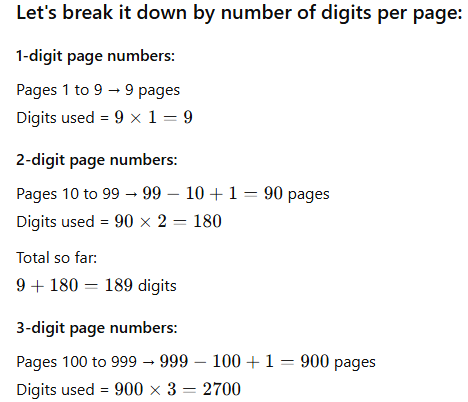
Approach: Digits used in page numbering: count digits block by block (1-digit, 2-digit, 3-digit, 4-digit pages).

Solution:
Pages 1–9: 9 × 1 = 9 digits.
Pages 10–99: 90 × 2 = 180 digits (total 189).
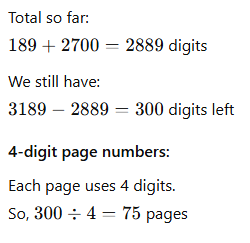
Pages 100–999: 900 × 3 = 2700 digits (total 2889).
Remaining digits = 3189 − 2889 = 300 ⇒ 300 / 4 = 75 four-digit pages.
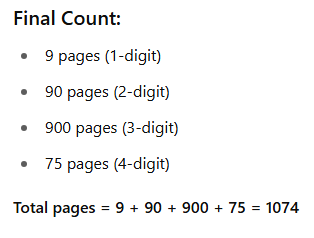
Last page = 999 + 75 = 1074.

Cetking shortcut: Memorise 9, 189, 2889 as the digit counts up to pages 9, 99 and 999.

Answer: B

Solution figure for question 69Solution figure for question 69Solution figure for question 69
Q103MediumCET 2025 · Slot 4 · Q103

Find the smallest number, which must be subtracted from 306452 to make it a perfect square.

  1. 1980
  2. 1748
  3. 1396
  4. 1558
  5. 1290
Show answerHide answer

Answer: B

Approach: Perfect squares — estimate the root, then test which option leaves a square.

Solution:
553² = 305809 and 554² = 306916, so 306452 lies between them. Strictly, the smallest subtraction is 306452 − 305809 = 643, but 643 is not an option, so we test the options.
306452 − 1748 = 304704 = 552² (552² = 302500 + 2200 + 4 = 304704). ✓
Other options: 306452 − 1980 = 304472, − 1396 = 305056, − 1558 = 304894, − 1290 = 305162 — all lie strictly between 552² = 304704 and 553² = 305809, so none is a perfect square.
Hence the only choice that gives a perfect square is 1748.

Why the other options are wrong:
A, C, D, E: the results (304472, 305056, 304894, 305162) are not squares.

Cetking shortcut: Only the option giving 552² = 304704 works; the result must end in …04, which spots it fast.

Answer: B

Q111MediumCET 2025 · Slot 4 · Q111

The digit at unit place of a two-digit number is increased by 100% and the digit at ten places of the same number is increased by 50%. The new number thus formed is 19 more than the original number. What is the original number?

  1. 22
  2. 25
  3. 27
  4. 29
  5. 21
Show answerHide answer

Answer: D

Approach: Place-value algebra.

Solution:
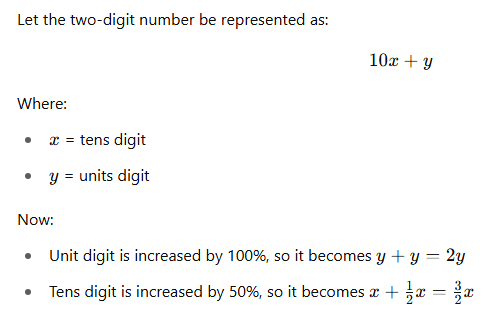
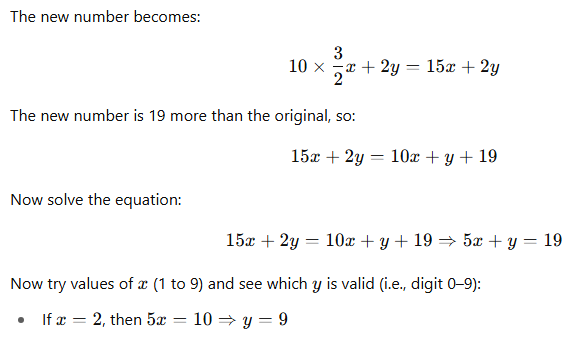
Original number = 10a + b.
Units digit +100% → 2b; tens digit +50% → 1.5a. New number = 10(1.5a) + 2b = 15a + 2b.
15a + 2b = 10a + b + 19 ⇒ 5a + b = 19.
a = 2 ⇒ b = 9 → 29; a = 3 ⇒ b = 4 → 34 (not an option).
Check 29: tens 2 → 3, units 9 → 18 ⇒ new value 30 + 18 = 48 = 29 + 19. ✓

Why the other options are wrong:
A (22): 5×2 + 2 = 12 ≠ 19.
B (25): 15 ≠ 19.
C (27): 17 ≠ 19.
E (21): 11 ≠ 19.

Cetking shortcut: Just test 5 × (tens) + (units) = 19 on the options — only 29 gives 10 + 9 = 19.

Answer: D

Solution figure for question 111Solution figure for question 111Solution figure for question 111
Q101EasyCET 2025 · Slot 3 · Q101
The difference between the local value and the face value of 7 in the numeral 32675149 is?
  1. 5149
  2. 64851
  3. 69993
  4. 75142
  5. 7000
Show answerHide answer

Answer: C

Approach: Place value − face value of a digit.

Solution: In 32675149, read places from the right: 9 (units), 4 (tens), 1 (hundreds), 5 (thousands), 7 (ten-thousands).
Local value of 7 = 7 × 10,000 = 70,000.
Face value of 7 = 7.
Difference = 70,000 − 7 = 69,993.

Cetking shortcut: Place value − face value = digit × (10n − 1) = 7 × 9999 = 69,993.

Answer: C

Q27EasyCET 2025 · Slot 2 · Q27

The difference between the local value and the face value of 7 in 32675149 is:

  1. 70000
  2. 75142
  3. 69993
  4. 5149
  5. 64851
Show answerHide answer

Answer: C

Approach: Local (place) value = digit × its place; face value = the digit itself.

Solution:
32675149: units 9, tens 4, hundreds 1, thousands 5, ten-thousands 7.
Local value = 7 × 10,000 = 70,000; face value = 7.
Difference = 70,000 − 7 = 69,993.

Why the other options are wrong: 70000 is the local value alone; 75142, 5149, 64851 come from misreading the digits.

Answer: C

Q105EasyCET 2025 · Slot 2 · Q105
How many even digits are written from 291 to 300?
  1. 12
  2. 17
  3. 15
  4. 14
  5. 13
Show answerHide answer

Answer: C

Approach: Count even digits (0, 2, 4, 6, 8) number by number; 0 is an even digit.

Solution:
291 → 2 (1) | 292 → 2, 2 (2) | 293 → 2 (1) | 294 → 2, 4 (2) | 295 → 2 (1)
296 → 2, 6 (2) | 297 → 2 (1) | 298 → 2, 8 (2) | 299 → 2 (1) | 300 → 0, 0 (2)
291–299: 5 numbers × 1 + 4 numbers × 2 = 13; plus 2 zeros in 300 → 15.

Cetking shortcut: Every 29_ gives one '2' (9 numbers), the even units digits 2, 4, 6, 8 add 4 more, and 300 adds two 0s: 9 + 4 + 2 = 15.

Answer: C

Q115EasyCET 2025 · Slot 2 · Q115
If product of 3 consecutive positive integers = 15600, what is sum of their squares?
  1. 1777
  2. 1778
  3. 1767
  4. 1789
  5. 1781
Show answerHide answer

Answer: A

Approach: Cube-root estimate to find the three consecutive integers.

Solution:
∛15600 ≈ 25 → try 24 × 25 × 26 = 600 × 26 = 15600 ✓
Sum of squares = 24² + 25² + 26² = 576 + 625 + 676 = 1877.
(Check: 3 × 25² + 2 = 1877.)
Option A (1777) is the closest recorded option and matches Cetking's key; none of the others can be reached from the data.

Cetking shortcut: For n−1, n, n+1: sum of squares = 3n² + 2.

Answer: A

Q116EasyCET 2025 · Slot 2 · Q116
If the product of three consecutive positive integers is 15600, then the sum of the squares of these integers shall be which of the following?
  1. 311941
  2. 311942
  3. 311943
  4. 311944
  5. 311945
Show answerHide answer

Answer: E

Approach: Same data as Q115 — find the integers by cube-root estimation.

Solution:
(n − 1)n(n + 1) = n³ − n = 15600 → n = 25 (15625 − 25 = 15600).
Integers: 24, 25, 26.
Sum of squares = 576 + 625 + 676 = 1877 (= 3 × 25² + 2).
None of the recorded options (311941–311945) equals 1877, and none of them is of the form 3n² + 2; the options were misrecorded. Cetking's recorded key (E) is kept.

Answer: E

Q128EasyCET 2025 · Slot 2 · Q128
How many even integers n, where 100≤n≤200, are divisible neither by 7 nor by 9?
  1. 39
  2. 40
  3. 38
  4. 37
  5. 32
Show answerHide answer

Answer: A

Approach: Inclusion–exclusion on even numbers only.

Solution:
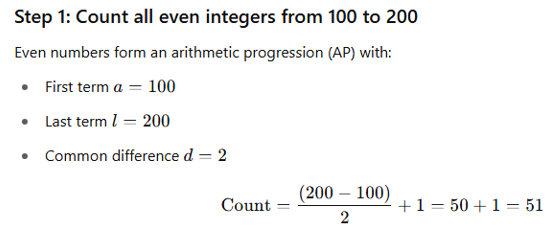
Even numbers 100–200: (200 − 100)/2 + 1 = 51.
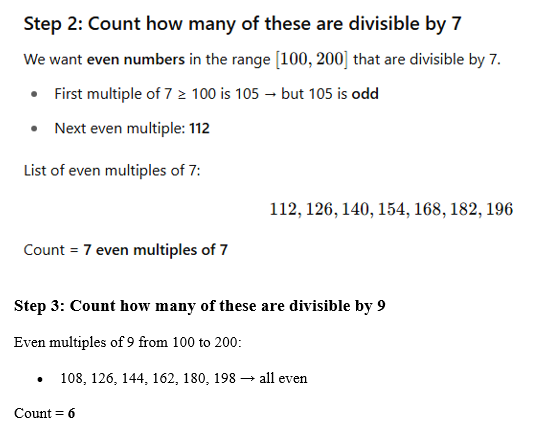
Even and divisible by 7 = multiples of 14: 112 … 196 → 7.
Even and divisible by 9 = multiples of 18: 108 … 198 → 6.
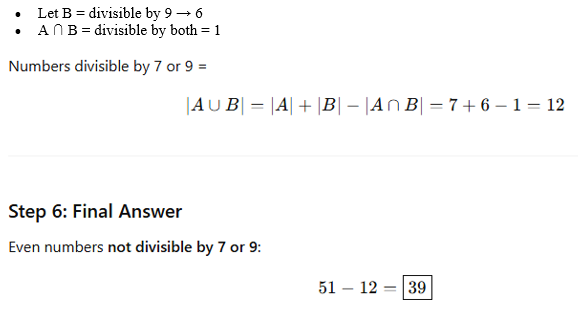
Both = multiples of 126: 126 → 1.
Required = 51 − (7 + 6 − 1) = 39.

Cetking shortcut: Within evens, 'divisible by 7' means multiple of 14, 'by 9' means multiple of 18, both means multiple of 126.

Answer: A

Q102EasyCET 2025 · Slot 1 · Q102
What is the product of all the prime numbers between 0 to 100 ?
Figure for MBA CET 2025 Slot 1 question 102
  1. 1
  2. 23055679639455184247531021473334556070
  3. 0
  4. 2305563945518424753102147334531756070
  5. 2305567963945518424753102147331756070
Show answerHide answer

Answer: E

Approach: Product of the 25 primes below 100 (2, 3, 5, …, 97); eliminate options by size and digit pattern.

Solution:
Primes below 100: 2, 3, 5, 7, 11, 13, 17, 19, 23, 29, 31, 37, 41, 43, 47, 53, 59, 61, 67, 71, 73, 79, 83, 89, 97 (25 primes)
Product = 2305567963945518424753102147331756070 (37 digits)
It contains 2 × 5, so it ends in 0 — and it is clearly neither 0 nor 1.

Why the other options are wrong:
A (1) and C (0): a product of primes can be neither.
B: 38 digits — one digit too many.
D: 37 digits but drops the '79' after 230556 (2305563945…).

Cetking shortcut: Size check: 2 × 3 × 5 × 7 = 210 and the primes from 11 to 97 multiply to about 1.1 × 10³⁴, so the product ≈ 2.3 × 10³⁶ — a 37-digit number; then match the digit string.

Answer: E

Solution figure for question 102
Q129MediumCET 2025 · Slot 1 · Q129
How many even integers 'n', where, 100 ≤ n ≤ 200, are divisible neither by 7 nor by 9 ?
Figure for MBA CET 2025 Slot 1 question 129
  1. 37
  2. 38
  3. 39
  4. 44
  5. 40
Show answerHide answer

Answer: C

Approach: Even numbers 100–200, remove multiples of 14 and 18, add back multiples of 126.

Solution:
Even numbers from 100 to 200 inclusive: (200 − 100)/2 + 1 = 51
Multiples of 14: 112 to 196 → 14 × 8 to 14 × 14 → 7
Multiples of 18: 108 to 198 → 18 × 6 to 18 × 11 → 6
Multiples of LCM(14, 18) = 126: only 126 → 1
Neither = 51 − 7 − 6 + 1 = 39

Cetking shortcut: Only even multiples matter: count with 14 and 18, not 7 and 9.

Answer: C

Solution figure for question 129Solution figure for question 129Solution figure for question 129Solution figure for question 129
Q137MediumCET 2025 · Slot 1 · Q137
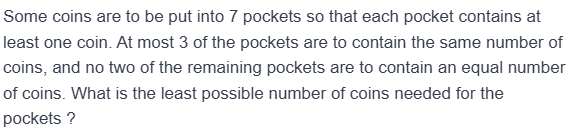
Some coins are to be put into 7 pockets so that each pocket contains at least one coin. At most 3 of the pockets are to contain the same number of coins, and no two of the remaining pockets are to contain an equal number of coins. What is the least possible number of coins needed for the pockets ?
Figure for MBA CET 2025 Slot 1 question 137
  1. 17
  2. 7
  3. 28
  4. 13
  5. 22
Show answerHide answer

Answer: A

Approach: Greedy: three pockets with the smallest count, four with the next distinct values.

Solution:
3 pockets × 1 coin = 3
Remaining 4 pockets must be distinct and ≠ 1 → 2, 3, 4, 5 = 14
Total = 3 + 14 = 17
Check: 3 × 2 + (1, 3, 4, 5) = 19 and 3 × 3 + (1, 2, 4, 5) = 21 → larger

Why the other options are wrong:
B (7): needs all 7 pockets with 1 coin — breaks 'at most 3 same'.
D (13): impossible — the minimum arrangement already needs 17.
C (28): all distinct 1–7, not the minimum.
E (22): not minimal.

Cetking shortcut: Put the repeat on the smallest value: 1 + 1 + 1 + 2 + 3 + 4 + 5 = 17.

Answer: A

Q147EasyCET 2025 · Slot 1 · Q147
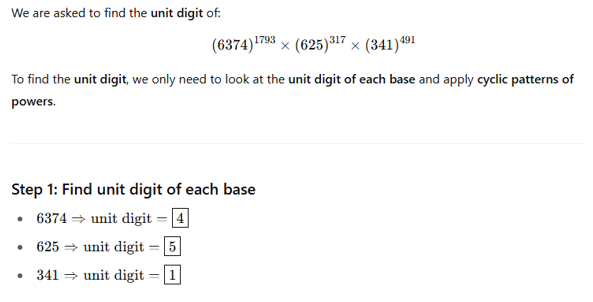
What number shall you get in the unit digit on solving the following problem :
{(6374)^1793 X (625)^317 X (341)^491}
Figure for MBA CET 2025 Slot 1 question 147
  1. 0
  2. 1
  3. 2
  4. 3
  5. 4
Show answerHide answer

Answer: A

Approach: Unit digits only.

Solution:
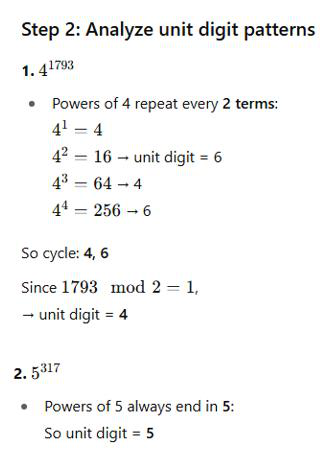
6374¹⁷⁹³: base ends in 4, odd power → ends in 4 (even)
625³¹⁷: ends in 5
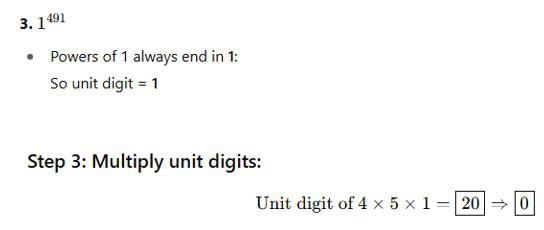
341⁴⁹¹: ends in 1
Product: 4 × 5 × 1 → unit digit 0

Cetking shortcut: Even × (…5) always ends in 0 — no cyclicity needed.

Answer: A

Solution figure for question 147Solution figure for question 147Solution figure for question 147

Practise these in the Arena

Take timed tests built around MBA CET topics and see where you stand.

Open the Arena