Let’s Crack CET 2027

Your CET check-up · tap a ring to see yours

Percentages – MBA CET questions with solutions

30 questions · CET 2025–2026 · Easy 26 · Medium 3 · Hard 1. Newest paper first. Full papers

Q113EasyCET 2026 · Attempt 2 Slot 2 · Q113
In a class, 70% of the students read Hindi. 40% of the students are boys and 20% of the girls do not read Hindi. Then determine, that what percentage of boys read Hindi ?
  1. 40%
  2. 45%
  3. 55%
  4. 44%
  5. 56%
Show answerHide answer

Answer: C official key

Approach: Split into boys/girls on a base of 100 students.

Solution:
Students = 100 → boys 40, girls 60.
Girls not reading Hindi = 20% of 60 = 12 → girls reading Hindi = 48.
Total reading Hindi = 70 → boys reading Hindi = 70 − 48 = 22.
% of boys reading Hindi = 22/40 × 100 = 55%.

Cetking shortcut: Take 100 students and fill a 2×2 table (boys/girls × Hindi/not).

Answer: C
Q115EasyCET 2026 · Attempt 2 Slot 2 · Q115
In an auditorium, the management decided to increase the number of seats by 25% and the prices of a ticket were increased by 12%. Calculate the percentage increase in revenue collection for the management :
  1. 30%
  2. 40%
  3. 45%
  4. 55%
  5. 35%
Show answerHide answer

Answer: B official key

Approach: Revenue = seats × price → successive percentage change.

Solution:
New revenue factor = 1.25 × 1.12 = 1.40.
Increase = 40%.

Cetking shortcut: 25 + 12 + (25 × 12)/100 = 25 + 12 + 3 = 40%.

Answer: B

Q102EasyCET 2026 · Attempt 2 Slot 1 · Q102

The population of a town is 18,000. It increases by 15% in the first year, 10% in the second year, and 25% in the third year. What will be the population after 3 years?

  1. 27,600
  2. 28,125
  3. 28,463
  4. 29,000
  5. 29,463
Show answerHide answer

Answer: C official key

Approach: Successive percentage growth: multiply the growth factors.

Solution:
After year 1: 18,000 × 1.15 = 20,700.
After year 2: 20,700 × 1.10 = 22,770.
After year 3: 22,770 × 1.25 = 28,462.5 ≈ 28,463.

Cetking shortcut: 1.15 × 1.10 = 1.265; × 1.25 = 1.58125; 18,000 × 1.58125 = 28,462.5.

Answer: C

Q124EasyCET 2026 · Attempt 2 Slot 1 · Q124

The difference between two numbers is 1660.
If 7.5% of one number is equal to 12.5% of the other number, find the larger number.

  1. 1992
  2. 2075
  3. 2490
  4. 4150
  5. 3150
Show answerHide answer

Answer: D official key

Approach: Convert the percentage equality into a ratio.

Solution:
7.5% of a = 12.5% of b → a/b = 12.5/7.5 = 5/3.
Difference = 5 − 3 = 2 parts = 1660 → 1 part = 830.
Larger number = 5 × 830 = 4150.

Cetking shortcut: The smaller percentage goes with the larger number.

Answer: D

Q112EasyCET 2026 · Slot 5 · Q112

Two numbers are 18% less and 42% less than a third number.
If the third number is increased by 25%, what percentage is the second number of the first number now?

  1. 57.14 %
  2. 70.73 %
  3. 76.73 %
  4. 79.14 %
  5. 84.73 %
Show answerHide answer

Answer: B official key

Approach: Fix the third number at 100; the increase in the third number does not change the other two.

Solution:
Third = 100 → first = 100 − 18 = 82, second = 100 − 42 = 58.
Increasing the third number by 25% does not affect the first and second numbers.
Second as % of first = 58/82 × 100 = 70.73%.

Why the other options are wrong:

  • A (57.14%), C (76.73%), D (79.14%), E (84.73%): come from rescaling the first two numbers or using the wrong base.

Cetking shortcut: The 25% increase is a distractor — the ratio 58 : 82 stays the same; 58/82 ≈ 0.707.

Answer: B

Q120EasyCET 2026 · Slot 5 · Q120

The expenditure and savings of an employee are in the ratio 4 : 1. His income increases by 12%, but at the same time his expenditure also increases by 18%.
What is the approximate percentage change in his savings?

  1. Increase by 8%
  2. Decrease by 12%
  3. Increase by 12 %
  4. Decrease by 8 %
  5. Decrease by 6%
Show answerHide answer

Answer: B official key

Approach: Savings = Income − Expenditure; apply each change in units.

Solution:
Expenditure : savings = 4 : 1 → income = 5, expenditure = 4, savings = 1.
New income = 5 × 1.12 = 5.60; new expenditure = 4 × 1.18 = 4.72.
New savings = 5.60 − 4.72 = 0.88.
Change = (0.88 − 1)/1 × 100 = −12% → decrease by 12%.

Why the other options are wrong:

  • A, C: savings cannot rise when expenditure grows faster than income here.
  • D (−8%): arithmetic slip; E (−6%): just subtracts 12% − 18%.

Cetking shortcut: Change in savings = 5 × 12 − 4 × 18 = 60 − 72 = −12 (on base 1 × 100) → −12%.

Answer: B

Q139EasyCET 2026 · Slot 5 · Q139

In an election contested by two candidates, one candidate secured 30% of the total votes and still lost the election by 500 votes. What was the total number of votes cast?

  1. 1000
  2. 1250
  3. 1500
  4. 1750
  5. 2000
Show answerHide answer

Answer: B official key

Approach: Winning margin as a percentage of total votes.

Solution:
Two candidates: loser 30%, winner 70%.
Margin = 70% − 30% = 40% of total = 500.
Total = 500 × 100/40 = 1250.

Why the other options are wrong:

  • A (1000): margin would be 400.
  • C, D, E: margins 600, 700, 800.

Cetking shortcut: 40% ↔ 500 → 10% ↔ 125 → 100% ↔ 1250.

Answer: B

Q140MediumCET 2026 · Slot 5 · Q140

In a city, domestic electricity charges are as follows:

₹4.20 per unit for the first 100 units,

₹5.80 per unit for consumption above 100 units

A fixed meter charge of ₹120 per month is applicable.
Electricity duty at 10% is charged only on energy charges, not on the fixed charge.

If a household consumed 168 units of electricity for one month, what will be the total electricity bill?

  1. ₹1016
  2. ₹1136
  3. ₹1192
  4. ₹1312
  5. ₹1368
Show answerHide answer

Answer: A official key

Approach: Slab billing; duty only on energy charges.

Solution:
First 100 units: 100 × 4.20 = ₹420.
Next 68 units: 68 × 5.80 = ₹394.40.
Energy charges = ₹814.40.
Duty 10% of 814.40 = ₹81.44.
Fixed meter charge = ₹120 (no duty).
Total = 814.40 + 81.44 + 120 = ₹1015.84 → ₹1016 (bill rounded to the nearest rupee).

Why the other options are wrong:

  • B (₹1136): adds the ₹120 fixed charge twice.
  • C (₹1192): charges all 168 units at ₹5.80.
  • D, E: overcharge / duty on wrong base.

Cetking shortcut: Energy × 1.1 + 120: 814.4 × 1.1 = 895.84 → + 120 = 1015.84.

Answer: A

Q107EasyCET 2026 · Slot 4 · Q107
Solve: 15% of 200 + 20% of 150 =
  1. 50
  2. 55
  3. 60
  4. 65
  5. 70
Show answerHide answer

Answer: C official key

Approach: Direct percentage of a number.

Solution:
15% of 200 = 0.15 × 200 = 30.
20% of 150 = 0.20 × 150 = 30.
Sum = 30 + 30 = 60.

Cetking shortcut: x% of y = y% of x: 15% of 200 = 200% of 15 = 30.

Answer: C

Q117EasyCET 2026 · Slot 4 · Q117
The price of sugar is increased by 20%. By how much percent must a household reduce its consumption so as not to increase the expenditure?
  1. 20.33%
  2. 16.66%
  3. 25.50%
  4. 15.33%
  5. 10.66%
Show answerHide answer

Answer: B official key

Approach: Expenditure = price × consumption; keep the product constant.

Solution:
New price = 1.2 × old.
Consumption must become 1/1.2 = 5/6 of old.
Reduction = 1 − 5/6 = 1/6 = 16.66%.
Formula: r/(100 + r) × 100 = 20/120 × 100 = 16.66%.

Why the other options are wrong:
A (20.33%) – assumes the cut equals the rise.
C, D, E – arithmetic slips.

Cetking shortcut: 20% = 1/5 rise ⇒ cut = 1/(5 + 1) = 1/6 = 16.66%.

Answer: B

Q118EasyCET 2026 · Slot 4 · Q118
A man spends 35% of his income on food, 25% on children's education, and 80% of the remaining on house rent. What percent of his income is he left with?
  1. 8%
  2. 10%
  3. 12%
  4. 15%
  5. 6%
Show answerHide answer

Answer: A official key

Approach: Successive spending — apply the 80% to the remaining income only.

Solution:
Food + education = 35% + 25% = 60% ⇒ remaining = 40%.
Rent = 80% of 40% = 32%.
Left = 40% − 32% = 8% of income.

Why the other options are wrong:
E (6%), B (10%), C (12%), D (15%) – come from taking 80% of the whole income or mixing bases.

Cetking shortcut: Left = 40% × 20% = 8%.

Answer: A

Q117EasyCET 2026 · Slot 3 · Q117
An engineering college has only four batches that contain 20, 40, 60 and 80 students respectively. The pass percentage of these classes, are 10%, 20%, 30% and 40% respectively. Find the pass percentage of the entire college.
  1. 25%
  2. 30%
  3. 28%
  4. 32%
  5. 35%
Show answerHide answer

Answer: B official key

Approach: Overall pass % = total passed / total students (weighted, not simple average).

Solution:
Total students = 20 + 40 + 60 + 80 = 200.
Passed = 10% of 20 + 20% of 40 + 30% of 60 + 40% of 80 = 2 + 8 + 18 + 32 = 60.
Pass % = 60/200 × 100 = 30%.

Cetking shortcut: Weights 1 : 2 : 3 : 4 → (10 + 40 + 90 + 160)/10 = 30%.

Answer: B

Q119EasyCET 2026 · Slot 3 · Q119
A machine costs ₹3,20,000 at present. If its value depreciates at the rate of 5% per annum, what will be the value of the machine after 6 years?
  1. ₹2,45,760
  2. ₹2,52,000
  3. ₹2,35,230
  4. ₹2,30,400
  5. ₹2,60,000
Show answerHide answer

Answer: C official key

Approach: Depreciation: Value = P(1 − r/100)ⁿ.

Solution:
Value = 3,20,000 × (0.95)⁶.
(0.95)² = 0.9025; (0.95)³ = 0.857375; (0.95)⁶ = 0.857375² ≈ 0.73509.
Value ≈ 3,20,000 × 0.73509 ≈ ₹2,35,229 ≈ ₹2,35,230.

Cetking shortcut: Binomial: (1 − 0.05)⁶ ≈ 1 − 0.30 + 0.0375 − 0.0025 ≈ 0.735 → 3,20,000 × 0.735 ≈ 2,35,200 → C.

Answer: C

Q120MediumCET 2026 · Slot 3 · Q120
The price of raw materials has increased by 15%. Labour cost has also increased from 25% of the cost of raw material to 30% of the cost of raw material. By how much percentage should the usage of raw materials be reduced so as to keep the total cost the same?
  1. 15.2 %
  2. 16.4 %
  3. 18.6 %
  4. 19.8 %
  5. 20 %
Show answerHide answer

Answer: B official key

Approach: Fix the old total cost; let usage of raw material become a fraction u and keep total cost equal.

Solution:
Old: raw material cost = 100, labour = 25% of 100 = 25, total = 125.
New price of raw material = 115 per old unit of usage; labour = 30% of raw material cost.
New total = 115u + 0.30 × 115u = 149.5u.
149.5u = 125 → u = 0.8361.
Reduction in usage = (1 − 0.8361) × 100 ≈ 16.4%.

Cetking shortcut: Reduction = 1 − 125/149.5 = 24.5/149.5 ≈ 16.4%.

Answer: B

Q110EasyCET 2026 · Slot 2 · Q110

DIRECTION for the question: Solve the following question and mark the best possible option.

The population of a town increased from 1,75,000 to 2,62,500 in a decade. The average % increase in the population per year is?
  1. 4.37%
  2. 5%
  3. 6%
  4. 8.75%
  5. 8%
Show answerHide answer

Answer: B official key

Approach: Total percentage increase spread evenly over 10 years.

Solution: Increase = 2,62,500 − 1,75,000 = 87,500.
Total % increase = 87,500/1,75,000 × 100 = 50%.
Average per year = 50% ÷ 10 = 5%.

Why the other options are wrong:
D (8.75%): divides 87,500 by 10,000 (wrong base).
C, E: no valid working gives these; 'average' here is the simple per-year rate, not compound (≈4.1%).

Answer: B

Q111EasyCET 2026 · Slot 2 · Q111

DIRECTION for the question: Solve the following question and mark the best possible option.

If p% of p is 36, then p is equal to
  1. 15
  2. 60
  3. 600
  4. 3600
  5. 36
Show answerHide answer

Answer: B official key

Approach: Convert 'p% of p' into an equation.

Solution: (p/100) × p = 36 ⇒ p² = 3600 ⇒ p = 60.
Check: 60% of 60 = 36.

Why the other options are wrong:
D (3600): stops at p².
C (600): 600% of 600 = 3600.
A, E: 15% of 15 = 2.25; 36% of 36 = 12.96.

Answer: B

Q113EasyCET 2026 · Slot 1 · Q113

In a town of 2000 people, 60% are males. Out of the males, 40% are literate. If 55% of the total population is literate, what percentage of females is literate?

  1. 67.5%
  2. 72.5%
  3. 70.5%
  4. 77.5%
  5. 80.5%
Show answerHide answer

Answer: D official key

Approach: Split population into males/females and subtract literate males from total literates.

Solution:
Males = 60% of 2000 = 1200; females = 800
Literate males = 40% of 1200 = 480
Total literate = 55% of 2000 = 1100
Literate females = 1100 − 480 = 620
Female literacy = 620/800 × 100 = 77.5%

Cetking shortcut: Alligation: 0.6 × 40 + 0.4 × f = 55 → 24 + 0.4f = 55 → f = 77.5.

Answer: D

Q114EasyCET 2026 · Slot 1 · Q114

Ramesh spends 25% of his income on rent, 30% of the remaining on food, and 20% of the remaining on transport. If he saves ₹21,000, find the amount spent on transport.

  1. ₹4,250
  2. ₹5,550
  3. ₹5,250
  4. ₹6,200
  5. ₹5,150
Show answerHide answer

Answer: C official key

Approach: Successive percentages apply to the remaining amount each time.

Solution:
After rent: 75% of I remains
Food = 30% of 0.75I = 0.225I → remaining 0.525I
Transport = 20% of 0.525I = 0.105I → savings = 0.42I
0.42I = 21000 → I = 50000
Transport = 0.105 × 50000 = ₹5,250

Cetking shortcut: Savings = 0.75 × 0.70 × 0.80 = 0.42 of income; transport = savings × 0.2/0.8 = 21000/4 = 5250.

Answer: C

Q115EasyCET 2026 · Slot 1 · Q115

The salary of P is 60% more than Q, while the salary of R is 20% less than the total salary of P and Q together.
If Q's salary is ₹30,000, find the salary of R.

  1. ₹62,400
  2. ₹60,500
  3. ₹61,700
  4. ₹60,850
  5. ₹72,400
Show answerHide answer

Answer: A official key

Approach: Convert each 'more/less than' into a multiplier.

Solution:
Q = 30000; P = 1.6 × 30000 = 48000
P + Q = 78000
R = 80% of 78000 = 62400

Cetking shortcut: R = 0.8 × 2.6Q = 2.08 × 30000 = 62400.

Answer: A

Q121MediumCET 2025 · Slot 6 · Q121
There are 1450 cars in the factory. The factory produces 8 cars hourly. If the sales of the factory are 80 cars per day, what will be the sale percentage to the total cars held by the factory after 7 days. It is known that the factory runs 8 hours daily.
  1. 28.6%
  2. 27.5%
  3. 29.5%
  4. 24.54%
  5. 26.74%
Show answerHide answer

Answer: C

Approach: Percentage of sales to total cars held (opening stock + production) over 7 days; the garbled hourly figure is 8 cars.

Solution:
Production = 8 cars/hour × 8 hours = 64 cars/day ⇒ 7 days = 448 cars.
Total cars held in 7 days = 1450 + 448 = 1898.
Cars sold in 7 days = 80 × 7 = 560.
Sale % = 560/1898 × 100 = 29.5%.

Why the other options are wrong:
With 6 cars/hour (doc's reading) the figures give 31.35% (sales/1786) or 45.68% (sales/closing stock) — neither is an option, so 6 is not the intended value.
A 28.6%, B 27.5%, D 24.54%, E 26.74%: correspond to non-integer hourly production (≈ 9.1, 10.5, 14.9, 11.5 cars) — not sensible.

Cetking shortcut: Back-solve: 560/0.295 ≈ 1898 ⇒ production = 448 = 7 × 64 = 7 × 8 × 8 — a clean 8 cars/hour, so C.

Answer: C

Q111EasyCET 2025 · Slot 5 · Q111

In measuring the side of a square, an error of 5% in excess is made. The error % in the calculated area is,

  1. 10.75%
  2. 10.25%
  3. 10.50%
  4. 10.00%
  5. 11.25%
Show answerHide answer

Answer: B

Approach: Area varies as side², so a +5% side error gives successive +5% and +5%.

Solution:
New side = 1.05s
New area = (1.05)²s² = 1.1025s²
Error in area = 10.25%

Why the other options are wrong:
D (10%): simply doubling 5% ignores the 0.25% cross term.

Cetking shortcut: Successive % formula: a + b + ab/100 = 5 + 5 + 25/100 = 10.25%.

Answer: B

Q112EasyCET 2025 · Slot 5 · Q112

In a factory producing parts of an automobile, the parts manufactured on the shop floor are required to go through three quality checks, each conducted after a specific part of the processing on the raw material is completed Only parts that are not rejected at one stage are put through the subsequent stages of production and testing. If average rejection rates at these three testing machines during a month are 10%, 5% and 2% respectively, then what is the effective rejection rate for the whole plant?

  1. 17%
  2. 15.25%
  3. 16.21%
  4. 16.76%
  5. 17.2%
Show answerHide answer

Answer: C

Approach: Rejections at successive stages apply to the survivors — multiply pass rates.

Solution:
Take 100 parts
After stage 1 (10% rejected): 90
After stage 2 (5% rejected): 0.95 × 90 = 85.5
After stage 3 (2% rejected): 0.98 × 85.5 = 83.79
Effective rejection = 100 − 83.79 = 16.21%

Why the other options are wrong:
A (17%): simply adds 10 + 5 + 2, ignoring that later stages see fewer parts.
B, D, E: computation slips.

Cetking shortcut: Pass rate = 0.9 × 0.95 × 0.98 = 0.8379; rejection = 16.21%.

Answer: C

Q112EasyCET 2025 · Slot 4 · Q112

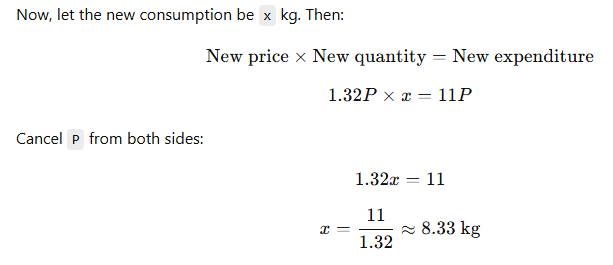
The price of sugar was increased by 32%. A family reduces its consumption so that the expenditure on sugar is up by 10% only. If the total consumption of sugar before the price rises was 10 kg per month, then the consumption of sugar per month at present (in kg) is:

  1. 8.5
  2. 9
  3. 8.33
  4. 8.6
  5. 8.2
Show answerHide answer

Answer: C

Approach: Expenditure = Price × Consumption.

Solution:
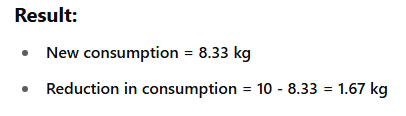
Let original price = P; original expenditure = 10P.
New price = 1.32P; new expenditure = 1.10 × 10P = 11P.
New consumption = 11P/1.32P = 11/1.32 = 8.33 kg.

Why the other options are wrong:
A, B, D, E: none equals 11/1.32 = 8.33.

Cetking shortcut: Consumption factor = 1.10/1.32 = 5/6 ⇒ 10 × 5/6 = 8.33 kg.

Answer: C

Solution figure for question 112Solution figure for question 112
Q113EasyCET 2025 · Slot 4 · Q113

In a housing society, 30% of residents are men over the age of 18 and 40% are women over the age of 18. If there are 24 children living in the housing society, then how many total residents live in the society?

  1. 75
  2. 80
  3. 72
  4. 100
  5. 32
Show answerHide answer

Answer: B

Approach: Complement percentage gives the count.

Solution:
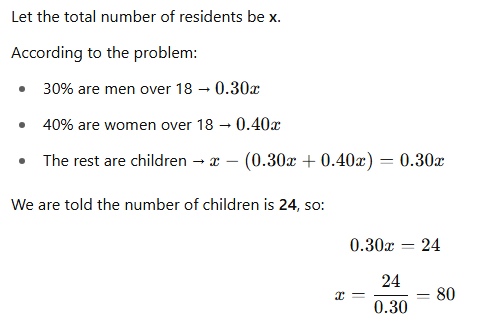
Adults = 30% + 40% = 70% ⇒ children = 30%.
30% of total = 24 ⇒ total = 24 × 100/30 = 80.

Cetking shortcut: 10% = 8 ⇒ 100% = 80.

Answer: B

Solution figure for question 113
Q114EasyCET 2025 · Slot 4 · Q114

The price of an item was increased by 10%. This reduced the monthly total sales by 20%. What is the overall effect on the value of monthly sales?

  1. 12% decrease
  2. 10% increase
  3. 8% decrease
  4. 10% decrease
  5. 13% decrease
Show answerHide answer

Answer: A

Approach: Successive percentage change.

Solution:
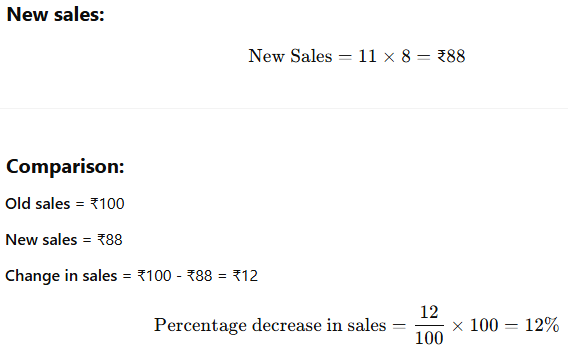
Value factor = 1.10 × 0.80 = 0.88.
Change = 0.88 − 1 = −12% ⇒ 12% decrease.
Formula check: 10 − 20 + (10 × −20)/100 = −10 − 2 = −12%.

Why the other options are wrong:
D (10% decrease): simple addition, ignores the cross term.
C, E, B: do not match 1.1 × 0.8.

Cetking shortcut: a + b + ab/100 = 10 − 20 − 2 = −12.

Answer: A

Solution figure for question 114
Q116EasyCET 2025 · Slot 3 · Q116
5 kg of metal A and 20 kg of metal B are mixed to form an alloy. What is the percentage of metal A in the alloy?
  1. 20%
  2. 25%
  3. 40%
  4. 50%
  5. 60%
Show answerHide answer

Answer: A

Approach: Part ÷ total × 100.

Solution: Total alloy = 5 + 20 = 25 kg.
% of A = 5/25 × 100 = 20%.

Why the other options are wrong: 25% comes from 5/20 (wrong base).

Answer: A

Q117EasyCET 2025 · Slot 3 · Q117
A’s salary is 40% of B’s salary which is 25% of C’s salary. What % of C’s salary is A’s salary?
  1. 5%
  2. 10%
  3. 15%
  4. 20%
  5. 40%
Show answerHide answer

Answer: B

Approach: Multiply chained percentages.

Solution: Let C = 100. B = 25% of 100 = 25. A = 40% of 25 = 10.
A is 10% of C.

Answer: B

Q4HardCET 2025 · Slot 2 · Q4

A fruit seller has a stock of mangoes, bananas and apples with at least one fruit of each type. At the beginning of a day, the number of mangoes make up 40% of his stock. That day, he sells half of the mangoes, 96 bananas and 40% of the apples. At the end of the day, he ends up selling 50% of the fruits. The smallest possible total number of fruits in the stock at the beginning of the day is:

  1. 345
  2. 340
  3. 225
  4. 196
  5. 448
Show answerHide answer

Answer: B

Approach: Express apples and bananas in terms of total T, then apply integer constraints.

Solution:
Mangoes = 0.4T, so bananas + apples = 0.6T. Let apples = A.
Sold = 0.2T (half mangoes) + 96 + 0.4A = 0.5T → 0.4A = 0.3T − 96 → A = 0.75T − 240.
A ≥ 1 → T ≥ 321.4.
Integers: half of 0.4T must be whole → T multiple of 5; 0.75T whole → T multiple of 4; so T is a multiple of 20 (then 0.4A is also whole).
Smallest multiple of 20 above 321.4 = 340.
Check: mangoes 136 (sell 68), apples 0.75×340 − 240 = 15 (sell 6), bananas 340 − 136 − 15 = 189 (sell 96). Sold = 68 + 96 + 6 = 170 = 50% ✓.

Why the other options are wrong: 345 is not a multiple of 4 (0.75T not whole); 225 and 196 give negative apples; 448 is not a multiple of 5 (mangoes 0.4T = 179.2 is not whole), so it is invalid.

Cetking shortcut: Need T > 320 and T a multiple of 20 → among the options only 340 qualifies.

Answer: B

Q49EasyCET 2025 · Slot 1 · Q49

If one third of one-fourth of a number is 15, then three-tenth of that number will be :

  1. 46
  2. 61
  3. 54
  4. 63
  5. 38
Show answerHide answer

Answer: C

Approach: Fractions of a number.

Solution:
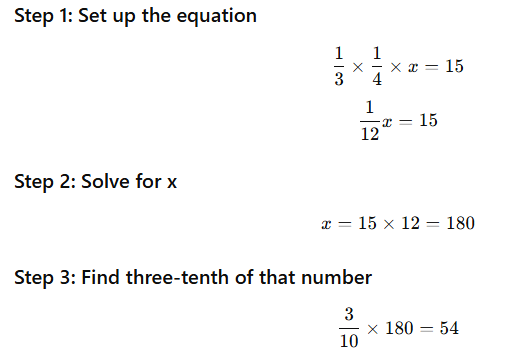
(1/3) × (1/4) × N = 15 → N/12 = 15 → N = 180.
(3/10) × 180 = 54.

Why the other options are wrong:
A 46, B 61, D 63, E 38 — not 3/10 of 180.

Cetking shortcut: 3/10 of N = 3/10 × 12 × 15 = 3.6 × 15 = 54.

Answer: C

Solution figure for question 49
Q122EasyCET 2025 · Slot 1 · Q122
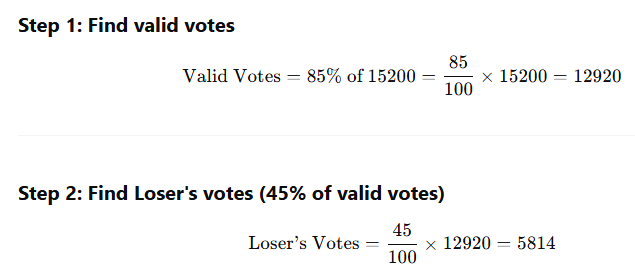
In a local election between two candidates, one candidate got 55% of the total valid votes and was declared as winner. 15% of the votes were invalid. If the total number of votes polled were 15200, what were the valid votes of the loser ?
Figure for MBA CET 2025 Slot 1 question 122
  1. 5832
  2. 5416
  3. 6018
  4. 5800
  5. 5814
Show answerHide answer

Answer: E

Approach: Valid votes first, then loser's share.

Solution:
Valid votes = 85% of 15200 = 12920
Loser's share = 100% − 55% = 45%
Loser's votes = 45% of 12920 = 5814

Cetking shortcut: 0.85 × 0.45 = 0.3825; 0.3825 × 15200 = 5814.

Answer: E

Solution figure for question 122Solution figure for question 122

Practise these in the Arena

Take timed tests built around MBA CET topics and see where you stand.

Open the Arena