A water tank has three taps: A, B and C. A fills four buckets in 24 minutes, B fills 8 buckets in 1 hour and C fills 2 buckets in 20 minutes. If all the taps are opened together, a full tank is emptied in 2 hours. If a bucket can hold 5 liters of water, what is the capacity of the tank in liters ?
- A180
- B260
- C320
- D360
- E240
Show answerHide answer
Answer: E ✓ official key
Approach: Convert every tap to a common rate (buckets per hour), then capacity = rate × time.
Solution:
A: 4 buckets in 24 min → 10 buckets/hour.
B: 8 buckets/hour.
C: 2 buckets in 20 min → 6 buckets/hour.
Together: 24 buckets/hour → in 2 hours 48 buckets drain the tank.
Capacity = 48 × 5 = 240 litres.
Cetking shortcut: Work per minute: 1/6 + 2/15 + 1/10 = 2/5 bucket/min → 120 min × 2/5 = 48 buckets.
Answer: E
Three taps have diameters of 1 cm, 4/3 cm, and 2 cm respectively. The rate of water flow through each tap is proportional to the square of its diameter. The tap with the largest diameter can fill the tank by itself in 61 minutes. If all three taps are opened together, how long will it take to fill the tank completely ?
- A36 minutes
- B24 minutes
- C15 minutes
- D28 minutes
- E45 minutes
Show answerHide answer
Official CET key: A · Cetking's answer: E — see why below
Approach: Flow ∝ (diameter)²; add rates and divide the tank volume.
Solution:
Rates ∝ 1², (4/3)², 2² = 1, 16/9, 4.
Largest tap alone: 61 min → tank = 4 × 61 = 244 units.
Combined rate = 1 + 16/9 + 4 = 61/9 units/min.
Time = 244 ÷ (61/9) = 244 × 9/61 = 36 minutes.
Cetking shortcut: Time together = 61 × 4 ÷ (61/9) = 36 — the odd '61' is chosen so it cancels.
Answer: A
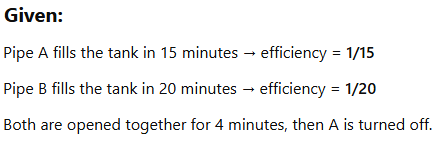
Two pipes, A and B, can fill a tank individually in 15 minutes and 20 minutes, respectively. Both pipes are opened simultaneously, but after 4 minutes, pipe A is closed. How much total time is required to fill the tank completely?
- A15 minutes 30 seconds
- B14 minutes 40 seconds
- C12 minutes 40 seconds
- D14 minutes 30 seconds
- E12 minutes 30 seconds
Show answerHide answer
Answer: B ✓ official key
Approach: Work done together, then the remaining by B alone.
Solution:
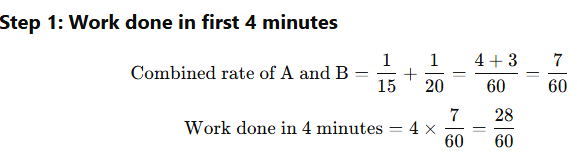
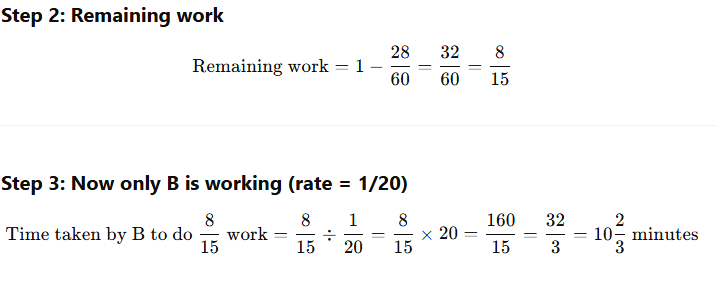
In 4 min together: 4(1/15 + 1/20) = 4 × 7/60 = 28/60.
Remaining = 32/60 = 8/15 of the tank.
B alone: (8/15) × 20 = 32/3 min = 10 min 40 s.
Total = 4 + 10 min 40 s = 14 min 40 s.
Cetking shortcut: Take tank = 60 units: A = 4, B = 3/min. 4 min → 28; left 32 → 32/3 = 10⅔ min → total 14 min 40 s.
Answer: B
Eight taps are fitted to a water tank. Some are inlet taps that fill the tank, while the remaining are outlet taps that empty it.
Each inlet tap can fill the tank in 12 hours, and each outlet tap can empty the tank in 36 hours.
When all the taps are opened together, the tank is filled in 3 hours.
How many of the taps are inlet (water) taps?
- A3
- B4
- C5
- D6
- E7
Show answerHide answer
Answer: C ✓ official key
Approach: Net work rate: inlets positive, outlets negative.
Solution:
Let n inlets, (8 − n) outlets.
n/12 − (8 − n)/36 = 1/3.
Multiply by 36: 3n − (8 − n) = 12 → 4n = 20 → n = 5.
Cetking shortcut: Option check: 5 inlets = 5/12, 3 outlets = 3/36 = 1/12 → net 4/12 = 1/3 ✓.
Answer: C
Two pipes P and Q can fill a cistern in 12 minutes and 15 minutes respectively. Both pipes are opened together, but at the end of 3 minutes pipe P is closed. How much longer will the cistern take to fill completely?
- A8 (1/4) minutes
- B8 (3/4) minutes
- C5 minutes
- D8 (1/2) minutes
- E6 minutes
Show answerHide answer
Answer: A ✓ official key
Approach: Work done together for 3 min, then the remaining by Q alone.
Solution:
P = 1/12, Q = 1/15 per minute; together = 1/12 + 1/15 = (5 + 4)/60 = 9/60 = 3/20.
In 3 min: 3 × 3/20 = 9/20 filled.
Remaining = 1 − 9/20 = 11/20.
Q alone: 11/20 × 15 = 165/20 = 8¼ minutes.
Why the other options are wrong:
- B (8¾), D (8½): arithmetic slips in 11/20 × 15.
- C (5), E (6): do not equal (11/20) ÷ (1/15) = 8¼ min; they come from a wrong rate for the remaining work.
Cetking shortcut: Q works all the time: Q's total time t → t/15 + 3/12 = 1 → t = 11.25 min → after the first 3 min: 8¼ min.
Answer: A
A cistern has a leak which would empty it in 8 hours. A tap is turned on which admits 6 liters a minute into the cistern and it is now emptied in 12 hours. What is the capacity of the cistern?
- A8000 liters
- B8240 liters
- C8640 liters
- D9000 liters
- E9600 liters
Show answerHide answer
Answer: C ✓ official key
Approach: Net rate = leak rate − inlet rate; find the tap's rate as a fraction of the tank.
Solution:
Leak alone empties in 8 h ⇒ −1/8 per hour.
With tap on, it empties in 12 h ⇒ net −1/12 per hour.
Tap rate = 1/8 − 1/12 = 1/24 tank per hour ⇒ tap fills the tank in 24 h.
Tap gives 6 L/min = 360 L/h ⇒ capacity = 24 × 360 = 8640 L.
Why the other options are wrong:
A, B, D, E – result from wrong time (e.g. 20 h or 25 h) or not converting minutes to hours.
Cetking shortcut: Tap time = (8 × 12)/(12 − 8) = 24 h; capacity = 24 × 60 × 6 = 8640.
Answer: C
A tank is filled in 5 hours by three pipes A, B, and C. The pipe C is twice as fast as B, and B is twice as fast as A. How much time will pipe A alone take to fill the tank?
- A20 hours
- B25 hours
- C30 hours
- D35 hours
- E40 hours
Show answerHide answer
Answer: D ✓ official key
Approach: Use efficiencies: total work = combined efficiency × time.
Solution:
Let A = 1 unit/h ⇒ B = 2, C = 4 (C twice B, B twice A).
Combined = 7 units/h; tank filled in 5 h ⇒ capacity = 35 units.
A alone = 35/1 = 35 hours.
Why the other options are wrong:
A (20), B (25), C (30), E (40) – wrong efficiency ratios (e.g. 1 : 2 : 3).
Cetking shortcut: A alone time = 5 × (1 + 2 + 4)/1 = 35 h.
Answer: D
Two pipes A and B can fill a tank in 24 minutes and 32 minutes respectively. If both the pipes are opened simultaneously, after how much time should B be closed so that the tank is full in 18 minutes?
- A8 minutes
- B9 minutes
- C7 minutes
- D15 minutes
- E24 minutes
Show answerHide answer
Answer: A ✓ official key
Approach: Work done by each pipe = rate × time it stays open.
Solution:
A works all 18 min: 18/24 = 3/4 of the tank.
B must fill the remaining 1/4: x/32 = 1/4 → x = 8 min.
B should be closed after 8 minutes.
Cetking shortcut: Remaining fraction × B's time = 1/4 × 32 = 8.
Answer: A
A cistern is normally filled in 6 hours but takes 4 hours longer to fill because of a leak in its bottom. If the cistern is full, the leak will empty it in how much time?
- A15 hours
- B16 hours
- C12 hours
- D20 hours
- E24 hours
Show answerHide answer
Answer: A ✓ official key
Approach: Leak rate = filling rate without leak − net rate with leak.
Solution:
Pipe alone: 1/6 per hour; with leak the tank takes 10 h → 1/10 per hour.
Leak rate = 1/6 − 1/10 = (5 − 3)/30 = 1/15.
The leak empties a full tank in 15 hours.
Cetking shortcut: Leak time = (6 × 10)/(10 − 6) = 60/4 = 15 h.
Answer: A
DIRECTION for the question: Solve the following question and mark the best possible option.
Two pipes A and B can fill a tank in 15 minutes and 20 minutes respectively. Both the pipes are opened together but after 4 minutes, pipe A is turned off. What is the total time required to fill the tank?
- A10 min 20 sec
- B11 min 45 sec
- C12 min 30 sec
- D14 min 40 sec
- E15 min 20 sec
Show answerHide answer
Answer: D ✓ official key
Approach: LCM-unit method.
Solution: Tank = LCM(15, 20) = 60 units. A = 4 units/min, B = 3 units/min.
First 4 min together: 7 × 4 = 28 units. Remaining = 32 units.
B alone: 32 ÷ 3 = 10 2/3 min = 10 min 40 sec.
Total = 4 min + 10 min 40 sec = 14 min 40 sec.
Why the other options are wrong:
A (10 min 20 sec) and others: miss the first 4 minutes or miscalculate the remainder.
Answer: D
DIRECTION for the question: Solve the following question and mark the best possible option.
Four pipes can fill a reservoir in 15, 20, 30 and 60 hours respectively. The first pipe was opened at 8 am, the second at 9 am, the third at 10 am and the fourth at 11 am. When will the reservoir be full?
- A1:00 pm
- B2:00 pm
- C2:30 pm
- D3:00 pm
- E4:00 pm
Show answerHide answer
Official CET key: D · Cetking's answer: B — see why below
Approach: LCM-unit method with staggered start times.
Solution: Tank = LCM(15, 20, 30, 60) = 60 units. Rates: 4, 3, 2, 1 units/hr.
8–9 am: 4 units. 9–10 am: 4 + 3 = 7 units. 10–11 am: 4 + 3 + 2 = 9 units.
Filled by 11 am = 4 + 7 + 9 = 20 units. Remaining = 40 units.
From 11 am all four pipes: 4 + 3 + 2 + 1 = 10 units/hr ⇒ 40 ÷ 10 = 4 hours.
Full at 11 am + 4 h = 3:00 pm.
Check (x = hours from 8 am = 7): 7/15 + 6/20 + 5/30 + 4/60 = (28 + 18 + 10 + 4)/60 = 1.
Why the other options are wrong:
B (2:00 pm) / C (2:30 pm): wrong combined rate (1/5) or rounding.
A, E: arithmetic slips.
Cetking shortcut: Let pipe 1 run x hours: 4x + 3(x − 1) + 2(x − 2) + (x − 3) = 60 ⇒ 10x − 10 = 60 ⇒ x = 7 ⇒ 8 am + 7 h = 3 pm.
Answer: D
Three pipes X, Y and Z can fill a tank completely in 24 minutes, 12 minutes and 8 minutes respectively.
All three pipes are opened together when the tank is empty.
- Pipe X fills solution A
- Pipe Y fills solution B
- Pipe Z fills solution C
After 4 minutes, what is the proportion of solution C in the tank?
- A1/2
- B1/4
- C1/3
- D2/3
- E3/4
Show answerHide answer
Answer: A ✓ official key
Approach: Each pipe's share in the tank is proportional to its filling rate.
Solution:
Rates per minute: X = 1/24, Y = 1/12 = 2/24, Z = 1/8 = 3/24
Ratio X : Y : Z = 1 : 2 : 3
Share of C (from Z) = 3/(1 + 2 + 3) = 3/6 = 1/2
(After 4 min: 4/24 + 8/24 + 12/24 = 1 → tank exactly full, no overflow issue.)
Cetking shortcut: Times 24 : 12 : 8 → rates 1 : 2 : 3; the 4 minutes do not matter.
Answer: A
Two pipes A and B together can fill a cistern in 4 hours. Had they been opened separately, then B would have taken 6 hours more than A to fill the cistern. How much time will be taken by A to fill the cistern by itself?
- A8 hours
- B6 hours
- C10 hours
- D7 hours
- E4 hours
Show answerHide answer
Answer: B ✓ official key
Approach: Combined rate = sum of individual rates; form a quadratic in A's time.
Solution:
Let A take a hours, B take a + 6 hours
1/a + 1/(a + 6) = 1/4
4(2a + 6) = a(a + 6) → a² − 2a − 24 = 0
(a − 6)(a + 4) = 0 → a = 6 hours
Cetking shortcut: Option test: A = 6 → B = 12 → 1/6 + 1/12 = 3/12 = 1/4 ✓ — quick to verify.
Answer: B
Two outlet pipes P and Q are connected to a full tank. Pipe P alone can empty the tank in 12 minutes and pipe Q alone can empty it in 18 minutes.
If both pipes are opened together, how long will it take to empty the tank completely?
- A6.2 minutes
- B5.4 minutes
- C6.8 minutes
- D7.2 minutes
- E4.5 minutes
Show answerHide answer
Official CET key: D · Cetking's answer: B — see why below
Approach: Two outlets work together → add their emptying rates.
Solution:
P empties 1/12 per min, Q empties 1/18 per min
Together = 1/12 + 1/18 = 3/36 + 2/36 = 5/36 per min
Time = 36/5 = 7.2 minutes
Why the other options are wrong:
Time must lie between 6 (if both were as fast as P: 12/2) and 9 (if both were as slow as Q: 18/2) → B (5.4) and E (4.5) are impossible; 6.2 and 6.8 do not equal 36/5.
Cetking shortcut: Two jobs together: T = ab/(a + b) = 12 × 18 / 30 = 7.2.
Answer: D
Two pipes can fill a tank in 10 minutes together if the efficiency of the first pipe is 8 times the efficiency of the second pipe find the time required to fill the tank using the second pipe alone.
- A88 minutes
- B87 minutes
- C89 minutes
- D90 minutes
- E93 minutes
Show answerHide answer
Answer: D
Approach: Efficiency method for pipes.
Solution:
Efficiency ratio first : second = 8 : 1 ⇒ together 9 units/min.
Tank = 9 × 10 = 90 units.
Second pipe alone = 90 / 1 = 90 minutes.
Cetking shortcut: Second pipe does 1/9 of the joint rate ⇒ takes 9 × 10 = 90 minutes.
Answer: D
A, B and C are three taps connected to a tank. A and B together can fill the tank in 6 h, B and C together can fill it in 10 h and A and C together can fill it in 7(1/2) h. In how much time would all three take to fill the tank?
- A6 h
- B5 h
- C10 h
- D12 h
- E8 h
Show answerHide answer
Answer: B
Approach: Add the three pairwise rates: it counts each tap twice.
Solution:
A + B = 1/6, B + C = 1/10, A + C = 1/7.5 = 2/15
Sum = 5/30 + 3/30 + 4/30 = 12/30 = 2/5
2(A + B + C) = 2/5 → A + B + C = 1/5
Time = 5 hours
Cetking shortcut: LCM 30 tank: pairwise rates 5, 3, 4 units/h; sum 12 = twice the total → 6 units/h → 30/6 = 5 h.
Answer: B
A pump can be operated both for filling a tank and for emptying it. The capacity of the tank is 2400 m³ The emptying capacity of the pump is 10 m³ per minute higher than its filling capacity. Consequently, the pump needs 8 minutes less to empty the tank than to fill it Find the filling capacity of the pump
- A50 m³/min
- B56 m³/min
- C55 m³/min
- D52 m³/min
- E54 m³/min
Show answerHide answer
Answer: A
Approach: Time = volume ÷ rate; set up the 8-minute difference.
Solution:
Filling rate = y m³/min, emptying = y + 10
2400/y − 2400/(y + 10) = 8
2400 × 10 = 8y(y + 10) → y(y + 10) = 3000
y² + 10y − 3000 = 0 → (y − 50)(y + 60) = 0 → y = 50
Check: 2400/50 = 48 min, 2400/60 = 40 min, difference 8 ✓
Cetking shortcut: Option test: need y(y + 10) = 3000 → 50 × 60 = 3000 ✓ immediately.
Answer: A
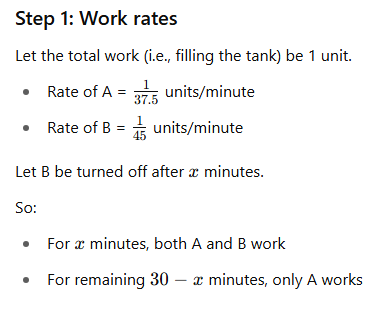
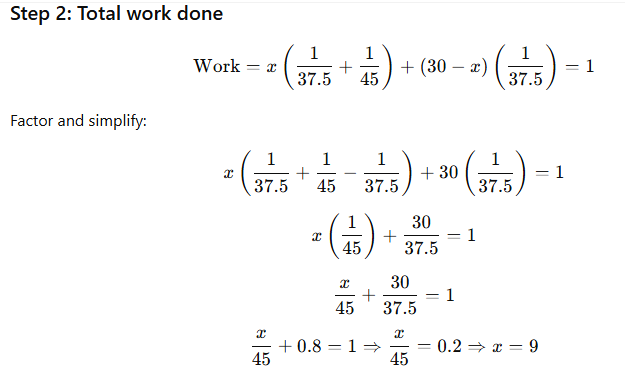
Pipe A can fill a cistern in 37 minutes 30 seconds and Pipe B fills it in 45 minutes individually. If both pipes are opened together and pipe B is turned off after sometime, it takes half an hour for the cistern to be filled. After how much time pipe B is turned off?
- A8 mins
- B9 mins
- C10 mins
- D12 mins
- E6 mins
Show answerHide answer
Answer: B
Approach: Fill fraction by the full-time pipe first.
Solution:
A fills 1/37.5 = 2/75 per min; in 30 min A fills 30 × 2/75 = 4/5.
B fills the remaining 1/5 of the cistern.
B's time = (1/5) × 45 = 9 min.
So B was turned off after 9 minutes.
Why the other options are wrong:
A, C, D, E: give B's share ≠ 1/5.
Cetking shortcut: A alone in 30 min = 30/37.5 = 80% ⇒ B did 20% of 45 min = 9 min.
Answer: B
Two pipes A and B can fill a tank in 15 minutes and 20 minutes respectively. Both the pipes are opened together but after 4 minutes, pipe A is turned off. What is the total time required to fill the tank?
- A10 min 20sec
- B12 min 20sec
- C14 min 40sec
- D14 min 20sec
- E10 min 40sec
Show answerHide answer
Answer: C
Approach: LCM units, two phases.
Solution:
Tank = 60 units; A = 4, B = 3 units/min.
First 4 min together: 4 × 7 = 28 units.
Remaining 32 units by B alone: 32/3 = 10 2/3 min = 10 min 40 s.
Total = 4 min + 10 min 40 s = 14 min 40 s.
Why the other options are wrong:
E (10 min 40 s): time for B alone after A stops.
A, B, D: arithmetic slips in 32/3.
Answer: C
A town is supplied with water from a big overhead tank which is fed with a constant volume of water regularly. When the tank is full, if 32000 gallons are used daily, the supply fails in 50 days. However, if 37000 gallons are used daily, the supply lasts for 40 days only. How much water can be used daily without the supply ever failing?
- A12000 gallons
- B15000 gallons
- C18000 gallons
- D20000 gallons
- E32 gallons
Show answerHide answer
Answer: A
Approach: Let tank capacity = C, daily inflow = S.
Solution: C + 50S = 50 × 32000 = 16,00,000
C + 40S = 40 × 37000 = 14,80,000
Subtract: 10S = 1,20,000 → S = 12,000 gallons/day.
If daily use = inflow = 12,000 gallons, the level never drops → supply never fails.
Cetking shortcut: This is the 'grass-grows / cattle-graze' pattern: inflow = (D1·T1 − D2·T2)/(T1 − T2).
Answer: A
A bath can be filled by the cold water pipe in 10 minutes and by the hot water pipe in 15 minutes. A person leaves the bathroom after turning on both the pipes. He returns just when the bath should have been full. Finding, however, the waste pipe was open, he closes it. In 4 minutes more, the bath is full. In what time will the waste water pipe empty it?
- A6 min
- B8 min
- C9 min
- D12 min
- E10 min
Show answerHide answer
Answer: C
Approach: Water lost through the waste pipe = water added in the extra 4 minutes.
Solution: Inlets together: 1/10 + 1/15 = 1/6 per min → bath should fill in 6 min.
Extra 4 min with both inlets adds 4/6 = 2/3 of the bath.
So the waste pipe drained 2/3 of the bath in 6 min → full bath in 6 × 3/2 = 9 min.
Answer: C
A full tank with a steady inflow of water lasts 50 days if 32000 gallons are used daily, and lasts 40 days if 37000 gallons are used daily. How much water can be used daily so that the supply never fails?
- A20000
- B18000
- C15000
- D12000
- E32000
Show answerHide answer
Answer: D
Approach: Tank with steady inflow — 'capacity + inflow' must equal total usage in both cases.
Solution:
Let capacity = C and inflow = r gallons/day.
Using 32,000/day lasts 50 days: C + 50r = 50 × 32,000 = 16,00,000.
Using 37,000/day lasts 40 days: C + 40r = 40 × 37,000 = 14,80,000.
Subtract: 10r = 1,20,000 → r = 12,000 gallons/day (and C = 10,00,000).
The supply never fails only if daily use ≤ inflow → 12,000 gallons/day.
Cetking shortcut: Like the cow-grazing problem: r = (50×32,000 − 40×37,000)/(50 − 40) = 12,000.
Answer: D
A tank has an inlet pipe and an outlet pipe.
- Inlet fills tank in 8 hrs (if outlet is closed)
- Together: inlet and outlet fill in 10 hrs
- Only outlet open, how long to empty half tank?
- A40
- B35
- C20
- D30
- E25
Show answerHide answer
Answer: C
Approach: Net rate = inlet rate − outlet rate.
Solution:
Inlet = 1/8 tank/h; together = 1/10 tank/h.
Outlet = 1/8 − 1/10 = 1/40 tank/h → empties a full tank in 40 h.
Half tank = 20 h.
Cetking shortcut: LCM 40 units: inlet 5, net 4 → outlet 1 unit/h; half tank = 20 units = 20 h.
Answer: C
A drain pipe can empty a tank in 12 hours, and a fill pipe can fill it in 6 hours. There are n pipes including some fill pipes and some drain pipes, and together they fill the tank in exactly 2 hours. How many of the following values could n have in this case?
24, 16, 33, 13, 9, 8
- A12
- B13
- C5
- D3
- E2
Show answerHide answer
Answer: D
Approach: Net rate equation with f fill pipes and d drain pipes.
Solution:
f/6 − d/12 = 1/2 → 2f − d = 6 → d = 2f − 6.
n = f + d = 3f − 6 → n must be a multiple of 3 (and d ≥ 1 → f ≥ 4 → n ≥ 6).
From 24, 16, 33, 13, 9, 8: 24 (f = 10, d = 14), 33 (f = 13, d = 20), 9 (f = 5, d = 4) work; 16, 13, 8 do not.
Count = 3.
Cetking shortcut: n = 3f − 6 → just pick the multiples of 3 (≥ 6) from the list.
Answer: D
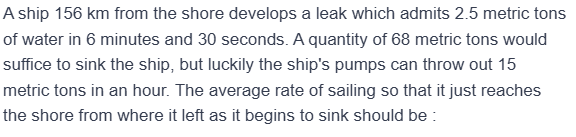
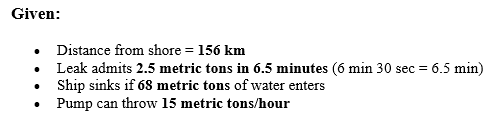
A ship 156 km from the shore develops a leak which admits 2.5 metric tons of water in 6 minutes and 30 seconds. A quantity of 68 metric tons would suffice to sink the ship, but luckily the ship's pumps can throw out 15 metric tons in an hour. The average rate of sailing so that it just reaches the shore from where it left as it begins to sink should be :
- A25kmph
- B10kmph
- C18kmph
- D15kmph
- E60kmph
Show answerHide answer
Answer: C
Approach: Net water rate → time to sink → required speed.
Solution:
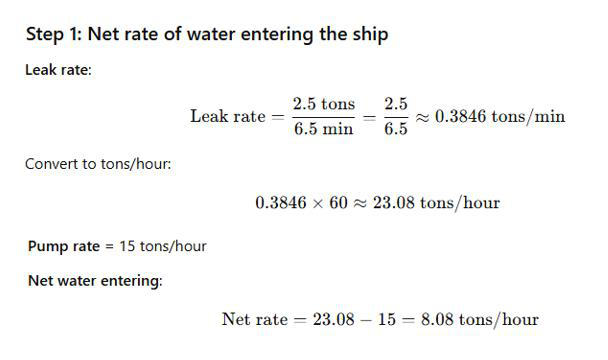
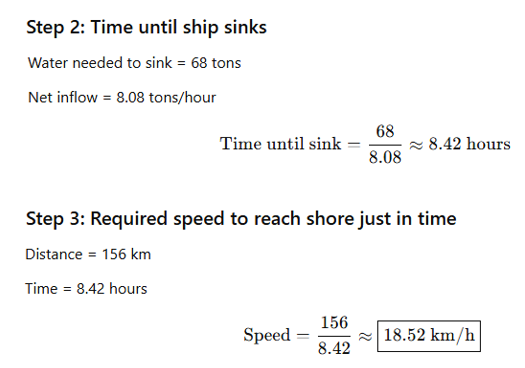
Leak: 2.5 t in 6.5 min → 2.5 × 60/6.5 = 300/13 ≈ 23.08 t/h
Pump: 15 t/h → net inflow = 300/13 − 15 = 105/13 ≈ 8.08 t/h
Time to take in 68 t = 68 × 13/105 ≈ 8.42 h
Speed = 156/8.42 ≈ 18.5 km/h → 18 km/h
Why the other options are wrong:
A (25), E (60): far above the required rate.
B (10), D (15): the ship would sink before reaching the shore.
Cetking shortcut: 156 km ÷ about 8.4 h is about 18.5 km/h; 18 is the only option in that range.
Answer: C
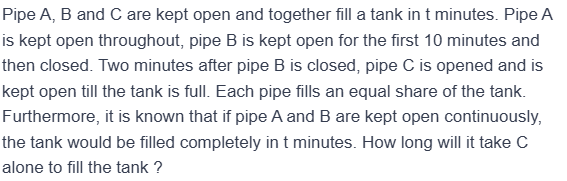
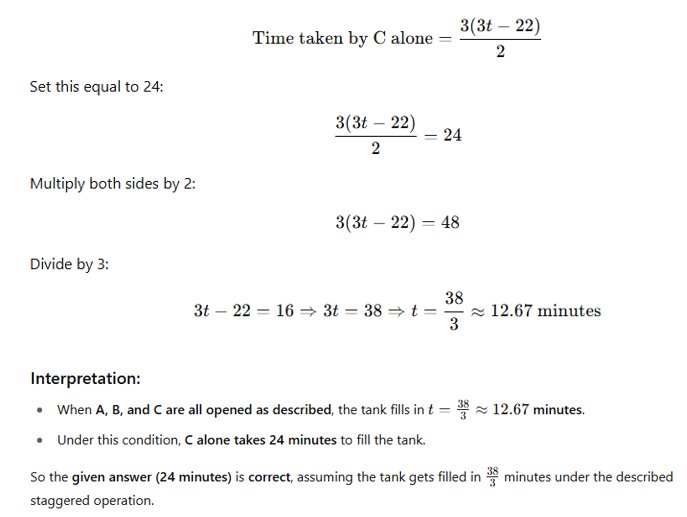
Pipe A, B and C are kept open and together fill a tank in t minutes. Pipe A is kept open throughout, pipe B is kept open for the first 10 minutes and then closed. Two minutes after pipe B is closed, pipe C is opened and is kept open till the tank is full. Each pipe fills an equal share of the tank. Furthermore, it is known that if pipe A and B are kept open continuously, the tank would be filled completely in t minutes. How long will it take C alone to fill the tank ?
- A20min
- B24min
- C32min
- D48min
- E18min
Show answerHide answer
Answer: B
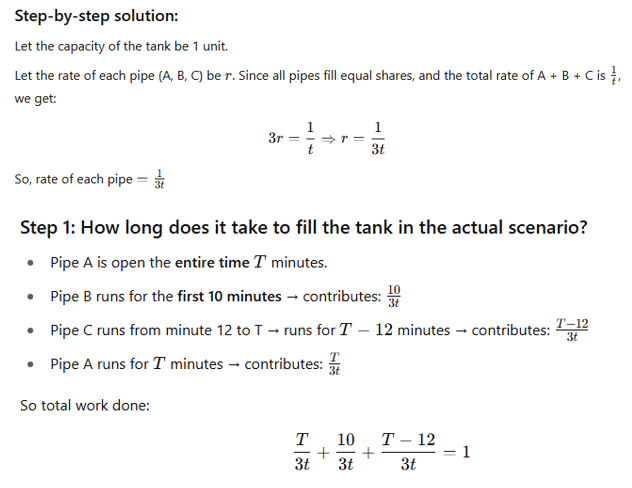
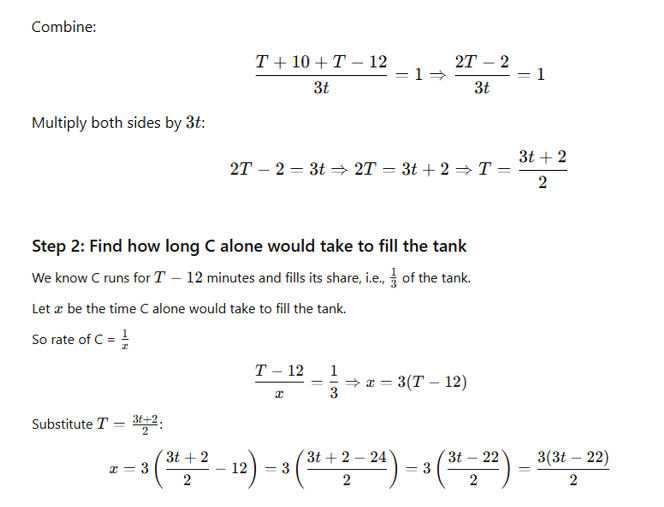
Approach: Each pipe fills 1/3; use 'A + B together fill in t' to find t.
Solution:
A is open all t minutes and fills 1/3 → rate of A = 1/(3t)
B is open 10 minutes and fills 1/3 → rate of B = 1/30
A + B fill the tank in t: 1/(3t) + 1/30 = 1/t
1/30 = 2/(3t) → t = 20 minutes
C is open from minute 12 to 20 = 8 minutes and fills 1/3
C alone = 8 × 3 = 24 minutes
Cetking shortcut: Once t = 20, C's window is 20 − 12 = 8 min for one-third → 24 min alone.
Answer: B