Passage / data for this question
What was the change in the subject of politics on account of the voice?
- Amaking the government personnel more and more native
- Bconcern for the needs of the common people
- Cproposals for better distribution of political power
- Dprotests against the sins of omission of the administration.
- Eprotests against the sins of commission of the administration.
Show answerHide answer
Answer: B ✓ official key
Approach: Separate 'before' from 'after' in para 2.
Solution: 'Till then politics had busied itself with ... making its personnel more and more native, with proposals for a better distribution of political power, with protests against the sins of omission and commission' — this is the OLD subject.
'This voice switched politics on to concern for the needs of the common people' — this is the CHANGE.
Why the other options are wrong:
A — old focus (personnel more native).
C — old focus (distribution of political power).
D — old focus (sins of omission).
E — old focus (sins of commission).
Cetking shortcut: Four options lifted from one 'Till then' sentence = all old; the odd one out is the change.
Answer: B
Passage / data for this question
Which of the following was not the objective to be kept in view according to the voice?
- AThe improvement especially of the lives of the people of the neglected villages
- BThe raising of the standard of living of the people of the villages
- CTaxes for common people
- DThe sanitation of the villages
- EThe finding of subsidiary occupations which would give the agricultural poor work for their enforced leisure during the off season
Show answerHide answer
Answer: C ✓ official key
Approach: Match each option to the list of objectives in paras 2–3.
Solution: Para 3 lists: raising the standard of living of village people, finding subsidiary occupations for the agricultural poor, addition to income, housing of the poor, sanitation of villages — 'these were to be the objectives to be kept in view'.
Para 2 also names improvement of the lives of people of neglected villages as the goal.
'Taxes for common people' is not an objective anywhere.
Why the other options are wrong:
A — stated in para 2.
B — stated in para 3.
D — stated in para 3.
E — stated in para 3 almost verbatim.
Cetking shortcut: Options copied verbatim from the passage are 'mentioned'; the short, vague one is the outsider.
Answer: C
Passage / data for this question
Why did the people listen to the voice of Mahatma Gandhi?
- APeople listened to the voice because it was aimed at the government machinery
- BPeople listened to the voice because it gave a strong message to the aristocracy
- CPeople listened to the voice because it gave a trivial message.
- DPeople listened to the voice not only on account of its form, but also for the matter that it delivered
- EPeople listened to the voice because it propagated for better distribution of political power
Show answerHide answer
Answer: D ✓ official key
Approach: Direct detail — scan for 'listened to'.
Solution: Para 1: 'it had to be listened to not only on account of its form but also for the matter which it delivered'.
Option D restates this exactly.
Why the other options are wrong:
A — the Voice turned politics away from government machinery.
B — the aristocracy is the group politics moved away from.
C — 'trivial' contradicts 'a message the country needed greatly'.
E — this was the old focus of politics.
Answer: D
Passage / data for this question
What is the advantage of paper money over Rupee coins according to the passage?
- APaper money is guaranteed by the government.
- BPaper money is easier to carry and count.
- CPaper is the more durable form of currency.
- DPaper money is the acceptable form of payment in every transaction.
- EIt is not easy to print a great deal of paper money.
Show answerHide answer
Answer: B ✓ official key
Approach: Direct detail — the advantage is stated in para 1.
Solution: Para 1: coins 'are heavy to carry and also ... it takes much time to count them'; paper notes 'save the trouble of carrying metal coins ... paper is lighter than metal'.
So paper money is easier to carry and count.
Why the other options are wrong:
A — the guarantee explains why paper has value, not why it beats coins.
C — durability is never claimed.
D — 'every transaction' is an overstatement not in the passage.
E — the passage says the opposite: it is very easy to print paper money.
Answer: B
Passage / data for this question
What is the need to still have silver, nickel and copper coins in spite of the advantages of paper money according to the passage?
- APrinting paper money is easier than minting coins.
- BSilver, nickel and copper coins are the best form of payment for large transactions.
- CIt is impossible to print just the right amount of paper money that would keep prices at their proper natural level.
- DPaper money depreciates in value faster as compared to silver, nickel and copper coins.
- EPaper money can be easily counterfeited.
Show answerHide answer
Answer: C ✓ official key
Approach: Direct detail — answer to 'why not have paper money only?' in para 3.
Solution: Reasons given: money must be something everyone wants; metals are the best form of money; 'thirdly because it would be impossible to print just the right amount of paper money that would keep prices at their proper natural level'.
Option C reproduces the third reason.
Why the other options are wrong:
A — the passage says printing is easy, but that is not given as the reason for keeping coins in this form.
B — distorts 'best form of money' into 'best for large transactions'; para 1 says coins are cumbersome for big payments.
D — depreciation speed is never compared.
E — counterfeiting is never mentioned.
Answer: C
Passage / data for this question
Which statement is false according to the passage?
- AMoney is only useful for what it will buy
- BThe more money there is, the lower will be the prices of everything.
- CIt is very easy to print a great deal of paper money
- DIt is not at all easy to increase the number of Rupee-coins.
- EIt is no good at all having more money if there are no more things to buy with it
Show answerHide answer
Answer: B ✓ official key
Approach: False-statement question — look for a reversed fact.
Solution: Para 4: 'the more money there is, the higher will be the prices of everything'.
Option B says 'lower' — false.
Why the other options are wrong:
A — stated: 'money is only useful for what it will buy'.
C — stated: 'it is very easy to print a great deal of paper money'.
D — stated: 'not at all easy to increase the number of Rupee-coins'.
E — stated: 'no good at all having more money if there are no more things to buy'.
Cetking shortcut: Same trap as the sarcasm set: a near-verbatim line with one word flipped.
Answer: B
Passage / data for this question
Read the passage carefully and answer the question that follows. Choose the correct alternative from the given options based only on the information in the passage.
Women empowerment refers to the process of enabling women to have equal access to education, employment, decision-making, and social freedoms, thereby enhancing their capacity to contribute meaningfully to society. Historically, gender inequality has been a persistent issue across cultures, often manifesting in restricted access to resources, limited participation in governance, and social discrimination. In recent decades, however, increasing awareness, legal reforms, and advocacy have paved the way for greater opportunities and recognition of women’s rights.
Education is widely recognized as a cornerstone of women empowerment. When women are educated, they not only gain knowledge and skills but also develop confidence and the ability to make informed decisions. Studies show that higher levels of female literacy correlate with improved health outcomes, reduced child mortality, and economic growth. Education empowers women to challenge societal norms, pursue careers, and participate actively in civic life.
Economic independence further strengthens women’s empowerment. Employment opportunities, access to financial resources, and entrepreneurship enable women to contribute to family income and community development. Economic empowerment reduces vulnerability to exploitation and social marginalization, giving women greater control over their personal and professional lives.
Social and political participation is another critical aspect. Representation in decision-making bodies ensures that policies reflect women’s perspectives and address issues like gender-based violence, maternal health, and workplace equality. Grassroots movements, non-governmental organizations, and international frameworks such as the Sustainable Development Goals have been instrumental in promoting gender equity worldwide.
Despite these advancements, challenges persist. Cultural biases, discriminatory laws, and societal expectations continue to impede full empowerment. Women in rural areas or marginalized communities often face compounded barriers, including limited access to education and economic opportunities. Moreover, empowerment is not merely about external opportunities; it also involves challenging internalized stereotypes and fostering self-efficacy.
Promoting women empowerment requires a multi-pronged approach: legislative measures, educational initiatives, financial inclusion, mentorship programs, and societal awareness campaigns. Empowerment is not just a moral imperative but also a strategic necessity, as gender equity enhances societal resilience, economic growth, and social justice. A society that empowers women invests in its own sustainable development and ensures that every individual can realize their potential without prejudice.
Which of the following is identified as a continuing barrier to women empowerment?
- AInternational frameworks
- BCultural biases and discriminatory laws
- CAccess to education
- DMentorship programs
- EGrassroots movements
Show answerHide answer
Answer: B ✓ official key
Approach: Specific detail — locate the paragraph that talks about what still blocks empowerment.
Solution: Para 5 opens with "Despite these advancements, challenges persist" and names them: cultural biases, discriminatory laws and societal expectations that "continue to impede full empowerment". So the continuing barrier is option B.
Why the other options are wrong:
A: International frameworks (SDGs) are described as having promoted gender equity.
C: Access to education is an enabler; only limited access is a barrier, not access itself.
D: Mentorship programs are listed among the solutions in the last paragraph.
E: Grassroots movements are credited with promoting equity.
Cetking shortcut: "Barrier" questions point to the "Despite… challenges persist" paragraph; any option that appears in the solutions list is out.
Answer: B
Passage / data for this question
Read the passage carefully and answer the question that follows. Choose the correct alternative from the given options based only on the information in the passage.
Women empowerment refers to the process of enabling women to have equal access to education, employment, decision-making, and social freedoms, thereby enhancing their capacity to contribute meaningfully to society. Historically, gender inequality has been a persistent issue across cultures, often manifesting in restricted access to resources, limited participation in governance, and social discrimination. In recent decades, however, increasing awareness, legal reforms, and advocacy have paved the way for greater opportunities and recognition of women’s rights.
Education is widely recognized as a cornerstone of women empowerment. When women are educated, they not only gain knowledge and skills but also develop confidence and the ability to make informed decisions. Studies show that higher levels of female literacy correlate with improved health outcomes, reduced child mortality, and economic growth. Education empowers women to challenge societal norms, pursue careers, and participate actively in civic life.
Economic independence further strengthens women’s empowerment. Employment opportunities, access to financial resources, and entrepreneurship enable women to contribute to family income and community development. Economic empowerment reduces vulnerability to exploitation and social marginalization, giving women greater control over their personal and professional lives.
Social and political participation is another critical aspect. Representation in decision-making bodies ensures that policies reflect women’s perspectives and address issues like gender-based violence, maternal health, and workplace equality. Grassroots movements, non-governmental organizations, and international frameworks such as the Sustainable Development Goals have been instrumental in promoting gender equity worldwide.
Despite these advancements, challenges persist. Cultural biases, discriminatory laws, and societal expectations continue to impede full empowerment. Women in rural areas or marginalized communities often face compounded barriers, including limited access to education and economic opportunities. Moreover, empowerment is not merely about external opportunities; it also involves challenging internalized stereotypes and fostering self-efficacy.
Promoting women empowerment requires a multi-pronged approach: legislative measures, educational initiatives, financial inclusion, mentorship programs, and societal awareness campaigns. Empowerment is not just a moral imperative but also a strategic necessity, as gender equity enhances societal resilience, economic growth, and social justice. A society that empowers women invests in its own sustainable development and ensures that every individual can realize their potential without prejudice.
Which of the following best describes the role of education in women empowerment as presented in the passage?
- AIt functions primarily as a means of political mobilization
- BIt serves as a foundational catalyst enabling multiple forms of empowerment
- CIt is effective only when supported by economic reforms
- DIt benefits society indirectly by reducing population growth
- EIt is limited to improving literacy statistics
Show answerHide answer
Answer: B ✓ official key
Approach: Specific detail with paraphrase — how para 2 describes education.
Solution: Para 2: "Education is widely recognized as a cornerstone of women empowerment." It gives knowledge, skills, confidence and decision-making ability, and lets women "challenge societal norms, pursue careers, and participate actively in civic life" — i.e. it unlocks social, economic and civic empowerment. A cornerstone that enables many forms = a foundational catalyst — option B.
Why the other options are wrong:
A: Political mobilization is only one outcome; "primarily" is unsupported.
C: The passage never makes education conditional on economic reforms.
D: Population growth is not mentioned.
E: "Limited to literacy statistics" contradicts the wide benefits listed.
Cetking shortcut: "Cornerstone" = "foundation" — match the passage's key word to its synonym in the options.
Answer: B
Passage / data for this question
Read the passage carefully and answer the question that follows. Choose the correct alternative from the given options based only on the information in the passage.
In the digital age, cyber crime has emerged as one of the most complex and rapidly evolving threats to individuals, organizations, and governments. Cyber crime refers to illegal activities conducted using computers, digital networks, or the internet, ranging from identity theft and online fraud to hacking, ransomware attacks, and cyber terrorism. As societies increasingly rely on digital infrastructure for communication, finance, healthcare, and governance, the potential impact of cyber crime has expanded exponentially.
One of the most alarming features of cyber crime is its anonymity. Unlike traditional crimes, cyber offences often transcend geographical boundaries, making it difficult for law enforcement agencies to identify perpetrators and enforce jurisdiction. A cyber criminal operating from one country can target victims across multiple continents within seconds. This borderless nature not only complicates investigations but also necessitates international cooperation, which is often hindered by differing legal frameworks and enforcement priorities.
Another critical dimension of cyber crime is its psychological manipulation. Many cyber attacks rely less on technical sophistication and more on exploiting human vulnerabilities. Phishing emails, fraudulent messages, and social engineering tactics deceive users into revealing sensitive information such as passwords, banking details, or one-time verification codes. Despite advances in cybersecurity technology, human error remains one of the weakest links in digital security systems.
The economic consequences of cyber crime are equally severe. Businesses suffer financial losses due to data breaches, operational disruptions, and reputational damage. Small and medium enterprises, often lacking robust cybersecurity infrastructure, are particularly vulnerable. On a broader scale, cyber crime can destabilize national economies by targeting financial institutions, stock markets, and critical infrastructure such as power grids and transportation systems.
Governments and organizations have responded by strengthening cybersecurity laws, investing in advanced detection technologies, and promoting digital literacy among citizens. However, cyber criminals continuously adapt, employing artificial intelligence, encrypted communication, and decentralized networks to evade detection. This ongoing arms race underscores the need for a holistic approach that combines technological innovation, legal reform, international collaboration, and public awareness.
Ultimately, combating cyber crime is not solely the responsibility of authorities or technology experts. Individuals must remain vigilant, adopt safe online practices, and understand that convenience in the digital world often comes with hidden risks. Only through collective effort can the pervasive threat of cyber crime be effectively mitigated.
According to the passage, which factor most significantly contributes to the persistence of cyber crime?
- AInsufficient internet penetration
- BExcessive dependence on artificial intelligence
- COverregulation by governments
- DAnonymity and borderless nature of digital networks
- ELack of interest from law enforcement agencies
Show answerHide answer
Answer: D ✓ official key
Approach: Specific detail — what the passage calls the most alarming, hard-to-tackle feature.
Solution: Para 2: "One of the most alarming features of cyber crime is its anonymity… cyber offences often transcend geographical boundaries, making it difficult for law enforcement agencies to identify perpetrators and enforce jurisdiction." This borderless nature also complicates investigations and international cooperation. Among the options, only D (anonymity and borderless nature) is a factor the passage gives for crime persisting.
Why the other options are wrong:
A: Insufficient internet penetration — the passage says the opposite: society increasingly relies on digital networks.
B: AI is used by criminals to evade detection; "excessive dependence on AI" is not the cause given.
C: Governments are said to strengthen laws; overregulation is never mentioned.
E: Law enforcement is hindered by jurisdiction, not by lack of interest.
Cetking shortcut: Human error is also discussed, but it is not among the options — pick the only option that matches a passage cause word for word.
Answer: D
Passage / data for this question
Read the passage carefully and answer the question that follows. Choose the correct alternative from the given options based only on the information in the passage.
In the digital age, cyber crime has emerged as one of the most complex and rapidly evolving threats to individuals, organizations, and governments. Cyber crime refers to illegal activities conducted using computers, digital networks, or the internet, ranging from identity theft and online fraud to hacking, ransomware attacks, and cyber terrorism. As societies increasingly rely on digital infrastructure for communication, finance, healthcare, and governance, the potential impact of cyber crime has expanded exponentially.
One of the most alarming features of cyber crime is its anonymity. Unlike traditional crimes, cyber offences often transcend geographical boundaries, making it difficult for law enforcement agencies to identify perpetrators and enforce jurisdiction. A cyber criminal operating from one country can target victims across multiple continents within seconds. This borderless nature not only complicates investigations but also necessitates international cooperation, which is often hindered by differing legal frameworks and enforcement priorities.
Another critical dimension of cyber crime is its psychological manipulation. Many cyber attacks rely less on technical sophistication and more on exploiting human vulnerabilities. Phishing emails, fraudulent messages, and social engineering tactics deceive users into revealing sensitive information such as passwords, banking details, or one-time verification codes. Despite advances in cybersecurity technology, human error remains one of the weakest links in digital security systems.
The economic consequences of cyber crime are equally severe. Businesses suffer financial losses due to data breaches, operational disruptions, and reputational damage. Small and medium enterprises, often lacking robust cybersecurity infrastructure, are particularly vulnerable. On a broader scale, cyber crime can destabilize national economies by targeting financial institutions, stock markets, and critical infrastructure such as power grids and transportation systems.
Governments and organizations have responded by strengthening cybersecurity laws, investing in advanced detection technologies, and promoting digital literacy among citizens. However, cyber criminals continuously adapt, employing artificial intelligence, encrypted communication, and decentralized networks to evade detection. This ongoing arms race underscores the need for a holistic approach that combines technological innovation, legal reform, international collaboration, and public awareness.
Ultimately, combating cyber crime is not solely the responsibility of authorities or technology experts. Individuals must remain vigilant, adopt safe online practices, and understand that convenience in the digital world often comes with hidden risks. Only through collective effort can the pervasive threat of cyber crime be effectively mitigated.
According to the passage, which of the following groups is described as being particularly vulnerable to cyber crime?
- ASmall and medium enterprises
- BGovernment intelligence agencies
- CLarge multinational corporations
- DEducational institutions
- ETechnology startups
Show answerHide answer
Answer: A ✓ official key
Approach: Specific detail — scan for the phrase "particularly vulnerable".
Solution: Para 4: "Small and medium enterprises, often lacking robust cybersecurity infrastructure, are particularly vulnerable." Option A.
Why the other options are wrong:
B: Government intelligence agencies are not mentioned.
C: Large multinationals are not singled out.
D: Educational institutions are not mentioned.
E: Startups are not mentioned.
Cetking shortcut: The question quotes the exact phrase — scan for it and read that sentence only.
Answer: A
Read the passage carefully and answer the questions that follow. Choose the correct alternative from the given options based only on the information in the passage.
Tariffs have long been a significant instrument in the economic policy of the United States, used to regulate international trade, protect domestic industries, and exert geopolitical influence. A tariff is essentially a tax imposed on imported goods, making foreign products more expensive in the domestic market. The stated objective behind imposing tariffs is often to safeguard local manufacturers from cheaper imports and to encourage domestic production. However, the broader economic implications of tariffs are complex and frequently debated.
In recent decades, the USA has employed tariffs not merely as a revenue-generating mechanism but as a strategic tool to address trade imbalances. When the value of imports significantly exceeds exports, policymakers argue that tariffs can reduce dependency on foreign goods and revive domestic industries. For instance, tariffs on steel and aluminum were justified on grounds of national security, with the argument that a strong domestic metals industry is essential for defense preparedness. Such measures, however, often invite retaliation from trading partners, resulting in trade wars that can disrupt global supply chains.
Critics of tariffs contend that while they may offer short-term protection to specific sectors, they impose long-term costs on the economy. Higher import prices are often passed on to consumers, leading to inflationary pressures. Moreover, domestic firms that rely on imported raw materials may face increased production costs, reducing their competitiveness in both domestic and international markets. Economists frequently emphasize that tariffs distort market efficiency by interfering with the principle of comparative advantage, under which countries specialize in producing goods they can make most efficiently.
The impact of US tariffs extends beyond national borders. Developing countries that depend heavily on exports to the American market can experience reduced demand, affecting employment and economic growth. At the same time, multinational corporations may reconfigure their supply chains to circumvent tariffs, shifting production to alternative countries rather than bringing it back to the USA. This outcome often contradicts the original intent of tariff policies.
Thus, while tariffs remain a powerful policy instrument for the United States, their effectiveness depends on careful calibration. When used indiscriminately, tariffs risk triggering economic inefficiencies, diplomatic tensions, and unintended consequences that may outweigh their perceived benefits.
The author suggests that tariffs may fail to revive domestic manufacturing mainly because:
- ADomestic labor is unavailable
- BMultinational firms shift supply chains instead
- CConsumers stop purchasing goods altogether
- DExports increase excessively
- ETariffs are too low to be effective
Show answerHide answer
Answer: B ✓ official key
Approach: Specific detail / cause — para 4 on the unintended outcome of tariffs.
Solution: Para 4: "multinational corporations may reconfigure their supply chains to circumvent tariffs, shifting production to alternative countries rather than bringing it back to the USA. This outcome often contradicts the original intent of tariff policies." So tariffs fail to revive domestic manufacturing because firms relocate supply chains — option B.
Why the other options are wrong:
A: Domestic labour availability is never discussed.
C: Consumers pay higher prices; they do not stop buying altogether.
D: Exports are not said to rise excessively.
E: The size of tariffs is never called too low.
Cetking shortcut: "Contradicts the original intent" is the passage's own signal for why the policy fails.
Answer: B
Passage / data for this question
Read the passage carefully and answer the questions that follow. Choose the correct alternative from the given options based only on the information in the passage.
The global automobile industry is undergoing a fundamental transformation as electric vehicles (EVs) steadily move from the periphery to the mainstream. Driven by concerns over climate change, volatile fossil fuel prices, and tightening emission regulations, governments and manufacturers alike are increasingly investing in electric mobility. What was once considered a niche technology limited by high costs and inadequate infrastructure is now being positioned as the cornerstone of future transportation systems.
One of the most significant drivers of EV adoption is technological advancement in battery systems. Improvements in lithium-ion batteries have enhanced energy density, reduced charging time, and lowered production costs. Simultaneously, research into solid-state batteries promises even greater efficiency and safety. These innovations are gradually addressing the persistent concerns of range anxiety and long charging durations that once deterred potential buyers. However, battery production still relies heavily on rare minerals such as lithium and cobalt, raising questions about long-term sustainability and geopolitical dependence.
Infrastructure development plays an equally critical role in shaping the future of electric vehicles. Urban areas in many countries are witnessing a rapid expansion of public charging stations, while private players are experimenting with fast-charging networks and battery-swapping models. Nevertheless, the uneven distribution of charging infrastructure—particularly in rural and developing regions—continues to impede widespread adoption. Without a reliable and accessible charging ecosystem, consumer confidence in EVs may remain fragile.
Economic considerations further complicate the EV narrative. Although the total cost of ownership of electric vehicles is often lower due to reduced fuel and maintenance expenses, the initial purchase price remains relatively high. Government subsidies and tax incentives have temporarily bridged this gap, but their gradual withdrawal in some markets raises concerns about long-term affordability. Moreover, the transition to electric mobility threatens traditional automotive employment structures, necessitating large-scale reskilling of the workforce.
Despite these challenges, the future of electric vehicles appears increasingly inevitable. Major automakers have announced timelines to phase out internal combustion engines, while advancements in renewable energy integration strengthen the environmental case for EVs. The success of electric mobility, however, will ultimately depend on a coordinated approach involving technological innovation, infrastructure expansion, supportive policies, and consumer acceptance. Rather than a sudden revolution, the rise of electric vehicles is likely to be a gradual yet irreversible evolution.
Which of the following is identified as a major factor encouraging the adoption of electric vehicles?
- ADecline in public transport systems
- BRising fuel prices and emission regulations
- CComplete elimination of fossil fuels
- DUniform global charging infrastructure
- EReduction in automobile manufacturing
Show answerHide answer
Answer: B ✓ official key
Approach: Specific detail — para 1 lists the drivers of EV adoption.
Solution: Para 1: EV adoption is "Driven by concerns over climate change, volatile fossil fuel prices, and tightening emission regulations". Option B matches.
Why the other options are wrong:
A: Public transport is not mentioned.
C: Fossil fuels are not said to be eliminated.
D: Charging infrastructure is described as uneven, not uniform.
E: Manufacturing is not said to fall.
Cetking shortcut: "Driven by" in the first paragraph is the answer line.
Answer: B
Passage / data for this question
Read the passage carefully and answer the questions that follow. Choose the correct alternative from the given options based only on the information in the passage.
The global automobile industry is undergoing a fundamental transformation as electric vehicles (EVs) steadily move from the periphery to the mainstream. Driven by concerns over climate change, volatile fossil fuel prices, and tightening emission regulations, governments and manufacturers alike are increasingly investing in electric mobility. What was once considered a niche technology limited by high costs and inadequate infrastructure is now being positioned as the cornerstone of future transportation systems.
One of the most significant drivers of EV adoption is technological advancement in battery systems. Improvements in lithium-ion batteries have enhanced energy density, reduced charging time, and lowered production costs. Simultaneously, research into solid-state batteries promises even greater efficiency and safety. These innovations are gradually addressing the persistent concerns of range anxiety and long charging durations that once deterred potential buyers. However, battery production still relies heavily on rare minerals such as lithium and cobalt, raising questions about long-term sustainability and geopolitical dependence.
Infrastructure development plays an equally critical role in shaping the future of electric vehicles. Urban areas in many countries are witnessing a rapid expansion of public charging stations, while private players are experimenting with fast-charging networks and battery-swapping models. Nevertheless, the uneven distribution of charging infrastructure—particularly in rural and developing regions—continues to impede widespread adoption. Without a reliable and accessible charging ecosystem, consumer confidence in EVs may remain fragile.
Economic considerations further complicate the EV narrative. Although the total cost of ownership of electric vehicles is often lower due to reduced fuel and maintenance expenses, the initial purchase price remains relatively high. Government subsidies and tax incentives have temporarily bridged this gap, but their gradual withdrawal in some markets raises concerns about long-term affordability. Moreover, the transition to electric mobility threatens traditional automotive employment structures, necessitating large-scale reskilling of the workforce.
Despite these challenges, the future of electric vehicles appears increasingly inevitable. Major automakers have announced timelines to phase out internal combustion engines, while advancements in renewable energy integration strengthen the environmental case for EVs. The success of electric mobility, however, will ultimately depend on a coordinated approach involving technological innovation, infrastructure expansion, supportive policies, and consumer acceptance. Rather than a sudden revolution, the rise of electric vehicles is likely to be a gradual yet irreversible evolution.
What is the main concern related to battery production mentioned in the passage?
- ALow energy efficiency
- BExcessive charging time
- CHigh maintenance requirements
- DDependence on rare minerals
- ELack of technological innovation
Show answerHide answer
Answer: D ✓ official key
Approach: Specific detail — para 2 on battery production.
Solution: Para 2: "battery production still relies heavily on rare minerals such as lithium and cobalt, raising questions about long-term sustainability and geopolitical dependence." Option D.
Why the other options are wrong:
A: Energy density has improved.
B: Charging time has been reduced.
C: Maintenance is lower for EVs (para 4).
E: Innovation (solid-state batteries) is ongoing.
Cetking shortcut: Look for the "However" sentence in the battery paragraph — it carries the concern.
Answer: D
Passage / data for this question
Read the passage carefully and answer the questions that follow. Choose the correct alternative from the given options based only on the information in the passage.
The global automobile industry is undergoing a fundamental transformation as electric vehicles (EVs) steadily move from the periphery to the mainstream. Driven by concerns over climate change, volatile fossil fuel prices, and tightening emission regulations, governments and manufacturers alike are increasingly investing in electric mobility. What was once considered a niche technology limited by high costs and inadequate infrastructure is now being positioned as the cornerstone of future transportation systems.
One of the most significant drivers of EV adoption is technological advancement in battery systems. Improvements in lithium-ion batteries have enhanced energy density, reduced charging time, and lowered production costs. Simultaneously, research into solid-state batteries promises even greater efficiency and safety. These innovations are gradually addressing the persistent concerns of range anxiety and long charging durations that once deterred potential buyers. However, battery production still relies heavily on rare minerals such as lithium and cobalt, raising questions about long-term sustainability and geopolitical dependence.
Infrastructure development plays an equally critical role in shaping the future of electric vehicles. Urban areas in many countries are witnessing a rapid expansion of public charging stations, while private players are experimenting with fast-charging networks and battery-swapping models. Nevertheless, the uneven distribution of charging infrastructure—particularly in rural and developing regions—continues to impede widespread adoption. Without a reliable and accessible charging ecosystem, consumer confidence in EVs may remain fragile.
Economic considerations further complicate the EV narrative. Although the total cost of ownership of electric vehicles is often lower due to reduced fuel and maintenance expenses, the initial purchase price remains relatively high. Government subsidies and tax incentives have temporarily bridged this gap, but their gradual withdrawal in some markets raises concerns about long-term affordability. Moreover, the transition to electric mobility threatens traditional automotive employment structures, necessitating large-scale reskilling of the workforce.
Despite these challenges, the future of electric vehicles appears increasingly inevitable. Major automakers have announced timelines to phase out internal combustion engines, while advancements in renewable energy integration strengthen the environmental case for EVs. The success of electric mobility, however, will ultimately depend on a coordinated approach involving technological innovation, infrastructure expansion, supportive policies, and consumer acceptance. Rather than a sudden revolution, the rise of electric vehicles is likely to be a gradual yet irreversible evolution.
Which of the following best describes the main reason why charging infrastructure is crucial for the future growth of electric vehicles, as per the passage?
- AIt eliminates the need for government subsidies
- BIt directly reduces the cost of battery production
- CIt helps overcome consumer hesitation related to accessibility and reliability
- DIt replaces the need for technological innovation
- EIt ensures uniform EV adoption across all countries
Show answerHide answer
Answer: C ✓ official key
Approach: Specific detail / reason — para 3 on infrastructure.
Solution: Para 3: uneven charging infrastructure "continues to impede widespread adoption. Without a reliable and accessible charging ecosystem, consumer confidence in EVs may remain fragile." So infrastructure matters because it removes consumer hesitation about access and reliability — option C.
Why the other options are wrong:
A: Subsidies are a separate economic issue.
B: Infrastructure does not cut battery production costs.
D: Technology and infrastructure are both needed; neither replaces the other.
E: "Uniform adoption across all countries" is extreme.
Cetking shortcut: Match "reliable and accessible" in the passage to "accessibility and reliability" in the option.
Answer: C
Passage / data for this question
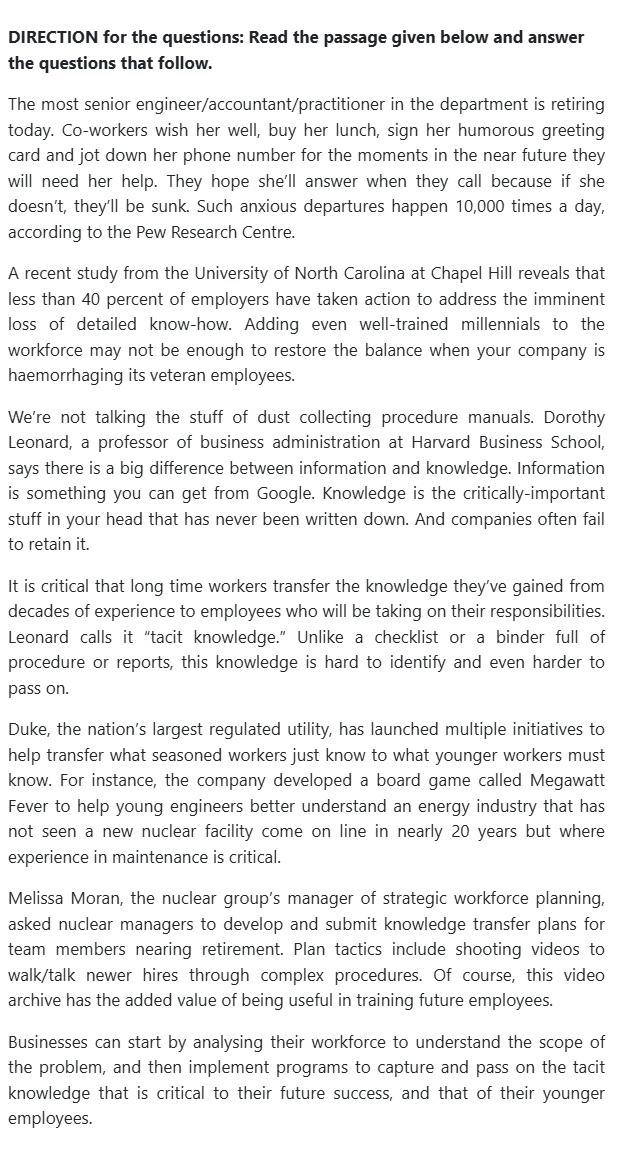
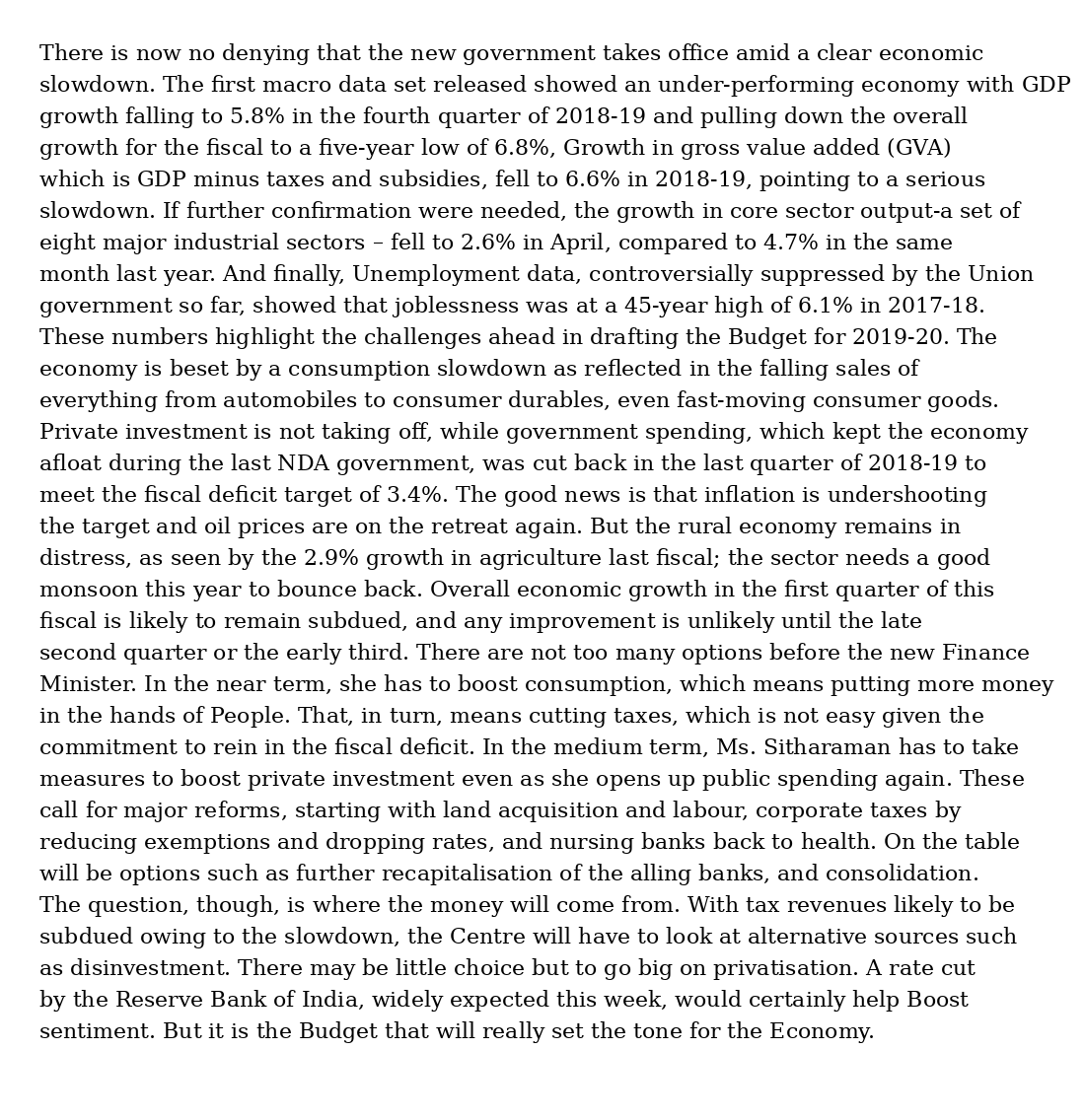
Reading Comprehension passage — shown as image.
Which of the following is / are true as per the passage?
I. There is going to be a definite rate cut by the RBI in the coming week.
II. The rural economy is in better shape than the urban
III. Government spending has increased in in the last quarter of 2018-19.
- AOnly II
- BOnly I AND II
- COnly I AND III
- DOnly II AND III
- ENone of the above
Show answerHide answer
Answer: E
Approach: Multi-statement true/false — check each statement against the passage.
Solution: I: The RBI rate cut is only 'widely expected this week' — not definite. False.
II: The passage says the rural economy 'remains in distress' (2.9% agriculture growth); it never says rural is better than urban. False.
III: Government spending 'was cut back in the last quarter of 2018-19' to meet the 3.4% fiscal deficit target — not increased. False.
None of the statements is true.
Why the other options are wrong:
A, B, D: each includes II, which is false.
C: includes I and III, both false.
Cetking shortcut: One firm reversal (III says 'increased', passage says 'cut back') kills options C and D at once.
Answer: E
Passage / data for this question
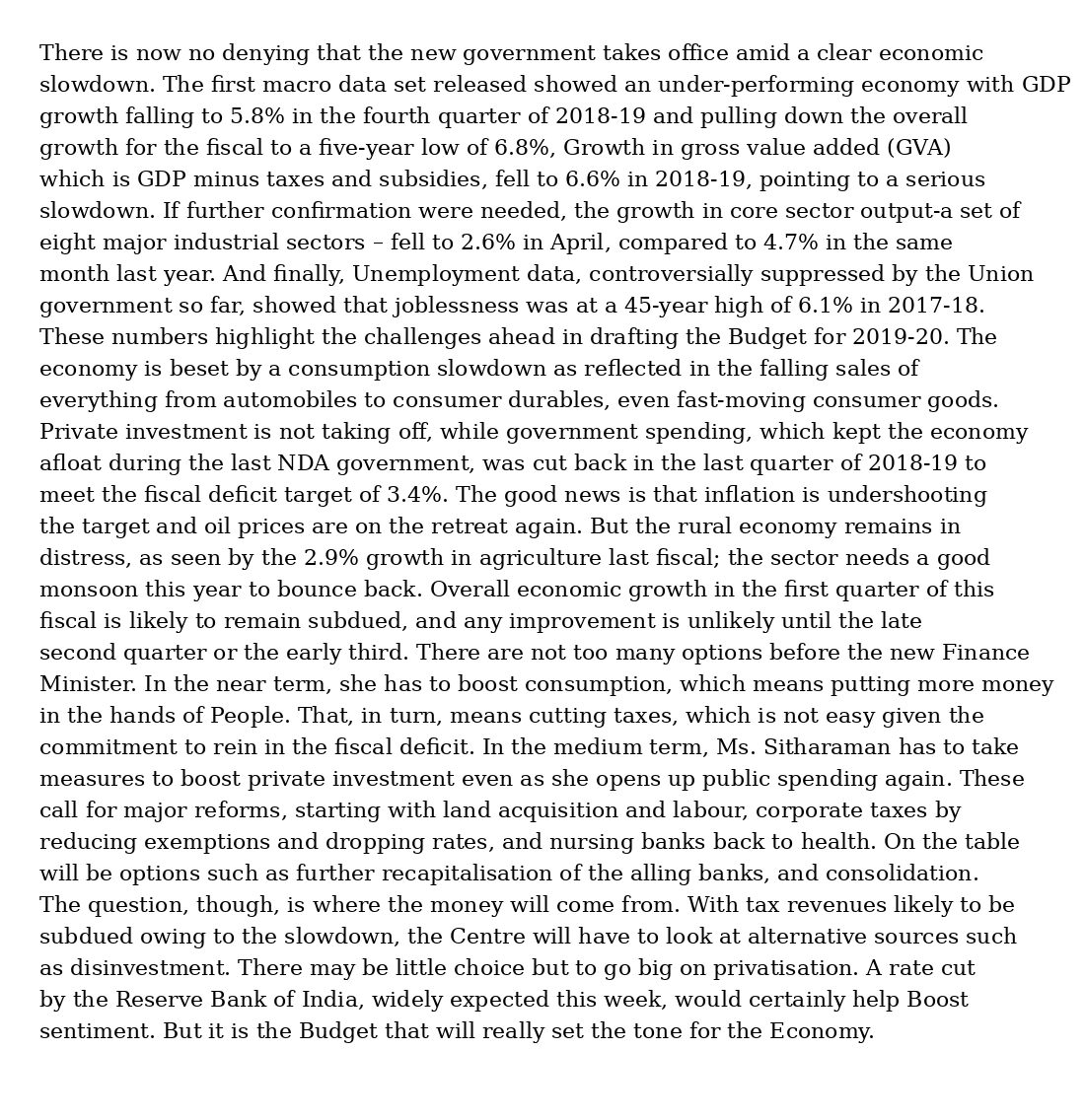
Reading Comprehension passage — shown as image.
Which of the following, as per the passage, indicates a slowdown in the Indian economy.
I Fall in sale levels of consumer ddurable
II Negative growth in the core sector output
III Fall in inflations levels
- AOnly I
- BOnly III
- COnly II
- DOnly I and II
- EAll I, II, AND III
Show answerHide answer
Answer: A
Approach: Multi-statement — which items does the passage give as signs of slowdown?
Solution: I: 'consumption slowdown as reflected in the falling sales of ... consumer durables' — a slowdown indicator. True.
II: Core sector growth 'fell to 2.6%' from 4.7% — slower but still positive, not negative growth. False.
III: Inflation undershooting the target is called 'the good news'. False.
Only I.
Why the other options are wrong:
B: III is presented as good news.
C, D: II says 'negative growth', but growth was +2.6%.
E: includes II and III.
Cetking shortcut: Watch for 'negative growth' vs 'fall in growth' — a classic CET distortion.
Answer: A
Passage / data for this question
Reading Comprehension passage — shown as image.
As per the passage, which of the following would lead to putting more money in hands of people?
I. Decrease in tax rates.
II. Increase in inflation 10
III. Increase in private investment
- AOnly I
- BOnly III
- COnly I and II
- DOnly I And III
- EOnly II
Show answerHide answer
Answer: A
Approach: Locate the 'money in the hands of people' line and see what it links to.
Solution: Passage: 'she has to boost consumption, which means putting more money in the hands of people. That, in turn, means cutting taxes'. So a decrease in tax rates puts money in people's hands — I is true. Inflation is not linked to this at all (II false). Private investment is a separate medium-term goal, not a way to put money in people's hands (III false).
Why the other options are wrong:
B, D: III — private investment is mentioned as a separate goal.
C, E: II — inflation is not linked to people's money.
Answer: A
Passage / data for this question
Reading Comprehension passage — shown as image.
As per the passage, which of the following reforms has NOT been mentioned in the passage to improve the investment climate?
- ALand acquisition
- BPrivatization of banks
- CAdjustment in the prevailing corporate tax
- DRecapitalization of banks
- EAll are correct
Show answerHide answer
Answer: B
Approach: NOT-mentioned question — tick each option against the reforms list.
Solution: Reforms listed: 'land acquisition and labour, corporate taxes by reducing exemptions and dropping rates, and nursing banks back to health ... further recapitalisation of the ailing banks, and consolidation'. Land acquisition (A), corporate tax adjustment (C) and bank recapitalisation (D) are all mentioned. Privatisation is mentioned only as a way to raise money, and never for banks — privatisation of banks is NOT mentioned.
Why the other options are wrong:
A: land acquisition — mentioned.
C: corporate tax (exemptions and rates) — mentioned.
D: recapitalisation of banks — mentioned.
E: not valid, since B is not mentioned.
Cetking shortcut: In EXCEPT/NOT questions, the answer often merges two passage words (privatisation + banks) that never appear together.
Answer: B
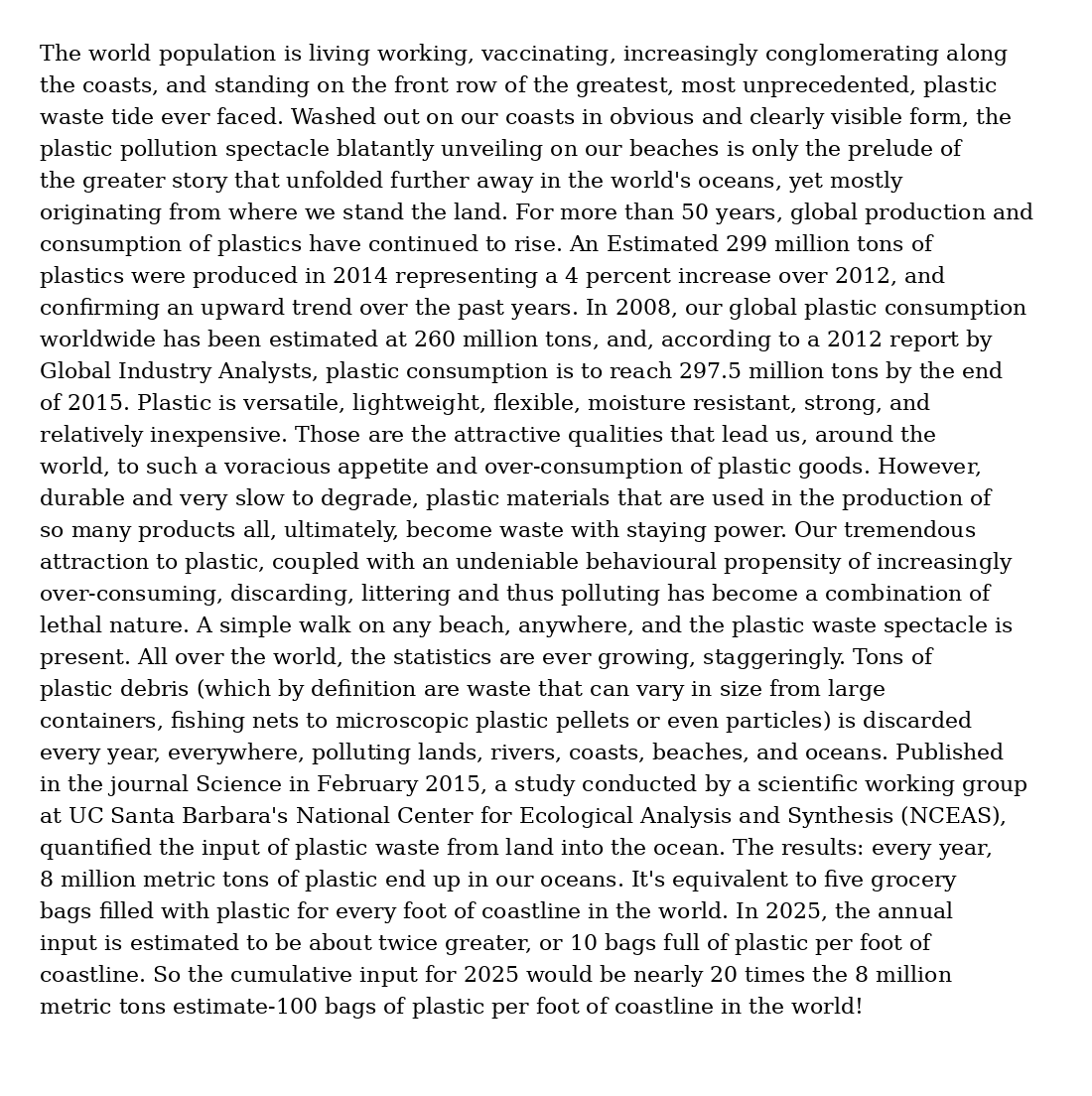
Reading Comprehension passage — shown as image.
As per the passage, which of the following statement is true
1 Most of the plastic present in the ocean today has originated from land.
2 In recent years, production of plastic has declined.
3 Plastic pollution is present on almost every beach
- AOnly 1
- BOnly 2
- CNone of 1,2 and 3
- DAll 1, 2, and 3
- EOnly 1 and 3
Show answerHide answer
Answer: E
Approach: Multi-statement — verify each against the passage.
Solution: 1: The ocean plastic story is 'mostly originating from where we stand, the land'. True.
2: 'global production and consumption of plastics have continued to rise' — production has not declined. False.
3: 'A simple walk on any beach, anywhere, and the plastic waste spectacle is present' — true.
So only 1 and 3.
Why the other options are wrong:
A: misses statement 3.
B: 2 is false.
C: 1 and 3 are true.
D: includes 2.
Cetking shortcut: Statement 2 reverses the 'continued to rise' trend — eliminate every option containing 2 first.
Answer: E
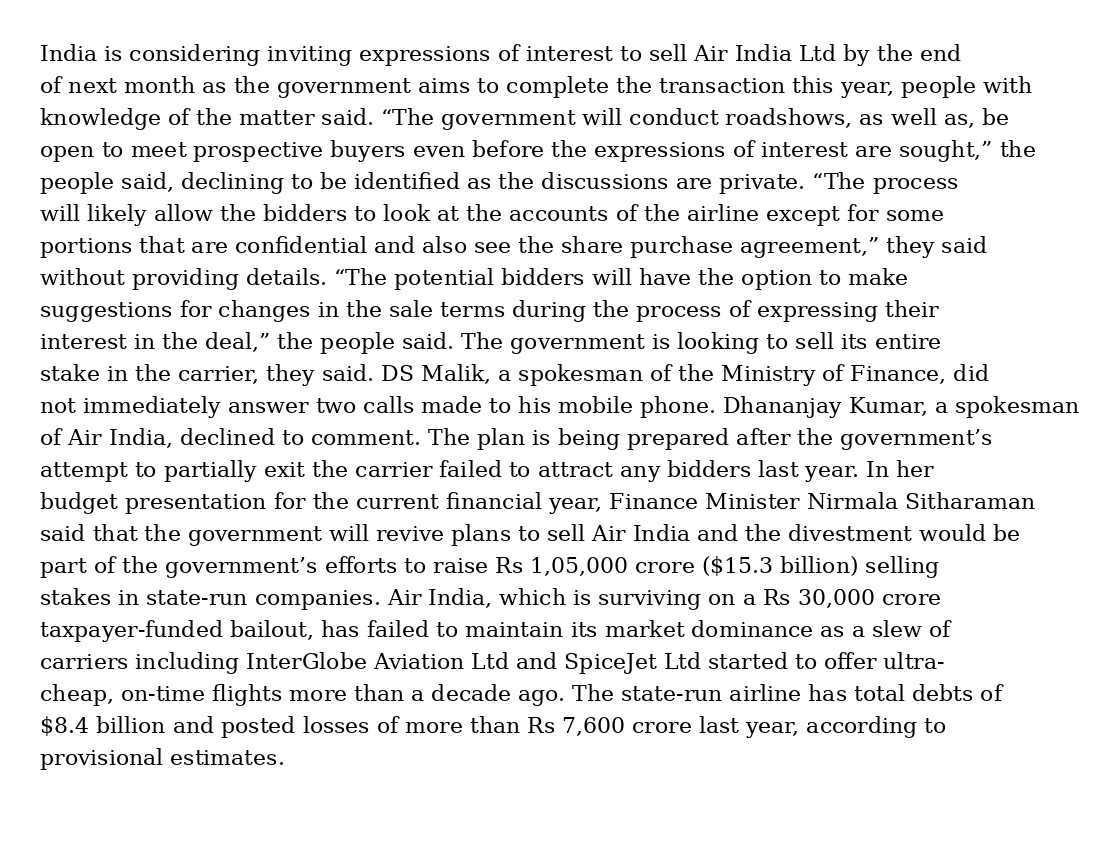
Reading Comprehension passage — shown as image.
Which among the following has been shown as the main reason for present situation of Air India in the passage?
- AAir India does not have enough money to survive in the long run though it is trying to find out.
- BAir india has lost all the deposit it had received from government last year.
- CAir India is in the process of earning deposits from the depositors and investors so that they are worried about the stake sale
- DAir India has got competition from other airlines and it has simply failed to live up the same.
- ENone of the above
Show answerHide answer
Answer: D
Approach: Find the stated cause in the passage.
Solution: Passage: Air India 'has failed to maintain its market dominance as a slew of carriers including InterGlobe Aviation and SpiceJet started to offer ultra-cheap, on-time flights more than a decade ago.' So the main reason is competition from other airlines that it could not match.
Why the other options are wrong:
A: a consequence (it survives on a bailout), not the stated reason.
B: no lost 'deposit' is mentioned.
C: no depositors or investors earning deposits are mentioned.
E: D is stated.
Answer: D
Reading Comprehension passage — shown as image.
Which of the following is false in the context of the passage?
I The Dawson-Lambton Glacier colony died due to collapse of rough sea.
II The penguin birds breed during April every year.
III Halley Bay colony reached 5315 pairs in 2016
- AOnly I
- BOnly II
- COnly I AND III
- DOnly II AND III
- EAll I, II AND III
Show answerHide answer
Answer: C
Approach: Find the FALSE statements — check each against the passage.
Solution: I: The Dawson-Lambton colony did not die; it 'significantly swelled in numbers'. It was the Halley Bay colony that collapsed. False.
II: 'The birds arrive at the site ... each April to breed.' True.
III: 5,315 pairs in 2016 was the Dawson-Lambton colony, not Halley Bay. False.
False statements: I and III.
Why the other options are wrong:
A: misses III.
B: II is true.
D: includes II.
E: includes II.
Cetking shortcut: In 'which is false' questions, swap-of-names (Halley Bay ↔ Dawson-Lambton) is the standard trap — mark which number belongs to which colony.
Answer: C
Passage / data for this question
Reading Comprehension passage — shown as image.
Which of the following is/are true about Tuan?
I He was a doctor along with being a farmer.
II. He was a good-natured and kind person.
III He was a wealthy farmer who gave away his wealth to needy.
- AOnly I
- BOnly II
- COnly I AND III
- DOnly II AND III
- EAll I, II, and III
Show answerHide answer
Answer: B
Approach: Multi-statement — check each claim about Tuan.
Solution: I: Tuan only stood 'beside the village doctor to help him prepare the medicines and tend to the sick' — he was a helper, not a doctor. False.
II: 'he was a very kind and good-natured person'. True.
III: He 'had a little land' and earned from his crops — not wealthy, and no giving away of wealth. False.
Only II.
Why the other options are wrong:
A, C, E: I is false — he assisted the doctor.
D: III is false — he had a little land.
Answer: B
Passage / data for this question
Reading Comprehension passage — shown as image.
Which of the following is/are a/some ways in which Juan transformed himself?
I He began to work hard on his crops.
II He became more helpful towards people
III He started a small charity in in Tuan's name
- AOnly I
- BONLY III
- COnly I AND II
- DOnly II AND III
- EAll I, II and III
Show answerHide answer
Answer: A
Approach: Check what the passage says about Juan's change.
Solution: 'From that day, Juan changed himself. Within a year, he could produce much crops in his land through his hard work.' So I (worked hard on his crops) is stated. Nothing is said about him becoming more helpful (II) or starting a charity (III).
Why the other options are wrong:
B, D, E: III — no charity is mentioned.
C: II is not stated; it is an assumption.
Cetking shortcut: Stick to what is written — 'transformed' is explained only through hard work on his land.
Answer: A
Passage / data for this question
Reading Comprehension passage — shown as image.
What did Tuan do when he discovered Juan's son was ill?
- AHe called the village doctor who lived a few houses away
- BHe went back to his house thinking Juan deserved what he got.
- CHe rode out to the nearest hospital along with Juan’s son to get him treated.
- DHe went back to his house to get some medicine which could help Juan’s son.
- EHe rode to the nearest town to get a better doctor.
Show answerHide answer
Answer: E
Approach: Locate the sequence of events after the boy fell ill.
Solution: The village doctor could not cure the boy. Tuan 'untied his own horse and rode it ... rushed to the town that was ten miles away and fetched a more experienced doctor'. So he rode to the nearest town to get a better doctor.
Why the other options are wrong:
A: the village doctor was already there and could not cure him.
B: the opposite of what Tuan did.
C: the boy was not taken anywhere; the doctor was brought to him.
D: Tuan did not fetch medicine from his house.
Answer: E
Passage / data for this question
Reading Comprehension passage — shown as image.
Which of the following gave Tuan clues that Juan had set fire to his crops ?
- AJuan has dropped a lighter with his initials in the field.
- BTuan had seen Juan carry kerosene earlier that evening.
- CA neighbour saw Juan sneak out at night and set fire to the crop.
- DThe direction from which the fire had started
- EBoth 3 and 4
Show answerHide answer
Answer: D
Approach: Find the clue the passage actually gives.
Solution: 'When the flames were doused, Tuan saw which direction the fire had started from.' Juan lived on the land next to his — the direction of the fire was the clue. No lighter, kerosene or eyewitness neighbour is mentioned (the neighbour only alerted others and saved the crops).
Why the other options are wrong:
A: no lighter is mentioned.
B: no kerosene is mentioned.
C: the neighbour saved the crops but did not see Juan set the fire.
E: includes C, which is false.
Answer: D
Passage / data for this question
Reading Comprehension passage — shown as image.
What were the findings of the 2015 research report by Nielsen?
- AIndian urban men presumed that being fair enhanced their professional opportunities.
- BIndian urban men believed that being fair would give them better marriage and employment contracts.
- CIndian urban men would eventually question the logic behind male-grooming product advertisements.
- DIndian urban men do not endorse the concept of fairness helping them in their personal and professional life.
- ENot any of the above
Show answerHide answer
Answer: A
Approach: Direct detail — locate 'Nielsen'.
Solution: 'According to a 2015 research report by Nielsen, urban Indian men believe that fair skin can improve professional prospects.' That is option A.
Why the other options are wrong:
B: 'marriage' prospects are what companies promised women, not the Nielsen finding.
C: questioning advertisements is the Bombay Shaving Company CEO's view.
D: the opposite of the finding.
E: A matches.
Cetking shortcut: Scan for the proper noun (Nielsen) and read only that sentence.
Answer: A
Passage / data for this question
Reading Comprehension passage — shown as image.
With reference to the passage, why exactly was “Dark is beautiful” campaign initiated?
- ATo motivate Indians to ditch their liking for the fair skin and accept their inherent beauty.
- BTo throw light on the sinister intentions of fairness brands.
- CTo make sure that Indians do not fall prey to misleading beauty product advertisements.
- DTo encourage Indians to be sympathetic towards people with other skin tones.
- ENot any of the above
Show answerHide answer
Answer: A
Approach: Direct detail — locate 'Dark is Beautiful'.
Solution: Nandita Das launched the campaign 'to encourage Indians to embrace a wider definition of beauty', and such efforts are 'encouraging consumers to take pride in their natural skin tones'. That is: give up the fixation on fair skin and accept their inherent beauty — option A.
Why the other options are wrong:
B: exposing brands' intentions is not the stated aim.
C: misleading advertisements are not mentioned as the purpose.
D: sympathy towards others is not the purpose — it is about self-acceptance.
E: A matches.
Answer: A
Passage / data for this question
Reading Comprehension passage — shown as image.
Which of the following statements is not true with respect to the passage?
- ASince the inception of beauty products, men have been its most targeted audience.
- BLight skin is a culturally endorsed notion worldwide.
- CSkin whitening products existed for centuries in China and Japan.
- DDeodorants and shaving creams were the only grooming products advertised for men till the mid-2000s.
- ENot any of the above.
Show answerHide answer
Answer: A
Approach: NOT-true question — verify each statement; the false one is the answer.
Solution: A says men have been the most targeted audience 'since the inception' — false: companies sold fair skin to women 'for generations'; men became a favoured target only 'over the last few years'. B is true ('In India, as in other parts of the world, light skin is the culturally accepted...'). C is true (China and Japan had skin-whitening products for centuries). D is true ('Until the mid-2000s, deodorants and shaving creams were the only grooming products advertised for men').
Why the other options are wrong:
B: stated in paragraph 2.
C: stated (Kiran Khalap's quote).
D: stated in paragraph 1.
E: A is not true.
Cetking shortcut: Time-words like 'since inception' or 'always' are red flags in NOT-true questions.
Answer: A
Reading Comprehension passage — shown as image.
What was the purpose behind the Supreme Court’s order regarding Cauvery water?
- ATo solve the irrigation needs faced by the farmers of Tamil Nadu.
- BThat the two states share their distress due to shortage of water.
- CTo fulfil the needs of the farmers in both states.
- DTo solve the irrigation needs faced by the farmers of Karnataka.
- ENot any of the above
Show answerHide answer
Answer: B
Approach: Direct detail — find the sentence on the Supreme Court order's purpose.
Solution: 'The point of the Supreme Court order was to make the States share their distress and not to magically fulfil the needs of farmers on both sides.' So the purpose was that the two states share their distress due to water shortage — option B.
Why the other options are wrong:
A, D: the order was not to solve one state's irrigation needs; water is insufficient for both.
C: explicitly rejected — 'not to magically fulfil the needs of farmers on both sides'.
E: B matches.
Cetking shortcut: The passage states the purpose and rejects option C in the same sentence.
Answer: B
Passage / data for this question
Today, every major anthology of nineteenth century poetry includes examples of the work which Christina Rossetti produced during her long literary career. Born in 1830, she began composing verse at the age of eleven and continued to write for the remaining fifty-three years of her life. Her brother, Dante Gabriel Rossetti, himself a poet and painter, soon recognized her genius and urged her to publish her poems. By the time of her death in 1894, Rossetti had written more than eleven hundred poems and had published over nine hundred of them. Although this work has earned her recognition as the greatest woman poet of the Victorian Age, there is still no authoritative edition of her poetry
Christina Rossetti began writing poetry:
- Aonly after her brother urged her to do so.
- Bwhen she was fifty three years old.
- Cwhen she was very young.
- Dwhen her genius was recognized.
- Ewhen she started reading the works of other poets.
Show answerHide answer
Answer: C
Approach: Specific detail — locate the line and match the paraphrase.
Solution: "She began composing verse at the age of eleven" — i.e., when she was very young.
Why the other options are wrong:
A: brother urged her to publish, not to begin writing.
B: 53 is the number of years she kept writing, not her age at start.
D: recognition came after she had started writing.
E: reading other poets is never mentioned.
Answer: C
Passage / data for this question
Today, every major anthology of nineteenth century poetry includes examples of the work which Christina Rossetti produced during her long literary career. Born in 1830, she began composing verse at the age of eleven and continued to write for the remaining fifty-three years of her life. Her brother, Dante Gabriel Rossetti, himself a poet and painter, soon recognized her genius and urged her to publish her poems. By the time of her death in 1894, Rossetti had written more than eleven hundred poems and had published over nine hundred of them. Although this work has earned her recognition as the greatest woman poet of the Victorian Age, there is still no authoritative edition of her poetry
By 1894, Rossetti had
- Apublished only a few of the many poems she had written.
- Bpublished all the poems she had written.
- Cpublished more than eleven hundred poems.
- Dpublished over nine hundred poems.
- Enot published any of her poems.
Show answerHide answer
Answer: D
Approach: Specific detail — match the exact figure.
Solution: "Rossetti had written more than eleven hundred poems and had published over nine hundred of them."
Why the other options are wrong:
A: 900 of 1,100 is most, not 'only a few'.
B: not all — about 200 remained unpublished.
C: 1,100+ were written, not published.
E: contradicts the 900 published.
Answer: D
Passage / data for this question
If life exists on Mars, it is most likely to be in the form of bacteria buried deep in the planet’s permafrost or lichens growing within rocks, say scientists from NASA. There might even be fossilized Martian algae locked up in ancient lake beds, waiting to be found. Christopher McKay of NASA's Ames Research Centre in California told the AAAS that exobiologists, who look for life on other planets, should look for clues among the life forms of the Earth's ultra-cold regions, where conditions are similar to those on Mars.
Lichens, for example, are found within some Antarctic rocks, just beneath the surface where sunlight can still reach them. The rock protects the lichen from cold and absorbs water providing enough for the lichen's needs, said McKay.
Bacteria have also been found in 3-million-year-old permafrost dug up from Siberia. If there are any bacteria alive on Mars today, they would have had to have survived from the time before the planet cooled more than 3 billion years ago. Nevertheless, McKay is optimistic: "It may be possible that bacteria frozen into the permafrost at the Martian South Pole may be viable".
McKay said algae is found in Antarctic lakes with permanently frozen surfaces. Although no lakes are thought to exist on Mars today, they might have existed long ago. If so, the dried-out Martian lake beds may contain the fossilised remains of algae. On Earth, masses of microscopic algae form large, layered structures known as Stromatolites, which survive as fossils on lake beds, and the putative Martian algae might have done the same thing, said Jack Farmer, one of McKay’s colleagues.
The researchers are compiling a list of promising Martian lake beds to be photographed from spacecraft, said Farmer. Those photographed could help to select sites for landers that would search for signs of life, past or present. “If we find algae on Mars, I would say the universe is lousy with algae,” McKay said “Intelligence would be another question”.
The most primitive forms of life likely to exist on Mars are all the following except
- AVillus and space
- BBacteria
- CLichen
- DAlgae
- EMicrobes
Show answerHide answer
Answer: A
Approach: RC factual EXCEPT — tick off what the passage names.
Solution: The passage names bacteria (permafrost), lichens (within rocks) and algae (lake beds); all of these are microbes/simple life. "Villus and space" is never mentioned and is not a life form.
Why the other options are wrong:
B, C, D: each is explicitly named as a likely Martian life form.
E: bacteria and microscopic algae are microbes, so this is covered.
Answer: A
Passage / data for this question
If life exists on Mars, it is most likely to be in the form of bacteria buried deep in the planet’s permafrost or lichens growing within rocks, say scientists from NASA. There might even be fossilized Martian algae locked up in ancient lake beds, waiting to be found. Christopher McKay of NASA's Ames Research Centre in California told the AAAS that exobiologists, who look for life on other planets, should look for clues among the life forms of the Earth's ultra-cold regions, where conditions are similar to those on Mars.
Lichens, for example, are found within some Antarctic rocks, just beneath the surface where sunlight can still reach them. The rock protects the lichen from cold and absorbs water providing enough for the lichen's needs, said McKay.
Bacteria have also been found in 3-million-year-old permafrost dug up from Siberia. If there are any bacteria alive on Mars today, they would have had to have survived from the time before the planet cooled more than 3 billion years ago. Nevertheless, McKay is optimistic: "It may be possible that bacteria frozen into the permafrost at the Martian South Pole may be viable".
McKay said algae is found in Antarctic lakes with permanently frozen surfaces. Although no lakes are thought to exist on Mars today, they might have existed long ago. If so, the dried-out Martian lake beds may contain the fossilised remains of algae. On Earth, masses of microscopic algae form large, layered structures known as Stromatolites, which survive as fossils on lake beds, and the putative Martian algae might have done the same thing, said Jack Farmer, one of McKay’s colleagues.
The researchers are compiling a list of promising Martian lake beds to be photographed from spacecraft, said Farmer. Those photographed could help to select sites for landers that would search for signs of life, past or present. “If we find algae on Mars, I would say the universe is lousy with algae,” McKay said “Intelligence would be another question”.
Which of the following statements is not true?
- AIf any bacteria are alive today on Mars, they must have survived from the time before the planet cooled
- BSpace photographs of Martian craters should reveal to the explorers signs of life there
- CBacteria frozen into permafrost at the Martian South Pole may be viable
- DOn digging up: more than 3 million years old Siberian permafrost has revealed bacteria
- EAlgae could have existed on Mars
Show answerHide answer
Answer: B
Approach: RC 'not true' — verify each option against the text.
Solution: The passage says researchers will photograph lake beds only to help select sites for landers, which would then search for life. Option B says photographs of craters should themselves reveal signs of life — both the object and the claim are wrong.
Why the other options are wrong:
A: stated — survivors from before the planet cooled.
C: McKay's quote, almost verbatim.
D: bacteria found in 3-million-year-old Siberian permafrost.
E: dried lake beds may contain fossil algae.
Cetking shortcut: In 'not true' questions, look for the option with a swapped noun or an overstated verb ('should reveal').
Answer: B
Passage / data for this question
Know Your Product. Believe in Your Product and sell with Enthusiasm.
These are the fundamental selling truths. If you don't know your product, people will resent your efforts to sell it, if you don't believe in it, no amount of personality and technique will cover that fact; if you can't sell with enthusiasm the lack of it will be infectious.
Nothing turns off a potential customer quicker than a salesman's lack of familiarity with his products. Have you ever walked into a department store, asked a clerk how a particular gadget or appliance worked, then stood by while he fiddled with the knobs and wondered out loud why they don't make things simple anymore? Even if he finally gets it to work, by that time your interest has diminished and you are not likely to make the purchase.
Knowing your product also means understanding the idea behind its projection, how it is perceived - the relationship between it and what someone wants to buy. How will it help the customer? What problem is it solving? What is its promise?
An understanding of these intangible features is at least as important as knowing a product's mechanical features. Yet precisely because they are intangible, and may even vary from customer to customer, they are more prone to being misinterpreted and misunderstood
Knowing your product also means understanding the image it is projecting. I believe all products project an image of some sort. It may be a positive one, which you want to promote, or a negative one, which you need to overcome.
The home computer industry, for instance, really didn't take off until it solved its image problem. Here was the device that saved time and simplified all sorts of tasks, yet it looked complicated and difficult to use. Until it was made to seem "friendlier", less forbidding, sales lagged.
What, according to the author, would selling without enthusiasm result in?
- ANo sale at all
- BAbsence of enthusiasm in the buyers as well
- CLack of confidence of the salesman in the product
- DLack of knowledge on part of salesman
- EComplaints from buyers
Show answerHide answer
Answer: B
Approach: Specific detail — decode the key word 'infectious'.
Solution: "If you can't sell with enthusiasm, the lack of it will be infectious" — the salesman's lack of enthusiasm spreads to the customer, so buyers also become unenthusiastic.
Why the other options are wrong:
A: too extreme; the text predicts lost interest, not 'no sale at all'.
C, D: these are the other two 'truths' (belief, knowledge), not results of low enthusiasm.
E: complaints are never mentioned.
Answer: B
Passage / data for this question
Know Your Product. Believe in Your Product and sell with Enthusiasm.
These are the fundamental selling truths. If you don't know your product, people will resent your efforts to sell it, if you don't believe in it, no amount of personality and technique will cover that fact; if you can't sell with enthusiasm the lack of it will be infectious.
Nothing turns off a potential customer quicker than a salesman's lack of familiarity with his products. Have you ever walked into a department store, asked a clerk how a particular gadget or appliance worked, then stood by while he fiddled with the knobs and wondered out loud why they don't make things simple anymore? Even if he finally gets it to work, by that time your interest has diminished and you are not likely to make the purchase.
Knowing your product also means understanding the idea behind its projection, how it is perceived - the relationship between it and what someone wants to buy. How will it help the customer? What problem is it solving? What is its promise?
An understanding of these intangible features is at least as important as knowing a product's mechanical features. Yet precisely because they are intangible, and may even vary from customer to customer, they are more prone to being misinterpreted and misunderstood
Knowing your product also means understanding the image it is projecting. I believe all products project an image of some sort. It may be a positive one, which you want to promote, or a negative one, which you need to overcome.
The home computer industry, for instance, really didn't take off until it solved its image problem. Here was the device that saved time and simplified all sorts of tasks, yet it looked complicated and difficult to use. Until it was made to seem "friendlier", less forbidding, sales lagged.
What does the author say about the image your product should project?
- AIt is always in harmony with the customers' needs
- BIts knowledge is necessary for the product to sell
- CThe better the image is, the higher your product will sell
- DIt serves to lift up the stagnating sales
- EIt should meet the customer expectations
Show answerHide answer
Answer: B
Approach: Specific detail — find what the author actually says about image.
Solution: "Knowing your product also means understanding the image it is projecting... It may be a positive one, which you want to promote, or a negative one, which you need to overcome." Knowing the product is the first selling truth, so knowledge of the image is necessary for the product to sell. The computer example (sales lagged until the image problem was solved) supports this.
Why the other options are wrong:
A: the image may be negative, so it is not 'always in harmony' with needs.
C: a proportional 'better image → higher sales' rule is not stated.
D: lifting stagnating sales is one example, not a general claim about image.
E: customer expectations are not linked to image in the text.
Cetking shortcut: Pick the option that restates the author's own sentence ('knowing... means understanding the image'), not a generalisation built from an example.
Answer: B
Passage / data for this question
Know Your Product. Believe in Your Product and sell with Enthusiasm.
These are the fundamental selling truths. If you don't know your product, people will resent your efforts to sell it, if you don't believe in it, no amount of personality and technique will cover that fact; if you can't sell with enthusiasm the lack of it will be infectious.
Nothing turns off a potential customer quicker than a salesman's lack of familiarity with his products. Have you ever walked into a department store, asked a clerk how a particular gadget or appliance worked, then stood by while he fiddled with the knobs and wondered out loud why they don't make things simple anymore? Even if he finally gets it to work, by that time your interest has diminished and you are not likely to make the purchase.
Knowing your product also means understanding the idea behind its projection, how it is perceived - the relationship between it and what someone wants to buy. How will it help the customer? What problem is it solving? What is its promise?
An understanding of these intangible features is at least as important as knowing a product's mechanical features. Yet precisely because they are intangible, and may even vary from customer to customer, they are more prone to being misinterpreted and misunderstood
Knowing your product also means understanding the image it is projecting. I believe all products project an image of some sort. It may be a positive one, which you want to promote, or a negative one, which you need to overcome.
The home computer industry, for instance, really didn't take off until it solved its image problem. Here was the device that saved time and simplified all sorts of tasks, yet it looked complicated and difficult to use. Until it was made to seem "friendlier", less forbidding, sales lagged.
What according to the author caused the initial set-back in the computer industry?
- AThe misplacement of brand in the market.
- BThe lack of faith in the product capacity.
- CComputers were highly complicated.
- DCost was very high
- EQuality was not up to the mark.
Show answerHide answer
Answer: C
Approach: Specific detail — find the stated cause of lagging sales.
Solution: "Here was the device that saved time and simplified all sorts of tasks, yet it looked complicated and difficult to use. Until it was made to seem 'friendlier'... sales lagged." The cause is that computers came across as highly complicated — option C.
Why the other options are wrong:
A: brand placement in the market is not discussed.
B: the passage concedes the product's capacity (saves time, simplifies tasks); the doubt was about ease of use.
D: cost is never mentioned.
E: quality is never mentioned.
Cetking shortcut: When the passage praises a feature ('saved time') right before 'yet', the problem lies after 'yet'.
Answer: C
Passage / data for this question
TO EACH WHAT SHE DESERVES
The second plan we now have to examine is that of giving each person what she deserves. Many people, especially those who are comfortably off, think that this is what happens at present: that the industrious and sober and thrifty are never in want, and that poverty is due to idleness, extravagance, drink, betting, dishonesty, and bad character generally.
They can point to the fact that a laborer whose character is bad finds it more difficult to get employment than one whose character is good; that a farmer or country gentleman who gambles and bets heavily, and mortgages his land to live wastefully and extravagantly, is soon reduced to poverty; and that a man of business who is lazy and does not attend to it becomes bankrupt.
But this proves nothing but that you cannot eat your cake and have it too: it does not prove that your share of the cake was a fair one
It shows that certain vices and weaknesses make us poor, but it forgets that certain other vices make us rich. People who are hard, grasping, selfish, cruel, and always ready to take advantage of their neighbours, become very rich if they are clever enough not to overreach themselves.
On the other hand, people who are generous, public-spirited, friendly, and not always thinking of the main chance, stay poor when they are born poor unless they have extraordinary talents.
Also, as things are today, some are born poor and others are born with silver spoons in their mouths that is to say, they are divided into rich and poor before they are old enough to have any character at all.
The notion that our present system distributes wealth according to merit, even roughly, may be dismissed at once as ridiculous. Everyone can see that it generally has the contrary effect, it makes a few idle people very rich, and a great many hardworking people very poor.
Choose the correct statement: The passage says that
- Athe hard-working, sober and thrifty people never want something for themselves
- Bbad people always lose their money, and stay poor ever after
- Cespecially those who are comfortably off think that what one gets is what one deserves
- Dthe poor never want to be rich anyway; they prefer to be idle rather than work
- Ewe must make a plan to give each person what she deserves.
Show answerHide answer
Answer: C
Approach: Specific detail — match who holds which view.
Solution: "Many people, especially those who are comfortably off, think that this is what happens at present" — i.e., that each person gets what she deserves. Option C restates this.
Why the other options are wrong:
A: 'never in want' means never poor, not 'never want something'.
B: 'always... ever after' is extreme; the text gives examples, not a rule.
D: never said about the poor.
E: the plan is being examined, not recommended.
Answer: C
Passage / data for this question
TO EACH WHAT SHE DESERVES
The second plan we now have to examine is that of giving each person what she deserves. Many people, especially those who are comfortably off, think that this is what happens at present: that the industrious and sober and thrifty are never in want, and that poverty is due to idleness, extravagance, drink, betting, dishonesty, and bad character generally.
They can point to the fact that a laborer whose character is bad finds it more difficult to get employment than one whose character is good; that a farmer or country gentleman who gambles and bets heavily, and mortgages his land to live wastefully and extravagantly, is soon reduced to poverty; and that a man of business who is lazy and does not attend to it becomes bankrupt.
But this proves nothing but that you cannot eat your cake and have it too: it does not prove that your share of the cake was a fair one
It shows that certain vices and weaknesses make us poor, but it forgets that certain other vices make us rich. People who are hard, grasping, selfish, cruel, and always ready to take advantage of their neighbours, become very rich if they are clever enough not to overreach themselves.
On the other hand, people who are generous, public-spirited, friendly, and not always thinking of the main chance, stay poor when they are born poor unless they have extraordinary talents.
Also, as things are today, some are born poor and others are born with silver spoons in their mouths that is to say, they are divided into rich and poor before they are old enough to have any character at all.
The notion that our present system distributes wealth according to merit, even roughly, may be dismissed at once as ridiculous. Everyone can see that it generally has the contrary effect, it makes a few idle people very rich, and a great many hardworking people very poor.
In the passage, which kind of people are not mentioned as likely to get rich quickly?
- ASelfish
- BCruel
- CGrasping
- DHard
- EAmbitious
Show answerHide answer
Answer: E
Approach: RC factual EXCEPT — tick off the listed traits.
Solution: "People who are hard, grasping, selfish, cruel, and always ready to take advantage of their neighbours, become very rich." 'Ambitious' is not in the list.
Why the other options are wrong:
A, B, C, D: all four appear verbatim in the passage.
Answer: E
Passage / data for this question
TO EACH WHAT SHE DESERVES
The second plan we now have to examine is that of giving each person what she deserves. Many people, especially those who are comfortably off, think that this is what happens at present: that the industrious and sober and thrifty are never in want, and that poverty is due to idleness, extravagance, drink, betting, dishonesty, and bad character generally.
They can point to the fact that a laborer whose character is bad finds it more difficult to get employment than one whose character is good; that a farmer or country gentleman who gambles and bets heavily, and mortgages his land to live wastefully and extravagantly, is soon reduced to poverty; and that a man of business who is lazy and does not attend to it becomes bankrupt.
But this proves nothing but that you cannot eat your cake and have it too: it does not prove that your share of the cake was a fair one
It shows that certain vices and weaknesses make us poor, but it forgets that certain other vices make us rich. People who are hard, grasping, selfish, cruel, and always ready to take advantage of their neighbours, become very rich if they are clever enough not to overreach themselves.
On the other hand, people who are generous, public-spirited, friendly, and not always thinking of the main chance, stay poor when they are born poor unless they have extraordinary talents.
Also, as things are today, some are born poor and others are born with silver spoons in their mouths that is to say, they are divided into rich and poor before they are old enough to have any character at all.
The notion that our present system distributes wealth according to merit, even roughly, may be dismissed at once as ridiculous. Everyone can see that it generally has the contrary effect, it makes a few idle people very rich, and a great many hardworking people very poor.
What, according to the author, do generous and public-spirited people need to become rich?
- AA criminal mind
- BTo be born with silver spoon
- CExtraordinary talent
- DStrength of character
- ECruel nature
Show answerHide answer
Answer: C
Approach: Specific detail — find the 'unless' condition.
Solution: "People who are generous, public-spirited... stay poor when they are born poor unless they have extraordinary talents."
Why the other options are wrong:
A, E: criminal or cruel traits belong to the other group, not a need of the generous.
B: birth with a silver spoon is a separate observation.
D: strength of character is never linked to getting rich.
Answer: C
Passage / data for this question
TO EACH WHAT SHE DESERVES
The second plan we now have to examine is that of giving each person what she deserves. Many people, especially those who are comfortably off, think that this is what happens at present: that the industrious and sober and thrifty are never in want, and that poverty is due to idleness, extravagance, drink, betting, dishonesty, and bad character generally.
They can point to the fact that a laborer whose character is bad finds it more difficult to get employment than one whose character is good; that a farmer or country gentleman who gambles and bets heavily, and mortgages his land to live wastefully and extravagantly, is soon reduced to poverty; and that a man of business who is lazy and does not attend to it becomes bankrupt.
But this proves nothing but that you cannot eat your cake and have it too: it does not prove that your share of the cake was a fair one
It shows that certain vices and weaknesses make us poor, but it forgets that certain other vices make us rich. People who are hard, grasping, selfish, cruel, and always ready to take advantage of their neighbours, become very rich if they are clever enough not to overreach themselves.
On the other hand, people who are generous, public-spirited, friendly, and not always thinking of the main chance, stay poor when they are born poor unless they have extraordinary talents.
Also, as things are today, some are born poor and others are born with silver spoons in their mouths that is to say, they are divided into rich and poor before they are old enough to have any character at all.
The notion that our present system distributes wealth according to merit, even roughly, may be dismissed at once as ridiculous. Everyone can see that it generally has the contrary effect, it makes a few idle people very rich, and a great many hardworking people very poor.
Which of the following is not a vice attributed to the poor by the rich?
- AIdleness
- BDrug Addiction
- CGambling
- DAlcoholism
- EBad character
Show answerHide answer
Answer: B
Approach: RC factual EXCEPT — translate each listed vice.
Solution: The rich attribute poverty to "idleness, extravagance, drink, betting, dishonesty, and bad character". Drink = alcoholism, betting = gambling. Drug addiction is not mentioned.
Why the other options are wrong:
A: idleness — listed.
C: gambling = betting — listed.
D: alcoholism = drink — listed.
E: bad character — listed.
Answer: B
Reading Comprehension passage — shown as image.
What came in Lincoln's way of carrying out emancipation as a gradual process?
- A

- B

- C

- D

- E

Show answerHide answer
Answer: D
Approach: Specific detail — locate the line on gradual emancipation.
Solution: Para 2: Lincoln proposed compensation and "colonization", "But fate was to deem otherwise. The haste with which the South wanted to break away from the Union with the North, compelled him to move faster than he expected." So the South's haste to secede blocked the gradual process — option D.
Why the other options are wrong:
A His proposition of a grant for rehabilitation: part of his gradual plan, not the obstacle.
B His own over-enthusiasm: the text says he was compelled, not eager.
C Inadequate compensation: never mentioned.
E His ownership mindset: not in the passage.
Cetking shortcut: Signal phrase "But fate was to deem otherwise" — the answer is the very next sentence.
Answer: D
Passage / data for this question
Reading Comprehension passage — shown as image.
The first real robot was
- A

- B

- C

- D

- E
Show answerHide answer
Answer: A
Approach: Specific detail.
Solution: Para 1: Engelberger and Devol "produced the first real robot in 1961. Robots of this type were installed at automobile plants." Option A.
Why the other options are wrong:
B A machine that thinks like a person: the robot in Capek's play, which was fiction.
C Invented by a science fiction writer: Asimov coined "robotics", he did not build a robot.
D Looked and behaved like a human: para 2 says industrial robots were nothing like fiction's creatures.
E Invented in 1921: that was the word, not the real robot (1961).
Cetking shortcut: The word "real" in the question separates the 1961 robot from the 1921 fictional one.
Answer: A
Passage / data for this question
Reading Comprehension passage — shown as image.
What kind of jobs are done by Industrial robots?
- A

- B

- C

- D

- E

Show answerHide answer
Answer: B
Approach: Specific detail.
Solution: Para 2: "they could perform certain jobs that were difficult or dangerous for humans, particularly jobs that involve high heat." Option B.
Why the other options are wrong:
A They saved money for companies: a result, not a kind of job.
C All kinds of jobs: overstated.
D Jobs that involve fewer humans / E Jobs needing less strength: not stated.
Answer: B
Passage / data for this question
Reading Comprehension passage — shown as image.
Complete the sentence with most suitable alternative. In industry, robots......
- A

- B

- C

- D

- E

Show answerHide answer
Answer: A
Approach: Specific detail — sentence completion.
Solution: Para 3: "Though the use of robots has meant the loss of some jobs, at the same time other jobs have been created in the design, development, and production of the robots." So in industry robots have taken away some jobs and created others — option A.
Why the other options are wrong:
B Caused factories to close: not stated.
C Look and behave like humans: para 2 says the opposite.
D Replace programmers and engineers: they create such jobs.
E "work only": incomplete and unsupported.
Answer: A
Passage / data for this question
Reading Comprehension passage — shown as image.
The intense Middle Class intensely yearns for
- A

- B

- C

- D

- E

Show answerHide answer
Answer: C
Approach: Specific detail.
Solution: Last paragraph: "What is fascinating, however, is the intense yearning of this class for a clean, corruption-less politics and society." Option C (clean honest society).
Why the other options are wrong:
A Better material resources: their ambitions soared, but the "intense yearning" is for clean politics.
B Extensive practice of corruption: a fact about them, not a yearning.
D Law of increasing returns: misreads "not subjected to the law of diminishing returns".
E Freedom of speech: not mentioned.
Cetking shortcut: Match the question's word "intensely yearns" to "intense yearning" in the passage.
Answer: C
Passage / data for this question
Reading Comprehension passage — shown as image.
Teachers are not high on the list of corruption because they do not have ______ (see figure).
- ACourage
- BOpportunities
- CSupport
- DAmbition
- EWillingness
Show answerHide answer
Answer: B
Approach: Specific detail.
Solution: "If teachers do not figure high on this priority list, it is not for lack of trying, but for lack of opportunities." Option B.
Why the other options are wrong:
A Courage / D Ambition / E Willingness: the passage says they are "trying", so lack of will is ruled out.
C Support: not mentioned.
Answer: B
The last twenty years have witnessed an explosion of growth opportunities for women in industry, especially at the decision-making level. Today, more and more young women have a chance to walk the competitive edge and prove that their abilities are at par with, if not better than, those of their male colleagues.
However, as they are beginning to storm the traditional male bastions of management, they are finding out that the roads to success are paved with difficulties. They discover very early in their career that the battle for supremacy in corporate organizations calls into play not only the forces of power, control and dominance, but issues of gender, attitude and acceptance of women.
According to passage, women in high position also have.
- ANot problems at all
- BSome problems
- CProblems related to power and control
- DProblem related to roles of women in society
- ECompetitive edge
Show answerHide answer
Answer: D
Approach: RC detail — read the 'not only … but' line carefully.
Solution: Last sentence: the battle calls into play 'not only the forces of power, control and dominance, but issues of gender, attitude and acceptance of women'.
The extra problems women in high positions also have are gender-related — how society sees and accepts the role of women. That is option D.
Why the other options are wrong:
A. No problems at all — contradicts 'roads to success are paved with difficulties'.
B. Some problems — too vague; does not say which.
C. Power and control — the common battle for everyone, not the additional women-specific problem.
E. Competitive edge — an opportunity, not a problem.
Cetking shortcut: 'Also' + 'not only X but Y' → the answer is Y.
Answer: D
Passage / data for this question
It is difficult to reconcile the ideas of different schools of thought on the question of education. Some people maintain that pupils at school should concentrate on a narrow range of subjects which will benefit them directly in their subsequent careers. Others contend that they should study a wide range of subjects so that they have not only the specialised knowledge needed for their careers but also general knowledge about the world they will have to work and live in. Supporters of the first theory state that the greatest contributions to civilisation are made by those who are most expert in their trade or profession. Those on the other side say that unless they have a broad general education, the experts will be too narrow in their outlook to have sympathy with their fellows or a proper sense of responsibility towards humanity as a whole.
What does broad general education contribute to ?
- Awithout it no one would get job
- Bit broadens one’s outlook
- Cit teaches us about the similar things
- Dspecialization is incomplete without it
- Eit concentrates on a narrow range of subjects
Show answerHide answer
Answer: B
Approach: RC specific detail — match the paraphrase.
Solution: Last sentence: without a broad general education, experts will be 'too narrow in their outlook'. So broad general education contributes to a broader outlook.
Why the other options are wrong:
A. Without it no one would get a job — not stated.
C. Teaches about similar things — not stated; it teaches a wide range.
D. Specialisation is incomplete without it — overstatement; not said.
E. Concentrates on a narrow range — describes the opposite theory.
Cetking shortcut: 'Too narrow in outlook without X' ⇒ 'X broadens outlook' — a direct flip.
Answer: B
Passage / data for this question
It is difficult to reconcile the ideas of different schools of thought on the question of education. Some people maintain that pupils at school should concentrate on a narrow range of subjects which will benefit them directly in their subsequent careers. Others contend that they should study a wide range of subjects so that they have not only the specialised knowledge needed for their careers but also general knowledge about the world they will have to work and live in. Supporters of the first theory state that the greatest contributions to civilisation are made by those who are most expert in their trade or profession. Those on the other side say that unless they have a broad general education, the experts will be too narrow in their outlook to have sympathy with their fellows or a proper sense of responsibility towards humanity as a whole.
What do the pupils need to have, for having sympathy with their fellows or a proper sense of responsibility towards humanity as a whole?
- Anarrow outlook
- Bonly expertise
- Cnarrow range of subjects
- Dbroad general education
- Efocus on their profession
Show answerHide answer
Answer: D
Approach: RC specific detail — locate the phrase in the passage.
Solution: 'Unless they have a broad general education, the experts will be too narrow in their outlook to have sympathy with their fellows or a proper sense of responsibility towards humanity as a whole.'
Why the other options are wrong:
A. Narrow outlook — this is what prevents sympathy.
B. Only expertise — the passage says expertise alone is not enough.
C. Narrow range of subjects — the first theory, which leads to narrow outlook.
E. Focus on their profession — again the first theory.
Answer: D
Passage / data for this question
It is difficult to reconcile the ideas of different schools of thought on the question of education. Some people maintain that pupils at school should concentrate on a narrow range of subjects which will benefit them directly in their subsequent careers. Others contend that they should study a wide range of subjects so that they have not only the specialised knowledge needed for their careers but also general knowledge about the world they will have to work and live in. Supporters of the first theory state that the greatest contributions to civilisation are made by those who are most expert in their trade or profession. Those on the other side say that unless they have a broad general education, the experts will be too narrow in their outlook to have sympathy with their fellows or a proper sense of responsibility towards humanity as a whole.
What do the supporters of the first theory say?
- Aexperts have done nothing to help mankind
- Bexperts have contributed most to progress in the modern world
- Cpeople with general knowledge are most useful than experts
- Dpeople with general knowledge have contributed to civilization
- Epeople with general knowledge have not contributed to civilization
Show answerHide answer
Answer: B
Approach: RC specific detail — paraphrase of the first theory's claim.
Solution: 'Supporters of the first theory state that the greatest contributions to civilisation are made by those who are most expert in their trade or profession.' Option B says the same: experts have contributed most to progress.
Why the other options are wrong:
A. Experts have done nothing to help mankind — opposite.
C. People with general knowledge are more useful than experts — the view of the other side, not the first theory.
D. People with general knowledge have contributed to civilisation — not their claim.
E. People with general knowledge have not contributed — an extreme inference; they only say experts contributed most.
Answer: B
The complexity of modern problems often precludes any one person from fully understanding them. Factors contributing to rising obesity levels, for example, include transportation systems and infrastructure, media, convenience foods, changing social norms, human biology and psychological factors. The multidimensional or layered character of complex problems also undermines the principle of meritocracy: the idea that the 'best person' should be hired. There is no best person. When putting together an oncological research team, a biotech company such as Gilead or Genentech would not construct a multiple-choice test and hire the top scorers, or hire people whose resumes score highest according to some performance criteria. Instead, they would seek diversity. They would build a team of people who bring diverse knowledge bases, tools and analytic skills.
Believers in a meritocracy might grant that teams ought to be diverse but then argue that meritocratic principles should apply within each category. Thus the team should consist of the 'best' mathematicians, the 'best' oncologists, and the 'best' biostatisticians from within the pool. That position suffers from a similar flaw. Even with a knowledge domain, no test or criteria applied to individuals will produce the best team. Each of these domains possesses such depth and breadth, that no test can exist. Consider the field of neuroscience. Upwards of 50,000 papers were published last year covering various techniques, domains of enquiry and levels of analysis, ranging from molecules and synapses up through networks of neurons. Given that complexity, any attempt to rank a collection of neuroscientists from best to worst, as if they were competitors in the 50-metre butterfly, must fail. What could be true is that given a specific task and the composition of a particular team, one scientist would be more likely to contribute than another. Optimal hiring depends on context. Optimal teams will be diverse.
Evidence for this claim can be seen in the way that papers and patents that combine diverse ideas tend to rank as high-impact. It can also be found in the structure of the so-called random decision forest, a state-of-the-art machine-learning algorithm. Random forests consist of ensembles of decision trees. If classifying pictures, each tree makes a vote: is that a picture of a fox or a dog? A weighted majority rules. Random forests can serve many ends. They can identify bank fraud and diseases, recommend ceiling fans and predict online dating behaviour. When building a forest, you do not select the best trees as they tend to make similar classifications. You want diversity. Programmers achieve that diversity by training each tree on different data, a technique known as bagging. They also boost the forest 'cognitively' by training trees on the hardest cases – those that the current forest gets wrong. This ensures even more diversity and accurate forests.
Yet the fallacy of meritocracy persists. Corporations, non-profits, governments, universities and even preschools test, score and hire the 'best'. This all but guarantees not creating the best team. Ranking people by common criteria produces homogeneity. That's not likely to lead to breakthroughs.
The author critiques meritocracy for all the following reasons EXCEPT that:
- AModern problems are multifaceted and require varied skill-sets to be solved
- BDiversity and context-specificity are important for making major advances in any field
- CProblems in today’s day and age are also complex
- DAn ideal team comprises of best individuals from diverse fields of knowledge
- EThe criteria designed to assess merit are insufficient to test expertise in any field of knowledge
Show answerHide answer
Answer: D
Approach: EXCEPT question: four options are reasons the author gives; find the one the author argues against.
Solution: Author's reasons: problems are multidimensional and need varied skills (para 1); problems are complex (para 1); no test can measure expertise in a deep domain (para 2); optimal hiring depends on context and optimal teams are diverse, which leads to breakthroughs (paras 2–4).
D – 'an ideal team comprises the best individuals from diverse fields' – is exactly the position of 'believers in a meritocracy' in para 2, which the author says 'suffers from a similar flaw'. It is not his reason; it is what he rejects.
Why the other options are wrong:
A: stated – complex problems need diverse knowledge bases, tools and skills.
B: stated – 'optimal hiring depends on context', diverse ideas rank high-impact.
C: stated – 'the complexity of modern problems'.
E: stated – 'no test or criteria applied to individuals will produce the best team… no test can exist'.
Cetking shortcut: In EXCEPT questions, look for the option that repeats the opponent's view – here the 'best mathematicians, best oncologists' line.
Answer: D
In a world where aspirations for upward mobility are fervent, the opportunities for achieving such dreams remain limited. When one generation falls short, the mantle of ambition passes to the next, embedding within it a heavy burden of responsibility. Failing to meet these expectations can lead to profound sorrow, and in the direst cases, even to suicide. It’s in this landscape that coaching institutes assume a significant role, cultivating an atmosphere of uncertainty among students and parents. A stark discrepancy emerges between preparation for board examinations and competitive tests, amplifying the inequalities that plague the education system. The coaching industry’s massive marketing campaigns further exacerbate the situation, with some strategies veering into ethical gray areas. The tests themselves, designed to be more challenging than standardised exams, set the stage for feelings of inadequacy and self-doubt when not conquered. Our educational system is tailored to gauge an individual’s merit through examinations. Eminent thinker Michael J Sandel dubs this system the “tyranny of merit”, a sentiment echoed by the Supreme Court of India, when the Court called for a deeper evaluation of the “idea of merit”, highlighting its nuanced nature. Merit as a concept remains shrouded in misunderstanding and often goes unexamined within school curriculum. Adapting to new living arrangements, sourcing nourishing meals, battling isolation, and grappling with commutes form the backdrop against which education unfolds. For marginalised communities and gender minorities, these hurdles are often amplified. Social media algorithms exacerbate mental health concerns, sowing loneliness and impeding attention spans and creativity. Technology emerges as a potential equaliser in this landscape. Online platforms now offer preparation opportunities from the comfort of one’s home. Government-curated or market-driven content could usher in a new era of accessibility.
Which of the following is correct regarding the inequalities mentioned by the author?
- AThat there are existing inequalities which are enlarged by the competitive examinations
- BBoard Examinations do not keep the societal inequalities hidden
- CCompetitive examination leads us towards a social equality
- DThe education system accommodates the inequalities
- EThat there is no difference between the preparation of a Board and a competitive examination
Show answerHide answer
Answer: A
Approach: Locate the line on inequalities.
Solution: The passage says: 'A stark discrepancy emerges between preparation for board examinations and competitive tests, amplifying the inequalities that plague the education system.' So inequalities already exist and the competitive-exam system enlarges them – A.
Why the other options are wrong:
B: board exams hiding or revealing inequality is not discussed.
C: opposite – competitive exams amplify inequality.
D: the system is 'plagued' by inequalities, not 'accommodating' them.
E: opposite – the author says there is a stark discrepancy.
Cetking shortcut: 'Amplifying' = 'enlarged' – direct paraphrase.
Answer: A
In a world where aspirations for upward mobility are fervent, the opportunities for achieving such dreams remain limited. When one generation falls short, the mantle of ambition passes to the next, embedding within it a heavy burden of responsibility. Failing to meet these expectations can lead to profound sorrow, and in the direst cases, even to suicide. It’s in this landscape that coaching institutes assume a significant role, cultivating an atmosphere of uncertainty among students and parents. A stark discrepancy emerges between preparation for board examinations and competitive tests, amplifying the inequalities that plague the education system. The coaching industry’s massive marketing campaigns further exacerbate the situation, with some strategies veering into ethical gray areas. The tests themselves, designed to be more challenging than standardised exams, set the stage for feelings of inadequacy and self-doubt when not conquered. Our educational system is tailored to gauge an individual’s merit through examinations. Eminent thinker Michael J Sandel dubs this system the “tyranny of merit”, a sentiment echoed by the Supreme Court of India, when the Court called for a deeper evaluation of the “idea of merit”, highlighting its nuanced nature. Merit as a concept remains shrouded in misunderstanding and often goes unexamined within school curriculum. Adapting to new living arrangements, sourcing nourishing meals, battling isolation, and grappling with commutes form the backdrop against which education unfolds. For marginalised communities and gender minorities, these hurdles are often amplified. Social media algorithms exacerbate mental health concerns, sowing loneliness and impeding attention spans and creativity. Technology emerges as a potential equaliser in this landscape. Online platforms now offer preparation opportunities from the comfort of one’s home. Government-curated or market-driven content could usher in a new era of accessibility.
Which of the following statements reflects the use of online platforms for education as per the author?
- AThey hamper the natural mental growth of the students.
- BIt cannot be accessed by majority of the people due to technological impediments.
- CIt encourages the students to prepare for examination.
- DIt should be the only means to education.
- EIt provides equal opportunity to all the students irrespective of caste or creed.
Show answerHide answer
Answer: C
Approach: Locate the line on online platforms and do not go beyond it.
Solution: 'Technology emerges as a potential equaliser… Online platforms now offer preparation opportunities from the comfort of one's home.' So, as per the author, online platforms help/encourage students to prepare for exams – C.
Why the other options are wrong:
A: harm to mental health is said of social media, not educational platforms.
B: opposite – the author sees them as increasing accessibility.
D: 'only means' is an extreme claim not made.
E: 'potential equaliser' only; guaranteeing equal opportunity to all irrespective of caste/creed overstates it.
Cetking shortcut: Words like 'potential' and 'could' rule out absolute options such as D and E.
Answer: C
In a world where aspirations for upward mobility are fervent, the opportunities for achieving such dreams remain limited. When one generation falls short, the mantle of ambition passes to the next, embedding within it a heavy burden of responsibility. Failing to meet these expectations can lead to profound sorrow, and in the direst cases, even to suicide. It’s in this landscape that coaching institutes assume a significant role, cultivating an atmosphere of uncertainty among students and parents. A stark discrepancy emerges between preparation for board examinations and competitive tests, amplifying the inequalities that plague the education system. The coaching industry’s massive marketing campaigns further exacerbate the situation, with some strategies veering into ethical gray areas. The tests themselves, designed to be more challenging than standardised exams, set the stage for feelings of inadequacy and self-doubt when not conquered. Our educational system is tailored to gauge an individual’s merit through examinations. Eminent thinker Michael J Sandel dubs this system the “tyranny of merit”, a sentiment echoed by the Supreme Court of India, when the Court called for a deeper evaluation of the “idea of merit”, highlighting its nuanced nature. Merit as a concept remains shrouded in misunderstanding and often goes unexamined within school curriculum. Adapting to new living arrangements, sourcing nourishing meals, battling isolation, and grappling with commutes form the backdrop against which education unfolds. For marginalised communities and gender minorities, these hurdles are often amplified. Social media algorithms exacerbate mental health concerns, sowing loneliness and impeding attention spans and creativity. Technology emerges as a potential equaliser in this landscape. Online platforms now offer preparation opportunities from the comfort of one’s home. Government-curated or market-driven content could usher in a new era of accessibility.
Which one of the following is not a challenge for quality education?
- ALack of competitive atmosphere among the peers
- BInfluence of social media
- CUnderstanding the importance of merit
- DAvailability of online resources
- EMental health of the students and parents
Show answerHide answer
Answer: D
Approach: NOT-a-challenge question: find the item the passage presents as a help, not a problem.
Solution: The challenges named: social-media algorithms harming mental health and attention (B); misunderstood, unexamined idea of merit (C); stress, sorrow and self-doubt of students and parents (E); a high-pressure exam environment. The passage ends by presenting online platforms as a 'potential equaliser' offering preparation from home – a solution, not a challenge. So D.
Why the other options are wrong:
A: the passage never lists a lack of competitive atmosphere as a challenge, but D is the item it explicitly presents as a remedy (a 'potential equaliser'), so D is the clear answer.
B: stated challenge – social media sows loneliness and hurts attention.
C: stated challenge – merit is misunderstood and unexamined.
E: stated challenge – sorrow, inadequacy, self-doubt.
Cetking shortcut: The option the passage explicitly calls a remedy is the 'NOT a challenge' answer.
Answer: D
No one argues that the rich should be rich because they were born to wealthy parents. Critics of inequality may complain that those who would abolish inheritance taxes, say, are implicitly condoning inherited privilege. But no one defends hereditary privilege outright or disputes the principle that careers should be open to talents. Most of our debates about access to jobs, education, and public office proceed from the premise of equal opportunity. Our disagreements are less about the principle itself than about what it requires. For example, critics of affirmative action in hiring and college admissions argue that such policies are inconsistent with equality of opportunity because they judge applicants on factors other than merit. Defenders of affirmative action reply that such policies are necessary to make equality of opportunity a reality for members of groups that have suffered discrimination or disadvantage. At the level of principle at least, and political rhetoric, meritocracy has won the day.
In democracies throughout the world, politicians of the center-left and center-right claim that their policies are the ones that will enable all citizens—whatever their race or ethnicity, gender or class—to compete on equal terms and to rise as far as their efforts and talents will take them. When people complain about meritocracy, the complaint is usually not about the ideal but about our failure to live up to it. The wealthy and powerful have rigged the system to perpetuate their privilege; the professional classes have figured out how to pass their advantages on to their children, converting the meritocracy into a hereditary aristocracy; colleges that claim to select students on merit give an edge to the sons and daughters of the wealthy and the well-connected. According to this complaint, meritocracy is a myth, a distant promise yet to be redeemed.
Based on the passage, which of the following will the defenders of affirmative action identify as the main problem in the implementation of the meritocratic system?
- AMeritocratic system supports those having hereditary privileges
- BMeritocratic system does not acknowledge the initial disadvantages in opportunities
- CMeritocratic system rewards individuals based on the outcome they produce
- DMeritocratic system intentionally favours the rich
- EMeritocratic system is based on structural bias
Show answerHide answer
Answer: B
Approach: Use the line stating the defenders' position.
Solution: 'Defenders of affirmative action reply that such policies are necessary to make equality of opportunity a reality for members of groups that have suffered discrimination or disadvantage.' So their problem with a purely merit-based system is that it ignores the disadvantage some groups start with – B.
Why the other options are wrong:
A: hereditary privilege is a separate complaint, not the defenders' argument.
C: rewarding outcomes is the nature of meritocracy; the defenders do not object to it.
D: 'intentionally' is too strong; the defenders speak of disadvantage, not deliberate favouritism.
E: 'structural bias' is broader than what the passage attributes to them.
Cetking shortcut: Paraphrase match: 'suffered discrimination or disadvantage' = 'initial disadvantages in opportunities'.
Answer: B
When the COVID-19 pandemic struck, a social safety net was needed most. Yet the system fighting inequality in India faltered. Though the policies were perfectly geared on paper—targeted cash transfers, employment guarantee programs and subsidised meals for workers and families—they did not reach the unreached.
The workers had been left adrift for so long. Funded by the tax we all pay, and wrongly viewed often as favour or a misdirected inclusion, schemes like PDS (Public Distribution System), Jan Dhan, and MGNREGA have served as the most consistent support. Their expanding footprint and adoption have been praised in several quarters. That India’s safety net encourages and not hinders the incentive to work has been validated through many studies. The pandemic too re-emphasised the importance and positive externalities these programs provide. For instance, MGNREGA enabled households to tide over food insecurity, the broadening of account access showed how to serve all Indians better.
The demonitisation of financial liabilities has meant two things. First, it has stigmatised a population in need of support. Second, it has diverted attention from what ails the system and why it cannot serve those at the margins. On one hand, there is still a call to increase direct cash transfers. On the other hand, there is also a demand to double down on reforming delivery systems (PDS, job cards, insurance) to make them more inclusive and accountable. The idea is to ensure greater accessibility, fairer functioning and most importantly, increase dignity of access to public services.
The broadening of financial liabilities has meant three things so far. First, it diverted attention from the institutional rot which worsens social security of many. Second, the fundamental idea behind the safety net is now threatened. If the idea is to serve the poorest, it must do so in a way that does not diminish their public presence, and hence their social citizenship. Third, it puts the onus on the individual, instead of the state. The levels of destitution have already risen. State governments have often attempted to rescue the most 'worthy' poor with schemes such as Bhamashah, Ujjwala, PM Kisan, etc. Yet, even with such policies, coverage is patchy. Bizarrely, one could get ₹500 from one scheme, free food from a third, and LPG in another. However, these programs lack depth, and instead risk compartmentalising those in poverty. The fear is that the welfare architecture, having been government-built, will be blamed. The state opts to shift this to the individual.
People insist loans are a piped line. They selectively offer bad credit additional incentives (what banks do as stimulus) ignoring the very financial and social stress behind a crisis. Think about how carefully the credit card companies place ATMs at walking distance from their financiers’ offices, while the poor trek miles. You hear loud grumbling that banks are finally free of policy-driven lending after two years of lockdown-induced loan moratoriums. Far from that: most of the freedom has been granted by way of a regulatory forbearance. If banks in India have been nudged to lend to viable businesses, it means they are not business-unfriendly, nor risk-averse. Rather, it means that it’s not about borrowers’ ability to take risk. It reflects how the state itself became so uncertain to take risks in behalf of the poor. And the endgame to this failure is clear. The market’s preference for scale and efficiency over the safety net is likely to push the state’s fingers into deeper stress holes. Unless the state rechecks the rate of disbursement across schemes to study why such exclusion or hunger? Addressing hunger is not the point. The real challenge is that the hungry are now faceless. First, the state is now faceless. Second, the hungry are faceless. Third, the public is being made blind. The state can speak of numbers for weeks, but not of suffering. We ask the poor about the scale of their consumption and design reforms accordingly. The urban middle class constructs fairness in food choices based on television footage. College-educated voters back reformers who are aggressive. This is a crisis we could solve with ease, not in terms of money, but in terms of dignity. Sadly, our imagination is not working.
But the most important thing, is to talk about this. “The ‘welfare model’ is not about enabling a moral citizen unless it suits. Now it foolishly prescribes a new income credit-score metric. That it only fails the poor, yet claims to manage risk. Decline in morale likely will move in one direction,” the author ends.
Why does the author of the given passage seem to be displeased with the welfare schemes?
- AThey make fictive use of the job cards which are barely socially useful
- BThey have penetrated the cause of debt among various sections of society
- CThey have been drawing criticism of takers and thus added to a bias towards the needs of below-average earners
- DThey are directly responsible for the hunger, malnutrition and poverty among the Indian mass population
- EThe author does not give a specific answer to this displeasure
Show answerHide answer
Answer: E
Approach: Test each specific reason against the passage; if none is stated, the 'no specific answer' option wins.
Solution: The author's displeasure is spread across many points – patchy coverage, schemes that 'lack depth', compartmentalising the poor, stigma, and the burden shifted from the state to the individual. None of the specific reasons in A–D appears in the passage, so the best answer is that the author gives no single specific answer of the kind offered – E.
Why the other options are wrong:
A: 'fictive use of job cards' is never said; job cards are mentioned only as a delivery system to reform.
B: schemes 'penetrating the cause of debt' is not stated.
C: the passage says schemes are wrongly viewed as favours, but not that they create a bias against below-average earners.
D: the author never blames the schemes for hunger and poverty; he calls them the most consistent support.
Answer: E
When the COVID-19 pandemic struck, a social safety net was needed most. Yet the system fighting inequality in India faltered. Though the policies were perfectly geared on paper—targeted cash transfers, employment guarantee programs and subsidised meals for workers and families—they did not reach the unreached.
The workers had been left adrift for so long. Funded by the tax we all pay, and wrongly viewed often as favour or a misdirected inclusion, schemes like PDS (Public Distribution System), Jan Dhan, and MGNREGA have served as the most consistent support. Their expanding footprint and adoption have been praised in several quarters. That India’s safety net encourages and not hinders the incentive to work has been validated through many studies. The pandemic too re-emphasised the importance and positive externalities these programs provide. For instance, MGNREGA enabled households to tide over food insecurity, the broadening of account access showed how to serve all Indians better.
The demonitisation of financial liabilities has meant two things. First, it has stigmatised a population in need of support. Second, it has diverted attention from what ails the system and why it cannot serve those at the margins. On one hand, there is still a call to increase direct cash transfers. On the other hand, there is also a demand to double down on reforming delivery systems (PDS, job cards, insurance) to make them more inclusive and accountable. The idea is to ensure greater accessibility, fairer functioning and most importantly, increase dignity of access to public services.
The broadening of financial liabilities has meant three things so far. First, it diverted attention from the institutional rot which worsens social security of many. Second, the fundamental idea behind the safety net is now threatened. If the idea is to serve the poorest, it must do so in a way that does not diminish their public presence, and hence their social citizenship. Third, it puts the onus on the individual, instead of the state. The levels of destitution have already risen. State governments have often attempted to rescue the most 'worthy' poor with schemes such as Bhamashah, Ujjwala, PM Kisan, etc. Yet, even with such policies, coverage is patchy. Bizarrely, one could get ₹500 from one scheme, free food from a third, and LPG in another. However, these programs lack depth, and instead risk compartmentalising those in poverty. The fear is that the welfare architecture, having been government-built, will be blamed. The state opts to shift this to the individual.
People insist loans are a piped line. They selectively offer bad credit additional incentives (what banks do as stimulus) ignoring the very financial and social stress behind a crisis. Think about how carefully the credit card companies place ATMs at walking distance from their financiers’ offices, while the poor trek miles. You hear loud grumbling that banks are finally free of policy-driven lending after two years of lockdown-induced loan moratoriums. Far from that: most of the freedom has been granted by way of a regulatory forbearance. If banks in India have been nudged to lend to viable businesses, it means they are not business-unfriendly, nor risk-averse. Rather, it means that it’s not about borrowers’ ability to take risk. It reflects how the state itself became so uncertain to take risks in behalf of the poor. And the endgame to this failure is clear. The market’s preference for scale and efficiency over the safety net is likely to push the state’s fingers into deeper stress holes. Unless the state rechecks the rate of disbursement across schemes to study why such exclusion or hunger? Addressing hunger is not the point. The real challenge is that the hungry are now faceless. First, the state is now faceless. Second, the hungry are faceless. Third, the public is being made blind. The state can speak of numbers for weeks, but not of suffering. We ask the poor about the scale of their consumption and design reforms accordingly. The urban middle class constructs fairness in food choices based on television footage. College-educated voters back reformers who are aggressive. This is a crisis we could solve with ease, not in terms of money, but in terms of dignity. Sadly, our imagination is not working.
But the most important thing, is to talk about this. “The ‘welfare model’ is not about enabling a moral citizen unless it suits. Now it foolishly prescribes a new income credit-score metric. That it only fails the poor, yet claims to manage risk. Decline in morale likely will move in one direction,” the author ends.
Which of the following, according to the author, has/have been responsible for the encouragement of culture of debt in the society lately?
- The changing lifestyle which makes it impossible for a common man to sustain himself without debts and loans.
- Breaking down of moral institutions which supported economic prudence.
- Provision for easy availability of loans to every section of the society regardless of their ability to repay these.
- AOnly 1
- BOnly 2
- COnly 3
- DBoth 1 & 2 together
- EBoth 1 & 3 together
Show answerHide answer
Answer: B
Approach: Check each statement against what the author blames for the debt culture.
Solution: Statement 1 – changing lifestyle: never mentioned.
Statement 2 – the author ends by saying the 'welfare model' is no longer about enabling a moral citizen and that the decline in morals will move in one direction: the erosion of moral institutions that once supported prudence is what he blames.
Statement 3 – the author does not say loans are given to every section regardless of ability to repay; he criticises selective incentives and policy, not universal easy credit.
Only statement 2 is supported.
Why the other options are wrong:
A (only 1): lifestyle is not discussed.
C (only 3): universal easy loans are not the author's claim.
D (1 & 2): statement 1 is unsupported.
E (1 & 3): neither 1 nor 3 is the author's point.
Answer: B
Passage / data for this question
Reading Comprehension passage — shown as image.
The passage indicates that one responsibility of smokejumpers is to :
- A

- B

- C

- D

- E

Show answerHide answer
Answer: E
Approach: Specific detail: find the line about smokejumpers' duties.
Solution: The opening line says smokejumpers 'are often asked to address organizations and public groups about the importance of fire protection'. The option 'Address corporate companies about the importance of preventing fires' restates this duty.
Why the other options are wrong:
A: checking homes is never mentioned.
B: they advise on installation; they do not install.
C: developing safety programmes is not stated.
D: this option is a word-for-word duplicate of E in the printed paper; E is the keyed choice.
Cetking shortcut: Duty questions are answered from the first one or two lines of the passage.
Answer: E
Passage / data for this question
Reading Comprehension passage — shown as image.
Which of the following should be avoided as per the contents of the passage :
- A

- B

- C
- D

- E

Show answerHide answer
Answer: C
Approach: Specific detail: what the passage says must NOT happen.
Solution: The last line says detectors should not be put in kitchens or garages 'where cooking and gas fumes are likely to cause bogus alarms'. So bogus (false) alarms are what must be avoided.
Why the other options are wrong:
A: placing high on a wall (4–12 inches from the ceiling) is recommended.
B: a hallway is called 'a good site'.
D: making people aware of fire hazards is the smokejumpers' job.
E: the passage warns about dead-air space; it does not recommend firefighting provisions for it.
Cetking shortcut: Look for negative words in the passage ('should not', 'nor').
Answer: C
Reading Comprehension passage — shown as image.
According to the author, Shaw’s didacticism was unusual in that it was characterized by :
- AMoralism
- BHedonism
- CDogmatism
- DIdealism
- EHistoricism
Show answerHide answer
Answer: E
Approach: Specific detail: what made Shaw's didacticism 'take an unusual turn'.
Solution: The passage says Shaw's didacticism is unusual 'in its application to the history of arts': ideas go out of date, so even great works date, and each renewal of philosophy gets its full form from the first great artist after it. Judging art by its place in history is historicism.
Why the other options are wrong:
A Moralism: moral purpose is ordinary didacticism, not the unusual part.
B Hedonism: Shaw rejects art for pleasure.
C Dogmatism: the passage stresses his modesty.
D Idealism: not discussed.
Cetking shortcut: Find the line right after 'unusual turn'; it says 'history of arts', which points to historicism.
Answer: E
Reading Comprehension passage — shown as image.
According to the passage, why do people in meetings routinely answer their cell phones to say, “I’m sorry, I can’t talk now, I’m in a meeting.”?
- A

- B

- C

- D

- E

Show answerHide answer
Answer: D
Approach: Specific detail from the passage's argument about cell phones.
Solution: The passage contrasts the landline days, when 'there was no expectation of being able to reach us at all times', with today, when phones are everywhere and this 'has created an implicit' expectation of always being reachable. So people answer even in meetings because carrying a phone creates the expectation that you will respond.
Why the other options are wrong:
A: looking busy is not given as the reason.
B: the passage criticises multitasking; it does not say phones let people multitask in meetings.
C: convenience of messaging is not discussed.
E: others' tolerance of calls is not mentioned.
Cetking shortcut: Find the sentence that contrasts 'then' and 'now'; the change it names (an expectation) is the reason.
Answer: D
Reading Comprehension passage — shown as image.
According to the passage, which of the following options could most appropriately be attributed to the American travel literature of the 1920’s ?
- A

- B

- C

- D

- E

Show answerHide answer
Answer: D
Approach: Specific detail on the 1920s road narrative.
Solution: The passage says the 1920s highway created the road narrative, which highlights male protagonists 'discovering themselves' and emphasises 'the independence of road travel'. Celebrating the freedom that travel gives restates this.
Why the other options are wrong:
A: the narratives emphasised independence; they did not 'develop the desire' for it.
B: women travellers are not discussed.
C: 'discovering themselves' does not mean being different from others.
E: they valued rural folk traditions but did not show the travellers taking part in them.
Cetking shortcut: Match the option to the exact phrase 'emphasizing the independence of road travel' = freedom of travel.
Answer: D